Nuclear forces from EFT: Recent developments
H. Krebs1,2,a, E. Epelbaum2,1, and U.-G. Meißner1,2,31 Helmholtz-Institut f¨ur Strahlen- und Kernphysik (Theorie) and Bethe Center for Theoretical Physics,
Universit¨at Bonn, D-53115 Bonn, Germany
2 Forschungszentrum J¨ulich, Institut f¨ur Kernphysik (IKP-3) and J¨ulich Center for Hadron Physics,
D-52425 J¨ulich, Germany
3 Forschungszentrum J¨ulich, Institut f¨ur Kernphysik (IKP-3), Institite for Advanced Simulation (IAS-4)
and J¨ulich Center for Hadron Physics, D-52425 J¨ulich, Germany
Abstract. Nuclear forces are considered based on chiral perturbation theory with and without explicit∆-isobar degrees of freedom. We discuss the subleading corrections to chiral three-nucleon forces in the∆-less formal-ism which contain no additional free parameters. In the formalformal-ism with explicit∆-isobar we present the com-plete next-to-next-to-leading order analysis of conserving and next-to-leading order analysis of isospin-violating nuclear forces. The perturbative expansion of nuclear forces in the∆-full case is shown to have much better convergence compared with the∆-less theory where the∆-resonance is integrated out and is encoded in certain low-energy constants.
1 Nuclear forces in chiral effective field
theory
One of the most important questions in nuclear physics is how the nucleons as the constituents of nuclei interact with each other. Already 1935 Yukawa made an attempt to ex-plain the nature of the nucleon-nucleon interaction by a virtual meson exchange between nucleons [1]. Later the discovery of pions and heavier mesons laid the foundation for the development of highly sophisticated phenomeno-logical models for nuclear forces which were motivated by the original idea of Yukawa. In the two-nucleon sec-tor they give a perfect description of the experimental data at the cost of often more than 40 parameters fixed from the fit to data. In the three-nucleon sector it is probably not feasible to follow a similar phenomenological path. The rich spin-isospin structure allows much more possibilities to parameterize the three-nucleon force leading to much more unknown constants which can hardly be fixed from the experimental input.
In order to improve our understanding of nuclear forces we need to learn how they are connected to the underly-ing theory of strong interactions, Quantum Chromo Dy-namics (QCD). In the above mentioned phenomenologi-cal models this connection is obviously missing. From the QCD point of view, nuclear forces are given as residual interaction between hadrons described by quark-gluon dy-namics. However, in the low-energy sector far below the chiral-symmetry-breaking scaleΛχ ∼ 1 GeV, quarks and gluons are not the most efficient degrees of freedom for the
a e-mail:[email protected]
description of nuclear processes. Nuclear forces in this re-gion are largely driven by chiral Goldstone boson dynam-ics which appears due to spontaneous and explicit break-ing of chiral symmetry in QCD. In the SU(2) scenario the Goldstone bosons can be interpreted as pions which get their mass due to the explicit chiral symmetry breaking by the small up and down quark masses. Since pions are Gold-stone bosons, their interactions vanish with vanishing four-momenta. This fact allows us to construct an effective field theory (EFT) with nucleons and pions as degrees of free-dom and the same underlying symmetries of QCD in form of a perturbative expansion in low external momenta and pion mass divided by the hard scaleΛχ∼1 GeV [2, 3]. In this systematic, order-by-order improvable approach called chiral perturbation theory (ChPT) we get both a direct con-nections to QCD and a description in efficient hadronic (rather than quark) degrees of freedom by construction.
In the pure meson and one-nucleon sectors, ChPT has been used to calculate various processes like form factors, pion-nucleon, Compton scattering etc. (see [4] for a re-cent review). In the two and more nucleon sector an addi-tional problem appears which does not allow to use ChPT as just a perturbation theory. Almost two decades ago we learned from the seminal paper of Weinberg [5] that dia-grams with two (or more) nucleon cuts violate the power counting of ChPT. As a solution to this problem he sug-gested to define an effective potential which per construc-tion should not have any two (or more) nucleon cuts and thus can be calculated perturbatively to a desired order by using chiral EFT. In order to describe a given nuclear process we need to solve Lippman-Schwinger, Faddeev or DOI:10.1051/epjconf/201005001
Faddeev-Jakubowsky equations numerically (with the pre-viously constructed effective potential as input) in the two-, three-, four- and more-nucleon sector, respectively.
This path has been followed in the last two decades by several groups. The chiral effective nucleon-nucleon (NN) potential has been constructed up to next-to-next-to-next-to-leading-order (N3LO). At this order 24 unknown low-energy-constants (LECs) coming from short-range NN con-tact interactions have been fitted to the proton-neutron scat-tering phase shifts obtained from the Nijmegen partial wave analysis (PWA) [6, 7]. At N3LO the chiral effective NN po-tential describes the Nijmegen PWA phases almost as good as other phenomenological potentials. The three-body forces have been analyzed numerically only up to N2LO. At this order there appear two additional short-range LECs which have been fitted e.g. to the binding energy of 3H and S-wave doublet neutron-deuteron scattering length. At N2LO the description of three-body observables is in most cases satisfactory. The results for the differential cross section of elastic neutron-deuteron scattering e.g. are in good agree-ment with experiagree-mental data. On the other hand there are some observables which are rather poorly described at this order even at low energies. One example is the so-called symmetric space-star configuration in neutron-deuteron break up reaction. In this configuration, the plane in the CMS spanned by the outgoing nucleons is perpendicular to the beam axis, and the angles between the nucleons are 120◦. At Elab=15 MeV theoretical calculations based on both phenomenological and chiral nuclear forces are un-able to describe the data (see recent reviews [9, 10] for ex-tensive discussion). There is, however, hope of improve-ment once N3LO three-body forces are included.
2
N
3LO
chiral three-nucleon force
An interesting point about the N3LO contributions to chiral three-nucleon forces is the absence of additional LECs at that order. Their potential appearance is just prevented by the underlying symmetries of QCD. The rich spin-isospin structure of the N3LO contributions makes them also promis-ing to resolve the discrepancies in the description of some until now poorly described three-nucleon observables.
The N3LO contributions can be divided into two parts. The first part is given by long-range contributions which include following contributions:
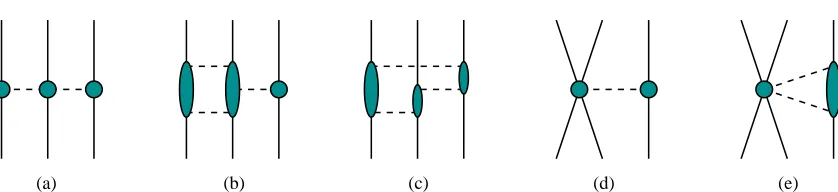
– Two-pion exchange (2π) graphs (see graph (a) in Fig. 1) which have been considered by Ishikawa and
Robilotta [12] using the so-called infrared regulariza-tion method and by our group [13] in the framework of unitary transformations combined with Heavy Baryon formalism.
– Two-pion-one-pion exchange (2π−1π) graphs which are visualized by graph (b) in Fig. 1.
– Three-pion exchange, so-called ring diagrams, which
are visualized by graph (c) in Fig. 1.
Analytic expressions of all these contributions can be found in [13]. The second part is given by shorter-range contribu-tions which is visualized by graphs (d) and (e) in Fig.1 and
corresponding 1/m corrections (with m the nucleon mass).
Their construction has been by now finished and will be published elsewhere. It is important to note that the con-struction of the N3LO forces is unique only modulo uni-tary transformations. In the static limit, however, the nat-ural choice of unitary transformation is entirely dictated by renormalizability requirement of the three-nucleon for-ces [14]. One can even speculate that in general an effective potential in the static limit is unique once we additionally require its renormalizability.
3 Chiral EFT with
∆
-isobar degrees of
freedom
In the standard chiral EFT discussed so far only pions and nucleons are treated as dynamical degrees of freedom. All other resonances like e.g.∆orρare integrated out and their contributions are encoded in the LECs. In this scheme pion four-momenta Q and mass Mπ are treated as a soft scale and the mass difference∆ =m∆−mN between the
light-est baryon∆-resonance and nucleon as a hard scale which is assumed to be of the same size as the chiral symmetry breaking scaleΛχ∼1 GeV:
Q∼Mπ≪∆=293 MeV. (1)
One can still argue that scales of the order of∼300 MeV can be treated as a soft scale. In this case one has to intro-duce the∆degrees of freedom explicitely into the theory and enlarge the set of expansion parameters by the delta-nucleon mass difference∆/Λχ:
Q∼Mπ ∼∆≪Λχ. (2)
This expansion is known in the literature as the small scale expansion (SSE) [15]. Integrating out of∆degrees of free-dom leads often to an enlargement of the values of the LECs. This e.g. happens with theππNN LECs c3 and c4 which are saturated by the∆-isobar and are known to be unnaturally large. In the theory with explicit ∆, however, they have natural size. Therefore the unnatural enlarge-ment of some ci’s in the delta-less theory can be explained
by large∆-contributions which get absorbed by the ci.
The appearance of unnaturally large LECs in an EFT can spoil its convergence. This can be seen in the chiral effective potential: subleading-order contributions to chiral 2π-exchange potential in the∆-less theory appears to be larger than the leading one. From this point of view, the explicit inclusion of ∆-isobar is well motivated: One can expect the LECs to be of natural size and the SSE of chiral nuclear forces to possess a natural convergence.
4 Nuclear forces with explicit
∆
-isobar
(a) (b) (c) (d) (e)
Fig. 1. Various topologies that appear in the three-nucleon force at N3LO. Solid and dashed lines represent nucleons and pions, respec-tively. Shaded blobs are the corresponding amplitudes. The long-range part of the three-nucleon force considered in this paper consists of (a) 2πexchange graphs, (b) 2π-1πdiagrams and the ring diagrams (c). The topologies (d) and (e) involve four-nucleon contact operators and are of shorter range.
that the large N2LO contributions to the 2π-exchange po-tential in the standard chiral EFT are shifted to NLO such that the dominant contribution to the nuclear forces appear already at NLO in the∆-full scenario. In the standard chiral EFT three-nucleon forces start to contribute at N2LO. This changes in a ∆-full theory where the first three-nucleon contribution starts already at NLO and is given by the well known Fujita-Miyazawa force [19, 20]. Recently we calcu-lated the subleading∆-resonance effects [18] which con-tribute to N2LO chiral nuclear forces. An interesting point is that at N2LO there are no corrections to the three-nucleon forces coming from∆-isobar excitations: all possible NNN∆
contact interactions are forbidden by the Pauli exclusion principle. The forces constructed out of building blocks with that contact interaction disappear after antisymmetriza-tion. So the only non-zero∆-resonance contribution to the three-nucleon forces upto N2LO is given by the Fujita-Miyazawa force [21].
In order to discuss numerical results for the∆-full forces upto N2LO we need to fix all the unknown constants which appear at this order. These are leading and subleading com-bination of the pion-nucleon-delta coupling constants hA
and b3+b8, respectively, and ci,i=1,2,3,4,fromπN
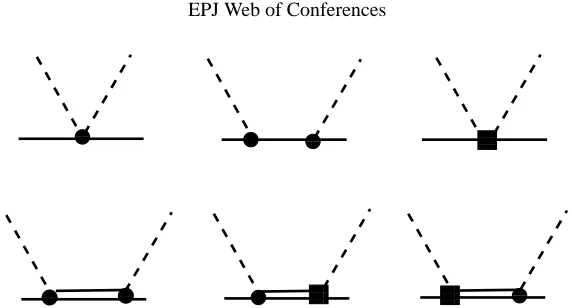
sec-tor. We fixed them in two different fits to the S- and P-wave threshold parameters of pion-nucleon scattering calculated upto second order in SSE. The diagrams contributing to this order are shown in Fig. 2. In the first fit we take large
Ncvalue for
hA=
3gA
2√2 ≃1.34,
where gA = 1.27 is the nucleon axial vector coupling,
and fitted all other constants to various threshold param-eter. In the second fit we used hA = 1.05 which has been
extracted from the Heavy-Baryon∆-width analysis in the static limit [15] and is consistent with quark model rela-tion.
hA=
6gA
5√2 ≃ 1.07.
Numerical values for various LECs determined in this way are given in Table 1. Note that the constants c3and c4are strongly reduced in the ∆-full theory which is consistent with our previous considerations. With these constants we
found for all effective NN potentials much better conver-gence compared with the potentials in the delta-less theory (see [18] for an extensive discussion). The same behav-ior can be seen in peripheral partial waves (see e.g.3F 3-and3F4-partial waves within∆-full and∆-less theories in comparison with the Nijmegen and Virginia Tech PWA in Fig. 3). Note that although the convergence in the∆-full theory is much better than in the ∆-less one, the overall N2LO results in both formulations are very similar.
4.1 Leading isospin-breaking∆-isobar
contributions
To estimate the size of isospin-breaking effects we also studied isospin-breaking contributions to chiral NN forces within the∆-full theory up to next-to-leading order. In this presentation we concentrate only on charge symmetry break-ing (CSB) contributions to nuclear forces. For the full dis-cussion see [23] and the forthcoming publication [24].
The leading CSB contributions to the nuclear force in the ∆-full theory are proportional to the nucleon- and∆ -mass splittings. At leading order there are electromagnetic and strong isospin-breaking contributions to the ∆-mass splittings. While both of them contribute to the equidistant splittingδm1
∆in the∆quartet, the non-equidistant splitting
δm2∆ is of a pure electromagnetic origin. To estimate the values of the∆-mass splittings we proceeded in two ways. In the first fit we used the most recent Particle Data Group values for
m∆++=1230.80±0.30 MeV, m∆0=1233.45±0.35 MeV
together with the average mass m∆=1233 MeV. With this input we get for the∆-mass splittings
δm1∆=−5.3±2.0 MeV, δm2∆=−1.7±2.7 MeV. (3)
Alternatively, instead of using m∆ = 1233 MeV, we em-ployed the quark model relation [25]
m∆+−m∆0 =δmN, (4)
whereδmN is the nucleon mass splitting. The results for
00 00 00 00 11 11 11 11 00
00 00 11 11 11
00 00 00 11 11 11
000 000 000 000 111 111 111 111 000
000 000 111 111 111
000 000 000 000 111 111 111 111 000 000 000 000 111 111 111 111
00 00 00 11 11 11 000
000 000 111 111 111
000 000 000 111 111 111
000000
111111 000000111111 00000001111111
Fig. 2. Tree graphs for pion-nucleon scattering at NLO. The filled circles/squares denote leading/subleading vertices. Crossed graphs are not shown.
LECs Q2, no∆ Q2, fit 1 Q2, fit 2 Q3no∆[22], fit 2
c1 −0.57 −0.57 −0.57 −1.42±0.03
c2 2.84 −0.25 0.83 3.13±0.04
c3 −3.87 −0.79 −1.87 −5.58±0.01
c4 2.89 1.33 1.87 3.50±0.01
hA – 1.34⋆ 1.05⋆ –
b3+b8 – 1.40 2.95 –
Table 1. Determinations of the LECs from S– and P–wave threshold parameters inπN scattering based on the Q2fits with and without explicit∆’s. LECs used as input are marked by the star. Also shown are the values determined in Ref. [22] from fit 2 at Q3 without explicit∆’s (the errors given are purely statistical and do not reflect the true uncertainty of the LECs). The LECs ciand b3+b8are given in GeV−1.
0 50 100 150 200
Lab. Energy [MeV] -4
-3 -2 -1 0
Phase Shift [deg]
0 50 100 150 200
-4 -3.5 -3 -2.5 -2 -1.5 -1 -0.5 0
3
F
3
0 50 100 150 200
Lab. Energy [MeV] 0
0.5 1 1.5 2
Phase Shift [deg]
0 50 100 150 200
0 0.5 1 1.5 2
3
F
4
Fig. 3. 3F
3- and3F4-wave NN phase shifts. The dotted curve is the LO prediction (i.e. based on the pure one-pion-exchange po-tential). Dashed double-dotted (dashed) and solid (dashed-dotted) lines show the NLO and N2LO results with (without) the explicit
∆-contributions. The filled circles (open triangles) depict the results from the Nijmegen multi–energy PWA [6, 7] (Virginia Tech single– energy PWA [8])
consistent with the first determination:
δm1∆=−3.9 MeV, δm2∆=0.3±0.3 MeV. (5)
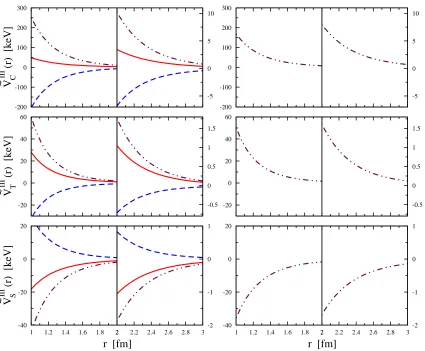
Having determined the values for the∆-mass splittings we studied the CSB contributions to the nuclear forces. In Fig. 4 we show CSB two-pion-exchange contributions to the two-nucleon potential
V =(τ31+τ32)(VCIII+VSIIIσ1·σ2+VIII
T σ1·qσ2·q+. . .) (6)
in configuration space. The contributions due to the nucleon-mass splitting δmN for the potentials VSIII,T appear to be
similar in the∆-less and∆-full theories. In the central po-tential VCIII, however, we see sizeable differences. In all po-tentials we observe strong cancellations between theδmN
-andδm1
∆-contributions which lead to significantly weaker
VIII
-200 -100 0 100 200 300
V
~
III C(r) [keV]
-5 0 5 10
-200 -100 0 100 200 300
-5 0 5 10
-20 0 20 40 60
V
~
III T(r) [keV]
-0.5 0 0.5 1 1.5
-20 0 20 40 60
-0.5 0 0.5 1 1.5
1 1.2 1.4 1.6 1.8 2
r [fm]
-40 -20 0 20
V
~
III S(r) [keV]
2 2.2 2.4 2.6 2.8 3 -2 -1 0 1
1 1.2 1.4 1.6 1.8 2
r [fm]
-40 -20 0 20
2 2.2 2.4 2.6 2.8 3 -2 -1 0 1
Fig. 4. CSB two-pion exchange potential. The left (right) panel shows the results obtained at leading order in chiral EFT with explicit ∆-resonances (at subleading order in chiral EFT without explicit∆degrees of freedom). The dashed and dashed-double-dotted lines depict the contributions due to the∆- and nucleon-mass differencesδm1
∆andδmN, respectively, while the solid lines give the total result.
4.2 Subleading isospin-breaking∆-isobar
contributions
In order to study the convergence of the isospin-breaking nuclear forces within SSE we need to calculate them at least up to next-to-leading order. We concentrate here again on the two-pion-exchange part of CSB forces and refer to forthcoming publication [24] for the full discussion. At NLO there appear three unknown constants: one of them is βwhich is a combination of the LECs accompanying the leading isospin-breakingπNN vertex [11]. Two other
unknown constants which we callβ1 ∆andβ
2
∆are given by a particular combination of the LECs accompanying the leading isospin–breakingπN∆vertex [24]. For our current considerations we set all the three constants to zero. Simi-lar to LO there are two contributions to CSB forces at NLO which are proportional to nucleon- and∆-mass splittings
δm andδm1
∆, respectively.
In Fig. 5 we show individual contributions to CSB-forces at NLO (right panel) compared with the correspond-ing forces at leadcorrespond-ing order (left panel). NLO corrections to CSB-forces appear to be of a natural size. In all the po-tentials both at LO and at NLO we observe strong cancel-lations between the contributions proportional toδm and
δm1∆. In all CSB-forces at NLO, however, one can see that
δm-contributions are almost by factor 2 larger thanδm1∆ -contributions. This leads to stronger VIII
C,S,T potentials even
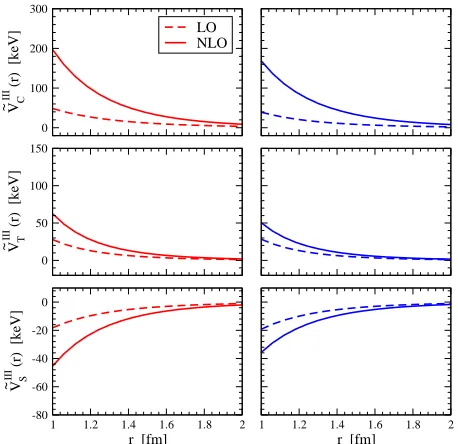
in the∆-full theory. The entire effect which leads to weaker CSB forces at leading order in SSE and which can be inter-preted as higher order effects from the resonance saturation point of view in the∆-less theory is completely compen-sated at NLO in SSE. This can be clearly seen from Fig. 6 where we show the results for CSB-forces up to NLO both in the ∆-full (left panel) and ∆-less theory (right panel). Similar to the isospin-conserving case one can see that the overall results in both theories with and without explicit
∆degrees of freedom are remarkably close. Only the con-vergence of the nuclear forces is improved once the ∆is explicitely taken into account.
4.3 Summary
consti--200 0 200 400
V
~III C
(r) [keV]
δmN
δm∆ total
-40 0 40 80
V
~III T
(r) [keV]
1 1.2 1.4 1.6 1.8 2 r [fm]
-80 -40 0
V
~III S
(r) [keV]
1 1.2 1.4 1.6 1.8 2 r [fm]
Fig. 5. CSB two-pion exchange potential. The left (right) panel
shows the results obtained at leading order (at subleading order) in chiral EFT with explicit∆-resonances. The dashed and dashed-double-dotted lines depict the contributions due to the ∆- and nucleon-mass differences δm1
∆and δmN, respectively, while the
solid lines give the total result.
0 100 200 300
V
~III C
(r) [keV]
LO NLO
0 50 100 150
V
~III T
(r) [keV]
1 1.2 1.4 1.6 1.8 2 r [fm]
-80 -60 -40 -20 0
V
~III S
(r) [keV]
1 1.2 1.4 1.6 1.8 2 r [fm]
Fig. 6. CSB two-pion exchange potential. The left (right) panel
shows the results obtained up to NLO in chiral EFT with (with-out) explicit∆-resonances. The dashed (solid) lines depict LO (LO+NLO) results.
tute the first systematic corrections to the leading 2π ex-change that appears at N2LO. Another two contributions are of shorter range and include, additionally to an ex-change of pions, also one short-range contact interaction and all corresponding 1/m corrections. The requirement
of renormalizability leads to unique expressions for N3LO
contributions to the three-nucleon force (except for 1/
m-corrections).
We presented the complete N2LO analysis of the nu-clear forces with explicit∆-isobar degrees of freedom. Al-though the overall results in the isospin-conserving case are very similar in the∆-less and∆-full theories we found a much better convergence in all peripheral partial waves once ∆-resonance is explicitely taken into account. The leading CSB contributions to nuclear forces are propor-tional to nucleon- and∆-mass splittings. There appear strong cancellations between the two contributions which at lead-ing order yield weaker VIIIpotentials. This effect is, how-ever, entirely compensated at subleading order such that the results in the theories with and without explicit∆ de-grees of freedom are remarkably similar.
We are looking forward to numerical studies of N3LO three-nucleon forces and implementations of N2LO forces in the∆-full EFT in future NN partial-wave analyses.
References
1. H. Yukawa, Proc. Phys. Math. Soc. Jap. 17, 48 (1935). 2. S. Weinberg, Physica A 96, 327 (1979).
3. J. Gasser and H. Leutwyler, Annals Phys. 158, 142 (1984).
4. V. Bernard, Prog. Part. Nucl. Phys. 60, 82 (2008) [arXiv:0706.0312 [hep-ph]].
5. S. Weinberg, Nucl. Phys. B 363, 3 (1991).
6. V. G. J. Stoks, R. A. M. Kompl, M. C. M. Rentmeester and J. J. de Swart, Phys. Rev. C 48, 792 (1993). 7. NN-Online program, M. C. M. Rentmeester et al.,
http://nn-online.org.
8. SAID on-line program, R. A. Arndt et al., http://gwdac.phys.gwu.edu. [9]
9. E. Epelbaum, H. W. Hammer and U.-G. Meißner, arXiv:0811.1338 [nucl-th]. Rev. Mod. Phys., in print. 10. E. Epelbaum, Prog. Part. Nucl. Phys. 57, 654 (2006)
[arXiv:nucl-th/0509032].
11. E. Epelbaum and U.- G. Meißner, Phys. Rev. C 72, 044001 (2005) [arXiv:nucl-th/0502052].
12. S. Ishikawa and M. R. Robilotta, Phys. Rev. C 76, 014006 (2007) [arXiv:0704.0711 [nucl-th]].
13. V. Bernard, E. Epelbaum, H. Krebs and U.-G. Meißner, Phys. Rev. C 77, 064004 (2008) [arXiv:0712.1967 [nucl-th]].
14. E. Epelbaum, Phys. Lett. B 639, 456 (2006) [arXiv:nucl-th/0511025].
15. T. R. Hemmert, B. R. Holstein and J. Kambor, J. Phys. G 24, 1831 (1998) [arXiv:hep-ph/9712496].
16. C. Ordonez, L. Ray and U. van Kolck, Phys. Rev. C
53, 2086 (1996) [arXiv:hep-ph/9511380].
17. N. Kaiser, S. Gerstendorfer and W. Weise, Nucl. Phys. A 637 (1998) 395 [arXiv:nucl-th/9802071].
18. H. Krebs, E. Epelbaum and U.-G. Meißner, Eur. Phys. J. A 32, 127 (2007) [arXiv:nucl-th/0703087].
19. J. Fujita and H. Miyazawa, Prog. Theor. Phys. 17 (1957) 360.
21. E. Epelbaum, H. Krebs and U.-G. Meißner, Nucl. Phys. A 806, 65 (2008) [arXiv:0712.1969 [nucl-th]]. 22. N. Fettes, U.-G. Meißner and S. Steininger, Nucl.
Phys. A 640, 199 (1998) [arXiv:hep-ph/9803266]. 23. E. Epelbaum, H. Krebs and U.-G. Meißner, Phys. Rev.
C 77, 034006 (2008) [arXiv:0801.1299 [nucl-th]]. 24. E. Epelbaum, H. Krebs and U.-G. Meißner,
forthcom-ing.