Research Article Available online www.ijsrr.org ISSN: 2279–0543
International Journal of Scientific Research and Reviews
Fluoride removal by column using Hydroxyapatite Granules
Bhaskarrav Makwana
1*and Vivek Sharma
1Gujarat Environment Management Institute (GEMI), Sec -25, Gandhinagar, Gujarat, India ____________________________________________________________________________________
ABSTRACT:
Fluoride in drinking water has a found effect on teeth and bones. Up to a small level (1–1.5
mg/L) this strengthens the enamel and (4–10 mg/L) dental fluorosis progresses to skeletal fluorosis.
High fluoride concentrations in groundwater, up to more than 30 mg/L, occur widely, in many parts of
the world. The fluoride removal has been divided in two sections dealing with membrane and adsorption
techniques. This paper is aimed to separate and remove fluoride by preparing HAp column.
Hydroxyapatite (HAp) was prepared by co precipitation of calcium carbonate and phosphoric acid.
KEYWORDS
: Fluoride, Adsorption, Hydroxyapatite granules, column____________________________________________________________________________________
*
Corresponding Author
Dr. Bhaskarrav Makwana
Senior Scientific Assistant
Gujarat Environment Management Institute,
Gandhinagar, Gujarat, India
1. INTRODUCTION:
The fluoride occurs mainly as sellaite (MgF2), fluorspar (CaF2), cryolite (Na3AlF6) and Fluor
apatite [3Ca3 (PO4)2 Ca (F, Cl2)]. As fluorspar, it is found in sedimentary rocks and as cryolite in
igneous rocks. These fluoride minerals are nearly insoluble in water. Hence, fluorides will be present in
groundwater only when conditions favor their dissolution or high fluoride containing effluents are
discharged to the water bodies from industries. Fluoride ion exists in natural waters and it is an essential
micronutrient in humans in preventing dental caries and in facilitating the mineralization of hard tissues
if consumed at a recommended range of concentration. Higher level of fluoride in groundwater is a
worldwide problem 1–3. The World Health Organization (WHO) has set a guideline of 1.5mg/L for
fluoride in potable water 4. Concentration higher than this value can lead to fluorosis (dental and/or
skeletal) and several types of neurological damage in severe cases 5. The difference between desirable doses and toxic doses of fluoride is ill defined, and fluoride may therefore be considered as an essential
mineral with a narrow margin of safety (WHO, 1984) 6.
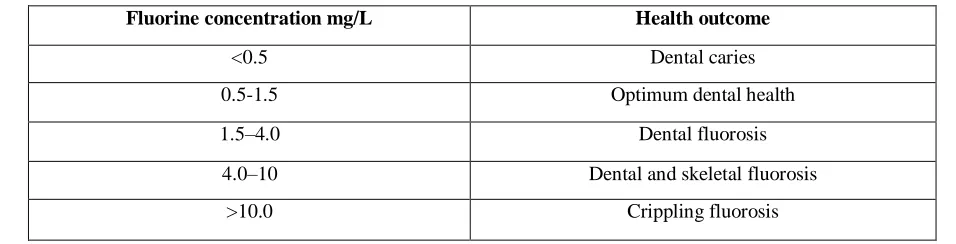
Table 1: Effect of prolonged use of drinking water on human health, related to fluoride content (Dissanayake7, 1991).
Fluorine concentration mg/L Health outcome
<0.5 Dental caries 0.5-1.5 Optimum dental health 1.5–4.0 Dental fluorosis
4.0–10 Dental and skeletal fluorosis >10.0 Crippling fluorosis
Many methods have been developed for fluoride removal from water such as adsorption 7, ion
exchange8, membrane processes such as reverse osmosis and Nano filtration 9, 10, electro dialysis 11, 12,
and precipitation 13.
Defluoridation methods can be broadly divided into three categories according to the main
removal mechanism:
Chemical additive methods:
Chemicals include lime used alone or with magnesium or aluminumContact precipitation:
Contact precipitation is a recently reported technique in which fluoride isremoved from water through the addition of calcium and phosphate compounds.
Adsorption/ion exchange methods:
In the adsorption method, raw water is passed through a bedcontaining defluoridating material. The material retains fluoride by either physical, chemical or ion
exchange mechanisms. These materials like, Fly ash, bone char, activated alumina and clays have been
successfully used in the field.
The majority of people live in tropical countries where the problem is exacerbated by the need to
drink more water because of the heat. It is thus absolutely essential to bring down the fluoride levels to
acceptable limits for which tremendous research and development efforts are being put all over the
world. The manuscript has done potential for fluoride removal from drinking water and ground water.
Therefore, different technologies, such as coagulation, precipitation, nanofiltration,
electrodialytic membrane technique, response surface method (RSM), reverse osmosis and adsorption,
adopted for controlling the elevated level of fluoride in aqueous environment. Among all, adsorption has
been considered as economical, environment friendly and effective method for the removal of excess
fluoride from drinking water because of its simplicity and relatively low cost.
Initiation point in the development of adsorption unit is the choice of suitable adsorbent among
other. Different adsorbents have been exploited successfully for the removal of fluoride such as calcined
magnesia (Maliyekkal, Shukla et al. 2008)14, iron impregnated granular ceramics (Chen et al., 2011)15,
alumina based adsorbents (Meenakshi and Maheshwari 2006) 6, bio polymer based composites (Hu and
Dickson 2006) 16, Brushite (Mourabet et al., 2011) 17,mixed oxides (A Ghosh et al., 2014) 18 and more.
However, some issues are still unsolved in association with their applications for instance, low
adsorption capacities and adsorbent regeneration.
Hydroxyapatite (HAp), Ca5(PO4)3·(OH), is a well-studied and known member of calcium
phosphate family with no toxicity and high biocompatibility.
In this study, column was prepared with granules of HAP and the combined effects of adsorbent dose,
pH, initial concentration and temperature on fluoride removal from aqueous medium by hydroxyapatite
2. MATERIAL AND METHOD:
2.1 Material:
Calcium carbonate (CaCO3) and Ortho phosphoric acid (H3PO4) were purchased from Merck.
2.2 Synthesis of Hydroxyapatite (HAP)
Hydroxyapatite was synthesised from ortho - phosphoric acid (6M) by vigorously adding
calcium carbonate (9M) gradually at 800 C, one-step reaction, then evaporated water.
6H3PO4 + 9CaCO3---> Ca9 (PO4)6(OH)2
2.3 Synthesis of Hydroxyapatite (HAP) granules
Ethyl - 2 – cyanoacrylate was used for prepared granules of hydroxyapatite, due to higher tensile
strength (5.74 + 0.62 MPa) [14] and its insolubility in water.
2.4 Adsorption studies
Adsorption studies of fluoride were investigated by batch experiments. All batch experiments
were carried out in 250 mL LDPE flasks. For preparing the samples, 0.2 g of Hydroxyapatite powder
was added in 50mL of fluoride solution. The mixture was agitated at 300 rpm for 90 minutes. The
solution was then filtered and the residual fluoride ion concentration was analysed
spectrophotometrically by using SPADNS Zirconyl acid dye.
2.5 Column
100 ml Borosil Burrate was used as column. Prepared three layer from Silica gel:
Hydroxyapatite granules: Silica gel (10 cm: 30 cm: 10 cm) in column.
3. EXPERIMENTAL
Experiment of fluoride removal was performed on higher concentration 7.8 ppm fluoridated
sample. Sample was taken 50 ml. Dosage was designed 50,100,150 and 200 mg/ml of hydroxyapatite
powder. Contact time was 90 minute at 300 rpm. Experiment was done at room temperature in 250 ml
LDPE flask. After positive result, prepared hydroxyapatite granules using ethyl-2-cyanoacrelate.
Prepared column using Hydroxyapatite granules at 30 cm height. For 30 cm height, approximately 50
gm hydroxyapatite granules were used. Further experiment was performed using column for higher
gravitational force, repeated it 3 times. As per experiment, column can remove fluoride from 2 litre
fluoridated sample.
For regeneration of fluoridated column, was used 1M 500 ml sodium hydroxide for 24 hours. 1M
sodium hydroxide was passed through column by gravitational force with repeated in sequent.
4. RESULT AND DISCUSSION
4.1. Characterization of Hydroxyapatite
Hydroxyapatite was synthesised from ortho - phosphoric acid (6M) by vigorously adding
calcium carbonate (9M) gradually at 80 0C, one-step reaction, then evaporate water.
4.1.1. X- ray Diffraction Analysis
An XRD pattern of a precipitate prepared powder is shown in Fig. 1. The effect of sintering
temperature on the formation of HA can be seen in Fig. 1. The samples heated at 80°C show broad
peaks indicating the formation crystalline phase, which was increased with the increase of sintering
temperature. As the sintering temperature is increased, several peaks of XRD pattern which belongs to
the HA powder become more distinct and, also the widths of the peaks become more narrow, which
suggests that there is an increase in the crystallinity of powder.
Figure- 1. XRD patterns of the HA powder 0
100 200 300 400 500 600 700
1 43 85
127 169 211 253 295 337 379 421 463 505 547 589 631 673 715 757 799 841 883 925 967 1009 1051 1093
R
el
at
ive
In
te
n
si
ty
2 Theta (Degree)
4.1.2. FT-IR Analysis
The FT-IR spectra of HA samples at is shown in Fig. 2. From the graph it is indicated that there
is a broad envelop between 3825 cm-1 and 2550.16 cm-1. The O-H stretching bond is shown at 3434.6
cm-1 in sample (a) and 3575.02cm-1, which confirms the presence of hydroxyapatite powder. A weak
band of CO32- was detected in the region around 872.63 cm-1 and 1455.03 cm-1 asymmetric
stretching was detected. The peak at 1035.59 cm-1 corresponds to asymmetric stretching mode of PO43-.
The peaks at 564.07 cm-1 indicate the bending mode of PO43-.
Figure- 2. FT-IR spectrum of the HA powder
4.2. Effect of pH
The pH of the solution is one of the important parameter that significantly affect the fluoride
adsorption. Removal is over 99% in higher acidic solution and drastically decrease in basic solution by
Hydroxyapatite. The pH equilibrated solution remain in the range 6.5 – 8.5, which is pH of ground
water.
Practically, chemical reaction predict that fluoride removal capacity of hydroxyapatite will be
Figure-3. pH Vs % of fluoride removal
4.3. Effect of doses
Experiment show the combined effect of adsorbent dose with initial concentration, temperature
and pH, respectively. It can be seen that the increase in the adsorbent dose value increases the removal
percent of fluoride. An increase in the adsorption with the adsorbent dosage can be attributed to a greater
surface area and the availability of more adsorption sites at higher adsorbent dosage. The effect of
adsorption dose on the fluoride removal was studied using mass of adsorption and initial fluoride
concentration of 9.0 mg/L in 100 mL of Fluoride solution at an optimum pH of 7.0 for Hydroxyapatite.
An optimum dose is set 200 mg for 50 mL solution.
Figure- 4. Dosage Vs % of fluoride removal
0 20 40 60 80 100 120
1 2 3 4 5 6 7 8 9 10 11 12
% o f rem o va l o f Fl uo ri de pH 27.82 52.95 67.56 80.13 0 10 20 30 40 50 60 70 80 90
0 50 100 150 200 250
4.4. Effect of contact time
The removal of fluoride as a function of contact time is also investigated. It is found that the first
30 minute, the removal of fluoride by hydroxyapatite is 99.0 %. The removal of fluoride increase with
time and attains equilibrium value after 90 minute.
Figure- 5. Time Vs % of fluoride removal
4.5. Effect on other coexisting ions
The drinking water contains several common other anions, viz. nitrate, sulfate, and chloride,
which can compete with fluoride ions during the adsorption process for the active sites on the HAp.
Hence, the effect of these competitive ions on the uptake of fluoride ions should be studied. All studied
coexisting ions show negligible effect on fluoride sorption.
Table – 2: % removal of other coexisting ions.
Coexisting Ions Before Treatment After Treatment % Removal
Cl- 311.77 281.77 1
SO42- 128.3 121.2 0.5
Cyanide Nil Nil Nil
Nitrate 9.56 9.456 1
4.6. Adsorption isotherm
Adsorption isotherms are very important in order to design adsorption processes; they also
provide adsorption capacity of the adsorbent under the studied conditions. Although there are a lot of
adsorption isotherm models, Langmuir and Freundlich are the most frequently used equations in the 92
93 94 95 96 97 98 99 100 101
0 20 40 60 80 100
%
o
f
fl
uo
ri
de
rem
o
val
literature expressing the nonlinear relationship between the adsorbed fluoride ion on the adsorbent and
the fluoride ion in the solution. These two-parameter models are simple and give a good description of
experimental behaviour in a large range of operating conditions.
Langmuir model is expressed by the following equation:
qe = QmbCe / 1 + bCe ……… (1)
where Ce (mg L_1) is the equilibrium concentration of the adsorbate, qe (mg g_1) is the amount of
adsorbate per unit mass of adsorbent, Qm (mg g_1) and b (L mg_1) are Langmuir constants related to
sorption capacity and rate of sorption, respectively. Values of Qm and b can be graphically determined
from the linear form of the Langmuir model (Fig. 6).
Ce/qe = Ce / Qm + 1 / bQm ………… (2)
Figure- 6. Langmuir isotherm model.
The affinity between F_ and HAp adsorbent can be predicted using the Langmuir parameter b from the
dimensionless separation factor RL (Hall et al., 1966):
RL = 1/ 1 + bCo ……… (3)
19.96 20.98
24.66
27.73
0 5 10 15 20 25 30
50 100 150 200
C
e/
qe
Where, Co is the initial F_ concentration and b is Langmuir isotherm constant. The value of RL
indicates the type of isotherm to be either unfavourable (RL > 1), linear (RL =1), favourable (0< RL< 1),
or irreversible (RL= 0). In experiment, the RL values for the adsorption of fluoride onto hydroxyapatite
lying between 0 and 1, indicate that the adsorption is a favourable process.
Freundlich model is expressed by the following equation:
qe = KFCe1/n …………. (4)
Where, KF and n are the indicators of adsorption capacity and adsorption intensity, respectively.
The constants KF and n of the Freundlich model are respectively obtained from the intercept and the
slope of the linear plot of Freundlich model (Fig. 7).
Figure- 7. Freundlich isotherm model.
According to the correlation coefficients, the adsorption of fluoride on the hydroxyapatite was
correlated well with the Langmuir (R2=0.978) and Freundlich (R2=0.999) isotherms.
5. CONCLUSION
Based on result, hydroxyapatite have good efficiency for defluoridation of water. There is major
role of pH, contact time and temperature.
Defluoridation of hydroxyapatite may be complex chemical reaction mechanism.
1.70
2.00
2.18 2.30
0.00 0.50 1.00 1.50 2.00 2.50
1 2 3 4
lo
gqe
6. FUTURE SCOPE:
Advance column technology may use for fluoride removal from water, in fluoride affected area.
7. REFERENCES:
1. Fantong W. Y., Satake H., Ayonghe S. N.., “Geochemical provenance and spatial distribution of fluoride in groundwater of Mayo Tsanaga River Basin, Far North Region, Cameroon:
implications for incidence of fluorosis and optimal consumption dose,” Environmental
Geochemistry and Health, 2010; 32(2): 147–163.
2. Neal C., Neal M., Davies H., and Smith J., “Fluoride in UK rivers,” Science of the Total
Environment, 2003; 314-316: 209– 231
3. Tekle-Haimanot R., Melaku Z., Kloos H., “The geographic distribution of fluoride in surface and
groundwater in Ethiopia with an emphasis on the Rift Valley,” Science of the Total Environment,
2006; 367(1): 182–190
4. World Health Organization, Guidelines for Drinking -Water Quality, first addendum to third
edition, World Health Organization, Geneva, 2006; 1: 376,
5. World Health Organization, Guidelines for Drinking Water Quality. In: Health Criteria and
Other Supporting Information, World Health Organization, Geneva, 1984; second ed.: 2.
6. Meenakshi and Maheshwari R. C., “Fluoride in drinking water and its removal,” Journal of
Hazardous Materials, 2006; 137(1): 456–463
7. Dissanayake, C.B., The fluoride problem in the groundwater of Sri Lanka – environmental
management and health. Int. J. Environ. Stud., 1991; 19: 195–203.
8. Lounici H., Addour L., Belhocine D. et al., “Study of a new technique for fluoride removal from
water,” Desalination, 1997; 114(3): 241–251.
9. Vaaramaa K. and Lehto J., “Removal of metals and anions from drinking water by ion
exchange,” Desalination, 2003, vol. 155, no. 2, pp. 157–170
10. Onyango M. S. and Matsuda H., “Fluoride removal from water using adsorption technique,”
Advances in Fluorine Science,2006, vol. 2, pp. 1–48
11. Tahaikt M., El Habbani R., Ait Haddou A., “Fluoride removal fromgroundwater by
12. Sahli M. A. M., Annouar S., Tahaikt M., Mountadar M., Soufiane A., and Elmidaoui A.,
“Fluoride removal for underground brackish water by adsorption on the natural chitosan and by electrodialysis,” Desalination, 2007, vol. 212, no. 1-3, pp. 37–45
13. Ergun E., Ali T., Yunus C., and Izzet K., “Electrodialytic removal of fluoride from water:
Effects of process parameters and accompanying anions,” Separation and Purification
Technology, 2008, vol. 64, no. 2, pp. 147–153
14. Maliyekkal S. M., Shukla S., Philip L. and Nambi I. M. "Enhanced fluoride removal from
drinking water by magnesia-amended activated alumina granules." Chemical Engineering
Journal 2008, 140(1): 183-192.
15. Nan Chen, Zhenya Zhang, Chuanping Feng, Miao Li, Dirui Zhu and Norio Sugiura, “Studies on
fluoride adsorption of iron-impregnated granular ceramics from aqueous solution,” Materials
Chemistry and Physics, 2011, Volume 125, Issues 1–2, Pages 293-298.
16.Hu, K. and Dickson J. M. "Nanofiltration membrane performance on fluoride removal from
water." Journal of Membrane Science ,2006 , 279(1): 529-538
17.Mourabet M., El Rhilassi A., El Boujaady H., Bennani-Ziatni M., El Hamri R., “A Taitai
Removal of fluoride from aqueous solution by adsorption on hydroxyapatite (HAp) using
response surface methodology”, Journal of Saudi Chemical Society 2015, 19, 603–615.
18.Ghosh Abir, Chakrabarti Sharadindra, Biswas Krishna, Ghosh Uday Chand, “Agglomerated
nanoparticles of hydrous Ce(IV) + Zr(IV) mixed oxide: Preparation, characterization and
physicochemical aspects on fluoride adsorption”, Applied Surface Science,2014, Volume 307,
Pages 665-676.