Inter-annotator Agreement on a Multilingual Semantic Annotation Task
Rebecca Passonneau, Nizar Habash, Owen Rambow
Center for Computational Learning Systems, Columbia University New York, NY USA
(becky|habash|rambow)@cs.columbia.edu
Abstract
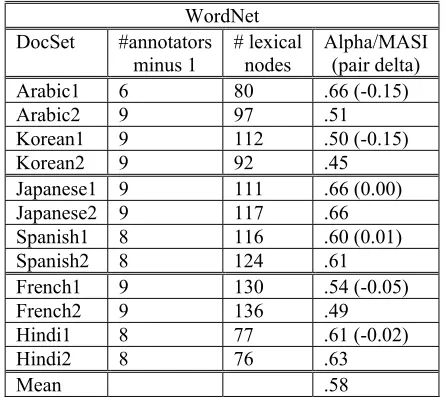
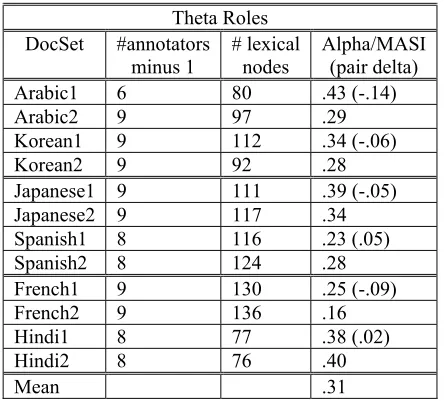
Six sites participated in the Interlingual Annotation of Multilingual Text Corpora (IAMTC) project (Dorr et al., 2004; Farwell et al., 2004; Mitamura et al., 2004). Parsed versions of English translations of news articles in Arabic, French, Hindi, Japanese, Korean and Spanish were annotated by up to ten annotators. Their task was to match open-class lexical items (nouns, verbs, adjectives, adverbs) to one or more concepts taken from the Omega ontology (Philpot et al., 2003), and to identify theta roles for verb arguments. The annotated corpus is intended to be a resource for meaning-based approaches to machine translation. Here we discuss inter-annotator agreement for the corpus. The annotation task is characterized by annotators’ freedom to select multiple concepts or roles per lexical item. As a result, the annotation categories are sets, the number of which is bounded only by the number of distinct annotator-lexical item pairs. We use a reliability metric designed to handle partial agreement between sets. The best results pertain to the part of the ontology derived from WordNet. We examine change over the course of the project, differences among annotators, and differences across parts of speech. Our results suggest a strong learning effect early in the project.
1. Introduction
Six sites participated in the Interlingual Annotation of Multilingual Text Corpora (IAMTC) (Dorr et al., 2004; Farwell et al., 2004; Mitamura et al., 2004).1 The six sites are Carnegie Mellon University (CMU), Columbia University (CU), Information Sciences Institute (ISI), Mitre, New Mexico State University (NMSU), and University of Maryland (UMD). English translations of news articles from Arabic, French, Hindi, Japanese, Korean and Spanish were annotated by up to ten annotators. The annotation task was to match open-class lexical items (nouns, verbs, adjectives, adverbs) to one or more concepts taken from the Omega ontology (Philpot et al., 2003), and to identify theta roles for verb arguments. The annotated corpus is intended to be a resource for meaning-based approaches to machine translation and other natural language technologies.
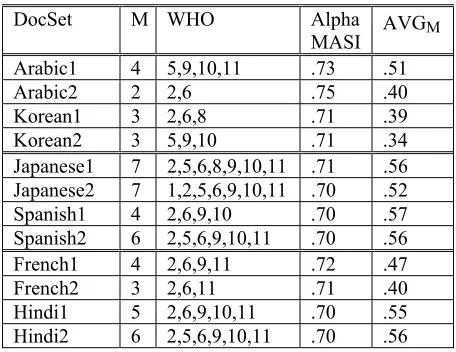
Parameters of the IAMTC project that define the agreement issues include: sets of concepts or theta roles as the values that annotators select, an unbounded number of labels for concepts, and different sets of annotators on different datasets. In this paper, we discuss inter-annotator agreement with a focus on three questions: (a.) how to quantify agreement for set-valued items; (b.) how to rate individual annotators; and (c.) how to determine if the IAMTC annotations are reliably annotated.
1 http://aitc.aitcnet.org/nsf/iamtc/
In section 2, we describe the annotation tasks and datasets. In section 3, we discuss related work on inter-annotator agreement measures, and suggest that in pilot work such as this, agreement measures are best used to identify trends in the data rather than to adhere to an absolute agreement threshold. In section 4, we motivate the use of a metric for Measuring Agreement for Set-valued Items (MASI) (Passonneau, 2004). In Section 5, we present our results, showing an apparent learning effect as reflected in narrower differences between the two translations of the same documents later in the project. We also show how agreement can be used to prune less reliable annotators. The facts that agreement increases over time, and that some annotators are particularly proficient, are evidence that the IAMTC task can be performed reliably.
2. Annotation Tasks
The six sites collaborated on annotation procedures and instructions, but independently supervised annotators. There were six pairs of translations into English, or twelve document sets, as listed in column one of Figure 1. Although the original goal was to have twelve annotations with two contributed by each site, some annotators were unable to complete their assignments.
Krippendorff, Klaus. (1980.) Content Analysis: An Introduction to its Methodology. Sage Publications, Beverly Hills, CA.
Mitamura, T.; Miller, K.; Dorr, B. J.; Farwell, D.; Habash, N.; Levin, L.; Helmreich, S.; Hovy, E.; Levin, L.; Rambow, O.; Reeder, F.; Siddharthan, A. (2004). Semantic annotation of multilingual text corpora. In Proceedings of the Workshop on Beyond Named Entity Recognition: Semantic Labeling for NLP Tasks, LREC, Portugal.
Nirenburg, S., S. Beale, K. Mahesh, B. Onyshkevych, V. Raskin, E. Viegas, Y. Wilks and R. Zajac. (1996). Lexicons in the Mikrokosmos project. Proceedings of the Society for Artificial Intelligence and Simulated Behavior Workshop on Multilinguality in the Lexicon, Brighton, UK.
Passonneau, R.; Nenkova, A.; McKeown, K.; Sigelman, S. (2005). Applying the pyramid method in DUC 2005. In Proceedings of the Workshop of the Document Understanding Conference. Vancouver, B.C.
Passonneau, R. (2006). Measuring agreement on set- valued items (MASI) for semantic and pragmatic annotation. In Proceedings of the International Conference on Language Resources and Evaluation (LREC). Genoa, Italy.
Passonneau, R. (2004). Computing reliability for co-
reference annotation. Proceedings of the International Conference on Language Resources and Evaluation (LREC). Portugal.
Philpot, A.; Fleischman, M.; Hovy, E.H. (2003). Semi-automatic construction of a general purpose ontology. Proceedings of the International Lisp Conference. New York, NY. Invited.
Rosenberg, A. and Binkowski, E. (2004). Augmenting the kappa statistic to determine inter-annotator reliability for multiply labeled data points. In Proceedings of the Human Language Technology Conference and Meeting of the North American Chapter of the Association for Computational Linguistics (HLT/NAACL).
Scott, W. A. (1955). Reliability of content analysis: the case of nominal scale coding. Public Opinion Quarterly 19:321-325.
Siegel, S. and N. John Castellan, Jr. (1988) Nonparametric Statistics for the Behavioral Sciences, 2nd edition. McGraw-Hill, New York.
Teufel, S. and H. van Halteren. (2004). Evaluating information content by factoid analysis:
human annotation and stability. Proceedings of the 2004 Conference on Empirical Methods in Natural Language Processing,pp. 419-426.
Uebersax, J. (1988). Validity inferences from interobserver agreement. Psychological Bulletin, 104(3):405-416.
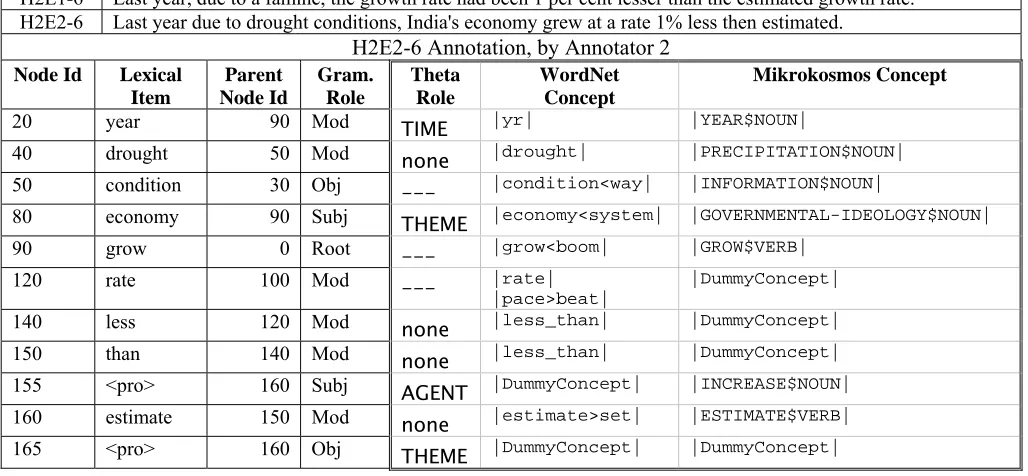
H2E1-6 Last year, due to a famine, the growth rate had been 1 per cent lesser than the estimated growth rate. H2E2-6 Last year due to drought conditions, India's economy grew at a rate 1% less then estimated.
H2E2-6 Annotation, by Annotator 2
Node Id Lexical Item
Parent Node Id
Gram. Role
Theta Role
WordNet Concept
Mikrokosmos Concept
20 year 90 Mod TIME |yr| |YEAR$NOUN|
40 drought 50 Mod none |drought| |PRECIPITATION$NOUN|
50 condition 30 Obj --- |condition<way| |INFORMATION$NOUN|
80 economy 90 Subj THEME |economy<system| |GOVERNMENTAL-IDEOLOGY$NOUN|
90 grow 0 Root --- |grow<boom| |GROW$VERB|
120 rate 100 Mod --- |rate|
|pace>beat|
|DummyConcept|
140 less 120 Mod none |less_than| |DummyConcept|
150 than 140 Mod none |less_than| |DummyConcept|
155 <pro> 160 Subj AGENT |DummyConcept| |INCREASE$NOUN|
160 estimate 150 Mod none |estimate>set| |ESTIMATE$VERB|
165 <pro> 160 Obj THEME |DummyConcept| |DummyConcept|