INTERNATIONAL RESEARCH JOURNAL OF PHARMACY
www.irjponline.com
ISSN 2230 – 8407
Research Article
DEVELOPMENT AND EVALUATION OF FLOATING TABLET CONTAINING NEVIRAPINE USING
A 3
2FULL FACTORIAL DESIGN OPTIMIZATION METHOD
Subhash V. Deshmane *
1, Aijaz A. Sheikh
1, Om. S. Kharde
1, Ravindra H. Kale
2, Kailash R. Biyani
3 1Department of Pharmaceutics, Anuradha College of Pharmacy, Chikhli. Dist-Buldana.443201 (M.S.) India
2Department of Pharmacognosy, Anuradha College of Pharmacy, Chikhli. Dist-Buldana.443201 (M.S.) India
3Department of Pharmacology, Anuradha College of Pharmacy, Chikhli. Dist-Buldana.443201 (M.S.) India
*Corresponding Author Email: [email protected]
Article Received on: 19/03/19 Approved for publication: 26/04/19
DOI: 10.7897/2230-8407.1006200
ABSTRACT
Floating oral drug delivery system is retained in the stomach and are useful for drugs that are poorly soluble or unstable in intestinal fluids. Nevirapine are the suitable drug candidates for the formulation of floating sustained drug delivery system. Nevirapine is a non-peptic, protease inhibitor antiretroviral drug used in the treatment of the human immune deficiency virus. Floating tablet of Nevirapine is prepared with a view to attain early onset of action and giving prolonged release of Nevirapine by enhancing gastric retention time. A 37 full factorial design by Design Expert software
was used for the development of floating sustained release tablet in which the composition of release retardant polymer and effervescent agent were incorporated as two independent variables or factors. Compatibility study was carried out by FTIR study. The regression coefficients and the analysis of variance information is well exposed. It was observed that as the concentration of the HPMC K4M increased the percentage of swelling also increased. The percentage of swelling was determined at the end of 8 h for all the developed formulations. The buoyancy lag time was measured by using stop watch and total floating time was observed visually. Floating lag time was observed less than 78 sec for all batches. Total floating time was observed more than 12 h. Hence, this new type of floating sustained release tablet which can transfer to industry scale production with high output rates by considering the need of nevirapine.
KEYWORDS: Nevirapine, gastric retention time, factorial design, ANOVA, dependent and independent variables, lag time.
INTRODUCTION
The primary aim for designing oral sustained release dosage form should be achieving predetermined and predictable drug release and thereby increasing bioavailability. But there are several physiological difficulties, which include restraining and localizing the drug delivery system within the regions of the gastrointestinal tract and the highly variable nature of gastric emptying process (a few minutes to 12 h) 1. This variability, in
turn may lead to unpredictable bioavailability and the time to achieve peak plasma levels, since the majority of drugs are preferentially absorbed from the upper part of small intestine. In human, drug remains 2-3 h only in major absorption zone as stomach or upper part of GIT. Various type drug degrade in small intestine or colon for such type of drug it is beneficial to design gastroretentive devices to avoid further consequences 2. The
conventional dosage forms retained in the stomach for 0.5- 2 h and passes to small intestine and where it gets absorbed within 3-6 h. Therefore it is difficult to adjust release retardation and stomach retention of drug for longer period of time. The concept of gastro retentive drug delivery system came from the need to localize the drug at a certain site in the body 3. The majority of
drugs are preferentially absorbed from the upper part of GIT hence, drug release at site of absorption can improve therapeutic efficacy of drug 4. Floating oral drug delivery system (FDDS) are
retained in the stomach and are useful for drugs that are poorly soluble or unstable in intestinal fluids 5. Drugs having pH
dependent solubility i.e. highly soluble at low pH (gastric pH) and poorly soluble at high pH (intestinal pH), drugs having short biological half-life e.g. Nevirapine are the suitable drug
candidates for the formulation of floating sustained drug delivery system. Nevirapine (NVP) is a non-peptic, protease inhibitor (IP) antiretroviral drug used in the treatment of the human immune deficiency virus (HIV). NVP belongs to class II drug as per biopharmaceutical classification system. Oral bioavailability rendering to 29-43 %, having 4.1 log P value. Nevirapine is soluble in acidic environment of stomach since it is a weak basic drug and its therapeutic efficacy is limited by its poor aqueous solubility with half-life 3.5-5 h 6. Moreover a tablet formulation
of NVP is not available worldwide, preventing appropriate dose adjustment and more convenient administration. Even today a parenteral formulation has also not available in spite of their reported disadvantages. The gastro-retentive drug delivery systems can be able to retain the dosage unit in the stomach, get absorbed from stomach and thereby assist in improvement of drugs bioavailability. The purpose of this investigation was to develop a novel gastroretentive tablet formulation of Nevirapine for prolonged release. Floating tablet of Nevirapine is prepared with a view to attain early onset of action and giving prolonged release of Nevirapine by enhancing GRT.
MATERIALS AND METHODS
DRUG -EXCIPIENTS INTERACTION STUDY
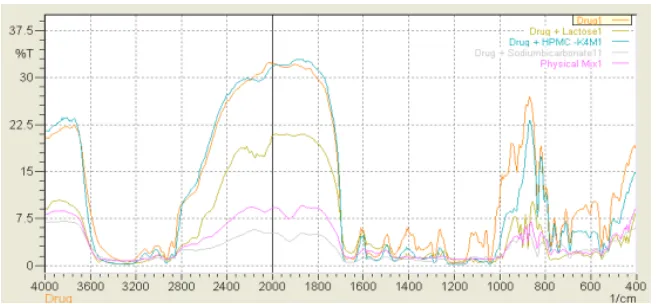
The drug-excipients interaction study was carried out using Fourier Transform-Infrared spectroscopy (FTIR). FTIR spectra of NVP, HPMC K4M, Lactose and physical mixture of lipids with NVP were studied. Above samples were compressed using KBr pellet technique using FTIR (Model-200, Thermo Electron, Shimadzu, Japan). The spectrum was scanned over the frequency range between 4000 and 400 cm–1. The FTIR spectra of mixtures were compared with that of the FTIR spectra of pure drug and lipid, to confirm any changes in the principle peaks of spectra of plain drug and lipid.
DEVELOPMENT AND OPTIMIZATION
A 37 full factorial design by Design Expert software (Design Expert Software Version 8.0.1) was used for the development of floating sustained release tablet in which the composition of release retardant polymer and effervescent agent were incorporated as two independent variables or factors 7. In the
constructed design the independent variables selected are HPMC K 4M (X1) and NaHCO3 (X2). The three levels of the two factors were preferred on the basis of the preliminary studies which carried out before implementing the experimental design with suitable support of literature survey 8. All other formulation and
processing variables were kept invariant throughout the study. The dependent variables studied were the buoyancy lag time (Y1) and percent cumulative drug release (Y2). Accurate quantity of drug and release retarding polymer HPMC K4M were weighed and mixed well. Sodium bicarbonate was added as gas generating agent. Finally lubricant was added and blend was mixed properly. Accurately weighed 500 mg powder was fed manually at the 10 station of tablet machine and compressed by using 9 mm flat faced punch. Compression force was kept constant for all formulations. (Table 1)
FORMULATION OF FLOATING SUSTAINED RELEASE TABLETS
Various formulation batches were tried out to finalize the concentration of release retardant polymer and effervescent agent. Finally on the basis of trial and error with literature support the various levels were set. Accurate quantity of drug and release retarding polymers were weighed and mixed well. Sodium bicarbonate was added as effervescent agent. Finally lubricant was added and blend was mixed properly. Accurately weighed 500 mg powder was fed manually in to 10 station tablet machine (Rimek minipress-1) and compressed by using 9 mm flat faced punch. Compression force was kept constant for all formulations. (Table 2)
EVALUATION OF FLOATING SUSTAINED RELEASE TABLETS
Prepared sustained release tablets were evaluated for post compression parameters like thickness, hardness, friability, drug content, weight variation, swelling study, floating lag time, total floating time and in vitro drug release study 9,10.
Swelling Study of Floating Sustained Release Tablet
The hydration ability of the formula is important because it influences: (i) tablet buoyancy, (ii) adhesion ability of swellable polymers in contact with the test fluid and (iii) drug release kinetics. The ability of hydrogels to absorb water is due to the
The swelling behaviour of the tablet was determined, according the method described. A tablet was weighed (W1) and placed in a glass beaker, containing 200 mL of 0.1 N HCl, maintained in a water bath at 37 ± 0.5oC. The tablet was taken out and the excess surface liquid was carefully removed by a filter paper. The swelling index was calculated at the end of 8 h. The swollen tablet was then reweighed (W2). The % swelling was calculated using following formula.
% Swelling = {(W2-W1)/W1)} × 100
Determination of Floating Lag Time (FLT) and Total Floating Time
Floating lag time is the time required for the tablet to rise towards surface and float. The floating of tablets was studied at 37 ± 0.5OC
in 200 mL of 1.2 pH buffer (simulated gastric fluid without pepsin). The floating lag time was measured by using stop watch and total floating time was observed visually 12.
In Vitro Drug Release Study
In vitro drug release study was performed using type II (paddle) apparatus (Electrolab TDT08L plus, dissolution tester USP Mumbai, India) at 50 rpm in 900 mL simulated gastric fluid of 1.2 pH for 12 h 13. Temperature was maintained at 37 ± 0.50C.
The 5 mL sample was withdrawn at predetermined time intervals and replaced with same fresh dissolution media. The withdrawn samples were filtered through membrane filter 0.45 µm, suitably diluted and analyzed by using UV spectrophotometer (UV Shimadzu 1700) at ƛmax 282.9 nm.
RESULT AND DISCUSSION
The drug-excipients interaction study of Nevirapine with different excipients was carried out satisfactorily using FTIR. Overlay Infrared spectra of NVP, HPMC K4M, Lactose and physical mixture of lipids with NVP mentioned in Figure 1. All the spectra of all compounds were found within shift, no overlapping was observed hence conclude that all are compatible with each other.
Development and Optimization
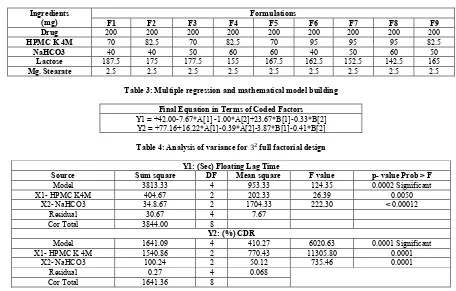
Multiple regression and mathematical model was used to develop a floating sustained release system with release retardant polymer and effervescent agent. The polymer compositions with effervescent agent level are important parameters affecting the drug release profile as well as buoyancy of dosage form, regardless of the core composition. A multivariate optimization approach was approved with the aim of finding the optimum polymers and effervescent agent composition to achieve a gastro retentive release pattern from a floating sustained release tablet. Figure 2 shows the release profiles of the 9 experimental runs performed in accordance with Table 3. The consequences obtained from the research were statistically analysed for response variables by using Design Expert 8.0.1 version (Stat-Ease Inc., Minneapolis, Minnesota). The design was evaluated by a 3-level two factorial design 14. The regression coefficients for
each term in the regression model (equations) are summarized in Table 3, and the analysis of variance (ANOVA) information is exposed in Table 4.
Effect of formulation variables on release properties in the case of Y1 (FLT) coefficients X1 and X2 were found to be significant, with an interaction of X1X2. While the highest polymer content to formulation (X1) increased, drug release decreased. Similar results were reported earlier as the polymer concentration increases the %CDR decreases. Effect of factors on 37 full factorial design model and connected p-values for the responses Y1 and Y2 are offered in table 4. Values of "Prob > F" less than 0.0500 indicate model terms are significant. In this case X1, X2 are significant model terms for Y1 and X2 is significant in the case of Y2 (% CDR) 15. Values greater than 0.1000 indicate the
model terms are not significant. A factor is considered to influence the response if the effects significantly differ from zero and the p-value is less than 0.05.
Response Surface Analysis
The relationship between variables was further elucidated using response surface methodology. The effects of X1 and X2 on Y1 are specified in Figure 2 A. Y1 did not illustrate any significant changes at low as well as high level of X2. But the same when the release retardant polymer concentration (HPMC K 4M as X1) was increased Y2 (% CDR) decreased from 97.99 % to 57.48 % at the end of 12 h. The effects on Y1 by factors X1 and X2 expressed in Figure 2. X2 (effervescent system i.e. NaHCO3)
showed the increase and decreased in floating lag time. As the concentration of NaHCO3 increased the FLT was decreased
whereas concentration of (HPMC K 4M) (X1) decreases the Y2 get increased 16.
Evaluation of Floating Sustained Release Tablets
Table 5 indicated the post compression data. Almost all the batches showed uniform thickness. Hardness range was in between 5.1-5.4 and drug content was in the range of 96.14-98.75%. All batches passed weight variation test and found to be within range (500 ± 5%) and friability was less than 1%, it indicates that tablet surfaces are strong enough to withstand mechanical shock or attrition during storage, transportation and until they are consumed. Percentage swelling for all batches was observed in the range of 158±25 to 174±39. Floating lag time was observed lees than 78 sec for all batches and total floating time was observed more than 12 h 17.
Swelling study, Floating Lag Time (FLT) and Total Floating Time (TFT)
It was observed that as the concentration of the HPMC K4M increased the percentage of swelling also increased. The tablets were removed and the excess surface liquid was carefully removed by a filter paper. As the water continues to enter the tablet, a highly concentrated polymer solution is formed, denoted as a gel layer. The solvent continues to penetrate the tablet, the gel layer and the dimensions of the swollen tablet increase, a process normally referred to as the swelling process. Complete swelling was achieved by the end of seven hrs. Thus, the
percentage of swelling was determined at the end of 8 h for all the developed formulations. The buoyancy of floating sustained release tablet was studied at 37 ± 0.5oC in 200 mL of 1.2 pH buffer (Simulated gastric fluid without pepsin). The buoyancy lag time was measured by using stop watch and total floating time was observed visually. Floating lag time was observed less than 78 sec for all batches. Total floating time was observed more than 12 h 18. Results were reported in Table 6.
The in vitro Dissolution Study of Floating Sustained Release Tablets
The in vitro dissolution study of Nevirapine floating sustained release tablets were carried out by using USP dissolution type II (Paddle) apparatus (Electro lab TDT- 08L plus, Dissolution tester USP Mumbai, India). In vitro dissolution study carried using polymer such as HPMC K4M, NaHCO3 and lactose. Comparative
in vitro dissolution of floating sustained release tablets using 37 full factorial design in 1.2 pH buffer shown in Figure 3.
Effect of HPMC K4M: The varying percent cumulative drug release (%CDR) after 12 h for formulation F1 to F9 were obtained with different concentration of HPMC K4M. Highest concentration of HPMC K 4M, decrease the % CDR and low concentration of HPMC K 4M, increase the % CDR. The percent cumulative drug release for formulation F3, F4 and F7 was 92.72±4.1%, 76.45±5.1% and 61.08±5.2%, respectively. These variations were observed in drug release because of change in concentration of HPMC K 4M. Thus one can conclude that HPMC K 4M is a major variable to regulate the release rate of Nevirapine from tablet. The percent cumulative drug release after 12 h for formulation F1 was found 97.99±6.5% hence considered as optimized by considering all other parameters 19.
Effect of Effervescent system: Nevirapine (NVP) floating sustained release tablets containing effervescent (NaHCO3) showed much less floating lag time. If the concentration of effervescent (NaHCO3) increase then the FLT was decrease, and
if the concentration effervescent (NaHCO3) decrease then FLT
was increase. NVP tablets of batch F1, F2, F4, and F6 started floating immediately. NVP Tablets showed floating lag time was 11, 18, 42 and 25 Sec respectively. Sodium bicarbonate acts as a gas generating agent; it generates CO2 gas when it comes into
contact with an acidic environment of the stomach 20. This gas
entraps into the matrix of water-soluble polymers and the formulation floats in an acidic environment of the stomach. All above batches contain same concentration of NaHCO3, the
variation in FLT is only because of concentration of HPMC K4M. As the concentration of sodium bicarbonate increase, the drug release was increase at the end of 12 h. The duration of floating for all formulations was found to be >12 h in pH 1.2 buffer with the short floating lag time showed optimum batch F1 NVP floating sustained release tablet was 11 Sec 21.
Table 1: Selection of independent and dependent variables for 𝟑𝟐 full factorial design
Coded Values
Independent Variables Dependent Variables HPMC K4M Concentration
(X1) NaHCO3 Concentration (X2) Floating Lag Time (Y1) Cumulative Drug Release (Y2)
-1 70 40 Sec %
0 82.5 50 Sec %
Table 2: Composition of floating sustained release tablets using 𝟑𝟐 full factorial design
Ingredients (mg)
Formulations
F1 F2 F3 F4 F5 F6 F7 F8 F9
Drug 200 200 200 200 200 200 200 200 200
HPMC K 4M 70 82.5 70 82.5 70 95 95 95 82.5
NaHCO3 40 40 50 60 60 40 50 60 50
Lactose 187.5 175 177.5 155 167.5 162.5 152.5 142.5 165
Mg. Stearate 2.5 2.5 2.5 2.5 2.5 2.5 2.5 2.5 2.5
Table 3: Multiple regression and mathematical model building
Final Equation in Terms of Coded Factors
Y1 = +42.00-7.67*A[1] -1.00*A[2]+23.67*B[1]-0.33*B[2] Y2 = +77.16+16.22*A[1]-0.39*A[2]-3.87*B[1]-0.41*B[2]
Table 4: Analysis of variance for 37 full factorial design
Y1: (Sec) Floating Lag Time
Source Sum square DF Mean square F value p- value Prob > F
Model 3813.33 4 953.33 124.35 0.0002 Significant X1- HPMC K4M 404.67 2 202.33 26.39 0.0050
X2- NaHCO3 34.8.67 2 1704.33 222.30 < 0.00012 Residual 30.67 4 7.67
Cor Total 3844.00 8
Y2: (%) CDR
Model 1641.09 4 410.27 6020.63 0.0001 Significant X1- HPMC K 4M 1540.86 2 770.43 11305.80 0.0001
X2- NaHCO3 100.24 2 50.12 735.46 0.0001 Residual 0.27 4 0.068
Cor Total 1641.36 8
Table 5: Evaluation of Post Compression Parameters for floating sustained release tablets
Formulation Hardness (kg/cm2) Mean ± S.D.
Friability (%) Mean ± S.D.
Thickness (mm) Mean ± S.D.
Weight variation (mg) Mean ± S.D.
Drug content (%) Mean ± S.D.
F1 5.2±0.3 0.3 ± 0.1 4.34 ± 0.2 500±2.3 96.95±1.3
F2 5.1±0.2 0.5 ± 0.2 4.84 ± 0.7 500±4.4 96.45±1.4
F3 5.4±0.2 0.2 ± 0.05 4.06 ± 0.3 500±2.1 97.15±1.5
F4 5.2±0.4 0.4 ± 0.08 3.98 ± 0.6 500±1.2 96.14±1.2
F5 5.4±0.3 0.3 ± 0.1 4.21 ± 0.8 500±3.5 96.95±1.7
F6 5.3±0.4 0.2 ± 0.09 4.57 ± 0.5 500±2.2 96.95±1.5
F7 5.1±0.1 0.5 ± 0.2 4.259 ± 0.1 500±3.1 97.05±1.7
F8 5.2±0.2 0.3 ± 0.07 4.87 ± 0.5 500±1.3 98.75±1.3
F9 5.3±0.3 0.4 ± 0.1 4.61 ± 0.8 500±2.5 97.95±1.2 (n = 3) mean value ± S.D.
Table 6: Swelling study of tablet in 1.2 pH at 37 ± 0.5 °C
Formulation Code % Swelling (8 h) Mean± S.D.
Floating lag time (Sec-1) Mean ± S.D.
Total floating time (h)
In vitro release (12 h) Mean ± S.D. F1 162±20 11±2 > 12 97.99±6.5
F2 168±29 18±3 > 12 80.88±5.5
F3 158±25 36±4 > 12 92.72±4.1
F4 164±35 42±5 > 12 76.45±5.1
F5 161±34 56±6 > 12 89.43±5.3
F6 174±39 25±3 > 12 65.45±5.4
F7 168±20 49±5 > 12 61.08±5.2
F8 171±30 78±9 > 12 57.48±5.1
Figure 1: Overlay spectra of Nevirapine, HPMC K4M, lactose and physical mixture
Figure 2: 3D diagram A- Effect of X1 and X2 on Y1. B- Effect of X1 and X2 on Y2
Figure 3: Percent drug released up to 12 hrs
CONCLUSION
This study discussed a positive application of a computer optimization technique for the development of a gastro-retentive delivery. It was concluded on the basis of in vitro release study, that optimized F1 formulation containing 200 mg of NVP is suitable as floating sustained release tablet. This study showed that there is potential for this novel intragastric, floating sustained tablet to remain in the stomach for a longer time and to have a better in vitro drug release for 12 h. The dosage form can control the release; extend the duration of action of a drug with prolonged floating time and gives proper utilization of drug. Hence, this new type of floating sustained release tablet which can transfer to industry scale production with high output rates by considering the need of nevirapine.
REFERENCES
1. Rouge N, Buri P, Doelker E; Drug absorption sites in the gastrointestinal tract and dosage forms for site-specific delivery, International Journal Pharmaceutics. 1996; 136: 117–139.
2. Bardonnet PL, Faivre V, Pugh WJ, Piffaretti, J.C. and Falson, F; Gastro retentive dosage forms: Overview and special case of Helicobacter pylori. Journal of controlled release. 2006; 111(1), 1- 18.
3. Talukder R, Fassihi R, Gastroretentive delivery systems: a mini review. Drug development and industrial pharmacy. 2004; 30(10): 1019-1028.
4. Streubel A, Siepmann J. Bodmeier R, Floating matrix tablets based on low density foam powder: effects of formulation
In-Vitro Dissolution Study
0 2 4 6 8 10 12
0 20 40 60 80 100
F1 F2 F3 F4 F5 F6 F7 F8 F9
Time in hr
%
Cu
m
u
la
ti
ve
Dr
u
g
Re
le
a
and processing parameters on drug release. European journal of pharmaceutical sciences, 2003; 18(1), 37-45.
5. Shweta Arora, Javed Ali, Alka Ahuja, Roop K. Khar, and Sanjula Baboota; Floating Drug Delivery Systems: A Review. American Association of Pharmaceutical Scientists PharmSciTech. 2005; 6 (3): E372-E390.
6. https://www.drugbank.ca/drugs/DB00238
7. Sasa Baumgartner, Julijana Krist, Franc Vrecer, Polona Vodopivec, Bojan Zorko. Optimization of floating matrix tablets and evaluation of their gastric residence time. International Journal of Pharmaceutics.2000; 195: 125–135. 8. Tadros MI; Controlled-release effervescent floating matrix tablets of ciprofloxacin hydrochloride: Development, optimization and in vitro–in vivo evaluation in healthy human volunteers. European Journal of Pharmaceutics and Biopharmaceutics. 2010; 74(2), 332- 339.
9. Lachmann, L. Lieberman, H. Kanig, J.The Theory and Practice of Industrial Pharmacy, 3rd edition, Bombay, Varghese pubilishing house. 1990
10. Eda Gökbulut, İmran Vural, Makbule Aşıkoğlu, Nurten Özdemir. Floating drug delivery system of itraconazole: Formulation, in vitro and in vivo studies. Journal of Drug Delivery Science and Technology. 2019; 49: 491-501
11. Dorożyński, P., Jachowicz, R., Kulinowski, P., Kwieciński, S., Szybiński, K., Skorka, T. and Jasiński, A; The macromolecular polymers for the preparation of hydrodynamically balanced systems—methods of evaluation. Drug development and industrial pharmacy. 2004; 30(9): 947-957.
12. Varshosaz, J., Tavakoli, N. and Roozbahani, F., 2006. Formulation and in vitro characterization of ciprofloxacin floating and bioadhesive extended-release tablets. Drug delivery, 13(4), 277-285.
13. Malakar J, Nayak AK, Pal D; Development of cloxacillin loaded multiple-unit alginate-based floating system by emulsion–gelation method, International journal of biological macromolecules. 2012; 50: 138–147.
14. Chemate SZ, Godge GR, Pawa KK, Rupnar KA; Preparation and evaluation of hollow calcium pectinate beads for
floating-pulsatile drug delivery, Turkish Journal of Pharmaceutical Sciences. 2016; 13: 91–102.
15. M. Ninan, X. Lu, W. Qifang, Z. Xiangrong, Z. Wenji, L. Yang, J. Lingyu, L. Sanming, Development and evaluation of new sustained-release floating microspheres, International Journal of Pharmaceutics. 2008; 358: 82–90. 16. Whitehead L, Fell JT, Collett JH, Sharma HL, Smith AM;
Floating dosage forms: an in vivo study demonstrating prolonged gastric retention. Journal of Controlled Release. 1998; 55: 3–12.
17. Srivastava, A.K., Wadhwa, S., Ridhurkar, D. and Mishra, B., Oral sustained delivery of atenolol from floating matrix tablets - Formulation and in vitro evaluation. Drug development and industrial pharmacy. 205; 31(4): 367-374. 18. Gattani SG, Londhe SG, Chalikwar SS, Amrutkar, JR; Formulation and evaluation of gastroretentive drug delivery of verapamil hydrochloride. European Journal of Parenteral Sciences and Pharmaceutical Sciences. 2010; 15(4): 125. 19. Adel S, Kasabgy NA; Design of innovated lipid-based
floating beads loaded with an antispasmodic drug: in-vitro and in-vivo evaluation, Journal of Liposome Research. 2014; 24: 136-149.
20. A. A. Kharia, S. N. Hiremath, A. K. Singhai, L. K. Omray, and S. K. Jain. Design and optimization of floating drug delivery system of acyclovir. Indian Journal of Pharmaceutical Sciences. 2010; 72(5): 599–606.
21. Sayed M Ahmed, Adel Ahmed Ali, Ahmed MA Ali, Omiya A Hassan. Design and in vitro/in vivo evaluation of sustained-release floating tablets of itopride hydrochloride. Drug Design, Development and Therapy. 2016; 10: 4061– 4071.
Cite this article as:
Subhash V. Deshmane et al. Development and evaluation of floating tablet containing nevirapine using a 32 full factorial
design optimization method. Int. Res. J. Pharm. 2019;10(6):37-42 http://dx.doi.org/10.7897/2230-8407.1006200
Source of support: Nil, Conflict of interest: None Declared