6132
Development Of Feature Descriptor Based
Methods For Images Annotation
Lakshmi Kiran Yeggena, Dr. A. Bhavani Sankar
Abstract: These days Content-Based Image Retrieval (CBIR) has gotten progressively prevalent. CBIR framework relies upon the visual ideas of the images. These visual ideas are characterized by the low-level highlights like color, surface, and state of whole images that are separated. At that point, they are put away in the database as an element database. The practiced CBIR techniques are utilized in an enormous image database. Be that as it may, these techniques likewise need some solid advancement in the abstract content of images. Color is a generally utilized component for speaking to images in CBIR. We present a novel way to deal with naturally produce transitional image descriptors by misusing idea co-event designs in the pre-named preparing fixed that renders it conceivable to delineate complex scene images semantically. Our work is roused by the way that different ideas that every now and again co-happen crosswise over images structure designs that could give relevant signals to singular idea induction.
Keywords: CBIR techniques, contextual, pattern,
——————————◆——————————
1.
INTRODUCTION
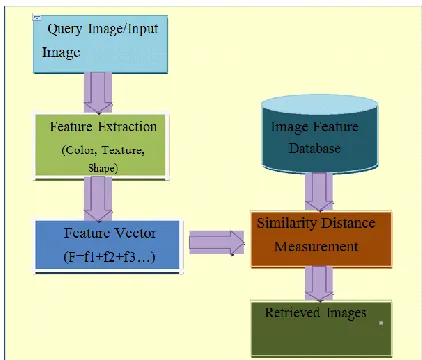
Content-Based Image Retrieval (CBIR) is considered as a functioning examination region in the field of image handling. It is utilized to depict the way toward recovering images from an enormous assortment based on image highlights, for example, color, surface, shape, and so on that can be consequently removed from the image themselves. The image retrieval process relies upon the contents of the image. Highlights of the image are removed and put away in the image database. This framework works just on highlights. The client gives input images as the question image which might be transferred. CBIR framework figures relating highlights for the question image and database image. Closeness separation measure, for example, Euclidean Distance is utilized to compute the comparability among question images and every one of the databases in the images. In CBIR, the retrieval procedure begins when the client gives the image question to the framework. The inquiry image is changed over into an element vector utilizing highlight extraction. The separation between the inquiry image highlight vector and highlight database is determined to discover comparable images from the image database based on the separation measure. The highlights utilized for retrieval fluctuate contingent upon the application. For instance, the CBIR framework for Iris utilizes all the low-level visual ideas for
retrieval. Inquiry by Image Content (QBIC), Visual Seek and Virage are manufactured, based on the low-level highlights of the images. In numerous applications, the utilization of CBIR is careless and furthermore has more points of interest. For the most part, CBIR is utilized in applications like a therapeutic conclusion for correlation of X-beam pictures with past cases, and furthermore to discover the essences of culprits from video shots of a group. In this sort of framework, the images must be looked not based on the semantic closeness yet based on literary word encompassed by the images. This kind of framework simply relies upon image content. A working technique of a typical CBIR framework comprises of four phases. Highlight extraction is the most fundamental procedure of CBIR in which extricates the highlights of the image like color, surface, and shape from spatial based on pixels. Furthermore, the framework develops component vectors. Thirdly, the examination of the question image and database image utilizing highlight vectors Finally, based on closeness measures, for example, Euclidian separation, Hamming Distance, and so on register closeness separation, the yield image is positioned and showed. The presentation of the content-based image retrieval framework is estimated by exactness and review.
Figure 1: Content Based Image Retrieval Typical System
________________________
• Lakshmi Kiran Yeggena, Research Scholar, Dept. of ECE, Sri
SatyaSai University of Technology & Medical Sciences, Sehore, Bhopal-Indore Road, Madhya Pradesh, India.
• Dr. A. Bhavani Sankar, Research Guide, Dept. of ECE, Sri
INTERNATIONAL JOURNAL OF SCIENTIFIC & TECHNOLOGY RESEARCH VOLUME 9, ISSUE 02, FEBRUARY 2020 ISSN 2277-8616
6133
Figure 1 shows the procedure associated with the CBIR System. The foundation of the CBIR framework is the element extraction part. When all is said in done, CBIR can be utilized to depict include portrayal, highlight extraction, ordering, separation estimation, and so forth. The method is utilized to recover ima232es based on consequently determined highlights, for example, color, surface, and shape. Used to depict the ideal images recovering procedure from an enormous assortment of the database based on image visual contents, regularly called highlights, for example, color, shape, surface and spatial. Likeness coordinating is performed between the separated highlights of the inquiry image with the highlights of the image put away in the image include the database. It doesn't include the extra overhead of the task of extraordinary words or catchphrases to an image, consequently, it is less tedious contrasted with content-based image retrieval. A few instances of CBIR frameworks are QBIC.
PROBLEM STATEMENT
The image retrieval process by the proposed CBIR frameworks is performed through a progression of steps to be specific, highlight extraction, ordering and coordinating. Various calculations exist for every one of these means. In any case, there are no investigations that focus on the issue of proposing techniques on the best way to coordinate the triumphant methodologies and accomplish a far better
calculation. To put it plainly, it is hard to respond to the inquiry "What is the best methodology that can be utilized at each stage to accomplish the best execution?" This examination is an endeavor made to address this inquiry by proposing a model that consolidates improved techniques to build up a reasonable Content-Based Image Retrieval System.
PROPOSED SYSTEM
1. Co-occurrence Pattern Detection
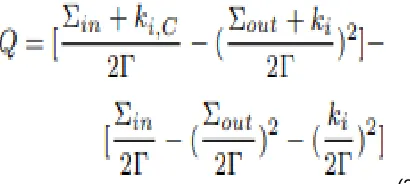
Finding the co-event instances of the unified center points identifies with uncovering system constructions from the inconsistency of the framework which is close to chart packing or parceling issue. Anyway, the issue is the figuring accomplice unmanageable. Starting late seclusion has been used as a measure for choosing the feasibility of the recognized systems, and all the while it can fill in as an objective ability to enlarge. In this, we get a seclusion headway perspective to address the issue and propose a system subject to Newman-Girvan particularity streamlining. The seclusion assesses the idea of a segment by differentiating the association thickness of center points inside a system with the associations with the outside centers. By and large, high estimations of seclusion suggest incredible parcels. By virtue of the weighted framework, we de ne the seclusion of system C as:
(1) Ordinarily seclusion score is in the extent of [1: 1], and before
long a value more conspicuous than 0:3 show an important system. The particularity is resolved over all of the arrangements of centers in the framework, where IDi and IDj are their district IDs, (IDi; IDj) = 1if IDi = IDj for two centers vi
and vj, for the most part = 0. We deliberate iteratively joining the centers into a dynamic system construction with different degrees of objectives by growing the measured quality increase at each cycle the particularity expansion of moving an outside center vi into a system C is evaluated by:
(2) Computation 2 is given for recognizing the dynamic thought
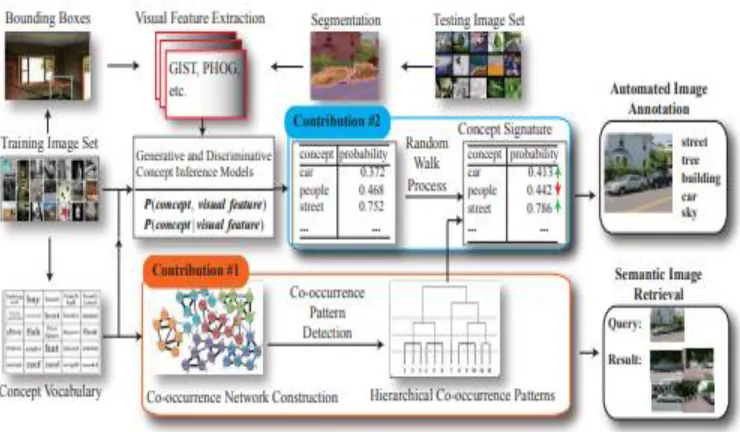
co-event structures (systems) in a framework. The runtime of the count for co-event plan recognizable proof is O (jV j(jEj + jV j))where jEj is the quantity of edges and jV j is the amount of hubs in the framework. The computation iteratively delivers a different leveled organize structure with various objectives, all things considered, the systems of individual thoughts, and the systems of systems. To raise, our figuring keeps an eye on the part of hubs issue between systems unequivocally. We show the plausibility of dynamic system structure and co-event configuration in Figure 2. Diagram segment computations give a ground-breaking choice as opposed to looking at the systems. We get
6134 Figure 2: shows the system diagram of the proposed approach.
The flowchart of the proposed idea deriving structure the obligations are: (I) a co-occasion plan revelation method that adequately investigates distinctive leveled relationship among semantic considerations, (ii) subjective walk based way to deal with oversee refine the idea mark portrayal dependent on recognized idea co-occasion plans.
EXPERIMENTAL RESULTS
System Parameters and Image Datasets 1. Image Datasets
The Label Me dataset is a gathering of 72,852 images containing more than 10,000 attitudes. We utilize a subset which contains 10,000 images and 2,500 considerations. The rough images have different objectives (for instance 256, 1200, 1600, 1920, 2560 etc.). In this paper, we use the objectives of 1200, 1600 downloaded from the webpage by using the Toolbox given by the dataset creators. The SUN'09 dataset contains 12,000 images and more than 5,800 thoughts covering a variety of indoor/outside scenes. The total number of explained names is 85,456 which brings about an ordinary of seven imprints for each image. The images are assembled from various sources (Flickr, Google, Altavista and Label Me) and are named by a lone annotator using the Label Me instrument. The imprints are physically checked for consistency. The OSR dataset has 2,682 images with 520 thoughts transversely more than eight
outside scene classes: coast, woodlands, roadway. All of the thoughts is set apart with relating bouncing boxes physically.
INTERNATIONAL JOURNAL OF SCIENTIFIC & TECHNOLOGY RESEARCH VOLUME 9, ISSUE 02, FEBRUARY 2020 ISSN 2277-8616
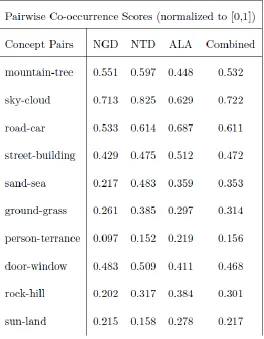
6135 Table 1: Pair wise NGD, NTD, ALA and the combination of the three
Table 2: 5th to 10th level Averaged modularity scores (Q).
➢ Experiment II: Impact from the hierarchy level Figure 3 (a) shows the quality degradation measured for different demand levels in the three datasets. We can see that isolation include point for Label Me occurs at level 6 with Q0: 354, the most extraordinary for SUN'09 at level 7 with Q0: 513, and the best for OSR at level 5 with F0: 402. This shows that the individual Thoughts in SUN'09 have a basic system feature like OSR and Label Me and even appear at a lower level of SUN'09. The system property is colossal and different from the amounts of data label. Me and OSR. Fig. 3 (a) shows the correspondence between the number of
co-event levels and the isolation aspects at different levels of the structures of the dynamic system.
6136 Figure 3: (a) level of the hierarchy vs. Modularity (b) the number of co-occurrence patterns) vs. Modularity.
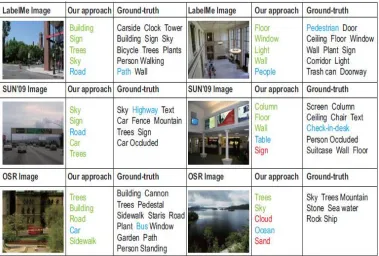
Figure 4 exhibits the principle 5 explanation outcomes for few model images would conveyed by our philosophy. The comments in green-color are the precisely anticipated names and red ones are incorrectly anticipated. It is captivating to look at the comments in blue. These thoughts are interpreted from the perceived different thoughts and co-event plans. Regardless of the way that they are not really proportionate to the comments in the ground-truth, yet they are close in the significance for a detailed circumstance. This
exhibits our proposed procedure can enough propel the explanations by considering the scene thoughts absolutely contained in the co-event plans. The modification furthest reaches of our philosophy could be seen from the explanation outcomes of the right image in the ensuing line and left image in the last segment where the ground-truth ideas are blocked in the image and the comparable idea are advanced by our proposed refinement methodology.
Figure 4: The comments for the test images from the three datasets by our methodology.
CONCLUSION
We present a novel way to deal with naturally create transitional image descriptors by misusing idea co-event designs in the pre-marked preparing usual that extracts it conceivable to portray difficult scene images semantically. In this paper is persuaded by the way that different ideas that
co-INTERNATIONAL JOURNAL OF SCIENTIFIC & TECHNOLOGY RESEARCH VOLUME 9, ISSUE 02, FEBRUARY 2020 ISSN 2277-8616
6137
event designs is applied to obtain the refined idea signature portrayal. Through tests in programmed image comment and semantic image retrieval on a few testing datasets, we exhibit the adequacy of the proposed idea co-event designs just as the idea signature portrayal in correlation with best in class draws near.
REFERENCES
[1] A.Zisserman., P. Perona, and R. Fergus Object class recognition by unsupervised scale-invariant
learning. In Proceedings of the Conference on Computer Vision and Pattern Recognition, Madison, Wisconsin, USA, pages 264.271, 2003
[2] B. Triggs and N. Dalal “Histograms of oriented gradients for human detection”, In CVPR (1), pages 886–893, 2005.
[3] C. Schmid and G. Dorko “Selection of scale-invariant parts for object class recognition”, In Proceedings of the 9th International Conference on Computer Vision, Nice, France, pages 634-640, 2004.
[4] Dr. B. Prabhakara Rao, Dr. A. Govardhan, Image Retrieval based on Local Histogram and Texture Features, (IJCSIT) International Journal of
Computer Science and Information Technologies, Vol. 2 (2) , p.741-746, 2011
[5] Hae-Yeon Choi, Color Image Semantic Information Retrieval System Using Human Sensation and Emotion, P. Huang and S. Dai, “Image retrieval by texture
similarity,” Pattern Recognition,vol. 36, pp. 665–679, 2003.
[6] J.Z.Wang., J.Li, D.Joshi, “Image Retrieval: Ideas, Inuences, and Trends of the New Age”. ACM Transactions on Computing Surveys, Vol. 40, No. 2,pages 1-60,2008.
[7] Kai-Kuang Ma, Rotation-invariant and scale-invariant Gabor features for texture image retrieval, Elsevier, ScienceDirect, Image and Vision Computing 25 (2007) 1474–1481.
[8] L. Van Gool, and T. Tuytelaars. Simultaneous object recognition and segmentation by image exploration In Proceedings of the 8th European Conference on Computer Vision, Prague, Tcheque Republic,pages 40.54, 2004.
[9] Luc Van Gool, Tinne Tuytelaars, "SURF: Speeded Up Robust Features", Computer Vision and Image Understanding (CVIU), Vol. 110, No. 3, pp. 346--359, 2008.
[10]Mingjing Li., Kap Luk Chan, Mapping low level features to high level semantic concept in region based image retrieval”. IEEE CVPR05. 2005
[11]V Venkata Krishna, Texture Based Image Indexing and Retrieval, IJCSNS International Journal of Computer Science and Network Security, VOL.9 No.5, May 2009. [12]Youli Chang, Color and Texture Feature For Content