R E S E A R C H
Open Access
A single consumption of curry improved
postprandial endothelial function in healthy male
subjects: a randomized, controlled crossover trial
Hideki Nakayama
1*, Nobuaki Tsuge
2, Hiroshi Sawada
2, Noriya Masamura
2, Shohei Yamada
1, Shigeki Satomi
1and Yukihito Higashi
3Abstract
Background:Curry, one of the most popular foods in Japan, contains spices that are rich in potentially
antioxidative compounds, such as curcumin and eugenol. Oxidative stress is thought to impair endothelial function associated with atherosclerosis, a leading cause of cardiovascular events. The aim of this study was to determine whether a single consumption of curry meal would improve endothelial function in healthy men.
Methods:Fourteen healthy male subjects (BMI 23.7 ± 2.7 kg/m2; age 45 ± 9 years) were given a single serving of curry meal or spice-free control meal (180 g of curry or control and 200 g of cooked rice; approximately 500 kcal in total) in a randomized, controlled crossover design. Before and 1 hr after the consumption, fasting and postprandial flow-mediated vasodilation (FMD) responses and other parameters were measured.
Results:The consumption of the control meal decreased FMD from 5.8 ± 2.4% to 5.1 ± 2.3% (P= 0.039). On the other hand, the consumption of the curry meal increased FMD from 5.2 ± 2.5% to 6.6 ± 2.0% (P= 0.001), and the postprandial FMD after the curry meal was higher than that after the control meal (P= 0.002). Presence of spices in the curry did not alter significantly the systemic and forearm hemodynamics, or any biochemical parameters including oxidative stress markers measured.
Conclusions:These findings suggest that the consumption of curry ameliorates postprandial endothelial function in healthy male subjects and may be beneficial for improving cardiovascular health.
Trial registration:UMIN Clinical Trials Registry 000012012.
Keywords:Curry, Spice, Antioxidant, Endothelial function, Postprandial hyperglycemia, Flow-mediated vasodilation, Prevention, Cardiovascular events
Background
Curry originated in Indian traditional diet, and has become widely eaten throughout the world, especially in Asia [1]. In fact, curry is one of the most popular foods in Japan [1]. Japanese curry is often milder in flavor and thicker in consistency than the traditional Indian curry, and usually is served with cooked rice [1]. With a good amount of meat and vegetables in it, Japanese curry can make a convenient and nutritious meal for people of all ages [1].
While being mild in flavor, Japanese curry still con-tains an abundant amount of spices, some of which are high in antioxidants. For example, turmeric contains antioxidant yellow pigment, curcumin, which is known to have many health benefits such as vasoprotective, antiinflammatory, anticarcinogenic, and neuroprotective effects [2,3]. Clove contains antioxidant aromatic oil, eu-genol, which is also known to have some health benefits such as vasoprotective and pulmonary protective effects [4,5]. Epidemiologic studies have shown that curry im-proves pulmonary function in Asian elderly adults [6] and curry consumption improved cognitive performance of nondemented elderly Asians [7]. However, few inter-vention studies about curry have been reported.
* Correspondence:[email protected] 1
Research & Development Institute, House Foods Corporation, Yotsukaido 284-0033, Japan
Full list of author information is available at the end of the article
It is well known that postprandial hyperglycemia is a contributing factor to the development of atherosclerosis and is a risk factor for cardiovascular events. A meta-regression analysis showed that the progressive relation-ship between glucose levels and cardiovascular risk extends even in subjects with normal glucose tolerance below the diabetic threshold [8].
Although mechanism by which postprandial hypergly-cemia induces vascular dysfunction is not fully understood, a review by Mar and Bruno points out that oxidative stress-mediated disruptions in nitric oxide homeostasis have been implicated as key events leading to vascular dysfunction [9]. Glucose loading produced a decrease in endothelial function and an increase in a marker of oxidative stress in normal and diabetic subjects [10,11]. Hyperglycemia in response to oral glucose loading rapidly suppressed endothelium-dependent vasodilation, probably through increased production of oxygen free radicals [11-13].
Accumulating evidence suggests that endothelial dysfunc-tion plays a crucial role in the development and progression of atherosclerosis. The endothelium is suggested to be a tar-get of damage in the postprandial state [14-16].
The aim of this study was to determine whether a sin-gle consumption of a dish of Japanese curry and rice would improve postprandial endothelial function in healthy men.
Methods Subjects
In December 2012, 18 healthy males aged 33 to 64 years were recruited for the study. We selected healthy male subjects who do not have any history of hypertension, diabetes mellitus, and dyslipidemia, to avoid the possibil-ity of any influence on the endothelial function by these factors as well as by menstrual cycle. The study protocol was approved by Tana Orthopedic Surgery Institutional Review Board. Informed consent for participation in the study was obtained from all subjects.
Study design
The study was performed at House Foods Corporation during the period from January 2013 to February 2013. Subjects were randomized into a control-first group and a curry-first group. Each subject was given a single serv-ing of test meal (control meal or curry meal) in a cross-over manner with more than one week in between the two test meals. Fasting and postprandial measurements were taken by the primary investigator under blinded condition as follows.
Subjects were asked not to take any nutritional supple-ments on the day before the test and were fasted for at least 12 hours overnight prior to the fasting measurements. No other instructions were given to the subjects. After the fast-ing measurements, subjects were given 180 g of either
control (198 kcal) or curry (187 kcal) and 200 g of cooked rice (294 kcal) by a support staff, and one hour afterwards, postprandial measurements were taken. A preliminary test which we had made before this study showed that a meas-urement one hour after the intake of the control meal showed low endothelial function in healthy subjects but this effect was not observed two hours after the intake of the control meal. For this reason, we thought that the single point measurement one hour after meal was appropriate for studying curry effects on postprandial endothelial dys-function in healthy subjects.
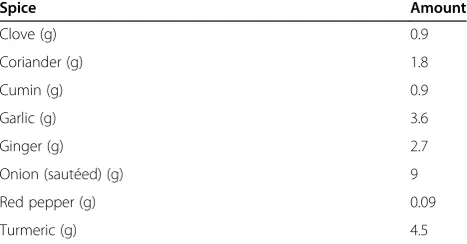
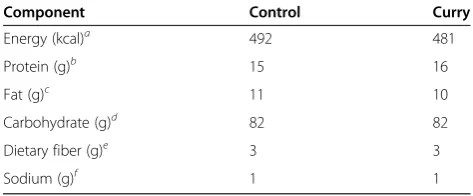
The curry consisted of ground beef, tomato, tomato puree, some seasonings, and a blend of spices (Table 1). The control was prepared as the curry except that all the spices were removed from the formula; it tasted like a meat sauce for spaghetti. The nutritional compositions of the control meal and curry meal both with 200 g of cooked rice were essentially the same as shown in Table 2.
Single serving portions (180 g) of both the curry and the control were packed and sterilized in retort pouches and were stored at room temperature until use. They were heated in boiling water for five minutes just before serving with 200 g of cooked rice.
FMD and hemodynamic measurements
All measurements were taken in the morning, in a quiet, air-conditioned room maintained at 24°C and 50% rela-tive humidity. The subjects rested quietly in the supine position for 20 min before and during each FMD meas-urement. Just before the cuff inflation, systolic and dia-stolic blood pressure was measured on the left arm.
FMD was measured on the right arm as described pre-viously [17] with a UNEXEF18G ultrasound imaging sys-tem programmed specifically for FMD measurements with the autocuff (UP310), the semi-automatic vessel tracking (X-link), and the flow mode (uFFLOW) options (UNEX Co., Nagoya, Japan). After the brachial artery diameter was determined for the baseline arterial diam-eter from a longitudinal image of the artery acquired 5
Table 1 Composition of the spice blend used in a single serving portion of the curry meal
Spice Amount
Clove (g) 0.9
Coriander (g) 1.8
Cumin (g) 0.9
Garlic (g) 3.6
Ginger (g) 2.7
Onion (sautéed) (g) 9
Red pepper (g) 0.09
to 10 cm above elbow, reactive hyperemia was induced by 5 min of distal lower arm occlusion by a blood pres-sure cuff inflated to 50 mm Hg above systolic prespres-sure. Subsequently, the longitudinal image of the artery was recorded continuously until 2 min after the cuff defla-tion for the maximal brachial artery diameter determin-ation. Pulsed Doppler velocity signals were acquired for 20 seconds before cuff inflation and for 10 seconds after cuff deflation for the hyperemic flow (% increase in blood flow) determination.
We have already estimated the reproducibility and ac-curacy of the measurement by a preliminary test using 10 subjects. The same person, who performed the FMD measurement of this study, had measured FMD of each subject twice at one hour interval. The interclass correl-ation coefficient was 0.98 and systematic error across these two measurements was 0.1%.
Serum measurements
Whole blood samples were collected from the left arm, just after the FMD and hemodynamic measurements. They were separated immediately by centrifugation (1,200 g, 10 min) and were stored at −80°C until use. Glucose, triglycerides, and total cholesterol were measured by enzymatic procedures (Mitsubishi Chemical Medience Corporation, Tokyo, Japan). High-density lipoprotein cholesterol (HDL-C) and low-density lipoprotein choles-terol (LDL-C) were measured by enzymatic procedures (Kyowa Medex Co., Ltd., Tokyo, Japan). Insulin was measured by Chemiluminescent immunoassay (ABBOTT JAPAN Co., Ltd, Tokyo, Japan). High-sensitivity C-reactive protein (hs-CRP) was measured by nephelometry using N-latex CRP-2 (Siemens Healthcare Japan, Tokyo, Japan). Malondialdehyde-modified LDL (MDA-LDL) was measured by two step ELISA (SEKISUI MEDICAL Co., Ltd., Tokyo, Japan) which uses monoclonal antibody
recognizing MDA residues (ML25) and monoclonal anti-body against apoB (AB16) to make the assay specific to MDA-LDL as described previously [18].
Urine measurement
For the urine 8-isoprostane determinations, a single voided urine sample was collected from each subject just after the blood sampling and was stored at −80°C until use. To 1000 μl (Creatinine < 50 mg/dl) or 500 μl (Creatinine≥50 mg/dl) urine sample, 3H-8epi PGF2α (20 dpm/μL) 50μL and 4% acetic acid 3 ml were added. After being stirred for 30 min, the sample was applied on an OASIS HLB solid phase extraction column (Nihon Waters K.K., Tokyo, Japan) preconditioned with 2 ml each of Ethylacetate and Acetonitryl and 3 ml of 4% acetic acid). After being washed with 15% acetonitry in Ehylacetate: hexane: 1-butanol = 15: 85: 1, the column was eluted with 2 ml ethylacetate:hexane = 85: 1. The eluted sample was dried under nitrogen, dissolved in 1 ml EIA buffer, and stirred for 30 min before being subjected to EIA assay (Cayman Chemical, Michigan, United States) as described previously [19]. The urine cre-atinine for normalization of 8-isoprostane concentration was measured by enzymatic procedures (Mitsubishi Chem-ical Medience Corporation, Tokyo, Japan).
Statistical analysis
A power analysis for two-way within subjects ANOVA was performed as described [20] and showed that a total sample size of 12 subjects was required to detect an interaction be-tween meals and prandial status with anαerror of 0.05 and a power of 0.80. Data are presented as means ± standard deviations. Baseline characteristics were compared between the curry-first and the control-first group by unpaired
t-test. Statistical analyses about the effects of curry on FMD and other parameters were performed by using two-way within subjects ANOVA (control/curry and fasting/postprandial). If the interaction was significant, post hoc Student’s paired t-test was performed. Statis-tical significance was assumed if a null hypothesis could be rejected atP= 0.05. All analyses were performed with SPSS (version 22; IBM Japan, Ltd., Tokyo, Japan).
Results
Baseline characteristics
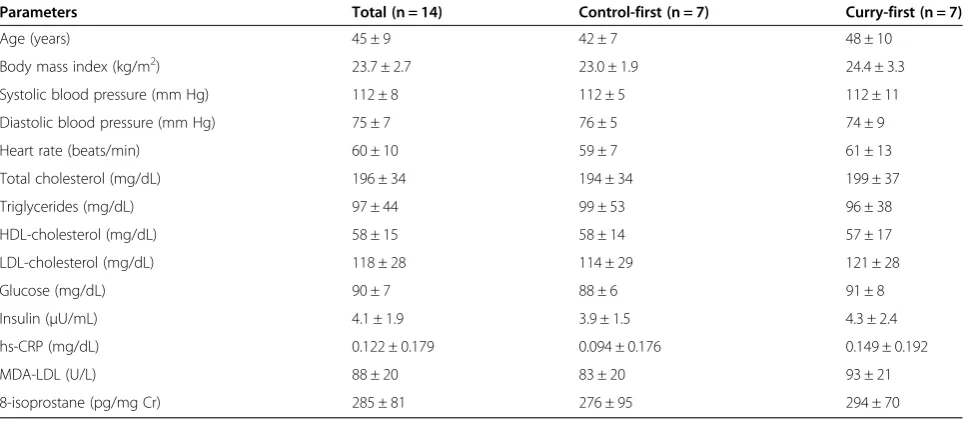
Of the 18 subjects enrolled in the study, 4 subjects were ex-cluded from the analysis for the follwoing reasons. One subject canceled after the first participation. The ultrasound images of another subject were technically unsuitable for the analysis, Another subjects had a sleeping problem on the night before the test day, and the other subject showed very low postprandial glucose level (<50 mg/dL). Table 3 summarizes the baseline characteristics of the remaining 14
Table 2 Composition of a single serving portion of the test meal with 200 g of rice
Component Control Curry
Energy (kcal)a 492 481
Protein (g)b 15 16
Fat (g)c 11 10
Carbohydrate (g)d 82 82
Dietary fiber (g)e 3 3
Sodium (g)f 1 1
aModified Atwater methods.
bKjeldahl nitrogen determination method (conversion factor: 6.25). c
Ether extraction method.
dCarbohydrate was calculated from protein, fat, ash (direct ashing), and
moisture (oven drying at 105°C for 16 hours).
eModified Prosky method.
subjects. All baseline characteristics did not differ signifi-cantly between the control-first and the curry-first group.
Effects of curry consumption on FMD and other hemodynamic parameters
Table 4 summarizes the brachial and hemodynamic pa-rameters with significance probability values (P values) from the ANOVA results.
Only on FMD, the interaction effect between meals (control/curry) and prandial status (fasting/postprandial) was significant (P< 0.001). Post hoc Student’s paired
t-tests revealed that the consumption of the control sig-nificantly decreased the FMD from 5.8 ± 2.4% to 5.1 ± 2.3% (Figure 1, P= 0.039). On the other hand, the con-sumption of the curry increased FMD from 5.2 ± 2.5% to 6.6 ± 2.0% (P= 0.001), and the postprandial FMD after
the curry meal was higher than that after the control meal (5.1 ± 2.3% vs. 6.6 ± 2.0%,P= 0.002).
After consumption of the test meals, heart rate and base-line arterial diameter increased significantly, and diastolic blood pressure decreased significantly. Other than these, no main effects of the meals, the prandial status, or no inter-action effects on systemic and forearm hemodynamics were significant.
Effects of curry consumption on biochemical parameters
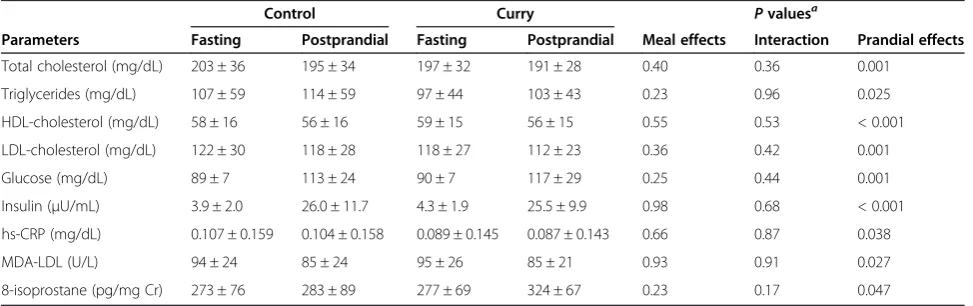
Table 5 summarizes the biochemical parameters with P values from the ANOVA results.
While the main effects of meals and the interaction ef-fects between meals (control/curry) and prandial status (fasting/postprandial) were not significant, the main effects of prandial status were significant for all parameters measured.
Table 3 Baseline characteristics
Parameters Total (n = 14) Control-first (n = 7) Curry-first (n = 7)
Age (years) 45 ± 9 42 ± 7 48 ± 10
Body mass index (kg/m2) 23.7 ± 2.7 23.0 ± 1.9 24.4 ± 3.3
Systolic blood pressure (mm Hg) 112 ± 8 112 ± 5 112 ± 11
Diastolic blood pressure (mm Hg) 75 ± 7 76 ± 5 74 ± 9
Heart rate (beats/min) 60 ± 10 59 ± 7 61 ± 13
Total cholesterol (mg/dL) 196 ± 34 194 ± 34 199 ± 37
Triglycerides (mg/dL) 97 ± 44 99 ± 53 96 ± 38
HDL-cholesterol (mg/dL) 58 ± 15 58 ± 14 57 ± 17
LDL-cholesterol (mg/dL) 118 ± 28 114 ± 29 121 ± 28
Glucose (mg/dL) 90 ± 7 88 ± 6 91 ± 8
Insulin (μU/mL) 4.1 ± 1.9 3.9 ± 1.5 4.3 ± 2.4
hs-CRP (mg/dL) 0.122 ± 0.179 0.094 ± 0.176 0.149 ± 0.192
MDA-LDL (U/L) 88 ± 20 83 ± 20 93 ± 21
8-isoprostane (pg/mg Cr) 285 ± 81 276 ± 95 294 ± 70
Values are means ± SD.
Abbreviations:HDLhigh-density lipoprotein,LDLlow-density lipoprotein,hs-CRPhigh-sensitivity C-reactive protein,MDAmalondialdehyde-modified,Crcreatinine.
Table 4 Vascular function and Systemic Hemodynamics
Control Curry Pvaluesa
Parameters Fasting Postprandial Fasting Postprandial Meal effects Interaction Prandial effects
FMD (%) 5.8 ± 2.4 5.1 ± 2.3 5.2 ± 2.5 6.6 ± 2.0 0.20 < 0.001 0.25
Systolic blood pressure (mm Hg) 110 ± 7 110 ± 10 111 ± 8 113 ± 7 0.07 0.57 0.33
Diastolic blood pressure (mm Hg) 73 ± 8 67 ± 7 75 ± 7 70 ± 7 0.07 0.32 < 0.001
Heart rate (beats/min) 60 ± 10 66 ± 11 59 ± 9 66 ± 10 0.56 0.55 < 0.001
Baseline arterial diameter (mm) 4.00 ± 0.47 4.12 ± 0.49 3.96 ± 0.47 4.02 ± 0.46 0.12 0.07 < 0.001
Peak hyperemic flow (%) 595 ± 259 536 ± 157 609 ± 217 571 ± 170 0.60 0.76 0.22
Values are means ± SD.
Abbreviations:FMDflow-mediated vasodilation.
a
Discussion
In the present study, we demonstrated that a single con-sumption of a dish of curry and rice improved the post-prandial FMD in healthy men.
We believe the significant interaction effect on FMD between meals and prandial status was due to the anti-oxidant components in the curry, although consumption of the curry meal did not change the two oxidative stress parameters (MDA-LDL and urine 8-isoprostane) mea-sured in our study. Many researchers reported that FMD was improved by some antioxidant consumption (long term and short term) without 8-isoprostane decrease [21-23]. Few intervention studies using antioxidants re-port serum MDA-LDL levels. Pfeuffer et al. rere-ported that consumption of 150 mg/d quercetin for 8 weeks affected neither oxidized LDL nor 8-isoprostane [24].
These reports suggest that no change in MDA-LDL and urine 8-isoprostane does not necessarily mean that im-provement in FMD is not attributable to decrease in oxi-dative stress. On the other hand, it has been reported that administration of glucose in oral glucose tolerance test (OGTT) impaired endothelial function with con-comitant increase in postprandial oxidative stress [11]. It is also reported that the postprandial serum glucose after rice is lower than that after the equivalent amount of glucose consumption [25]. In our study, we found that the test meals containing 82 g carbohydrate, which is nearly equivalent to the amount of glucose administered in 75-g OGTT, increased postprandial serum glucose and a consumption of the control meal resulted in de-crease in FMD suggesting impairment of endothelial function. We speculate that the presence of spice antiox-idants in the curry would have prevented the increase in the oxidative stress induced by postprandial serum glu-cose increase, but the change in the oxidative stress pa-rameters after our test meal was too small to be detected, because the postprandial serum glucose level after our test meals (113 mg/dL after control or 117 mg/dL after curry) was much lower than that normally encountered after 75-g oral glucose loading [26].
Curcumin, eugenol and quercetin in curry could have contributed to our results suggesting that spices improved postprandial endothelial function. It was reported that curcumin alleviates an endothelium-dependent vasodilator dysfunction induced by high glucose in rat aortic rings and increased heme oxygenase-1 activity, and that stimulation of guanylyl cyclase may be involved in the protective effects of curcumin [27]. Eugenol was reported to produce smooth muscle relaxation resulting from the blockade of both voltage-sensitive and receptor-operated channels that are modulated by endothelial-generated nitric oxide [4]. It has been also suggested that qurcetin, which is a main polyphe-nol of onion and is also contained in curry, is known as a
0 1 2 3 4 5 6 7
Control Curry
FMD (%)
Fasting
Postprandial
P= 0.001
P= 0.039
P= 0.002
P= 0.11
Figure 1Effects of a single consumption of curry on flow-mediated vasodilation (FMD), n = 14.Because the interaction between meals (control/curry) and prandial status (fasting/postprandial) was found significant (P= 0.002) by using two-way within subjects ANOVA,Pvalues were calculated by post hoc Student’s pairedt-test. Abbreviations:FMDflow-mediated vasodilation.
Table 5 Biochemical parameters
Control Curry Pvaluesa
Parameters Fasting Postprandial Fasting Postprandial Meal effects Interaction Prandial effects
Total cholesterol (mg/dL) 203 ± 36 195 ± 34 197 ± 32 191 ± 28 0.40 0.36 0.001
Triglycerides (mg/dL) 107 ± 59 114 ± 59 97 ± 44 103 ± 43 0.23 0.96 0.025
HDL-cholesterol (mg/dL) 58 ± 16 56 ± 16 59 ± 15 56 ± 15 0.55 0.53 < 0.001
LDL-cholesterol (mg/dL) 122 ± 30 118 ± 28 118 ± 27 112 ± 23 0.36 0.42 0.001
Glucose (mg/dL) 89 ± 7 113 ± 24 90 ± 7 117 ± 29 0.25 0.44 0.001
Insulin (μU/mL) 3.9 ± 2.0 26.0 ± 11.7 4.3 ± 1.9 25.5 ± 9.9 0.98 0.68 < 0.001
hs-CRP (mg/dL) 0.107 ± 0.159 0.104 ± 0.158 0.089 ± 0.145 0.087 ± 0.143 0.66 0.87 0.038
MDA-LDL (U/L) 94 ± 24 85 ± 24 95 ± 26 85 ± 21 0.93 0.91 0.027
8-isoprostane (pg/mg Cr) 273 ± 76 283 ± 89 277 ± 69 324 ± 67 0.23 0.17 0.047
Values are means ± SD.
Abbreviations:HDLhigh-density lipoprotein,LDLlow-density lipoprotein,hs-CRPhigh-sensitivity C-reactive protein,MDAmalondialdehyde-modified,Crcreatinine.
a
selective modulator of cyclic GMP-dependent relaxations [28]. Future studies are needed for elucidating the mechan-ism of our findings.
After consumption of the test meals, baseline arterial diameter increased significantly. Similar increase in baseline arterial diameter after a fatty meal consumption has been reported [29,30]. Although many researchers reported that increase in baseline diameter would decrease FMD [31,32], the increase did not appear to have diminished the effect of spices on FMD, because significant interaction effect be-tween meals and prandial status on baseline diameter was not found, and because the postprandial FMD after curry even increased despite that the increase of baseline diam-eter should decrease FMD.
It is reported that a single consumption of a high antioxi-dant spice blend attenuated postprandial insulin and trigly-ceride responses and increased some plasma measures of antioxidant activities [33]. The results of the present study, however, showed that no interaction effects (i.e., the effects due to spices) on biochemical data between meals (control/ curry) and prandial status (fasting/postprandial) were sig-nificant. In the previous study, the subjects were given a test meal with different composition, and with different kind of spices. Moreover, they collected blood samples at 30-min intervals for 3.5 h. These differences in experimen-tal conditions may have affected the results.
We found that postprandial diastolic blood pressure decreased and postprandial heart rate increased signifi-cantly, but postprandial systolic blood pressure did not change significantly. Berry et al. reported that glucose solution with ground beef (i.e., solid food), when fed to human subjects, caused higher postprandial systolic blood pressure than glucose solution alone (i.e., liquid food) [34]. They also reported that diastolic blood pres-sure fell and heart rates increased, without significant (observable) effects from the ground beef [34]. Although the mechanisms were not fully understood, the results of our study in which participants consumed solid meal, agree with their findings.
There are some limitations in the current study. The first limitation is our small sample size (n = 14). Follow-up work using a larger sample size may be needed. The second limitation is that because of the unique flavor and color of spices used in the curry, the curry meals were readily distinguishable from the control meals by the subjects. Although we cannot exclude the possibility entirely that this feature of our study had some influence on our results, it is more likely that the presence of spices in the curry reduced the impact of the postpran-dial state on the endothelium after the meal.
Conclusion
Curry consumption ameliorates postprandial endothe-lial dysfunction and may be beneficial for preventing
cardiovascular events. Lifestyle-related diseases such as atherosclerosis and diabetes mellitus have become ser-ious health problems in the modern world. Curry may be helpful in the fight against those lifestyle-related diseases.
Abbreviations
FMD:Flow-mediated vasodilation; HDL-C: High-density lipoprotein-cholesterol; LDL-C: Low-density lipoprotein-lipoprotein-cholesterol; hs-CRP: High-sensitivity C-reactive protein; MDA-LDL: Malondialdehyde-modified LDL; OGTT: Oral glucose tolerance test; Cr: Creatinine.
Competing interests
This study was supported by House Foods Corporation. HN, SY and SS are employees of House Foods Corporation. NT, HS, and NM are employees of House Foods Group Inc. YH has no competing interest.
Authors’contribution
HN designed the research, performed measurements and statistical analysis, and wrote the manuscript. NT conducted the research. HS provided statistical consultation and critically revised the manuscript. NM provided much consultation about the study design and conducted the research. SY designed and prepared test meals. SS provided much consultation about the study design. YH provided much consultation about the study design, conducted the research, provided consultation about the discussion of the test results, and critically revised the manuscript. All authors read and approved the final manuscript.
Acknowledgements
We thank Shintaro Ide and Seiichi Ueno for assistance in the preparation of materials for the institutional review. Hisashi Tanaka, Takuya Hamano and Hitomi Iida for assistance in various stages of the study.
Author details
1
Research & Development Institute, House Foods Corporation, Yotsukaido 284-0033, Japan.2Central Research & Development Institute, House Foods Group Inc., Yotsukaido 284-0033, Japan.3Department of Regeneration and Medicine, Research Institute for Radiation Biology and Medicine, Hiroshima University, Hiroshima 734-8553, Japan.
Received: 19 December 2013 Accepted: 24 June 2014 Published: 28 June 2014
References
1. Sen CT:Curry: A Global History.London: Reaktion Books; 2009. 2. Rungseesantivanon S, Thenchaisri N, Ruangvejvorachai P, Patumraj S:
Curcumin supplementation could improve diabetes-induced endothelial dysfunction associated with decreased vascular superoxide production and PKC inhibition.BMC Complement Altern Med2010,10:57.
3. Esatbeyoglu T, Huebbe P, Ernst IMA, Chin D, Wagner AE, Rimbach G: Curcumin–from molecule to biological function.Angew Chem Int Ed2012, 51:5308–5332.
4. Damiani CEN, Rossoni LV, Vassallo DV:Vasorelaxant effects of eugenol on rat thoracic aorta.Vascul Pharmacol2003,40:59–66.
5. Zin WA, Silva AGLS, Magalhaes CB, Carvalho GMC, Riva DR, Lima CC, Leal-Cardoso JH, Takiya CM, Valenca SS, Saldiva PHN, Faffe DS:Eugenol attenuates pulmonary damage induced by diesel exhaust particles.
J Appl Physiol2011,112:911–917.
6. Ng TP, Niti M, Yap KB, Tan WC:Curcumins-rich curry diet and pulmonary function in Asian older adults.PLoS One2012,7:e51753.
7. Ng T-P, Chiam P-C, Lee T, Chua H-C, Lim L, Kua E-H:Curry consumption and cognitive function in the elderly.Am J Epidemiol2006,164:898–906. 8. Coutinho M, Gerstein HC, Wang Y, Yusuf S:The relationship between
glucose and incident cardiovascular events. A metaregression analysis of published data from 20 studies of 95,783 individuals followed for 12.4 years.Diabetes Care1999,22:233–240.
10. Ceriello A:New insights on oxidative stress and diabetic complications may lead to a“causal”antioxidant therapy.Diabetes Care2003, 26:1589–1596.
11. Lacroix S, Rosiers CD, Tardif J-C, Nigam A:The role of oxidative stress in postprandial endothelial dysfunction.Nutr Res Rev2012,25:288–301. 12. Kawano H, Motoyama T, Hirashima O, Hirai N, Miyao Y, Sakamoto T,
Kugiyama K, Ogawa H, Yasue H:Hyperglycemia rapidly suppresses flow-mediated endothelium-dependent vasodilation of brachial artery.
J Am Coll Cardiol1999,34:146–154.
13. Suzuki K, Watanabe K, Futami-Suda S, Yano H, Motoyama M, Matsumura N, Igari Y, Suzuki T, Nakano H, Oba K:The effects of postprandial glucose and insulin levels on postprandial endothelial function in subjects with normal glucose tolerance.Cardiovasc Diabetol2012,11:98.
14. Lefèbvre PJ, Scheen AJ:The postprandial state and risk of cardiovascular disease.Diabet Med J Br Diabet Assoc1998,15(Suppl 4):S63–S68. 15. O’Keefe JH, Gheewala NM, O’Keefe JO:Dietary strategies for improving
post-prandial glucose, lipids, inflammation, and cardiovascular health.
J Am Coll Cardiol2008,51:249–255.
16. Node K, Inoue T:Postprandial hyperglycemia as an etiological factor in vascular failure.Cardiovasc Diabetol2009,8:23.
17. Soga J, Noma K, Hata T, Hidaka T, Fujii Y, Idei N, Fujimura N, Mikami S, Maruhashi T, Kihara Y, Chayama K, Kato H, Liao JK, Higashi Y, for the ROCK Study Group:Rho-Associated Kinase Activity, Endothelial Function, and Cardiovascular Risk Factors.Arterioscler Thromb Vasc Biol2011, 31:2353–2359.
18. Kotani K, Maekawa M, Kanno T, Kondo A, Toda N, Manabe M:Distribution of immunoreactive malondialdehyde-modified low-density lipoprotein in human serum.Biochim Biophys Acta1994,1215:121–125.
19. Devaraj S, Hirany SV, Burk RF, Jialal I:Divergence between LDL oxidative susceptibility and urinary F2-isoprostanes as measures of oxidative stress in type 2 diabetes.Clin Chem2001,47:1974–1979.
20. Faul F, Erdfelder E, Lang A-G, Buchner A:G* power 3: a flexible statistical power analysis program for the social, behavioral, and biomedical sciences.Behav Res Methods2007,39:175–191.
21. Engler MB, Engler MM, Chen CY, Malloy MJ, Browne A, Chiu EY, Kwak H-K, Milbury P, Paul SM, Blumberg J, Mietus-Snyder ML:Flavonoid-rich dark chocolate improves endothelial function and increases plasma epicatechin concentrations in healthy adults.J Am Coll Nutr2004,23:197–204. 22. Hall WL, Formanuik NL, Harnpanich D, Cheung M, Talbot D, Chowienczyk
PJ, Sanders TA:A meal enriched with soy isoflavones increases nitric oxide-mediated vasodilation in healthy postmenopausal women.J Nutr
2008,138:1288–1292.
23. Hamilton SJ, Chew GT, Watts GF:Coenzyme Q10 improves endothelial dysfunction in statin-treated type 2 diabetic patients.Diabetes Care2009, 32:810–812.
24. Pfeuffer M, Auinger A, Bley U, Kraus-Stojanowic I, Laue C, Winkler P, Rüfer CE, Frank J, Bösch-Saadatmandi C, Rimbach G, Schrezenmeir J:Effect of quercetin on traits of the metabolic syndrome, endothelial function and inflammatory parameters in men with different APOE isoforms.
Nutr Metab Cardiovasc Dis NMCD2011,23:403–409.
25. Crapo PA, Reaven G, Olefsky J:Postprandial plasma-glucose and -insulin responses to different complex carbohydrates.Diabetes1977, 26:1178–1183.
26. Mah E, Noh SK, Ballard KD, Matos ME, Volek JS, Bruno RS:Postprandial hyperglycemia impairs vascular endothelial function in healthy men by inducing lipid peroxidation and increasing asymmetric dimethylarginine: arginine.J Nutr2011,141:1961–1968.
27. Fang X-D, Yang F, Zhu L, Shen Y-L, Wang L-L, Chen Y-Y:Curcumin amelio-rates high glucose-induced acute vascular endothelial dysfunction in rat thoracic aorta.Clin Exp Pharmacol Physiol2009,36:1177–1182.
28. Suri S, Liu XH, Rayment S, Hughes DA, Kroon PA, Needs PW, Taylor MA, Tribolo S, Wilson VG:Quercetin and its major metabolites selectively modulate cyclic GMP-dependent relaxations and associated tolerance in pig isolated coronary artery.Br J Pharmacol2010,159:566–575. 29. Rudolph TK, Ruempler K, Schwedhelm E, Tan-Andresen J, Riederer U, Böger
RH, Maas R:Acute effects of various fast-food meals on vascular function and cardiovascular disease risk markers: the Hamburg Burger Trial.Am J Clin Nutr2007,86:334–340.
30. Raitakari OT, Lai N, Griffiths K, McCredie R, Sullivan D, Celermajer DS: Enhanced peripheral vasodilation in humans after a fatty meal.J Am Coll Cardiol2000,36:417–422.
31. Järvisalo MJ, Rönnemaa T, Volanen I, Kaitosaari T, Kallio K, Hartiala JJ, Irjala K, Viikari JSA, Simell O, Raitakari OT:Brachial artery dilatation responses in healthy children and adolescents.Am J Physiol Heart Circ Physiol2002, 282:H87–H92.
32. Jazuli F, Pyke KE:The impact of baseline artery diameter on flow-mediated vasodilation: a comparison of brachial and radial artery responses to matched levels of shear stress.Am J Physiol Heart Circ Physiol
2011,301:H1667–H1677.
33. Skulas-Ray AC, Kris-Etherton PM, Teeter DL, Chen C-YO, Vanden Heuvel JP, West SG:A high antioxidant spice blend attenuates postprandial insulin and triglyceride responses and increases some plasma measures of anti-oxidant activity in healthy, overweight men.J Nutr2011,141:1451–1457. 34. Berry MK, Russo A, Wishart JM, Tonkin A, Horowitz M, Jones KL:Effect of
solid meal on gastric emptying of, and glycemic and cardiovascular responses to, liquid glucose in older subjects.Am J Physiol Gastrointest Liver Physiol2003,284:G655–G662.
doi:10.1186/1475-2891-13-67
Cite this article as:Nakayamaet al.:A single consumption of curry improved postprandial endothelial function in healthy male subjects: a randomized, controlled crossover trial.Nutrition Journal201413:67.
Submit your next manuscript to BioMed Central and take full advantage of:
• Convenient online submission
• Thorough peer review
• No space constraints or color figure charges
• Immediate publication on acceptance
• Inclusion in PubMed, CAS, Scopus and Google Scholar
• Research which is freely available for redistribution