International Journal of Emerging Technology and Advanced Engineering
Website: www.ijetae.com (ISSN 2250-2459,ISO 9001:2008 Certified Journal, Volume 5, Issue 7, July 2015)
97
An Advanced Method for Person Identification from Image
Using HMM
Aswani Pookkudi
1, Rishin C. K.
2, A. Ranjith ram
3 1,2,3Department of ECE, Government College of Engineering Kannur, Kannur, Kerala, India
Abstract—In recent years face recognition has received substantial attention from both research communities and the market, but still remained very challenging in real applications, especially to identify criminals. A lot of face recognition algorithms, along with their modifications, have been developed during the past decades. Personal identification systems based on faces have the advantage that facial images can be obtained from a distance without requiring cooperation of the subject, as compared to other biometrics such as fingerprint, iris, etc. In this paper we propose hidden Markov model (HMM) based person identification system from facial images along with small number of quantized Singular Values Decomposition (SVD) coefficients as features. The system has been evaluated on the database created by ourselves using images of 20 people.
Keywords- hidden Markov model, Singular Values Decompo- sition, person identification.
I. INTRODUCTION
Face recognition with its wide range of commercial and law enforcement applications has been one of the most active areas of research in the field of computer vision and pattern recognition due to the new interests in, security, smart environments, video indexing and access control. There are a large number of commercial, security, and forensic applications requiring the use of face recognition technologies. These applications include automated crowd surveillance, access control, mugshot identification (e.g., for issuing driver licenses), face reconstruction, design of human computer interface (HCI), multimedia communication (e.g., generation of synthetic faces), and content-based image database management.
There have been several face recognition methods, common face recognition methods are Geometrical Feature Matching, Eigenfaces method, Neural Networks Support Vector Machines and Hidden Markov Models etc.
The rest of the paper is organized as follows. In Section II, we present the current state of the art related to person identification from images. In Section III, we give an idea about background processes used in the proposed system. In Section IV we propose a facial recognition system using HMM. Project and in Section V we discuss its applications.
Finally Section VI summarizes this paper with some concluding remarks.
II. CURRENT STATE OF THE ART
There are so many literature and methods are found in the area of face recognition. Some of the methods used in commonly are given below.
A. Principal Component Analysis (PCA)
PCA also known as Karhunen-Loeve method is one of the popular methods for feature selection and dimension reduction. Recognition of human faces using PCA was first done by Turk and Pentland [1]. The recognition method, known as eigenface method defines a feature space which reduces the dimensionality of the original data space. This reduced data space is used for recognition. One of the common problems in PCA method is the poor discriminating power within the class and large computation. This limitation is overcome by Linear Discriminant Analysis (LDA). LDA is the most dominant algorithms for feature selection in appearance based methods [2]. But many LDA based face recognition system first used PCA to reduce dimensions and then LDA is used to maximize the discriminating power of feature selection. The reason is that LDA has the small sample size problem in which dataset selected should have larger samples per class for good discriminating features extraction. Thus implementing LDA directly resulted in poor extraction of discriminating features.
B. Support Vector Machine (SVM)
International Journal of Emerging Technology and Advanced Engineering
Website: www.ijetae.com (ISSN 2250-2459,ISO 9001:2008 Certified Journal, Volume 5, Issue 7, July 2015)
98
C. Linear Discriminant Analysis(LDA)
The linear discriminant analysis (LDA) is a powerful method for face recognition. It yields an effective repre- sentation that linearly transforms the original data space into a low-dimensional feature space where the data is well separated. However, the within class scatter matrix (SW) becomes singular in face recognition and the classical LDA cannot be solved which is the under sampled problem of LDA (also known as small sample size problem). A subspace analysis method for face recognition called kernel discriminant locality preserving projections (MMDLPP) was proposed in [6] based on the analysis of LDA, LPP and kernel function. A nonlinear subspace which can not only preserves the local facial manifold structure but also emphasizes discriminant information.
D. Artificial Neural Network (ANN)
An ANN [7] is a mathematical model to describe the problems in a network of directed graphs, whose nodes are represented as artificial neurons and the weighted directed edges in the graphs are connections between artificial neurons. As mentioned in [7], an ANN enables to learn complex nonlinear input-output relationships with a universal approximation (a black box) model. With a systematically sequential training procedure, an ANN can train the model to adapt to the input data. ANNs use the concept of biological neuron networks to supply nonlinear capability via more discriminative feature transformation through hidden layers, resulting in more effective classification through multilayer perceptrons (MLPs), which apply the back propagation (BP) supervised learning algorithms to compute suitable connection weights and biases of the network .
III. BACKGROUND
A. Hidden Markov Models
HMM are a set of statistical models used to characterize the statistical properties of a signal. HMM consist of two interrelated processes: (1) an underlying, unobservable markov chain with a finite number of states, a state transition probability matrix and an initial state probability distribution and (2) a set of probability density functions associated with each state. The elements of a HMM are: • N= S is the number of states in the model, where
S={s1,s2,,sN} is the set of all possible states. The state of the model at time t is given by qt εS .
• M= V is the number of the different observation symbols,
• Where V=v1,v2,,vM is the set of all possible observation symbols vi (also called the code book of the model). The observation symbol at time t is given by ot εV .
• A=aij is the state transition probability matrix, where:
aij = P [qt+1=sj |qt =si ], 1 ≤ i, j ≤ N, 0 ≤ aij≤1 (1)
N X
aij = 1, 1 ≤ i ≤ N (2) j
= 1
• B= bj (k) is the observation symbol probability matrix, where:
bj (k) = P [ot = vk |qt = sj ], 1 ≤ j ≤ N, 1 ≤ k ≤ M (3)
• π = {π1 , π2 , ..., πN } is the initial state distribution, where:
[image:2.612.320.564.131.568.2]πi = P [q1 = si ], 1 ≤ i ≤ N (4)
Figure 1. Seven regions of face coming from top to down in natural order.
Using shorthand notation HMM is defined as following triple:
λ = (A, B, π) (5)
B. Singular Value Decomposition
The Singular Value Decomposition (SVD) has been an
International Journal of Emerging Technology and Advanced Engineering
Website: www.ijetae.com (ISSN 2250-2459,ISO 9001:2008 Certified Journal, Volume 5, Issue 7, July 2015)
99 As singular vectors of a matrix are the span bases of the matrix, and orthonormal, they can exhibit some features of the patterns embedded in the signal. SVD provides a new way for extracting algebraic features from an image.
A singular value decomposition of a m×n matrix X is any function of the form:
X = U ΣV T (6)
Where U(m×m) and V(m×m) are orthogonal matrix, and Σ is and mn diagonal matrix of singular values with com- ponents σij = 0, i = j and σij > 0 . The columns of the orthogonal matrices U and V are called the left and right singular vectors respectively and they are mutually orthogonal. The main theoretical property of SVD relevant to face image recognition is its stability on face image. Singular values represent algebraic properties of an image.
IV. PROPOSED SYSTEM
As said before HMMs generally work on sequences of symbols called observation vectors, while an image usually is represented by a simple 2D matrix. In the case of using a one dimensional HMM in face recognition problems, the recognition process is based on a frontal face view where the facial regions like hair, forehead, eyes, nose and mouth come in a natural order from top to bottom. In this paper we divided image faces into seven regions which each is assigned to a state in a left to right one dimensional HMM. Figure 1 shows the mentioned seven face regions.
Figure 2 shows equivalent one-dimensional HMM model for a partitioned image into seven distinct regions like figure 1.
[image:3.612.332.512.123.305.2]Figure 2. A one dimensional HMM model with seven states for a face image with seven regions.
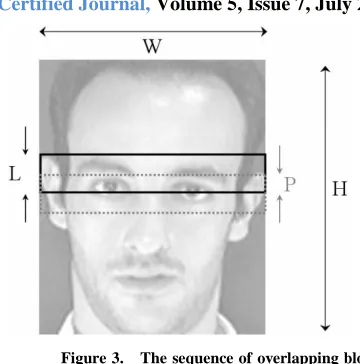
Figure 3. The sequence of overlapping blocks
A. Feature Extraction
The observation sequence is generated by dividing each face image of width W and height H into overlapping blocks of height L and width W. Then compute SVD coefficients of each block and use them as our features. The technique is shown in figure 3. A L×W window is slid from top to bottom on the image and creates a sequence of overlapping blocks. The number of blocks extracted from each face image is given by:
Where P is overlap size of two consecutive blocks. A high percent of overlap between consecutive blocks significantly increases the performance of the system consequently increases the computational complexity.
B. Training the Face Models
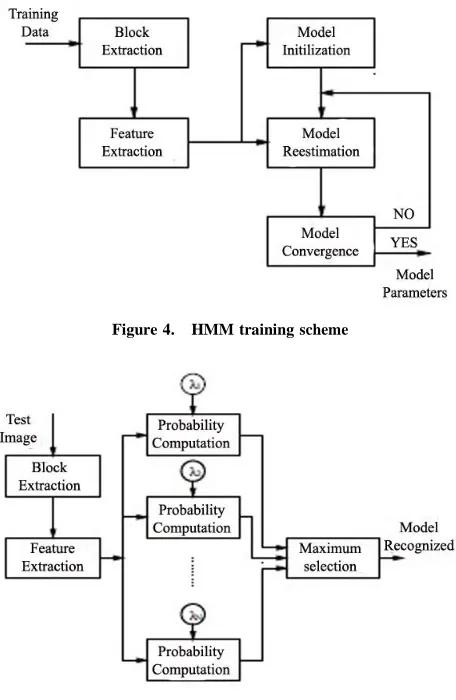
After representing e a c h face image by observation vectors, they are modeled by a seven -state HMM shown in figure 2. Five images of the same face are used to train the related HMM and the remaining five are used for testing.
[image:3.612.51.287.538.607.2]International Journal of Emerging Technology and Advanced Engineering
Website: www.ijetae.com (ISSN 2250-2459,ISO 9001:2008 Certified Journal, Volume 5, Issue 7, July 2015)
[image:4.612.53.281.141.491.2]100
Figure 4. HMM training scheme
Figure 5. HMM recognition scheme
The training scheme of one image is shown in figure 4. Here the estimated parameters of each training image are used as initial parameters of next training image. The estimated HMM of the last training image of a class (person) is considered as its final HMMC. Recognition
After learning process, each class (face) is associated to a HMM. For a K-class classification problem, we find K distinct HMM models. Each test image experiences the block extraction, feature extraction and quantization process as well. Indeed each test image like training images is represented by its own observation vector. Here for an incoming face image, we simply calculate the probability of the observation vector (current test image) given each HMM face model. A face image m is recognized as face d if:
P (O (m) |λd) = maxn P (O (m) |λn) (8)
The Recognition scheme of HMM is shown in figure 5. The system has been tested by using the database created by using images of 20 people. The database contains ten different face images per person of 20 people with the resolution of 11292 pixels. From that five images of each person for the training task; the remaining five images were used for testing the system. The images are of with different expression. We find the recognition rate is 99%.
V. APPLICATIONS
The major application of facial recognition systems is for security purposes. In addition to being used for security sys- tems, authorities have found a number of other applications for facial recognition systems. Facial recognition system is now used to search for potential criminals and terrorists.
In election, government can employ facial recognition software to prevent voter fraud. Some individuals may register to vote under several different names, in an attempt to place multiple votes. By comparing new facial images to those already in the voter database, authorities are able to reduce duplicate registrations. Similar technologies are being used in the some places to prevent people from obtaining fake identification cards and driver’s licenses.
There are also a number of potential uses for facial recognition that are currently being developed. For example, the technology could be used as a security measure at ATMs. Instead of using a bank card or personal identification number, the ATM would capture an image of the customer’s face, and compare it to the account holder’s photo in the bank database to confirm the customer’s identity.
Facial recognition systems are used to unlock software on mobile devices. An independently developed Android Marketplace app called Visidon Applock makes use of the phone’s built-in camera to take a picture of the user. Facial recognition is used to ensure only this person can use certain apps which they choose to secure.
VI. CONCLUSION
International Journal of Emerging Technology and Advanced Engineering
Website: www.ijetae.com (ISSN 2250-2459,ISO 9001:2008 Certified Journal, Volume 5, Issue 7, July 2015)
101 REFERENCES
[1] M. Turk and A. Pentland, ”Eigenfaces for recognition,” vol. 3,pp. 71–86, 1991.
[2] D. L. Swets and J. J. Weng, ”Using discriminant eigenfeatures for image retrieval”, IEEE Transaction PAMI., vol. 18, pp.831, 836, 1996.
[3] E. Osuna and R. Freund, ” Training support vector machines: an application to face detection,” Proc. of CVPR, 1997.
[4] B. Heisele and T. Serre,”A componentbased framework for face detection and identification,” 2007.
[5] Q. Tao and D. Chu,”Recursive support vector machnes for dimensionality reduction,” IEEE Trans. NN, 2008.
[6] Rongbing Huang and Changming Su a, ”Kernel Dis- criminant Locality Preserving Projections for Human Face Recognition,”Journal of Information and Computational Science 2010.
[7] Jain, A.K.; Duin, R.P.W.; Mao, J. Statistical pattern recognition: A review. IEEE Trans. Pattern Anal. Mach. Intell. 2000, 22, 4–37. [8] Rabiner L. R., A Tutorial on Hidden Markov Modeles and