R E S E A R C H A R T I C L E
Open Access
The flipped classroom: for active, effective
and increased learning
–
especially for low
achievers
Jalal Nouri
Correspondence:[email protected] Department of Computer and Systems sciences, Stockholm University, Stockholm, Sweden
Abstract
Higher education has been pressured to shift towards more flexible, effective, active, and student-centered teaching strategies that mitigate the limitations of traditional transmittal models of education. Lately, the flipped classroom model has been suggested to support this transition. However, research on the use of flipped classroom in higher education is in its infancy and little is known about student’s perceptions of learning through flipped classroom. This study examined students’perceptions of flipped classroom education in a last year university course in research methods. A questionnaire was administered measuring students’(n= 240) perceptions of flipped classroom in general, video as a learning tool, and Moodle (Learning Management System) as a supporting tool within the frame of a flipped classroom model. The results revealed that a large majority of the students had a positive attitude towards flipped classroom, the use of video and Moodle, and that a positive attitude towards flipped classroom was strongly correlated to perceptions of increased motivation, engagement, increased learning, and effective learning. Low achievers significantly reported more positively as compared to high achievers with regards to attitudes towards the use of video as a learning tool, perceived increased learning, and perceived more effective learning.
Keywords:Teaching/learning strategies, Distributed learning environments, Improving classroom teaching, Interactive learning environments, Post- secondary education
Introduction
Teaching at the university level has been performed in a relatively similar manner during a long historical time and across cultures. As a central pillar, we find the traditional lec-ture with the professor, or the “sage on the stage” as put by King (1993), transmitting knowledge to receiving students. Nevertheless, over the past 30 years, university educa-tion and tradieduca-tional lectures in particular have been strongly criticized. The main criti-cism has cast light on the following: students are passive in traditional lectures due to the lack of mechanisms that ensure intellectual engagement with the material, student’s at-tention wanes quickly, the pace of the lectures is not adapted to all learners needs and traditional lectures are not suited for teaching higher order skills such such as application and analysis (Cashin, 1985; Bonwell, 1996; Huxham, 2005; Young, Robinson, & Alberts, 2009). Consequently, various researchers and educators have advocated forms of lectur-ing based on an active learnlectur-ing philosophy, some involvlectur-ing novel technology mediated
interactions (Beekes, 2006; Rosie, 2000), others without an explicit focus on technology such as the enhanced lecture of Bonwell (1996). However, despite the comprehensive cri-tique, the traditional lecture continues to prevail as the predominant didactic strategy in higher education (Roehl, Reddy, & Shannon, 2013).
It is against such a background, and to high extent because of advancements in edu-cational technology, increasing pressures on higher education have been witnessed that have spawned a push to flexible blended student-centered learning strategies that mitigate the limitations of the transmittal model of education (Betihavas, Bridgman, Kornhaber, & Cross, 2015). Accompanied with the shift to provide student-centered learning we have seen a surge of researchers and educators advocating flipped class-room curricula in higher education. The advocacy of the flipped classclass-room model is justifiable. Judging by its underlying theory and the conducted empirical studies, the flipped classroom model appears to address several challenges with traditional ways of lecturing and pave way for active learning strategies and for using classroom time for engaging in higher levels of Bloom’s taxonomy (Krathwohl, 2002) such as applica-tion, analysis, and synthesis.
The flipped classroom model is based on the idea that traditional teaching is inverted in the sense that what is normally done in class is flipped or switched with that which is normally done by the students out of class. Thus, instead of students listening to a lecture in class and then going home to work on a set of assigned problems, they read course literature and assimilate lecture material through video at home and engage in teacher-guided problem-solving, analysis and discussions in class. Proponents of flipped classroom list numerous advantages of inverting teaching and learning in higher educa-tion according to the flipped classroom model: it allows students to learn in their own pace, it encourages students to actively engage with lecture material, it frees up actual class time for more effective, creative and active learning activities, teachers receive ex-panded opportunities to interact with and to assess students’ learning, and students take control and responsibility for their learning (Gilboy, Heinerichs, & Pazzaglia, 2015; Betihavas et al., 2015).
Findlay-Thompson and Mombourquette (2014) comparing traditional teaching methods and the flipped classroom approach within the same business course showed no significant differences in academic outcomes.
However, empirical research on the flipped classroom model in higher education, and more detailed investigations of students’perceptions of its use, is in its infancy and the need for further research is underlined by many (Bishop & Verleger, 2013; Uzunboylu & Karagozlu, 2015; Betihavas et al., 2015; Gilboy et al., 2015).
Research purpose
The purpose of this study was to examine how students perceive flipped classroom education in a university research methods course. Three particular aspects were con-sidered, namely, (a) the student’s general experiences and attitudes of learning through flipped classroom, (b) the student’s experiences of using video lectures as a medium for learning, and (c) the student’s experiences of using a Learning Management System (LMS) in the frame of the flipped classroom model. Further, this study has also consid-ered differences in experiences and attitudes of low and high achieving students.
Method
This study is based on a quantitative analysis of a closed questionnaire addressing undergraduate students’perceptions and experience of learning through flipped class-room in a course preparing students for the bachelor thesis with respect to scientific methodology and communication. The course was implemented during autumn 2015.
Participants
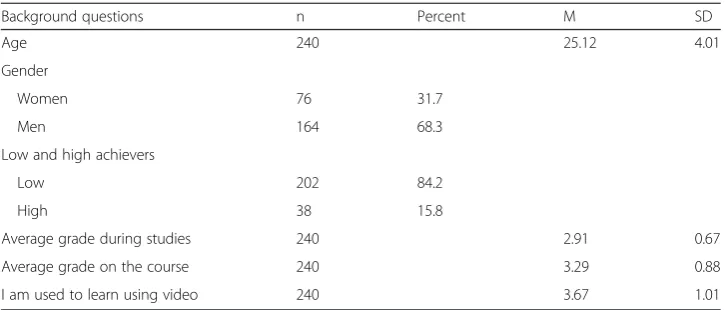
The participants were undergraduate students (n= 240) at Stockholm University in Sweden taking the last year course Research methods and communication during au-tumn semester 2015. All of the students were enrolled in 8 different bachelor level pro-grams at the department of Computer and Systems Sciences. The students, 76 females and 164 males, ranged in age from 20 to 43 years, with a mean age of 25.12 years (SD = 4.09). Out of the 240 students only 23 had a previous experience of flipped classroom. The number of students passing the course was 218. Table 1 presents an overview of
Table 1Student demographics and other background questions
Background questions n Percent M SD
Age 240 25.12 4.01
Gender
Women 76 31.7
Men 164 68.3
Low and high achievers
Low 202 84.2
High 38 15.8
Average grade during studies 240 2.91 0.67
Average grade on the course 240 3.29 0.88
I am used to learn using video 240 3.67 1.01
student demographics and background questions. Low and high achievers among the students were determined by the student’s average grade during their studies. Here high achievers were defined as having average grades A to B while low achievers were de-fined as having average grades C to F.
Materials and procedure
Course structure
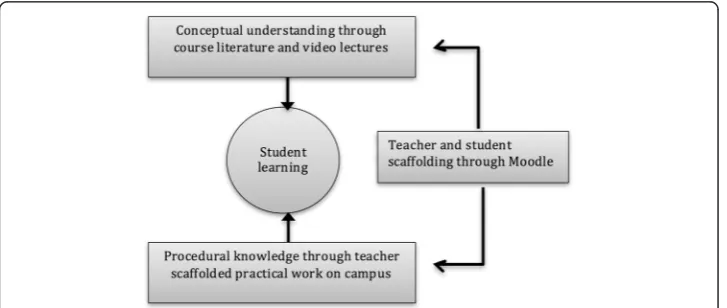
The course focused on in this study prepares students for the bachelor thesis with respect to scientific methodology and communication. The learning objectives are on the one hand to facilitate students understanding of the fundamentals of re-search strategies, data-collection methods, and analysis methods, and on the other hand to familiarize students with application of qualitative and quantitative methods of analysis. Put differently, the course aimed at equipping students with conceptual knowledge (an understanding of scientific methods), and procedural knowledge (application of analysis methods and scientific writing). See Fig. 1 for the underlying pedagogical structure.
The course was divided into three parts with three different examination tasks. The first part concerned gaining a theoretical understanding of the fundamentals of research strategies, data-collection methods, and analysis methods. The peda-gogical structure for this part comprised of independent reading of course litera-ture. Students reading of the course literature was supported by three longer video lectures (in average 60 min each), one traditional campus lecture (teacher present-ing and summarizpresent-ing the fundamentals of research strategies), and one interactive flipped classroom lecture in which the teacher presented examples of exam ques-tions that students answered in real-time by using a digital response system (Socrative) via their own smart phones, tablets and computers. The response sys-tem provided an overview of the responses that allowed students to assess their knowledge and the teacher to provide formative feedback and elaborated explana-tions when needed. In addition, digital supervision was offered through a learning management system (Moodle). The examination for this part comprised of a multiple-choice digital exam in the learning management system.
The second part was a practical qualitative analysis project that students conducted in groups of two. The task of this project was to use a qualitative analysis method to analyze qualitative interview data and communicate the results in a report following scientific standards of qualitative data presentation. During this project the students were supported by five digital lectures (in average 35 min each), three flipped lectures on campus, and digital supervision through the learning management system. In the three flipped lectures on campus students worked with their projects and were scaf-folded by several teachers that answered questions and provided feedback. When the teachers identified common misunderstandings or needs among the students, they pro-vided elaborated explanations to the whole class. The examination of the second part comprised of a written group report.
The third part of the course was similar to the second part, comprising of a project with a focus on using quantitative methods to analyze a questionnaire and communi-cate the results according to scientific standards of quantitative result presentation. During this project the students were supported by seven video lectures (in average 30 min each), three flipped lectures in class with teachers scaffolding practical work, and digital supervision in the learning management system. The videos covered the theoretical fundamentals of descriptive and inferential statistics as well as how different statistical tests can be performed and interpreted in SPSS. The examination of the third part comprised of a written group report.
All video lectures made available to the students during the course were produced by teachers and researchers in a professional video studio at Stockholm University. The video lectures were specifically tailored for the course.
Survey measures and procedure
A questionnaire was developed consisting of 4 sections with 58 items to measure stu-dents’perceptions of flipped classroom in general, video as a learning tool, and Moodle as a supporting system.
Section 1 (General information) consisted of 12 demographic and background items
Section 2 (Flipped Classroom Scale) consisted of 21 items measuring students’ experiences and attitudes of learning through flipped classroom
Section 3 (Video Scale) consisted of 16 items measuring students’experiences of using video lectures as a medium for learning.
Section 4 (LMS scale) consisted of 9 items measuring students’perceptions of the utility of Moodle in supporting their learning processes within the frame of flipped classroom pedagogy.
Results
Students’general perceptions of flipped classroom
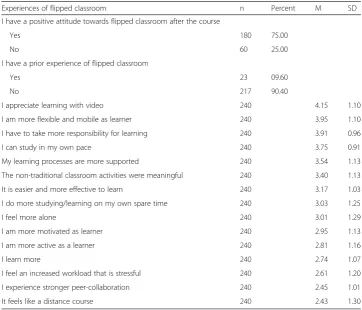
The flipped classroom model proved to be appreciated by many students. Among the 240 respondents, 180 students expressed a positive attitude to flipped class-room after the course (75 %). The students most appreciated the use of video (M = 4.15, SD = 1.10), flexibility and mobility given by the flipped classroom model (M = 3.95, SD = 1.10), that learning can be done at own pace (M = 3.75, SD = 0.91), that learning processes are better supported (M = 3.54, SD = 1.13), and that non-traditional campus activities are meaningful (M = 3.40, SD = 1.13).
In terms of other characteristics of the learning process, to some extent the students appeared to agree that it is easier and more effective to learn with the flipped classroom approach (M = 3.17, SD = 1.03) and that they feel more motivated as learners (M = 2.95, SD = 1.13). Furthermore, many students perceived that they had to take more responsi-bility for their learning (M = 3.91, SD = 0.96) in a flipped classroom course.
Noteworthy, some students also felt themselves alone during their learning (M = 3.01, SD = 1.29). Table 2 shows the students’ experiences of flipped classroom after the course was completed.
The results of an analysis of the correlations between the measured variables, with a particular focus on attitudes towards flipped classroom and its effect on learning and motivation is presented in Table 3. Students with positive attitudes towards flipped classroom more likely had positive attitudes towards video (p< 0.01), experienced
Table 2Students’experiences of flipped classroom after the course
Experiences of flipped classroom n Percent M SD
I have a positive attitude towards flipped classroom after the course
Yes 180 75.00
No 60 25.00
I have a prior experience of flipped classroom
Yes 23 09.60
No 217 90.40
I appreciate learning with video 240 4.15 1.10
I am more flexible and mobile as learner 240 3.95 1.10
I have to take more responsibility for learning 240 3.91 0.96
I can study in my own pace 240 3.75 0.91
My learning processes are more supported 240 3.54 1.13
The non-traditional classroom activities were meaningful 240 3.40 1.13
It is easier and more effective to learn 240 3.17 1.03
I do more studying/learning on my own spare time 240 3.03 1.25
I feel more alone 240 3.01 1.29
I am more motivated as learner 240 2.95 1.13
I am more active as a learner 240 2.81 1.16
I learn more 240 2.74 1.07
I feel an increased workload that is stressful 240 2.61 1.20
I experience stronger peer-collaboration 240 2.45 1.01
It feels like a distance course 240 2.43 1.30
increased motivation (p< 0.01), more effective learning (p< 0.01), and increased learn-ing (p< 0.01). They also tended to agree that flipped classroom made them more active as learners (p< 0.01) and take more responsibility for their learning (p< 0.01).
The use of video as a learning tool
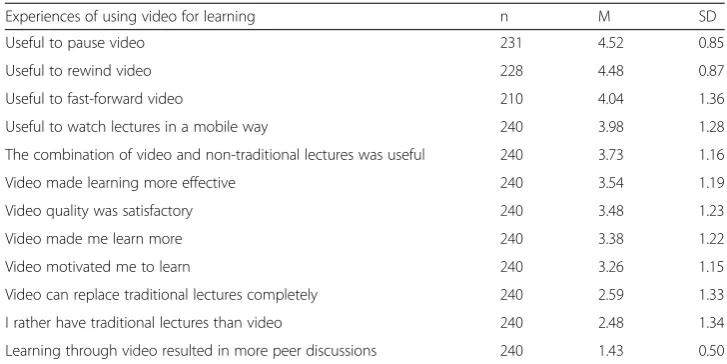
Using flipped classroom and in particular video as a tool for assimilating knowledge otherwise presented in traditional lectures proved to correlate strongly with perceived in-creased motivation, inin-creased learning and effective learning. When analyzing the stu-dent’s experiences of using video as a learning tool in more detail a number of reasons for appreciating video stand out (see Table 4 for an overview). The students strongly agreed that it was useful for their learning to be able to pause (M = 4.52, SD = 0.85), rewind (M = 4.48, SD = 0.87) and fast-forward video (M = 4.04, SD = 1.36). They also agreed that the combination of video and non-traditional lectures was useful (M = 3.73, SD = 1.16) as well as being able to watch lectures in a mobile way (MD = 3.98, SD = 1.28).
The use of Moodle within the frame of flipped classroom
A learning management system (Moodle) was used during the course to support stu-dents’learning processes within the frame of a flipped classroom model. As presented Table 3Correlations between variables
Variable 1 2 3 4 5 6 7
1. Attitude towards FC 1,00
2. Attitude towards video ,74** 1,00
3. Increased motivation ,81** ,80** 1,00
4. More effective learning ,85** ,85** ,74** 1,00
5. Increased learning ,82** ,87** ,74** ,89** 1,00
6. More active learner ,80** ,58** ,68** ,70** ,70** 1,00
7. More responsibility for learning ,67** ,47** ,49** ,52** ,49** ,44** 1,00
*psignificant at 0.05 **psignificant at 0.01
Table 4Students’experiences of using video for learning
Experiences of using video for learning n M SD
Useful to pause video 231 4.52 0.85
Useful to rewind video 228 4.48 0.87
Useful to fast-forward video 210 4.04 1.36
Useful to watch lectures in a mobile way 240 3.98 1.28
The combination of video and non-traditional lectures was useful 240 3.73 1.16
Video made learning more effective 240 3.54 1.19
Video quality was satisfactory 240 3.48 1.23
Video made me learn more 240 3.38 1.22
Video motivated me to learn 240 3.26 1.15
Video can replace traditional lectures completely 240 2.59 1.33
I rather have traditional lectures than video 240 2.48 1.34
Learning through video resulted in more peer discussions 240 1.43 0.50
in Table 5, the students appreciated this support (M = 4.22, SD = 0.86). In particular, they found it useful to be able to see other students’questions posed in Moodle and the teachers answers to those questions (M = 4.39, SD = 0.94), and for general commu-nication with teachers (M = 4.07, SD = 1.05). Interestingly, the LMS itself contributed to some student’s motivation to learn (M = 3.40, SD = 1.26).
Comparing low and high achievers
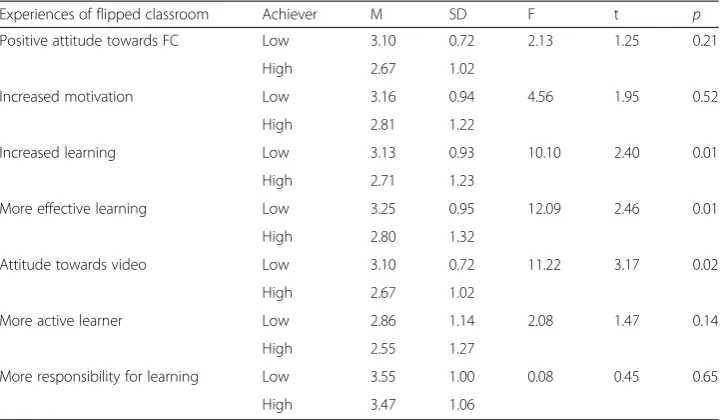
When comparing low and high achievers among the students in terms of attitudes to-wards flipped classroom, video and the effect on learning and motivation some interest-ing findinterest-ings were obtained. The results of conducted independent sample t-tests showed no significant differences in positive attitudes to flipped classroom of low achievers (M = 3.37, SD = 0.74) and high achievers (M = 3.20, SD = 0.87), t(238) = 2.13,
p> 0.05. Significant differences were however revealed with regards to attitudes towards the use of video of low achievers (M = 3.10, SD = 0.72) and high achievers (M = 2.67, SD = 1.02), t(238) = 3.17,p< 0.05.
Interestingly, the perception of increased learning also significantly differed be-tween low achievers (M = 3.13, SD = 0.93) and high achievers (M = 2.71, SD = 1.23), t(238) = 2.40, p< 0.05. The tests likewise showed significant differences in perceived more effective learning of low achievers (M = 3.25, SD = 0.95) and high achievers (M = 2.80, SD = 1.32), t(238) = 2.46, p< 0.05. However, no significant differences could be identified between low achievers and high achievers in the other variables measured (see Table 6).
Conclusions
The calls for reforming traditional higher education teaching, and for transforming the sage on the stage into the guide on the side in order to pave way for student-centered active learning strategies have probably never been as loud as now. In this context, flipped classroom has been proposed to answer these calls. Several studies have demon-strated that flipped classroom as a teaching method may promote student engagement and a more active approach to learning in higher education. The findings from this study confirm the results of these studies and highlights additional advantages associ-ated with the flipped classroom model.
The students in the study’s sample were found to generally appreciate the flipped classroom. The most commonly valued reasons for this was that the students appreci-ated learning through using video material, the opportunity to study in their own pace, flexibility and mobility brought about by accessible video lectures, and that learning is easier and more effective within the frame of the flipped classroom.
Table 5Students’experiences of using the learning management system (Moodle)
Experiences of using Moodle n M SD
It was useful to see other students questions and teacher answers in Moodle 240 4.39 0.94
Moodle supported my learning 240 4.22 0.86
It was useful to communicate with teachers through Moodle 240 4.07 1.05
Moodle motivated me to learn 240 3.40 1.26
A correlation analysis further demonstrated significant strong correlations between students’appreciation of the flipped classroom experience on the one hand, and atti-tudes towards video as a learning tool, increased motivation, increased learning, more effective learning and more active learning on the other hand.
Interestingly, independent sample t-tests showed significant differences between low and high achievers in that the low achievers tended to have more positive attitudes to-wards the use of video as a learning tool. Low achievers also to higher extent perceived increased and more effective learning through flipped classroom. A more detailed ana-lysis of the students’experiences of using video showed that the most valued aspects of video use was being able to pause and rewind the video lectures. Against this fact, it is not unreasonable to conclude that low achievers, who might find traditional lectures challenging and fast-paced (Young et al., 2009), experienced an empowerment using the flipped classroom model in terms of gaining more opportunities to reflect and learn in their own pace.
For all students in general, the results indicate that the reasons for students’ percep-tions of increased and more effective learning are associated with: 1) the affordances of video lectures (the ability to reflect and learn in own pace); 2) more meaningful practice-oriented and teacher supervised classroom activities; and 3) more supported learning processes due to teacher and peer scaffolding in class and out of class through the use of Moodle.
Thus, as final remarks, considering the ineffectiveness of traditional lectures in retaining students’attention and promoting active learning (Windschitl, 1999; Young et al., 2009) in higher education, the results of this study indicate that the flipped class-room model seem to offer promising ways to engage students in more effective, sup-portive, motivating and active learning, especially for low achievers and students that may struggle with traditional lectures. However, the results should be viewed in light of the limitations of this study. One such limitation is the non existence of a control group which limits the external validity of the results. Another limitation is connected Table 6Comparing low- and high achievers experience of flipped classroom
Experiences of flipped classroom Achiever M SD F t p
Positive attitude towards FC Low 3.10 0.72 2.13 1.25 0.21
High 2.67 1.02
Increased motivation Low 3.16 0.94 4.56 1.95 0.52
High 2.81 1.22
Increased learning Low 3.13 0.93 10.10 2.40 0.01
High 2.71 1.23
More effective learning Low 3.25 0.95 12.09 2.46 0.01
High 2.80 1.32
Attitude towards video Low 3.10 0.72 11.22 3.17 0.02
High 2.67 1.02
More active learner Low 2.86 1.14 2.08 1.47 0.14
High 2.55 1.27
More responsibility for learning Low 3.55 1.00 0.08 0.45 0.65
High 3.47 1.06
to the fact that the majority of the student’s surveyed have not experienced flipped classroom before, thus the results may partly reflect the influence of a new approach of learning and teaching and not necessary the influence of the flipped classroom ap-proach. It also should be noted that all results related to improved learning and effect-iveness of learning is based on students self-declared perceptions and not on independent measures. Future studies on the effects of flipped classroom should ad-dress these limitations and in particular explore the extent to which the actual perform-ance of students is or is not affected by the flipped classroom approach moving beyond just student perceptions.
Competing interests
The author declares that he has no competing interests.
Received: 27 February 2016 Accepted: 14 July 2016
References
Beekes, W. (2006). The“millionaire”method for encouraging participation.Active Learning in Higher Education, 7(1), 25–36.
Betihavas, V., Bridgman, H., Kornhaber, R., & Cross, M. (2015). The evidence for‘flipping out’: A systematic review of the flipped classroom in nursing education.Nurse Education Today, 6, 15–21.
Bishop, J. L., & Verleger, M. A. (2013). The flipped classroom: a survey of the research. InASEE National Conference Proceedings, Atlanta, GA.
Bonwell, C. C. (1996). Enhancing the lecture: revitalizing a traditional format.New Directions for Teaching and Learning, 1996(67), 31–44.
Butt, A. (2014). Student views on the use of a flipped classroom approach: evidence from Australia.Business Education & Accreditation, 6(1), 33–43.
Cashin, W. E. (1985).Improving lectures. Idea paper no. 14. Manhattan: Kansas State University, Center for Faculty Evaluation and Development.
Davies, R. S., Dean, D. L., & Ball, N. (2013). Flipping the classroom and instructional technology integration in a college-level information systems spreadsheet course.Educational Technology Research and Development, 61(4), 563–580. Findlay-Thompson, S., & Mombourquette, P. (2014). Evaluation of a flipped classroom in an undergraduate business
course.Business Education & Accreditation, 6(1), 63–71.
Gilboy, M. B., Heinerichs, S., & Pazzaglia, G. (2015). Enhancing student engagement using the flipped classroom.Journal of nutrition education and behavior, 47(1), 109–114.
Hung, H. (2015). Flipping the classroom for English language learners to foster active learning.Computer Assisted Language Learning, 28(1), 81–96.
Huxham, M. (2005). Learning in lectures Do‘interactive windows’help?Active learning in higher education, 6(1), 17–31. King, A. (1993). From sage on the stage to guide on the side.College teaching, 41(1), 30–35.
Krathwohl, D. R. (2002). A revision of Bloom's taxonomy: an overview.Theory into practice, 41(4), 212–218. Larson, S., & Yamamoto, J. (2013). Flipping the college spreadsheet skills classroom: initial empirical results.Journal of
Emerging Trends in Computing and Information Sciences, 4(10), 751–758.
Love, B., Hodge, A., Grandgenett, N., & Swift, A. (2014). Student learning and perceptions in a flipped linear algebra course.International Journal of Mathematical Education in Science and Technology, 45(3), 317–324.
McLaughlin, J. E., Griffin, L. M., Esserman, D. A., Davidson, C. A., Glatt, D. M., Roth, M. T.,…Mumper, R. J. (2013). Pharmacy student engagement, performance, and perception in a flipped satellite classroom.American Journal of
Pharmaceutical Education,77(9), 196.
McLaughlin, J. E., Roth, M. T., Glatt, D. M., Gharkholonarehe, N., Davidson, C. A., Griffin, L. M.,…Mumper, R. J. (2014). The flipped classroom: a course redesign to foster learning and engagement in a health professions school.Academic Medicine,89(2), 236–243.
Roach, T. (2014). Student perceptions toward flipped learning: new methods to increase interaction and active learning in economics.International Review of Economics Education, 17, 74–84.
Roehl, A., Reddy, S. L., & Shannon, G. J. (2013). The flipped classroom: an opportunity to engage millennial students through active learning strategies.Journal of Family & Consumer Sciences, 105(2), 44–49.
Rosie, A. (2000).“Deep learning”: a dialectical approach drawing on tutor-led web resources.Active Learning in Higher Education, 1(1), 45–59.
Uzunboylu, H., & Karagozlu, D. (2015). Flipped classroom: a review of recent literature.World Journal on Educational Technology, 7(2), 142–147.
Windschitl, M. (1999). Using small-group discussions in science lectures.College Teaching, 47(1), 23–7.