Available from ArXiv, BioRxiv, CogPrints, PhilSci-Archive
T
HE
S
PECIES
P
ROBLEM AND
I
TS
L
OGIC
Inescapable Ambiguity and Framework-relativity
Steven James Bartlett
e-mail: sbartlet [at] willamette [dot] edu
KEYWORDS: species problem, species concepts, definitions of species, similarity theory, logic of commonality, Theorem of the Ugly Duckling, Satosi Watanabe, Nelson Goodman, framework-relativity, Löwenheim-Skolem Theorem, Hilary Putnam, human speciation
ABSTRACT
For more than fifty years, taxonomists have proposed numerous alternative definitions of species while they searched for a unique, comprehensive, and persuasive definition. This monograph shows that these efforts have been unnecessary, and indeed have provably been a pursuit of a will o’ the wisp because they have failed to recognize the theoretical impossibility of what they seek to accomplish. A clear and rigorous understanding of the logic underlying species definition leads both to a recognition of the inescapable ambiguity that affects the definition of species, and to a framework-relative approach to species definition that is logically compelling, i.e., cannot not be accepted without inconsistency. An appendix reflects upon the conclusions reached, applying them in an intellectually whimsical taxonomic thought experiment that conjectures the possibility of an emerging new human species.
_________________________________
The author has chosen to issue this monograph as a free open access publication under the terms of the Creative Commons Attribution-NonCommercial-NoDerivs license, which allows anyone to distribute this work without changes to its content, provided that both the author and the original URL from which this work was obtained are mentioned, that the contents of this work are not used for commercial purposes or profit, and that this work will not be used without the author’s or his executor’s permission in derivative works (i.e., you may not alter, transform, or build upon this work without such permission). The full legal statement of this license may be found at
http://creativecommons.org/licenses/by-nc-nd/4.0/legalcode
T
HE
S
PECIES
P
ROBLEM AND
I
TS
L
OGIC
Inescapable Ambiguity and Framework-relativity
CONTENTS
Introduction
1. The Species Problem
2. What Definition Can and Cannot Accomplish 3. Classification and Pattern Recognition 4. The Logic of Commonality
4.1 Similarity and Commonality
4.2 Similarity Theory and the Species Problem – Historical Landmarks 4.3 Watanabe’s Theorem of the Ugly Duckling: A Neglected Variety of
Formal Limitation
4.4 The Löwenheim-Skolem Theorem
4.5 Taxonomic Consequences of the Logic of Commonality and of the Löwenheim-Skolem Theorem
5. The Illogic of Ontological Bias 6. The Solution of the Species Problem
7. Appendix: A Framework-relative Recognition of a New Human Species
7.1 Human Heterogeneity
7.2 The Possibility of a New Human Species among Us 7.3 A Few Questions and Objections
7.4 Concluding Unscientific Postscript
Works Cited
T
HE
S
PECIES
P
ROBLEM AND
I
TS
L
OGIC
Inescapable Ambiguity and Framework-relativity
Steven James Bartlett
The species concept is one of the oldest and most fundamental in biology. And yet it is almost universally conceded that no satisfactory definition of what constitutes a species has ever been proposed.
— Dobzhansky (1935, p. 344)
Have enough words been said and written on the subject of what species are? How many evolutionary biologists sometimes wish that not one more word, in speech or text, be spent on explaining species? How many biologists feel that they have a pretty good understanding of what species are? Among those who do, how many could convince a large, diverse group of scientists that they are correct?
At this last and most essential task, many great scientists have tried and failed. Darwin, Mayr, Simpson and others have taught us about species, but none has been broadly convincing on the basic questions of what the word ‘species’ means or how we should identify species. For its entire brief history, the field of evolutionary biology has simply lacked a consensus on these two related questions.
— Jody Hey (2001), p. 326.
INTRODUCTION
n biology the concept of species has had a long and tattered history. It is an ancient and a fundamental concept that author after author has attempted to define in different ways, and yet never one of them with sufficient justification to persuade the scientific world of its unique and universal applicability.
We are inheritors of a tradition that goes back more than two thousand years when Aristotle (384–322 BCE) laid the basis for taxonomy by classifying organisms by kind and by giving each kind two names: a name for the genus to which it belongs and a secondary name for the property that distinguishes that kind. Although taxonomists continue to formulate such binomial definitions of species, no one has yet been able to formulate a satisfactory, unanimously accepted definition that expresses what the concept of species means or should mean.
There are, as we shall see, very good reasons that explain why this should be the case. We shall see why, on the one hand, from the standpoint of the logic underlying species definition, it cannot be otherwise. On the other hand, recognizing the constraints of logic for what they are, we’ll find that it is possible to define species successfully in a way that is conceptually iron-clad, that is, cannot not
be accepted without inconsistency.
The species problem has important, wider dimensions than are often perceived. The problem relates not only to the definition of species, but to fundamental problems in human and machine pattern recognition, and to some of the most abstract studies of the nature of theory. The species problem is in modern guise at one and the same time the medieval problem of universals and the problem of natural kinds, while its answer hinges on a resolution of the age-old conflict between realists and subjectivists. The species problem is not often understood from a sufficiently wide perspective that appreciates its place as an important problem with wide-ranging consequences.
In writing this monograph I recognize that it presents a critical challenge to a tradition spanning two millennia; it cannot help but scandalize and perhaps affront some readers. A short description of the basis for the discussion that follows may therefore be appropriate, providing reference to some of the author’s publications that give further explanation and justification.
I hold the view that scientists and ordinary people alike make statements and adhere to ideas which, when analyzed from a strictly developed, theoretically self-critical, epistemological standpoint, can be shown to exceed their own capacities both to refer and to know what they are talking about. When people do this, as they commonly do, both in everyday life as well as in scientific theorizing, they trespass
beyond the boundaries of possible sense. They think and make statements about alleged referents that cannot possibly be referred to—as they believe they are doing—by them or by anyone else. They are, in an epistemological sense, caught up in forms of projective thinking and in ways of expressing themselves that are fundamentally illusory and inconsistent with their own presuppositions.
The present discussion of the logic of species definition builds upon my previously published work which shows that both of the widely employed concepts of objectivity and subjectivity are inherently projective, and I therefore point to ways in which we can do without either. Similarly, I recognize that both notions of the
discovery and invention of species cannot, in principle, be justified, because, once again, both force their users to trespass beyond the limits of possible reference. It will follow from this approach that species are neither discovered nor invented; what their status therefore is will become clear.
Last, I recognize that all claims to knowledge have meaning and potential truth, falsity, provability or impossibility of proof, only relative to appropriate frames of reference in terms of which those claims can be thought, expressed, confirmed, or disconfirmed. The theoretical position resulting from this perspective I have called framework-relative epistemology. Its central purpose is to increase awareness of the frames of reference that we rely upon when we think and express claims, and to insure our compliance with the inherent limitations of the systems of reference of which we make use. Often, these frameworks are employed implicitly and remain in the background until we make a reflective effort to render them explicit.1
1 The justification for the claims in this and the preceding two paragraphs is found in
1. The Species Problem
No one definition has satisfied all naturalists; yet every naturalist knows vaguely what he means when he speaks of a species.
– Darwin, On the Origin of Species (1859, Chap. 2)
[I]t is a hopeless endeavour to decide this point on sound grounds, until some definition of the term ‘species’ is generally accepted, and the definition must not include an element that cannot possibly be ascertained....
– Darwin, The Descent of Man (1871, Chap. VII)
y the time of Carl Linnaeus (1707-1778), a wide variety of alternative systems for classifying plants was in use; the same plant was often given different names and placed in differing systems of classification. In his 1735 Systema Naturae, Linnaeus presented an integrated classification system that could, he believed, organize all organisms, whether animals or plants, from the level of kingdoms down to species. It was an attractive, well-developed system of categories, but despite its later influence, taxonomy has labored unsuccessfully to find an effective and unitary classification system that could integrate, in a way satisfying to all biologists, the findings of the developing science.
Before Darwin, debates were already in progress over the question whether common traits or shared reproduction should be used as defining criteria to distinguish separate species (Grant 1994). Darwin was aware of the problem, as the quotations at the beginning of this section show, but he may not have advanced appreciably beyond a state of ambivalence in conceiving how the term ‘species’ should be defined. In 1856, for example, he wrote to botanist Joseph Hooker:
It is really laughable to see what different ideas are prominent in various naturalists’ minds, when they speak of ‘species’; in some, resemblance is everything and descent of little weight—in some, resemblance seems to go for nothing, and Creation the reigning idea—in some, sterility an unfailing test, with others it is not worth a farthing. It all comes, I believe, from trying to define the indefinable. (F. Darwin 1887, Vol. 2, p. 88, italics added)
Then, three years later, in On theOrigin of Species, he wrote, “I look at the term species as one arbitrarily given for the sake of convenience to a set of individuals closely resembling each other, and that it does not essentially differ from the term variety” (Darwin 1964/1859, 52, italics added; note that the context here is the possible distinction between ‘variety’ and ‘species’).
And then, some three hundred pages later in the same book, he wrote: “[f]rom the first dawn of life, all organic beings are found to resemble each other in descending degrees, so that they can be classed in groups under groups. This classification is evidently not arbitrary like the grouping of the stars in constellations” (Darwin 1964/1859, 411, italics added; here the context is whether taxonomic classes are real or imagined).
A modern reader may shake his or her head over what on the surface appears to be outright ambivalence or perhaps flip-flopping on Darwin’s part: First there is his claim that the term ‘species’ is “indefinable,” then his assertion that its definition is arbitrary and chosen as a matter of convenience, followed by an expression of belief that classifications are not arbitrary at all but correspond to real groupings. The contexts in which these different claims were made are certainly different, but in the end no definition of ‘species’ emerges. This is not the place to engage in Darwinian textual analysis; instead, such quotations may be taken as evident signs of the historical deep-rootedness of the species problem.2 If these
quoted passages from Darwin’s writings point to an ambiguity in his mind, it was later literally to prove to be, as this monograph seeks to demonstrate, a telltale, significant, and, in fact, an inescapable kind of ambiguity.
The species problem has arisen to frustrate generations of taxonomists due to the multitude of often incompatible ways that have been proposed to classify organisms. The problem is that there so far appears to be no unique and adequately general way to define the meaning of ‘species’; the multiplicity of distinct ways of classifying organisms reflects a corresponding multitude of distinct ways of identifying and recognizing properties that can be specified so as to group organisms in separable classes.
Perhaps the earliest researcher to recognize the close connection between species definitions and criteria of identification was Ernst Mayr (1942, 1982, 2000). As the species problem gained momentum, biologists have recommended a variety of alternative defining properties and criteria of identification based on them—for example, Mayr’s influential biological species concept (“groups of actually or potentially interbreeding natural populations which are reproductively isolated from other such groups” (Mayr 1942, p. 120)), or the phylogenetic species concept (a species is identified as the smallest set of organisms that shares a common ancestor and can be distinguished from other such sets), and then there is the straightforward criterion of identification, that of shared reproduction. Other biologists have favored an organism’s genetic blueprint and place in an evolutionary map of descent; still others have argued for the inclusion of an organism’s behavioral traits; and this listing could be expanded to include a veritable multiplicity of alternative preferred defining properties of species that have been urged by their adherents. During only the past three decades, more than twenty different definitions of ‘species’ have been advocated by biologists (Mayden, 1997; Hey, 2006), while among philosophers of science discussions and debates concerning the problem continue unabated without any clear-cut resolution.
The species problem is not new, but clearly the proliferation of competing species definitions and the amount of contention and head-scratching this has led to have made the species problem particularly prominent in recent years, and in need of an actual solution that is at once definitive, provable, and conclusive.
2For detailed discussions of Darwin’s views on the definition of ‘species’, see, e.g., Mayr
2. What Definition Can and Cannot Accomplish
Controversies from the careless employment of terms ought to be impossible, and they can be prevented mainly through the agency of Definition. Well-defined words, clearly understood and intelligently expressed meanings, are a sort of panacea for the thinker; and, in proportion as we approach the ideal here or recede from it, we may expect accuracy and progress in thought or deterioration and confusion.
– Davidson (1885, p. 2)
[N]o problems of knowledge are less settled than those of definition, and no subject is more in need of a fresh approach.
– Abelson (1967, p. 314)
uring taxonomy’s long history, the definition of species has had several purposes: Foremost among these is effective communication among biologists, so that, as a group, they may achieve a measure of consensus and consequent efficiency in organizing and communicating about the wide range of organisms. In serving this goal, however, a long tradition has it that species definitions are not believed to be mere conceptual constructions that have no anchor in reality, but instead are intended and are believed to refer to real, shared commonalities among distinguishable classes of organisms—commonalities that, as a result of their mind-independent reality, are discovered. Another long tradition has disagreed, claiming that, on the contrary, species definitions are constructs or artifices that human beings create; the commonalities they identify do not exist in reality, but only in people’s minds; species are therefore invented. Independently of their opposing beliefs, both parties accept that species definitions are to be formulated in an authoritative context with the expectation that definitions judged to offer a true and comprehensive account of the evidence will persuade others to accept them. A proposed definition of species is intended to account for the facts, establish authority, and to persuade its acceptance.
There are different kinds of definitions, of which a few should be clearly distinguished here.3 There are stipulative definitions that, through allegedly
authoritative assertion, specify how important terms are to be understood. In addition, there are real definitions that embody empirical content; they are intended to refer beyond the mere wording of a definition to real referents that make the definition true or false. For example, a definition of DNA commonly includes specific information or explanatory content: “DNA is composed of the following nucleic acids ... that serve as the molecular basis of heredity, are localized in cell nuclei, are constructed in the form of a double helix, (etc.)....”). A third variety of definition relevant to the task of defining species makes up the class of coordinative definitions, which assert relationships between the terms of a theory and the phenomena the theory is about.
3 For a more comprehensive and detailed inventory and discussion of general types of
definition, without application to the species problem, see Bartlett (2011, Chapter 2) and the earlier work, Robinson (1962/1950).
These three varieties of definition are routinely employed by theorists who propound opposing views concerning the ontological status of what they define— specifically whether what is defined exists in a dependent or mind-independent way. These views, for which, as we shall see, justification cannot in principle be provided, I will call ontological “biases” since they rate no higher estimation.
During the past millennia, a deep divide has come to separate two contesting camps, each of which consists of more specialized sub-groups, whose individual agendas will not concern us here: They include realism, objectivism, and Platonism in mathematics, which stand together on one side of the ontological abyss, and together assert autonomous existence that is independent of human minds, while idealism, subjectivism, conceptualism, and intuitionism in mathematics stand on the other side, together asserting mind-dependence. Within a wide range of disciplines, these different –isms express opposing views that have come to separate theorists with respect to their ontological preferences.
The ontological conflict between these opposing groups is not merely an invention of the philosophers. It permeates human consciousness, whether in religion, psychology, mathematics, philosophy, or theoretical physics—wherever there can be disagreement whether the contents of awareness or theory or dogma exist independently apart from that awareness, theory, or dogma—as realists, objectivists, and Platonists claim—or whether those contents fail to possess an autonomous existence of their own—as idealists, conceptualists, subjectivists, and intuitionists believe. In what follows, for simplicity I will refer to the two opposing camps merely as “realists” and “subjectivists.”
Species definitions as they are proposed by realists combine all three of the above roles of definition: They are at once stipulative; they are intended to have referents believed to possess a mind-independent existence about which such definitions make true statements; and they serve as coordinative definitions that establish relationships between the systematic nomenclature of a taxonomy and specified classes of organisms. Species definitions viewed as human constructs also are stipulative and serve as coordinative definitions, but deny they have a basis in mind-independent reality and therefore assert they are only human constructions.
As we’ve noted, the core of the species problem for any taxonomist who proposes a species definition lies in his or her wish to provide a conception of species that serves as a unique, univocal, comprehensive, and persuasive definition. However, in addition, and consistently overlooked in the literature, the species problem is more deeply problematic because of inconsistent thinking that is internal both to the realist claim and to the subjectivist claim. As we shall see, those taxonomists who assert that their definitions have real, mind-independent reference make one kind of conceptual mistake, while taxonomists who claim that species definitions are mere human constructs make another. Compounding these errors, we’ll also find that the very wish that both camps express—to formulate one univocal and comprehensive species definition—is, for logical reasons alone, impossible.
subjective,” and hence are “invented.”
The definition of ‘centaur’ is not a real definition, neither are the definitions of ‘line’ and ‘point’ in Euclidean geometry. Real definitions make assertions, believed to be true, of objects asserted to have mind-independent reality. It is here that real definitions, and hence definitions of species that are presented as real definitions, get into trouble.
Human psychology of course plays a role. Mathematician and philosopher Alfred North Whitehead (1925) described “the fallacy of misplaced concreteness,” the mistaken reifying belief that what is a fiction or an abstract construct exists physically. The mistake is psychologically easy for many people to make, and this is most especially a self-destructive deterrent to progress when it happens in science, as we recall from Ptolemy’s epicycles, phlogiston, the luminiferous aether, bodily humors, the vital force, Darwin’s gemmules, and extending perhaps to today’s inferential-hypothesized realities that include dark matter in cosmology and branes in string theory.
Reification is not just a technical misstep of faulty logic, but it is basic to the human psychological constitution. The readiness to believe that, once defined, the thing defined should exist in its own right, is a predisposition of human psychology. I have studied this propensity elsewhere (Bartlett 1971; 1975a; 1976; 1982; 1983; 2005, Part III; 2011, Chapters 2, 9); relevant here is the psychological fact that, once we formulate definitions that we mistake to be real definitions, we build on these, using them to make further statements that we then take to be true of their purported referents. By then, the ties that should bind us to our original framework of reference have been sufficiently loosened, and the ties that should anchor our thoughts and their expression tend to be forgotten, so that we no longer are aware of what it is we are actually referring to and talking about, all the while believing that what we have in view possesses an independent reality of its own.
I have called this psychological propensity to believe in alleged realities that are, so to speak, “thrown beyond the boundaries of our systems of reference,”
epistemological projection. In the context of the logic of species definition, we fall victims to our own propensity to engage in epistemological projection when we are persuaded to believe that stipulated, coordinative definitions are actually real definitions that refer to independent empirical realities.
When realist species definitions are propounded, a psychological and illogical shift often takes place: Having stipulated a certain species definition, that definition is transformed into a judgment that there exist, in the organisms being classified, shared real commonalities of properties that at once define the class to which they belong, and distinguish that class from others. We shall see how this shift that
defines species into existence is not only a fundamental mistake of epistemology, but runs headlong into an inescapable limitation of judgments of commonality.
3. Classification and Pattern Recognition
classificatrices et dans les sciences physiques mais aussi dans la vie quotidienne aussi bien que dans les problèmes technologiques et médicaux.
— Watanabe (1965, p. 39) — All human intellectual activities begin with the mental formation of classes of objects. This is true not only in the classificatory and in the physical sciences, but also in daily life as well as in [the study of] technological and medical problems.4
s Japanese physicist Satosi Watanabe (1910–1993) has observed, classification is conceptually fundamental in science as well as everyday life. Without classification we would be unable to make abstract, organized sense of the world; we would be limited to the undifferentiated experience of reflective, non-intellectual present sensation, memory of past impressions, and unstructured apprehensions of the future. We could call on no integrating concepts and hence could formulate and communicate no general principles by means of which to establish an order and structure based on experience: Generalization, deduction, and induction would all cease to be possible.
The mental ability to identify classes of objects is indeed basic, and, as logicians would say, it is a logically primitive (i.e., fundamental) capacity without which intelligent, meaningful, and useful comprehension becomes impossible.
Classification ultimately rests on the pattern recognition of commonalities, the ability to identify shared properties, or features, or structures. To understand the nature and limits of classification, we need to understand the logic that governs the recognition of commonalities, to which we shall turn in the next section.
The study of pattern recognition, and in particular the modern study of what I will here call the logic of commonality, together have emerged from a long tradition that has focused on the nature and ontological status of so-called universals—of general ideas, names of properties, universal truths, etc. Plato and Aristotle took positions on this question, as did their intellectual descendents a thousand years later, including William of Champeaux, Abelard, Scotus, Aquinas, and Occam, and, yet another thousand years later, as is to be expected of perennial philosophy, the question persists today in the still-unsettled controversies among realists and subjectivists (as well as the more ontologically neutral group of nominalists, who believe that universals or properties are simply words, with no real or mental referents).
More evident progress in the study of pattern recognition has been made in computer science and in psychology and cognitive neuroscience.5 In computer
science, studies of machine pattern recognition have led to substantive and useful results. Computerized pattern recognition has now become woven into our daily lives—examples include speech recognition; optical character recognition; machine
4This and subsequent translations from the French are the author’s.
5 Relating to machine pattern recognition, see, e.g., Watanabe (1985), Theodoridis &
Koutroumbas (2009/2006), Rokach (2010), Kuncheva (2014); in connection with the psychology of pattern recognition, see, e.g., Watanabe (1985), Margolis (1996), Eysenck (2001).
recognition of handwriting; face detection by cameras; and fingerprint, license plate, and facial recognition by police computers.
Some of these advances, now highly technical and mathematicized, have profited from research findings in psychology and cognitive neuroscience where human pattern recognition has come to be understood as a matching process that compares present perceptions with remembered information. This human-centered work has led to several leading theories of pattern recognition, among them template and prototype matching: According to the first theory, sensory data are compared with pattern models, or templates, that are stored in memory (for example, the alleged mental “template” that enables one to identify the following as the same number: 5, 5,
5
, 5). In the second theory, the properties of a given subject of reference are thought to be “averaged” in a concept that serves as a prototype for future identifications (for example, the concept of a cold-blooded marine vertebrate with fins can serve as a prototype of a shark, swordfish, grouper, barracuda, tuna, etc.)Despite such advances, research both in psychology/neuroscience and in computer science has often fallen victim to the projective variety of conceptual error referred to earlier, while philosophical thought is no exception. In all three of these areas we see evidence of the human urge to project, to transgress beyond the limits of possible reference. In philosophy, the subjectivists, nominalists, and realists mentioned above have argued for millennia whether universals exist only in the mind, only in language, or in combination, or whether they exist independently of minds and language. In philosophy of science, a long history of debate similarly continues to be fought in efforts to establish whether natural kinds—the grouping of natural objects—once again reflect the discovered structure of an independently existing natural world, or only psychologically-based human constructs that are invented. Later, we’ll explore why such epistemological projections are fundamentally self-undermining and without meaning, and will look at an instructive case of projective thinking in one attempted approach through computer science to understand pattern recognition.
Psychologists have attempted to distinguish real from imagined patterns. As one would expect, real patterns are thought to be patterns that putatively exist “in reality,” whereas imagined patterns are patterns that “don’t actually exist.” In this view, when you see that 5, 5,
5
, 5 have certain properties in common, you have recognized a pattern that is said to be real. However, when you look at the full moon and recognize the image of a man’s face, you don’t see what is real—so it is claimed; the pattern that you see, according to this view, is only imagined. Psychologists have named the human propensity to imagine patterns apophenia,6 andhave gone further to name the (alleged) misperception of random data pareidolia.
6 The term (Apophänie in German) was coined by Klaus Conrad in his 1958 study, Die
Apophenia and pareidolia are supposed to be, in other words, fundamentally different from the perception of “real” patterns. To mark this contrast, we may say that, according to this conventional account, the two types of patterns reflect different ontological biases. Since the majority of people recognize that 5, 5,
5
, 5 are symbols for the same number, an ontological bias in favor of realism is established by general consensus; whereas if you see a face in a cloud shape, and most other people don’t, there is little bias in favor of realism. Recognizing the Man in the Moon, however, is something that a great many people see, and here the boundaries between real patterns, apophenia, and pareidolia become indistinct and arbitrary.To make headway in connection with the species problem, a clear and precise understanding of the recognition and identification of patterns will require something more than sloppy thinking of this kind. In particular, we shall need a better grasp and formulation of the logic of commonality.
4. The Logic of Commonality
Modern logic ... has the effect of enlarging our abstract imagination, and providing an infinite number of possible hypotheses to be applied in the analysis of any complex fact.... It has, in my opinion, introduced the same kind of advance ... as Galileo introduced into physics, making it possible at last to see what kinds of problems may be capable of solution, and what kinds must be abandoned as beyond human powers. And where a solution appears possible, the new logic provides a method which enables us to obtain results that do not merely embody personal idiosyncrasies, but must command the assent of all who are competent to form an opinion.
— Russell (1972/1922, pp. 68-69)
espite widespread progress in science, a shade of suspicion is often felt by researchers as well as by the general public when highly abstract mathematical results are applied to their specialties and to everyday reality. In connection with our subject-matter here, this has been particularly true of those biologists who continue to advance and debate competing definitions of species. What we have learned from purely abstract and formal studies provides a technical framework that dissolves such disagreements, and points to a satisfactory and, as we shall see, a theoretically compelling answer to the species problem. In publications relating to the species problem, the mathematical results that are summarized in this monograph have been ignored; they are long overdue a careful hearing and emphasis.
A personal anecdote from the author’s experience may illustrate the reluctance of many researchers to embrace the applicability of purely formal results to their more concrete areas of interest. In the early 1970s, I served as a consultant to the Rand-National Science Foundation Project in Regional Analysis and Management
“that don’t exist,” or to the recognition by fervently religious people of the face of a saint in the graining of a piece of wood or in the shape of a Cheeto®.
of Environmental Systems (Bartlett, 1975b).7 The main goal of the project was to
develop machine algorithms capable of detecting previously unspecified environmental commonalities from among unstructured data. The intention, in other words, was to develop a variety of computer-based pattern recognition that could be applied to environmental management, with the specific objective of developing computer algorithms capable of sorting unstructured data so that commonalities among the data would be disclosed and made explicit to the human operators.
This goal of course antedated the substantial developments that were to come later in the field of pattern recognition, and so the project was characterized by a certain amount of understandable innocence. The conceptual naïveté that concerned me as a consultant was the prevailing unquestioned belief among the project’s participants that it should be possible to detect commonalities from among disorganized data without first specifying the criteria by virtue of which those commonalities could be identified. Clearly, if such commonalities were to be specified in advance, a computer algorithm might be developed to detect them— but it was the basic purpose of the project to design machine pattern recognition that could detect patterns of commonality not specified ahead of time. It was the belief of most of its participants that this could be done.
The reader should quickly see the connection between this belief and the similar belief among many biologists who have sought to formulate species definitions that identify taxonomic commonalities among groups of organisms. Much of the controversy in connection with the species problem is an expression of the fundamental and persistent belief that organisms do fall into classes by virtue of their “naturally occurring” commonalities—that is, commonalities that “are just there, that mark real distinctions that must be recognized in any valid, scientifically compelling system of classification.”
At the time of the Rand-NSF project, I was familiar with some of the then-recent work of theoretical physicist Satosi Watanabe, which I described to the Rand-NSF group members. If Watanabe’s unexpected and far-reaching proof were to be accepted by the project participants, then they would need to accept that it would be impossible to achieve the basic goal of the environmental management project. With characteristic American optimism, the bold rejoinder of one project participant was, “Well, we’ll do it anyway!”
Unfortunately, it doesn’t pay to ignore impossibility proofs: There is no point investing large sums of money and human effort in building a structure whose design exceeds the stress limits not only of any known material, but of any possible organization of physical matter. The logic of commonality provides this kind of impossibility proof.
4.1
Similarity and Commonality
he most theoretically fundamental studies related to our subject have focused attention on what has become known as similarity theory. Similarity theory attempts to understand and formulate principles that underlie and govern the
7Headquartered at Colorado State University, under Grant GI-33370A#1.
possible detection of similarities, whether by human beings or by artificial intelligence. This previous work has concentrated attention on the concept of similarity rather than that of commonality.
There are, however, good reasons to consider commonality to be the more fundamental concept. Like other similarity theorists, Watanabe gave the concept of similarity center stage, and yet, even so, he recognized: “To persuade that two objects are similar, it is natural to enumerate the properties that are commonly owned
by the objects. The more properties are shared, the more similar they are” (Watanabe 1985, p. 75, italics added). —In other words, we make recourse to detection of commonalities, the sharing of properties, in order to judge that objects are similar.
To explain this further, similarities between objects are identified as a function of their shared possession of a property—i.e., its commonality—which they may have to a variable degree. The property they may have in common is, in turn, itself identified as a function of certain, often fuzzily defined, limits. For example, in order to judge whether two objects are similar in having a particular hue of blue, one must have in mind some approximate standard of that color; it may be a vaguely defined standard, but even though fuzzy it can nonetheless be usable. We may not know, or agree precisely, where the boundaries of that hue of blue begin and end, but we usually are not for that reason prevented from accomplishing practical objectives.
Commonality differs from similarity in the following sense: When we recognize that two objects share the same property, we thereby detect a commonality between the two objects. This recognition may not require a human being to have a particular standard in mind, as is the case with similarity judgments, which require one to specify with respect to what standard recognition of similarity is made. Rather, the mere awareness that there is a commonly shared property, whatever it may be, can be enough; there may be no need to apply a separately held criterion.
In short, recognition of similarities requires that we make recourse to some standard, separate from the objects being compared and held independently in mind, relative to which property matching and thereby judgments of similarity can be made. Recognition of commonalities in some instances can be less dependent upon comparison relative to a separately conceived standard, as when people intuitively recognize certain commonalities between two objects without having been instructed what to look for. Such an intuitive form of recognition of commonalities seems, as we’ll see, to be an inherent, even innate (but likely not exclusively human) natural ability.
people can be baby-faced in a wide variety of overlapping ways; there is no one specific, unique property they must share. Recognizing when two people have brown eyes in common is a much simpler task. Commonality detection tends to lend itself much more to precise specification than does the detection of similarities.
For such reasons, among others there is no relevant need or space to discuss here, commonality rather than similarity will in the following discussion be regarded as the more fundamental concept.
Whether one prefers to use the term ‘similarity’ or ‘commonality’, we should note that both forms of identification are based upon the prior ability to identify specific properties. Being able to explain what it is that makes a certain judgment of commonality true rests on the more fundamental ability to identify when two or more objects each has the property in question.
We therefore have a simple hierarchical ranking of pattern recognition concepts and corresponding abilities, with the ability to detect a specific property on a lower, more fundamental level; on the next higher level of complexity, the ability to recognize when a given property is shared in common by two or more objects; and, on a still higher level, the ability to recognize similarities with respect to specified properties.
The ability to identify, recognize, name or otherwise refer to properties will here be left undefined as a logically primitive, unexplained concept. Although this is an important assumption to make, its legitimate status as an assumption is borne out by recent studies. To date, research in both the psychology of pattern recognition and the theory of machine pattern recognition point to the same tentative conclusion, that human subjects are “innately” predisposed in their perceptual experience to pick out properties that are, in a multitude of possible ways, important to them. In other words, they are selective with respect to those properties that attract their attention, what they then pay attention to, what they remember, and what they tend to anticipate. Even newborn infants display this attentional selectivity. When it is claimed that this ability is “innate,” this is another way of saying that we don’t ultimately understand why human beings are like this or how they manage to do this; for now, we simply accept that this is the way they are: The ability to detect properties is here then left unexplained as inborn, inherent, or instinctive.
Our present understanding of human pattern recognition therefore accepts that this ability to home in on an object’s properties, properties that are perceived to be important in some way, is both psychologically and theoretically fundamental. Derivatively, the conceptual framework of pattern recognition by means of artificial intelligence, which seeks to simulate human abilities, also accepts that attentional selectivity plays an elemental role in the recognition of patterns. But machine pattern recognition is different from the human in that it is necessary to specify in advance what the machine is to look for.
Even though we choose for present purposes to leave the ability to detect properties unexplained, it is important that we do not unknowingly import and leave unexamined another related and conceptually fundamental concept. That concept, which rides along parasitically, so to speak, on the back of property detection, is valuation. As soon as attention, human or machine, is selectively directed to some particular property, this implies some degree of recognition, implicit or explicit, of the relative importance, and hence value, of that property; for that property has to possess some degree of relative importance in order to be recognized as an object of attention discriminated from among an indefinite plurality of others that are possible. This “value-dimension” of property identification will become central to our later discussion.
4.2
Similarity Theory and the Species Problem – Historical
Landmarks
here have been few significant landmarks in the development of similarity theory as it relates specifically to the species problem. This is largely due to the fact that discussions of the species problem by biologists have seldom taken into account studies of similarity theory, which have evolved on an abstract, formal, and often heavily mathematical plane. It is understandable that connections between the two independently evolving areas would not often be recognized.
An early paper more than half a century ago by H. Gulliksen (1947) recommended the usefulness of studying paired comparisons in connection with what he termed “the logic of measurement.” Gulliksen’s interest was directed toward the ways in which human subjects in psychological experiments made paired comparisons between adjacent members of an ordered series of test objects (for example, test subjects might be asked to make comparisons among different pairs of lights, each of which has a different intensity of brightness). Gulliksen did not relate paired comparisons to comparative judgments of similarity, but his work helped point to the efficiency of reducing comparative judgments to comparisons of objects taken a pair at a time. We shall see how this pair-wise strategy becomes important in the development of similarity theory.
It was not until the early 1960s that Satosi Watanabe, and then later Nelson Goodman, published research that made similarity theory directly relevant to the biological species problem. (Although neither Watanabe nor Goodman discussed the species problem per se, Watanabe was aware (as likely also was Goodman) that similarity theory applied in important ways to taxonomy).
Watanabe was a theoretical physicist with broad research interests that wove together information theory, mathematical logic, set theory, Boolean algebra, and lattice theory. As a young man he worked under the direction of Heisenberg, developing a counter-conventional and still not widely known study that sought to demonstrate that quantum probability is time-asymmetric, that is, that the probability laws describing quantum events are not reversible in time.8 In 1962,
Watanabe participated in an international conference on information theory and
8For a relatively recent affirmation of Watanabe’s results, see Holster (2003).
prediction in science held in Brussels, and there presented work with a direct bearing on the species problem, work seldom known by biologists and therefore not often recognized for its fundamental importance to taxonomy. This work will be summarized in the next section.
Nelson Goodman (1906–1998) was an American philosopher one of whose main interests was the logical study of parts and the wholes they form, which in mathematical logic has come to be known as mereology. In 1972, Goodman published a paper directly relevant to the species problem, and which, unlike Watanabe’s more technical earlier contribution to the theory of taxonomy, is occasionally cited by biologists. In his 1972 paper, Goodman did not seem to be aware of Watanabe’s work even though Goodman was writing a decade later. Goodman’s paper, whose informally reached conclusions supported Watanabe’s results, ought properly then to be considered subordinate to Watanabe’s. Goodman’s thoughts will also be summarized in the next section.
4.3
Watanabe’s Theorem of the Ugly Duckling: A Neglected
Variety of Formal Limitation
This paper contains a proof of a theorem which I should like to dub “Theorem of the Ugly Duckling,” for it claims that an ugly duckling and a swan are just as “similar” to each other as are two swans. This would make H. Chr. Andersen’s story pointless and all scientific efforts groundless. The aim of the paper is to save our beloved Andersen and science, showing that the actual process of classification of objects is based on an extra-logical factor beyond the grasp of such purely formal consideration.
– Watanabe (1965, p. 39)
he above abstract in English accompanied Satosi Watanabe’s first published proof, written in French, of his “Theorem of the Ugly Duckling.”9 Because of
the theorem’s direct bearing on the species problem and the fact that the majority of biologists who have written about the problem have been unaware of Watanabe’s work, a brief summary and worked out illustration of his theorem are given here.
Watanabe recognized the importance of his theorem and repeatedly presented it in his later publications, but he gave the fullest account in its earliest publication
9He first described the theorem in a paper given in Denver at the annual meeting of the
American Association for the Advancement of Science in 1961. He then developed a formal proof of the theorem, which he presented in 1962 at the International Symposium on Information Theory and Prediction in Science, sponsored by the Académie Internationale de Philosophie des Sciences in Brussels. His proof was not published until 1965, and when it was, it appeared in French with the short English abstract quoted at the beginning of this section. The French text, however, makes no mention of ugly ducklings and swans; instead, it uses a different comparative analogy, between sparrows and crows. This suggests that the idea of naming his theorem after the ugly duckling of Andersen’s story came to Watanabe as a happy after-thought that he then incorporated into the English abstract placed before the French text.
(Watanabe 1965). As is the case with his work relating to the irreversibility of time in quantum theory, Watanabe’s theorem pushes beyond the limits of conventionally accepted views, and it comes as a surprise to many people.
The Theorem of the Ugly Duckling reflects Watanabe’s recognition that categorizing things in classes is fundamental to virtually all conceptual processes. I quoted part of the following passage earlier in this essay; here is the complete passage:
Toutes les activités intellectuelles humaines commencent par la formation mentale de classes d’objets. Cela est vrai non seulement dans les sciences classificatrices et dans les sciences physiques mais aussi dans la vie quotidienne aussi bien que dans les problèmes technologiques et médicaux. Le but de ce mémoire est d’une part de donner une formulation mathématique du processus de classement en précisant en un langage logico-mathématique ce que nous faisons souvent intuitivement, et d’autre part de donner un algorithme de classement qui peut être exécuté par une machine à calculer.
– Watanabe (1965, p. 39)
All human intellectual activities begin with the mental formation of classes of objects. This is true not only in the classificatory and in the physical sciences, but also in daily life as well as in [the study of] technological and medical problems. The purpose of this paper is, on the one hand, to give a mathematical formulation of the process of classification by stating in logical-mathematical language what we frequently accomplish intuitively, and, on the other hand, to present an algorithm of classification that can be executed by a computer.
Among the most fundamental questions to be asked about classification, Watanabe claims, are these:
Existe-t-il une possibilité de classifier d’une façon unique un ensemble d’objets dont les propriétés nous sont connues? Est-ce qu’il y a une classification « naturelle » d’objets? Nous crayons naïvement que deux corbeaux partagent beaucoup plus de prédicats en commun qu’un corbeau et un moineau n’en partagent en commun. Notre analyse ... cependant montrera que cette croyance est entièrement fausse. (Watanabe 1965, p. 40)
Does any unique method exist for classifying a set of objects for which the properties are known? Is there a “natural” classification of objects? We naïvely believe that two crows share many more predicates in common than a crow and a sparrow share in common.10 Our analysis ... however will show that this
belief is entirely false.
When confronted with unstructured information—data that has not already been selectively perceived and conceptualized—the general human tendency is to believe—once we recognize an order in that information, once we perceive a structure among the data—that the order we recognize and the structure we see “were there all along.” This, reappearing once again, is an ontological bias, a belief that is questionable and which we will proceed later to do.
When we perceive two objects and recognize that they belong to the same class because they share certain specified properties, the general tendency is to believe that they share more properties in common than do any pair of randomly chosen objects. This is a classification belief, one which Watanabe’s theorem leads one rationally to question. The classification belief is usually fused at the hip with the ontological belief. The resulting combined belief routinely takes the following form: When we perceive that two objects have more properties in common that other pairs of objects chosen at random, we believe ourselves, first, not to be victims of arbitrary judgment, and, second, we hold firmly to the additional belief that what we perceive is an independently existing reality. We need to back away from both of these uncritically held beliefs and acquire some dispassionate distance.
When confronted by two objects, one of which is a live swan and the other a live duckling, we have already advanced beyond a level of unstructured information and have selectively identified the objects as objects of particular kinds for which we apply different names. Yet, the set of the properties of those two objects, properties which are in principle identifiable, contains indefinitely numerous possible shared properties: Both objects share the property of being birds, of being perceived at a certain time and by a certain observer; both are, for example, less than a thousand years old (and of course they also have the indefinitely numerous additional properties of being less than a great many other ages!); both birds possess the property of being unable to speak English (and also the properties of not speaking any other human language from among the host of possible languages); both have the property of not being florescent in color, not being radioactive, not being highly charged electrically, and the list could go on and on— indefinitely; and so the list of the two birds’ possible shared properties is potentially infinite.
Suppose we take the opposite approach, and list the properties the swan and the duckling do not have in common? One is large, the other small; one is an older animal, the other is very young; one weighs x, the other y; one is self-sufficient, the other not; one is white, the other grey; one is n inches high, the other m inches; one was born on a weekday, the other on a weekend; one has walked a total distance of
d1, the other d2; etc. —In short, the properties they don’t share are also indefinitely
numerous.
Reasoning in this informal, impressionist way suggests that perhaps the number of properties the two birds have in common may not, in relation to the range of all the other properties they do and don’t have in common, be enough to justify, from a strictly logical point of view, calling them both members of the same class. This impressionist reasoning points in the direction of Watanabe’s theorem, but it has little theoretical compelling force. Watanabe sought to prove that the classificatory belief must, of logical necessity, be mistaken; later on, we’ll show how the linked ontological belief is, as well.
Boolean algebra, and their combined application in a form of mathematical analysis that he called spectral decomposition. His modus operandi throughout his published work was highly technical. Certainly his heavily mathematicized style of presentation may have been responsible for the lack of attention his Theorem of the Ugly Duckling has received in connection with the species problem.
It is possible to gain a reasonable understanding and appreciation of both the theorem and its proof in a simpler and more effectively communicated way. Watanabe gives several clear statements of the consequences of his theorem. Here are several of them. The theorem11 proves:
“that it is impossible to speak of the similarity or dissimilarity of objects as long as one attempts to define these concepts as a function of the number of all the possible predicates that the objects possess or do not possess” (Watanabe 1965, p. 49).12
“from the formal point of view there exists no such thing as a class of similar objects in the world, insofar as all predicates (of the same dimension) have the same importance. Conversely, if we acknowledge the empirical existence of classes of similar objects, it means that we are attaching non-uniform importance to various predicates, and that this weighting has an extra-logical origin” (Watanabe 1969, p. 376).
“... any two objects are equally as similar to each other as any other two objects, and are equally as dissimilar to each other as any other pair, insofar as the number of shared predicates is regarded as a measure of similarity and the number of predicates that are not shared is regarded as an indication of dissimilarity” (Watanabe 1969, pp. 377-8).
“[a]ny two objects, in so far as they are distinguishable, are equally similar. A corollary to this theorem is that if we want to revive the idea of class of similar objects we have to ponderate (give weights to) the predicates so that we can say that in order for two objects to be similar to each other they have to share more important (weighty) predicates” (Watanabe 1986, p. 7).
In a moment, we’ll look at a elaborated illustration of Watanabe’s approach, but before turning to this it is important that we recognize two things: First, the fundamental purpose of his theorem is to disclose and to underscore that purely formal methods alone can never provide a basis for the judgments that we make of similarity and dissimilarity. He expresses this by saying that such judgments must rely on “extra-logical” weighting, which therefore puts similarity judgments beyond the possible justification they might receive from the abstract, universally applicable principles we associate with logic and mathematics. In this sense, the Theorem of the Ugly Duckling comprises yet another variety of limitation that formal systems cannot escape (others include, for example, Gödel’s proofs and the
11To be accurate, actually a collection of several theorems that are linked together.
12 The original text reads: “... qu’il est impossible de parler de la similarité et de la dissimilarité des
Skolem Theorem, which we will meet in the next section).
Secondly, we need to recognize that the Theorem of the Ugly Duckling does not undermine judgments of similarity or commonality, but instead it brings to light the essential framework-relativity of all such judgments. This second aspect of Watanabe’s result was perhaps not recognized by him and was not developed in his publications; we’ll discuss this aspect later.
Here, I would like to help the reader see the strength and generality of Watanabe’s theorem by means of a simple illustration that has intuitive force, from which it is possible to infer Watanabe’s result in a semi-formal way.
We have seen that judgments of commonality presuppose recognition of salient properties; human attention tends to be selective and—at this stage of our knowledge, for lack of a more satisfying explanatory term—human attention appears to be innately discriminatory, placing objects of perception and their properties in intuitive or instinctive classes. People frequently make such comparative judgments two objects at a time. If we wish to analyze the logic underlying judgments of commonality, it is helpful to do this on a greatly simplified basis by focusing on comparative judgments that do exactly this, that relate two objects at a time. (We recall that this approach was suggested many years ago by Gulliksen (1947).) As did Watanabe, we’ll follow that pair-by-pair approach here.
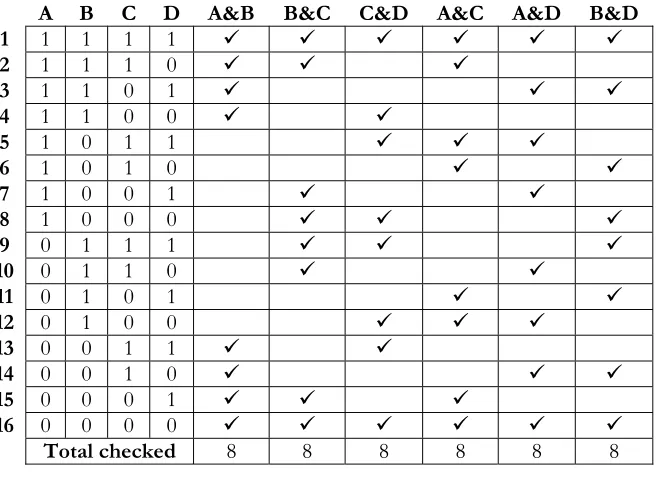
Let us consider a moderately complex situation that illustrates the possible combinations that four objects may have when there is a designated property they may possess. (This was not, incidentally, Watanabe’s more generalized approach, but it may serve to illustrate what he demonstrates.) We wish to see how often any pair of the objects has, or fails to have, that property in common; when two objects both fail to have a individual property, they also have that fact in common—and hence have in common the property that expresses that fact: They then share the property of not having that particular property. This is not far-fetched: Consider the property of having citizenship. Not having that property is to be stateless, which is certainly a property that people can have and some do.13
We wish to tally the total number of possible property commonalities the four objects may have. In the table that follows, the four objects are named A, B, C, and D. The four vertical columns on the left below the letters A, B, C, and D enumerate all of the possible 16 numbered combinations of properties that the objects may have (the combinations are exhaustive; there are no others): If an object has the property, this is designated by a ‘1’; if it does not have that property, a ‘0’ shows this. Line 1 of the table is the case where all four objects possesses in common the property designated by ‘1’; the last line of the table represents the case where the four objects all fail to have that property.
Suppose now that we ask how often, for the 16 possible combinations of properties, any pair of the four objects has properties in common, or fails to have
13 Citizenship and statelessness may appear at first sight to be unusual as complementary
properties, but only because we are not accustomed to thinking of non-possession of a given property as itself a legitimate property.
those properties in common—i.e., we want to identify all combinations for which a given pair of objects possesses 1’s or 0’s in common.
As the table shows, there are 6 possible object pairs: A & B, B & C, C & D, A & C, A & D, and B & D. We place a check mark in the table whenever a specified pair of objects has 1’s or 0’s in common. We do this to make evident how often, out of the 16 possible combinations of properties, commonalities show up. For example, on line 7, we note that column B and column C both have the same value; both are 0s; and so we place a check mark below column B&C on line 7. In the same way, we see that both columns A and D have the same value; both are 1s; and so we also place a check mark below column A&D on line 7. By doing this, Table 1 visually represents all the ways in which four objects, when analyzed pair-by-pair, may have properties in common.
A B C D A&B B&C C&D A&C A&D B&D
1 1 1 1 1
2 1 1 1 0
3 1 1 0 1
4 1 1 0 0
5 1 0 1 1
6 1 0 1 0
7 1 0 0 1
8 1 0 0 0
9 0 1 1 1
10 0 1 1 0
11 0 1 0 1
12 0 1 0 0
13 0 0 1 1
14 0 0 1 0
15 0 0 0 1
16 0 0 0 0
Total checked 8 8 8 8 8 8
TABLE 1
If we add up the check marks in the column A&B, we see there are 8 total. And we see there is a total of 8 check marks for every possible pair of objects. But it is equally important to recognize that there are an equal number of times when pairs of objects fail to have properties in common; there are also 8 unchecked cells in every
column below the possible pairs of objects.
objects, there will be an equal number of times when pairs of those objects have properties in common as there are times when they do not.
The above simplified example is hopefully not too simple that the reader will dismiss what it conveys. Watanabe provides proofs for the general case in which n
may be any number of objects, and therefore 2n represents the possible
combinations of property pairs they may have.14
The Theorem of the Ugly Duckling tells us something about the occurrence of commonalities that, from a strictly logical point of view, is surprising to many people: If you take any two objects at random, the number of property commonalities they can possibly have is equal to the number of commonalities that two objects that are judged to be similar may possess. Hence, an arbitrarily chosen object—a duckling (or a stone, for that matter)—when compared with a swan have just as many properties in common as do two swans. Alternatively expressed, there are just as many ways for two objects that are judged to have properties in common to fail to have other possible commonalities as there are ways in which two objects judged to be dissimilar also have no properties in common. The number of properties that two swans (which are believed to have properties in common) possess in common is no more, no less, than the number of ways they fail to have properties in common, and the latter number of failed commonalities is the same as in the case of two objects considered to be unrelated.
Now, what is the point of this formal analysis? Clearly, in ordinary experience we can and do recognize when two objects have something in common, and we can and do recognize when two objects don’t. The purpose of Watanabe’s Theorem of the Ugly Duckling is to make evident that, no matter how many properties may be distinguishable, and no matter how many objects we may wish to compare that have or fail to have those properties, any commonalities that we end up paying attention to are not commonalities that purely formal, logical criteria determine. Instead, logical criteria alone leave us in a state of necessary ambiguity whenever judgments of commonality are desired. To progress beyond this
inescapable condition of ambiguity, we are forced to specify and then identify in objects properties that, for extra-logical reasons, are considered to be important. It is only relative to those properties that are elevated in stipulated importance that objects are ever justifiably considered to have anything in common.
Finally, in order to stipulate which properties are to be considered important, we must apply some criteria or standards of importance, and it is this choice of criteria or standards, based on considerations that no formal considerations in mathematics can settle, that we so often mistakenly believe point to the “real, actually existing, natural kinds” which traditional taxonomists thought they were identifying when they classified distinct species.
Earlier I referred to a paper by Nelson Goodman that is directly relevant to a clearer understanding of the species problem. Before we leave the present discussion of the Theorem of the Ugly Duckling, I’d like to summarize several observations made by Goodman that relate to Watanabe’s result, although Goodman was apparently unaware of it. Goodman’s paper on similarity has come to the attention of a few biologists (a fairly long discussion of Goodman appears,
for example, in Medin, Goldstone, & Gentner (1993)—and yet the authors only provide in passing—even so, a great rarity in taxonomic literature—a single and unexplained citation to Watanabe’s more substantive work).
In his paper, “Seven Strictures on Similarity,” published more than a decade after Watanabe’s first presentation of his Theorem of the Ugly Duckling, Goodman refers to Gulliksen (1946), whose method of paired comparisons we met earlier, but, as we know, not to Watanabe, whose result Goodman comes very close to duplicating, although he does this by means of a less mathematically rigorous route. In his paper, Goodman sets out to critique the concept of similarity and to point out certain of its limitations. To do this, he formulates a group of “strictures,” or injunctions, against the widespread uncritical use of the concept of similarity; he argues for these strictures informally, and unlike Watanabe does not provide any proofs.
The last of these strictures parallels Watanabe’s result; as Goodman expresses it: “Similarity cannot be equated with, or measured in terms of, possession of common characteristics” (Goodman 1972, p. 443). Here is the core of Goodman’s argument:
When, in general, are two things similar? The first response is likely to be “When they have at least one property in common.” But since every two things have some property in common, this will make similarity a universal and hence useless relation. That a given two things are similar will hardly be notable news if there are no two things that are not similar.
Are two things similar, then, only if they have all their properties in common? This will not work either, for of course no two things have all their properties in common. Similarity so interpreted will be an empty and hence useless relation. That a given two things are similar in this sense would be notable news indeed, but false.
By now we may be ready to settle for a comparative rather than a categorical formula. Shall we say that two things a and b
are more alike than two others c and d if a and b have more properties in common than do c and d? If that has a more scientific sound and seems safer, it is unfortunately no better, for
any two things have exactly as many properties in common as any other two
[italics added]. If there are just three things in the universe, then any two of them belong together in exactly two classes and have exactly two properties in common: the property of belonging to the class consisting of the two things, and the property of belonging to the class consisting of all three things. If the universe is larger, the number of shared properties will be larger but will still be the same for every two elements. Where the number of things in the universe is n, each two things have in common exactly 2n-2 properties out of the total of 2n - 1