IJSRR, 8(1) Jan. – Mar., 2019 Page 1877
Research article Available online www.ijsrr.org
ISSN: 2279–0543
International Journal of Scientific Research and Reviews
On The Upper Open Geodetic Domination Number of a Graph
Vijimon Moni.V
1and Robinson Chellathurai.S
2Register Number-12357,
1
St. Xavier’s Catholic College of Engineering, Chunkankadai-629 013
2
Scott Christian College, Nagercoil-629 003,India.
Affiliated to Manonmaniam Sundaranar University, Abishekapatti, Tirunelveli - 627 012, Tamil Nadu, India
ABSTRACT
Let = ( , ) be a connected graph of order . A set ⊆ ( ) is called an open geodetic
dominating set of if is both open geodetic set and dominating set of . The minimum cardinality of an open geodetic dominating set of is called the open geodetic domination number of and is
denoted by ( ). An open geodetic dominating set of minimum cardinality is called - set of .
An open geodetic dominating set in a connected graph is called a minimal open geodetic
dominating set of if no proper subset of is an open geodetic dominating set of .The maximum
cardinality of a minimalopen geodetic domination set of is the upper open geodetic domination
number of and is denoted by ( ). A minimal open geodetic dominating set of cardinality
( )is called a - set of . The upper open geodetic dominating number of certain classes of
graph are determined. Some general properties satisfied by this concept are studied. For any positive
integers and with 2 ≤ ≤ , there exists a connected graph with ( ) = and ( ) = .
KEYWORDS
: Open geodetic number, Open geodetic domination number,upper open geodetic dominating number.AMS Subject Classification
: 05C05, 05C69.*Corresponding author
Vijimon Moni.V
Register Number-12357, Department of Mathematics
St. Xaviers Catholic College of Engineering,
Chunkankadai-629 003, Tamilnadu. India.
Email:[email protected].
IJSRR, 8(1) Jan. – Mar., 2019 Page 1878
INTRODUCTION
By a graph = ( , ), we mean a finite, undirected connected graph without loops or
multiple edges. The order and size of are denoted by and respectively. For basic graph
theoretic terminology, we refer to Harary10. The distance ( , )between two vertices and in a connected graph is the length of a shortest − path in . An − path of length ( , )is called an − geodesic. A vertex is said to lie on a − geodesic if x is a vertex of including the vertices and . The closed interval consists of , and all vertices lying on some
− geodesic of . For a non-empty set ⊆ ( ), the set [ ] =⋃ , ∈ [ , ] is the closure of
. A set ⊆ ( ) is called a geodetic set if [ ] = ( ). Thus every vertex of is contained in a geodesicjoining some pair of vertices in .The minimum cardinality of a geodetic set of is called
the geodetic number of and is denoted by ( ). A geodetic set of minimum cardinality is called -set of , , , . ( ) = { ∈ ( )∶ ∈ ( )}is called the neighborhood of the vertex in . A vertex is anextreme vertex of a graph if < ( )> is complete. A set of vertices in a graph is a dominating set if each vertex of is dominated by some vertex of . The domination number
( ) of is the minimum cardinality of a dominating set of , . If = { , } is an edge of a graph with ( ) = 1 and ( ) > 1, then we call a pendent edge, a leaf and a support vertex. Let ( ) be the set of all leaves of a graph . For any connected graph , a vertex ∈ ( ) is called a cut vertex of if − is no longer connected. A set of vertices in is called a
geodetic dominating set if is both a geodetic set and a dominating set. The minimum cardinality of
a geodetic dominating set of is its geodetic domination number and is denoted by ( ). A geodetic dominating set of size ( ) is said to be a -set of , . A set of vertices of a connected graph is an open geodetic set if for each vertex in either is an extreme vertex of and
∈ or is an internal vertex of a − geodesic for some , ∈ . An open geodetic set of minimum cardinality is a minimum open geodetic set and this cardinality is the open geodetic
number and is denoted by ( ) .A Set ⊆ ( )is called an open geodetic dominating set of a connected graph if is both open geodetic set and dominating set of . The minimum cardinality of an open geodetic dominating set of is called open geodetic domination number of and is
denoted by ( ) . An open geodetic dominating set of minimum cardinality is called -set of
.For a cut vertex in a connected graph and the component of − , the subgraph and the vertex together with all edges joining to ( ) is called a branch of at . The middle graph of a graph = ( , ) is the graph ( ) = ( ∪ , ), Where ∈ if and only if either is a vertex of and is an edge of containing , or and are edges in having a vertex in common.
IJSRR, 8(1) Jan. – Mar., 2019 Page 1879 Theorem1.1[13]. Let be a connected graph of order n. Then
i. every open geodetic dominating set of a graph contains its extreme vertices.
ii. every end vertex belongs to every open geodetic dominating set of .
iii. if theset of extreme vertices of is a open geodetic dominating set of , then is
theunique minimum open geodetic dominating set of and ( ) = | |.
THE UPPER OPEN GEODETIC DOMINATION NUMBER OF A GRAPH
Definition2.1. An open geodetic dominating set in a connected graph is called a minimal open
geodetic dominating set of if no proper subset of is an open geodetic dominating set of . The
maximum cardinality of a minimal open geodetic dominating set of is the upper open geodetic set
domination number of and is denoted by ( ). A minimal open geodetic dominating set of
cardinality ( ) is called a - set of .
Example2.2. For the graph given in Figure 1, ={ , , , , }and = { , , , , , }are open geodetic dominating sets of . It is clear that no proper subsets of and are open geodetic dominating set of and so and are minimal open geodetic dominating sets of .
Hence ( )= 5 and ( ) = 6. It is clear that there is no minimal open geodetic dominating set of cardinality greater than 6. Therefore
( ) = 6.
Theorem2.3. Let be a connected graph of order . Then
(i) every minimal open geodetic dominating set of a graph contains its extreme vertices. (ii) every
end vertex belongs to every minimal open geodetic dominating set of .
(iii) if has the unique minimal open geodetic dominating set,then ( )= ( ).
Proof. (i) Since every minimal open geodetic dominating set of connected graph is a open geodetic
dominating set of , by Theorem 1.1, (i)and (ii) follows immediately.
(iii)Let be unique minimal open geodetic dominating set of a connected graph . Then it is clear
that ( ) = | | and ( ) = | |. Hence ( ) = ( ).
G
Figure 1
IJSRR, 8(1) Jan. – Mar., 2019 Page 1880 Theorem 2.4. For the complete graph = , (G) = .
Proof. Since every vertex of G is an extreme vertex, then by Theorem 2.3(i) (G) = . Theorem 2.5. If a connected graph has m extreme vertices, then ( ) ≥ .
Proof. As every minimal open geodetic dominating set of a connected graph contains its extreme
vertices, by Theorem 2.3(i) ( ) ≥ .
Theorem2.6. Let ( )be the middle graph of a connected graph of order .
Then ( ( )) = ( ( )) = .
Proof. Let ( )be the middle graph of a connected graph of order . Then it is clear that set of extreme vertices of ( ) is ( ). It is easily verified that ( ) is the unique minimal open geodetic dominating set of ( ). Therefore, by Theorem 2.3(iii) ( ( )) = ( ( )) = .
Theorem2.7. Let be a connected graph of order , 2 ≤ ( ) ≤ ( ) ≤ . Proof. Since every open geodetic dominating set needs at least two vertices, Therefore
( ) ≥ 2. Since every minimal open geodetic dominating set is a open geodeticdominating set of
, ( )≤ ( ). Also since the set of all vertices of is an open
geodetic dominating set of , ( )≤ . Hence2 ≤ ( ) ≤ ( ) ≤ .∎
Remark 2.8. The bounds in Theorem 2.7 are sharp. For the path = , ( ) = 2. For the star
= , , ( ) = ( ) = −1.For the complete graph, = , ( ) = ( ) = . Also the bounds in Theorem 2.7 are strict. For the graph given in Figure 2, ( ) = 7, ( ) = 8 and
= 11. Thus 2 ≤ ( ) ≤ ( ) ≤ .
Theorem 2.9. For the connected graph ( ) = 2if and only if ( ) = 2.
Proof.If ( ) = 2, then by Theorem 2.7, ( ) = 2 . Conversely, let ( ) = 2. Then contains two extreme vertices and such that = { , }is the uniqueminimum -set of .
G
IJSRR, 8(1) Jan. – Mar., 2019 Page 1881
Since is subset of every open geodetic dominating set itfollows that = { , } is the unique minimal open geodetic dominating set of , sothat ( ) = 2.∎
Theorem 2.10. Let be a connected graph of order .If ( ) = , if and only if
γ ( ) = .
Proof. If ( ) = , then by Theorem 2.7, ( ) = . Conversely, let ( ) = . Then
= ( ) is the unique minimal open geodetic dominating set of . Henceit follows that is the unique minimum open geodetic dominating set of , so that ( ) = .∎
Theorem 2.11. Let be a connected graph of order n. If ( ) = −1, then ( ) = −1. Proof. Let ( ) = – 1. Then by Theorem 2.7, ( ) = or − 1. If ( ) = , then by Theorem 2.10, ( ) = , Which is a contradiction. Therefore ( ) = − 1.
Theorem 2.12. For the complete Bipartite graph G = , with 2 ≤ m ≤ n, ( ) = 4.
Proof. Let G = , .LetX = { , , ..., } and Y = { , , ..., } be the partitesets of . Let = { , , , }. Then is a minimal open geodetic dominating setof and so ( ) ≥ 4. We show that ( ) = 4. If not, let ( ) ≥ 5. Then thereexists a minimal open geodetic dominating set such that | ′|≥ 5. If ⊆ X,then is not a open geodetic dominating set of , Which is a contradiction. If ⊆ , then is not a open geodetic dominating set of , Which is a contradiction. Therefore, ⊆ ∪ . Let ′= ∪ , Where ⊆ and ⊆ . Then | | 2 and
| | 2.Since | |5,either or contains atleast three vertices, withoutloss of generality let us assume that| | 3. Let , , ∈ and , ∈ . Then , , , , ∈ . Let = − { }, Which is a contradiction to ′ is a minimal open geodetic dominating set of . Let = − { }. Then is a open geodetic dominating set of such that ′⊂ which is a contradiction to is a minimal open geodetic dominating set of .Therefore ( ) = 4.
Theorem2.13. For any connected non-complete graph of order , then ( ) ≤ − ( ). Proof. Let be a upper open geodetic dominating set of a non-complete connectedgraph order .
Then ( ) = | |. We show that | | ≤ − ( ). Let ∈ .Assume that is adjacent to m distinct vertices in . Since ( ) > ( ), v mustbe adjacent to atleast ( ) − vertices in
( )− and so | ( )− | > ( )− .If = 0,then | ( ) − | ( ),that is | |≤
| ( )| − ( ) = − ( ). If > 0, then the distinct vertices belong to [ ] and doesnot lie on a geodesicjoining any pair of vertices of , Since is a minimal open geodetic dominating set
IJSRR, 8(1) Jan. – Mar., 2019 Page 1882 Remark2.14. The bounds in Theorem 2.13 are sharp. For the graph = , of order . It is clear
that δ( ) = 1, − ( ) = −1 and ( ) = −1. Thus ( ) = − ( ).The bounds in
Theorem 2.13 can be strict. For the graph inFigure 3, δ( ) = 1, ( ) = 4, = 6, −
( ) = 5.Thus ( ) < − ( ).
Theorem 2.15. Let be a connected graph of order and ∈ ( ). If deg( ) = 1, then ( −
)≤ ( ).
Proof. Let ∈ ( )and deg( ) = 1. Let S be a minimal open geodetic dominatingset of −
with maximum cardinality, so ( − ) =| |. Since deg( ) = 1, is an end vertex and is adjacent to exactly one vertex, say . By Theorem 2.3 every minimal open geodetic dominating set of contains . We consider two cases.
case(i): Let ∈ . Since is an open geodetic dominating set of − , there exists a vertex
∈ ( − ) such that ∈ [ , ] ⊆ [ ], ∈ [ ], , ∈ [ ] and ( , ) ≤ 3. If
( , ) = 3, then consider the set = ( − { }) ∪ { , }. If ( , ) ≤ 2 then consider the set = ( − { }) ∪ { }. It is straight forward to verify that is a minimal open geodetic dominating set of . So that ( − ) = | |≤| | ≤ ( ).
case(ii): Let ∉ . Then consider the set = ∪ { }. It is straight forward toverify that is a minimal open geodetic dominating set of . So that ( − ) = | | < | | ≤ ( ). Hence in both the cases, ( − )≤ ( ). ∎
Remark 2.16. The bounds in Theorem 2.15 are sharp. For the graph = ,letu be an end vertex of
. It is clear that ( − ) = 2 and (G) = 2. Hence ( − ) = ( ). The bounds in Theorem 2.16 can be strict. For the graph G inFigure 4, ( − ) = 3 and ( ) = 4.Hence ( − ) < ( ).
IJSRR, 8(1) Jan. – Mar., 2019 Page 1883 Remark 2.17.The converse of the Theorem 2.15 is need not true. For the completegraph ,
it is clear that ( ) = n, ( − ) = − 1 and deg( ) = −1 forevery ∈ ( ). Hence ( − ) < ( ) but deg( )≠ 1.
Remark 2.18. Theorem 2.15 is not true if deg( ) ≠ 1. For the graph = , givenin Figure
5, ( ) = 3, ( − ) = 4 and deg( ) = 2 ≠1.Thus ( − ) ≰ ( ).
Theorem 2.19. For any non-trivial tree with ≥ 3, there exists a vertex ∈ ( ) such that ( − ) = ( ).
Proof. Let be any non-trivial tree with ≥ 3. It can be verified that the result istrue for = 3. Since if = 3 then = . Now consider the case that > 3. Since has atleast one vertex with degree greater than or equal to 2, there exists a vertex ∈ ( ) with deg( ) 2 such that v is adjacent to at least one leaf and atmostone non-leaf. If there exists a vertex such that is adjacent
to atleast one- leafand no non-leaf then it is clear that = , and v is the support vertex So that
( ( − ) = −1= ( ).If there does not exist a vertex such that is adjacentto exactly one leaf, then it is clear that is adjacent to two or more leaves. Assumethat is adjacent to exactly one
non-leaf. By Theorem 2.3 every minimal opengeodetic dominating set of contains its leaves So it
is clear that ( − ) = ( ).If there exists a vertex such that is adjacent to exactly one leaf and one non-leaf, then deg( ) = 1 and deg( ) = 2. Let = − − . Since deg( ) = 1, By Theorem 2.16, ( − ) ≤ ( ). Hence, ( ( ) ≤ ( − ) ≤ ( ). However,we have ( ) > (T) − 1. If ( ) = (T) − 1, then (T) = (T − u). If ( ) > (T)−1, then
G Figure 5
IJSRR, 8(1) Jan. – Mar., 2019 Page 1884
( ) = (T) = ( – ). Hence there exists a vertex v ∈ V (T) such that (T − v) = ( T).∎
Remark 2.20. Theorem 2.19 is not true for any graph . For the complete graph .
( − )≠ ( ) for every ∈ ( ).
Theorem 2.21. Let be a connected graph of order . If is a graph obtainedby adding , where
1 ≤ ≤ , end edges to a graph , then ( )≤ ( ) ≤ ( ) + .
Proof. Let be a connected graph of order and let be a connected graphobtained from by
adding end edges (1 ≤ ≤ ), where each ∈ ( )and ∉ ( ).First we show that
( )≤ ( ) Let be a -set of , So ( ) = | |. We now consider three cases.
Case(i): Let ∈ for all (1 ≤ ≤ ). Then let = ∪ { , , ..., }. Since each
∉ ( )is an end vertex of and ∉ , ∉ [ ]and ∉ [ ], is a minimal open geodetic dominating set of . Therefore ( ) = | | < | |≤ ( ).
Case(ii): Let ∈ for some , 1 ≤ ≤ . Since is an open geodetic dominating set of , there exists a vertex ∉ such that ∈ [ , ] ⊆ [ ], ∈ [ ] and ( , ) ≤ 3 for some
∈ . If ( , ) = 3, then consider the set = (S - { }) ∪ { , v}. If d( , ) ≤ 2, then consider the set = (S - { }) ∪ { }. It is easily verified that is a minimal open geodetic dominating set of . Therefore ( ) =| |≤| |≤ ( ).
Case(iii): Let ∈ for all , 1 ≤ ≤ .Then by the similar argument as in case(ii),
wecanprove that ( ) ≤ ( ). Next, we show that ( ) ≤ ( ) + .Let ⊆ ( )and let
= ∪{ , , ..., } be a minimal open geodetic dominatingset of with maximum cardinality so that ( ) =| | = | | + . Since isaminimal opengeodetic dominating set of , ∉ for all , where 1 ≤ ≤ . We showthat isa minimalopen geodetic dominating set of . If ∈ [ ]and ∈ [ ]for all ∈ ( )– , then is a minimal open geodetic dominating set of . Ifnot, then thereexists avertex ∈ ( ) suchthat ∉ I[S] or ∉N[S]. Thenthe set ∪
{ }(1≤ ≤ ) is a minimal opengeodetic dominating set of . Hence ( ) =| | + ≤
( ) + .
Theorem 2.22. For any two integer a and with 2≤ ≤ , there exists a connectedgraph with
( ) = and | ( )| = .
Proof. It can be easily verified that the result is true for 2 ≤ ≤ 3. If = 2, then =
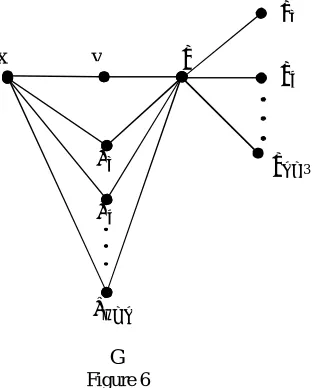
and if = 3, then is either or . For 4. If = , then G = andif = − 1, then = , . For ≤ −2. Let : , , be a path on three vertices.Let be a graph obtainedfrom
IJSRR, 8(1) Jan. – Mar., 2019 Page 1885
joining each (1 ≤ ≤ − ) with and . Thegraph G is shown in Figure 6. Let S = { , , ..., }. Then By Theorem 1.1 (i) is a subset of every open geodeticdominating set. It is easily
verified that ∪ { }, and ∪ { , } is not an open geodeticdominating set of and so ( ) ≥
. Now = S ∪ { } ∪ {y, } (1 ≤ ≤ − )or = ∪ { } ∪ { , } (1 ≤ , ≤ − ) is a minimal open geodetic dominatingset of and so (G) a. We provethat ( ) = .If not, suppose that (G)> . Then there exists a minimal open geodetic dominating set of with | | ≥ a + 1. Then contains atleast two (1 ≤ ≤ − ). Now must lie on [ , ] for (1 ≤ ≤ − ) and (1 ≤ ≤ −3).Then must belongs to Then it follows that ⊂ , which is a contradiction to is a minimalopen geodeticdominating set of . Therefore ( ) = .
∎
Theorem 2.23. For any two integer and with 2 ≤ ≤ , there exists aconnected graph with ( ) = , ( ) = .
Proof. It can be easily verified that the result is true for 2 = = . Considerthe graph = . It is clear that ( ) = 2 , ( ) = 2. If 2 < = , thenconsider the graph = (n > 2). It is clear that ( ) = ( ) = . If 2 < = , then consider the graph = , . It is clear that ( , ) = ( , ) = −1.Now we consider 2 < < .Let : , , , , be a path on five vertices. Let be a graph obtained from byadding new vertices , , ..., and joining each (1 ≤ i ≤ a − 4)
with . Let be a graph obtained from by adding new vertices , , , , ..., and joiningeach (1 ≤ ≤ − + 1) with and and joint with and , the graph isshown in Figure 7.First we show that ( ) = . Let = { , , ..., } be the set of all endvertices of
. By Theorem 1.1 (i) is a subset of every open geodetic dominating set of . Itis easily verified
3 y
x
G
IJSRR, 8(1) Jan. – Mar., 2019 Page 1886
that is not a open geodetic dominating set of . It is easily verifiedthat ∪ { } or ∪{ , } or ∪ { , , } is not a open geodetic dominatingset where , , ∉ and so ( ) ≥ . Now = ∪ { , , , } is an opengeodetic dominating set of so that ( ) = . Next we prove that ( ) = . Let = ∪ { , , ..., , , , }. Then is an open geodetic dominating setof and so ( ) ≥ − 4 + − + 1 + 3 = . First we prove that is a minimal open geodetic dominating setof . Suppose that is not a minimal open geodetic dominating setof . Then there exists ⊂ W such that is a open geodetic dominating setof .
Hence there exists ∈ such that ∉ . By Theorem 1.1 (ii) ≠ (1 ≤ ≤ − 4). If = (1 ≤ ≤ − + 1) then is not a dominating setof . If = or or , then is not an open geodetic setof . Hence is not an open geodetic dominating setof . Therefore is a
minimalopen geodetic dominating setof . Next we prove that (G) = .Suppose that ( ) ≥ + 1.Then there exists a open geodetic dominating set of such that | | ≥ + 1. By Theorem 1.1(i) ⊂ . Suppose that ∉ T for some . Then ∈ and either or ∈ . Let us assume that
∈ . Now and must lie onsome pair of vertices of .
Which implies must belongs to . Hence contains opengeodetic dominating set, which is a
contradiction. Therefore ( ) = . ∎
REFERENCES
1. Buckley.F and Harary.F, Distance in Graphs, Addition- Wesley, Redwood City, CA, 1990.
2. Buckley. F , Harary.F and Quintas.L.V., Extremal results on the geodetic number of a graph,
Scientia1988;2A:17-26.
3. Caro. Y and Yuster. R, Dominating a family of graphs with small connected graphs,
Combin.Probab.Comput.2000; 9: 309-313.
4. Chartrand .G, Harary.F and Zhang.P, Geodetic sets in graphs, Discussiones
MathematicaeGraph Theory, 2000;20: 129-138.
IJSRR, 8(1) Jan. – Mar., 2019 Page 1887
5. Chartrand .G, Harary.F, Swart.H.C and Zhang.P. Geodomination in Graphs, Bulletin of the
ICA, 2001; 31: 51 - 59.
6. Chartrand .G, Harary.Fand Zhang. P, On the geodetic number of a graph, Networks, 2002;
39(1): 1-6.
7. Cockayne.E. J, Goodman.S and Hedetniemi.S.T, A linear algorithm for the domination
number of a tree, Inform. Process.Lett. 1975; 4: 41-44.
8. Douglas B. West, Introduction to graph theory, Second Edition, 2012.
9. Hansberg. A, Volkmann. L, On the Geodetic and Geodetic domination number of a graph,
Discrete Mathematics 2010; 310: 2140-2146.
10.Harary. F, Graph theory, Addison-Wesley, 1969.
11. Harary. F, Loukakis. E, Tsouros. C, The geodetic number of a graph. Math..Comput.
Modeling1993;11: 89-95.
12.Robinson Chellathurai.S and Padma Vijaya.S, Geodetic domination in the corona and join of
graphs,Journal of Discrete Mathematical Sciences and Cryptography, 2014; 17(1):81-90.
13.Robinson Chellathurai.Sand Vijimon Moni.V, The Open Geodetic domination number of a
Graph, International Journal of Pure and Applied Mathematics, 2018;119(16): 5337-5348.
14.Santhakumaran. A.P and Kumari Latha.T, On the Open Geodetic Number of a Graph