145 | P a g e
International Journal of Pharmaceutical
Development & Technology
e ISSN - 2248 - 910X
www.ijpdt.com
Print ISSN - 2248 - 9096FORMULATION AND EVALUATION OF EXTENDED RELEASE
TABLET OF
DIVALPROEX SODIUM
USING DIFFERENT POLYMERS
AS RELEASE RETARDING AGENT
B.S.Shibu
1*, S. Suresh
1, C.Saravanan
21PGP College of Pharmaceutical Science and Research Institute, Namakkal-637207, Tamilnadu, India. 2Aadhi Bhagawan College of Pharmacy, Rantham, Cheyyar-604407, Tamilnadu, India.
ABSTRACT
The main objective of this work is to investigate the possibility of sustained release dosage forms for the drug Divalproex Sodium by using different polymers like Hydroxy Propyl methyl cellulose, Hydroxy Propyl cellulose by the diffusion controlled matrix. Various formulations of extended release tablets of Divalproex Sodium were developed using various polymers viz, HPC-HF, HPMC K4M, HPMC K15M and HPMC K100M in different proportions and combinations by direct compression
technique. The tablets were evaluated for physical characterization, in vitro release study and stability studies. Results of in vitro
release profile indicated that formulation (DERT-V) was the most promising formulation as the extent of drug release from this formulation was optimum and match with the In-house Specification when compared to other formulations. The formulation of extended release tablet of Batch DERT-V containing 19.5% of HPMC K100M and 7% of HPMC K4M can be taken as an ideal or
optimized formulation of extended release tablets for 18 hour release as it fulfills all the requirements for extended release tablet.
Keywords: Direct compression, Divalproex Sodium, Hydroxy propyl methylcellulose, In-vitro release studies.
INTRODUCTION
Oral route of drug administration is oldest and safest mode of drug administration. It posses several advantage. It provides accurate dosing without assistantship of administration. In conventional oral drug delivery system, there is little or no control over release of drug, and effective concentration at the target site can be achieved by administration of grossly excessive dosage form. Sustained release technology is relatively new field and as a consequence, research in the field has been extremely fertile and has produced many discoveries. With many drugs, the basic goal is to achieve a steady state blood level that is therapeutically effective and non-toxic for an extended period of time. The design of proper dosage form is an important element to accomplish this goal [1-11].
Divalproex Sodium [12] is an Anticonvulsant drug, with half life of 9 to 16 hours and requires multiple daily doses to maintain adequate plasma concentrations. So it is selected to prepare a extended release tablet. The objective of this present study is to develop an extended release tablet of Divalproex Sodium which releases the drug in a extended manner over a period of 18 hours, by using different polymers and study on polymer concentration effect on release pattern.
The present study was undertaken with an aim to formulate develop and evaluate Divalproex Sodium Extended release tablets using different polymers as release retarding agent. Hydroxy propyl methylcellulose (HPMC), a semi-synthetic derivative of cellulose, is one of the best choices as swellable and hydrophilic polymer. It has been widely used in the formulation of hydrophilic matrices for oral extended release drug delivery due to its key features and advantages including global regulatory acceptance, stability, ease of manufacture, versatility, suitability for various drugs and release profiles, and availability of the polymer [13-17].
MATERIALS AND METHODS
Divalproex Sodium was received as a gift sample from the Sun Pharmaceuticals Pvt. Ltd. Various grades of Hydroxy propyl methylcellulose (Methocel K4M, Methocel K15M and Methocel K100M) were obtained as gift from Pushkar Pharma Pvt. Ltd.., Dicalcium phosphate; Magnesium Stearate and Aerosil were purchased from Nice Chemicals Pvt. Ltd, Cochin.
MANUFACTURING PROCEDURE: (Direct Compression Method)
146 | P a g e
Step: 1 – All ingredients were weighed in specified quantityas given in the formula.
Step: 2 - Divalproex sodium was sifted through 20# sieve,
Step: 3 -Polymer (HPC-HF, HPMC K100M, HPMC K4M,
HPMC K15M) PVP-K30, MCC (Avicel ph-102), Lactose
DCL-21 was sifted through 40# sieve.
Step: 4 - The step 1&2 ingredients were loaded into planetary mixer and mixed for 30 minutes.
Step: 5 – Talc, Colloidal Silicon Dioxide and Magnesium Stearate was sifted through 40# sieve.
Step: 6 – Then the above sieved materials were transferred to planetary mixer and mixed for 5 minutes with step 3 material.
Step: 7 – Finally this dry mixed powder was compressed into tablets and evaluated for all physical and chemical parameters, and coating.
EVALUATION OF GRANULES [18, 19] Bulk Density
It is the ratio of total mass of powder to the bulk volume of powder. It was measured by pouring the weight powder (passed through standard sieve # 20) into a measuring cylinder and initial weight was noted. This initial volume is called the bulk volume. From this the bulk density is calculated according to the formula mentioned below. It is expressed in g/ml and is given by
Db = M/ Vb
Where, M is the mass of powder Vb is the bulk volume of the powder.
Tapped Density (Dt)
It is the ratio of total mass of the powder to the tapped volume of the powder. Volume was measured by tapping the powder for 750 times and the tapped volume was noted if the difference between these two volumes is less than 2%. If it is more than 2%, tapping is continued for 1250 times and tapped volume was noted. Tapping was continued until the difference between successive volumes is less than 2 % (in a bulk density apparatus). It is expressed in g/ml and is given by
Dt = M / Vt
Where, M is the mass of powder Vt is the tapped volume of the powder.
Carr’s index (or) % compressibility
It indicates powder flow properties. It is expressed in percentage and is give
Dt – Db I = --- × 100
Dt
Where, Dt is the tapped density of the powder and Db is the bulk density of the powder.
Hausner ratio
Hausner ratio is an indirect index of ease of powder flow. It is calculated by the following formula.
Dt Hausner ratio = ---
Db
Where, Dt is the tapped density. Db is the bulk density.
Lower hausner ratio (<1.25) indicates better flow properties than higher ones (>1.25).
Angle of Repose (θ)
The friction forces in a loose powder can be measured by the angle of repose (θ). It is an indicative of the flow properties of the powder. It is defined as maximum angle possible between the surface of the pile of powder and the horizontal plane
tan ( θ ) = h / r θ = tan-1 (h / r)
Where, h = height of pile
R = radius of the base of the pile
= angle of repose
The powder mixture was allowed to flow through the funnel fixed to a stand at definite height (h). The angle of repose was then calculated by measuring the height and radius of the heap of powder formed. Care was taken to see that the powder particles slip and roll over each other through the sides of the funnel. Relationship between angle of repose and powder flow property. The result had shown in table no 2.
EVALUATION OF TABLET [19]
All the prepared Sustained release tablets were evaluated for following official and unofficial parameters.
Weight Variation
Thickness
Hardness Test
Friability Test
Drug content
Dissolution Study
WEIGHT VARIATION
Twenty tablets were randomly selected form each batch and individually weighed. The average weight and standard deviation of 20 tablets was calculated. The batch passes the test for weight variation test if not more than two of the individual tablet weight deviates from the average weight by more than the percentage shown in Table No.8 and none deviate by more than twice the percentage shown.
THICKNESS
Twenty tablets were randomly selected form each batch and there thickness and diameter was measured by using digital vernier caliper.
HARDNESS
147 | P a g e
standard deviation was determined. The results are shown in Table No. 3.
FRIABILITY:
Twenty tablets were weighed and placed in the Electro lab friabilator and apparatus was rotated at 25 rpm for 4 minutes. After revolutions the tablets were dedusted and weighed again Table No. 3. The percentage friability was measured using the formula,
% F = {1-(Wt/W)} ×100
Where, % F = friability in percentage W = Initial weight of tablet
Wt = weight of tablets after revolution
DRUG RELEASE PROFILE Dissolution System
APPARATUS : Dissolution apparatus II as per BP (Paddle)
SPEED : 100 RPM
MEDIUM : Phosphate buffer pH 6.8: 900 ml TEMPERATURE : 370C ± 0.50CTIME
TIME : 4th, 6th, 8th, 12th, 16th & 18th Hour in Phosphate buffer pH 6.8
Preparation of Phosphate Buffer pH 6.8
Dissolve 40.83 gm of monobasic potassium phosphate and 5.5gm of sodium hydroxide into a 5000ml of water. Adjust the pH to 6.8 with either 1N sodium hydroxide or 1N hydrochloric acid if necessary dilute with water to 6.0 liters and mix.
Test solution (Buffer stage)
Place one tablet each in 6-dissolution bowl containing 900ml of pre-adjusted phosphate buffer pH 6.8 and maintained temperature 370c ± 0.50c into the each bowl, run the apparatus for 18 hours. Withdraw 10ml of the solution at above intervals from each bowl, replacing the same amount every time with dissolution medium and collect the filtrate after discarding first few ml of the filtrate and use for buffer release.
Stability Studies [18]
Stability studies were used to find out whether the formulation is maintaining its quality during the storage
period or not. These studies are used to find out the best formulation. It can be performed by applying a stress to the formulation such as temperature, humidity and light. Here stability study was conducted for DERT-I at 25°C/60%RH and 42°C/75% RH and for long term stability. The product was analysed at the end of the one month by using the same procedure as described previously.
RESULTS AND DISCUSSION
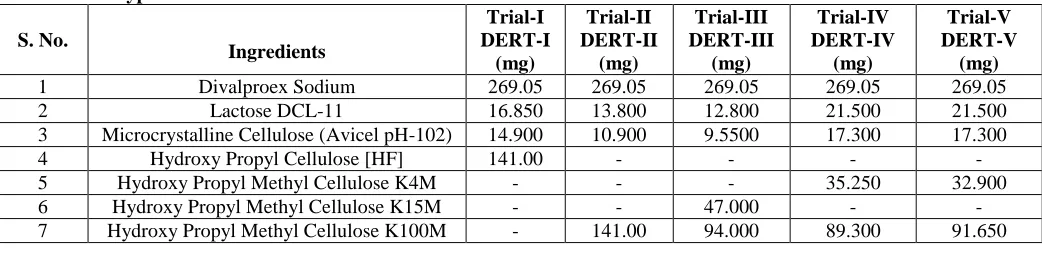
In trail-I 30% of HPC (HF) used as a Matrix Polymer in , According to the result the release rate was more, so further trial was taken. And also sticking of granule on punches and dies was occurred during compression. So, glidant and lubricant concentration was increased from 1% to 1.5% in further trials. The hardness of the tablet was also less. So the concentration of Povidone K-30 was increased from 3% to 3.5% in further trials.
In trial-II instead of HPC (HF), HPMC K100M 30%
was used as matrix polymer, According to the above result the release retardness was more so, further trial was conducted with less concentration of HPMC K100M. The
sticking problem was optimized with 1.5% of glidants. So this concentration was used in further trials. In this trial also the hardness of the tablet was less. So the concentration of Povidone K-30 was increased 4% to 4.5% in further trials.
Trial-III was taken with 20% HPMC K100M and
10% of HPMC K15M, the result of drug release given in
above table. According to the release shown in table the further trial planned with reduced concentration of HPMC K100M and Instead of HPMC K15M, HPMC K4M, because
the release retardness was still more. The required hardness was achieved with 4.5% of Povidone K-30. So this concentration was used in further trials.
Based on the trial -III trial-IV was taken with 19% HPMC K100M and 7.5% HPMC K4M, the result of drug
release given in above table. The release rate was controlled and satisfactory up to 12th hour, but after 12th hr the release was not match with I.H.S, so further trial want to be taken with slight modification of both polymers.
19.5% of HPMC K100M and 7% of HPMC K4M
was used in this trial, the drug release was controlled and match with In-house specifications. The concordant trial was taken with same formula, the same result got, so this trial formula (DERT-V) was considered as Final formula, consequently this batch was planned to go coating.
Table 1. Prototype formulations
S. No. Ingredients Trial-I DERT-I (mg) Trial-II DERT-II (mg) Trial-III DERT-III (mg) Trial-IV DERT-IV (mg) Trial-V DERT-V (mg)
148 | P a g e
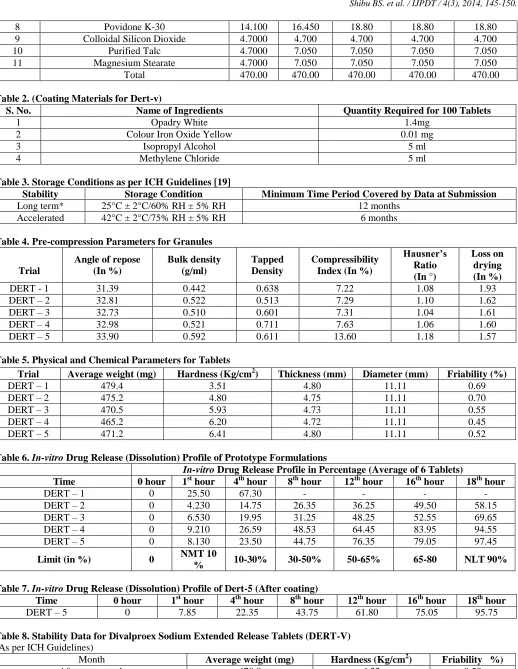
8 Povidone K-30 14.100 16.450 18.80 18.80 18.80 9 Colloidal Silicon Dioxide 4.7000 4.700 4.700 4.700 4.700 10 Purified Talc 4.7000 7.050 7.050 7.050 7.050 11 Magnesium Stearate 4.7000 7.050 7.050 7.050 7.050 Total 470.00 470.00 470.00 470.00 470.00
Table 2. (Coating Materials for Dert-v)
S. No. Name of Ingredients Quantity Required for 100 Tablets
1 Opadry White 1.4mg
2 Colour Iron Oxide Yellow 0.01 mg
3 Isopropyl Alcohol 5 ml
4 Methylene Chloride 5 ml
Table 3. Storage Conditions as per ICH Guidelines [19]
Stability Storage Condition Minimum Time Period Covered by Data at Submission
Long term* 25°C ± 2°C/60% RH ± 5% RH 12 months Accelerated 42°C ± 2°C/75% RH ± 5% RH 6 months
Table 4. Pre-compression Parameters for Granules
Trial
Angle of repose (In %)
Bulk density (g/ml)
Tapped Density
Compressibility Index (In %)
Hausner’s Ratio (In °)
Loss on drying (In %)
DERT - 1 31.39 0.442 0.638 7.22 1.08 1.93 DERT – 2 32.81 0.522 0.513 7.29 1.10 1.62 DERT – 3 32.73 0.510 0.601 7.31 1.04 1.61 DERT – 4 32.98 0.521 0.711 7.63 1.06 1.60 DERT – 5 33.90 0.592 0.611 13.60 1.18 1.57
Table 5. Physical and Chemical Parameters for Tablets
Table 6. In-vitro Drug Release (Dissolution) Profile of Prototype Formulations
In-vitro Drug Release Profile in Percentage (Average of 6 Tablets)
Time 0 hour 1st hour 4th hour 8th hour 12th hour 16th hour 18th hour
DERT – 1 0 25.50 67.30 - - - -
DERT – 2 0 4.230 14.75 26.35 36.25 49.50 58.15 DERT – 3 0 6.530 19.95 31.25 48.25 52.55 69.65 DERT – 4 0 9.210 26.59 48.53 64.45 83.95 94.55 DERT – 5 0 8.130 23.50 44.75 76.35 79.05 97.45
Limit (in %) 0 NMT 10
% 10-30% 30-50% 50-65% 65-80 NLT 90%
Table 7. In-vitro Drug Release (Dissolution) Profile of Dert-5 (After coating)
Time 0 hour 1st hour 4th hour 8th hour 12th hour 16th hour 18th hour
DERT – 5 0 7.85 22.35 43.75 61.80 75.05 95.75
Table 8. Stability Data for Divalproex Sodium Extended Release Tablets (DERT-V)
(As per ICH Guidelines)
Month Average weight (mg) Hardness (Kg/cm2) Friability %)
After one month 470.8 6.22 0.50
Trial Average weight (mg) Hardness (Kg/cm2) Thickness (mm) Diameter (mm) Friability (%)
DERT – 1 479.4 3.51 4.80 11.11 0.69
DERT – 2 475.2 4.80 4.75 11.11 0.70
DERT – 3 470.5 5.93 4.73 11.11 0.55
DERT – 4 465.2 6.20 4.72 11.11 0.45
149 | P a g e
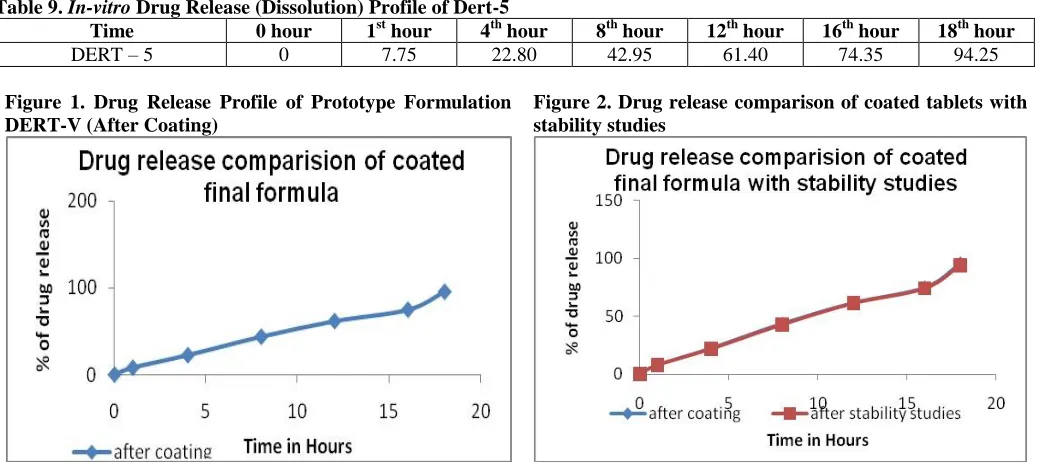
Table 9. In-vitro Drug Release (Dissolution) Profile of Dert-5Time 0 hour 1st hour 4th hour 8th hour 12th hour 16th hour 18th hour
DERT – 5 0 7.75 22.80 42.95 61.40 74.35 94.25
Figure 1. Drug Release Profile of Prototype Formulation DERT-V (After Coating)
Figure 2. Drug release comparison of coated tablets with stability studies
SUMMARY & CONCLUSION
The present study was undertaken with an aim to formulate develop and evaluate Divalproex Sodium Extended release tablets using different polymers as release retarding agent. Divalproex Sodium tablets were prepared using selected excipients. Granules were evaluated for tests Loss on drying, Bulk density, tapped density, Angle of Repose, compressibility index, Hausner’s ratio before being punched as tablets.
IR spectra studies revealed that the drug and polymers used were compatible. Various formulations of extended release tablets of Divalproex Sodium were developed using various polymers viz, HPC-HF, HPMC K4M, HPMC K15M and HPMC K100M in different
proportions and combinations by direct compression technique. The tablets were evaluated for physical characterization, in vitro release study and stability studies.
Observations of all formulations for physical characterization had shown that, all of them comply with the specifications of official pharmacopoeias and/or standard references. Results of in vitro release profile indicated that formulation (DERT-V) was the most promising formulation
as the extent of drug release from this formulation was optimum and match with the In-house Specification when compared to other formulations.
Stability study was conducted on tablets of Batch DERT-V stored at 42°C ± 2°C/75% RH ± 5% RH (Accelerated) for one month. Tablets were evaluated for Weight variation, Hardness, Friability and In-vitro release profile. After one month there was no much significant changes observed in any of the studied parameters during the study period, thus it could be concluded that formulation of Batch DERT-V was stable. It was concluded that the tablets of Batch DERT-V had considerable in vitro drug release.
CONCLUSION
It is concluded that the formulation of extended release tablet of Batch DERT-V containing 19.5% of HPMC K100M and 7% of HPMC K4M can be taken as an
ideal or optimized formulation of extended release tablets for 18 hour release as it fulfills all the requirements for extended release tablet.
REFERENCES
1. Vyas SP & Khar RK. Controlled Drug Delivery Concepts and Advances, Delhi, India, 1st edition Vallabh Prakashan, 2002, 155-195.
2. Liberman HA. Pharmaceutical Dossage Form, Tablets, Second Edn, Vol.I, 201-213.
3. Lachman Leon, Liberman HA and Kanig JL. The Theory and Practice of Industrial Pharmacy (3rdEdn.), Varghese publishing House Bombay, 443-453.171.
4. Jain NK. Controlled and Novel Drug Delivery CBS Publishers and distributors, New Delhi, 1-2, 2002, 676-698. 5. Remington. The Science and Practice of Pharmacy, 20th Edn, Vol. I, 903-913.
6. Banker GS, Rhodes CT. Modern Pharmaceutics, Ed. 4th, Vol. 121, Revised and Expanded Marcel Dekker, 501-573.
7. Bamba M, Puisievx F, Marty JP, Carstensen JT. Release mechanism in gel forming sustained release formulations. Int J Pharm, 1979, 2, 307.
150 | P a g e
9. Donald LW. Bioploymeric controlled release system. Vol I USA, CRS Press Inc, 1984.
10. James MA, Sung Wankim. Advances in drug delivery systems. Controlled release series-1. New York, Elsevier, 1980. 11. Theeuwes FG, Higuchi T. Fabrication of sustained release dosage form. U.S. patent No. 3, 845, 770.
12. James A. Wilcox. Divalproex Sodium as a Treatment for Borderline Personality Disorder. Annals of Clinical Psychiatry, 7, (1), 1995, 33 – 37.
13. Xu G, Sunada H. Influence of the formulation on the drug release kinetics from hydroxy propyl methyl cellulose matrix tablets. Chem Pharm Bull, 43, 1995, 483-487.
14. Maffione, Iamartino P, Guglielmini G, Gazzaniga A. High Viscosity HPMC as a Film-Coating Agent. Drug Development and Industrial Pharmacy, 19(16), 1993 , 2043 – 2053.
15. Mahesh Kumar S, Chandrasekhar MJN, Gopinath R. In Vitro and In Vivo Studies on HPMC-K-100 M Matrices Containing Naproxen Sodium Drug Delivery, Volume 14, Issue 3 March 2007 , 163 – 169
16. Hand book of Pharmaceutical Excipients, Edited by Raymond C.Rowe, Paul J.Sheskery and Paul J.Weller, 3rd ed. 61-63,181-83,297-301,309 - 11,508, 11,641-43.
17. Hand book of Pharmaceutical Excipients, 1985 Edition, 138- 41, 131-34, 146-48, 234-40.
18. Preformulation testing in Pharmaceutical Dosage forms Tablets, Edited by Herbert A.Lieberman, Leon Lachmann and Joseph. B.Schwartz, 1, 2 edition, 57-68.