Article
Quantum Nonlocality From Higher-Derivative
Gravity
Gregory S. Duane1,2
1 2 3 4
5 6 7
8 9 10 11
12 13
1GeophysicsInstitute
UniversityofBergen Postboks7803 5020Bergen,Norway
2Dept.ofAtmosphericandOceanicSciences
UCB311
UniversityofColorado Boulder,C080309-0311
* [email protected],720-987-3760
Abstract: A classical origin for the Bohmian quantum potential, as that potential term arises in the quantum mechanical treatment of black holes and Einstein-Rosen (ER) bridges, can be based on 4th-order extensions of Einstein’s equations. In Bohm’s ontological interpretation, black hole radiation, and the analogous tunneling process of quantum transmission through an ER bridge, are classically allowed if the dynamics are modified to include such a quantum potential. The 4th-order extension of general relativity required to generate the quantum potential is given by adding quadratic curvature terms with coefficients that maintain a fixed ratio, as their magnitudes approach zero. Quantum transmission through the classically non-traversable bridge is replaced by classical transmission through a traversable wormhole. If entangled particles are connected by a Planck-width ER bridge, as conjectured by Maldacena and Susskind, then the classical wormhole transmission effect gives the ontological nonlocal connection between the particles posited in Bohm’s interpretation of their entanglement. It is hypothesized that higher-derivative extensions of classical gravity can account for the nonlocal part of the quantum potential generally.
Keywords: 4th order gravity, quantum potential, ER=EPR, wormholes
14
1. Motivation and Introduction
15
Nonlocality is a prominent feature of quantum mechanics both in the standard, probabilistic
16
Copenhagen interpretation and in the deterministic re-interpretation by Bohm [1]. In the former case,
17
the spin of each member of an EPR pair, along any measurement axis, is determined at the time of
18
measurement of either member’s spin along that axis, despite any space-like separation, however
19
large, between the measurement apparatus and the remote spin. Bell’s Theorem [2] precludes any
20
understanding of this result in terms of spin values that exist at the time of creation of the pair,
21
independently of observation. In Bohm’s interpretation, the effect of measurement on the remote spin
22
is taken to be a real physical effect, mediated by a quantum potential.
23
With either interpretation, one is left to ask if any sort of generalization of the classical, and
24
relativistic, notion of locality can be articulated that does not depend on the full apparatus of standard
25
quantum theory. If observations trigger the collapse of a globally defined wave packet, as in the
26
Copenhagen interpretation, can one be more specific about the aspect of the observational process that
27
is responsible for the collapse? If one adopts Bohm’s quantum potential interpretation, can such a
28
non-local potential be linked to interactions that are familiar in classical physics? One must account
29
for the impossibility of non-local transmission of information either through the alleged effect of
30
observation or through the quantum potential.
31
A picture of quantum nonlocality emerges from the Maldacena-Susskind “ER=EPR" conjecture
32
that was originally put forward to resolve the black-hole information loss paradox [3]. We do not
33
review the original motivation for ER=EPR, which involved entangled macroscopic black holes, but
34
simply note that what emerged was a suggestion that any pair of entangled particles is connected by
35
an Einstein-Rosen (ER) bridge of Planck-scale width. Non-locality, in the proposed view, is mediated
36
by ER bridges, which intimately link space-like separated regions. Indeed, the members of an EPR pair
37
have zero separation, as computed along a path through the bridge and thus are, in effect, the same
38
particle. An Einstein-Rosen bridge is an unfolding of a black hole in a multiply-connected space time
39
topology, so information that enters the bridge is not transmitted for the same reason that it cannot
40
escape a black hole. That would explain why the non-local connections cannot be used for signaling.
41
It is not clear how Einstein-Rosen bridges, while offering a more specific and ontological picture,
42
could lead to the kind of nonlocality that would be induced by observations Copenhagen-style. But
43
it is possible to compare the physical effects of such bridges with those of the quantum potential in
44
the Bohm interpretation. Effects like those of the quantum potential would require that the bridges
45
be traversable, in order for the measurement outcome for one member of an EPR pair to feel the
46
orientation of the measurement apparatus for its partner, as required by Bell’s Theorem. Classical
47
ER bridges are not traversable. However we note that just as quantum black holes emit radiation,
48
quantum ER bridges are crudely traversable. That is, particles can tunnel out of the black hole or
49
through the bridge. There are severe restrictions on the kind of information that can be re-emitted in
50
one case, or transmitted, in the other, but neither effect requires essentially new physics that is beyond
51
general relativity or quantum mechanics.
52
Further, if the Bohm interpretation can be applied to field theory and to gravity in particular, then
53
tunneling through quantum ER bridges should itself be explicable in terms of a quantum potential
54
added to classical general relativity. Thus an extension of general relativity could account for quantum
55
entanglement. Here, we assume that general relativity describes phenomena down to well below the
56
Planck scaleLP. In bootstrap fashion, the quantum behavior of black holes and ER bridges would
57
provide an explanation for quantum nonlocality, at least as it appears strikingly in EPR correlations.
58
On the occasion of the Bohm Centennial, it is suggested that an ontological re-interpretation of the
59
quantum ER bridge behavior would then also explain nonlocal quantum entanglement generally. But
60
what kind of geometrodynamics would give rise to the quantum potential required in the specific case
61
of an ER bridge? The purpose of this short paper is to examine an extension of Einstein’s equations
62
that will account for the extra term and will thus allow us to interpret the quantum ER transmission
63
effect classically.
64
The proposed ontological account of quantum nonlocality tends to resolve the contradiction
65
between quantum mechanics and general relativity in a way that gives primacy to the latter. It can
66
be compared to Penrose’s suggestion that the collapse of the wavefunction is a gravitational effect
67
[4] in this regard. After reviewing both the quantum potential interpretation of black hole radiation
68
and classical higher derivative gravity in the next section, we compare the two in the following
69
section. We derive a result that only infinitesimal higher-derivative corrections are required (so that
70
the standard second-order theory is a singular limit). Implications for a re-interpretation of quantum
71
theory generally are discussed in the final section.
72
2. Background
73
2.1. Quantum potential interpretation of black hole radiation
74
a)
! " #$ !"#$!"#
%&'(!)*+ ! " %#$
'&,!&(+, %&'(!)*+
%&!'-%'$,.)(!$"
!"#$"%$&'()*"+,(-.*/
b)
! " #$%
! " $%
!"#$!"# %&'(!)*+
%&!', %'$-.)(!$"
/
('&"01!((+-%&'(!)*+
!"#$%&'(('$)*+'$%(,'$-./%,$*0"'1),
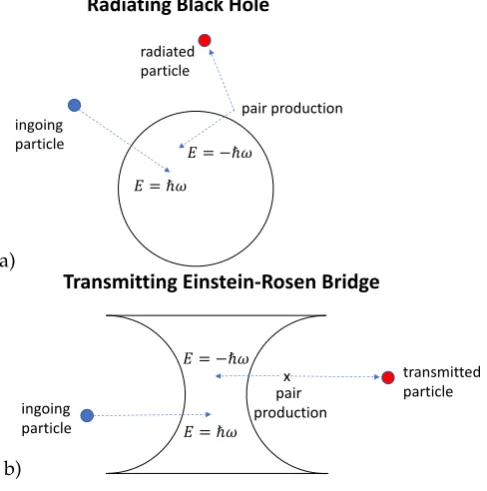
Figure 1.Steady states of a) a radiating black hole, and b) a transmitting Einstein-Rosen bridge, result from pair production just outside the horizon and ongoing classical ingestion.
give such radiation, which can indeed be characterized as a form of tunneling [5]. A quantum potential for black hole radiation was in fact derived by deBarroset al.[6,7] in work that has not been widely cited. Recall that for a simple quantum mechanical system with a wave-functionΨwritten in polar form asΨ=Rexp(iS), the quantum potential isQ=−(∇2R)/2mR, meaning that the Schrodinger
equation forΨimplies that particle motion is governed by the Hamilton-Jacobi equation with an extra potential term:
∂S
∂t +
(∇S)2
2m +V−
1 2m
∇2R
R =0 (1)
In the common example of tunneling through a potential barrier, we imagine that the particles each
75
possess an energyE<V, whereVis now the height of the barrier. There are no classically allowed
76
trajectories through the barrier, but nevertheless, according to standard quantum mechanics, and as
77
experimentally confirmed, particles that start on one side do appear on the opposite side. There are
78
no definite trajectories in standard quantum mechanics (although the result could be obtained as a
79
sum over alternative classically forbidden trajectories in the path integral formalism). But in Bohm’s
80
ontological interpretation, each particle follows a definite, classically allowed trajectory in a dynamical
81
system governed by the potentialV+Q. That is possible becauseE>V+Qover the entirety of at
82
least some paths through the barrier, as illustrated in [8].
83
In the current context, the quantum potential is gleaned from the Wheeler-Dewitt equation ˆ
HΨ = 0, obtained by quantizing the hamiltonian constraint in the ADM formulation of general relativity, in which spacetime is foliated into a temporal sequence of spacelike hypersurfaces. For a general wave-functionalΨ of the spatial metric on a hypersurface and of the matter fields, this equation is:
[Gijkl
δ δhij
δ δhkl
wherehis the determinant of the space metrichij,Gijkl ≡ 12h
−1/2(h
ikhjl+hilhjk−hijhkl)and(3)Ris
84
the intrinsic curvature of the evolving space-like hypersurface. Inserting the polar decomposition
85
Ψ=Rexp(iS)in (2), we get:
86
Gijkl
δS δhij
δS δhkl
− √h (3)R(h) +√h Q
+ matter terms=0 (3)
for a quantum potentialQthat is defined in terms of derivatives ofRboth with respect to the metric
87
and with respect to the matter fields. ForQ=0, Eq. (3) is the Hamilton-Jacobi equation for the usual
88
actionSin the ADM formalism. ForQ 6= 0, the dynamics are modified, but all fields still follow
89
well-defined trajectories, as for a single particle in the Bohmian interpretation.
90
Tomimatsu [9] solved the Wheeler-Dewitt equation (2) for a spherically symmetric case, using boundary conditions that describe a scalar field in an evaporating black-hole metric, limiting attention to the region near the apparent horizon. He found:
Ψ(ro,Φ) =Cexp[iro
4 +
k2
2ro
− |kΦ]| (4)
giving the wave-functionalΨ(ro,Φ)as a function of the instantaneous apparent black-hole radiusro and the scalar fieldΦat the apparent horizon, withkan eigenvalue to be determined. We take the wave functional to have the same form for a transmitting ER bridge, since only the topology is different from that of a black hole. Traversability can indeed be determined at the horizon. For the wave function (4), we haveR=Cexp(−|kΦ]), and so the quantum potential depends only on derivatives with respect to the scalar field and not with respect to the metric. As found by deBarroset al.[7], the term in the matter sector of the hamiltonian,(1/2r2o)PˆΦ2 =−(1/2r2o)δ2/δΦ2, contributes a quantum potential
Q=− k
2
2r2
o
(5)
to the Hamilton-Jacobi equation (3). We assume here that the quantum evaporation/transmission
91
process induced by the quantum potential (5) is balanced by a purely classical accretion/particle-entry
92
process to maintain a steady state (Fig.1). The change in boundary conditions needed to describe the
93
added classical process will not affect the quantum potential.
94
2.2. Classical higher-derivative gravity
95
In this paper, we seek a generally covariant extension of Einstein’s equations that gives a quantum
96
potential of the form (5) in the corresponding generalization of the Wheeler-Dewitt equation for a
97
radiating black hole in a steady state.. A simple candidate is constructed by adding terms containing
98
higher derivatives of the metric to the standard second-order equations. While such higher-derivative
99
extensions of general relativity have become familiar in the context of quantum corrections to general
100
relativity, here we regard the resulting theory simply as an alternative to the standard classical theory.
101
A textbook derivation of Einstein’s equations, e.g. [18], relies not only on general covariance, but on an explicit assumption that the equations are second order, or equivalently, that they are scale invariant. General relativity can in fact be extended to theories of the form:
Rµν−
1
2Rgµν+gµνΛ+
∑
n>2
cnLn−2Rµν(n)=8πTµν (6)
whereR(µνn)is a quantity involving a total ofnderivatives of the metric,Lis a fundamental length
102
scale, thecn are dimensionless constants and we have included a cosmological constantΛfor full
103
generality. IfL=LP, the Planck length, then the new terms in the extended theory (6) are negligible on
macroscopic scales. They need only be considered if curvature is significant at the Planck length scale.
105
It might be hoped that no macroscopic effects would ensue in that case, but this is not guaranteed
106
because of the nonlinearities.
107
A fourth-order classical theory was introduced by Stelle [10], in the hope that the quantized
108
version of the theory would be renormalizable. A 4th-order classical theory of the same type was
109
studied by Ruzmaikina and Ruzmaikin [11] for application to cosmology. More recently, a thorough
110
study of 4th order gravity by Luet al.[12], which we shall rely on heavily, was enabled by the advent
111
of algebraic calculation tools like Mathematica. Though Luet al.stated that the principal intended
112
application was to compute quantum corrections, their results are applicable in a purely classical
113
domain.
114
3. Equivalent of the quantum potential in 4th order gravity
115
A generally covariant description of the quantum potential term must exist to satisfy the principle
116
of relativity. The same geometrodynamics and the same quantum potential will describe both standard
117
black-hole evaporation and a steady state of the black hole or bridge. So we seek extensions of
118
Einstein’s equations that would produce the quantum potential term classically. As with a potential
119
barrier in simple quantum mechanics, the only way that the resulting classical equations would
120
permit “tunneling" through a modified ER bridge is for the modifications to make the bridge formally
121
traversable. That is indeed what we will find. (The impossibility of super-luminal signaling will be
122
discussed briefly in the concluding section.)
123
The most general 4th order extension of Einsteinian general relativity [12] is given by a Lagrangian density of the formL=√−g[γR−αCµνρσCµνρσ+βR2]whereCµνρσ is the Weyl tensor, formed by
removing non-vanishing contractions from the curvature tensorRµνρσ. This Lagrangian density can
also be written:
L=p
−g[γR−2αRµνRµν+ (β+
2α
3 )R
2] (7)
by using the topological invariance of a quantity specified in the Gauss-Bonnet theorem [12].
124
An ADM-type formulation of 4th order gravity is derived as for ordinary general relativity.
125
The Gauss-Codazzi relations [13,14] are used to express the Riemann tensor, the Ricci tensor and
126
the Ricci scalar in terms of the corresponding objects for 3-dimensional space-like hypersurfaces,
127
denoted (3)Rµνσρ etc., and the extrinsic curvature Kab of those hypersurfaces, together with lapse
128
and shift variables that describe the flow of time and the point-to-point connections, respectively,
129
between hypersurfaces. The canonical momentum pabthat is conjugate to hab is pab = ∂L/∂h˙ab.
130
The Hamiltonian density is constructed fromH(p,q) = p·q˙− L(q, ˙q), withq =h, by writing the
131
kinematic termp·h˙ also in terms of the extrinsic curvature as with ordinary gravity, and expressing the
132
extrinsic curvature in terms of the canonical momenta [14]. The lapse appears as a Lagrange multiplier
133
of the hamiltonian constraint, as in the usual ADM approach. Let us write the hamiltonian constraint
134
in the form:
135
F(p, ˙p, ¨p)−√h
γ(3)R − 2α(3)Rab(3)Rab
+ (β+2α
3 ) (
(3)R)2
+Hmatter =0 (8)
where the functionF(p, ˙p, ¨p)depends also on curvature, to isolate thep-independent terms. (Greek
136
indices assume values in{0, 1, 2, 3}while latin indices are restricted to{1, 2, 3}.)1
137
This constraint is to be compared to the one for ordinary gravity, with quantum potential added, which is
Gijkl pijpkl−
√
hγ(3)R− √
h k
2
2r2
o
+Hmatter=0 (9)
from which equation (3) is obtained by substitutingpab→∂S/∂hab. Eq. (8) is generally 4th-order in
138
the canonical momenta while the corresponding equation for ordinary gravity (9) is 2nd order, but
139
we claim that we can ignore the terms inp. That is because for static metrics such as we will consider
140
here, hypersurfaces of constant time have zero extrinsic curvatureKab ≡ ∇anb = 0, wheren is a
141
time-like unit vector field normal to the surface, and∇is the projection of the covariant derivative
142
onto the hypersurface. For such metrics we can taken(x) = (nt, 0, 0, 0). The Lagrangian densityL
143
can be written as a sum of terms with factors of the intrinsic curvature(3)Rabor its contraction(3)R,
144
and terms with factors that are quadratic in the extrinsic curvatureKabor that are time derivatives of
145
Kab, since the metric is Gaussian normal [14] as restricted to the horizon. Using∂(3)Rij/∂h˙ab=0 and
146
∂Kab/∂h˙ab=1/2l, wherelis the time-independent lapse, andKab=0, we find thatpab=∂L/∂h˙ab=0.
147
So the kinematic termp·h˙ vanishes and sinceKab=0, the Lagrangian contributes only two new terms,
148
in(3)Rab(3)Raband((3)R)2, and soF=0. The steady states of the dynamics defined by the Hamiltonian
149
(including the matter terms), as would include ER bridges or wormholes prior to collapse, are the
150
same in quantized ordinary general relativity and in classical 4th order gravity, if near the horizon:
151
(γ−γGR)(3)R − 2α(3)Rab(3)Rab
+ (β+2α/3)((3)R)2=− k
2
2r2
o
(10)
whereγGR = 1/16πGis the canonical value ofγ. (The usual “supermomentum" part of the total
152
Hamiltonian vanishes forp=0.) It is noted that the negative sign of the quantum potentialQ, viewed
153
as a contribution to the energy density at the horizon, is what is required of the “exotic matter" that
154
could serve to violate the averaged weak energy condition and to keep a traversable wormhole open
155
[16].
156
For black holes and Einstein-Rosen bridges, we generally haveRµν,R=O(1/r2o). The requirement of Eq. (10) is thus that that the 1/r4oterms in the expressions that are quadratic in curvature,(3)Rab(3)Rab and((3)R)2cancel, and that these quadratic curvature expressions, taken together, areO(1/r2o). We consider spherically symmetric, time-independent metrics of the form:
ds2=−B(r)dt2+A(r)dr2+r2dθ2+r2sin2θdφ2 (11)
with the spatial metric on hypersurfaces of constanttgiven trivially by:hij =gij. For a metric of this
157
form, the indices 0, 1, 2, 3 are more specifically written ast,r,θ,φ, respectively. The Ricci tensor on the
158
hypersurfaces is diagonal with three non-vanishing elements:
159
(3)R
rr = −1
r A0
A (3)R
θθ = −1−
A0
2A2+
1
A (12)
(3)R
φφ = sin2θ
−1− A
0
2A2 +
1
A
where primes denote derivatives with respect tor. DenotingA−1(r
o)(3)Rrr(ro)≡a,ro−2(3)Rθθ(ro)≡b,
andr−o2sin−2θ (3)Rφφ(ro)≡c, we have at the horizon:
(3)R=a+b+c (13)
(3)R
Assuming a,b,c ∼ 1/r2o, the requirement that the quadratic curvature terms mimic the quantum
160
potential is that the terms of leading order in 1/rovanish, and that:
161
−2α(3)Rab(3)Rab+ (β+2α
3 ) (
(3)R)2 =
−2α(a2+b2+c2) + (β+2α/3)(a+b+c)2 = −
4α
3 −β
a2−4
β−2α
3
b2+4
β+2α
3
ab =
−k2
2r2
o
(15)
having noticed thatb=c, and having takenγ=γGR, as we will henceforth for agreement with general
162
relativity at large scales.
163
We have solved for the metric (11) in terms ofA(r)andB(r), in series expansions, following the
164
method of Luet al.[12]:
165
1
A(r) ≡ f(r) = f1(r−ro) + f2(r−ro)
2+. . . (16a)
B(r) = bo+b1(r−ro) +b2(r−ro)2+. . .
(16b)
There are indeed wormhole solutions withA(r) =∞at the horizonr=ro, as with a Schwarzchild
166
black hole, butB(ro)6=0, unlike a black hole in ordinary gravity or in 4th order gravity [17]. Such
167
traversable wormholes were studied by Luet al.[12] in the restricted caseβ=0. Here,β6=0 is needed
168
so that there are non-trivial solutions to (15) withα6=0 and different from ordinary gravity. The 4th
169
order theory admits traversable wormhole solutions, as in [12], but with more free parameters than for
170
theβ=0 case. Quantum tunneling is thus accounted for classically.
171
The equations of motion are derived by minimizing the actionI=R
d4x√−gLformed from the 172
Lagrangian density (7). They are:
173
0 = √1
−g δI
δgµν ≡H
µν
= −γ(Rµν−
1
2gµνR)− 2
3(α−3β)R;µ;ν
+2αgρσRµν;ρ;σ−
1
3(α+6β)gµνg
ρσR
;ρ;σ
+4αRρσRµρνσ+2
β+2
3α
RRµν
+αgµνRρσRρσ−
1 2gµν
β+2
3α
R2 (17)
where a semicolon denotes covariant differentiation with respect to the index following. One first
174
substitutes the spherically symmetric, static metric form (11) in the usual expressions for the Ricci
175
tensor (see e.g. [18]), to get 4-dimensional expressions forRµνthat are extensions of (12), and inserts
176
these expressions in (17) to derive differential equations forA(r)andB(r). Combining the equations
177
for HttandHrr (sufficient to determine Hθθ andHφφas well, because of a Bianchi identity) in the
178
manner of Ref. [12], one derives a pair of third-order differential equations forA(r)andB(r)that are
found to match those given in the Appendix to [12]. The series expansions (16) were substituted in
180
those equations and solved for the lowest order coefficients in Mathematica. We find:
181
f1 = 1
3 s
−2(α−3β)(2α−6β−3γr2o)
3αβr2o (18a)
b1/b0 = 2
(α+6β)
(α−3β)ro (18b)
The condition b0 > 0 implies that the solution is a wormhole, as in [12]. But unlike the β = 0
182
case, we find thatb2is unconstrained, and therefore can be tuned for asymptotic flatness. It can be 183
checked that the extra terms in (17), as compared to the usual second-order Einstein equations, give an
184
effective negative energy contribution, when averaged along a null geodesic through the interior of
185
the wormhole, that violates the averaged weak energy condition, as required for traversability.
186
To satisfy the equivalence condition (15), we first note that the curvature variables a =
187
A−1(ro)(3)Rrr(ro)andb=c=r−o2(3)Rθθ(ro), where (3)R
ijis given by (12), depend only on the leading
188
coefficient f1: 189
a = f1
ro
b=c = −1 r2
o
+ f1
2ro (19)
We will use the solution (18a) forf1in terms ofαandβto compute the quadratic curvature contribution
190
(15) , which we now denoteV(ro).
191
V(ro) ≡ −
4α
3 −β
(a(α,β))2−4
β−2α
3
(b(α,β))2
+4
β+2α
3
a(α,β)b(α,β) (20)
Substituting from (19) and (18), the condition for equivalence ofV(ro)to the de Barroset al.quantum
192
potential becomes:
193
V(ro) ≡ 2 81r4
oω
(
3γGRr2o(36−15ω+ω2)
+ β
"
216−2ω3
+ 36ω −9+
s
6(−3+ω)(6β+3γGRr2o−2βω)
βω
!
+ 6ω2 15+
s
6(−3+ω)(6β+3γGRr2o−2βω)
βω
! #)
= − k
2
(2r2
o)
(21)
where we have expressedVin terms ofβandω≡α/βfor convenience.
194
The coefficient of the second term in the braced expression, β, must vanish to avoid a 1/r4o
contribution for smallro. Then the first term gives
2γGR(36−15ω+ω2))/(27ω) =−
k2
a quadratic equation that can be solved for ω, for given k. Since the same geometrodynamics
195
must describe black-hole evaporation, a value of the eigenvaluek can be obtained by matching
196
the black-hole evaporation rate as computed by deBarroset al. [7],k2/4M2, to the Hawking rate
197
[19]P= ¯hc6/(15360πG2M2). This givesk= √
¯
hc6/3840πG2, or in units for which ¯h = c= G= 1, 198
k≈0.01. In the limitβ→0, the desired value of the ratio of the coefficientsω=α/βsolves (22) and is
199
found to beα/β=ω=3.009 orα/β=11.962. Forα/βfixed at these values, the contribution of the
200
quadratic curvature terms is plotted vs.roin Fig.2as the two coefficients each approach zero. As we
201
approach the limit, the quadratic curvatureVcontribution matches the quantum potential−k2/(2r2o)
202
down to smaller and smaller radiiro, but very large values ofVare found for a narrowing range
203
aroundro=0. We note that the large potentials could conceivably help in avoiding divergences due to
204
an arbitrarily large tendency to form arbitrarily narrow wormholes. Otherwise the quantum potential
205
can be matched as closely as desired for sufficiently small coefficients.
206
4. Discussion
207
The extension of ER=EPR that is required here is only slight. The authors of that conjecture, who
208
started with macroscopic black holes and bridges, did not consider quantum tunneling. Alice, at one
209
end of such a bridge, can send any kind of object or signal through the bridge (including a firewall)
210
that Bob will encounter as soon as he crosses the horizon from the other end. But macroscopic objects
211
cannot reach him before that time, either classically or through tunneling, just as they cannot tunnel
212
through a potential barrier in simple quantum mechanics. The suggested impact of tunneling is for
213
Planck-scale configurations, where it is enough to take us from the Copenhagen interpretation to the
214
ontological one, in one sense a slight change.
215
For black holes or non-traversable ER bridges of macroscopic size, the quadratic curvature terms
216
in the above analysis have no significant effect on the dynamics that is different from that of the
217
quantum potential, or therefore, of the usual quantum theory. Indeed, the potential that follows
218
from the quadratic curvature terms is unique, and does not depend on a choice of eigenstate as
219
in the treatment of Tomimatsu [9] where classical (non-radiating) black hole behavior occurs for
220
another wavefunction solution. So the ambiguity reported by deBarroset al.[7] regarding black hole
221
evaporation in a quantum potential treatment, is avoided if the potential comes from extra classical
222
curvature terms. An absence of macroscopic effect might have been expected if the coefficientsα
223
andβ(which have the dimensions [length]2) had Planck-scale values. That these coefficients can be
224
infinitesimal strengthens the argument that the macroscopic predictions of ordinary general relativity
225
are preserved.
226
At sub-Planck scales, wherero<<LP, on the other hand, the potential arising from the quadratic
227
curvature terms can deviate strongly from that predicted by quantum theory, for any values ofαandβ
228
that remain finite. Differences could have detectable physical consequences.
229
In regard to verifiable consequences, we also note that the quantum potential depends on specific
230
combinations of the matter fields with gravity. The quantum potential (5) used here arises from a single
231
scalar field in the matter portion of the hamiltonian, but in a traditional EPR pair, an electromagnetic
232
field is used in the observation of charged spinor particles. It is noteworthy that wormhole solutions
233
with electric charge in a modified theory that includes small quadratic curvature terms with a fixed
234
ratio have been previously reported [20]. In general, allowable combinations of matter fields might be
235
constrained by a supersymmetry required to maintain the equivalence between the quantum potential
236
due to the matter fields and contributions from the extra curvature terms. The prescribed combinations
237
could be compared with the spectrum of particles known to populate the vacuum.
238
Gravity itself has not been quantized in the configuration studied here, since the quantum
239
potential (5) comes only from the matter portion of the Hamiltonian through Dirac replacement of
240
the scalar field momentaPΦby operators. It is interesting that a previous attempt to quantize gravity,
241
using the asymptotic safety approach [21] to defining renormalizable equations with higher derivatives
242
has yielded similar results: 4th order equations involving very small coefficients with fixed ratios and a
a)
!"# $"! $"# %"! %"#!!
!!"!!!& !!"!!!' !!"!!!% !!"!!!$ !"!!!! !"!!!$ !"!!!%
!!!"
!"!#$!!! %"!#$!!! &"!#$!!! '"!#$!!! #"!#$!!"
"#!#$!#
"(!#$!$
$ (!#$!$
#!#$!#
b)
!"# $"! $"# %"! %"#
!
!!!"!!!& !!"!!!' !!"!!!% !!"!!!$ !"!!!! !"!!!$ !"!!!%
!
!
!"!"!#$!!" %"!#$!!" &"!#$!!" '"!#$!!" #"!#$!#
"#!#$!$ "(!#$!%
$ (!#$!%
#!#$!$
Figure 2.The contribution of the quadratic curvature terms to the hamiltonian constraint, vs. wormhole radiusro, for a) decreasing values ofβ: β = 10−7 (purple), 10−7.5(green), 10−8(red), 10−9(blue), and 10−30 (yellow), while the the ratio of the coefficients is held fixed at the first solution to (22), α/β≈3.009; and for b) values ofβ:β=10−10(purple), 2×10⁻¹¹(green), 10−11(red), 10−12(blue), and 10−30 (yellow), while the ratio is held at the second solution,α/β ≈ 11.962. The quadratic curvature contributionVconverges to the quantum potential−k2/(2r2
o)(dashed line) asβ→0 in both cases, except for large positive values for a decreasing range of smallro, as shown for the smallest value
steady state black hole solution [22]. The relationship between such attempts at a full quantum theory
244
of gravity and our treatment of the scalar field in a fixed space-time remains to be studied.
245
The focus of our analysis has been on steady entangled states. Collapse of the wormhole has
246
not been discussed. It is thought that the fourth-order time derivatives in the classical hamiltonian
247
constraint (8), away from the steady state, could describe a physical process of wormhole/wavefunction
248
collapse on very short time scales. Unlike the situation with a macroscopic wormhole, the entry
249
of a single particle would trigger collapse, preventing [23] the problems due to closed time-like
250
curves through macroscopic wormholes and the resulting vacuum polarization divergence that was
251
previously debated between Kim and Thorne [24] and Hawking [25]. Hawking’s argument still
252
precludes macroscopic wormholes. For a Planck scale wormhole, the collapse itself (with some
253
sensitivity to the orientation of the remote measuring field, as required by Bell’s theorem) could indeed
254
be the only effect transmitted. And in the absence of a Maxwell’s Demon, one could not effectively
255
control the collapse so as to transmit information. That is, one does not have knowledge of the detailed
256
state at either end and considers only a statistical ensemble of states. That the statistical properties are
257
unchanged by the nonlocal effects of measurement is also what bars the use of the quantum potential
258
for superluminal signaling in Bohm’s original interpretation [8].
259
It is tempting to elevate the proposed role of traversable wormholes in mediating entanglement to
260
a full interpretation of quantum mechanics. Planck’s constant would emerge if any physical processes
261
select a preferred width for the wormholes that is O[1] in non-dimensional units. One candidate for
262
such a process is just the weak vacuum polarization divergence [24,25] that precludes macroscopic
263
widths. But in addition to the need for a description of collapse, one would also need to show that all
264
of quantum theory follows from nonlocal entanglement conjoined with some properly constructed,
265
local classical theory.
266
While we have not yet shown that nonlocal entanglement is everything, it is certainly central. It is
267
hypothesized that at least the non-local part of the quantum potential, in the general situation, arises
268
from the new, multiply connected topology. As with an Einstein-Rosen bridge, entangled particles
269
connected by a traversable wormholes withroof Planck scale are not separated within the wormhole
270
and are in a sense the same particle, until the connecting geometry collapses. The resulting negation of
271
the usual concept of the continuum establishes a new order in the physical world, best described in an
272
atomized spacetime together, arguably, with non-standard metrics in state space [26] and an ontology
273
given by nonlocally defined basis states that are not easily specified [27]. The view taken here is that an
274
account of how the new order forms from the intrinsically required breakdown of the classical order,
275
through gravitational instability of the populated vacuum at microscale, could ultimately yield a more
276
complete, more detailed and more predictive version of quantum theory.
277
Acknowledgments:Acknowledgments
278
This work was partly supported by European Commission Grant 658602.
279
Conflicts of Interest:Conflicts of Interest
280
The author declares no conflict of interest.
281
282
1. Bohm, D. A suggested interpretation of the quantum theory in terms of “hidden” variables, I and II.Phys.
283
Rev.1952,85, 166–193.
284
2. Bell, J.S. On the Einstein-Podolsky-Rosen paradox.Physics1964,1, 195–200.
285
3. Maldacena, J.; Susskind, L. Cool horizons for entangled black holes.Fortschr. Phys.2013,61, 781–811.
286
4. Penrose, R.The Emperor’s New Mind; Oxford University Press: Oxford, UK, 1989.
287
5. Parikh, M.K.; Wilczek, F. Hawking radiation as tunneling.Phys. Rev. Lett2000,85, 5042–5045.
288
6. De Barros, J.A.; Pinto-Neto, N. The causal interpretation of quantum mechanics and the singularity problem
289
and time issue in quantum cosmology.Int. J. Mod. Phys. D1998,7, 201–213.
290
7. De Barros, J.A.; Oliveira-Neto, G.; Vale, T.B. Bohmian trajectories for an evaporating blackhole.Phys. Lett.A
291
2005,336, 324–330.
8. Bohm, D.; Hiley, B.J.The Undivided Univers e; Routledge: London, UK, 1992.
293
9. Tomimatsu, A. Evaporating black holes in quantum gravity.Phys. Lett. B1992,289, 283–286.
294
10. Stelle, K.S. Renormalization of higher-derivative quantum gravity.Phys. Rev. D1977,16, 953–969.
295
11. Ruzmaikina, T.V. ; Ruzmaikin, A.A. Quadratic corrections to the Lagrangian density of the gravitational field
296
and the singularity.Sov. Phys. JETP1970,30, 372–374.
297
12. Lu, H.; Perkins, A.; Pope, C.N.; Stelle, K.S. Spherically symmetric solutions in higher-derivative gravity.Phys.
298
Rev. D2015,92, 124019.
299
13. Eisenhart, L.P.Riemannian Geometry; Princeton Univ. Press, Princeton, New Jersey 1926.
300
14. Misner, C.W.; Thorne, K.S.; Wheeler, J.A.Gravitation; W.H. Freeman, San Francisco 1973.
301
15. Cotsakis, S.; Kadry, S.; Trachilis, D. The regular state in higher-order gravity.Int. J. Mod. Phys. A2016,31,
302
1650130.
303
16. Morris, M.S.; Thorne, K.S. Wormholes in spacetime and their use for interstellar travel: A tool for teaching
304
general relativity.Am. J. Phys.1988,56, 395–412..
305
17. Lu, H.; Perkins, A.; Pope, C.N.; Stelle, K.S. Black holes in higher derivative gravity.Phys. Rev. Lett.2015,114,
306
171601.
307
18. Weinberg, S.Gravitation and Cosmology: Principles and Applications of the General Theory of Relativity; Wiley:
308
New York, NY, USA, 1972.
309
19. Hawking, S.W. Black-hole explosions.Nature1974,248, 30–31.
310
20. Olmo, G.J.; Rubiera-Garcia, D.; Sanchis-Alepuz, H. Geonic black holes and remnants in Eddington-inspired
311
Born-Infeld gravity.Eur. Phys. J. C2014,74, 2804.
312
21. Weinberg, S. Critical phenomena for field theorists, inUnderstanding the Fundamental Constituents of Matter, ed.
313
A. Zichichi; Plenum Press: New York, 1977.
314
22. Cai, Y.-F.: Easson, D.A. Black holes in an asymptoticially safe theory with higher derivatives.J. Cosmology and
315
Astroparticle Phys. 2010,9, 002.
316
23. Duane, G.S. Synchronicity from synchronized chaos.Entropy2015,17, 1701–1733.
317
24. Kim, S.-W.; Thorne, K.S. Do vacuum fluctuations prevent the creation of closed timelike curves?Phys. Rev. D
318
1991,43, 3929–3947.
319
320 25. Hawking,S.W.Thechronologyprotectionconjecture.Phys.Rev.D1992,46,603–611. 321 26. Palmer,T.N.Experimentalnon-violationoftheBellinequality. Entropy 2018, 20,356.