IMPROVED ONSET DETECTION FOR TRADITIONAL IRISH FLUTE
RECORDINGS USING CONVOLUTIONAL NEURAL NETWORKS
Islah Ali-MacLachlan, Carl Southall, Maciej Tomczak, Jason Hockman
DMT Lab, Birmingham City University
islah.ali-maclachlan, carl.southall, maciej.tomczak, jason.hockman
@bcu.ac.uk
ABSTRACT
The usage of ornaments is key attribute that defines the style of a flute performances within the genre of Irish Traditional Music (ITM). Automated analysis of ornaments in ITM would allow for the musicological investigation of a player’s style and would be a useful feature in the analysis of trends within large corpora of ITM music. As ornament onsets are short and subtle variations within an analysed signal, they are substantially more difficult to detect than longer notes. This paper addresses the topic of onset detection for notes, ornaments and breaths in ITM. We propose a new onset detection method based on a convolutional neural network (CNN) trained solely on flute recordings of ITM. The presented method is evaluated alongside a state-of-the-art gen-eralised onset detection method using a corpus of 79 full-length solo flute recordings. The results demonstrate that the proposed system outperforms the generalised system over a range of musi-cal patterns idiomatic of the genre.
1. INTRODUCTION
Figure 1: Player with Rudall and Rose eight-key simple system flute manufactured from cocus wood.
Irish Traditional Music (ITM) is a form of Folk music that developed alongside social dancing and has been an integral part of Irish culture for hundreds of years (Boul-lier, 1998). ITM consists of various subgenres and is
played with a wide variety of traditional instrumentation, including melody instruments such as fiddles, bagpipes, tin whistles, accordions and flutes. Figure 1 presents an ITM performer with a wooden simple system flute.
Determining the stylistic differences between players is an important first step towards understanding how the music and culture associated with ITM has developed. Within traditional music, mastery is determined by tech-nical and artistic ability demonstrated through individu-ality and variation in performances. Individual playing style is comprised of several features, including variations in melody, rhythmic phrasing, articulation, and ornamen-tation (McCullough, 1977; Hast & Scott, 2004; Keegan, 2010; K¨ok¨uer et al., 2014).
time
fre
quency
cut time
fre
quency
strike
time
fre
quency
long roll time
fre
quency
short roll
=1/8 Note
time
fre
quency
crann time
fre
quency
single trill
Figure 2: Frequency over time of cut andstrike articu-lations showing change of pitch. Long and short rolls, cranns andsingle trills are also shown with pitch devia-tions. Eighth-note lengths are shown for reference.
notes and ornaments. This study continues the work of Ali-MacLachlan et al. (2016) by evaluating notes and single-note ornaments known ascutsandstrikes. We also inves-tigate breaths and the cut and strike elements of multi-note ornaments known asshort roll, long roll,crannand sin-gle trill as described in Larsen (2003). Figure 2 depicts single-note and multi-note ornaments over time.
Onset detection algorithms are used to identify the start of musically relevant events. Ornament onset detection for Irish traditional flute recordings is a difficult task due to their subtle nature; ornaments tend to be played in a short and soft manner, resulting in onsets characterised by a long attack with a slow energy rise (Gainza et al., 2005; B¨ock & Widmer, 2013).
1.1 Related work
There are relatively few studies concentrating on onset de-tection of flute signals within ITM. Gainza et al. (2004) and Kelleher et al. (2005) used instrument-optimised band-specific thresholds alongside a decision tree to deter-mine note, cut or strike based on duration and pitch. K¨ok¨uer et al. (2014) also analysed flute recordings, us-ing an instrument-specific filterbank and a fundamental frequency estimation method using the YIN algorithm by De Cheveign´e & Kawahara (2002) to minimise inaccu-racies associated with octave doubling. More recently, Janˇcoviˇc et al. (2015) presented a method for transcription of ITM flute recordings with ornamentation using hidden Markov models and Beauguitte et al. (2016) evaluated note tracking using a range of methods on a corpus of 30 tune recordings.
Onset detection techniques used in existing flute sig-nal asig-nalysis have largely relied upon algorithms utilising signal processing, while state-of-the-art generalised on-set detection methods use probabilistic modelling. Ali-MacLachlan et al. (2016) evaluated 11 methods that had previously performed well in the MIREX wind instrument class.OnsetDetectorachieved the highest precision and F-measure scores. The use of bidirectional long short-term memory neural networks allows this model to learn the context of an onset based on past and future information, resulting in high performance in the context where soft on-sets and features with small pitch deviations are coupled with other spurious events.
1.2 Motivation
The approach undertaken in this paper extends upon the work published in Ali-MacLachlan et al. (2016) in which onsets were detected through the use of the
OnsetDetector system Eyben et al. (2010). Inter-onset segment classification was performed using an classifica-tion method based on a feed-forward neural network.
The OnsetDetector system was trained on a broad range of music making it effective at detecting a variety of instrument onsets. While note onset detection accu-racy was very successful, ornament detection accuracies proved to be quite low by comparison. In an attempt to
improve onset detection for ITM, we implemented an on-set detection method based on a convolutional neural net-work (CNN) and trained this model specifically on ITM flute recordings. As we believe that the detection of or-nament onsets to be context-dependent, we evaluate detec-tion accuracy in reladetec-tion to events that occur immediately before and after the detected events. This evaluation allows us to determinewhereonset detection errors occur and al-lows us to observe limitations in the detection of notes, cuts, strikes and breaths, in the context of traditional music being played authentically at a professional level.
The remainder of this paper is structured as follows: Section 2 outlines the proposed onset detection method and Section 3 presents our evaluation methodology and dataset. Section 4 presents the results of this evaluation and Section 5 presents conclusions and future work.
2. METHOD
Our onset detection method is based on a convolutional neural network (CNN) classification method. CNNs share weights by implementing the same function on sub-regions of the input. This enables CNNs to process a greater number of features at a lower computational require-ment compared to other neural network architectures (i.e., multi-layer perceptron). High onset detection accuracies have been achieved by CNNs using larger input features (Schluter & B¨ock, 2014).
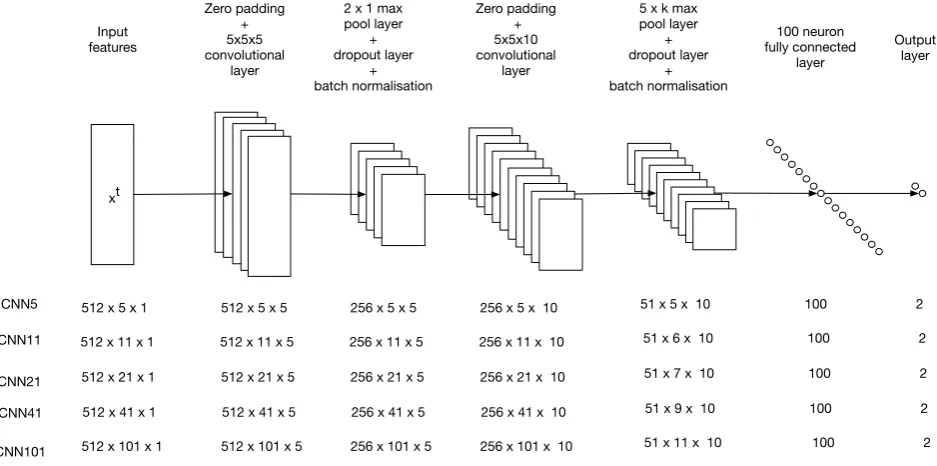
Figure 3 gives an overview of the implemented CNN architecture. The input features are first fed into two sets of convolutional and max pooling layers containing dropouts and batch normalisation. The output is then reshaped into a one-dimensional format before being run through a fully-connected layer and a softmax output layer.
2.1 Convolutional and max pooling layers
The output h of a two-dimensional convolutional layer with a rectified linear unit transfer function is calculated using:
hfij=r
L−1
X
l=0 M−1
X
m=0
Wmlf x(i+l)(j+m)+bf
!
(1)
where x is the input features, W and b are the shared weights and bias andf is the feature map. LandM are the dimensions of the shared weight matrix andI andJ
are the output dimensions of that layer. The equation for the rectifier linear unit transfer functionris:
r(φ) =max(0, φ) (2)
Zero padding + 5x5x5 convolutional
layer
2 x 1 max pool layer
+ dropout layer
+ batch normalisation
Zero padding + 5x5x10 convolutional
layer
xt Input features
5 x k max pool layer
+ dropout layer
+ batch normalisation
100 neuron fully connected
layer
Output layer
CNN5
CNN11
CNN21
CNN41
CNN101
512 x 5 x 1 512 x 5 x 5 256 x 5 x 5 256 x 5 x 10 51 x 5 x 10 100 2
512 x 11 x 1 512 x 11 x 5 256 x 11 x 5 256 x 11 x 10 51 x 6 x 10 100 2
512 x 21 x 1 512 x 21 x 5 256 x 21 x 5 256 x 21 x 10 51 x 7 x 10 100 2
512 x 41 x 1 512 x 41 x 5 256 x 41 x 5 256 x 41 x 10 51 x 9 x 10 100 2
512 x 101 x 1 512 x 101 x 5 256 x 101 x 5 256 x 101 x 10 51 x 11 x 10 100 2
Figure 3: Overview of the proposed implemented CNN system with different input feature sizes.
2.2 Fully-connected layer
A fully-connected layer consists of neurons which are linked to all of the neurons in previous and future layers. The output Y of a fully connected layer with a rectified linear unit transfer function is calculated using:
Y =r(Wcz+bc) (3)
where z is the input, Wc is the weight matrix andbc is the bias. For the softmax output layer the rectified linear unitrtransfer function is swapped for the softmax function which is calculated using:
sof tmax(φ) = e
φ
Peφ (4)
2.3 Implementation
The CNN was implemented using the Tensorflow Python library (Abadi et al., 2016) with training data consisting of target activation functions created from ground truth an-notations. A frame-based approach was taken where each frame is assigned 1 if it contains an onset or 0 if it does not.
2.4 Input features
Before processing by the CNN, the audio files must be seg-mented into frame-wise spectral features. An N sample length audio file was segmented intoTframes using a Han-ning window ofγ samples (γ = 1024) and a hop size of
γ
2. A frequency representation of each of the frames was
then created using the discrete Fourier transform resulting in a γ2 byT spectrogram. Various centred on the frame to be classified.
As classification is performed on the frame at the centre of the input features, a potentially crucial parameter is the
number of input framesψ. To determine the most efficient number of frames to use as the input for the CNN, five different values forψwere used (ψ= [5,11,21,41,101]) creating theCNN5,CNN11,CNN21,CNN41,CNN101versions respectively.
2.5 Layer sizes
The layer sizes used for the different input features are in-dicated at the bottom of Figure 3. The size of all layers are consistent across systems apart from the second dimension
kof the second max pooling layer.kis set to 1, 2, 3, 5 and 10 for the different input features sizes respectively.
2.6 Peak picking
The onsets must be temporally located from within the ac-tivation functionY output from the CNN. To calculate on-set positions, the method from Southall et al. (2016) is used. A threshold τ is first determined using the mean across all frames and a constantλ:
τ=λY¯ (5)
The current frametis determined to be an onset if its mag-nitude is greater than those of the surrounding two frames and above thresholdτ.
O(t) =
1, yt=max(yt−1:t+1) & yt> τ,
0, otherwise. (6)
Finally, if an onset occurs within25msseconds of another then it is removed.
2.7 Training
re-Player Album(s) Reels Jigs Polkas Hornpipes
Harry Bradley The First of May 8 4 4
Bernard Flaherty Flute Players of Roscommon Vol.1 2
John Kelly Flute Players of Roscommon Vol.1 1 1
Josie McDermott Darby’s Farewell 2 2 2
Catherine McEvoy Flute Players of Roscommon Vol.1,
Traditional Flute Playing in the Sligo-Roscommon Style 4
Matt Molloy Matt Molloy, Heathery Breeze, Shadows on Stone 5 2
Conal O’Grada Cnoc Bui 13 1 10
Seamus Tansey Field Recordings 4
Michael Tubridy The Eagle’s Whistle 2 9
John Wynne Flute Players of Roscommon Vol.1 3
Table 1: Dataset recordings showing player, album source and tune type.
gions from the feature matrix. The Adam optimiser is used to train the neural networks with an initial learning rate of 0.003. Training is stopped when the validation set ac-curacy does not increased between iterations. To ensure training commences correctly, the weights and biases are initialised to random non-zero values between ±1 with zero mean and standard deviation equal to one. The per-formance measure used is cross entropy and the dropout probabilitydis set to 0.25 during training.
3. EVALUATION
As the performance of the proposed method depends heav-ily on the accuracy of the chosen onset detection method, the aim of our first evaluation is to determine the quality of existing timing data. We then perform an evaluation of our onset detection method by comparing it against the most successful method found in Ali-MacLachlan et al. (2016).
3.1 Dataset
The corpus for analysis consists of 79 solo flute recordings by nine prominent traditional flute players. Four common types of traditional Irish tune are represented: reels,jigs, hornpipesandpolkas. Individual players are discussed in K¨ok¨uer et al. (2014) and players, tune type and recording sources are detailed in Table 1.
The dataset contains annotations for onset timing infor-mation and labels for notes, cuts, strikes and breaths, and is comprised of approximately 18,000 individual events. First notes of long rolls, short rolls and cranns were also identified and labelled.
3.2 Onset detection evaluation
The ground truth annotation process was completed using multiple tools as the project evolved (K¨ok¨uer et al., 2014; Ali-MacLachlan et al., 2015) resulting in inconsistencies being found in onset placement and labelling. We there-fore improved the quality of these annotations by compar-ing ground truth onsets against true positive and false neg-ative onsets obtained usingOnsetDetector(Eyben et al., 2010). Events outside a50mswindow of acceptance were evaluated by an experienced flute player, allowing events to
be checked for onset accuracy. Patterns containing impos-sible sequences of events were identified and eliminated by checking each event in context with previous and sub-sequent events.
To obtain the results for the OnsetDetector system on the updated dataset all tracks were processed with the output onset times compared against the annotated ground truth. We assess the accuracy relating to the
OnsetDetectormethod before and after annotation cor-rection and the number of spectrogram frames used as in-put.
We then evaluate theOnsetDetector system against the implemented CNN systems the dataset is divided by tracks into a 70% training set (55 tracks), 15% validation set (12 tracks) and 15% test set (12 tracks). The training set is used to train the five versions of the CNN (CNN5,
CNN11,CNN21,CNN41, andCNN101) onset detector using the different input feature sizes, the validation set is used to prevent over-fitting and the test set is used as the unseen test data. TheOnsetDetectorresults for the 12 test tracks are compared to the results from the 5 CNN versions. F-measure, precision and recall are used as the evaluation metrics with onsets being accepted as true positives if they fall within 25ms of the ground truth annotations.
4. RESULTS 4.1 Onset detection results
P R F
OnsetDetector
Before annotation improvement 83.06 75.10 78.75
OnsetDetector
After annotation correction 85.86 78.46 81.85
CNN5 87.06 84.71 85.73
CNN11 88.07 84.73 86.25
CNN21 88.82 88.26 88.46
CNN41 88.84 86.63 87.58
CNN101 88.72 86.21 87.32
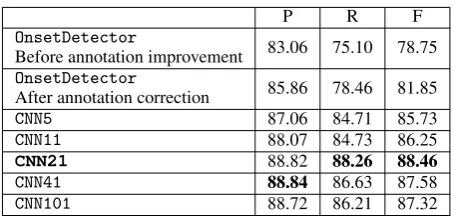
Table 2: Precision (P), Recall (R) and F-measure (F) for
OnsetDetector(Eyben et al., 2010) before and after an-notation improvement,CNN5,CNN11,CNN21,CNN41, and
True Positives Label
Code Musical Pattern Event Context
Onset
Detector CNN21 Total
111 notenotenote single notes 1097 1124 1184
211 notecutnote single cuts 229 269 310
121 cutnotenote single cuts 133 237 270
112 notenotecut single cuts 192 198 220
114 notenotebreath single notes 96 99 106
411 notebreathnote single notes with breath 21 53 88
311 notestrikenote single strike, end of roll 55 42 76
122 cutnotecut trill 13 48 63
141 breathnotenote single notes 55 56 61
131 strikenotenote single strike, end of roll 16 33 57
123 cutnotestrike rolls 14 33 36
261 notecutnote start of long roll 27 30 30
153 cutnotestrike start of short roll 8 22 24
511 notecutnote note before start of short roll 18 21 23
612 notenotecut note before start of long roll 20 20 21
142 breathnotecut breath before single cut 19 20 20
241 breathcutnote breath before single cut 12 17 19
412 notebreathcut breath before single cut 3 11 19
115 notenotecut two notes before start of short roll 16 17 18
271 notecutnote start of crann 15 16 18
116 notenotenote two notes before start of long roll 16 16 17
113 notenotestrike single strike 14 13 15
117 notenotenote two notes before start of crann 14 14 14
712 notenotecut note before start of crann 13 12 14
132 strikenotecut cut after roll 3 9 12
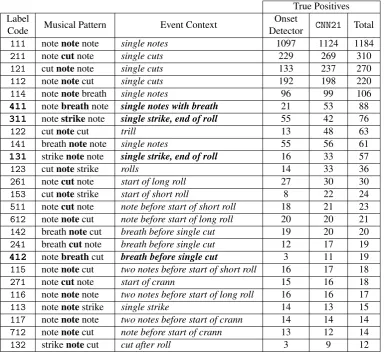
Table 3: Results comparing OnsetDetectorand CNN21onset detectors for all event classes in the context of events happening prior and subsequent to the detected onset. Label codes of patterns with under 70% accuracy forCNN21shown in bold. Patterns with under 10 total onsets omitted.
111 211 121 112 114 411 311 122 141 131 123 261 153 511 612 142 241 412 115 271 116 113 117 712 132
Label code
10 20 30 40 50 60 70 80 90 100
Accuracy
OnsetDetector CNN21
Figure 4: Accuracy ofOnsetDetectorandCNN21onset detectors for each event class above 10 onsets.
Table 2 presents the overall precision, recall and F-measure performance for the OnsetDetector and five CNN versions. The results indicate that all versions of the CNN achieve higher results than theOnsetDetector. The CNN21, which uses 10 spectrogram frames prior and
for theψparameter (ψ= [21,41,101]) are most appropri-ate for the task. The high performance of this approach is likely due to two factors. First, as CNNs are capable of processing large input feature sizes, they incorporate more context into the detection of a single frame. Second, as the CNNs are trained solely on traditional flute signals there is less variation in the represented classes, which has the potential of improving accuracy.
4.2 Note, cut and strike onset detection accuracy Table 3 presents the onset detection results for each class of musical pattern with over 10 onsets in the test cor-pus of 12 tunes. The mean pattern precision across all classes was 79.22 forCNN21in comparison with 59.86 for
OnsetDetector.
The classes consist of three event types where the cen-tral event is identified in bold. For example, label code 211 (notecutnote) is a detected cut with a note before it and note after it, which exists within the event context of short and long roll or a single cut. The number of correctly de-tected onsets (true positives) is found as a percentage of the overall number of annotated onsets of that pattern. Label codes with an accuracy of less that 70% are shown in bold.
Notes Cuts Strikes Breaths
OnsetDetector 76.31 77.78 72.37 19.83
CNN21 89.57 91.29 55.26 59.06
Table 4: Accuracy ofOnsetDetector andCNN21 onset detectors for note, cut, strike and breath classes above 10 onsets.
As can be seen in Figure 4 and Table 3, low accura-cies were found for strikes and notes following strikes. As a strike is played by momentarily tapping a finger over a tonehole, the pitch deviation is often much smaller than that of a cut and the event time is often shorter, making it more difficult to detect. Breaths are also difficult to de-tect in commercial recordings because it is usual to apply a generous amount of reverb effect at the mixing stage, re-sulting in a slow release masking a defined offset. Table 4 further illustrates inaccuracies in the detection of strikes and breaths by showing the accuracy for each single event class - note, cut, strike and breath. The note class also in-cludes the notes at the start of ornaments such as long roll and crann and the cut class includes cuts at the start of short rolls.
5. CONCLUSIONS AND FUTURE WORK In this paper, we have presented an onset detection method based a convolutional neural network (CNN) and is trained solely on Irish flute recordings. The results from the eval-uation show that this method outperformed the existing state-of-the-art generalised trained OnsetDetector. We have also improved the annotations of a ITM dataset by employing a process of automatic onset detection followed by manual correction as required. To evaluate the effec-tiveness of this approach, the top performing CNN version
(CNN21) method is compared to the OnsetDetector by (Eyben et al., 2010), most successful method found in Ali-MacLachlan et al. (2016).
In future research, we aim to develop note and orna-ment classification methods with additional features and attempt other neural network architectures in order to cap-ture trends that appear in time-series data. We plan to re-lease a corpus of solo flute recordings that will allow a deeper study into differences in playing style, and to ex-tend this corpus to include other instruments. We also plan to investigate the generality of the proposed system to other instruments characterised by soft onsets such as the tin whistle and fiddle. The dataset used in this paper will also be released shortly, alongside K¨ok¨uer et al. (2017).
6. REFERENCES
Abadi, M., Agarwal, A., Barham, P., Brevdo, E., Chen, Z., Citro, C., Corrado, G. S., Davis, A., Dean, J., Devin, M., & others (2016). Tensorflow: Large-scale machine learn-ing on heterogeneous distributed systems.CoRR.
Ali-MacLachlan, I., K¨ok¨uer, M., Athwal, C., & Janˇcoviˇc, P. (2015). Towards the identification of Irish traditional flute players from commercial recordings. InProceedings of the 5th International Workshop on Folk Music Analysis, Paris, France.
Ali-MacLachlan, I., Tomczak, M., Southall, C., & Hockman, J. (2016). Note, cut and strike detection for traditional Irish flute recordings. InProceedings of the 6th International Workshop on Folk Music Analysis, Dublin, Ireland.
Beauguitte, P., Duggan, B., & Kelleher, J. (2016). A Corpus of Annotated Irish Traditional Dance Music Recordings: Design and Benchmark Evaluations.
B¨ock, S. & Widmer, G. (2013). Local Group Delay Based Vibrato and Tremolo Suppression for Onset Detection. InProceedings of the 14th International Society for Mu-sic Information Retrieval Conference (ISMIR), (pp. 589– 594)., Curitiba, Brazil.
Boullier, D. (1998).Exploring Irish Music and Dance. Dublin, Ireland: O’Brien Press.
De Cheveign´e, A. & Kawahara, H. (2002). YIN, a fundamental frequency estimator for speech and music.The Journal of the Acoustical Society of America,111(4), 1917–1930.
Eyben, F., B¨ock, S., Schuller, B., & Graves, A. (2010). Univer-sal Onset Detection with Bidirectional Long Short-Term Memory Neural Networks. InProceedings of the Interna-tional Society for Music Information Retrieval Conference (ISMIR), (pp. 589–594)., Utrecht, Netherlands.
Gainza, M., Coyle, E., & Lawlor, B. (2004). Single-note orna-ments transcription for the irish tin whistle based on onset detection.Proc Digital Audio Effects (DAFX), Naples.
Gainza, M., Coyle, E., & Lawlor, B. (2005). Onset detection using comb filters. New Paltz, New York, USA.
Ioffe, S. & Szegedy, C. (2015). Batch normalization: Acceler-ating deep network training by reducing internal covariate shift. CoRR,abs/1502.03167.
Janˇcoviˇc, P., K¨ok¨uer, M., & Baptiste, W. (2015). Automatic transcription of ornamented Irish traditional music using Hidden Markov Models. InProceedings of the Interna-tional Society for Music Information Retrieval Conference (ISMIR), (pp. 756–762)., Malaga, Spain.
Keegan, N. (2010). The Parameters of Style in Irish Traditional Music. Inbhear, Journal of Irish Music and Dance,1(1), 63–96.
Kelleher, A., Fitzgerald, D., Gainza, M., Coyle, E., & Lawlor, B. (2005). Onset detection, music transcription and orna-ment detection for the traditional irish fiddle. In Proceed-ings of the 118th AES Convention, Barcelona, Spain.
K¨ok¨uer, M., Ali-MacLachlan, I., Janˇcoviˇc, P., & Athwal, C. (2014). Automated Detection of Single-Note Ornaments in Irish Traditional flute Playing. InProceedings of the 4th International Workshop on Folk Music Analysis, Istanbul, Turkey.
K¨ok¨uer, M., Ali-MacLachlan, Islah, Kearney, Daithi, & Janˇcoviˇc, P. (2017). Curating and annotating a collection of traditional Irish recordings to facilitate stylistic analy-sis. Special issue of the International Journal of Digital Libraries (IJDL) on Digital Libraries for Musicology, un-der review.
K¨ok¨uer, M., Kearney, D., Ali-MacLachlan, I., Janˇcoviˇc, P., & Athwal, C. (2014). Towards the creation of digital library content to study aspects of style in Irish traditional mu-sic. InProceedings of the 1st International Workshop on Digital Libraries for Musicology, London.
Larsen, G. (2003). The essential guide to Irish flute and tin whistle. Pacific, Missouri, USA: Mel Bay Publications.
McCullough, L. E. (1977). Style in traditional Irish music. Ethnomusicology,21(1), 85–97.
Schluter, J. & B¨ock, S. (2014). Improved musical onset de-tection with convolutional neural networks. InAcoustics, speech and signal processing (icassp), 2014 ieee interna-tional conference on, (pp. 6979–6983). IEEE.
Southall, C., Stables, R., & Hockman, J. (2016). Automatic drum transcription using bi-directional recurrent neural networks. In Proceedings of the International Society for Music Information Retrieval Conference (ISMIR), (pp. 591–597)., New York City, United States.