ANALYSIS OF THE ROLE OF MICROFINANCE BANKS ON THE
DEVELOPMENT OF SMALL AND MEDIUM SCALE ENTERPRISES IN NIGERIA.
Dr. Emmanvitalis Ifediba
Department of Marketing, Madonna University
Nigeria
Abstract
This study analyzed the role of Microfinance Banks in the development of small and medium enterprises in five selected communities in Anaocha L.G.A of Anambra State, Nigeria. The study used questionnaire to elicit information from a sample of 109 staff of both Microfinance Banks and small and medium scale enterprises in the study area. The Chi-square statistical tool was applied to determine the magnitude of discrepancy between the variables, expectation and observations. The test was carried out at 5% level of significance. The result obtained indicates that SMEs do encounter problems in the procurement of loans from commercial banks in the study area, government policies have favored SMEs and SMEs have knowledge of Microfinance Banks in the study areas. Hence the study recommended that government at all levels can intervene in reducing the restrictive requirements and high interest rates of financial institutions by providing funding to the SMEs through a state bank with low interest rates and restrictions.
Keywords- Microfinance Bank, Small and Medium Enterprises, Government Policies, Chi-square, Commercial Banks.
INTRODUCTION
Small and Medium Scale Enterprises in Nigeria constitutes a greater percentage (75%) of all the registered companies in Nigeria. They have been in existence for a long t ime as majorit y o f SMEs' grew from Cottage Industries. The operations of SMEs' are found in all the areas of human endeavours: Manufacturing, Production, information, Services, Agriculture, Hotel and Restaurants, Financial Intermediation, Real Estate, Education, Building and Constructions, Mining and Quarrying. For SMEs' to operate in these sub-sectors of the
GE-International Journal of Management Research ISSN (O): (2321-1709), ISSN (P): (2394-4226) Vol. 7, Issue 11, November 2019 Impact Factor: 5.779 © Association of Academic Researchers and Faculties (AARF)
economy, they are not left without controls. Federal government through the apex bank (CBN) monitors the activities of SMEs to ensure that they work in line with the set standards in other countries. The government set several agencies like small and medium scale industries equity investment schemes (SMIEIS),small and medium enterprise development agency(SMEDAN), Nigerian agricultural Cooperative and rural development bank,(NACRDB), Bank of industry(BOI), Nigerian bank for commerce and industry(NBCI), Nigerian industrial development Bank (NIDB). They are set to moderate, monitor, finance and control SMEs' to ensure that they are resurrected to be the major driver of our economic development and growth (Onugu, 2005).
A major/remarkable breakthrough in small scale business came about through the indigenization Decree 2002 and later in Nigeria Enterprise Promotion Act 2007. These were genuine attempts by the Federal Government to make sure that Nigerians play an active and worthwhile role in the development of the economy. In the National Development Plan, the Federal government gave special attention :o the development of small scale industries particularly in rural areas. This was in recognition of the roles of small and medium scale industries, as the seedbeds and training grounds for entrepreneurs. Nigerians need to take a cue from economic history, which is well stocked with enough insight into the humble beginnings of the present day giant conglomerates which started as small scale outfit. Within this decade, the government policy measures placed emphasis on the technological development of small scale industries in Nigeria. Various governments embarked on corrective measures to focus efforts towards the maximum exploitation of natural resources, and tried to discourage capital intensive mode of production in the light of the abundant resources available
seriousness, the federal government through its educational agencies like the National Board for Technical Education (NBTE), the Nigerian University commission (NUC), and the National youths Service Corps (NYSC) programme
gave directives that entrepreneurial development courses be incorporated into the curricular of tertiary institutions and NYSC program.
1.2 Statement of the Problem
SMEs represent a veritable vehicle for the achievement of National Economic objectives:
Employment generation, value added, rural development acceleration, stimulation of
entrepreneurship vital links between agriculture and industries, supply parts and components
to large scale industries (LSI), contribute to domestic capital formation (Anyanwu, 2001).
Despite incentives, polices, programmes and support by the government aimed at revamping
SMEs, they have performed rather below expectations in Nigeria (Salam, 2012). Why? To
address the above, this study embarked to identifying the various problems faced by SMEs in
the procurement of loans from commercial banks, the effect of government policies on SMEs
as well as the contribution of SMEs towards the growth and development of Nigeria’s
economy
Objective of the study
The main objective of this study is to determine the degree of accessibility of credit facilities from Microfinance Institute by Small and Medium scale Enterprises from five selected SMEs in Anaocha L.G.A, Anambra State.
Specific Objectives
1. Determine whether SMEs encounter problems toward accessing Microfinance loan in Anaocha L.G.A
2. Determine whether Government policies favoured SMEs in Anaocha L.G.A 3. Determine whether SMEs have knowledge about MFBs in the studied Area.
4. To find out the best and most efficient way of handling these factors with a view of finding solutions
Research Questions
The following research questions were formulated to guide the research objective;
2. Have government policies favored SMEs?
3. Do SMEs have knowledge about Microfinance Banks?
4. What are the possible solutions to these factors influencing SMEs?
Statement of the Hypothesis
Ho1: To a large extent SMEs do not encounter problems in the procurement of loans from commercial banks.
Ho2: To high degree government policies have not favoured small and medium enterprises in Anaocha Local Government Area.
Ho3: To high degree SMEs have no knowledge about MFB in the Anaocha L.G.A
2. Literature Review
The former CBN Governor, (Soludo, 2010) stated that government can provide funding to the SMEs either through the direct provision of funds through a state bank, or through the provision of funds which are leveraged by private sector investors. Both forms of intervention are common across developing countries. In as much as we observed that the effect of government policies is of a greater effect in developed nations (Japan, Russia and America etc) where the small and medium scale enterprises are the pivot of national development and transformation.
We observe that the importance of some policies as regards to the SMEs in Nigeria cannot be over emphasized. This is because the government has the powers to make out laws, rules and regulations and such must be carried out by even the financial institutions. The security and enabling environments are not off from what the government can do to ensure that SMEs thrive well and become the pivot of the national development just like the developed nations. The CBN (2012) statistics reported that commercial banks advances to SMEs have been on the decline over the years. Commercial bank loans to SMEs as a percentage of total credits decreased from 48.79% in 1992 to 0.15% in 2010.
Agbaje and Abiodun (2015) posit that it is important to note that the development of entrepreneurs cannot be over emphasized the role they play in economic development and how they are financed through both formal and informal sources. The development experience indicates that SMEs can meaningfully contribute to the attainment of many development objectives. These include output expansion, employment generation. Jegede (1990) observed in the early 1970s and according to a survey conducted by center for industrial Research and Development (CIRD), that small and medium scale enterprises concentrated on narrow range of activities with garment making and allied activities accounting for more than 50% of the total number of small and medium scale enterprises (SMEs). Compared with the position of large enterprises, the provision of finance to SMEs by lending institutions can be problematic for a number of reasons.(Berger and Udell. 2006)
3. Research Methodology
This study is a survey research covering the five selected SMEs in Anaocha Local Government Area in Anambra state. Anaocha Local Government Area is one of the twenty-one local government area in Anambra state, and the towns that make up the Local Government Area are; Neni, Adazi-Enu, Adazi-Nnukwu, Aguluzigbo, Ichida, Obeledu, Nri, Adazi-Ani, Agulu and Akwaeze. The target population for this study consists of respondents randomly selected from five SMEs in Anaocha L.G.A, which are Adazi-Nnukwu, Aguluzigbo, Ichida, Obeledu, and Nri.
The sample size for the research using Taro Yamani formula is 109 comprising of 100 SMEs staff and 9 bank staff under study in the L.G.A, Anambra State.
The data for the study were collected using questionnaires. Two sets of questionnaires were distributed because the research involved two study groups: SME's and microfinance bank officials.
Method of Data Analysis
The responses gotten from the questionnaires were presented in tabular forms. The responses were converted to frequencies and percentages. Interpretation was based on the findings and the research question of the study. The hypothesis formulated in this work was tested with the use of chi-square method, which shows the magnitude of the discrepancy between the variables, expectation and observation. The test was carried out at 5% level of significance. In this study, a field survey was carried out to ensure the reliability of the instrument used for the study. Here, a measure of reliability called Cronbach’s Alpha was employed. Cronbach's Alpha ranges in value from 0 to I. A coefficient equal to or greater than 0.6 is considered a minimum acceptable level, although some authorities argued for a stronger standard of at least 0.70. The internal consistency for this instrument is considered high and acceptable given a result of 0.76.
4. Findings of the study
Table 1 Respondent's opinion on whether SMEs encounter problems towards accessing Microfinance loan.
Responses Frequency Percentage (%)
Strongly Agree 21 19
Agree 64 59
Undecided 16 15
Disagree 8 7
Strongly Disagree
Total
0
109
0
100 Source: Field survey, (2019).
[image:7.595.71.510.342.514.2]The above table indicates that (19%) of the respondents strongly agree that small scale business encounter problems in accessing microfinance loan. (59%) Agreed, (15%) undecided while (7%) disagree
Table 2: Respondent's opinion on whether government policies favoured SMEs
Responses Frequency Percentage (%)
Strongly Agree 12 11
Agree 46 42
Undecided 45 41
Disagree 6 6
Strongly Disagree 0 0
Total 109 100
Source: Field survey, (2019).
[image:7.595.70.522.668.743.2]The above table shows results regarding whether government policies favoured SMEs. About (11%) strongly agreed while (42%) agreed, (41%) undecided and (6%) disagree.
Table 3 Respondent's opinion based on the Awareness of Government loan scheme (%). The aim of this subsection was to evaluate how well the SMEs have information about Government loan scheme
Variables Responses Frequency Percentage (%)
Awareness of Govern- Yes 70 64.2
Micro entrepreneurs
Total 109 100
Source: Field survey, (2019).
Table 3 shows how well the respondents have information on government loan schemes to micro entrepreneurs. About (64.2%) have heard about government loan scheme while (35.8%) indicated that they have not heard.
Table 4 Respondent's opinion based on whether they have benefited from any
Government loan scheme (%)
Variables Responses Frequency Percentage (%)
Benefited from Govern- Yes 24 22
ment loan scheme on No 85 78
Micro entrepreneur
Total 109 100
Source: Field survey, (2019).
Table 4 shows how the respondents have benefited from government loan schemes to micro entrepreneurs. About (22%) have benefited from government loan scheme while (78%) indicated that they have not benefited.
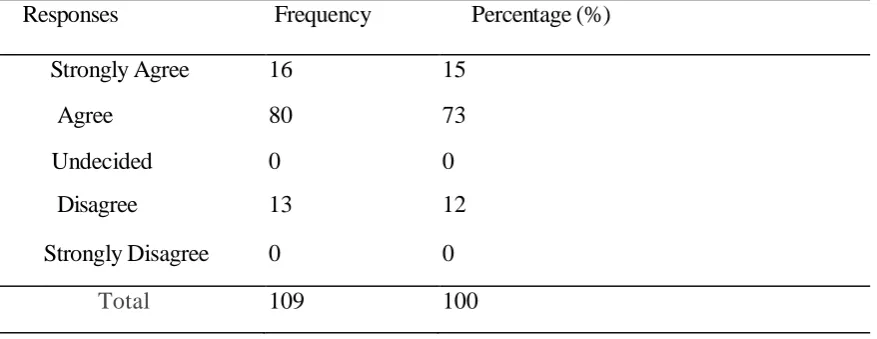
Table 5 Respondent's opinion based on whether they have knowledge about MFB in the studied area.
Responses Frequency Percentage (%)
Strongly Agree 16 15
Agree 80 73
Undecided 0 0
Disagree 13 12
Strongly Disagree 0 0
Total 109 100
[image:8.595.76.510.250.376.2] [image:8.595.72.511.522.691.2]Table 5 shows how well the respondents have knowledge about MFB. Out of 109 respondents, about (15%) strongly agree, while (73%) agree and (12%) disagree. This may be because MFB are sparingly located and this creates gap between SMEs and MFBs.
Table 6Distribution based on level of Borrowing (%)
Variables Responses Frequency Percentage (%)
Have you borrowed Yes 24 22
From MFBs No 85 78
Total 109 100
Table 6 shows that (22%) have borrowed while (78%) have not. Reason could be that the majority of those who accessed credit from MFBs only did that once, though some indicated that they have borrowed more than once.
Table 7 Distribution of Respondents based on Reasons for Borrowing
Variable Responses Frequency Percentage (%)
If yes, what was the
Start/ Expand Business
40 36
Loan for?
Pay off debt 35 32
Education 24 22
Others 10 10
Total 109 100
Source: Field survey, (2019).
Table 7 shows the respondents reasons for borrowing. About (22%) used theirs to sponsor their wards/children in school
[image:9.595.71.533.607.725.2]Majority used loan for starting or expanding their enterprise which is a welcomed development.
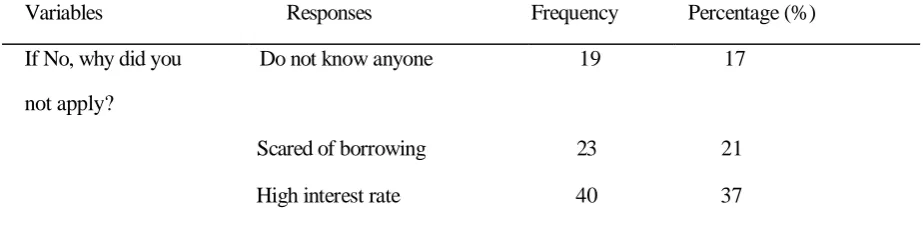
Table 8 Distribution of Respondents based on Reasons for not Borrowing
Variables Responses Frequency Percentage (%)
If No, why did you Do not know anyone 19 17
not apply?
Scared of borrowing 23 21
Loan was not necessary 25 23
Other reasons 2 2
Total 109 100
Source: Field survey, (2019).
[image:10.595.71.532.290.487.2]The micro entrepreneurs who indicated that they have not been able to access credit facility from MFBs were asked to indicate reasons why they were not able to access credit. Table 8 shows that majority of the respondents about (37%) believed that the interest charged on MFBs loans were too high for them to pay and still make profit from their business. 25 respondents (23%) believe that the loan was not necessary and so did not go for it, (21%) indicated that they were scared of borrowing from any financial institution while 2% indicated other reasons.
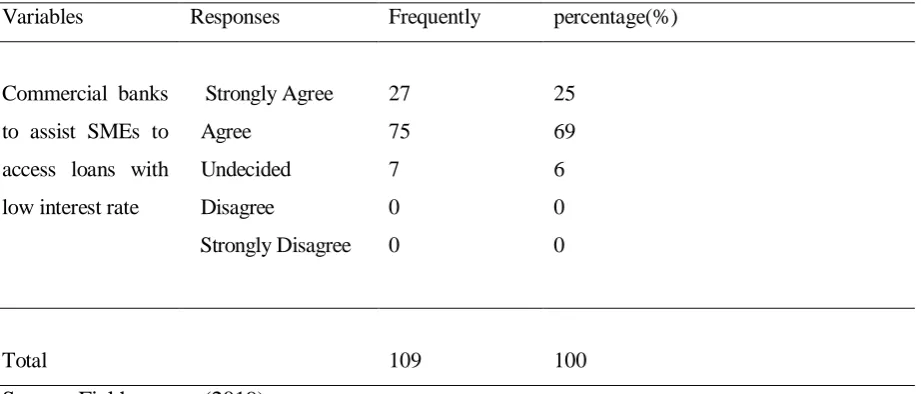
Table 9: Respondents opinion on the best solution for SMEs
Variables Responses Frequently percentage(%)
Commercial banks to assist SMEs to access loans with low interest rate
Strongly Agree Agree
Undecided Disagree
Strongly Disagree 27 75 7 0 0
25 69 6 0
0
Total 109 100
Source: Field survey, (2019).
Table 9 above shows respondents opinion on solution they considered best. About (25%) strongly agree that commercial banks should assist SMEs to access loans at low interest rate, (69%) agreed, (7%) were undecided.
Hypothesis One
Hoi: To a large extent SMEs do not encounter problems in the procurement of
loans from commercial banks.
Table 10: Result on the Chi-square test on the Research Question
Variables X2 Degrees of freedom p-value
Table 1 25.19 12 21.026
Tables 2&5 72.64 20 31.410
Decision
The decision rule state that null hypothesis should be rejected if the chi-square calculated (25.19) is greater than the critical value of chi-square (21,026), otherwise accept. Since the computed chi-square is greater than the critical value of chi-square, we reject the null hypothesis and accept the alternate hypothesis which states that the SMEs do encounter problems in the procurement of loans from commercial banks.
Hypothesis Two
Ho2: To high degree government policies have not favoured small and medium enterprises in Anambra State.
Ho3: To high degree SMEs have no knowledge about MFB in the Anaocha L.G.A In testing
this hypothesis, responses from table 2 &5.
Decision
The decision rule states that null hypothesis should be rejected if the chi-square calculated (72.64) is greater than the critical value of chi-square (31.410), otherwise accept. Since the computed chi-square is greater than the critical value of chi-square, we reject the null hypothesis and accept the alternate hypothesis which states that government policies have favoured small and medium enterprises and SMEs have knowledge of MFB in Anaocha L.G.A Anambra State. The chi-square result shows that amongst the numerous problems facing SMEs in Nigeria, that the greatest of all of them is access to credit facilities.
SMEs fail to secure loans because of restrictive requirements of the financial institutions, top among them being collateral security.
This is due to lack of tangible assets like land, which are used as assets to secure credits. Also the result of the chi-square analysis shows that government policies significantly favour SMEs in Nigeria.
[image:11.595.82.445.57.121.2]policies is of a greater effect in developed nations (Japan, Russia and America etc) where the small and medium scale enterprises are the pivot of national development and transformation.
5. Conclusion
Our result shows that accessibility of credit facility from financial institutions by SMEs in Nigeria has been bedeviled by many problems. This is evident in the responses from the questionnaires to the SMEs operators in the manufacturing sector of the economy. The resultant effect is that there is poor accessibility of credit facility from the financial institutions. There is indeed a great need for our government to wake up to the responsibility of providing avenues that will make funds available and accessible to the sub-sector in addition to providing enabling environments, upgraded infrastructures and favourable policies. These will not only give opportunity for SMEs to grow but will become the greatest pivot and driver of national development. Our focus and strengths should be drawn from other developed nations across the globe that supported SMEs and it worked for them.
The financial institutions on the other hand should not be allowed by government to abuse the extant rules and laws that affect the small and medium scale enterprises. The government must as a matter of urgency react to the abuse of these rules and laws so that they will be reduced to the barest minimum. For instance, in other to generate widespread interest in the scheme and maximize its development impact, a reasonable portion of the money set aside should be used to give working capital loans at interest rates that are in tune with the viability of SMEs.
6. Recommendations
Having highlighted the problems and shortcomings of the small and medium enterprises (SMEs) in Nigeria, the following recommendations aimed at correcting
managerial resources to various kinds of small enterprises customers. This would assist them in project preparation, implementation, financing and management. At the same time, small scale enterprises can avail themselves to such services provided by the government at the entrepreneurial development centre. In order to make credit available to SMEs sector, the banks and the government should make use of the rural banking program. The branches of each bank in the rural community should be given free hand to take certain decisions concerning advancement of these loans and advances to rural small scale enterprises. They should be able to act as 'management consultants' identifying problems and suggesting solutions.
Banks would also need to be encouraged to find the working capital requirements of SMEs. In the face of limitations and inadequacies already enumerated in this project, small size enterprises are high risk for banks to lend. Consequently, part of the government programs for small enterprises would be to devise a means of providing incentives and management to banks to be able to freely lend to small enterprises.
Central bank of Nigeria (CBN) should license more micro finance banks to be able to extend more loans to small and medium enterprises. We also recommend that SMEs should not base only in urban areas. This is because the numbers of small enterprises in urban areas are alarming and commercial banks cannot give loans to all. This is why they should be encouraged to reside more in rural areas i.e rural small enterprises should be encouraged. If this is achieved, the government should ensure that it provides more infrastructural facilities in rural areas so as not to discourage these small businesses in achieving their objectives.
Finally, a major impediment to growth generally in Nigeria has been the state of economic and social infrastructure. This has been an over-flogged issue in the discussion of Nigeria's economic development. Provision of necessary infrastructural facilities and the enabling environment for business operations generally is an imperative. Uninterrupted power supply, good roads and transportation networks, rural development communication etc. are the basis to competitive performance of enterprises. Their provision will definitely reduce the funding needs of small enterprises as they would no longer require funds to provide electricity, water, telephone and other infrastructures on their own.
REFERENCE
Agbaje, Abiodun R, Osho(2015); Commercial Banks Roles In Financing Small Scale Industries In Nigeria": European Journal Of Accounting, Auditing And Finance Research Vol.3 Pg 52-69.
Anyanwu, C.M. (2001J). ''Financing and Promoting SSI, concept issues and prospects. CBN Bullion Publication. Vol. 25, No 3, Pp. 12-15,
Berger, A.N. and Udell, G.F. (2006). "A More Complete Conceptual Framework for SME Finance'', Journal of Banking & Finance, 30(11), pp. 2945-2966.
CBN (2010) SMEs in Nigeria. Retrieved on 11/1/11 from http://www.cenbank.org
CBN (2011 ). Development finance. Retrieved on the 11th of January, 2011 from http://www.cenbank.org
CBN (2012 Development finance. Retrieved http://www.cenBank.org/devfin/acgst.asp. Central Bank of Nigeria (2QOO/ "The Changing Structure of the Nigerian Economy
and implication for Development. Realm communication Ltd, Lagos.
Jegede, C.T. (1990), "The Development of the Small and Medium Scale Industry in Nigeria, Management in Nigeria -journal of NIM, vol. 26, No. 3 May/June.
Nnanna, G. (2005), "SMEDAN explains un-development of SME sub-sector". Small Business journal. Business .Day Media Lagos.
Nofsinger, J.R. and Wang, W.(2011). Determinants of Start-up Firm External Financing
Onugu, B.A. (2005), "SMEs in Nigeria: Problems & Prospects" Dissertation paper presented to clement University, Lagos,
Salami, A.T. (2003), "Guideline and Stakeholders Responsibility" in SMIEIS: A seminar paper from Development dept., CBN.
Storey, DJ. and Thompson, J. (1995). "The Financing of New and Small Enterprises
in OCED Countries, Paris, OECD.