© 2018 IJSRST | Volume 4 | Issue 2 | Print ISSN: 2395-6011 | Online ISSN: 2395-602X Themed Section: Science and Technology
A Review on Using Crow Search Algorithm in Solving the
Problems of Constrained Optimization
B. Surya Samantha , M. Trupthi, U. Sairam
Assistant Professor Department of Information Technology, CBIT, Hyderabad, Telangana , India
ABSTRACT
This paper proposes a novel metaheuristic optimizer, named crow search algorithm (CSA), based on the wise conduct of crows. CSA is a population-based technique which works based on this thought crows store their abundance sustenance secluded from everything places and recover it when the nourishment is required. CSA is connected to improve six constrained engineering design problems which have diverse natures of target capacities, requirements and choice factors. Simulation results uncover that utilizing CSA may prompt finding promising results contrasted with alternate algorithms.
Keywords: Constrained Engineering Optimization, Metaheuristic Optimization, Crow Search Algorithm.
I.
INTRODUCTION
Engineering design is characterized as a decision making procedure to construct items that fulfill indicated needs. Frequently, building design problems incorporate entangled target capacities with countless variables. The doable arrangements are the arrangement of all designs portrayed by every single conceivable estimation of the design parameters (decision variables). An optimization technique tries to locate the ideal arrangement from all accessible plausible arrangements. Traditional search techniques have for quite some time been connected to take care of engineering design problems. In spite of the fact that these strategies find promising results in numerous genuine problems, they may flop in more mind boggling design problems. In genuine design problems, the quantity of decision variables can be extensive and their impact on the target capacity can be extremely convoluted. The target capacity may have numerous neighborhood optima, while the designer is occupied with the worldwide ideal. Such problems can't be taken care of by traditional
following: genetic algorithm (GA) based on normal determination [6], molecule swarm optimization (PSO) based on social conduct of feathered creature rushing and fish tutoring [7], harmony search (HS) based on music act of spontaneity process [8], cuckoo search algorithm based on the brood parasitism of some cuckoo species [9], bat algorithm (BA) based on echolocation conduct of microbats [10], bunch search optimizer (GSO) based on creature searching conduct [11], firefly algorithm (FA) based on the blazing light examples of tropic fireflies [12], and so forth. To date, researchers have just utilized an extremely restricted qualities propelled by nature and there is space for improvement of more algorithms. One of the primary inspirations of this paper is to build up an easy to use (straightforward idea and simple execution) metaheuristic technique by which we may get promising results when tackling optimization problems.
Crows are generally appropriated variety of feathered creatures which are presently considered to be among the world's most wise creatures [13,14]. As a gathering, crows demonstrate wonderful cases of insight and frequently score exceedingly on knowledge tests. They can retain faces, utilize apparatuses, convey in complex ways and stow away and recover nourishment crosswise over seasons [13,15].
In a crow run, there is a conduct which has numerous likenesses with an optimization procedure. As indicated by this conduct, crows conceal their abundance sustenance in specific positions (concealing spots) of the earth and recover the put away nourishment when it is required. Crows are avaricious winged creatures since they take after each other to acquire better sustenance sources. Discovering sustenance source covered up by a crow isn't a simple work since if a crow finds another is tailing it, the crow tries to
trick that crow by heading off to another position of the earth. From optimization perspective, the crows are searchers, the environment is search space, each position of the earth is comparing to an achievable arrangement, the nature of sustenance source is objective (wellness) work and the best nourishment wellspring of the earth is the worldwide arrangement of the issue. Based on these comparativeities, CSA endeavors to recreate the insightful conduct of the crows to discover the arrangement of optimization problems.
II.
CROW SEARCH ALGORITHM
Crows live as run.
Crows retain the position of their concealing spots.
Crows take after each other to do burglary.
Crows shield their reserves from being stolen by a likelihood.
It is accepted that there is a d-dimensional condition including various crows. The quantity of crows (rush size) is N and the position of crow I at time (cycle). At cycle iter, the position of concealing spot of crow i is appeared by mi;iter. This is the best position that crow I has acquired up until now. For sure, in memory of each crow the position of its best experience has been remembered. Crows move in nature and search for better sustenance sources (concealing spots).
State 1: Crow j does not realize that crow I is tailing it. Accordingly, crow I will way to deal with the concealing spot of crow j. In this
xi;iterþ1 ¼ xi;iter þ ri × fli;iter × ðmj;iter — xi;iterÞ where ri is a random number with uniform
distribution between 0 and 1 and fli;iter denotes the flight length of crow i at iteration iter.
Figure 1 shows the schematic of this state and the effect of fl on the search capability. Small values
of fl leads to local search (at the vicinity of xi;iter) and large values results in global search (far
from xi;iter). As Figure 1(a) shows, if the value of fl is selected less than 1, the next position of crow i is on the dash line between xi;iter and mj;iter. As Figure 1(b) indicates, if the value of fl is selected more than 1, the next position of crow i
is on the dash line which may exceed mj;iter.
State 2: Crow j knows that crow i is following it. As a result, in order to protect its cache from
being pilfered, crow j will fool crow i by going to another position of the search space.
Metaheuristic algorithms ought to give a decent harmony amongst broadening and heightening [2]. In CSA, increase and broadening are principally controlled by the parameter of mindfulness likelihood (AP). By reduction of the mindfulness probability esteem, CSA tends to direct the search on a neighborhood area where an ebb and flow great arrangement is found in this district. Accordingly, utilizing little estimations of AP, builds escalation. Then again, by increment of the mindfulness likelihood esteem, the likelihood of searching the region of flow great arrangements reductions and CSA has a tendency to investigate the search space on a worldwide scale (irregularization). Thus, utilization of vast estimations of AP expands broadening.
III.
CSA IMPLEMENTATION FOR
OPTIMIZATION
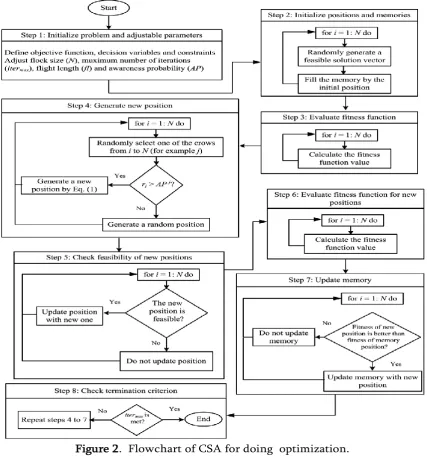
Pseudo code of CSA is appeared in Figure 2. The progression savvy methodology for the usage of CSA is given in this area.
Stage 1: Initialize issue and flexible parameters The optimization issue, decision variables and limitations are characterized
(a) fl < 1
Stage 3: Evaluate wellness (objective) work
For each crow, the nature of its position is processed by embeddings the decision variable esteems into the goal work.
Stage 4: Generate new position
Crows create new position in the search space as takes after: assume crow I needs to produce another position. For this point, this
crow (mj). The new position of crow I is gotten by Eq. (2). This procedure is rehashed for every one of the crows.
Stage 5: Check the attainability of new positions The attainability of the new position of each crow is checked. In the event that the new position of a crow is doable, the crow refreshes its position. Something else, the crow remains in the present position and does not move to the created new position.
Stage 6: Evaluate wellness capacity of new positions The wellness work an incentive for the new position of each crow is processed.
Stage 7: Update memory
Stage 8: Check end paradigm
Stages 4– 7 are rehashed until the point when itermax is come to. At the point when the termi-country rule is met, the best position of the memory as far as the target work esteem is accounted for as the arrangement of the optimization issue.
IV.
COMPARISON OF CSA WITH GA, PSO AND
HS
Like other algorithms, for example, PSO , GA and HS, CSA influences utilization of a population of searchers to investigate the search to space. By utilization of a population the likelihood of finding a decent solution and getting away from neighborhood optima increments. Notwithstanding pop-ulation size and most extreme number of cycles (ages), optimization algorithms have some different parameters which ought to be balanced. Parameter setting is one of the downsides of optimization algorithms since it is a tedious work. Algorithms which have less parameters to alter are less demanding to implement. In CSA, flight length and mindfulness likelihood ought to be tuned (2 parameters). In PSO algorithm the customizable parameters are idleness weight, greatest estimation of speed, singular learning component and social learning factor (4 parameters). HS requires the estimation of harmony memory thinking about rate, pitch changing rate and transfer speed of age (3 parameters). In GA, determination strategy, hybrid technique, hybrid likelihood, change technique, transformation likelihood and substitution technique ought to be resolved (6 parameters). In HS, another arrangement is acknowledged if its wellness esteem is
superior to the wellness of the most noticeably bad harmony of memory.
Like HS and PSO, CSA incorporates memory in which great arrangements are remembered. In PSO, every molecule is pulled in towards the best position at any point found without anyone else's input and the best position at any point found by the gathering. Therefore, at every cycle, the best arrangements discovered so far are straightforwardly utilized. At every emphasis of CSA, each crow chooses arbitrarily one of the run crows (it might act naturally) and moves towards its concealing spot (the best arrangement found by that crow). This implies at every emphasis of CSA, the best positions discovered so far are straightforwardly used to discover better positions.
V.
NUMERICAL EXAMPLES
Figure 2. Flowchart of CSA for doing optimization.
Figure 3. Schematic of three-bar truss design problem.
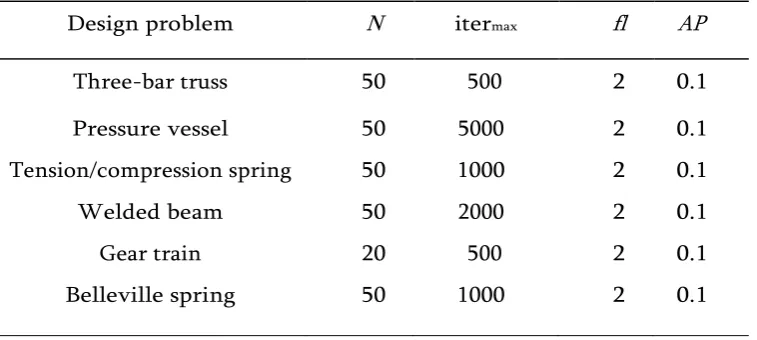
Table 1. Parameter setting of CSA for solving the design problems. Design problem N itermax fl AP
Three-bar truss 50 500 2 0.1
Pressure vessel 50 5000 2 0.1
Tension/compression spring 50 1000 2 0.1
Welded beam 50 2000 2 0.1
Gear train 20 500 2 0.1
Belleville spring 50 1000 2 0.1
Table 2. The best solution obtained by CSA for three-bar truss design problem.
Parameter x1 x2 f
Value 0.7886751284 0.4082483080 263.8958433765
Parameter g1 g2 g3
Value —1.687539e—14 —1.4641015952 —0.5358984048
Pressure vessel design problem
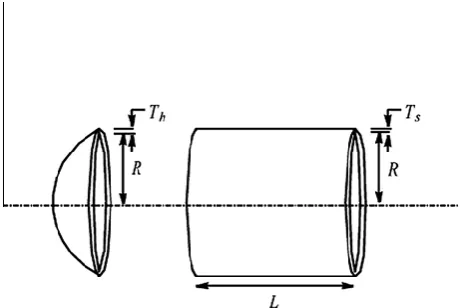
In this design issue, the objective is to limit the aggregate cost of a weight vessel including material, shaping and welding costs. As Fig. 6 appears, this optimization issue comprises of four decision variables: thickness of the shell (x1 or Ts), thickness of the head (x2 or Th), internal sweep (x3 or R) and length of the tube shaped segment of the vessel (x4 or L). Among the four decision variables, x1 and x2 are discrete (whole number increases of 0.0625 in) and x3 and x4 are continuous.
Table 4 shows the execution of the CSA on this issue. This table demonstrates the ideal estimations of the decision variables and the limitation esteems relating to the best arrangement acquired by CSA more than 50 autonomous runs. It can be seen that x1 and x2 are whole number duplicates of 0.0625 and x3 and x4 are in the conceivable range. Table 5 looks at the measurable results acquired by CSA and those got by alternate techniques for the writing which have
revealed attainable arrangements (particularly for x1 and x2).
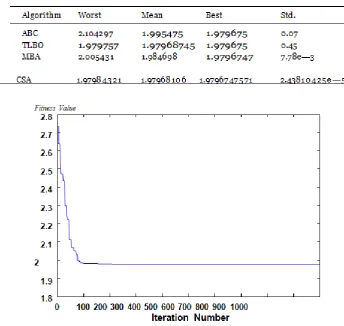
Figure 7 delineates the joining rate of the CSA for finding the best arrangement of the weight vessel issue. This figure demonstrates the estimation of best-so-far at every emphasis. It can be seen that the merging rate of CSA is great.
FitnessValue
Figure 4. Convergence rate of CSA for finding the best solution of three-bar truss
Figure 5. Schematic of the pressure vessel design problem.
Table 3. Comparison with statistical results obtained by CSA with other algorithms for three-bar truss design problem (50 runs).
Algorithm Worst Mean Best Std.
SC 263.969756 263.903356 263.895846 1.3e—2
PSO-DE 263.895843 263.895843 263.895843 4.5e—10 DSS-MDE 263.895849 263.895843 263.895843 9.72e—7
MBA 263.915983 263.897996 263.895852 3.93e—3
CSA 263.8958433770 263.8958433765 263.8958433765 1.0122543402e—10
Table 4. The best solution obtained by CSA for pressure vessel problem.
Table 5. Comparitive analysys of statistical results obtained by CSA and other algorithms for pressure vessel problem (50 runs). N.A. means not available.
Algorithm Worst Mean Best Std.
GA3 6308.4970 6293.8432 6288.7445 7.4133
GA4 6469.3220 6177.2533 6059.9463 130.9297
CPSO 6363.8041 6147.1332 6061.0777 86.45
HPSO 6288.6770 6099.9323 6059.7143 86.20
G-QPSO 7544.4925 6440.3786 6059.7208 448.4711
QPSO 8017.2816 6440.3786 6059.7209 479.2671
PSO 14076.3240 8756.6803 6693.7212 1492.5670
CDE 6371.0455 6085.2303 6059.7340 43.0130
UPSO 9387.77 8016.37 6154.70 745.869
PSO-DE N.A. 6059.714 6059.714 N.A.
ABC N.A. 6245.308144 6059.714736 205
(l + k)-ES N.A. 6379.938037 6059.701610 210
TLBO N.A. 6059.71434 6059.714335 N.A.
CSA 7332.84162110 6342.49910551 6059.71436343 384.9454163
Figure 6. Schematic of tension/compression spring design problem
Table 6. The best solution obtained by CSA for tension/compression spring problem.
Parameter x1 x2 x3 g1
Value 0.0516890284 0.3567169544 11.2890117993 —4.44089210e—
16
Parameter g2 g3 g4 f
Value —4.10782519e—15 —4.05378408 —0.72772934 0.0126652328
Table 7. Comparison of statistical results obtained by CSA and other algorithms for tension/compression spring problem (50 runs). N.A. means not available.
Table 8. The best solution obtained by CSA for welded beam problem.
Parameter x1 x2 x3 x4 g1 g2
Value 0.2057296398 3.4704886656 9.0366239104 0.2057296398 0 0
Parameter g3 g4 g5 g6 g7 f
Value 0 —3.43298379 —0.08072964 —0.23554032 —3.63797881 1.724852308
6
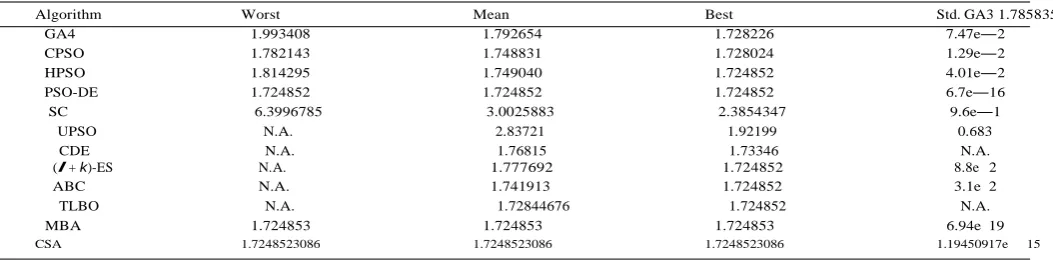
Table 9 .Comparison of statistical results obtained by CSA and other algorithms for welded beam problem (50 runs).
Algorithm Worst Mean Best Std. GA3 1.785835 1.12e—2
GA4 1.993408 1.792654 1.728226 7.47e—2
CPSO 1.782143 1.748831 1.728024 1.29e—2
HPSO 1.814295 1.749040 1.724852 4.01e—2
PSO-DE 1.724852 1.724852 1.724852 6.7e—16
SC 6.3996785 3.0025883 2.3854347 9.6e—1
UPSO N.A. 2.83721 1.92199 0.683
CDE N.A. 1.76815 1.73346 N.A.
(l + k)-ES N.A. 1.777692 1.724852 8.8e 2
ABC N.A. 1.741913 1.724852 3.1e 2
TLBO N.A. 1.72844676 1.724852 N.A.
MBA 1.724853 1.724853 1.724853 6.94e 19
CSA 1.7248523086 1.7248523086 1.7248523086 1.19450917e 15
HPSO
SC
Table 10. Comparison of statistical results obtained by CSA and other algorithms for gear train problem (50 runs).
Table 11. Comparison of statistical results obtained by CSA and other algorithms for Belleville spring problem (50 runs).
Figure 7. Convergence rate of CSA for finding the best solution of Belleville spring problem.
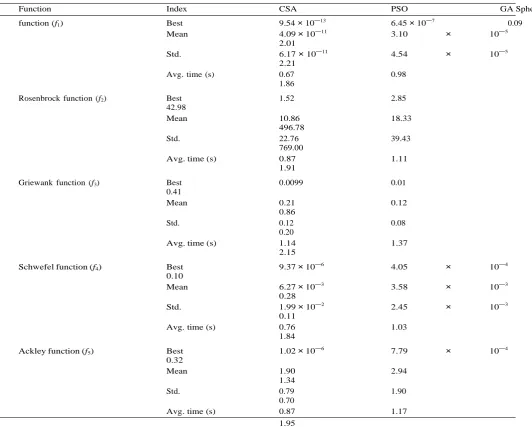
Despite the fact that the results got for the engineering problems demonstrate that CSA demonstrates a focused execution with the current strategies in the writing, yet, there exists an inquiry respect ing the execution of CSA in bigger scale problems. With a specific end goal to assess the execution of CSA on bigger scale optimization problems, five surely understood benchmark capacities appeared in Table 15 are tackled in 10 measurements. In CSA, as previously, AP and fl esteems have been set to 0.1 and 2, individually. In PSO, the speed is controlled and the learning factors (individual and social) are set to 2.
Also, the latency weight diminishes directly from 0.9 to 0.4 during cycles. In GA, curved hybrid (with the coefficients of 0.25 and 0.75), uniform transformation and competition choice are utilized. Hybrid and transformation probabilities are set to 0.9 and 0.005, individually. In CSA, PSO and GA, population measure is set to 20 and most extreme number of emphasess is chosen 2000. Thus, in the examinations, number of wellness assessments
(NFEs) is 40,000. Table 15 demonstrates the results got by CSA in examination with the results found by PSO and GA more than 30 free runs. It is seen, on every one of the capacities, CSA beats alternate algorithms as far as the best list. In this table, the normal time of the runs is appeared. It is seen that CSA expends less computational time than PSO and GA over same number of wellness assessments.
Table 13. Comparison of CSA, PSO and GA on test functions in 10 dimensions (30 runs). The parameters of AP and fl are set to 0.1 and 2, respectively.
Function Index CSA PSO GA Sphere
function (f1) Best 9.54 × 10
—13 6.45 × 10—7 0.09
Mean 4.09 × 10—11 3.10 × 10—5
2.01
Std. 6.17 × 10—11 4.54 × 10—5
2.21
Avg. time (s) 0.67 0.98
1.86
Rosenbrock function (f2) Best 1.52 2.85
42.98
Mean 10.86 18.33
496.78
Std. 22.76 39.43
769.00
Avg. time (s) 0.87 1.11
1.91
Griewank function (f3) Best 0.0099 0.01
0.41
Mean 0.21 0.12
0.86
Std. 0.12 0.08
0.20
Avg. time (s) 1.14 1.37
2.15
Schwefel function (f4) Best 9.37 × 10
—6 4.05 × 10—4
0.10
Mean 6.27 × 10—3 3.58 × 10—3
0.28
Std. 1.99 × 10—2 2.45 × 10—3
0.11
Avg. time (s) 0.76 1.03
1.84
Ackley function (f5) Best 1.02 × 10
—6 7.79 × 10—4
0.32
Mean 1.90 2.94
1.34
Std. 0.79 1.90
0.70
Avg. time (s) 0.87 1.17
Table 14. The effect of using different AP values on the performance of CSA.
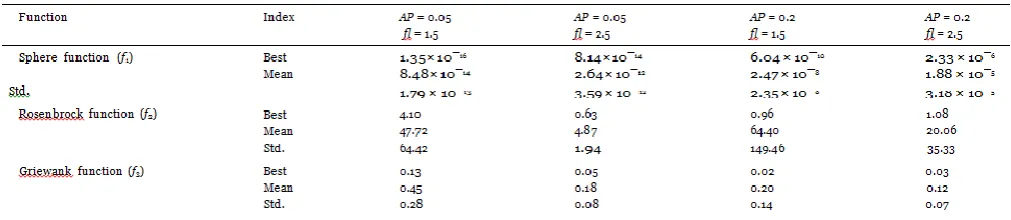
Table 15. The effect of AP and fl on the performance of CSA.
From Table 15, it is seen that AP = 0 prompts feeble execution of CSA since the expansion capacity of the algorithm has been eliminated. Considering the best index, from the studied parameter setting approaches the best one for f1, f2 and f3 is (AP = 0.05 and fl = 1.5), (AP = 0.05 and fl = 2.5) and (AP = 0.2 and fl = 2), respectively. Considering the mean index, from the studied parameter setting approaches the best one for f1, f2 and f3 is (AP = 0.05 and fl = 2), (AP = 0.05 and fl = 2.5) and (AP = 0.3 and fl = 2), respectively. Among the test functions, f1 and f2 are uni- modal while f3 is multimodal. It seems that for unimodal functions, small values of AP lead to better results while for multimodal functions, it is better to use larger values for AP to escape local optima. If a fixed value for AP is used (AP = 0.05) and the value of fl is increased from 1.5 to 2.5, on average the performance of CSA on f1, f2 and f3 improves. If the value of AP is set to 0.2 and the value of fl is increased from 1.5 to 2.5, on average the performance of CSA on f1 does not improve while on f3 the performance of CSA improves. As a result, like other optimization
the execution of CSA moves forward. Accordingly, as other optimization techniques, tweaking of CSA is an issue subordinate issue which ought to be finished by trial.
VI.
CONCLUSION
Based on the wise conduct of crows, a novel metaheuristic algorithm, called CSA, is proposed in this paper. CSA is population-based optimization algorithm which is fairly straightforward with two flexible parameters (flight length and mindfulness prob-capacity) just, which thusly makes it extremely alluring for applications in various engineering zones. In CSA, the parameter of mindfulness likelihood is straightforwardly used to control the assorted variety of the algorithm. In examination with GA, PSO and HS, CSA has less parameters to change and thus is simpler to execute. The value of CSA is assessed by taking care of various engineering design problems which have distinctive natures of target capacities, limitations and decision variables. Simulation results demonstrate that the execution of the proposed new algorithm is promising since it has delivered aggressive results in examination with the other contemplated algorithms. On an arrangement of benchmark capacities, it is watched that in spite of the fact that PSO is known as a quick technique among population-based algorithms, it is outflanked by CSA. From the results it is seen that the meeting rate of CSA is great and this algorithm finds the arrangement of the examined problems in around 1 s.
VII.
REFERENCES
[1]. Blum C, Roli A. Metaheuristics in combinatorial optimization: overview and conceptual comparison. ACM Comput Surv 2003;35:268-308.
[2]. Yang XS. Nature-inspired metaheuristic algorithms. Luniver Press; 2008.
[3]. Yang XS. Engineering optimization: an introduction with metaheuristic applications. Wiley; 2010.
[4]. Holland J. Adaptation in natural and artificial systems. Ann Anbor: University of Michigan Press; 1975.
[5]. Geem ZW, Kim JH, Loganathan GV. A new heuristic optimization algorithm: harmony search. Simulation 2001;76:60-8.
[6]. Yang X-S, Deb S. Cuckoo search via L_evy flights. In: Proceedings of world congress on nature & biologically inspired computing (NaBIC), Coimbatore, India; 2009. p. 210e4. [7]. Yang XS. A new metaheuristic bat-inspired
algorithm. In: Gonzalez JR et al., editors. Nature-inspired cooperative strategies for optimization (NICSO 2010). Springer, SCI 284; 2010. p. 65-74.
[8]. He S, Wu QH, Saunders JR. Group search optimizer: an optimization algorithm inspired by animal searching behavior. IEEE Trans Evol Comput 2009;13:973-90.
[9]. Yang XS. Firefly algorithm, stochastic test functions and design optimisation. Int J Bio-Inspired Comput 2010;2(2):78-84.
[10]. https://en.wikipedia.org/wiki/Corvus_%28genus %29.
[11]. Prior H, Schwarz A, Güntürkün O. Mirror-induced behavior in the magpie (pica pica): evidence of self-recognition. PLoS Biol 2008;6(8):e202.
[12]. https://en.wikipedia.org/wiki/Hooded_crow. [13]. Clayton N, Emery N. Corvide cognition. Curr
Biol 2005;15:R80-1.
[14]. Wolpert DH, Macready WG. No free lunch theorems for search. Citeseer; 1995.
[16]. Ray T, Liew KM. Society and civilization: an optimization algorithm based on the simulation of social behavior. IEEE Trans Evol Comput 2003;7:386-96.
[17]. Liu H, Cai Z, Wang Y. Hybridizing particle swarm optimization with differential evolution for constrained numerical and engineering optimization. Appl Soft Comput 2010;10:629-40. [18]. Zhang M, Luo W, Wang X. Differential evolution with dynamic stochastic selection for constrained optimization. Inf Sci 2008;178:3043-74.
[19]. Sadollah A, Bahreininejad A, Eskandar H, Hamdi M. Mine blast algorithm: a new population based algorithm for solving constrained engineering optimization problems. Appl Soft Comput 2013;13:2592-612.
[20]. Coello CAC. Use of a self-adaptive penalty approach for engineering optimization problems. Comput Ind 2000;41:113-27.
[21]. He Q, Wang L. An effective co-evolutionary particle swarm optimization for constrained engineering design problems. Eng Appl Artif Intell 2007;20:89-99.
[22]. He Q, Wang L. A hybrid particle swarm optimization with a feasibility-based rule for constrained optimization. Appl Math Comput 2007;186:1407-22.
[23]. Coelho LDS. Gaussian quantum-behaved particle swarm optimization approaches for constrained engineering design problems. Expert Syst Appl 2010;37:1676-83.
[24]. Parsopoulos K, Vrahatis M. Unified particle swarm optimization for solving constrained engineering optimization problems. Advances in natural computation LNCS, 3612. Berlin: Springer-Verlag; 2005. p. 582-91.