JETIR1506066 Journal of Emerging Technologies and Innovative Research (JETIR) www.jetir.org 1
Survey on Abandoned Object Detection
Kavita Patel, Prof. G. Ramya
Research Scholar M-Tech (CSE), Assistant Professor
Computer Science & Engineering Raipur Institute of Technology. Mandir Hasaud, Raipur (C.G.), India
Abstract— In recent years due to various kind of social activities such as theft, bomb attack and other terrorist attack
preventive security measures at public places has gained lot of importance. Abandoned Object detection is most crucial task in visual surveillance system. Many Public or open areas are facilitated with cameras at multiple angles to monitor the security of that area for keeping citizens safe. This is known as the surveillance system. In this paper a new algorithm is proposed for object tracking in video, which is based on image segmentation. With the image segmentation all objects in video can be detected whether they are moving or not by using segmentation results of successive frames. The algorithm will be tested on real time video surveillance system and it will produce very low false alarm and missing detection. This approach definitely provides security and detects the moving object in real time video sequence and live video streaming.
Keyword: Abandoned object detection, Surveillance, Background Subtraction.
I.
Introduction
Recent terrorist attacks have highlighted the need of video surveillance at public places. Visual surveillance systems today consist of a large number of cameras, monitored by human operator. Although human are the most intelligent creatures in this world there are still some problems in the existing solution. Typically, each operator watches a set of screens that cycle through views of different locations every few seconds.
In addition, the reason increased adaption of security cameras to survey public areas have caused a reason digital data explosion that human operator have difficulty to keep up with. Because of these shortcomings, human keep inventing new discoveries to make the best of it. In order to support this surveillance system, a recognition and tracking system is built to detect abandoned object.
The aim of the approach is to automatically recognize activities around restricted area to improve safety and security of the servicing area. The system takes as input from the camera, tracking and recognition results and fuses these into object estimation.
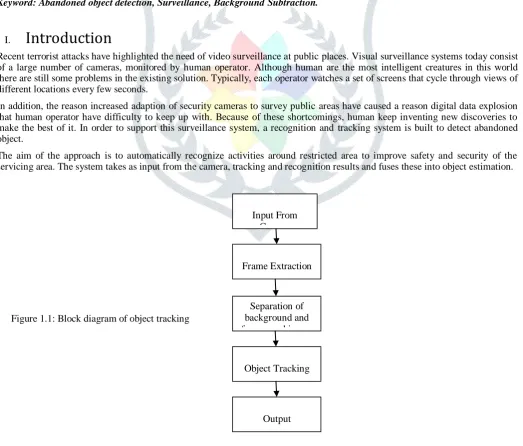
Figure 1.1: Block diagram of object tracking
Input From Camera
Frame Extraction
Separation of background and foreground image
Object Tracking
JETIR1506066 Journal of Emerging Technologies and Innovative Research (JETIR) www.jetir.org 2071 In last two decades, visual surveillance has attracted more and more researchers because of its tremendous application prospects. In most of the current setups, the recorded video has to be analyzed to reconstruct an event after the related alarming situation has been detected. In most of the current setups, the recorded video has to be analyzed to reconstruct an event after the related alarming situation has been detected. Because of the sequential scanning of entire video time lapse between occurrence of event and action required to correct the flaw increase considerably. Therefore there is a need for the development of smart surveillance system which will be automatically detecting potentially dangerous situations. Researchers are working towards making the video surveillance system more versatile, by developing fast, reliable and robust algorithms for moving object detection, classification, tracking and activity analysis.
After the attacks of 11th sep 2001 with the airplanes at the Twin Tower in New York and the Pentagon in Washington DC, the fear of terrorism has grown among people in the word. There were threats for more attacks and the world lived in fear. Then on 11th March 2004 there were the attacks in the train in Madrid and on 7th July 2005 subway stations in London. As a result, people feared to take public transportation with the attacks in their mind. When using public transportation, people now tend to be more scared for abandoned luggage and suspicious behavior of travelers. In Amsterdam, the whole railway system went down of precaution when travelers spotted two suspicious men in a train and alarmed the police. To provide people a safe feeling when travelling with public transportation, it is necessary to have better security systems at transportations area and their surroundings. Security cameras that can recognize suspicious circumstances automatically are convenient in this case. Even though security guards are watching the security videos, they are not always able to detect all crime. With software that is able to automatically detect crime, the guard will be warned and he can watch at the videos and trigger an alarm if necessary.
1.1Present Situation
Since the attacks of 11th September 2001 in USA and July 2005in London, an increasing number of places are covered with Closed Circuit Television (CCTV) cameras to prevent terrorism. Cameras are on public buses, airports and in railway stations, building lobbies, school and stores. The captured videos are fed to central control rooms with the security staff monitoring the videos, by that, the security staff will be able to detect suspicious activities and thus ensure public safety. For this reason, the use of surveillance camera has increased rapidly and has become a part of the daily life in public and private places.
The main function of using the camera is not only for the crime prevention, but also for the crime detection and prosecution. The terrorist who have committed and attacked in London at July 2005 have been found by using the CCTV videos. Cases such as murder or robbery can also be solved by using the CCTV evidence. With the rapid advance of today’s technology, cameras are getting ‘smarter’. As a result, the cameras will not only watch the places, but will also be able to interpret and analyze the observed objects to detect unusual activities at early stage.
1.2 Abandoned Object
In general an abandoned object is an object which is left at a particular place under surveillance and unattended over a period of time. Second, it should remains static in recent frames or for some time t. Detecting abandoned object is a very important in places like airports, railway stations, big shopping malls etc, where there is potentially high security threat. AOD is one of highly challenging task in video surveillance systems, lot of research is carried out to enhance and automate the surveillance system. One of the major and important tasks in video surveillance system is to detect abandoned objects. The biggest challenge in abandoned Object Detection is classifying an object as abandoned object which was not present previously in the scene may be an abandon ed object and mostly the object becomes an abandoned object when it is carried by a person previously and it is unattended for a particular period of time which creates the potential threat.
1.3 Need of Automated Surveillance
Although public areas are observed by many surveillance cameras, human can monitor a few cameras at a time. This causes the scarcity that human are unable to observe all kind of situation on certain cameras simultaneously. If a crime is committed, the cameras are only able to help with the investigation. Also the task of the security staff includes more than just sitting back on their chair and watches the videos 24 hours a day. They also need to inspect the environment, write logs and solve disturbances. Because the workload is more than just monitoring, it may occur that they miss some capture scenes. Another problem is that there are many cameras and too few personnel to watch every single camera.
JETIR1506066 Journal of Emerging Technologies and Innovative Research (JETIR) www.jetir.org 2072
II.
Literature Review
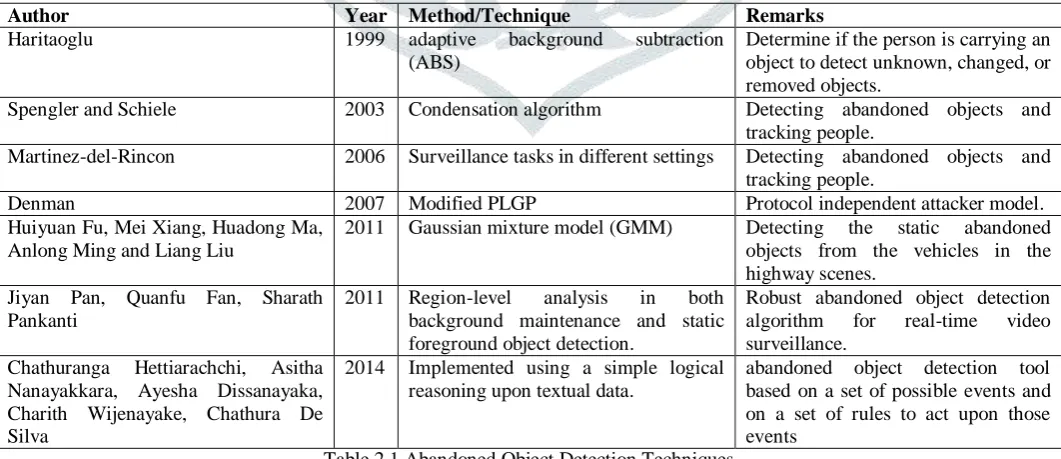
In recent year, much effort has been devoted to designing systems that automatically detect abandoned objects in public areas.
Haritaoglu (1999) et al described a method that exploits periodic motion and static symmetry of a person to determine if the person is carrying an object. System such as employ adaptive background subtraction (ABS) techniques to detect unknown, changed or removed objects.
Spengler and Schiele (2003) propose an approach for detecting abandoned objects and tracking people using the Condensation.
Martinez-del-Rincon (2006) et al and Aguilera et al have explored the use of multiple cameras for similar surveillance tasks in different settings
Tejas et al worked on the AOD for automated surveillance using Hadoop. His research proposed a system for video surveillance system which can increase the performance and the efficiency in term of processing speed by using Hadoop Horton works Data platform 2.0. The system was able to classify and detect the abandoned objects and update the same. Overcoming occlusion was a part the proposed objective, but the experimental results were not commendable to prove that the system overcomes occlusion and hence it continues to be hindrance to the efficiency.
Denman (2007) et al introduced the multi layer motion detection for AOD. They proposed a motion detection system that is capable of detecting medium term motion as well as regular motion. Multiple layers of medium term (static) motion can be detected and segmented. It handled occlusion effectively and eliminated the need of multiple motion detectors.
Huiyuan Fu, Mei Xiang, Huadong Ma, Anlong Ming and Liang Liu (2011) this paper focused on the important problem of detecting the static abandoned objects from the vehicles in the highway scenes. They propose a new three stage static object detection framework. In this paper, they present a new framework Gaussian mixture model (GMM) is used to model the background, but it is not updated every frame for keeping the abandoned objects in the foreground. To erase the noise caused by sunshine or wind, we bring an edge statistics feature based approach into the framework. Moreover, object tracking module is also integrated into the framework for a better abandoned object detection.
Jiyan Pan, Quanfu Fan, Sharath Pankanti (2011) propose a robust object detection algorithm for real time video surveillance. In background maintenance, region level information is fed back to adaptively control the learning rate. In static foreground object detection, region level analysis double checks the validity of candidate abandoned blobs. Attributed to such analysis , this algorithm is robust against illumination change.
Chathuranga Hettiarachchi, Asitha Nanayakkara, Ayesha Dissanayaka, Charith Wijenayake, Chathura De Silva (2014) introduce an AOD tool based on a set of possible events and on a set of rules to act upon those events. This implementation is simple and reusable unlike existing techniques. It is implemented using a simple logical reasoning upon textual data, in contrast to image centric processing. Object foreign to a usual environment are extracted using background subtraction. Results of blob detection and tagging process are passed to an abandoned object detector in a textual format. The abandoned object detector, which is an acyclic graph of asynchronously interconnected lightweight processing modules, evaluates the variations of speeds and blob distances. By configuring several parameters according to the context, it generates an alert upon encountering such scenario.
Author Year Method/Technique Remarks
Haritaoglu 1999 adaptive background subtraction (ABS)
Determine if the person is carrying an object to detect unknown, changed, or removed objects.
Spengler and Schiele 2003 Condensation algorithm Detecting abandoned objects and tracking people.
Martinez-del-Rincon 2006 Surveillance tasks in different settings Detecting abandoned objects and tracking people.
Denman 2007 Modified PLGP Protocol independent attacker model.
Huiyuan Fu, Mei Xiang, Huadong Ma, Anlong Ming and Liang Liu
2011 Gaussian mixture model (GMM) Detecting the static abandoned objects from the vehicles in the highway scenes.
Jiyan Pan, Quanfu Fan, Sharath Pankanti
2011 Region-level analysis in both background maintenance and static foreground object detection.
Robust abandoned object detection algorithm for real-time video surveillance.
Chathuranga Hettiarachchi, Asitha Nanayakkara, Ayesha Dissanayaka, Charith Wijenayake, Chathura De Silva
2014 Implemented using a simple logical reasoning upon textual data.
abandoned object detection tool based on a set of possible events and on a set of rules to act upon those events
JETIR1506066 Journal of Emerging Technologies and Innovative Research (JETIR) www.jetir.org 2073 III.
Methodology
The proposed system has four main modules: 1. Background subtraction
2. Morphological operation 3. Object tracking
4. Action detection
First background subtraction is performed to detect any new object that may have entered the scene. After that we determine which person left bag in the scene. The final module differentiates between removed and abandoned objects. The system notifies the user of an abandoned object by raising an alarm.
3.1 Background Subtraction
Background subtraction is a critical part of object detection systems as its out came is fed to higher level processes such as object recognition and tracking and these processes rely heavily on the accuracy of background subtraction techniques. This method is particular a commonly used technique for segmentation in static camera. It attempts to detect moving regions by subtracting the current image pixel by pixel from a reference background image. The pixels where difference is above a threshold are classified as foreground. After getting a foreground object some morphological post processing operations such as dilation and erosion are performed to reduce the effects of noise and enhance the detected regions.
3.2 Morphological Operations
After background subtraction we get raw foreground image contain only moving object. For pre-processing, foreground image is fed to erosion and dilation operation. This processing removes the noise and gives us exact boundaries of foreground object. Applying threshold to image, if difference between these is greater than threshold value then foreground object is detected otherwise no foreground object is found.
3.3 Object Tracking
The objective of object tracking is to construct a correspondence between objects in consecutive frames. Detection of objects for tracking in frame by frame is a significant and difficult problem. It is a crucial part for video surveillance system since without tracking the object, the system could not extract the information about objects and further higher level event analysis steps would be difficult. On the other hand, inaccurate segmentation of foreground objects due to occlusions, shadow and reflectance makes tracking a difficult and active research problem. In tracking step, the extracted information is adequate for most of the video surveillance applications.
3.4 Activity Recognition
After successfully tracking the moving objects from one frame to another in a video, the problem of recognizing an event from scene follows naturally. Activity recognition involves action recognition and description. Activity recognition can guide the development of object motion analysis systems. It is the most important area of future research in motion analysis.
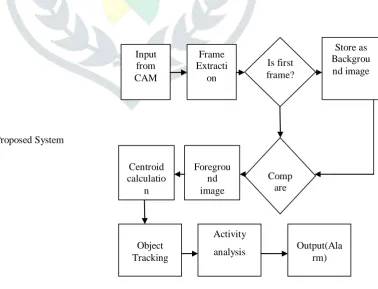
Fig 3.1: The Block Diagram of Proposed System
Input from CAM
Frame Extracti on
Is first frame?
Store as Backgrou nd image
Centroid calculatio
n
Foregrou nd image
Comp are
Object Tracking
Activity
JETIR1506066 Journal of Emerging Technologies and Innovative Research (JETIR) www.jetir.org 2074
IV.
Conclusion
Most of the proposed methods aiming to detect static objects based on the detection of motion and pixel level analysis, achieved by means of background subtraction, followed by some kind of tracking. Background subtraction is a commonly used technique for the segmentation of foreground regions in video sequences taken from a static camera, which basically based on detecting the moving objects from the difference between the current frame and a background model. In order to achieve good segmentation results, the background model must be regularly kept updated so as to adapt to the varying lighting conditions and to stationary changes in the scene. Therefore, background subtraction techniques often do not suffice for the detection of stationary objects and thus supplemented by an additional approach.
Abandoned object detection (AOD) systems are required to run in high traffic situations, with high levels of occlusion. System relies on background segmentation techniques to locate abandoned objects, by detecting areas of motion that have stopped. This is often achieved by using a medium term motion detection routine to detect long term changes in the background. Video stream of data are not pertained to be independent at any stage of the sequence. So it becomes difficult to modulate the video sequence into shots independent of each other. Even though shot boundary is efficient, it is not possible to completely remove the dependency between the frames. So this may lead to any miss predictions So there is a need for proposing a new algorithm for identifying the static object as abandoned.
References
[1] Chathuranga Hettiarachchi, Asitha Nanayakkara, Ayesha Sissanayaka, Charith Wijenayake, Chathura De Silva, in IEEE conference on Abandoned Object Detection with Logical Reasoning, 2014.
[2] Lin Chang, Hongmei Zhao, Sen Zhai, Yaei Ma and Hong Liu in IEEE Conference on Robust abandoned Object Detection and Analysis Based on Online Learning, December 2013.
[3] Zibin Zheng , Jieming Zhu, Lyu, M.R, Service-Generated Big Data as a service: an Overview, 2013.
[4] Chelmsford, Mass, Study: Retailers Use IP Video surveillance for loss Prevention Today, Business Performance Tomorrow, Jan 2013.
[5] Atul Borkar, dr. M. S. Nagmode, Dhaval Pimplaskar, real Time Abandoned Bag Detection Using Open CV, Nov 2013. [6] Dr. K. N. Ramachandran Nair, Sajith K, Abandoned or Removed Objects Detection from Surveillance Video using
Codebook, may 2013.
[7] Singh S, Big Data analystics, 2012.
[8] Jiyan Pan, Quanfu Fan, sarath Pankanti in 18th IEEE International Conference on Robust Abandoned Object Detection using Region Level Analysis, 2011.
[9] Huiyuan Fu, Mei Xiang, Huadong Mal, Analong Mingl and Liang Liu IEEE Conference on Robust Abandoned Object Detection in Highway Scene, 2011.
[10] L. Campos, J. SanMiguel and J. Martinez, Discrimination of abandoned and stolen object based on active contours, In AVSS, 2011.