HUMAN IDENTIFICATION USING GAIT
RECOGNITION: A STUDY
Anjali
M. Tech Student, Hindu College of Engineering , Sonipat, Haryana,(India)
ABSTRACT
Human identification by gait has become a key area of interest in cyber world due to its advantage of
inconspicuous recognition at a relatively far distance. Biometric systems are becoming increasingly important,
since they provide more reliable and efficient means of identity verification. Biometric authentication as well as
verification has been widely used for access management, law enforcement, security system and entertainment
over the past few years. Gait analysis is one of the behavioral biometric technologies that is becoming an
attractive topic in biometric research. In Gait biometric research there are various gait recognition approaches
available. In this paper, I am discussing about the gait recognition system.
Keywords: Gait Recognition System, Diagrammatic, Segmentation.
I. INTRODUCTION
The first and foremost important step towards preventing unauthorized access is user authentication. User
authentication is the process of verifying identity [1, 2]. Biometric authentication is based on someone’s
physiological and behavioral characteristics. A person can be identified or verified on the basis of different
physiological and behavioral attributes like fingerprints, live scans, faces, iris, hand geometry, gait, ear pattern,
voice recognition, keystroke pattern and thermal signature etc. Among them, gait recognition, as a relatively
new biometric technique, aims to recognize individuals by the way they walk. The advantage of identification
using gait recognition is that features can be extracted from the image without the co-operation of the person [3].
The paper is organized as follows. The Silhouette Extraction is discussed in section II. In section III, Gait
Recognition is summarized. Approaches for Gait Recognition and Steps of Gait Recognition System are
presented in section IV and V. The paper is concluded in section VI.
II. SILHOUETTE EXTRACTION
After importing the image through optical scanner or digital photography, the next step is creation of a
silhouette or feature extraction. The most important step of gait recognition is the extraction of silhouette.
Silhouette is important because it gives an exact and clear image of the person. They are mostly used in those
fields where speedy verification is necessary. But firstly, we need to be clear about the definition of a silhouette.
Silhouette is the dark shape and outline of someone or something visible in restricted light against a brighter
background [4]. In gait recognition, silhouette is defined as a region of black and white pixels of the walking
of techniques for segmenting the objects of interest [1]. For obtaining a clear silhouette best of the background
subtraction algorithms is to be used. Silhouette extraction is basically a two-tier process.
1. Detection
2. Segmentation
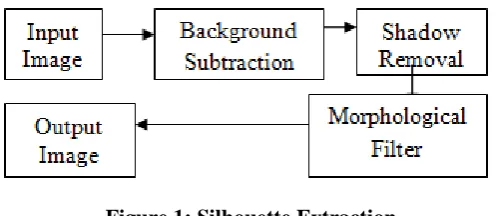
Silhouette extraction mainly focuses on segmenting the human body. The silhouette extraction process is shown
in Fig. 1 [1]. Each of the frames in the image sequence is subtracted from a background model of the respective
image sequence. If the pixel value of each frame is not the same with the pixel value of the background, the
pixel is marked as region of silhouette. To remove shadow from the difference image, a threshold value is
applied to the difference images. The difference image map is first analyzed by generating the intensity
histogram of the image so that the pixels distribution along the image can be represented clearly and in an
effective way according to an applied threshold value. The threshold must be suitable so that the foreground
image is neither under segmented nor over-segmented [1].
Figure 1: Silhouette Extraction
Under-segmentation and Over-segmentation purpose is to produce first and second reliable silhouette
respectively. Basically, the silhouette video is calculated frame by frame. From each frame human being is
extracted.
To conclude, silhouette determination is a process that includes detection and segmentation of walking persons
from the background by using motion detection and segmentation methods. In segmentation, the foreground
subject is extracted from the video-sequence, and is now ready for extraction of gait features.
III. GAIT RECOGNITION
Once we obtain gait features, the next step is gait recognition. Gait recognition is an emerging biometric
technology which involves people being identified purely on the basis of the way they walk [5,6]. Basically gait
recognition can be done through Gait analysis
.
3.1 Gait Analysis
It is the systematic study of locomotion, more specifically the study of human motion, using the eye and the
brain of observers, multiplied by instrumentation for measuring body movements, body structure, and the
activity of the muscles [1]. Gait analysis is used to assess, plan, and treat individuals through the conditions
interpretation, i.e., drawing various conclusions about the animal (health, age, size, weight, speed etc.) from its
gait pattern.
3.2 Factors and Parameters for Gait Analysis
3.2.1 Factors
The gait analysis is manipulated or modified by many factors, and changes in the normal gait pattern can be
temporary or permanent [7]. The factors can be of various types:
Extrinsic: such as terrain, footwear, clothing, cargo
Intrinsic: sex (male or female), weight, height, age, etc.
Physical: such as weight, height, physique
Psychological: personality type, emotions
Physiological: anthropometric characteristics, i.e., measurement and proportions of body
Pathological: for example trauma, neurological diseases, musculoskeletal anomalies, psychiatric disorders
3.2.2 Parameters
The parameters taken into account for the gait analysis are as follows [4]:
Step length
Stride length
Cadence
Speed
Dynamic Base
Progression Line
Foot Angle
Hip Angle
IV. APPROACHES FOR GAIT RECOGNITION
Some basic methods or approaches for gait recognition are [1]:
4.1 Moving Video Based Gait Recognition
In this category, gait is captured using a video-camera from distance. Video and image processing techniques
are employed to extract gait features for recognition purposes. Most of the M-V based gait recognition
algorithms are based on the human silhouette. For example stride, cadence, static body parameters, etc.
4.2 Floor Sensor Based Gait Recognition
In this approach, a set of sensors or force plates are installed on the floor and such sensors enable to measure
gait related features, when a person walks on them, e.g. maximum time value of heel strike, maximum
4.3 Wearable Sensor Based Gait Recognition
In this approach, gait is collected using body worn motion recording (MR) Sensors. The MR sensors can be
worn at different locations on the human body. The acceleration of gait, which is recorded by the MR sensor, is
utilized for authentication.
V. STEPS OF GAIT RECOGNITION SYSTEM
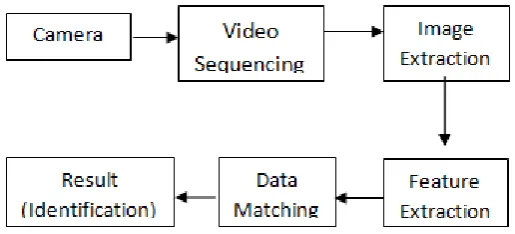
In gait recognition, following steps are to be executed for serving the purpose of verification [8]. The steps are
explained through block diagram shown in Fig. 2.
1. Firstly, camera captures the video data.
2. Detection and segmentation are the two main steps of silhouette representation which calculates walking
persons from the background by using motion detection and segmentation methods. In segmentation, the
foreground subject is extracted from the video-sequence, and is now ready for extraction of gait features.
3. After calculating the foreground and background image from segmentation and detection respectively, the
relevant gait features can now be extracted from the segmented images, which will be used in fulfilling the
classification purpose, i.e. gait features can be easily extracted after segmentation of silhouettes is done
from the background.
4. The similarity between the extracted gait feature and the feature present in the gait database or the
difference between output image and actual image is measured for person identification which gives the
final result.
Figure 2: Block Diagram of Gait Recognition System
VI. CONCLUSION
Human Motion Analysis is receiving a wide attention from the computer vision scholars. This wide interest is
motivated by wide spectrum of applications such as in closed-circuit television (CCTV) surveillance, because of
its high potential in unconstructive individual recognition and too from a distance. Commercial visual
surveillance has also many applications in a number of areas mainly in security systems, namely banks, airports,
military-based areas, public transportation like railway- stations and bus- stations, shops and malls, and
REFERENCES
[1] Pritpal Kaur And Gagandeep Singh Aujla, “Human identification using Gait Recognition Technique
with PAL and PAL Entropy and NN”, International Journal Of Computer Science And Information
Technologies, Vol. 5, Issue 3, 3281-3285, 2014.
[2] M. Pushparani and D. Sasikala, “A Survey of Gait Recognition Approaches Using PCA & ICA”, Double
Blind Peer Reviewed International Research Journal Vol. 12, Issue 10, Version 1, May, 2012.
[3] Navneet Kaur And Samandeep Singh “Gait Recognition For Human Identification Using NN”,
International Journal Of Computer Science And Information Technologies, Vol. 5, Issue 3 , 3991-3993,
2014.
[4] Jyoti Bharti, M. K. Gupta, “Gait Recognition with Geometric Characteristic and Fuzzy Logic”, Journal
on Image Processing and Computer Vision, Canada Vol. 3, Issue 1, 1 March, 2012.
[5] Mark S. Nixon, John N. Carter “Automatic Gait Recognition”, Sixth IEEE International Conference on
Automatic Face and Gesture Recognition, 2004.
[6] Jasvinder Pal Singh, Sanjeev Jain, “Person Identification Based On Gait Using Dynamic body
Parameters”, Trendz in Information Sciences & Computing (TISC), Vol. 53, Issue 4, 248-252, 17-19
December, 2010.
[7] S. Niyogi and E. Adelson, “Analyzing and Recognizing Walking Figures in XYT”, Proc. IEEE CS Conf.
Computer Vision and Pattern Recognition, 469-474, 1994.
[8] Yi-Bo Li, Tian-Xiao “General Methods And Development Actuality Of Gait Recognition”, International
Conference on Wavelet Analysis and Pattern Recognition, Beijing, China, 2-4 November, 2007.
[9] Jorge Fazenda, “Using Gait to Recognize People”, presented in Serbia & Montenegro, Belgrade, 22-24,
November, 2005.
[10] Jasvinder Pal Singh, Sanjeev Jain, “Person Identification Based On Gait Using Dynamic body
Parameters”, Trendz in Information Sciences & Computing (TISC), Vol. 53, Issue 4, 248-252, 17-19
December, 2010.
[11] A. Kale “Gait Analysis For Human Identification”, IEEE Transactions on Image Processing, Vol.13,