e-ISSN: 2278-067X, p-ISSN: 2278-800X, www.ijerd.com
Volume 12, Issue 10 (October 2016), PP.01-06
Reliability Based Design and Optimization of Trusses by Genetic
Algorithms
J. Renuka Kumari
1, K.V. Valsarajan
21Associate Professor in Civil Engineering, College of Agriculture, Vellayani. Kerala Agricultural University
2
Deceased June 2016. Formerly: Professor in Civil Engineering, College of Engineering, Trivandrum. Kerala
Abstract:
Reliability is the probability that a structure will not fail to perform its intended function. Genetic Algorithms have been shown to be very effective optimization technique for number of engineering problems. In this paper reliability analysis of a ten bar truss and optimization by genetic algorithms is presented.Keywords
: Reliability, Optimization, Reliability Based Design OptimizationI.
INTRODUCTION
Structural engineers always prefer to have optimal structures to satisfy all performance requirements. With advanced methods like finite element methods and efficient optimization algorithms like genetic algorithm, structural optimization techniques have expanded for design of framed structures. Most structural optimization techniques use deterministic criteria for optimization ignoring the statistical properties of structural loads, materials and performance models. With these optimization techniques structure weights and costs are reduced but structure safety levels may be either reduced or ignored.
A. Structural optimization
The achievement of optimum design is an attractive goal to the designer. A part from the possible economic advantages, there is the satisfaction of producing the best possible
design satisfying the required objective. The variables in structural design are generally
treated as discrete type. The important result of this assumption is that the total design space consists of a calculable finite number of individual designs represented by combinations of the design variables.
B. Reliability Of structures
Reliability of a structure can be defined as an ability that fulfills its design purpose for some specified period. There is a risk of failure, due to the sources of uncertainty present in the structural designs, which is unacceptable. The concept of limit state is used as a boundary between the desired and undesired structural performance. (Togan 2006). Basic variables like the resistance or the load carrying capacity (R) and the load effect (Q) are used for defining the uncertainties. Using these random variables or uncertainties, the limit state can be defined corresponding to the ability of the structure to fulfill its design purpose as follows.
𝑄 > 𝑅 means the structure has no ability to fulfill its design purpose, ie, failure 𝑅 > 𝑄 means the structure has ability to fulfill its design purpose, safe
Having accepted these conditions of structural behavior, the probability of each state can be evaluated. Probability of failure is the probability that an undesired performance will occur. This can be mathematical expressed as
𝑃𝑓 = 𝑃 𝑅 < 𝑄 = 𝑃 𝑅 − 𝑄 < 0 = 𝑃 𝑅 = 𝑄 < 1 (1)
Reliability index was introduced later, considering the difficulty involved in the calculation of probability of failure. A new definition for reliability index was introduced by Hasofer and Lind (1974) and according to this definition, the reliability index, β, can be calculated as follows
𝛽 = 𝜇𝑅 − 𝜇𝑄
√ 𝜎𝑅2 + 𝜎𝑄2
(2)
𝛽 depends only on means and standard deviations of the random variables. For uncorrelated and normaly distributed random variables, probability of failure is given by
𝑃 𝑓 = 𝛷 −𝛽 (3)
checking based on exact probabilistic analysis for whole structural systems or structural elements using full distributional approach based on failure probabilities is the Level 3 method.
C. Reliability Based Optimization
This is a growing area of interest in multi disciplinary design optimization techniques. The objective of this method is to design structures which are reliable and economical. There is always some uncertainty involved in any structural system due to the variations in material properties, improper definition of loading arrangements and manufacturing tolerances. This optimization technique includes those uncertainties by considering them as random variables. For a given framed structure, the optimization can be stated as minimizing the structural weight and satisfying the reliability index requirement for every failure mode. J. J. Chen and B.Y. Duan (1994) transformed the non normal loads acting on the structure to normal loads by using normal tail transformations. The displacements and stresses, reliability constraints under random loads, are transformed in to constraints of conventional forms. The structural systems were modeled as a collection of structural elements in series and parallel (Tarek N Kudsi and Chung C Fu ,2002). The redundant element is assumed to be parallel with the rest of the system and the non redundant member is considered to be in series with the rest of the system.
D. Genetic Algorithms
Genetic algorithms were originally proposed by John Holland at the University of Michigan (Goldberg 1989), and is a direct search method based on the principles of natural selection and survival of the fittest. The GA’s differ from traditional methods of search and optimization in a number of ways: 1) GA’s work with a coding of the design variables as against the design variables themselves; 2) GA’s work with a population of points as against a single point; and 3) GA’s require only the objective function values. The design variables in the objective functions are represented by binary strings of given length generated by random selection. Groups are formed, initially at random, to compose families of strings.
The concept of survival of the fittest is artificially simulated with genetic operators reproduction, cross over and mutation. The reproduction operator emphasizes the survival of the fittest. This operator allows highly productive strings to live and reproduce. The productivity of the individual string is assessed by its fitness. Fitness is defined as a string’s non negative objective function value. One of the methods of achieving effective reproduction is by selecting strings with higher fitness values. The second operator, crossover, exchanges the genetic information with a specified probability, by selecting the cross site at random and then joining the first part of the string with the second part of the other string. The third operator mutation, with specified mutation probability, changes 1 to 0 and vice versa. After each cycle, the fitness of each family is again assessed by decoding the strings and evaluating the objective function. The cycle then continues to the new generations. The process is terminated when convergence is reached or when the specified number of generations is reached.
E. Reliability based Optimization using Genetic Algorithm
Deterministic optimization techniques have been successfully applied to a large number of structural optimization problems during the last decades. The main difficulties in dealing with nondeterministic problems are lack of information about the variability of the system parameters and the high cost of calculating their statistics. These difficulties were circumvented with the introduction of probabilistic design where the mean and covariance of the random parameters influencing the design alone are considered. J. J. Chen and B.Y. Duan (1994) presented an approach for structural optimization design by means of displaying the reliability constraints. The non normal loads acting on the structure are transformed to normal loads by using normal tail transformations. The displacements and stresses, reliability constraints under random loads, are transformed in to constraints of conventional forms. This method is suitable for truss structures subjected to one or multiple random loads in any types of distribution. Reliability based optimum design procedure for transmission line towers was the objective of the study conducted by K. Natarajan and A. R. Santhakumar (1995). Studies were also conducted on the relationship between (i) weight and system reliability of the tower and (ii) co efficient of variation of variables and system reliability.
V.Kalatjari and P. Mansoorian (2009) have attempted to approximate the probability of structural system failure. The optimization of the truss is performed in two different levels using parallel genetic algorithm. Faster convergence is achieved by competitive distributed genetic algorithms. Todd W. Benazer, et al., (2009) proposed a solution method for minimizing the cost of a system maintaining the system reliability. The cost efficient design was achieved by performing a reliability-based design optimization using the statistical spread of structural properties as design variables. Reliability based optimization of two and three dimensional structures was studied by M.R.Ghasemi and M Yousefi (2011). Applied load and yield stress were the considered as probabilistic, the failure criterion was the violation of interior forces from the member ultimate strength. Optimization was done by GA and the constraints were the failure probabilities and the objective was to minimize the weight of the structure.
F. GA-Based Methodologies for Optimal Design of Trusses
Genetic algorithm suggested by Goldberg (1989) and Krishna Moorthy and Rajeev (1991) is a different search algorithm used to optimize the truss system involving area of members as discrete design variables. In genetic algorithm based methodologies, the design space is transformed to genetic space. This transformation is achieved by appropriate genetic coding schemes. Binary coding scheme is the most popular one and is used to code the design variables.
It is required to optimize the weight of the pin jointed truss subjected to stress and displacement constraints. The objective function is to minimize the weight and the weight function 𝑓 𝑥 is written as
𝑓 𝑥 = 𝑁𝐸𝑖=1𝜌𝐴𝑖𝐿𝑖 (4)
where
𝐴𝑖 - cross sectional area of the 𝑖𝑡 member,
𝐿𝑖 - length of the 𝑖𝑡 member,
𝜌 - weight density of material 𝑁𝐸 - number of elements
Area of cross section of the members of the truss is taken as variable. The available sections are given as input.
𝐴𝑇 = 𝐴
1, 𝐴2, … . , 𝐴𝑛 𝑇 (5)
where
𝐴 is the cross sectional area of elements. The constraints equations are given below.
𝑅𝑍𝑘
∗
𝛿 ≤ 𝑅𝑍𝑘 𝛿 (6)
𝑘 = 1,2, … … , 𝑁𝐽 where
𝑁𝐽 is the number of displacements
𝑅𝑍∗𝑘 𝜎 ≤ 𝑅𝑍𝑘 𝜎 (7)
𝑘 = 1,2, … … , 𝑁𝐸 where
𝑁𝐸 is the number of elements. 𝑅𝑧𝑘 𝑖 𝑁𝐽 +𝑁𝐸
𝑖=1 𝛿 ≤ 𝑅𝑧𝑘∗∗ (8)
where
𝑅𝑧𝑘∗∗ is the predefined reliability of the structural system.
Binary individual strings are generated using genetics to represent the variables. Number of strings in each generation or the population size is also varied. Stresses in the members and deflection at various joints were obtained using finite element program. The violation coefficient which is the sum of values of all violated constraints is calculated using Eqn. (9) and then the fitness function 𝐹 for each generation. The fitness function has to be converted in to corresponding fitness values. The best population is the one which has maximum fitness value.
𝐶 = 𝑔𝑗 for 𝑔𝑗 > 0 (9)
II.
NUMERICAL EXAMPLE
A. Optimization of 10 bar truss Using Reliability Method and Genetic Algorithm
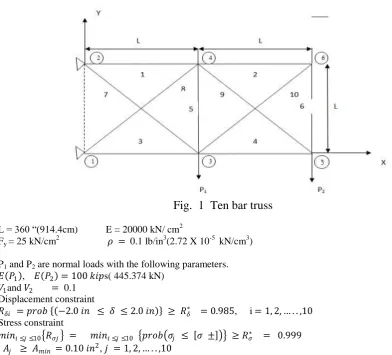
A ten bar truss shown in Fig. 1 is to be designed. The acting loads are P1 and P2 which are random
variables. The geometry of the truss is as shown in Fig. 1. The strength of steel is a random variable with a mean value Fy = 25kN/ cm2 and coefficient of variation (Vs ) = 10%.
The cross sectional areas of all the ten members are to be determined. The design requirements are
Weight of the structure should be minimum.
Maximum allowable probability of displacement exceeding limiting value 0.015. Maximum allowable probability of stress exceeding limiting value 0.001
Fig. 1 Ten bar truss
L = 360 “(914.4cm) E = 20000 kN/ cm2
Fy = 25 kN/cm2 𝜌 = 0.1 lb/in3(2.72 X 10-5 kN/cm3)
P1 and P2 are normal loads with the following parameters.
𝐸 𝑃1 , 𝐸 𝑃2 = 100 𝑘𝑖𝑝s( 445.374 kN)
𝑉1and 𝑉2 = 0.1
Displacement constraint
𝑅𝛿𝑖 = 𝑝𝑟𝑜𝑏 −2.0 𝑖𝑛 ≤ 𝛿 ≤ 2.0 𝑖𝑛 ≥ 𝑅𝛿 ∗ = 0.985, i = 1, 2, … . . ,10
Stress constraint
𝑚𝑖𝑛𝑖 ≤𝑗 ≤10 𝑅𝜎𝑗 = 𝑚𝑖𝑛𝑖 ≤𝑗 ≤10 𝑝𝑟𝑜𝑏 𝜎𝑗 ≤ 𝜎 ± ≥ 𝑅𝜎 ∗ = 0.999
𝐴𝑗 ≥ 𝐴𝑚𝑖𝑛 = 0.10 𝑖𝑛2, 𝑗 = 1, 2, … . . ,10
The first step is to convert the non normal load to normal loads by Box and Muller technique. Truss analysis is carried out by direct stiffness method for each set of loads. Mean and variance of member stresses and displacements corresponding to the random loads were then calculated. Reliability index 𝛽 is found out and using this value the reliability is obtained from the normal distribution curve. Optimization of the structure using genetic algorithm is done using the reliability constraints.The problem is run with the following genetic parameters.
String length = 40, Population size = 20, 30, 40
Probability of cross over = 0.7 Probability of mutation = 0.001 Convergence parameter = 85% Number of simulations = 200
Table 1 Results of 10 bar truss problem with string length 40
Population size20 Population size 30 Population size 40
A1 (cm2 ) 128.39 176.29 128.39 183.88 141.94 122.59
A2 (cm2 ) 16.97 0.65 16.90 0.65 18.9 0.65
A3 (cm2 ) 128.39 154.85 128.39 167.75 128.39 148.40
A4 (cm2 ) 89.68 100.01 89.68 96.78 89.68 100.01
A5 (cm2 ) 11.61 0.65 12.84 0.65 13.74 0.65
A6 (cm2 ) 16.9 0.65 13.74 3.23 13.74 0.65
A7 (cm2 ) 109.03 54.84 91.61 51.62 89.67 51.62
A8 (cm2 ) 109.03 135.49 109.03 132.27 109.03 129.04
A9 (cm2 ) 128.39 135.49 128.39 141.94 128.39 132.27
A10 (cm2 ) 18.58 0.65 20.19 0.65 18.06 0.65
Method A - With reliability constraints
Method B - With out reliability constraints **Rajeev, S. (1993)
Table 2 Comparison of optimal design results of a ten bar truss With reliability
constraints
Without reliability constraints *
Classical results**
Population size 30 30
Weight (kN) 22.3911 22.70995 25.268
A1 (cm2 ) 128.39 183.88 162.52
A2 (cm2 ) 16.90 18.9 0.65
A3 (cm2 ) 128.39 128.39 135.23
A4 (cm2 ) 89.68 89.68 132.92
A5 (cm2 ) 12.84 13.74 0.65
A6 (cm2 ) 13.74 13.74 2.45
A7 (cm2 ) 91.61 89.67 110.34
A8 (cm2 ) 109.03 109.03 134.30
A9 (cm2 ) 128.39 128.39 143.99
A10 (cm2 ) 20.19 18.06 0.65
*Rajeev, S.(1993) **Chen, J. J. and Duan, B. Y. (1994)
B. Effect of population size on the solution
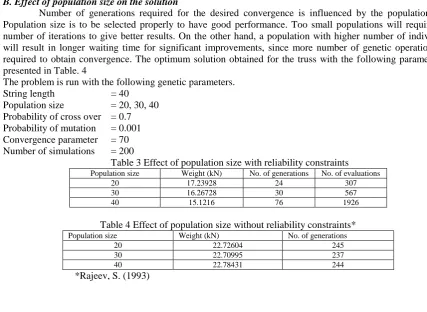
Number of generations required for the desired convergence is influenced by the population size. Population size is to be selected properly to have good performance. Too small populations will require less number of iterations to give better results. On the other hand, a population with higher number of individuals will result in longer waiting time for significant improvements, since more number of genetic operations are required to obtain convergence. The optimum solution obtained for the truss with the following parameters is presented in Table. 4
The problem is run with the following genetic parameters. String length = 40
Population size = 20, 30, 40 Probability of cross over = 0.7 Probability of mutation = 0.001 Convergence parameter = 70 Number of simulations = 200
Table 3 Effect of population size with reliability constraints
Population size Weight (kN) No. of generations No. of evaluations
20 17.23928 24 307
30 16.26728 30 567
40 15.1216 76 1926
Table 4 Effect of population size without reliability constraints*
Population size Weight (kN) No. of generations
20 22.72604 245
30 22.70995 237
40 22.78431 244
III.
CONCLUSION
Reliability based design and optimization is found to be very effective in obtaining optimal solutions for framed structures. Reliability design of the truss is done initially. Then by genetic algorithm, reliability based optimum design is achieved. For illustrating the procedure reliability based optimization was conducted with different population sizes. The results obtained confirms the effectiveness of this method.
DEDICATION
Professor K.V. Valsarajan passed away on June 10, 2016. He is well known as a sincere and dedicated teacher. He will be very much missed by his students. The other author would like to dedicate this paper to his memory.
REFERENCES
[1]. Charles Camp, Shahram Pezeshk and Guozhong Cao (1998). Optimized Design of Two Dimensional Structures Using A Genetic Algorithm. Journal of Structural Engineering, Vol. 124, No.5, 551-559. [2]. Chen, J.J and Duan, B.Y(1994) Structural Optimization by Displaying the Reliability Constraints.
Computers and Structures, Vol. 50, No.6, 777-783.
[3]. Ghasemi, M.R and Yousefi, M(2011)Reliability-Based Optimization of Steel Frame Structures Using Modified Genetic Algorithm. Asian Journal of Civil Engineering (Building And Housing), Vol. 12, No. 4 , 449-475.
[4]. Goldberg, D. E.(1989), Genetic Algorithms in Search, Optimization, and Machine Learning. Reading, Massachusetts. Addison- Wesley Publishing Company.
[5]. Hansofer , A.M. and Lind, N.C(1974), An Exact and Invariant First Order Reliability Format, Journal of Engineering Mechanics, ASCE, Vol.100, EM-1,111-121.
[6]. Kalatjari, V and Mansoorian,P. ( 2009 ), Bi-level Reliability – Based Optimisation of Trusses via Competitive Distributed Genetic Algorithm. 6th National Congress on Civil Engineering. Persian CIVILCA.
[7]. Krishnamoorthy, C.S and Rajeev, S,(1991), Computer Aided Design Software and Analytical Tools. Narosa Publishing House, New Delhi.
[8]. Natarajan, K and Santhakumar, A.R.(1995), Reliability-Based Optimization of Design Variance to Identify Critical Tolerances. Advances in Engineering Software, Vol.40, 305-311.
[9]. Prasad Varma Thampan, C. K. and Krishnamoorthy, C. S. (2001), System Reliability- Based Configuration Optimisation of Trusses. Journal of Structural Engineering, Vol.127, 947-957.
[10]. Rajeev, S(1993), Genetic Algorithms based Methodologies for Design Optimization of Framed Structures, Ph. D. thesis, Indian Institute of Technology, Madras.
[11]. Tarek N Kudsi and Chung(2002). Redundancy Analysis of Existing Truss Bridges:
[12]. “A System Reliability Based Approach”. First International Conference on Bridge Maintenance, Safety and Management.
[13]. Todd W. Benanzer, Ramana V. Grandhi and William P. Krol (2009) Reliability-based Transmission Line Towers. Computers and Structures, Vol. 55, No.3, 387-403.