e-ISSN: 2278-067X, p-ISSN: 2278-800X, www.ijerd.com
Volume 3, Issue 10 (September 2012), PP. 108-113
Dropping The Transmission Rate Using Distributed Broadcasting
Algorithm In Wireless Ad-hoc Network
R.Baskarane
1, R.Krishnaraj
2, G.Kalidass
31
Head of the department, 2Final yr, M.Tech , 3Final yr,M.Tech
Department of Computer Science and Engineering, Crist Collegeof Engineering and Technology, Puducherry, India.
Abstract––In this paper, a distributed broadcast algorithm for wireless ad hoc network is proposed. In wireless ad hoc network which supports the application that enables the wireless communication among variety of devices. The communication in mobile ad hoc network that comprises two approaches and two broadcast algorithms those are stated as static and dynamic. In the static approach, it determines the status of each node using the broadcast algorithm based on local topology information and known priority function that are declared globally. In static broadcast algorithm cannot achieve an approximation factor to the level of optimum solution which determines the non-deterministic polynomial time. Even though there are certain issues proved the constant approximation factor is achievable if the position information is relatively available. On the other hand dynamic approach, broadcast algorithm does not require position information to guarantee a constant approximation factor. It determines the status of each node based on wireless topology information and broadcast state information. It’s proved that the dynamic broadcast algorithm that can achieve a constant approximation factor to the optimum solution. By using the position information that simplifies the problem where as in some application it’s not applicable to have the position information practically. Therefore, the broadcast algorithm based on dynamic approach cannot require the position information to achieve constant approximation solution.
Keywords––Broadcasting, distributed broadcasting algorithms, mobile ad hoc networks (MANETs), constant approximation, mobility.
I.
INTRODUCTION
Fig.1.wireless ad hoc network
In 9070’s wireless network have become in increasingly popular in communication technology. The technology provides mobile users with ubiquitous computing information access regardless of the node location.
A group of nodes form a dominating set (DS). If every node in a network is called as connected dominating set (CDS) of sub graph of G. if the connected dominating set can be used for broad casting an information only the node in the set are required to forward the message . Therefore, the problem of finding the minimum connected dominating set (MCDS) is reduced to each other. It’s hard to find the MCDS because of non-deterministic polynomial time [2, 4]. In many efficient broadcast algorithms are used to reduce the number of transmission. Only if the node information is constant so it’s difficult in global network. In existing broad cast algorithm based on selecting a small subset of nodes to form a forward node set to carry out broadcast process. The forward node set can be constructed through proactive process. It’s generally called as table driven routing protocol, in this network continuously evaluate route to all reachable node [5]. In this paper we show that, using local topology information and priority function. In the broadcast algorithm based on static approach are not guarantee a good approximation factor to the maximum result (MCDS) non deterministic polynomial time .however, constant approximation factor is achievable if position information is available. The problem is static approach cannot guarantee a small sized CDS without position information is available.
In dynamic approach, each node has wireless topology information in broadcasting process. In dynamic approach have low maintenance cost and expected to be robust against node failure. Many existing broadcast algorithm uses neighbor information to reduce the number of transmission. But, others probability-based [6, 8] not relay in neighbor information. So these algorithms are not guarantee full delivery. In goassiping based approach, nodes are forward a message with some probability to reduce the routing protocol overhead [7]. The rest of the paper is organized as following: In section 2, we describe our related work and contribution. In section 3, analysis the distributed broadcast algorithm based on dynamic approach. In section 4, simulation and evolution. Finally,In section 5 we conclude the paper.
II.
RELATEDWORK
For a particular broadcasting, the status of each node can be determined before the broadcast process starts(called the static approach) or during the broadcast process (called the dynamic approach). The static approach is independent of the broadcast state information. It is also called proactive, since the status of each node is computed periodically as the network topology changes. The dynamic approach depends on both network topology and broadcast state information. It is also called reactive (“on-the-fly”) as the status of each node is computed for each Broadcast process.
As mention before, in many existing neighbour-information algorithm which are used to classify as neighbour-designating algorithm [9]. In self- pruning algorithm each node makes a decision whether forward/non forward a message based on self- pruning condition [10]. If all nodes receive the message in previous transmission. If next time the node must avoid forward message for those who are receive in previous transmission. Nodes in a wireless network often have a limited energy supply. CDSs play an important role in power management. They have been used to increase the number of nodes that can be in a sleep mode, while still preserving the ability of the network to forward messages. They have also been used to balance the network management requirements to conserve energy among nodes.
An efficient broadcast algorithm based on dynamic approach on 1-hop neighbour information. It is sender based broadcast algorithm that can achieve optimality by minimum number of transmission nodes in time complexity 0(n) log n. where n is number of neighbour. It is reduced the complexity of 0(n) p [11,12]. In a mobility model that represent mobile nodes whose movement are independent of each other. In some case their mobility model represent dependent on each other .
The basic idea in selecting designated forward neighbours is that by designating some forward neighbours, other neighbours can take the non-forwarding status. Designated forward neighbours should be those covering at least one 2-hop neighbour of the current node (otherwise, they will not contribute in coverage). One extreme is to select a minimum number of designated forward neighbours so that other neighbours can take the non-forwarding status.
A. CONTRIBUTION
III.
DYNAMIC
BROADCOST
APPROACH
In dynamic approach the status of each node is determined on the wireless topology information to the broadcasting network. Neighbour designation broadcast algorithm, each forward node select a subset of its neighbour to forward the packet and self-pruning algorithm each node determines its own based on self-pruning condition. Before that many several broadcast algorithm are required the position information. in dynamic approach its hard to finding the node and position information so, its hard to reduced the number of transmission. In such application may not have the position information . In this section we design a ring broadcast algorithm (self-pruning and neighbours-designation) and show the algorithm achieve full delivery.
A. Self-pruning and neighbour designation
In self-pruning broadcasting based on, each node may determine its own status as a forward node or non-forward node before a broadcast packet is received or after the first copy of a broadcast packet is received, or after several copies of a broadcast packet are received. Algorithms in category produce a relatively stable forward node set and can also be used in unicasting and multicasting. However, by neglecting the routing history, they also produce the largest forward node set among the three. Algorithms in category can produce a smaller forward node set than algorithms in category by considering the routing history. Algorithms in category can further reduce the size of a forward node set at the expense of longer end-to-end delay [13].
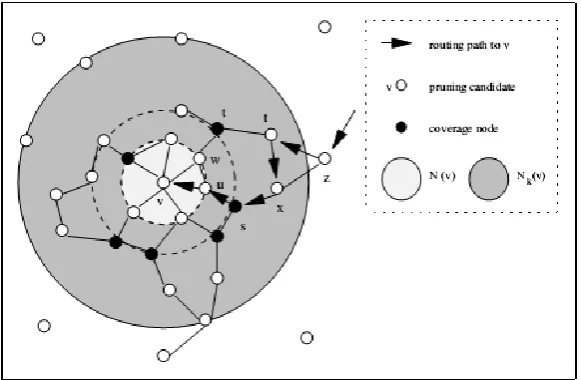
Fig.2. self-pruning based on neighbourhood information
Figure 2shows self-pruning based on coverage condition which represent the black nodes are coverage nodes for pruning candidate. It is assumed that all coverage nodes and connecting nodes are either visited nodes or nodes with higher priorities thanv’s priority. In neighbour- designating nor self-pruning algorithms can guarantee both full delivery and a constant approximation if they use only 1-hop neighbour information. Then we proposed a self-pruning algorithm based on partial 2-hop neighbour information and proved that the algorithm achieves a constant approximation to the optimum solution and guarantees full delivery [14]. However, in their proposed algorithm, each node was assumed to have its (approximate) position information, which is not practical in some applications/scenarios. Also, having position information can provide non-trivial information in wirelessed hoc networks and can greatly simplify the problem. As such, we wish to know whether similar results can be obtained without using position information. The proposed algorithm is both neighbour-designating and self-pruning, i.e. the status of each node is determined by itself and/or other nodes. In particular, using our proposed algorithm, each broadcasting node selects at most one of its neighbours to forward the message. If a node is not selected to forward, it has to decide, on its own, whether or not to forward the message.
B. Proposed Broadcast Algorithm
In broadcasting algorithm full coverage in ad hoc network can be achieved by selecting a connected dominating set as the forwarding node set. The delivery ratio is lesser than 100% due to collision, contention, & mobility. Therefore, its desirable to design the self –pruning algorithm that’s efficient is selective a small forwarding node set. This is especially important for real time application. Algorithm 1 shows our proposed ring broadcast algorithm. Initially extract all broadcast node ids and the status every node is marked as a non –forward node. Each node u that has more than one neighbouring node information its MAC layer queue. Let the neighbouring nodes of v listed in this order V0, V1………..Vr-1, where r =d(v). Each node pair (Vi, V (i+1) mod r).in this method the cycle that contain all nodes in the set of neighbouring node forwarding the broadcast packet [15].
ALGORITHM 1. The proposed ring algorithm
Begin
Extract ids of broadcast node if My_ status = nonforward; discard the message return
end if
Ifmy_ degree >1 i = 0;
while(i <my_ degree) and (my_ status = nonforward) j = (i + 1) mod my_ degree;
x = my _neighbor_ id[i]; y = my _neighbor_ id[j];
if(x and y are not directly connected by a link) update the neighbor_id
if(a node z with higher id than my id that connects to both x and y does not exist) my_ status = forward;
endif endif i++; endwhile endif end
C. Analysis of Proposed Broadcast algorithm
Determine status: If each node broadcasts its id to its 1-hop neighbour (which is simply called neighbours) and each node has a list of its neighbour. That means in a network a set of nodes form a dominating set if every node in the network is either in the set or has a neighbour in the set. In fig 3 shows the status determines the 1-hop neighbour.
Fig.3.determine status of nodes
Fig.4.path selection from source to destination
Data Transmission: In this phase, after getting the shortest path to every node we have to pass that data to destination through the forwarding nodes .these forwarding node said to be the dominating set. In figure 5 shows Each and every node maintains list that containing the some information about the neighbours. It may vary from one set to another. Suppose a node may go to another set means current set’s topology automatically changes the structure.
Fig.5. data transmission from source to destination
IV.
PERFORMANCE
ANALYSIS
AND
SIMULATIONS
The One of the major contribution of this paper work is the design of broadcast algorithm can achieve the full delivery without the position information. To confirm the analytical result, here we implement algorithm [1], liu et al.’s algorithm (a neighbouring- designation algorithm) [16], edge forwarding algorithm (a self-pruning algorithm) [17]. Both liu et al.’s broadcast algorithm and edge forwarding algorithm use position information of nodes to reduce the transmission rates. To compute the number of broadcast nodes, we uniformly distributed the nodes in square of size 1,000 × 1,000 m2. Figure 6&7 shows the average ratio of broadcasting nodes for over 500 runs for each given value of the input (i.e., the transmission range).
Fig.7.ratio of broadcast node versus transmission range
In figure.6, shows the transmission range to 250m and varied the total number of nodes from 25to 1,000. In figure.7, shows the number of nodes was fixed to 1,000 and transmission range varied from 50-300m.
V.
CONCLUTION
In this paper, we analyse the distributed broadcast algorithm in reducing the total number of transmission rate that are require to achieve full delivery. In distributed broadcast algorithm based on static approach cannot guarantee a small sized connected dominating set if the position info is not available. Even through there are certain issues proved the constant approximation factor is achievable if the position information is relatively available. Using the dynamic approach, the distributed broadcast algorithm do not required position information to achieve approximation factor. The result presented in this paper can be extended to the case where nodes are distributed in three dimension space. Therefore, the distributed broadcast algorithm based on dynamic approach cannot require the position information to achieve full delivery.
REFERENCES
[1]. B. Leiner, R. Ruth, and A. R. Sastry, “Goals and challenges of the DARPA GloMo program,” IEEE Personal Communications, vol. 3, no. 6, pp. 34–43, December 1996.
[2]. M. Garey and D. Johnson,Computers and Intractability; A Guide to theTheory of NP-Completeness. New York: W. H. Freeman & Co., 1990.
[3]. S. Guha and S. Khuller.Approximation algorithms for connected dominating sets. Algorithmica,20(4):374–387, Apr. 1998.
[4]. B. Clark, C. Colbourn, and D. Johnson, “Unit disk graphs,” DiscreteMathematics, vol. 86, pp. 165–177, 1990. [5]. J.Wu and F. Dai, “A generic distributed broadcast scheme in ad hocwireless networks,”IEEE Transactions on
Computers, vol. 53, no. ,pp. 1343–1354, 2004.
[6]. S. Ni, Y. Tseng, Y. Chen, and J. Sheu, “The broadcast storm problem ina mobile ad hoc network,”In Proc. ACM International Conference onMobile Computing and Networking (MOBICOM), pp. 151–162, 1999.
[7]. Z. Haas, J. Halpern, and L. Li, “Gossip-based ad hoc routing,” In Proc.IEEE INFOCOM, pp. 1707–1716, 2002. [8]. D.Y.Sasson and A. Schiper, “Probabilistic broadcast for flooding inwireless mobile ad hoc networks,”In Proc.
IEEE Wireless Communica-tions and Networking Conference, pp. 1124–1130, 2003.
[9]. H.Liu,P.Wan,X.Jia, X.Liu,andF.Yao, “Effcientfooding schemebased on 1-hop information in mobile ad hoc networks,”In Proc. IEEEINFOCOM, 2006.
[10]. I. Stojmenovic, M. Seddigh, and J. Zunic, “Dominating sets and neigh-bor elimination-based broadcasting algorithms in wireless networks,”IEEE Trans. on Parallel and Distributed Systems, vol. 13, pp. 14–25,2002. [11]. M. Khabbazian and V. K. Bhargava, “Efficient broadcasting in mobilead hoc networks,”IEEE Transactions on
Mobile Computing: acceptedfor publication, 2008.
[12]. Y. Xu, J. Heidemann, and D. Estrin, “Geography-informed energyconservation for ad hoc routing,”In Proc. ACM International Conferenceon Mobile Computing and Networking (MOBICOM), 2001.
[13]. jie. wu, "Broadcasting in Ad Hoc Networks Based on Self-Pruning".floridaatlanticuniversity,boca raton,FL33431. [14]. M. Khabbazian and V. K. Bhargava, “Localized broadcasting with guaranteed delivery and bounded transmission
redundancy,”IEEE Trans-actions on Computers, vol. 57, no. 8, pp. 1072–1086, 2008
[15]. Yaminli,Wanmingchu."an efficient distributed broadcasting algorithm in wireless adhoc network,"tokyo 184-8584jappan.
[16]. H.Liu,P.Wan,X.Jia, X.Liu,andF.Yao, “Efficientflooding schemebased on 1-hop information in mobile ad hoc networks,”In Proc. IEEEINFOCOM, 2006.