© 2018, IRJET | Impact Factor value: 6.171 | ISO 9001:2008 Certified Journal | Page 3699
EXPERIMENT STUDY ON STRENGTH CHARACTERISTICS OF CONCRETE
USING BAGASSE ASH
Dr Bhavin Patel
1, Hardik Lad
2,Priyank Shah
3, Bhavin Garasia
4 1Assisstant professor, Civil Engineering Department, FETR Bardoli, Gujarat, India.
2,3,4
UG
Student, Civil Engineering Department, FETR Bardoli, Gujarat, India.
---***---Abstract -
The present study focuses on the utilization of Sugarcane Bagasse Ash as replacement material for cement in concrete production. Sugarcane Bagasse ash contains high amorphous silica content and aluminum ion. For experimental investigations, Sugarcane bagasse ash and its chemical properties are obtained from Madhi sugar factory, Gujarat .Ordinary Portland cement was partly replaced by sugarcane bagasse ash in the ratio of 0%, 5%, 10%, and 15% by weight and the influence of Sugarcane bagasse ash as a partial replacement material has been examined on hardened concrete with tests for Compressive strength, Split tensile strength, Flexural strength for M25 grade of concrete. The result shows that the strength of concrete increased as percentage of bagasse ash replacement increased up to certain percentage. Beyond that optimum level the strength of concrete begins to decrease drastically. The highest strength was obtained at 10% Sugarcane bagasse ash replacementKey Words
:
Sugarcane bagasse ash, Pozzolanicproperty, Amorphous Silica, Strength
1. INTRODUCTION
Ordinary Portland cement is recognized as a major construction material throughout the world. Researchers all over the world today are focusing on ways of utilizing either industrial or agricultural waste, as a source of raw materials for industry. This waste, utilization would not only be economical, but may also result in foreign exchange earnings and environmental pollution control. Industrial wastes, such as blast furnace slag, fly ash and silica fume are being used as Supplementary cement replacement materials. Currently, there has been an attempt to utilize the large amount of bagasse ash, the residue from an in-line sugar industry and the bagasse-biomass fuel in electric generation industry. When this waste is burned under controlled conditions, it also gives ash having amorphous silica, which has pozzolanic properties. A few studies have been carried out on the ashes obtained directly from the industries to study pozzolanic activity and their suitability as binders, partially replacing cement.
The main composition of bagasse ash is siliceous oxide (sio2), which reacts with free lime from cement hydration pozzolanic property of sugarcane bagasse ash (SCBA) came from the silicate content of the ash. The silicate undergoes a pozzolanic reaction with the hydration products of the cement and results a reduction of the free
lime in the concrete. Therefore, study attempts to make use of the sugarcane bagasse ash in India as a pozzolanic material to replace cement. Thus it is possible to use sugarcane bagasse ash as cement replacement material to improve quality and reduce the cost of construction such as mortar, concrete pavers, concrete roof tiles and soil cement interlocking block.
The main components of raw bagasse are silica (60–75%), K2O , CaO and other minor oxides including Al2O3, Fe2O3, and SO3 . Low specific gravity (1.8–2.1) of raw bagasse ash may be due to of large amount of lightweight unburnt particles . The pozzolanic activity of SCBA mainly depends on its particle size and fineness.
1.1 AIM AND OBJECTIVE
The aim of study is to evaluate the performance and suitability of baggase ash in concrete with as alternative for cement
To evaluate the compressive strength, split tensile strength, and flexural strength of concrete with replacement of cement with bagasse ash
The objectives of experimental study are:
Study on strength characteristics of M25 grade concrete with replacement of 0%, 5%, 10% and 15% of cement by bagasse ash
To determine the %, strength of concrete at 7, 28 days
To study the effect of cement in concrete by pozzolonic material that is Bagasse ash
To find out the optimum percentage of Bagasse ash that can effectively replaces the cement by weight without any adverse effect on properties of hardened concrete.
2. MATERIALS USED
2.1 CEMENT
© 2018, IRJET | Impact Factor value: 6.171 | ISO 9001:2008 Certified Journal | Page 3700 investigation for all concrete mixes. The cement used was
fresh and without any lumps.
2.2 FINE AGGREGATE
Fine sand should consist of natural sand or crushed stone sand. It should be hard, durable and clean and be free from organic matter etc. Fine Sand should not contain any appreciable amount of clay balls and harmful impurities such as alkalis, salts, coal, decayed vegetation etc. Locally available river sand is used in experiment which is passing through 4.75mm IS sieve and retained on 75 micron IS sieve.
Table-1: Properties of fine aggregate
2.3 COARSE AGGREGATE
[image:2.595.309.545.105.211.2]Aggregate generally occupy 70% to 80 % of volume of concrete and therefore it have an important influence on its properties of concrete. Coarse aggregate was used of size 20mm conforming to IS 383 is used. Good-quality of aggregate which is clean, hard, strong, have durable particles, and be free of absorbed harmful chemicals, coatings of clay, or other contaminates that can affect hydration of cement or reduce the paste-aggregate bond.
Table- 2: Properties of coarse aggregate
Properties Results Specific gravity 2.69 Water absorption 0.26%
Maximum size 20 mm
Minimum size 12.5 mm Impact value 18.62 Crushing value 6.52
2.4 SUGARCANE BAGGASE ASH
The sugarcane bagasse consists of approximately 50% of cellulose, 215% of hemi cellulose and 25% of lignin. Each ton of sugarcane generates approximately 26% of bagasse (at a moisture content of 50%) and 0.62% of residual ash. The residue after combustion presents a chemical composition dominates by silicon dioxide (SiO2). In spite of being a material of hard degradation and that presents few nutrients, the ash is used on the farms as a fertilizer in the sugarcane harvests. Carbon and iron affect the colour of the bagasse ash.
High carbon content changes the color to grey or black. High iron content produces a tin colored ash .The
specific gravity of ash is given by manufacturer is 2.12.
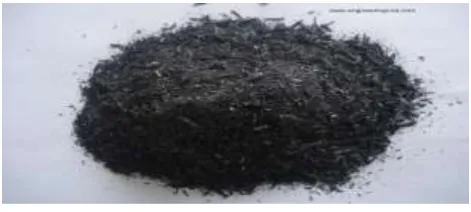
Fig-1: Bagasse ash
Table - 3: Chemical Composition of SCBA
Components
MASS in %
Silica(sio2 ) 58.62
Alumina(Al2O3) 14.95
Ferric oxide(Fe2O3) 12.25 Calcium oxide(CaO) 1.92 Sulpher trioxide SO3 2.070 Magnesium oxide Mgo 2.090 Loss of ignition 1.080
3.
MIX DESIGN
Concrete mix of M25 grade was designed by
conforming to IS 10262-1982 method. The cement were replaced with bagasse ash by 0%, 5%, 10% and15% 0.43water cement ratio was kept constant.
Table -4: Mix proportion cement Fine
aggregate Coarse aggregate Water
Ratio 1 1.17 2.36 0.43
Mass Kg/m3
445 523 1288 191.6
Mixes:
M1=100% of Cement+0% of BA+100% FA+100% CA
M2=95% of Cement+5% of BA+100% FA+100% CA
M3=90% of Cement+10% of BA+100% FA+100% CA
M4=85% of Cement+15% of BA+100% FA+100% CA Where, BA = Bagasse ash
FA = Fine Aggregate CA = Coarse Aggregate
4. CASTING, CURING AND TESTING OF SPECIMEN
Cement, fine aggregate and coarse aggregate of mix
proportion 1:1.17:2.37 were taken corresponding to M25Properties
Results
Specific gravity
2.65
Water absorption
1.34%
[image:2.595.312.557.473.544.2]© 2018, IRJET | Impact Factor value: 6.171 | ISO 9001:2008 Certified Journal | Page 3701 grade concrete. Bagasse ash as partial replacement of
cement. Batching of materials as per mix design is done by weigh batching. All ingredients are first dried mixed then water added. Machine mix is done to get homogenous mixture. Then the mixture is poured into specimens. Vibrators are used for compaction. After vibration the surface of specimen is leveled using trowel. Specimens are kept for drying for 24 hours and then specimen were demoulded. Specimens are then kept for curing. Curing is done 7,28 days.
Testing of specimen: The 6 cubes for each proportions were tested for compressive strength of size 150 × 150 × 150 mm. 4 cylinders for each proportions of size 150mm diameter and 300mm length were casted and used for testing split tensile strength and 4 beams for each proportions of size 500mm length, 100mm width and 100mm depth were casted and used for testing flexural strength at 7, 28 days curing.
4.1 COMPRESSIVE STRENGTH TESTS
Specimens of size 150 × 150 × 150 mm were casted for all the proportions and tested in compression testing machine. Capacity of machine is 2000KN.Compressive strength calculated by using equation,
F=P/A
Where, F= compressive strength in N/mm2 P= maximum load in Newton A= cross sectional area in mm2
Table-5: Shows the average compressive strength at various proportions
Mix
Proportions compressive 7days
strength
in N/mm2
28days compressive
strength
in N/mm2
0% 18.22 31.50
5% 19.023 33.20
10% 19.35 35.25
15% 18.78 32.23
Fig-2: Average compressive strength for various proportions
4.2 SPLIT TENSILE STRENGTH TESTS
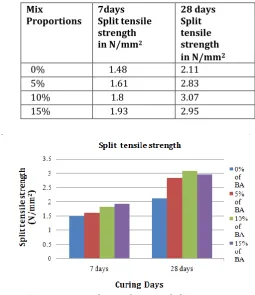
Specimen of size 150 mm diameters and 300mm length were casted. The test was conducted on the Compression Testing Machine. Cylinder specimens were placed under the Compression Testing Machine in a horizontal direction perpendicular to the direction in which they are casted. The tensile strength was found by using equation,
F = 2P/ΠLd
Where, F=tensile strength in N/mm²
P = Maximum load applied d = measured depth of specimen L= Length of specimen
[image:3.595.309.565.335.631.2]Table -6: Shows the average tensile strength of concrete at various proportions
Fig-3: Average split tensile strength for various proportions
4.3 FLEXURAL STRENGTH TESTS
Concrete as we know is relatively strong in compression and weak in tension. Beams tests are found to be dependable to measure flexural strength property of concrete. The system of loading used in finding out the flexural tension is two points loading. The specimen placed in flexural testing machine in such a manner that
Mix
Proportions 7days Split tensile strength in N/mm2
28 days Split tensile strength in N/mm2
0% 1.48 2.11
5%
1.61 2.83
10% 1.8 3.07
© 2018, IRJET | Impact Factor value: 6.171 | ISO 9001:2008 Certified Journal | Page 3702 the load to be applied to uppermost surface as cast in the
mould. The flexural strength was found by using equation,
F = PL/bd2
Where, F=Flexural strength in N/mm²
[image:4.595.33.290.307.578.2]P = Maximum load applied L = Length of specimen b = breadth of specimen d = depth of specimen
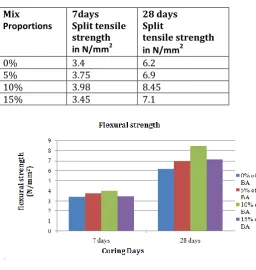
Table -8: Shows the average flexural strength at various proportions
Fig-4: Average flexural strength for various proportions
5. RESULTS AND DISCUSSION
From the experimental analysis, it is an evident that at age of 7, 28 days fig 2,3,4 shows the compressive strength, split tensile strength and flexural strength increases as a percentage of Baggase ash is increased. For the further increases of Bagasse ash the strength decreased. Optimum strength obtained at 10% replacement of bagasse ash as cement.
6. CONCLUSIONS
Bagasse ash can be used as partial replacement for cement up to percentage of 5 and 10. More than the 10% replacement decreases in strength is seen. For optimum result the 10% replacement bagasse ash is good.
The results showed that, the concrete with 10% SCBA replacement after 28 days of curing, showed maximum strength when compared to concrete with other percentage replacement mixes.
As the flexural tensile strength of SCBA concrete is more it can be used in slabs beams etc., where higher flexural tensile strength is required.
The density of concrete decreases with increase in SCBA content, thus low weight concrete can also be produced in the society with waste materials (SCBA)
In the economic point of view, the cement replaced by SCBA saves money.
It was clearly shown that SCBA is a pozzolanics material that has the potential to be used as partial cement replacement material and can contribute to the environmental sustainability.
In addition its use resolves the disposal problems associated with it in the sugar industries and thus keeping the environment free from pollution.
REFERENCES
1.
Ahmed Salih, E.M. (2014) ‘The Usage of the Sugarcane Bagasse Ash in Sudanese Sugar Company as Pozzolanic – Cement Binder’, IOSR Journal of Engineering, vol.04.2.
Balaji , K V G D. and Santhosh Kumar, T. (2014) ‘Partal replacement of Cement in concrete with sugarcane bagasse ash – behavior in HCl solution’ ,International Journal of Advanced Research in Science and Engineering.3.
Kawade, U.R. and Vaishali , D. (2013) ‘Effect of use of bagasse ash on strength of concrete’, International journal of innovative research in science, Engineering and Technology vol.2,Issue7.Mix Proportions
7days Split tensile strength in N/mm2
28 days Split
tensile strength in N/mm2
0% 3.4 6.2
5% 3.75 6.9
10% 3.98 8.45
© 2018, IRJET | Impact Factor value: 6.171 | ISO 9001:2008 Certified Journal | Page 3703
4.
Nareshkumar ,B.G. and Yashwanth , M.K. ‘Anexperimental study on bagasse ash as replacement for cement in lightweight concrete’,
International of latest trends in engineering and technology (IJLTET)
5.
Raijiwala, B. (2015) ‘Experimental study on use of sugarcane bagasse ash in concrete by partial replacement with cement’, International Journal of Innovative Research in Science, Engineering and Technology vol.4.6.
Abdulkadir, T.S. and Lawal, A.A. (2014) ‘Evaluation of sugarcane bagasse ash as a replacement for cement in concrete works’, ACTA TEHNICA CORVINIENSIS – Bulletin of Engineering7.
Srinivasan, R. and Sathiya, K. (2010) ‘Experimental study on bagasse ash in concrete’, International journal for service learning in engineering,vol.58.
BIS IS 12269-2004 Specification for 53 grade ordinary Portland cement.9.
BIS IS 516-2004 Methods of test for strength of concrete.10.
BIS IS 383-2002 Specification for coarse and fine aggregate.CODE BOOK
IS CODE 10262:2009 for Concrete Mix Proportion