e-ISSN: 2250-3021, p-ISSN: 2278-8719 Vol. 3, Issue 6 (June. 2013), ||V2|| PP 22-27
Experimental Investigation to Study Effect of Polyester Fibre on
Durability of HVFA Concrete through RCPT Method
Indrajit Patel
1, C D Modhera Author
2 1Gujarat Technological University, Gujarat, India
2
S V National Institute of Technology, Surat, India
Abstract: Global warming has emerged today as a life-threatening issue for the world. Since concrete is one of the most consumed material after water on the earth for infrastructure & construction industries, a commendable contribution can be made by optimizing the use of cement and natural resources in concrete manufacturing. High volume Fly Ash (HVFA) concrete is one of the major developments since last two decade leading to utilization of Fly Ash in a bulk quantity and thereby reducing cement consumption and ultimately reducing emulsion of CO2 in order of one ton per a ton of cement. Durability of concrete structure is another important parameter effecting the sustainability of concrete technology in addition to minimizing use of virgin material. Experimental investigation has been carried out by authors to study effect of 12mm triangular polyester fibre on engineering and durability properties of HVFA concrete. Engineering parameters include compressive and flexural strength, impact and abrasion resistance. Durability aspect is studied through Rapid Chloride Penetration Test (RCPT) as per ASTM C 1202 and comparative study for RCPT test is discussed for plain and fibre reinforced HVFA concrete in this article. The article describes durability parameters of HVFA concrete, methodology of RCPT, standards and test report of special additives to HVFA.
Keywords: - Durability, Fly ash, Fibre, RCPT
I. INTRODUCTION
The permeability of High Volume Fly Ash(HVFA) concrete is very low. The estimated permeability (hydraulic conductivity) of HVFA concrete is less than 10-13 m/s. As a comparison, normal Portland cement concrete with a W/C of 0.40 would have an estimated permeability of 10-12 m/s (Malhotra and Mehta, 2002). In general, the resistance of a reinforced concrete structure to corrosion, alkali aggregate expansion, sulfate and other forms of chemical attack depends on the water tightness of the concrete. HVFA concrete when properly cured is able to provide excellent water-tightness and durability (Mehta P K, 2004). The use of fly ash in concrete decreases the required water and this combined with the production of additional cementitious compounds leads to a low The porosity and discontinuous pore structure which reduces the permeability of the concrete (Estakhri and Saylak, 2004; Malhotra and Mehta, 2002). It is worth re-emphasizing that the permeability of HVFA concrete is greatly influenced by curing. Inclusion of structural or non structural fibre to overcome drawback of HVFA concrete like slow early age strength gaining, bleeding and segregation, poor resistance to tensile, abrasive and impact resistance needs a systematic study for its effect on durability parameters of HVFA concrete.
Following different tests are carried out to access the durability of HVFA concrete as per need and situation. Water permeability
Resistance to freezing and thawing cycles, ASTM C-666-test procedure. Resistance to de-icing-salt scaling, ASTM C -672 test method
Resistance to the penetration of chloride icons ASTM C 1202 and corrosion of steel reinforcement Carbonation ASTM C 192 /C 192M-98
Resistance to sulphate attack
Control expansion due to alkali silica reaction
The present experimental work includes study of different durability parameters, test methodology and Rapid Chloride Penetration Test in detail as per ASTM C 1207.
1. Rapid Chloride Penetration Test
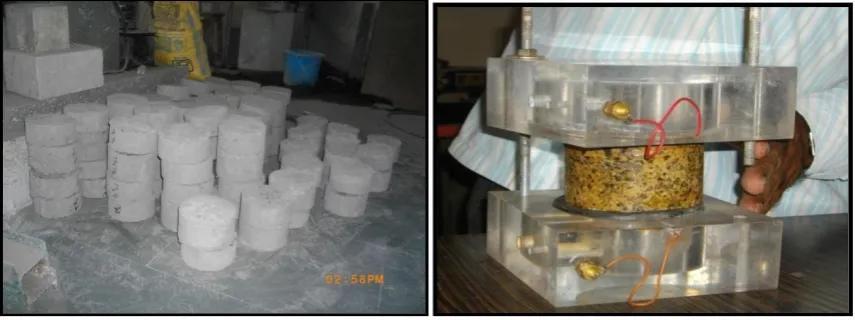
passed through the specimen is calculated. The test set up is shown in Fig.1
Fig.1 RCPT Test Equipment and Set Up.
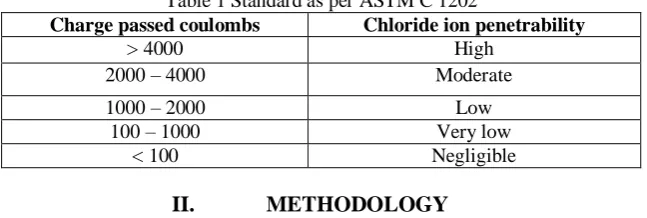
The test results are compared to the values in the TABLE .1. This chart was originally referenced in FHWA/RD-81/119 and is also used in AASHTO T277-83 and ASTM C1202 specifications.
Table 1 Standard as per ASTM C 1202
Charge passed coulombs Chloride ion penetrability
> 4000 High
2000 – 4000 Moderate
1000 – 2000 Low
100 – 1000 Very low
< 100 Negligible
II. METHODOLOGY
1. Material
Cement and Fly Ash: Ordinary Portland cement of 53 grades available in local market is used in the investigation. The cement used has been tested for various proportions as per IS 4031-1988 and found to be confirming to various specifications of are IS 12269-1987. Class F fly ash confirming to BIS 3812-2003 was used as mineral admixture. “Fig.2” shows scanning electron microscopic view of fly ash.
Coarse aggregate:Crushed angular granite metal of 20 mm and 10mm size from a local source was used as coarse aggregate in the proportion of 60:40. The specific gravity of 2.86 and fineness modulus 7.13 was used.
Fine aggregate:Local River sand confirming to zone-II was used as fine aggregate. The specific gravity of 2.60 and fineness modulus 2.86 was used in the investigation.
Polyester Fibre: 12mm size triangular-Tribodal shaped polyester fibre confirming to type III fibres under ASTM C: 1116 were used as a supplementary reinforcing material to enhance the mechanical properties of hardened concrete. The scanning electron microscopic view is shown in “Fig.2”
Fig.2 Scanning Electron Microscope View of Fly Ash and Fibre
2. Mix Design
Fig.3 RCPT Test Specimen and Test arrangement
III. RESULT AND DISCUSSION
As specified in ASTM C 1202 the current passed was measured at an interval of 15min for six hours for each sample and readings in Columbs were tabulated as shown in TABLE 3. The comparative study for different mix ,inclusion of fibre , replacement of cement at age of 28 and 91 days are shown graphically in “ Fig.4”.
Table. 3
M25 Grade
Fly Ash/Fibre % 50 55 60
Days 28 91 28 91 28 91
0.00 917.20 572.40 903.55 501.20 869.70 459.90
0.15 837.10 524.00 816.20 468.45 811.20 403.70
0.25 806.15 460.35 800.00 353.70 769.35 349.35
M30 Grade
Fly Ash/Fibre % 50 55 60
Days 28 91 28 91 28 91
0.00 857.70 561.50 868.90 498.75 789.00 512.30
0.15 817.35 512.45 834.50 436.50 804.67 397.60
0.25 805.00 448.60 768.00 379.12 772.40 361.00
M35 Grade
Fly Ash/Fibre % 50 55 60
Days 28 91 28 91 28 91
0.00 827.90 477.20 789.60 422.20 706.35 342.90
0.15 813.75 432.90 768.25 409.70 700.50 348.90
0.25 746.90 397.30 723.58 379.90 698.00 334.60
M40 Grade
Fly Ash/Fibre % 50 55 60
Days 28 91 28 91 28 91
0.00 734.00 351.00 695.90 369.00 678.12 355.50
0.15 678.50 341.70 654.00 339.45 634.00 336.85
Fig.4 Comparative Study of RCPT Results .
0 200 400 600 800 1000
28 Days 91 Days 28 Days 91 Days 28 Days 91 Days
R
C
P
T
Fly ash
M35
0% fibre 0.15% fibre 0.25% fibre
55% 60%
50%
0 200 400 600 800
28 Days 91 Days 28 Days 91 Days 28 Days 91 Days
R
C
P
T
Fly ash
M40
0% fibre 0.15% fibre 0.25% fibre
55% 60%
grade M25,M30, M35 and M40 respectively.
It is in order of 24.30, 24.38, 10.30, and 8.29 respectively for M25 to M40 grade samples with 0.25% fibre inclusion.
With 0.15% to 0.25% fibre, percentage increase in chloride resistance is in order of 62.10, 40.23, 53.98, and 34.37 for M25M30M35 and M40 grade respectively.
d) Measurement of current for six hours in all samples at an interval of 15min found to be almost constant which reflects uniform dense mix and lower permeability in the concrete.
e) All samples with and without fibre inclusion shows very low permeability as per ASTM C1202. f) Richer mix and higher replacement of cement gives excellent resistance at latter ages of samples.
REFERENCES
Journal Papers:
[1] A. Bilodeau, V. Sivasundaram, K.E. Painter, V.M. Malhotra, Durability of concrete incorporating high volumes of fly ash from sources in the USA, ACI Mater. J. 91 (1) (1994) 3– 12.
[2] A. Bisaillon, R. Michel, V.M. Malhotra,“Performance of high-volume fly ash concrete in large experimental monoliths”, ACI Mater. J. 91 (2) (1994) 178–187.
[3] Chandramouli K et.al ,”Rapid Chloride Permeability Test For Durability Studies On Glass Fibre Reinforced Concrete”, ARPN Journal of Engineering and Applied Sciences, Vol. 5, No. 3, March 2010,pp 67-71
Books:
[4] Gambhir, M. L Concrete Technology,( Tata Mc-Graw Hills,2004).
[5] Shetty, M.S. Concrete Technology,(S.Chand & Company Ltd., edition 2010 pp.1-503).
Theses:
[6] Donald Burden, , Theory The Durability of Concrete Containing High Levels of Fly Ash. Master of Science in Engineering Dissertation, University of New Brunswick, 2003.
Proceedings Papers:
[7] Gebler, S.H., and Klieger, Paul, "Effect of Fly Ash on Physical Properties of Concrete”, Proceedings of the CANMET/ACI Second International Conference on the Use of Fly Ash, Silica Fume, Slag, and Natural Pozzolana in Concrete, Madrid, Spain, V.M. Malhotra, Ed., Vol.1,ACI Special Publication No. SP-91, 1986, pp. 1-50.
Standards:
[8] ASTM C 1116-97, Standard specification for Fiber Reinforced concrete and shortcrete.
[9] ASTM C 1202-09, Standard test method for electrical indication of concrete’s ability to resist chloride ion penetration.
[10] BIS 10262: 1982 Recommended guidelines for concrete mix design.