R E S E A R C H
Open Access
A comparison of methods for temporal
analysis of aoristic crime
Matthew PJ Ashby
1*and Kate J Bowers
2Abstract
Objectives: To test the accuracy of various methods previously proposed (and one new method) to estimate offence times where the actual time of the event is not known.
Methods: For 303 thefts of pedal cycles from railway stations, the actual offence time was determined from closed-circuit television and the resulting temporal distribution compared against commonly-used estimated distributions using circular statistics and analysis of residuals.
Results: Aoristic analysis and allocation of a random time to each offence allow accurate estimation of peak offence times. Commonly-used deterministic methods were found to be inaccurate and to produce misleading results. Conclusions: It is important that analysts use the most accurate methods for temporal distribution approximation to ensure any resource decisions made on the basis of peak times are reliable.
Keywords: Temporal crime analysis, Aoristic analysis, Temporal accuracy, Peak offence times
Background
The routine activities approach to explaining crime pat-terns, first articulated by Cohen and Felson (1979, 590), describes how variations in the availability of offenders, targets and guardians explain spatio-temporal variations in crime. When and where there are more offenders, more targets and fewer guardians, there is likely to be more crime (Brantingham and Brantingham 1993, 6). The pur-pose of this article is to further efforts to analyse these variations by assessing the accuracy of different methods for estimating the most common offence times for certain types of crime for which individual offence times are not known.
Academic interest in developing crime-analysis tech-niques has focused on spatial variation in crime (Ratcliffe and McCullagh 1998, 752), with less attention being paid to temporal variation. This does not mean that tempo-ral variation is not important: Felson (2006, 7) described crime as being “in motion—daily, hourly, and momentar-ily, on large scale and small”, while Felson and Poulsen
*Correspondence: [email protected]
1UCL Security Science Doctoral Research Training Centre, 35 Tavistock Square, London WC1H 9EZ, UK
Full list of author information is available at the end of the article
(2003, 595) noted that the frequency of crime varies more throughout each day than in any other way.
Previous research has shown that the routine activi-ties approach can explain temporal variations in the fre-quency of many crimes. Temporal variation in crime can be explored on many scales—weekly, monthly and yearly (e.g. Baumer and Wright 1996)—but we focus on varia-tion across the day as our scale of interest here. Melbin (1978, 453) noted that the rhythms of crime in Boston followed, but lagged behind, the pattern of routine activ-ities. Cohn (1993, 76) found that day of the week, time of day, school vacations and public holidays—which influ-ence people’s activities—all predicted the frequency of police calls to deal with domestic violence. Messner and Tardiff (1985, 258) found that homicides in which the vic-tim and offender were related to one another were more common at weekends, when people spend more time with family and friends. Cohn and Rotton (2003, 356) took this idea further and demonstrated that the frequency and dis-tribution of many types of crime vary substantially on major public holidays, when both offenders and victims are engaged in activities that are different from activities on ‘normal’ days. These studies all indicate that temporal variation in crime is both substantial and associated with the routine activities of both victims and offenders.
Felson and Poulsen (2003) considered methods for sum-marising daily variations in crime that would be simple for crime analysts to use. They did not discuss circu-lar statistics, but noted that midnight is a purely arbi-trary and somewhat inconvenient ‘start’ time for a day, since it means that many late-night crimes straddle more than one day. They recommend explicitly choosing an appropriate time at which to ‘start’ the day for crime analysis purposes, and suggest that 05:00 hours will be suitable in many cases because very few motivated offend-ers are awake at that time and so little crime happens then.
Felson and Poulsen (2003, 597) also recommend a num-ber of summary statistics, including the “median minute of crime” and “crime’s daily timespan”, the (IQR) around the median. This requires each day to start at a set time: the present study will use 05:00 hours, as Felson and Poulsen (2003, 597) suggested.
Aoristic crimes
Knowing when crime occurs is crucial for crime anal-ysis, but it is also difficult: for certain common types of crime, the crime analyst will usually not know when individual incidents occurred. Ratcliffe and McCullagh (1998, 754) call these “aoristic crimes”, using a Greek-derived word meaning “indeterminate”. The magnitude of the problem of aoristic crimes may be one reason why many police officers appear to know more about where crime happens than when it happens Ratcliffe (1999, 70).
Most crimes against unattended property are aoris-tic, while most crimes against people are not. A victim of a robbery or assault will be able to tell the police more-or-less exactly when the crime occurred Helms (2008, 241), but the victim of a burglary or criminal damage to a motor vehicle will often only be able to state:
1. The time at which they left the property unattended. This is the earliest time at which the crime could have occurred, hereafter known aststart.
2. The time at which they returned to discover the crime had been committed. This is the latest time at which the crime could have occurred, known astend.
tend−tstart = trange, the range of times over which the
crime could have occurred. Withintrange, the crime
actu-ally occurred at an unknown time,tactual.trange can be a
few minutes, a few hours or a few weeks, depending on how long the victim left the property unattended for. The point halfway betweentstartandtendwill be known astmid.
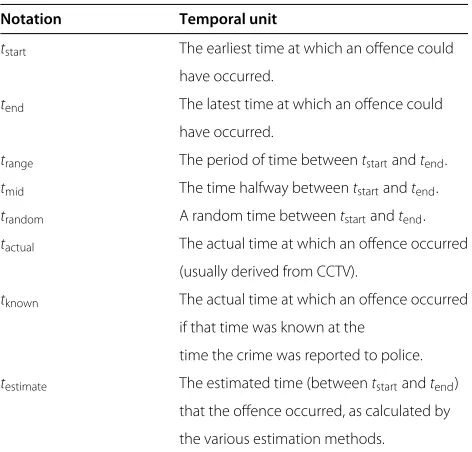
This terminology is summarised in Table 1. In each case, the point in time for each crime can be aggregated to form a distribution of that value.
Table 1 Temporal units
Notation Temporal unit
tstart The earliest time at which an offence could
have occurred.
tend The latest time at which an offence could
have occurred.
trange The period of time betweentstartandtend.
tmid The time halfway betweentstartandtend.
trandom A random time betweentstartandtend.
tactual The actual time at which an offence occurred
(usually derived from CCTV).
tknown The actual time at which an offence occurred
if that time was known at the
time the crime was reported to police.
testimate The estimated time (betweentstartandtend)
that the offence occurred, as calculated by
the various estimation methods.
Table 2 shows trange for some types of aoristic crime
recorded by British Transport Police in 2010. Although crimes do not occur instantaneously (i.e., the criminal event will have a start and end time of its own), the time taken to commit a crime such as burglary or theft from a motor vehicle is so short in comparison to the typical value oftrange(Ratcliffe 1999, 75) thattactualcan be treated
as if it were an instant in time rather than an event with its own duration.
Methods for analysing aoristic crimes
Sincetactualis important but often not known, crime
ana-lysts can choose to either ignore temporal variation in crime or use some method to calculatetestimate, the
esti-mated value of tactual. Various estimation methods exist,
but it has not previously been possible to establish their relative efficacy because there have been no available data
Table 2trangefor aoristic crimes
Crime type Mediantrange Crimes with
(hours:minutes) trange>1hour
Commercial burglaries 6:00 63%
Criminal damage . . .
to motor vehicles 11:04 82%
by graffiti 4:30 62%
Thefts . . .
of metal 5:00 55%
of motor vehicles 11:50 88%
from motor vehicles 10:00 90%
on the actual distribution of an aoristic crime against which the estimation methods could be compared.
The problems of aoristic crime have, in the authors’ experience, led some crime analysts to ignore temporal variation in aoristic crime and not mention it in their analytical products. Such a position can only be justified only if there is no systematic temporal variation in aoristic crime, or if the estimation methods available are so poor that they are misleading.
An alternative to this no-analysis method is to deter-mine a peak time intuitively (Walker 2009, 133), perhaps with apost hoc rationalisation if pressed. Both Ratcliffe and McCullagh (2001) and Bichler and Gaines (2005) found that police officers’ intuitive knowledge of where crimes happen was inconsistent. This is likely to be because officers’ intuitions are based on their experience of a non-random subset of crime. Since different crimes have different peak times (Grubesic and Mack 2008, 303) and crime patterns change over time (Johnson and Bowers 2004, 58), it appears unlikely that officers will be able to maintain an intuitive picture of when crime occurs (McLaughlin et al. 2007, 103). Although further empiri-cal research on this topic may be valuable, the intuitive method will not be considered further in this study.
The known-time method analyses only those crimes that definitely occurred within one unit of analysis, where the unit of analysis (known astunit) is the level of
aggrega-tion at which the data are presented. The time at which the crime occurred for crimes analysed by the known-time method will be referred to astknown. For example, if the
object of analysis is to determine the day of the week in which the plurality of crimes occurs,tunit=1 day and the
analyst would exclude all crimes that could have occurred in more than one day. Note, however, that this is not the same as saying that crimes are included in the known-time analysis iftrange<tunit. If (for example)tstart=23:01
hours andtend=01:01 hours the next day,trange=2 hours
(trangetunit) but the crime could have occurred in either
of two units of analysis, so the crime cannot be included in any known-time analysis. Ratcliffe (1999, 83) points out that this eccentricity will be more problematic if many crimes occur across the boundary of two units of analysis, such as commercial burglaries that occur overnight.
Whentunit is fairly smal l, only a small proportion of
crimes will be included in tknown, because the average
value oftrangefor aoristic crimes is much greater thantunit,
buttestimatefor those crimes that are included will be
rel-atively accurate (Ratcliffe 1999, 77). Unlike all the other estimation methods, whether the known-time method is a good way of estimating peak offence times depends on whether the crimes included in the distribution oftknown
are representative of all crimes (Sorensen 2004, 11). The known-time method is the only estimation method that reflects the actual behaviour of offenders, rather than
extrapolating from tstart or tend, which is more likely to
represent the routine activities of victimsa. This method
should therefore be a good estimator of the actual peak times, subject to the crimes included in the known-time analysis being representative of all crimes.
In the start and end methods, the analyst assumes that every crime occurred attstart or, alternatively, that every
crime occurred attend. This has the advantage of
includ-ing every crime in the analysis, but—dependinclud-ing on when the crimes actually occurred—means that the estimated time of each crime can be wrong by anything up to the value oftrange. Sincetrangeis typically substantial (Table 3),
the peak times oftestimate may be very different from the
peak times oftactual.tstartandtendreflect the routine
activ-ities of the victim (Ratcliffe 2001, 2), as described above, whereas the distribution oftactualis determined by when
(and whether) the routine activities of the offender, target and guardian interact.
The mid-point method assumes that every crime occurred attmid. Like the start and end methods, the
mid-point method includes every crime in the analysis, but the maximum error in the value oftestimateistrange/2. The value
of testimate generated by the mid-point method should
therefore be more accurate than the value generated by the start or end methods (Helms 2008, 242). That said, tmidis derived solely fromtstartandtend, and so it cannot
be free of any problems associated with the distributions oftstartandtend.
The start, mid-point and end methods all share a prob-lem: there is no more reason to believe that a crime occurred attstart, tmid or tend than at any other time. A
‘random’ method (which to the authors’ knowledge has not previously been described) could be used to minimise this error by assuming instead that each crime occurred at a random instant withintrange, known astrandom. Although
there is no reason to think that any individual crime is more likely to have happened attrandomthan at, for
exam-ple,tstart, for a large-enough sample of crimes it appears
likely that the distribution oftrandomwill be more accurate
than the distribution oftstart,tmidortend.
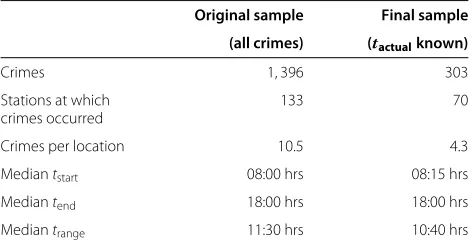
Table 3 Sample characteristics
Original sample Final sample
(all crimes) (tactualknown)
Crimes 1, 396 303
Stations at which crimes occurred
133 70
Crimes per location 10.5 4.3
Mediantstart 08:00 hrs 08:15 hrs
Mediantend 18:00 hrs 18:00 hrs
Another way of minimising this error is aoristic anal-ysis. The aoristic method was named and developed by Ratcliffe and McCullagh (1998) with similar methods being described by Gottlieb et al. (1994, 429–434), Rayment (1996, 3), and Brown (1998, 2851). The aoris-tic method gives each crime a value of 1 and assigns an equal fraction of that value to each unit of analysis in which the crime could have occurred. So if a crime could have occurred in any one of 10 hours, aoristic analysis will assume that there is a probability of 0.1 that the crime occurred in any single hour-long period. The distribution oftaoristicis the sum of all the fractions allocated from each
crime to each hour.
Existing evidence
Most work on aoristic analysis has been carried out in relation to residential burglary. Ratcliffe and McCullagh (1998, 756–758) showed that aoristic analysis is capable of revealing temporal peaks in burglary levels that were not revealed by known-time analysis. Ratcliffe (2000, 672) showed that the temporal distributions produced by the start, mid-point, end and aoristic methods were substan-tially different from one another. In that study the aoristic method produced a much smoother distribution than the other methods, which all showed a sharply peaked uni-modal distribution with the peak at a different time of day. Ratcliffe (2001, 2) noted that these peaks reflect the rou-tine activities of the burglary victims, in that the peak in tstartoccurred when most people left their house for work
and the peak intendoccurred when most people returned
home.
Ratcliffe (2002, 33) showed that there was a signifi-cant correlation between the distribution of tstart, tmid,
tend and taoristic for offences where the mean value of
trange was less than four hours (¯trange < 4tunit, where tunit = 1 hour), for example assaults, personal
rob-beries and possession of drugs. For domestic burglaries, for thefts of and from motor vehicles, and for crim-inal damage there was no correlation between tstart
or tend and taoristic, although the correlation between
tmid and taoristic remained. What these findings could
not show, however, was which estimation method most accurately reflected tactual, since tactual was not
known.
Representing time in crime analysis
Time is usually considered to be linear (Fitzpatrick 2004, 200): 13:10 hours on Saturday 17 January 1981 occurred before 16:00 hours on Thursday 15 September 2011, and neither moment will recur (at least in the Gregorian calen-dar). In other ways, however, time is circular: 15 Septem-ber will recur every year, Thursday every week, and 16:00 hours every day (the rhythms of time described by Hawley 1950, 289).
Although crime varies over time in cycles, researchers typically treat these variations as if they were linear (for typical examples, see Nelson et al. 2001, Ratcliffe 2002 and Townsley et al. 2000). Brunsdon and Corcoran (2006) suggested using circular statistics to better represent tem-poral crime cycles. These are a class of graphical and statistical methods that have been developed to handle data that are circular or cyclical (Berens 2009, 1). There are many examples of data that are inherently circular, such as wind directions, magnetic fields and migration patterns, as well as time (Fisher 1993, chapter 1). Spe-cial methods are required when dealing with circular data because any point around the circle can be cho-sen as ‘zero’, concepts such as ‘before’ and ‘after’ are often meaningless, and because there are two ways (clock-wise around the circle or anticlock(clock-wise) to measure the distance between any two points (Jammalamadaka and SenGupta 2001, 1–3). Using linear statistics on cycli-cal data can give misleading results (Mardia 1972, xviii), so this study used statistical methods developed for use with circular data.
The present study
The present study considered the different estimation methods described above from the point of view of a local police crime analyst studying everyday crime, since that is what most crime analysts do (O’Shea and Nicholls 2003, 7). The key consideration in judging the validity of the data and methods used here should be whether or not they reflect the circumstances typically faced by a police agency crime analyst.
This study used data on theft of pedal cycles from rail-way stations, which are aoristic (mediantrangeor˜trange =
11 hours,trange >1 hour for 95% of offences) but which
are often captured on CCTV. This allows the (motivated) investigating officer to determine tactual precisely. Since
tactualbecomes known from CCTV only after the victim
has reportedtstartandtend, cycle thefts captured on CCTV
can be used to compare the distribution of tactual with
the distribution of testimate produced by each estimation
method.
The central aim of this study was to determine which estimation method best predicted the distribution of
tactual. Within that aim, the study sought answers to a
number of questions:
1. What was the distribution oftactual?
2. What distribution oftestimatedid each method produce?
3. Which estimation method best predictedtactual?
Under what conditions is tknown a good approximation of tactual?
Ratcliffe (2002, 33) showed that it is not necessary to use methods suitable for analysing aoristic crimes if¯trange <
4tunit, indicating that it is not necessary to knowtactualfor
every crime in order to produce a reliable estimated dis-tribution. In other words,tknown can approximatetactual
in certain conditions. This leads to a related question: when ¯trange > 4tunit and it is possible (with additional
work) to identifytactualfor a random sample of crimes, for
what proportion of crimes musttactualbe determined in
order to make the resulting distribution (i.e.tknown) a good
approximation of the true distribution oftactual?
Should all crimes be included in aoristic analysis?
Ratcliffe (2000, 675) noted that aoristic analysis is compli-cated by crimes for whichtrangeis greater than 24 hours,
while Gottlieb et al. (1994, 417) suggested that such crimes be removed before estimatingtactualby any method. This
was suggested in order to make computation easier, but also because a crime for whichtrange =24 hours would
have an aoristic value of1/24 = 0.042, so that the crime would contribute little to the distribution oftaoristic.
Methods Data
British Transport Police (BTP), the railway police force for Great Britain, provided 1,396 reports of pedal cycle thefts from 133 railway stations in three areas north of London for the calendar year 2010. Each report includedtstartand tendas well as details of the investigating officer’s efforts to
identify the offender.
tactual was determined by one of the authors reading
each crime report and, where necessary, associated intel-ligence reports and prosecution files. The wide availabil-ity of CCTV at United Kingdom (UK) railway stations (McCahill and Norris 2003, 13) means that BTP officers are able to investigate almost all cycle thefts. However, even when CCTV systems are installed their recordings are not always available, for example because of techni-cal faults or the wrong images being retrieved. CCTV images of the crime scene were available in 59% of cases, but not all of these recordings showed the crime hap-pening, and in some cases the quality was too poor to allow the officer to identify one pedal cycle from another.
Taking these factors into account, officers could see the offence happening on CCTV (and therefore deter-minetactual) in 22% of cases (303 out of 1,396), from 70
different stations. This included 26 cases in which the suspect had either been arrested while stealing the bike or a witness had seen the theft happen. These 26 cases were those that were available to include in the known-time analysis.
Sincetactual could not be determined in 78% of cases,
three questions emerged:
1. Is the number of remaining crimes, for whichtactual is known, a large enough sample for use?
2. Are the crimes for whichtactualis known a representative sample of all crimes?
3. Is it reasonable to aggregate crimes from different stations into one sample?
Sample size
In most agencies, a crime analyst will have relatively few aoristic crimes to analyse: in 2010, the mean number of burglaries recorded in United States (US) cities was 158 (Federal Bureau of Investigation 2011, derived from Table eight). In England and Wales, crime analysis is typically done in one of 190 basic command units, which have a mean of 95 burglaries per month (Home Office 2011). The present sample of 303 crimes over one year thus appears sufficient for use in assessing the suitability of the different estimation methods for use in tactical analysis.
Sampling bias
The mediantstartandtend for the original and final
sam-ples were similar (Table 3), suggesting that the distribution of the final sample will be a good approximation of the original for estimatingtactual, since all the methods except
the known-time method are based ontstartandtend. The
crimes in the final sample of 303 crimes occurred at a subset of stations in the original sample, possibly because some stations had outdated or poor-quality CCTV systems.
It is unlikely that a local crime analyst will ever be sure that their crime data represent a random sample of all relevant crimes. Hoare (2011, 76) found that only 39% of cycle thefts were reported to the police, while Barclay and Tavares (1999, 6) found that the police did not record many of the cycle thefts reported to them. Victim sur-veys routinely find more crimes than are recorded by the police (Skogan 1974, 30), but surveys are time-consuming and expensive (Tilley 1995, 7), putting them beyond the resources of most agencies. Recorded crime statistics are a low-cost byproduct of the investigative process (Lewis 1992, 15), and so they will inevitably be the primary data for most agencies.
The ecological fallacy
included, (a) the more likely the sample is to be biased in some way (Spatz Widom 1989, 160) and (b) the more dif-ficult it is to conduct meaningful statistical tests (Brown 1989, 116). Is it reasonable to treat the final sample as if it were drawn from a homogeneous population to which the ecological fallacy would not apply?
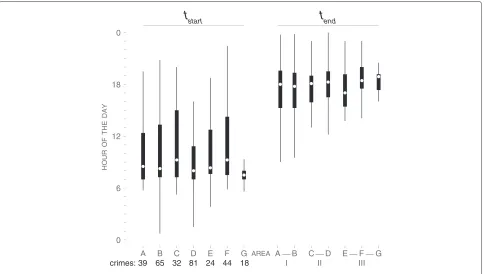
To answer this question, the offences in the final sample were grouped into seven geographical policing areas. Between areas, it is only necessary to determine whether the distributions of tstart and tend were
simi-lar (Figure 1), because all estimation methods but the known-time method derive testimate from these two
val-ues. Figure 1 shows these distributions as linear box plots starting at midnight, because circular box plots are diffi-cult to interpret (Abuzaid et al. 2012). The mediantstart
andtendfor each area are similar. When the areas are
clus-tered into three similar-sized groups, a Wheeler–Watson test (described further below) showed the distributions of each group to be homogeneous (Wr = 0.06 for Group I
and Group II,Wr=0.15 for Group II and Group III). This
suggests that it is reasonable to treat the final sample as a single group.
Tools
Techniques for analysing circular data are not included in most statistical packages. One exception is the R lan-guage (http://www.r-project.org/), for which there are two sets of functions that analyse circular statistics. In
the present study, the CircStats package was used for data analysis and the Circularpackage for graph-ical presentation. Non-circular analysis was done with the R language and the SPSS version 17. Aoristic anal-ysis was carried out in a program written by one of the authors in PHP (http://www.php.net/) for this purpose.
Statistical methods
A test was required to determine whether the frequency of crime varied non-randomly over time. Jammalamadaka and SenGupta (2001, 132) caution against assessing uni-formity visually, so Rayleigh’s test was used. This is a non-parametric test in which the null hypothesis is that the sample is drawn from a uniform circular distribution and the alternative hypothesis is that it is drawn from a unimodal distribution of unknown mean value (Moore 1980, 175).
Tests were necessary to determine the relationship between the distribution of tactual and the distribution
of testimate produced by each method. Since the samples
are not normally distributed, we used the test described by Wheeler and Watson (1964), test statisticWr, as
rec-ommended by Fisher (1993, 123). The Wheeler–Watson is a non-parametric two-sample test in which the null hypothesis is that the two temporal samples have the same distribution. The Wheeler–Watson test is an extension of an earlier test proposed by Watson (1961, 1962), for which
t
startt
endD
A B C E F G AREA A B C D E F G
0
12
0 6 18
HOUR
OF
THE
DAY
65 32 81 24 44 18
crimes: 39 I II III
Berens (2009, 13) states that the bin-width for aggregate data should be no more than 10°.tunitfor the aoristic
anal-ysis was therefore set at 30 minutes, equivalent to 7.5°. To investigate the possibility of an ecological fallacy further, the Wheeler–Watson tests were run both for the whole study area and for each group of stations (I, II and III).
To compensate for any possible problem with compar-ing samples of different sizes, the distribution oftknown
(n=26) was compared against both the whole sample of
tactualand against a sample of 26 crimes taken randomly
fromtactual. The comparison of samples of 26 crimes was
run 1,000 times and the mean value of the test statis-tic taken. To ensure that the random times generated for each crime did not produce an anomalous distribution of trandom, 100 randomly generated distributions were tested
and the mean value of the test statistic taken.
The Wheeler–Watson test indicates whether two distri-butions are homogeneous or not, but gives no indication of how they differ. To investigate the differences, offences were aggregated into one-hour categories and the pre-dicted number of offences in each category compared to the number of offences that actually occurred in that hour. These residual values were standardised to allow com-parison between estimation methods. z > |2| is often considered significant (Harvill 1991, 36) because−1.96<
z < +1.96 for 95% of normally-distributed observations. However, since there were 24 residuals for each method, one or more were likely to producez>|2|by chance and so z > |3|(approximate to p = 0.001) was considered significant.
Monte Carlo simulation was used to determine the conditions under whichtknownwould be a good
approxi-mation oftactual, following a model suggested by Ratcliffe
(2004, 66–69) in dealing with a similar problem. One per-cent of crimes were removed at random from the sample of 303 crimes and the resulting distribution was compared against the entiretactual distribution using the Wheeler–
Watson test. If the two distributions were homogeneous, a further 1% of crimes were removed and the test repeated. This procedure continued until the two distributions were significantly different at thep=0.05 level. The procedure was then repeated 1,000 times to generate a reasonable sample.
To test whether excluding crimes where trange > 24
hours would alter the distribution oftaoristic, that
distri-bution was tested against a modified distridistri-bution from which crimes where trange exceeded a certain number
of hours had been removed. This process was repeated using progressively smaller threshold values of trange,
until the unmodified and modified distribution were found not to be homogeneous. Rao’s test of homogeneity (SenGupta and Rao 1966, 172–173)—a parametric test of whether two distributions have the same mean value and variance—was used for this purpose. This test can be used
to compare any data in which each sample is of reason-able size and approximately normally distributed, as was taoristicin this case (r¯=0.457,p<0.001).
Results
What is the distribution oftactual?
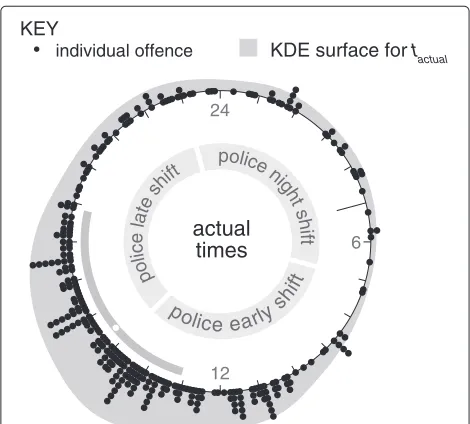
Figure 2 shows the distribution of tactual by time of day.
The times of individual offences are shown as dots on the circumference of the circle, stacked where necessary. Inside the circle, 05:00 hours (the ‘start’ of the day for the purposes of Felson–Poulsen statistics) is shown by an elongated tick mark, along with a white dot illustrating the median minute of crime and a grey bar to show the daily timespan (IQR) of crime. Specimen police shifts, which are commonly eight-hours long (Accenture 2004, 18) and start at 07:00 hours, 15:00 hours and 23:00 hours (Rengert 1997, 206), are also shown.
The Rayleigh test showed that the distribution oftactual
was significantly non-uniform (¯r = 0.458,p < 0.001), so the null hypothesis of a uniform distribution was rejected. Figure 2 shows that half of pedal cycle thefts happen between 13:04 and 18:52 hours. The daily times-pan of 5 hours 47 minutes suggests that cycle theft can be dealt with by teams of officers working a sin-gle 8-hour shift centred around the median minute: 15:22 hours.
The distribution of tactual is an estimate of the
true population distribution of crimes. One common non-parametric method of estimating the underlying population density from a sample is kernel density esti-mation (KDE) (Buskirk 1998, 799). KDE generates a con-tinuous distribution from a sample of discrete events, and
KEY
individual offence KDE surface for tactual
24
6
12 police nig
ht s
h ift
p o
lic
e
la
te s
hift
police early sh
ift
actual
times
has been adapted for use with circular data (Brunsdon and Corcoran 2006, 309). KDE was used in the present study to illustrate the population distribution of crime predicted by each estimation method.
KDE relies on the operator to choose a suitable smooth-ing parameter, known as the bandwidth (Jones et al. 1996, 401). The choice of bandwidth has a substantial effect on the results of the KDE process (Chiu 1996, 129), and there is extensive literature on choosing the most appropriate bandwidth for linear data sets (see Turlach 1993, for a review). Density estimation of circular data is less com-mon (Di-Marzio et al. 2011, 2156), and the present authors were unable to find any empirically-based suggestions for choosing an appropriate bandwidth. This study followed the lead given by Brunsdon and Corcoran (2006, 309) in adopting a ‘trial and error’ approach, with the aim of ensuring that the resulting (KDE) distribution appears visually to be neither under- nor over-fitted. The resulting KDE is shown in Figure 2 and demonstrates that the dis-tribution oftactualis broadly unimodal around the mean
time of 15:22 hours.
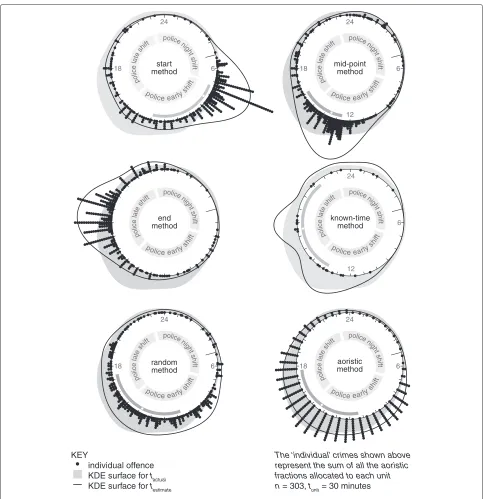
What distribution oftestimatedoes each method produce? Figure 3 shows the offence times predicted by each method and the resulting (KDE) surface, superimposed upon the (KDE) surface for tactual. Table 4 shows the
Felson–Poulsen statistics for each method. The aoristic and random methods predict the median minute most accurately and predict the daily timespan (IQR) to within one hour. The mid-point method comes next, although the median minute is almost two hours earlier than the actual median minute, and the daily timespan is more than two hours longer. The distributions oftstart,tmidand tendare clearly unimodal; the distributions oftrandomand taoristicless so; and the distribution oftknownis apparently
bimodal.
Which estimation method best predictstactual?
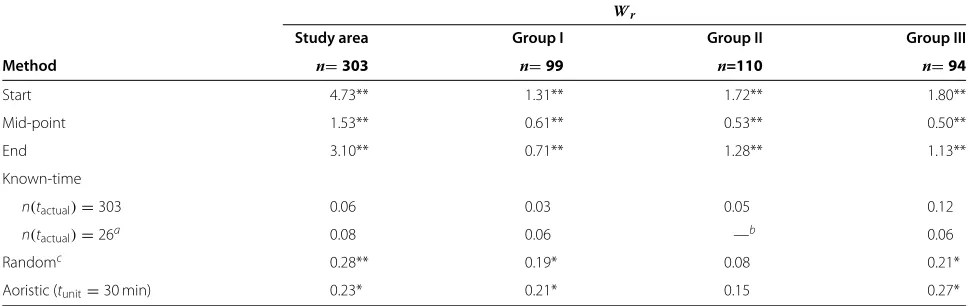
Table 5 shows the results of Wheeler–Watson tests com-paring the distribution oftactualand each distribution of testimate. Since this is a test of homogeneity, we are
inter-ested in those methods for which there is insufficient evidence to reject the null hypothesis. All the distributions other than the known-time distribution appear not to be homogeneous with tactual, although the values ofWr for
trandom andtaoristic are much smaller than for the
deter-ministic estimation methods and appear to be close to homogeneous withtactual.
The Wheeler–Watson results suggest that the tknown
distribution is homogeneous withtactualregardless of
dif-ferences in sample size. While this indicates that tknown
should be a good predictor of tactual, the differences
between these two distributions shown in Figure 3 sug-gests that they are not homogeneous. Given that there
were only 26 crimes in the tknown distribution, that they
are not drawn randomly from the underlying population of crimes and that their distribution is apparently bimodal, the result of the Wheeler–Watson test in this case should be treated with caution.
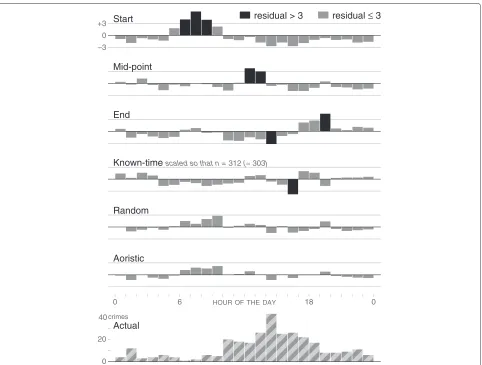
Figure 4 shows how the distribution oftestimateproduced
by each method differed from the distribution oftactualfor
each hour. The standardised residuals are presented in a linear format starting at midnight, because it is difficult to present negative values clearly in circular form. The start, mid-point and end methods significantly overestimate the occurrence of crimes in the early morning, early afternoon and evening respectively. The residuals of the random and aoristic distributions are very similar, and much smaller than those for the other methods, with no residual>|3|.
Optimal deployment of police resources
It will not always be necessary for a crime analyst to know the precise distribution oftactualin order to recommend
when officers should be deployed to deal with a partic-ular crime problem. To illustrate a simpler method than either the Wheeler–Watson test or analysis of residuals, it was assumed that an analyst had been asked to rec-ommend a four-hour time period (half a standard police shift) for which officers should be deployed, and that for simplicity that period should start and end on the hour or on the half-hour. If the analyst hada priorireasons to believe that the crime was normally distributed in time, he or she could simply take the median minute of crime described by Felson and Poulsen (2003, 597), round it to the nearest half-hour, and take that as the middle of the deployment time. The accuracy of this procedure, using the median minute for each estimation method, was mea-sured by considering what proportion of the four-hour period overlapped with the four-hour period suggested by the distribution oftactual.
Table 6 shows the results for each estimation method, and confirms the order of accuracy found above, with the aoristic method predicting a period that contained the same proportion of crimes as the actual optimum four-hour period. The start and end methods predicted very little.
Supplementary questions
When is tknowna good approximation of tactual?
The Monte-Carlo analysis showed that the mean pro-portion of crimes for which tactual must be known in
order for the distributions of tknown and tactual to be
minimum acceptable sample size, and should be treated with caution: the actual minimum size will depend on the unknown factors that drive the temporal distribution of crime.
Should all crimes be analysed by the aoristic method? Testing for progressively smaller maximum values oftrange
showed that the mean values oftaoristicwere homogeneous
until crimes where trange ≥ 47 hours were excluded
(H = 4.179,p < 0.05), and that the variances were homogeneous until crimes wheretrange ≥76 hours were
excluded (H=3.970,p<0.05).
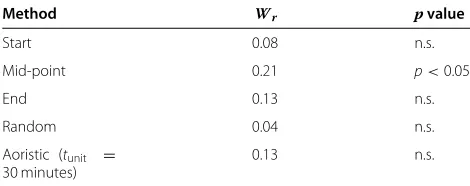
As a final test for sample bias, the distributions of testimate based on the final sample for which tactual was
known (n = 303) and those based on the original sam-ple of cycle thefts (n = 1, 396) were compared using the Wheeler–Watson test, as shown in Table 7. Each pair of distributions was homogeneous except the mid-point
24
18 6
24
18 6
12 police nig
ht s
h
ift
p o
lic
e
la
te s hift
police early shif
t
mid-point method
24
6
12 police nig
ht s
h
ift
p o
lic
e l
ate shi
ft
police early sh
ift end method
24
6
12
24
18 + 6
police nig
ht s
h
ift
p o
lic
e
la
te s
hift
police early sh
ift random method
24
18 6
police nig
ht s
h
ift
p o
lic
e l
ate shi
ft
police early sh
ift aoristic method
The ‘individual’ crimes shown above represent the sum of all the aoristic fractions allocated to each unit n = 303, tunit = 30 minutes KEY
individual offence KDE surface for tactual KDE surface for testimate
police nig
ht s
h
ift
p o
lic
e
la
te s hift
police early shif
t
start method
police nig
ht s
h
ift
p o
lic
e
la
te s
hift
police early shif
t
known-time method
Table 4 Summary of estimation-method statistics
Median minute Daily timespan
Method Distribution Value Diff. Value Diff.
Actual tactual 15:22 — 5:47 —
Start tstart 08:20 −7:02 5:35 −0:12
Mid-point tmid 13:30 −1:52 3:30 −2:17
End tend 18:15 +2:53 3:05 −2:42
Known-time tknown 17:31 +2:09 7:41 +1:54
Random trandom 13:49 −1:33 6:38 +0:51
Aoristic taoristic 14:23 −0:59 6:23 +0:35
method, for which the test statistic was very close to the critical value ofWr=0.18.
Discussion
Which estimation method should crime analysts use? The aoristic and random methods produced the distribu-tions oftestimatethat were closest to being homogeneous
with the distribution of tactual, and neither significantly
over- or under-estimated the frequency of crime in any hour of the day. Both methods appear suitable for use in the temporal analysis of aoristic crime. All crimes, even those with a longtrangeshould be included.
Alone among the estimation methods, the aoristic method does not assume that each crime happened at a particular time—this may explain the apparent predictive power of aoristic analysis. The random method does make this assumption, but recognises that there is no way to know which particular time is correct. The cost of this approach is that it requires a sample of sufficient size to reduce the chance of clustering in the random times cho-sen. The random method is therefore likely to be less
useful for small samples. Furthermore, the distribution produced by the random method is likely, with increas-ingn, to tend towards the results of the aoristic method. Since repeating the random method analysis, as was done here, can be computationally intensive, it may be wise to recommend the aoristic method for everyday crime analysis.
Aoristic analysis is not unproblematic. Astrangegrows,
the aoristic fraction will asymptotically approach zero, so that a crime with a very large trange will contribute
very little to the distribution of taoristic, which—if there
are enough such crimes—will become very smooth. Con-versely, if (for a particular crime)trange≤tunit, the aoristic
fraction will approach 1. In a small sample, this could cre-ate a temporal peak that outweighs several crimes with a more typicaltrange. If crimes wheretrange ≈ tunithappen
more often at a particular time of day, this time is likely to emerge as the peak time even if only a small proportion of offences happen then.
taoristic is only as accurate as the chosen unit of
analy-sis (Ratcliffe 1999, 97). Although it is possible to use an
Table 5 Wheeler–Watson two-sample test results comparing each distribution oftestimateto the distribution oftactual
Wr
Study area Group I Group II Group III
Method n=303 n=99 n=110 n=94
Start 4.73** 1.31** 1.72** 1.80**
Mid-point 1.53** 0.61** 0.53** 0.50**
End 3.10** 0.71** 1.28** 1.13**
Known-time
n(tactual)=303 0.06 0.03 0.05 0.12
n(tactual)=26a 0.08 0.06 —b 0.06
Randomc 0.28** 0.19* 0.08 0.21*
Aoristic (tunit=30 min) 0.23* 0.21* 0.15 0.27*
*p<0.05, criticalW r=0.18. **p<0.01, criticalW
r=0.27. aMean value ofW
rfor 1,000 runs in which the known values oftknownwere compared against an equal number of values randomly selected from the final sample of crimes.
bOnly six offences were available for known-time analysis in this group. cMean value ofW
Known-time scaled so that n = 312 (≈ 303)
Random End Mid-point
+3
–3 0
Start residual > 3 residual ≤ 3
Aoristic
0 6 HOUR OF THE DAY 18 0
20
0
Actual
40 crimes
Figure 4Standardised residual values for estimation methods showing that the start, mid-point and end methods significantly overestimate the frequency of crime at certain times of day.
infinitely small unit of analysis, the additional accuracy must be balanced against the additional processing time and effort (Ratcliffe 2000, 673).tunit should therefore be
chosen carefully, so that peaks of activity that are shorter thantunit are not obscured (Johnson 2003, 450). McCue
(2007, 94) recommends that, when the purpose of analysis
is to determine when to deploy police resources, tunit
should be set at four hours, or half a police shift. Although Koper (1995, 663) found that police presence was most efficient at deterring crime if officers remained in one place for only 15 minutes, Famega (2003, 158) found that few supervisors attempt to deploy officers so precisely.
Table 6 Optimal four-hour deployment period
Method Predicted period Proportion of actual period predicted Thefts in predicted period
Actual 13:30-17:30 — 39%
Start 06:30–12:30 0% 14%
Mid-point 11:30–15:30 50% 35%
End 16:30–20:30 25% 20%
Known-time 15:30–19:30 50% 27%
Random 12:00–16:00 62.5% 35%
The modified temporal unit problem (MTUP), first mentioned by Dorling and Openshaw (1992, 640), con-cerns how the choice of boundaries between temporal units can artificially create and destroy clusters of offences within each unit (Taylor 2010 462; C¸ ¨oltekin et al. 2011). The MTUP could compromise estimation results pre-sented in aggregate form, for example as circular his-tograms (Zar 1999, 596) or wind rose charts (Brasseur 2005, 167). Aggregation can be avoided using (KDE), but not for aoristic analysis because those data are inherently aggregated. Tompson and Townsley (2010, 37) recom-mend using smaller temporal units, but very small units are likely to produce a sample distribution that is very spikey and poorly fitted to the population distribution (Schubert 2009, 42).
For these reasons, aoristic analysis may perform less well if (a) many crimes have a largetrange, (b) several crimes
that occurred at the same time have a very shorttrange, or
(c) the unit of analysis is too corse.
The mid-point method was better at predicting peak offence times than the start or end methods, possibly because the maximum possible error of the mid-point method is half that of the other two deterministic meth-ods. However, the mid-point method is wholy derived from the distributions of tstart and tend, which in turn
depend entirely on the routine activities of crime victims and are unrelated to the activities of offenders. The rel-atively good performance of the mid-point method may be coincidental: mid-afternoon could simply be the time when a plurality of offenders came into contact with prop-erty that had been unattended since early morning. If most of the victims worked night shifts rather than day shifts, the distributions oftstart andtend would be inverted and
the peak time of tmid would be around 03:00 hours. In
these circumstances, the varying availability of offenders might give a peak offence time in the evening (very close to tstart) and tmid would be misleading. This hypothesis
could only be confirmed through further research into how offence frequency varies throughouttrangefor
differ-ent crimes, although such research may not be worthwhile if the mid-point method is, as it appears, inferior to the aoristic and random methods.
Table 7 Comparison of the final and original samples
Method Wr pvalue
Start 0.08 n.s.
Mid-point 0.21 p<0.05
End 0.13 n.s.
Random 0.04 n.s.
Aoristic (tunit = 30 minutes)
0.13 n.s.
The distributions oftknownfor the final and original samples included the same offences and so would be identical.
The known-time method appears to be approximately as good as the mid-point method in predictingtactual. The
potential of the known-time method is that it reflects the activities of offenders; the problem is that it is based on a non-random sample of offences. There is reason to believe that the crimes available for known-time analysis will vary systematically from other crimes: Johnson et al. (2006, 13) found that thefts of and from motor vehicles in car parks tended to have¯trange < 4 hours while thefts from other
locations had longer ranges. Iftknownwere based on a
ran-dom sample, the results described in Section the results of the present study suggest thattknownwould be a good
approximation oftactualwheretactualwas known for more
than 10.4% of crimes.
In the present study, the known-time method included 8.5% of offences. Figure 3 suggests that this was not a ran-dom sample. In circumstances where only a rough approx-imation oftactualis required, the known-time method may
be acceptable, but if the aoristic or random methods can be implemented then they should be used in preference.
The start and end methods appear to be so poor at pre-dictingtactualthat they are actively misleading. If we accept
that the present sample is typical of aoristic crimes, this finding suggests that the start and end methods should be avoided by all analysts, even though they may occasionally predicttactualaccurately.
A crime analyst using the results of this study to aid them in determining the most common time of day for a particular crime to occur could follow this model procedure.
1. Select an appropriate value oftunit, which (to minimise computational resources) should be no smaller than necessary.
2. Determine if the crime is aoristic or not: since this depends on the relationship betweentrangeandtunit, a crime-type might be aoristic for small values oftunit but not for larger values. Findings by Ratcliffe (2002, 33) summarised above suggest that practitioners should use methods suitable for analysing aoristic crimes ift¯range>4tunit, whereas if ¯
trange≤4tunitthe choice of method is unlikely to influence the results.
3. If methods suitable for analysis of aoristic crimes are to be used andtactualcan be determined for a random sample of more than 10% of crimes, use the
known-time method.
5. If software is not available to perform aoristic analysis, the random method can be used as an alternative.
Applicability to other crime types
To date, the present study provides the only empirical evidence as to the relative efficacy of different estima-tion methods for aoristic crime, but these results are based on the study of only one crime type. It is not cer-tain that the present results are generalisable to other types of crime, but—pending further work—the routine activities approach suggests that they might be. Analy-sis of the crime reports used in this study showed that most thefts occurred during the daytime while the vic-tim was at work, and it was the routine activities of these victims that determined the distribution of tstart, tendandtrange. Previous studies have shown that the
sim-ilar temporal distributions of other aoristic crimes such as residential burglaries (Weisel 2002; Sorensen 2004) and thefts of motor vehicles from city-centre parking facili-ties (Rengert 1997, 210) are shaped by the same routine activities. Since the recommended estimation methods are based ontstartandtend, such similar distributions may
well be amenable to similar methods of temporal approx-imation. Conversely, there may be less reason to believe in the applicability of these methods to aoristic crimes that occur mainly at night, such as graffiti (Williams and Poynton 2006, 5) or theft of vehicles from outside houses (Keister 2007, 5).
Spatio-temporal interaction
The research presented here has not considered the spatial dimension of aoristic crime in any great depth. Grubesic and Mack (2008, 287) note that time and space are too often separated in crime analysis, and demon-strate that time and space interact, so spatio-temporal interaction appears to be a useful avenue for further research.
Many researchers have shown that the temporal dis-tribution of crime varies in different places. Tranter (1985, 12) demonstrated that the daily temporal peak in calls for service differed depending on whether a neigh-bourhood was primarily composed of students, workers or retired people, all of whom have different routine activ-ities. More recently, Barthe and Stitt (2009, 146) found that the temporal distribution of violent crimes in areas surrounding casinos was different from that in the rest of Reno, Nevada, perhaps because the people around casi-nos were engaged in different actitivies from those in the rest of the city. Aoristic analysis was developed as a spatio-temporal technique to capture variations in both dimensions (Ratcliffe 2002, 41).
There are some crimes where both the offence time and location are unknown (Morgan 2010, 15). Examples include pickpocketing on public transport, theft of goods
in transit by road or rail, and illegal immigrants stow-ing away in lorries to cross international borders (Newton 2004, 33). Gill (2007) suggested that aoristic analysis could be used to map such crimes, with an aoristic fraction being assigned to each segment of the journey during which the crime took place.
Suggestions for future research
This research analysed a single crime type in one area. Further research is required to determine if the find-ings here are applicable to other circumstances. Analysis of crimes that are not normally distributed in time may be particularly useful in testing whether the methods described here are generally applicable, since crime ana-lysts will usually know nothing about the distribution of tactual. Bimodal temporal distributions include hourly
vari-ations in vandalism (Brower and Carroll 2007, 269) and seasonal variation in suicide among women (Kposowa and D’Auria 2010, 434), both of which can be aoristic. If data were gathered about a wide range of crime types, these could also be used to test the intuitive method, and to determine the performance of each method for samples of different sizes.
Further research would require data on the distribu-tion of tactual for more aoristic crimes. Passive
surveil-lance technologies such as CCTV and motion sensors, as well as radio-frequency identification (RFID) or global positioning system (GPS) chips embedded in vulnerable goods, are becoming increasingly common and could pro-vide accurate offence times for aoristic crimes. Computer simulation could also be used.
At present, temporal analysis of crime using circular statistics is beyond both the skills of most analysts and the abilities of the tools available to them. A decade ago, Williamson et al. (2000, 169) made the same observation about spatial-analysis techniques, some of which can now be done routinely in mainstream software. Such packages need not be expensive (Dorling and Openshaw 1992, 640), especially if they are developed by a small team of pub-licly funded experts, as was the case with the CrimeStat program (Levine 2006, 42) now used by many agencies. Work by a single agency in this area may benefit the wider analytical community.
Conclusion
This article has suggested a random method for the tem-poral analysis of aoristic crime and has demonstrated the relative ability of several methods to estimate the most common offence times for one type of aoristic crime. The aoristic and random methods were most accurate, while the start and end methods were found to be misleading and should not be used.
temporal analysis than (for example) for spatial analy-sis, where many techniques have been developed in the past 15 years. There has also been less research to val-idate those temporal techniques that do exist. In the experience of the present authors, there are many crime analysts who—potentially as a result of this discrepancy in research output—have developed extensive skills in spa-tial analysis while either not conducting temporal analysis or using temporal techniques not supported by evidence.
One of the key lessons of policing research is that resources for preventing and investigating crime should be led by intelligence. Since most crimes are clustered in time, temporal analysis is necessary to ensure that deploy-ment of such resources are effective: without knowing when crimes happen, officers are unlikely to be in the right place at the right time to prevent crime or appre-hend offenders. Since many common crimes are aoristic, techniques such as those evaluated here are necessary for ensuring resources are deployed correctly. Crime analysts that choose not to use techniques designed for use with aoristic-crime data are likely to deploy resources at the wrong times, failing to prevent crime and undermining the status of intelligence-led policing. It is hoped that the findings of the present study will assist practitioners in understanding aoristic crimes such as burglaries, motor vehicle thefts and damage to property.
Endnote
aThis is because it is the victim’s movement in time and
space that determines the times between which the target was left unattended.
Abbreviations
BTP: British transport police; CCTV: closed-circuit television; GPS: global positioning system; IQR: inter-quartile range; KDE: kernel density estimation; MTUP: modifiable temporal unit problem; RFID: radio-frequency identification; SPSS: Statistical package for the social sciences; UK: United Kingdom; US: United States.
Competing interests
Both authors declare that they have no competing interests.
Authors’ contributions
MA prepared and analysed the data used in this study and prepared the first draft of the manuscript. KB participated in the design of the study, the statistical analysis and the writing of the manuscript. Both authors read and approved the final manuscript.
Authors’ information
KB is professor of crime science in the UCL Department of Security and Crime Science. MA is a research student at the UCL Security Science Doctoral Research Training Centre. He is a former police officer and police intelligence researcher.
Acknowledgements
Thank you to British Transport Police for providing the data used in this research and to the anonymous reviewers for their helpful comments.
Author details
1UCL Security Science Doctoral Research Training Centre, 35 Tavistock Square,
London WC1H 9EZ, UK.2UCL Department of Security and Crime Science, 35 Tavistock Square, London WC1H 9EZ, UK.
Received: 19 December 2012 Accepted: 3 May 2013 Published: 23 May 2013
References
Accenture. 2004.Study of Police Resource Management and Rostering Arrangements, Home Office, London.
Abuzaid, A H, I B Mohamed, and A G Hussin. 2012.Boxplot for circular variables, Computational Statistics27, no. 3, 381–392.
doi:10.1007/s00180-011-0261-5.
Barclay, G C and C Tavares. 1999.Digest 4: information on the criminal justice system in England and Wales, Home Office, London. http://rds.homeoffice. gov.uk/rds/digest4/digest4.pdf.
Barthe, E and B G Stitt. 2009.Temporal distributions of crime and disorder in casino and non-casino zones, Journal of Gambling Studies25, no. 2, 139–152. doi:10.1007/s10899-009-9115-2.
Baumer, E and R Wright. 1996.Crime seasonality and serious scholarship: a comment on Farrell and Pease, British Journal of Criminology36, no. 4, 579–581. http://bjc.oxfordjournals.org/content/36/4/579.
Berens, P. 2009.CircStat: a MATLAB toolbox for circular statistics, Journal of Statistical Software31, no. 10, 1–21. http://www.jstatsoft.org/v31/i10/ paper.
Bichler, G and L Gaines. 2005.An examination of police officers’ insights into problem identification and problem solving, Crime and Delinquency51, no. 1, 53–74. doi:10.1177/0011128704265936/.
Brantingham, P L and P J Brantingham. 1993.Nodes, paths and edges: considerations on the complexity of crime and the physical environment, Journal of Environmental Psychology13, no. 1, 3–28.
doi:10.1016/S0272-4944(05)80212-9.
Brasseur, L. 2005.Florence Nightingale’s visual rhetoric in the rose diagrams, Technical Communication Quarterly14, no. 2, 161–182.
doi:10.1207/s15427625tcq1402 3.
Brower, A M and L Carroll. 2007.Spatial and temporal aspects of alcohol-related crime in a college town, Journal of American College Health55, no. 5, 267–275. doi:10.3200/JACH.55.5.267-276.
Brown, DE. 1998.The Regional Crime Analysis Program (ReCAP): a framework for mining data to catch criminals, 1998 IEEE International Conference on Systems, Man, and Cybernetics, Volume 3, Institute of Electrical and Electronics Engineers, 2848–2853. doi:10.1109/ICSMC.1998.725094. Brown, S E. 1989.Statistical power and criminal justice research., Journal of
Criminal Justic17, no. 2, 115–122. doi:10.1016/0047-2352(89)90004-4. Brunsdon, C and J Corcoran. 2006.Using circular statistics to analyse time
patterns in crime incidence, Computers, Environment and Urban Systems 30, no. 3, 300–319. doi:10.1016/j.compenvurbsys.2005.11.001. Buskirk, TD. 1998.Nonparametric density estimation using complex survey data.
http://www.amstat.org/sections/SRMS/proceedings/papers/1998 136.pdf. Chiu, S T. 1996.A comparative review of bandwidth selection for kernel density
estimation, Statistica Sinica6, 129–146. http://www3.stat.sinica.edu.tw/ statistica/oldpdf/A6n18.pdf.
Cohen, L E and M Felson. 1979.Social change and crime rate trends: a routine activity approach, American Sociological Review44, no. 4, 588–608. http:// www.jstor.org/stable/2094589.
Cohn, E G. 1993.The prediction of police calls for service: the influence of weather and temporal variables on rape and domestic violence, Journal of Environmental Psychology13, no. 2, 71–83.
doi:10.1016/S0272-4944(05)80216-6.
Cohn, E G and J Rotton. 2003.Even criminals take a holiday: instrumental and expressive crimes on major and minor holidays, Journal of Criminal Justice 31, no. 4, 351–360. doi:10.1016/S0047-2352(03)00029-1.
C¸ ¨oltekin, A, S De Sabbata, C Willi, I Vontobel, S Pfister, M Kuhn, and M Lacayo. 2011.Modifiable temporal unit problem.ICA Commission on
GeoVisualization, Paris: International Cartographic Association. http:// geoanalytics.net/ica/icc2011workshop.htm.
Di Marzio, M, A Panzera, and CC Taylor. 2011.Kernel density estimation on the torus, Journal of Statistical Planning and Inference141, no. 6, 2156–2173. doi:10.1016/j.jspi.2011.01.002.
Famega, C N. 2003.Discretion or direction? An analysis of patrol officer downtime, PhD thesis, University of Cincinnati,Cincinnati. http://cech.uc.edu/content/ dam/cech/programs/criminaljustice/docs/phd dissertations/2003/ Famega.pdf.
Federal Bureau of Investigation. 2011.Crime in the United States 2010, Federal Bureau of Investigation, Washington. http://www.fbi.gov/about-us/cjis/ ucr/crime-in-the-u.s/2010/crime-in-the-u.s.-2010.
Felson, M. 2006.Crime and Nature, Sage, Thousand Oaks.
Felson, M and E Poulsen. 2003.Simple indicators of crime by time of day, International Journal of Forecasting19, no. 4, 595–601.
doi:10.1016/S0169-2070(03)00093-1.
Fisher, N I. 1993.Statistical Analysis of Circular Data, Cambridge University Press, Cambridge.
Fitzpatrick, T. 2004.Social policy and time, Time and Society13, no. 2/3, 197–219. doi:10.1177/0961463X04043502.
Gill, A. 2007.Developing aoristic network analysis upon London’s transport system, Jill Dando Institute of Security and Crime Science, London. http://www.ucl. ac.uk/jdi/events/mapping-conf/conf-2007/conf-pres2007/pres16. Gottlieb, S, S I Arenberg, and R Singh. 1994.Crime analysis: from first report to
final arrest, San Bernardino, Alpha.
Grubesic, T H and E A Mack. 2008.Spatio-temporal interaction of urban crime, Journal of Quantitative Criminology24, no. 3, 285–306.
Harvill, L M. 1991.An NCME instructional manual on standard error of measurement, Educational Measurement: issues and practice10, no. 2, 33–41. doi:10.1111/j.1745-3992.1991.
Hawley, A H. 1950.Human Ecology: a theory of community structure, Ronald Press, New York.
Helms, D. 2008.Temporal analysis(SL Gwinn, C Bruce, JP Cooper, and S Hick, eds.), International Association of Crime Analysts, Overland Park. Hoare J. 2011.Acquisitive and other property crime(R Chaplin, J Flatley, and K
Smith, eds.), no. 10/11 in Home Office Statistical Bulletin series, first edition. Home Office.
Home Office. 2011.Recorded crime data by basic command unit, community safety partnership areas and local authorities—Crime in England and Wales 2010/11. https://www.gov.uk/government/uploads/system/uploads/ attachment data/file/116417/hosb1011.pdf.
Johnson, S D and K J Bowers. 2004.The stability of space-time clusters of burglary, British Journal of Criminology44, no. 1, 55–65. doi:10.1093/bjc/44.1.55. Johnson, S D, L Summers, and K Pease. 2006.Vehicle Crime: Communicating Spatial and Temporal Patterns, Final Report, Jill Dando Institute of Crime Science, London.
Jammalamadaka, S R and A SenGupta. 2001.Topics in Circular Statistics. No. 5 in Series on Multivariate Analysis, World Scientific, Singapore.
Jones, M C, J S Marron, and S J Sheather. 1996.A brief survey of bandwidth selection for density estimation, Journal of the American Statistical Association91, no. 433, 401–407. http://www.jstor.org/stable/2291420. Johnson, I. 2003.Aoristic analysis: seeds of a new approach to mapping
archaeological distributions through time, Archaeopress, in BAR International Series. Oxford.
Keister, T. 2007.Thefts of and from Cars on Residential Streets and Driveways. No. 46 in Problem-Oriented Guides for Police Problem-Specific Guides Series, US Department of Justice, Washington,DC. http://www.popcenter.org/ problems/residential car theft/.
Koper, C S. 1995.Just enough police presence: reducing crime and disorderly behaviour by optimizing patrol time in crime hotspots, Justice Quarterly12, no. 4, 649–672. http://heinonline.org/HOL/Page?collection=
journals&handle=hein.journals/jquart12&id=673.
Kposowa, A J and S D’Auria. 2010.Association of temporal factors and suicides in the United States, 2000–2004, Social Psychiatry and Psychiatric
Epidemiology45, no. 4, 433–445. doi:10.1007/s00127-009-0082-9. Levine, N. 2006.Crime mapping and the Crimestat program, Geographical
Analysis38, no. 1, 41–56. doi:10.1111/j.0016-7363.2005.00673.x. Lewis, C. 1992.Crime statistics: their use and misuse(T Griffin, ed.), Central
Statistical Office, London.
Mardia, K V. 1972.Statistics on Directional Data. No. 13 in Probability and Mathematical Statistics: a series of monographs and textbooks, Academic Press, London.
McCahill, M and C Norris. 2003.CCTV systems in London: their structure and practices. No. 10 in Urban Eye Working Papers series,Berlin: Zentrum Technik
und Gesellschaft,Technische Universit¨at Berlin. http://www.urbaneye.net/ results/ue wp10.pdf.
McCue, C. 2007.Data Mining and Predictive Analysis: intelligence gathering and crime analysis, Burlington, Butterworth–Heinemann.
McLaughlin, L M, S D Johnson, K J Bowers, D J Birks, and K Pease. 2007.Police perceptions of the long- and short-term spatial distribution of residential burglary, International Journal of Police Science and Management9, no. 2, 99–111.
Melbin, M. 1978.City rhythms(JT Fraser, N Lawrence, and D Park, eds.), Springer, New York.
Messner, S F and K Tardiff. 1985.The social ecology of urban homicide: an application of the “routine activities” approach, Criminology23, no. 2, 241–267. doi:10.1111/j.1745-9125.1985.
Moore, B R. 1980.A modification of the Rayleigh test for vector data, Biometrika 67, no. 1, 175–180. http://www.jstor.org/pss/2335330.
Morgan, J D. 2010.A visual time-geographic approach to crime mapping. PhD thesis, Florida State University,Tallahassee,FL. http://etd.lib.fsu.edu/theses/ available/etd-11012010-214122/unrestricted/
Morgan J Dissertation 2010.pdf.
Nelson, A L, R D F Bromley, and C J Thomas. 2001.Identifying micro-spatial and temporal patterns of violent crime and disorder in the British city centre, Applied Geography21, no. 3, 249–274.
doi:10.1016/S0143-6228(01)00008-X.
Newton, A D. 2004.Crime on public transport: ‘static’ and ‘non-static’ (moving) crime events, Western Criminology Review5, no. 3, 25–42. http://wcr. sonoma.edu/v5n3/manuscripts/newton.pdf.
O’Shea, T C and K Nicholls. 2003.Crime Analysis in America: findings and recommendations, US Department of Justice, Washington. http://cops. usdoj.gov/CDROMs/Tribal/stats/CrimeAnalysisAmericaFindings.pdf. Ratcliffe, JH. 1999.The genius loci of crime: revealing associations in time and
space, PhD thesis,University of Nottingham,Nottingham. Ratcliffe, J H. 2000.Aoristic analysis: the spatial interpretation of unspecific
temporal events, International Journal of Geographical Information Science 14, no. 7, 669–679. http://www.ingentaconnect.com/content/tandf/tgis/ 2000/00000014/00000007/art00004.
Ratcliffe, JH. 2001.Policing Urban Burglary. No. 213 in Trends and Issues in Crime and Criminal Justice series, Australian Institute of Criminology, Canberra. http://www.aic.gov.au/publications/current%20series/tandi/201-220/ tandi213.html.
Ratcliffe, JH. 2002.Aoristic signatures and the spatio-temporal analysis of high volume crime patterns, Journal of Quantitative Criminology18, no. 1, 23–43. doi:10.1023/A:1013240828824.
Ratcliffe, J H. 2004.Geocoding crime and a first estimate of a minimum acceptable hit rate, International Journal of Geographical Information Science18, no. 1, 61–72. doi:10.1080/1365881031000596076. Ratcliffe, J H and M J McCullagh. 1998.Aoristic crime analysis, International
Journal of Geographical Information Science12, no. 7, 751–764. doi:10.1080/136588198241644.
Ratcliffe, JH and M J McCullagh. 2001.Chasing ghosts? Police perception of high crime areas, British Journal of Criminology41, no. 2, 330–341.
doi:10.1093/bjc/41.2.330.
Rayment, M R. 1996.Spatial and temporal crime analysis techniques. No. TM/06/96 in Technical Memorandum series, Canadian Police Research Centre,Ottawa. http://cradpdf.drdc-rddc.gc.ca/PDFS/unc76/p530054.pdf. Rengert, G. 1997.Auto theft in central Philadelphia(R Homel, ed.), Criminal
Justice Press, NY. http://www.popcenter.org/library/crimeprevention/ volume 07/08 rengert.pdf.
Schubert, JL. 2009.Incorporating time and daily activities into an analysis of urban violent crime, University of Texas at Dallas, PhD thesis.
SenGupta, S and J S Rao. 1966.Statistical analysis of cross-bedding azimuths from the Kamthi Formation around Bheemaram, Pranhita: Godavari Valley, Sankhy¯a: the Indian Journal of Statistics,Series B28, no. 1/2, 165–174. http://www.jstor.org/stable/25051567.
Skogan, W G. 1974.The validity of official crime statistics: an empirical investigation, Social Science Quarterly55, no. 1, 25–38.
Sorensen, D W M. 2004.Temporal Patterns of Danish Residential Burglary, Copenhagen,Justits Ministeriet. http://justitsministeriet.dk/sites/default/ files/media/Arbejdsomraader/Forskning/Forskningspuljen/2011/2004/ Temporal Patterns of Danish Residential Burglary.pdf.