
R E S E A R C H
Open Access
Atom mapping with constraint programming
Martin Mann
1*, Feras Nahar
1, Norah Schnorr
1, Rolf Backofen
1,2,3,4, Peter F Stadler
5,6,7,8,9and Christoph Flamm
5Abstract
Chemical reactions are rearrangements of chemical bonds. Each atom in an educt molecule thus appears again in a specific position of one of the reaction products. This bijection between educt and product atoms is not reported by chemical reaction databases, however, so that the “Atom Mapping Problem” of finding this bijection is left as an important computational task for many practical applications in computational chemistry and systems biology. Elementary chemical reactions feature a cyclic imaginary transition state (ITS) that imposes additional restrictions on the bijection between educt and product atoms that are not taken into account by previous approaches. We demonstrate that Constraint Programming is well-suited to solving the Atom Mapping Problem in this setting. The performance of our approach is evaluated for a manually curated subset of chemical reactions from the KEGG database featuring various ITS cycle layouts and reaction mechanisms.
Keywords: Atom-atom mapping, Constraint programming, Chemical reaction, Imaginary transition state
Background
A chemical reaction describes the transformation of a set of educt molecules into a set of products. In this process, chemical bonds are re-arranged, while the atom types remain unchanged. Thus, there is a one-to-one corre-spondence, the so-calledatom map(or atom-atom map-ping), between the atoms of educts and products. Atom maps convey the complete information necessary to dis-entangle the mechanism, i.e., the bond re-arrangement, of a chemical reaction because they unambiguously iden-tify the bonds that differ between educt and product molecules. The changing parts of the molecules are described by a so called imaginary transition state (ITS) [1,2] that allows, for instance, a classification of chemi-cal reactions [3-5]. Atom maps are a necessary requisite for computational studies of an organism’s metabolism. For instance, they allow for consistency checks within metabolic pathway analyses [6] and play a key role in the global analysis of metabolic networks [7,8]. Practical applications include, for example, the tracing or design of the metabolic break down of a candidate drug, which constitutes an important issue in drug design studies [9].
*Correspondence: [email protected]
1Bioinformatics Group, Department of Computer Science, University of Freiburg, Georges-Koehler-Allee 106, 79110 Freiburg, Germany Full list of author information is available at the end of the article
Only the product and educt molecules involved in a chemical reaction are directly observable. The atom map therefore often remains unknown and has to be inferred from partial knowledge. Experimental evidence may be available from isotope labeling experiments. Here, special isotopes, i.e. atoms with special variations, are introduced into educt molecules that can then be identified in prod-uct molecules by means of spectroscopy techniques [10]. Such data, however, is not available for most reactions. The complete experimental determination of an atom map is in general a complex and tedious endeavor. Reac-tion databases, such as KEGG, therefore do not generally provide atom maps. The computational construction of atom maps is therefore an important practical problem in chemoinformatics [11].
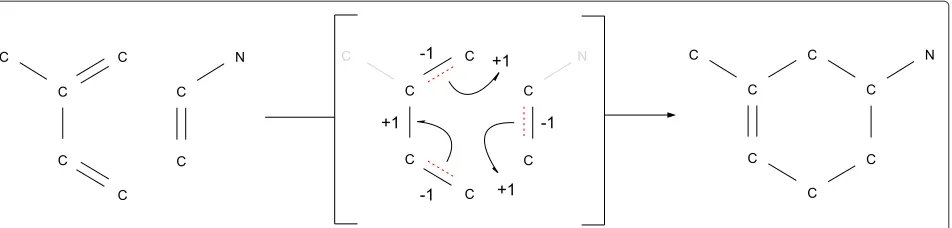
Several computational approaches for this problem have been developed over the last three decades (for a recent review see [12]). The educts and products are described as two not necessarily connected labeled graphsIandO, respectively. Vertex labels define atom types, while edge labels indicate bond types. The atom map is then deter-mined as the solution of a combinatorial optimization problem resulting in a bijective mapping of all vertices of the educt molecule graph to corresponding vertices in the product molecule graphs. An illustration of a Diels-Alder reaction is given in Figure 1.
Figure 1Diels-Alder reaction.Example of a Diels-Alder reaction omitting hydrogen atoms. The imaginary transition state (ITS) is an alternating cycle defined by the bonds that are broken (dotted) and the bonds that are newly formed.
The most common formulations are variants of the maximum common subgraph (isomorphism) problem [13]. Already the earliest approaches analyzed the adja-cency information within educts and products [14,15]. The Principle of Minimal Chemical Distance, which is equivalent to minimizing an edge edit distance, was invoked in [16], using a branch and bound approach to solve the corresponding combinatorial optimization problem. Maximum Common Edge Subgraph (MCES) algorithms search for isomorphic subgraphs of the educt/product graphs with maximum number of edges [4,17-20], an NP-hard problem. Furthermore, the use of specialized energetic [21,22] or weighting [23] criteria allows for the identification of the static parts of the reac-tion and, subsequently, of the atom mapping. A detailed investigation of the MCES from an Integer Linear Pro-gramming (ILP) perspective can be found in [24].
Akutsu [25] showed that the MCES approach fails for certain reactions. As an alternative, the Maximum Common Induced Subgraph (MCIS) problem was pro-posed as a remedy. This problem is also NP complete. Approximation results can be found in [26]. Algorithms for the MCIS iteratively decompose the molecules until only isomorphic sub-graphs remain [7,25,27,28]. Recently, an ILP approach incorporating stereochemistry was presented [29].
Neither the solutions of the MCES nor the MCIS neces-sarily describe the true atom map. Indeed, both optimality criteria are artificial and can not be derived from basic principles of chemical reactions. In fact, it is not hard to construct counter-examples, i.e., chemical reactions whose true atom maps are neither identified by MCES nor by MCIS. The re-organization of chemical bonds in a chemical reaction is far from arbitrary but follows strict rules that are codified e.g. in the theory of imag-inary transition states (ITS) [1,2]. The ITS encodes the redistribution of bond electrons that occurs along a chem-ical reaction. Bond electrons define the atom-connecting chemical bonds and their according bond orders. Their redistribution is expressed in terms of the deletion or for-mation of bonds as well as changes of the oxidation state of
atoms, the latter resulting from non-bound electrons that are freed from or integrated into bonds. The ITS can be used to cluster, classify, and annotate chemical reactions [1,2,30]. These studies revealed that only a limited num-ber of ITS “layouts” are found among single step reactions and that these layouts represent a cyclic electron redistri-bution pattern usually involving less than 10 atoms [30]. In a most basic case, an elementary reaction, the broken and newly formed bonds form an alternating cycle (see Figure 1) covering a limited even number of atoms [31], usually less than 8 [2]. In the case of homovalent reactions, i.e., those in which the number of non-bound electron pairs of all atoms (defining their oxidation state) remains unchanged, this cycle is elementary. That is, the transi-tion state is a single, connected even cycle, along which bond orders change by±1 [30]. This property imposes an additional, strong condition of the atom maps that is not captured by the optimization approaches outlined in the previous paragraphs. Here, we explicitly include it into the specification of the combinatorial problem.
A chemically correct atom map is a bijective map
between the vertices of the educt and product graphs such that:
1. The map preserves atom types
2. The total bond orders (including lone electron pairs) are preserved. Each broken bond thus must be compensated by a newly formed bond or a change in the oxidation number of an atom.
3. The broken and newly formed bonds constitute a chemically reasonable imaginary transition state (ITS) following [30]. In the case of elementary chemical reactions, the transition state is an alternating cycle.
are most frequently six-membered cycles, while cycles of length 4 or 8 are less abundant [1,2,31,32]. As a conse-quence, we will consider several variants of the chemical reaction mapping problem:
1. Decision problem: Is there an atom map with cyclic ITS? Of course one may restrict the question to ITS cycles of lengthk.
2. Optimization problem:Find the minimal lengthk of an ITS cycle that enables an atom map.
3. Enumeration problem:Find all atom maps with cyclic ITS (of lengthk ).
Given a straightforward encoding of molecular graphs in terms of vertex indices, atom labels, and adjacency information, the atom mapping problem is naturally open to be treated as a constraint satisfaction problem with finite integer domains. This approach is particularly appealing when additional information on the ITS, e.g. its size or atoms involved in the ITS, are known. The the-ory and model of such a constraint-based atom mapping approach was introduced by us in [33]. This manuscript is an extended version of [33]. Here, we provide a more detailed description of the formalisms and evaluate the performance of the approach on a large reaction data set. The latter was manually curated and compiled to enable a validation of the computational predictions.
Constraint programming formulation of the atom mapping problem
We focus on the identification of the cyclic ITS. Once the ITS has been identified the overall atom mapping is eas-ily derived. We formulate separate constraint satisfaction problems for different ITS layouts and cycle lengths. A fast graph matching approach is used subsequently to extend each ITS to a global atom mapping. In this section we follow closely [33]. We first formally define the problem, which is followed by a description of our constraint pro-gramming approach for identifying the cyclic ITS. Finally we discuss how to extend an ITS candidate to a complete atom mapping for the chemical reaction.
Problem definition
Both educts and products of a chemical reaction are each represented by a single, not necessarily connected, undi-rected graph defined by a set of verticesV and a set of edgesE ⊆ { {v,v} |v,v ∈ V}. The educt (input) graph
is denoted byI=(VI,EI)and the product (output) graph byO = (VO,EO). Here, each molecule corresponds to a connected component. Vertices represent atoms and are labeled with the respective atom type accessible via the functionl(v ∈ VI ∪VO). The principle of mass conser-vation implies|VI| = |VO|, i.e. no atom can dissolve or appear during a reaction. Edges encode covalent chemical
bonds between atoms. For the CSP formulation we label each edge {x,y} ∈ EI ∪EO with the number of shared electron pairs, i.e., its bond order: single, double or triple bonds are represented by a single edge with labels 1, 2, or 3, respectively. Note, this molecule representation ignores stereochemistry, i.e. there is no differentiation between the optimal isomers of chiral molecules. Non-bonding electron pairs of an atom, which define its oxidation state, are represented by self loop edges labeled with the accord-ing number of unbound pairs.
We use an adjacency matrixIto encode the edge labels of the educt graph (and a corresponding matrixOfor the products). The matrix elementsIv,vdenote the number of shared bond electron pairs for the edge between the atoms
vandvin the educt graphI. In practiceIv,v ∈ {0, 1, 2, 3}, where 0 means no electrons are shared. Non-bonding electron pairs (loops) are represented by the diagonal entriesIv,v and Ov,v. Now consider a bijective function
m: VI →VOmapping the vertices ofIonto the vertices ofO. We can use the mapping inversionm−1to make the
indexing ofIcompatible withO. This is defined byI◦m, which is the matrix withx,yentries= Im−1(x),m−1(y), i.e. with rows and columns indexed byVO. Based on that, we define thereaction matrixRm= O−(I◦m)as the ele-mentwise matrix subtraction ofO and the reindexedI, which encodes the charge and bond electron differences between educts and products.
Definition. Anatom mappingoratom mapis a bijection
m:VI→VOsuch that
1. ∀x∈VI :l(x)=l(m(x))(preservation of atom types) 2. Rm−→1 = −→0 (preservation of bond electrons for each
atom)
The reaction matrixRm encodes the imaginary tran-sition state (ITS) [1,2]. This definition ofm is a slightly more formal version of the Dugundji-Ugi theory [14]. Our notation emphasizes the central role of the (not neces-sarily unique) bijectionm. Since we considerI andOas given fixed input, the atom mapping m uniquely deter-minesRm. The triple(m,I,O), furthermore, completely defines the chemical reaction. It therefore makes sense to associate properties of the chemical reaction directly with the atom mapm.
Equivalently, the ITS can be represented as a graph
R = (VR,ER)so thatERconsists of the “changing” edges that lose or gain bond electrons during the reaction, i.e. Iv,v = Om(v),v(v) ↔ Rmv,v =0. The set of atom vertices
I v1 v2 v3 v4 v5 v6 v7 v8 v1 0 1 0 0 0 0 0 0
v2 1 0 1 2 0 0 0 0
v3 0 1 0 0 2 0 0 0
v4 0 2 0 0 0 0 0 0
v5 0 0 2 0 0 0 0 0
v6 0 0 0 0 0 0 2 1
v7 0 0 0 0 0 2 0 0
v8 0 0 0 0 0 1 0 0
O v1 v2 v3 v4 v5 v6 v7 v8 v1 0 1 0 0 0 0 0 0
v2 1 0 2 1 0 0 0 0
v3 0 2 0 0 1 0 0 0
v4 0 1 0 0 0 1 0 0
v5 0 0 1 0 0 0 1 0
v6 0 0 0 1 0 0 1 1
v7 0 0 0 0 1 1 0 0
v8 0 0 0 0 0 1 0 0
Rm v
1 v2 v3 v4 v5 v6 v7 v8 v1 0 0 0 0 0 0 0 0
v2 0 0 +1 -1 0 0 0 0
v3 0 +1 0 0 -1 0 0 0
v4 0 -1 0 0 0 +1 0 0
v5 0 0 -1 0 0 0 +1 0
v6 0 0 0 +1 0 0 -1 0
v7 0 0 0 0 +1 -1 0 0
v8 0 0 0 0 0 0 0 0
The verticesvi ∈VIandvj ∈ VOare numbered in top-down-left-right order of their appearance in Figure 1. The atom mappingm(vi) = videfinesRmand thus the ITS graphRcovers only verticesv2tov7 sincev1andv8do not show any bond electron changes.
It is important to note that the existence of an atom mappingmas defined above does not necessarily imply thatRmis a chemically plausible ITS.
We say that two edges{v,v},{v,v} ∈ERinRare
alter-nating if Rmv,v = 0 and Rmv,v + Rmv,v = 0. A simple
cycleinRof sizek > 2 is given by the vertex sequence (v1,v2,. . .,vk,v1)withvi ∈ VR,{vi,vi+1} ∈ ER,{vk,v1} ∈ ER, and ∀i<j≤k : vi = vj. Such a simple cycle is called alternating if all successive edges as well as the cycle closure{v2,v1},{v1,vk}are alternating.
Definition. An atom mapmishomovalentifRmv,v=0 for allv∈VR. A homovalent reaction iselementaryif its ITS
Ris a simple alternating cycle. ThusRmv,v ∈ {−k, 0,+k} with an absolute bond order change ofk ∈ N+holds for all elementary homovalent reactions.
In the following we outline a novel algorithm for finding atom maps for a given ITS graphRthat is guaranteed to retrieve all possible mappings given the educt and product graphsIandO, respectively. To simplify the presentation, first only elementary homovalent reactions with a bond order change of ±1 are considered. Generalizations are discussed in Section ‘Application and evaluation’.
Constraint programming approach
The central problem to find an elementary homovalent atom mapping is to identify the alternating cycle defining the ITSRgiven the adjacency information of the educts Iand productsO. This can be done via solving the Con-straint Satisfaction Problem (CSP) as presented below. Note, due to the alternating edge condition within the ITS, we have to consider cycles with an even number of atoms only. In practice, the ITS of elementary homovalent reactions involves|VR| =4, 6, or 8 atoms [31].
Basic CSP formulation
In the following, we will present a first basic CSP for an ITS of sizek= |VR|that we already introduced in [33]. It is given by the triple(X,D,C)defining the set of variables
X, according set of domainsD, and the set of constraints
C. A solution is an assignmentAthat maps each variable
Xi ∈ Xto a valueAi ∈ Difrom its domain such that all constraints inCare fulfilled.
We construct an explicit encoding of the ITS atom map-ping using k variables representing the cycle in I and another set for the k mapped vertices in O, i.e., X =
X1I,. . .,XkI∪X1O,. . .,XOkwith domainsDIi = VIand
DOi = VO. Note, we do not directly encode the over-all atom mapping problem but the identification of the two ITS subgraphs in the educts and products. Given this information, the overall atom mapping is easily identified as explained later.
To find a bijective mapping we have to ensure∀i =j :
XiI = XjI and∀i =j : XiO = XjO, i.e., a distinct assign-ment of all variables. To enforce atom label preservation we require consistency of labels for XiI andXiO, i.e., an assignmentAfulfillslAIi=lAOi .
Analogously, homovalence is represented by
IAI i,AIi − OAO
i,AOi
=0. Due to the alternating bond condition, each atom can lose or gain at most one edge during a reac-tion. Thus, we can further constrain the assignment with |degreeAIi−degreeAOi| ≤1; here degree(v)denotes the out-degree of vertexv.
Finally, we have to encode the alternating cycle struc-ture of the ITS in the mapping, i.e., for the sequence of bonds with indices 1-2-..-k-1. For all index pairs within the cycle(i,j)we therefore require pairs with even indexi
to correspond to the formation of a bond, i.e., we enforce
OAO
i,AOj −IA I i,AIj
= 1, while all odd indicesiare bond
breaking
OAO
i,AOj −IAIi,AIj
= −1 accordingly.
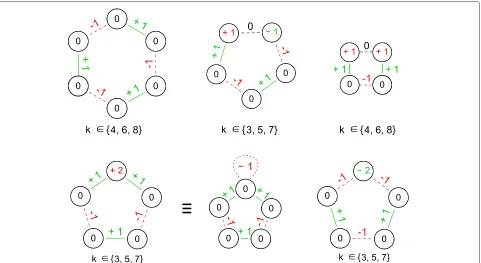
Figure 2Supported ITS layouts.(top) ITS layouts found within the elementary reaction data set from [34]. The number within the vertices corresponds to atomic oxidation state changes, broken bonds are dotted given a negative bond label while formed bonds show positive numbers. (left) Homovalent elementary reactions result in even sized cycles with no oxidation state changes at the atoms (see Figure 1). (middle) Odd cycles with two oppositely charged atoms separated by a non-changing pseudo bond (dashed edge labeled 0 see Figure 5). (right) Similar layout involving two equivalent oxidation state changes. Note, the inverse layout was also found and used. (bottom) Additionally supported ITS layouts for ambivalent elementary reactions involving non bonding electrons. These result in odd sized cycles and oxidation state changes of one atom. Note that this situation is equivalent to a non-elementary cycle with alternating bond labeling (middle).
∀i>1 :X1I <XiIusing e.g. an index order on the ver-tices. This ties the smallest cycle vertex to the first vari-ableXI1and prevents the rotation-symmetric assignments of the input variables. Note, since we constrain the bond (1, 2)to be a bond breaking
OAO
1,AO2 −IAI1,AI2 = −1
, the direction of the cycle is fixed and all direction symmetries are excluded as well.
As we will show in the evaluation (Section ‘Application and evaluation’), the basic CSP will produce many ITS candidates that do not extend to an atom mapping over the whole educt and product graphs. Therefore, we intro-duce an extended version of this CSP that incorporates further constraints derived from the input.
Extended CSP formulation
Investigating the given educt and product graph, we can exclude a large set of symmetric solutions that arise due to an exchange of hydrogens. The latter can form at most one single bond to other atoms. Thus, if a hydrogen par-ticipates in the ITS, its adjacent atom will do as well (since the bond is to be broken in the ITS). Most adja-cent atoms are non-hydrogens, e.g. carbon atoms, that can
have multiple adjacent hydrogens. Since there is exactly one bond breaking and formation for each ITS atom, only one such adjacent hydrogen will be part of the ITS. This results in a combinatorial explosion due to the symmetries of adjacent hydrogen atoms. The latter results from the missing chirality information within the molecular graph encoding (see Problem definition). An example is given in Figure 3. To break this type of symmetry, we select for each non-hydrogen one adjacent “master” hydrogen (e.g. the one with lowest vertex index) and remove all other sibling hydrogens from the domains, both for educt and product variablesXIandXO, respectively. The hydrogen vertices to remove are respectively given byHI
remandHremO
based on some vertex ordering ≺. They are defined as
HremI = { v | v ∈ VI∧l(v) = H∧ ∃{v,v∗}∈EI ∧ ∃v =v∈VI : (l(v) = H∧v ≺ v∧ {v,v∗} ∈ EI) }andHremO
accord-ingly. Thus, any assignmentAofXI andXO has to fulfill
AIi ∈ HremI andAOi ∈ HremO , which is implemented as a domain pruning preprocessing.
Figure 3Hydrogen symmetry problem.Symmetries resulting from interchangeable hydrogens. The figure presents three successive atom assignments within an ITS mapping. Bonds present inIare given in black, bonds to be formed to deriveOare dotted and gray. The ITS describes the loss of a hydrogen for the carbon (bond order decrease) and the bond formation between the decoupled hydrogen with the oxygen next in the ITS. It becomes clear that all 4 hydrogens are not distinguishable, which results in 4 possible symmetric ITS mappings.
all atoms (vertices) for the educt and product graph, resp., given by
NI = N(v)|v∈VIwith (1)
N(v) = l(v),Iv,v⊕l(v)|where
v =v∈VI∧Iv,v >0
(2)
whereN(v)is a tuple of the label of atom vertexvand an encoding of the multiset of all adjacent edges for this ver-tex. Note,⊕denotes string concatenation.NOis derived accordingly. For example, the neighborhood multisets for the reaction from Figure 1 are
NI= (C,1C),(C,1C, 2C),(C,1C, 1C, 2C), (C,1N, 2C), 3×(C,2C),(N,1C)
NO= (C,1C), 3×(C,1C, 1C),(C,1C, 1C, 1N), (C,1C, 1C, 2C),(C,1C, 2C),(N,1C)
Given the number of occurrences of an element x in a multiset N∗ by the multiplicity functionoccN∗(x), the multiset subtractionNI\NOis defined by the occurrence reduction for each elementx ∈ NI tomax(0,occN I(x)−
occN O(x)). This subtractionNI\NOgives the local neigh-borhoods that are unique within the educts and thus are part of the ITS, i.e. have to be changed during the reaction. Therefore, we can derive a lower bound on the number of atoms of a certain type that are participat-ing in the ITS. In the example this results inNI\NO = 3×(C,2C),(C,1N, 2C) revealing that at least 4 C -atoms of two neighborhood types (2Cand1N, 2C) are ITS members. The neighborhood types are educt/product specific, such that bothNI \NO as well as NO\NI are computed.
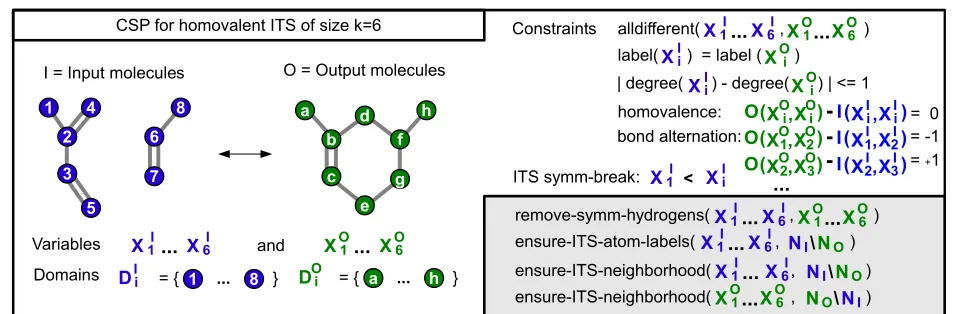
Given this information, we formulate an extended ver-sion of the basic CSP. Here, additional auxiliary node label variablesXL = XL1,. . .,XkLare introduced, which encode the atom labels still possible forXI assignments,
i.e. DLi = l(v)|v∈DIi. Next, we derive the multiset of atom labels NL to be present in the ITS withNL =
l(v) | N(v) ∈ NI \NO. In the example we findNL = C,C,C,C. To enforce the occurence of these atom labels in the ITS, we add for each each labellwithoccNLl>0 an according global cardinality (count) constraint onXL. The basic atom label preservation constraint was extended to a ternary constraint that also propagates changes inXLto both XI andXO and vice versa. In addition, we enforce that a valid assignmentAIof the ITS variablesXIreflects the explicit neighborhoodNI\NO, i.e.,NI\NO⊆N(AI)=
NAIi |1≤i≤k . An equivalent constraint is added forXOto preserve the neighborhoodN
O\NI, respectively. To minimize propagation cost, this is ensured by a simple n-ary constraint propagation after assignment. The CSP is illustrated in Figure 4.
Although the CSPs introduced above are defined for domains of vertices v ∈ VI ∪VO, they can be easily reformulated using integer encodings of the atom indices allowing for the application of standard constraint solvers such as Gecode [35]. This enables the use of efficient propagators for most of the required constraints, such as the algorithm of Regin [36] for globally unique assignments. Only a few binary constraints, e.g. to ensure atom label preservation or the cyclic bond pattern, require a ded-icated implementation as discussed in the Conclusions section.
All solutions for these CSPs are chemically valid ITS candidates. In order to check whether or not a true ITS is found we have to ensure that the remaining atoms, i.e., those that do not participate in the ITS, can be mapped without further bond formation or breaking. This is achieved using a standard graph matching approach as discussed in the following.
Overall atom mapping computation
Given the CSP formulation from above, we can enumer-ate all valid ITS candidenumer-ates. For a CSP solution we denote with aIi andaOi the assigned values of the variables XiI
andXOi , respectively. Once the ITS candidate is fixed, we can reduce the problem to a general graph isomorphism problem with a simple relabeling of the ITS edges. Thus, we derive two new adjacency matrices I and O from the original matrices I and O, resp., as follows: For all atom pairs(i,j)within the cyclic index sequence 1-2-..-k -1, we change the corresponding adjacency information to a unique label usingI
aIi,aIj = O aO
i,aOj ∈ {
f,b}encoding if
i XiI XOi
1 v2 v2
2 v4 v4
3 v6 v6
4 v7 v7
5 v5 v5
6 v3 v3
⇒
I v1 v2 v3 v4 v5 v6 v7 v8
v1 0 1 0 0 0 0 0 0
v2 1 0 f b 0 0 0 0
v3 0 f 0 0 b 0 0 0
v4 0 b 0 0 0 f 0 0
v5 0 0 b 0 0 0 f 0
v6 0 0 0 f 0 0 b 1
v7 0 0 0 0 f b 0 0
v8 0 0 0 0 0 1 0 0
O v
1 v2 v3 v4 v5 v6 v7 v8 v1 0 1 0 0 0 0 0 0
v2 1 0 f b 0 0 0 0
v3 0 f 0 0 b 0 0 0
v4 0 b 0 0 0 f 0 0
v5 0 0 b 0 0 0 f 0
v6 0 0 0 f 0 0 b 1
v7 0 0 0 0 f b 0 0
v8 0 0 0 0 0 1 0 0
Bond formations within the ITS are encoded byf while bond breakings are encoded byb. These matrices in con-cert with atom label information are target to full graph isomorphism search to identify the complete atom maps. In the example only the atom mappingm(vi)=viis found. Given these updated “ITS encoding” adjacency matrices IandO, the identification of the overall atom mapping
mreduces to the graph isomorphism problem based onI andO. Thus, all exact mappings ofI ontoOare valid atom mappingsmof an elementary homovalent reaction, since the encoded ITS respects all constraints due to the CSP formulation.
Extension to other ITS layouts
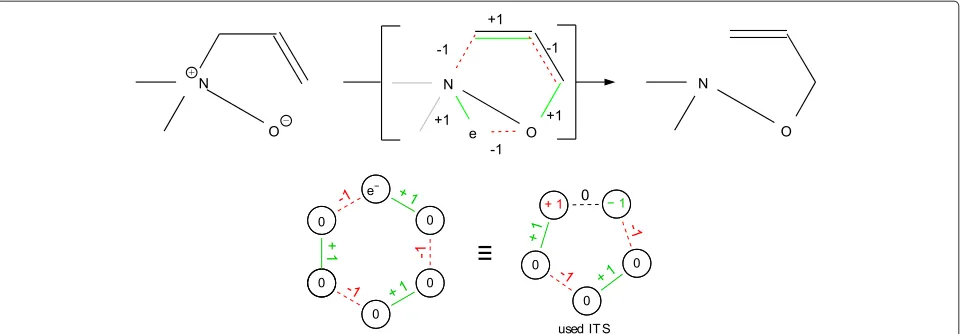
Of course, not all chemical transformations are based on a homovalent elementary ITS. This will in general be the case for multi-step reactions and for the so-called ambiva-lent reactions, in which the number of non-bonding elec-tron pairs (and thus the oxidation number of some atoms) changes in the course of a reaction [30]. Figure 5, for example, shows a reaction for which it is not possible to find a simple homovalent circular ITS using the presented ITS encoding. Still, the reaction shows a cyclic ITS with alternating bond electron changes for all but one bond [1]. We have extended the CSP-based framework outlined above to reactions with arbitrary cyclic ITS layouts, which
allows for any defined bond and atom valence changes (i.e. charge changes) within the ITS. Figure 2 exemplifies odd ITS cycle layouts for ambivalent reactions [32]. The main difference to homovalent reaction CSP is the relaxation of the homovalence constraint, which is not enforced for all participating atoms [32]. Furthermore, the preserva-tion of bond electrons for some ITS bonds instead of a change is enforced. The latter holds for instance for the bond connectingN+andO−in Figure 5.
Implementation details
Our C++ implementation of the approach currently takes a chemical reaction in SMILES format [38], identifies chemically correct atom mappings, and returns these in annotated SMILES format. The latter provides a num-bering of mapped atoms in the educts and products. It is available as C++ source code package v1.0.0 at http:// www.bioinf.uni-freiburg.de/Software/.
Molecule parsing, writing, and graph representation uses the chemistry module of the Graph Grammar Library (GGL) [39]. We use an explicit hydrogen representation within the CSP formulation, as in [29], because most homovalent elementary reactions involve the replacement of at least one hydrogen. Unfortunately, the compact string encoding of molecules in SMILES format does not explicitly represent hydrogens. Thus, we use the hydrogen
Figure 5Ambivalent reactions.(top) The Meisenheimer rearrangement [37] transforms nitroxides to hydroxylamines. It does not admit a simple alternating cycle as ITS when molecules are represented as graphs whose vertices are atoms. An extended representation, in which the additional electron at the oxygen is treated as a “pseudo-atom” can fix this issue. (bottom) Note that such even sized cycles with a virtual vertex for the moving charge (vertex labele−) can be represented by smaller odd cycles with two oppositely charged atoms separated by a non-changing pseudo bond (dashed edge labeled 0). See Figure 2 for further details of such an ITS layout.
correction procedures of the GGL to complete educt and product molecule input. The CSP formulation and solv-ing is performed within theGecodeframework on finite integer domains [35]. The final graph matching uses the state-of-the-art VF2-algorithm [40], which is among the fastest available [41].
The CSP uses standard binary order constraints and the
n-ary distinct and counting constraints provided by the Gecode library. Dedicated binary constraints propagat-ing on unassigned domains have been implemented for preservation of atom label, degree, and homovalence. The alternating cycle is implemented by a sequence ofk con-straints propagating the edge valence change of±1. The ITS local neighborhood preservation to be enforced in the extended CSP is implemented by a dedicated n-ary constraint over all variables propagating on assignments only.
We are using a Depth-First-Search where the branch-ing strategy chooses first variables with minimal domain size and first assigns non-hydrogen atom indices before hydrogen vertices are considered. The latter increases the performance to find the first solution since most reaction mechanism contain more than 50% non-hydrogen atoms. Once a non-hydrogen atom is selected for a variable, propagation will ensure that atom-adjacent hydrogens are considered for the variables adjacent within the ITS cycle encoding if appropriate.
For each ITS mapping identified, a full reaction atom mapping is derived via VF2-based graph matching. Therein, the discussed problem of hydrogen interchange-ability (see Extended CSP formulation) is faced again and would result in symmetric overall atom mappings. This is countered by first producing intermediate “collapsed”
educt/product graphs, where all adjacent non-ITS hydro-gens are merged into the atom labels of their adjacent non-hydrogens. This preserves the adjacency informa-tion and enables a unique mapping via VF2 excluding the hydrogen-symmetries. Furthermore, this compression speeds up the graph isomorphism identification since the graph size is approximately halved.
While not described here, the CSPs can be easily extended to find candidates for the entire atom mapping by introducing additional matching variables for all atoms participating in the reaction, all constrained to preserve atom label, vertex degree, and bond valence information. But first tests (not shown) revealed that the increase in CSP size and accordingly search and propagation effort needed does not repay due to the efficiency of the VF2 graph isomorphism approach used. Therefore, we omitted this approach from this work.
Application and evaluation
Benchmark sets for the evaluation of atom mapping meth-ods are not readily available, since well-curated reaction databases, such as the KEGG REACTION database [42], do not provide detailed atom mapping information. Thus a manual data retrieval and curation was necessary to test the constraint-based atom mapping approach presented above.
Predicting elementary reactions
atom mappings are restricted to non-hydrogen atoms. Thus they do not cover the whole reaction mechanisms, which usually involve hydrogen replacements. We there-fore manually extended the data with the corresponding hydrogen mappings within the reaction center. Further-more, the data set covers non-elementary reactions show-ing either multiple reaction centers or non-cyclic ITS. We found some atom mappings to be incorrect. We finally compiled a fully annotated data subset containing about 400 atom mappings of elementary reactions. The number of non-hydrogen atoms within the reactions ranges from 5 to 110 with a median of 36.
Studying the ITSs of these reactions, we found basi-cally only 3 different ITS layouts covering 3–8 atoms. This exemplifies the very limited number of such layouts to be expected for elementary reactions. The ITS layouts found are visualized in Figure 2-top. Most reactions are homovalent (375) and only 14 are found to be ambivalent reactions that change atomic oxidation states. This shows the prominence of homovalent reactions.
We applied the prototypical implementation of our extended CSP formulation to the data set using the ITS layouts depicted in Figure 2. Runtimes were on average low with a median of 0.5 seconds. Nevertheless, there are about 20 reactions where atom mapping computations took longer than ten minutes. All of them are homova-lent reactions of various ITS sizes. The increased runtime correlates with the number of involved atoms (Spearman rank correlation coefficient 0.79). Most such reactions contain large, connected static parts that cover about 90% of the involved molecules. Thus, we plan to incorporate an additional preprocessing to identify the small molecu-lar subgraphs that are likely associated with the ITS and focus the CSP on these parts. This will result in dras-tically reduced search spaces and thus we can expect a
substantial decrease of the running times. Atom mapping computations for ambivalent reactions were fast, which results from the additional constraints for the atomic oxidation state changes.
The resulting atom mappings were compared to the manually annotated data. We found only a single incorrect solution for a homovalent reaction according to the KEGG reaction mechanism classification (see Additional file 1): for R01440, our approach predicted an ITS ofk=4, while the true mechanism involves k = 6 atoms. Three reac-tions allowed for various mechanisms where the true atom mapping was contained in the set of alternative solutions predicted by our method. All atom mapping computations for ambivalent reactions were correct.
Impact of the extended model
In order to investigate the impact of our extended CSP formulation over the basic version, we selected a repre-sentative subset of homovalent elementary reactions from the KEGG REACTION database. We restrict the evalu-ation to homovalent reactions due to the much higher computational cost. The latter emerges since we can not as easily identify ITS participating atoms as is the case for ambivalent reactions. The latter show at least one atom that changes its oxidation state, which confines the search space drastically.
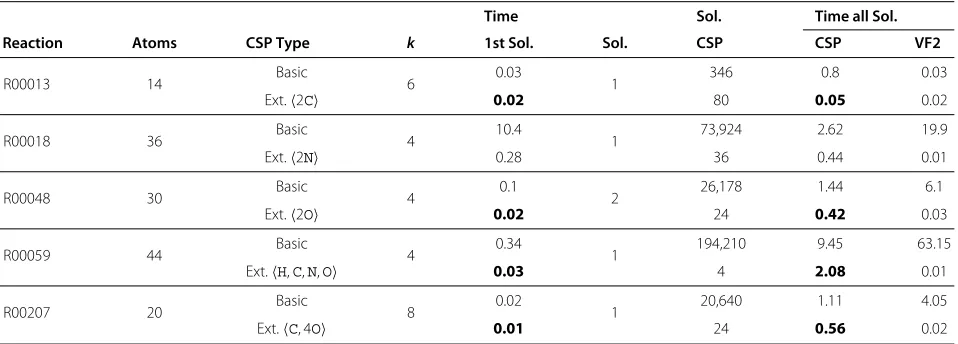
The reactions have been chosen to provide various ITS and reaction sizes for evaluation. The average size of the selected reactions, i.e. the average number of atoms, is about 30 (Table 1 column 2) while the whole KEGG database shows an average of 50 atoms per reaction. The example reactions cover homovalent ITS sizes ofk=4, 6, and 8 as introduced. Since there is no atom mapping infor-mation provided within the KEGG database, the example reactions had to be identified manually based on chemical
Table 1 Performance evaluation of the basic and extended CSP model for reactions from Table 2
Time Sol. Time all Sol.
Reaction Atoms CSP Type k 1st Sol. Sol. CSP CSP VF2
R00013 14 Basic 6 0.03 1 346 0.8 0.03
Ext.2C 0.02 80 0.05 0.02
R00018 36 Basic 4 10.4 1 73,924 2.62 19.9
Ext.2N 0.28 36 0.44 0.01
R00048 30 Basic 4 0.1 2 26,178 1.44 6.1
Ext.2O 0.02 24 0.42 0.03
R00059 44 Basic 4 0.34 1 194,210 9.45 63.15
Ext.H,C,N,O 0.03 4 2.08 0.01
R00207 20 Basic 8 0.02 1 20,640 1.11 4.05
Ext.C, 4O 0.01 24 0.56 0.02
knowledge. This again highlights the need for an auto-mated identification of chemically feasible atom mappings as provided by our approach. The selected homovalent reactions are given in Table 2 with their respective KEGG ID, educts and products.
For each reaction, we applied our approach using both the basic and extended CSP formulation to evaluate the impact of the latter for various reaction and ITS cycle sizes. In Table 1 we report runtime, search, and solution details for the smallest ITS sizekthat yields a solution. For smaller values ofk, the infeasibility tests were done within fractions of seconds and are therefore omitted.
Our atom mapping approach finds a first atom map-ping for homovalent elementary reactions within millisec-onds. It is clear that the additional constraints within the extended CSP formulation significantly increase the performance of the approach. This becomes even more striking when considering the timings for full solution enumeration. The extended CSP produces several orders of magnitude less ITS candidates (column “Sol. CSP”). Since the time consumption of the VF2 algorithm is about linear in the number of ITS candidates to test, this results in according speedups of the overall approach. Still there is room for optimization since the symmetry breaking within the CSP solution enumeration is not complete and ITS enumeration still allows for some symmetries (data not shown). The latter result from symmetries within the educt and product molecules, which are not handled by the simple ITS ordering applied so far. We are currently working on an extended generic symmetry identification and breaking for ITS, educts and products.
The strength of the extended CSP comes from the pre-computed list of local neighborhoods to be part of the ITS candidate and the “hydrogen symmetry” breaking. For the reactions from Table 1, this list comprises on aver-age about half the ITS resulting in the impressive impact of the constraint. For reaction R00059, the list covers the whole ITS with an according immense reduction in ITS candidates.
As already expected based on the results from other approaches [29], only a single or very few reaction mech-anisms, i.e., non-symmetric atom mappings, are identifi-able, see Table 2 column “Sol”.
Conclusions
We have presented here the first constraint programming approach to identify chemically feasible atom mappings based on the identification of a cyclic imaginary transition state (ITS). The incorporation of the cyclic ITS structure within the search ensures the chemical correctness of the mapping that is not guaranteed by standard approaches that attempt to solve Maximum Common Edge Subgraph Problems [25]. To our knowledge, this is the first approach explicitly incorporating the cyclic ITS structure into an atom mapping procedure. The formulation of the CSP using only the atoms involved in the ITS results in a very small CSP that can be solved efficiently. Thus, it is well placed as a filter for ITS candidates for the subse-quent, computationally more expensive graph matching approaches. The solutions of such an extended CSP are the desired chemically feasible atom mappings. We apply advanced symmetry breaking strategies and thus can enu-merate all possible chemical mechanisms underlying a reaction.
The feasibility of the approach was introduced here for the common case of elementary, homovalent reactions, i.e., for reactions in which the transition state is an ele-mentary cycle with an even number of atoms. We have shown that the CSP formulation can be easily extended to arbitrary cyclic ITS layouts. Usually, such reactions are not homovalent, i.e., at least one atom participating in the ITS is gaining or losing non-bonding electrons, which requires some moderate changes in the formulation of the constraints. We are currently identifying all feasible ITS layouts and are developing a generic CSP formulations for arbitrary layouts. This will result in a powerful approach to identify atom mappings with chemically valid ITSs.
At the moment, we apply a hierarchal combination of ITS-filtering via CP techniques followed by full atom mapping identification using a dedicated graph isomor-phism algorithm. As already mentioned, there are also approaches to directly solve the graph isomorphism prob-lem using CP [43-45]. While the used VF2 algorithm was shown to be efficient for first solution identification, other approaches (e.g. CP-based) show better performance for full solution space enumeration [46,47]. Currently, we are not aware of an available, efficient integration of the
Table 2 Elementary homovalent reactions from the KEGG REACTION database [42] used for the evaluation of the approach
Reaction Educts Products
R00013 C(=O)=O,C(C(=O)O)(C=O)O 2×C(=O)(C=O)O
R00018 N,N(CCCCN)CCCCN 2×C(CCN)CN
R00048 CC(O)CC(=O)OC(C)CC(O)=O,O 2×CC(O)CC(O)=O
R00059 N(C(=O)CCCCCN)CCCCCC(=O)O,O 2×C(CC(=O)O)CCCN
R00207 P(=O)(O)(O)O,O=O,CC(=O)C(=O)O P(=O)(OC(=O)C)(O)O,OO,C(=O)=O
approaches in Gecode v4, such that they were not yet considered in this work. A prototypical implementation of graph isomorphism using the introduced constraints and propagators did not enable VF2-comparable runtimes (data not shown). Since we are dealing with molecular graphs of relatively simple structural complexity, the use of dedicated graph isomorphism algorithms, e.g. for pla-nar graph [48], could increase the performance as well. Furthermore, other CSP encodings of the problem, e.g. by fusing current dedicated constraints like atom label preservation or homovalence into a single extensional table constraint [49], might improve the ITS identification step.
The current framework is designed to identify chem-ically feasible atom mappings for elementary, i.e. single-step, reactions. There are cases where short-lived intermediate molecules are formed that immediately react into the final products. Since these intermediate struc-tures are unknown our present approach cannot be directly applied to such reactions. As noted by Hendriksen [2], often there is only a single unknown intermediate link-ing two consecutive elementary reactions. We therefore plan to create “fused” ITS layouts based on our single-step ITS encodings that will allow for the correct identifica-tion of atom mappings for multi-step reacidentifica-tions and reveal the individual steps and intermediate structures. For the combination of ITS layouts, we are currently investigat-ing the multi-step reaction analyses by Fujita [50] and Herges [30].
Summarizing, we see constraint programming as a very promising approach to solve atom mapping problems since it provides a very flexible framework to incorporate combinatorial constraints determined by the underlying rules of chemical transformations.
Additional file
Additional file 1: Reaction mechanism comparison for reaction R01440, the only incorrect prediction.
Competing interests
The authors declare that they have no competing interests.
Authors’ contributions
Initial project design was done by MM, CF, and PFS, which was implemented by FN and MM. Final study design and manuscript by MM, CF, PFS, and RB. Manual data retrieval and approach evaluation by NS and MM. All authors read and approved the final manuscript.
Acknowledgements
We thank Prof. Alexandre Varnek for providing the manually currated reaction data set from [34] in RDF format. Furthermore, we thank Heinz Ekker for comments and discussions on the initial project design. This work was partially supported by the COST Action CM1304 “Emergence and Evolution of Complex Chemical Systems”. The article processing charge was funded by the German Research Foundation (DFG) and the Albert Ludwigs University Freiburg in the funding programme Open Access Publishing.
Author details
1Bioinformatics Group, Department of Computer Science, University of Freiburg, Georges-Koehler-Allee 106, 79110 Freiburg, Germany.2Centre for Biological Signalling Studies (BIOSS), University of Freiburg, Freiburg, Germany. 3Centre for Biological Systems Analysis (ZBSA), Cluster of Excellence, University of Freiburg, Habsburgerstr. 49, 79104 Freiburg, Germany.4Center for non-coding RNA in Technology and Health, University of Copenhagen, Grønnegårdsvej 3, 1870 Frederiksberg, Denmark.5Institute for Theoretical Chemistry, University of Vienna, Währingerstrasse 17, 1090 Vienna, Austria. 6Bioinformatics Group, Department of Computer Science, and Interdisciplinary Center for Bioinformatics, University of Leipzig, Härtelstraße 16-18, 04107 Leipzig, Germany.7Max Planck Institute for Mathematics in the Sciences, Inselstraße 22, 04107 Leipzig, Germany.8Fraunhofer Institute for Cell Therapy and Immunology, Perlickstraße 1, 04103 Leipzig, Germany.9Santa Fe Institute, 1399 Hyde Park Rd., 87501 Santa Fe, NM, USA.
Received: 17 April 2014 Accepted: 30 October 2014
References
1. Fujita S:Description of organic reactions based on imaginary transition structures. 1. Introduction of new concepts.J Chem Inf Comput Sci1986,26:205–212.
2. Hendrickson JB:Comprehensive system for classification and nomenclature of organic reactions.J Chem Inf Comput Sci1997,
37:852–860.
3. Kotera M, Okuno Y, Hattori M, Goto S, Kanehisa M:Computational assignment of the EC numbers for genomic-scale analysis of enzymatic reactions.J Am Chem Soc2004,126(50):16487–16498. 4. Leber M, Egelhofer V, Schomburg I, Schomburg D:Automatic
assignment of reaction operators to enzymatic reactions. Bioinformatics2009,25:3135–3142.
5. Yamanishi Y, Hattori M, Kotera M, Goto S, Kanehisa M:E-zyme: predicting potential EC numbers from the chemical transformation pattern of substrate-product pairs.Bioinformatics2009,
25(12):179–186. doi:10.1093/bioinformatics/btp223.
6. Arita M:Scale-freeness and biological networks.J Biochem2005,
138:1–4. doi:10.1093/jb/mvi094.
7. Blum T, Kohlbacher O:Using atom mapping rules for an improved detection of relevant routes in weighted metabolic networks. J Comput Biol2008,15:565–576.
8. Hogiri T, Furusawaa C, Shinfukua Y, Onoa N, Shimizua H:Analysis of metabolic network based on conservation of molecular structure. Biosystems2009,95(3):175–178. doi:10.1016/j.biosystems.2008.09.002. 9. Rautio J, Kumpulainen H, Heimbach T, Oliyai R, Oh D, Järvinen T,
Savolainen J:Prodrugs: design and clinical applications.Nat Rev Drug Discov2008,7(3):255–270.
10. Wiechert W:C13metabolic flux analysis.Meta Eng2001,3:195–206. doi:10.1006/mben.2001.0187.
11. Warr WA:A short review of chemical reaction database systems, computer-aided synthesis design, reaction prediction and synthetic feasibility.Mol Inform2014,33:469–476. doi:10.1002/minf.201400052.
12. Chen WL, Chen DZ, Taylor KT:Automatic reaction mapping and reaction center detection.WIREs Comput Mol Sci2013,3(6):560–593. doi:10.1002/wcms.1140.
13. Ehrlich H-C, Rarey M:Maximum common subgraph isomorphism algorithms and their applications in molecular science: a review. WIREs Comput Mol Sci2011,1(1):68–79. doi:10.1002/wcms.5.
14. Dugundji J, Ugi I:An algebraic model of constitutional chemistry as a basis for chemical computer programs.Topics Cur Chem1973,
39:19–64.
15. Lynch M, Willett P:The automatic detection of chemical reaction sites.J Chem Inf Comput Sci1978,18:154–159.
16. Jochum C, Gasteiger J, Ugi I:The principle of minimum chemical distance (PMCD).Angew Chem Int Ed1980,19:495–505.
17. de Groot MJL, van Berlo RJP, van Winden WA, Verheijen PJT, Reinders MJT, de Ridder D:Metabolite and reaction inference based on enzyme specificities.Bioinformatics2009,25(22):2975–2983.
19. Heinonen M, Lappalainen S, Mielikäinen T, Rousu J:Computing atom mappings for biochemical reactions without subgraph isomorphism.J Comp Biol2011,18:43–58.
20. Raymond JW, Willett P:Maximum common subgraph isomorphism algorithms for the matching of chemical structures.J Computer-Aided Mol Design2002,16:521–533.
21. Apostolakis J, Sacher O, Körner R, Gasteiger J:Automatic determination of reaction mappings and reaction center information. 2. Validation on a biochemical reaction database.J Chem Inf Mod2008,
48:1190–1198.
22. Körner R, Apostolakis J:Automatic determination of reaction mappings and reaction center information. 1. The imaginary transition state energy approach.J Chem Inf Mod2008,
48:1181–1189.
23. Latendresse M, Malerich JP, Travers M, Karp PD:Accurate
atom-mapping computation for biochemical reactions.J Chem Inf Model2013,52(11):2970–2982. doi:10.1021/ci3002217.
24. Bahiense L, Mani´c G, Piva B, de Souza CC:The maximum common edge subgraph problem: a polyhedral investigation.Discr Appl Math2012,
160:2523–2541.
25. Akutsu T:Efficient extraction of mapping rules of atoms from enzymatic reaction data.J Comp Biol2004,11:449–462. doi:10.1089/1066527041410337.
26. Huang X, Lai J, Jennings SF:Maximum common subgraph: some upper bound and lower bound results.BMC Bioinformatics2006,7(S4):6. 27. Crabtree JD, Mehta DP:Automated reaction mapping.J Exp Algor2009,
13(1.15):1–29. doi:10.1145/1412228.1498697.
28. Crabtree JD, Mehta DP, Kouri TM:An open-source Java platform for automated reaction mapping.J Chem Inf Model2010,50:1751–1756. doi:10.1021/ci100061d.
29. First EL, Gounaris CE, Floudas CA:Stereochemically consistent reaction mapping and identification of multiple reaction mechanisms through integer linear optimization.J Chem Inf Model2012,
52(1):84–92. doi:10.1021/ci200351b.
30. Herges R:Organizing principle of complex reactions and theory of coarctate transition states.Angewandte Chemie Int Ed1994,33:255–276. 31. Fujita S:Description of organic reactions based on imaginary
transition structures. 2. Classification of one-string reactions having an even-membered cyclic reaction graph.J Chem Inf Comput Sci1986,
26:212–223.
32. Fujita S:Description of organic reactions based on imaginary transition structures. 3. Classification of one-string reactions having an odd-membered cyclic reaction graph.J Chem Inf Comput Sci1986,
26:224–230.
33. Mann M, Nahar F, Ekker H, Backofen R, Stadler PF, Flamm C:Atom mapping with constraint programming.InProc. of the 19th International Conference on Principles and Practice of Constraint Programming (CP’13).LNCS, vol. 8124. Edited by Schulte C. Berlin: Springer; 2013:805–822. doi:10.1007/978-3-642-40627-0_59. 34. Muller C, Marcou G, Horvath D, Aires-de-Sousa J, Varnek A:Models for
identification of erroneous atom-to-atom mapping of reactions performed by automated algorithms.J Chem Inf Mod2012,
52(12):3116–3122. doi:10.1021/ci300418q.
35. Gecode Team: Gecode:Generic Constraint Development Environment.Available as an open-source library from [http://www. gecode.org], 2014.
36. Regin J-C:A filtering algorithm for constraints of difference.In Proceedings of the 12th National Conference of the American Association for Artificial Intelligence. Menlo Park: American Association for Artificial Intelligence; 1994:362–367.
37. Meisenheimer J:Über eine eigenartige Umlagerung des
Methyl-allyl-anilin-N-oxyds.Chemische Berichte1919,52:1667–1677. 38. Weininger D:SMILES:a chemical language and information system. 1
Introduction to methodology and encoding rules.J Chem Inf Comp Sci 1988,28(1):31–36. doi:10.1021/ci00057a005.
39. Mann M, Ekker H, Flamm C:The graph grammar library - a generic framework for chemical graph rewrite systems.InTheory and Practice of Model Transformations, Proc. of ICMT 2013.LNCS, vol. 7909. Edited by Duddy K, Kappel G. Berlin: Springer; 2013:52–53. doi:10.1007/978-3-642-38883-5_5. Extended abstract at, ICMT, long version at arXiv [http://arxiv. org/abs/1304.1356].
40. Cordella LP, Foggia P, Sansone C, Vento M:A (sub)graph isomorphism algorithm for matching large graphs.IEEE Trans Pattern Anal Mach Intell 2004,26(10):1367–1372.
41. Cordella LP, Foggia P, Sansone C, Vento M:Performance evaluation of the VF graph matching algorithm.InProceedings of the 10th International Conference on Image Analysis and Processing. ICIAP ‘99. Washington, DC: IEEE Computer Society; 1999:1172–1177. 42. Kanehisa M, Goto S, Sato Y, Furumichi M, Tanabe M:KEGG for
integration and interpretation of large-scale molecular data sets. Nuc Acids Res2012,40(Database issue):109–114. doi:10.1093/nar/gkr988. 43. Zampelli S, Mann M, Deville Y, Backofen R:Techniques de
decomposition pour l’isomorphisme de sous-graphe.InProc. of the 4th Journees Francophones de Programmation Par Contraintes (JFPC’08); 2008. An english version of the article is available at [http://arxiv.org/abs/ 0805.1030v1].
44. Dooms G, Deville Y, Dupont P:CP(Graph)Introducing a graph computation domain in constraint programming.InPrinciples and Practice of Constraint Programming - CP 2005.LNCS, vol. 3709. Berlin: Springer; 2005:211–225.
45. Rudolf M:Utilizing constraint satisfaction techniques for efficient graph pattern matching.InTheory and Application of Graph Transformations.LNCS, vol 1764. Berlin: Springer; 2000:381–394. 46. Zampelli S, Deville Y, Solnon C:Solving subgraph isomorphism
problems with constraint programming.Constraints2010,
15(3):327–353.
47. Solnon C:Alldifferent-based filtering for subgraph isomorphism. Artif Intell2010,174:850–864.
48. Eppstein D:Subgraph isomorphism in planar graphs and related problems.InProceedings of the Sixth Annual ACM-SIAM Symposium on Discrete Algorithms.SODA ‘95. Philadelphia: Society for Industrial and Applied Mathematics; 1995:632–640.
49. Gent IP, Jefferson C, Miguel I, Nightingale P:Data structures for generalised arc consistency for extensional constraints.In Proceedings of the Twenty Second Conference on Artificial Intelligence (AAAI-07), Vancouver, British Columbia, Canada. Menlo Park: AAAI Press; 2007:191–197.
50. Fujita S:Description of organic reactions based on imaginary transition structures. 5. Recombination of reaction strings in a synthesis space and its application to the description of synthetic pathways.J Chem Inf Comput Sci1986,26:238–242.
doi:10.1186/s13015-014-0023-3
Cite this article as:Mannet al.:Atom mapping with constraint programming.Algorithms for Molecular Biology20149:23.
Submit your next manuscript to BioMed Central and take full advantage of:
• Convenient online submission
• Thorough peer review
• No space constraints or color figure charges
• Immediate publication on acceptance
• Inclusion in PubMed, CAS, Scopus and Google Scholar
• Research which is freely available for redistribution

![Table 2 Elementary homovalent reactions from the KEGG REACTION database [42] used for the evaluation of theapproach](https://thumb-us.123doks.com/thumbv2/123dok_us/341293.1526619/10.595.59.538.641.723/table-elementary-homovalent-reactions-reaction-database-evaluation-theapproach.webp)
