Rajareddy A, et al. J Sci Res Pharm, 2018;7(10):118-123
World Inventia Publishers
J
ournal of
S
cientific
R
esearch in
P
harmacy
http://www.jsrponline.com/
Vol. 7, Issue 10, 2018 ISSN: 2277-9469
USA CODEN: JSRPCJResearch Article
SYNTHESIS AND CHARACTERIZATION OF NOVEL BENZOTHIAZOLE DERIVATIVES CONTAINING INDOLE
MOIETIES WITH ANTIMICROBIAL ACTIVITIES
Rajareddy Aleti 1 *, Srinivasa Murthy Muppavarapu 2
* 1 Mall Reddy Pharmacy College, Department of Pharmaceutical Chemistry, Dhulapally, Maisammaguda, Sec-bad-500043, Telangana, INDIA.
2 Vignan Institute of Pharmaceutical Sciences, Department of Pharmaceutical Chemistry, Near Ramoji Film City, Deshmukhi-508284, Telangana, INDIA.
Received on: 19-09-2018; Revised and Accepted on: 29-10-2018
ABSTRACT
T
he"(E)-5-chloro-1-((E)-1-((7-chloro-6-fluorobenzo[d]thiazol-2-yl)imino)ethyl)-3-(p-tolylimino)indolin-2-one" was to synthesize, purify,characterize and evaluate the biological activity of newly synthesized structural analogs of Benzothiazole derivatives Indole moieties. All these
molecules (5a-5o) were characterized by FTIR, H1NMR and mass spectral analysis along with physical data. The biological potentials of the newly
synthesized compounds are evaluated for their anti microbial activity The standard drugs and synthesized compounds were dissolved in minimum
quantity of dimethyl formamide (DMF) and adjusted, to made up the volume with distilled water to get 50g/ml and 100g/ml concentrations. Anti
bacterial activity of 5a, 5f, 5h, 5k, 5n and5o showed better against Bacillus substillis (gram +ve) at lower and higher concentration when compare with procaine penicillin. compounds, 5a, 5g, 5n, 5o and 5j promiting antibacterial activity againsty Pseudomonas aureus (gram –ve) at higher and lower concentration when compare with streptomycin. Compounds 5c, 5e, 5f, 5l and 5o showed promising antibacterial activity against Strphylococus aureus (gram +ve).when compare with procaine penicillin Compounds 5a, 5b, 5e, 5f, 5l and 5o showed better antibacterial activity against E. coli (gram – ve).when compare with streptomycin. the compounds tested 5a, 5f, 5h, 5k and 5k showed comparatively better antifungal activity against Aspergellus niger at both concentration compare to standard griseofulvin. Compounds 5a, 5f, 5h, 5n and 5o showed better antifungal activity against candida albicans compared to griseofulvin.
KEYWORDS: Substituted benzaldehyde, 2-amino benzothioazole, Isatine and anti microbial activity.
INTRODUCTION
H
eterocyclic compounds containing a ring made up, in addition to carbon atoms, other elements (heteroatoms), most often nitrogen, oxygen, and sulfur, and less frequently phosphorus, boron, and silicon.Although the parent compound, benzothiazole is not widely used, many of its derivatives are found in commercial products or in nature [1-3].
Thiazole rings are planar and aromatic. Thiazoles are characterized by larger pi-electron delocalization than the corresponding oxazoles and have therefore greater aromaticity. This aromaticity is evidenced by the chemical shift of the ring protons in proton NMR spectroscopy (between 7.27 and 8.77 ppm), clearly indicating a strong diamagnetic ring current. The calculated pi-electron density marks C5 as the primary site for electrophilic substitution, and C2 as the site for nucleophilic substitution. Since most of the benzothiazole derivatives were reported for their diversified activity such as antitumor, antitubercular, antimalarial, anticonvulsant, anthelmintic, analgesic, anti inflammatory and antifungal.
*Corresponding author:
Rajareddy Aleti
Vignan Institute of Pharmaceutical Sciences, Department of Pharmaceutical Chemistry, Near Ramoji Film City, Deshmukhi-508284, Telangana, INDIA.
* E-Mail: [email protected]
DOI:https://doi.org/10.5281/zenodo.1473391
Isatin or 1H-indole-2, 3-dione is an indole derivative. The compound was first obtained by Erdman and Laurent in 1841 as a product from the oxidation of indigo dye by nitric acid and chromic acids. The compound is found in many plants. In recent years, indole derivatives have acquired conspicuous significance due to their wide spectrum of biological activities.
MATERIALS AND METHODS [4-7]
T
he synthesized compounds were screened foranthelmentic activities. Fourier Transform IR spectrometer (model Shimadzu 8700) in the range of 400-4000 cm-1 Using KBr pellets and
values are reported in cm-1and the spectra were interpreted. 1H-NMR
spectra were recorded on DPX-200 MHz NMR spectrometer using DMSO-d6 and chemical shifts (δ) are reported in parts per million
down field from internal reference Tetramethylsilane (TMS) and the Spectra were interpreted. Mass spectra were recorded on Mass spectrophotometer (model Shimadzu) by LC- MS and the spectra were interpreted. Precoated Silica gel G plates were used to monitor the progress of reaction as well as to check the purity of the compounds: n-Hexane: Ethyl acetate (8:2).
General procedures:
Step: 1: Preparation of 2-aminobenzothiazole:
Steps 2: Synthesis of substituted Isatin from Aniline:
9 gm of Chloral hydrate was taken into the round bottom flask and dissolved in 120 ml water. To that 13 gm of sodium sulphate, a solution of 5.4 gm of Aniline in 30 ml of water containing 5.12 gm of concentrated hydrochloric acid (4.34 ml) to dissolve the amine and solution of 11 gm of hydroxylamine hydrochloride in 50 ml of water were added. Flask was then heated vigorously until the reaction was completed. After it, the solution containing beaker was cooled in running water followed by the filtration of reminder crystallized product with suction pump and air dried.
18.4 gm of concentrated sulphuric acid (10.0 ml) was warmed to 500C and 2.5 gm of dry isonitrosoacetanilide was added in such a rate
so as to keep the temperature between 60-700C but not higher. External
cooling was applied at this stage so that the reaction could be carried out more rapidly after the addition of isonitroso compound was finished. The solution was heated to 800C and kept at this temperature
for about 10 min to complete the reaction. Then the reaction mixture was cooled to room temperature and poured it into ten times its volume of cracked ice. After standing for 90 mints, the final product was filtered with suction pump followed by washing with cold water to remove sulphuric acid and dried in air.
Scheme-I
Step 3: Synthesis of Isatin Schiff’s bases (3a-3i):
A mixture of equimolar quantity of substituted aromatic aniline (0.01mol) and Compound 2a-2d was dissolved in 20ml of ethanol, refluxed for 2-3hrs in the presence of few drops of (2ml) glacial acetic acid. The progress of the reaction was monitored by TLC (n-Hexane: EtoAc 7:3). The reaction mixture was cooled to room temperature and keep in refrigerator for overnight to get precipitate. A solid was obtained, which was filtered off and recrystallized from methanol or ethanol to give crystalline solid.
Step 4: Synthesis of 1-acetyl-3-(phenylimino)indolin-2-one derivatives:
Step 5: General procedure: Synthesis of novel 1-((E)-1-(benzo[d] thiazol-2-yl)imino)ethyl)-3-(phenylimino)indolin-2-one(5a-5o):
A mixture of equimolar quantity of substituted N-acetyl Isatin derivatives (0.01mol) and Compound 1a-1b was dissolved in 20ml of ethanol, refluxed for 2-3hrs in the presence of few drops of (2ml) glacial acetic acid. The progress of the reaction was monitored by TLC (n-Hexane: EtoAc 8:2). The reaction mixture was cooled to room temperature and keep in refrigerator for overnight to get precipitate. A solid was obtained, which was filtered off and recrystallized from methanol or ethanol to give crystalline solid.
5a: (E)-1-((E)-1-(benzo[d]thiazol-2-yl)imino)ethyl)-3-(phenyl imino)indolin-2-one: M.P. 219–221°C; Mol. formula: C23H16N4OS,
yield 78%, IR (� cm−1): 3143, 3054(C-H Str, Ar), 2930, 2891, 2793(C–H Str, Aliphatic), 2311 (C-S-C Str), 1684(C=O Str, Indole), 1588 (C=N Str), 1515 (C=CH Str), 1431 (C=C Str, Ar). 1H-NMR
(DMSO) �� ppm: 8.38-8.27(d, 2H, Ar-H), 8.11-7.88(d, 2H, Ar-H), 7.84-7.77(t, 3H, H), 7.69-7.67 (d, 2H, H), 7.55-7.54 (d, 2H, Ar-H), 7.51-7.41 (t, 3H, Ar-H). 3.33(S, 3H, -CH3); Mass (ESI-MS): m/z
396(M), 397(M + 1, 100%).
5b: (E)-5-chloro-1-((E)-1-(benzo[d]thiazol-2-yl)imino)ethyl)-3-(phenylimino)indolin-2-on: M.P. 213-215°C; Mol. formula: C23H15N4OSCl, yield 82%, IR (� cm−1): 3037, 2932(C-H Str, Ar),
2872(C–H Str, Aliphatic), 2346 (C-S-C Str), 1721(C=O Str, Indole), 1555(C=N Str), 1520(C=CH Str), 1432 (C=C Str, Ar), 771(C-Cl Str, Ar).
1H-NMR (DMSO) �� ppm: 8.37-8.28(t, 3H, H), 7.88-7.84(t, 3H,
Ar-H), 8.10(s, 1H, Ar-Ar-H), 7.83-7.68(d, 4H, Ar-Ar-H), 7.58-7.57(d, 2H, Ar-Ar-H), 7.55-7.51 (d, 2H, Ar-H), 3.39(s, 3H, -CH3); Mass (ESI-MS): m/z
430(M), 431(M + 1, 100%),432(M + 2, 30%).
5c: (E)-1-((E)-1-(benzo[d]thiazol-2-yl)imino)ethyl)-3-(p-tolyl imino)indolin-2-one: M.P. 203–205°C; Mol. formula: C24H18N4OS,
yield 77%. IR (� cm−1): IR (� cm−1): 3100 (C-H Str, Ar), 2987,2882(C–H Str, Aliphatic), 2336(C-S-C Str), 1705(C=O Str, Indole), 1663, 1546(C=N Str), 1506(C=CH Str), 1459(C=C Str, Ar), 797(C-Cl Str, Ar), 588(C-F Str, Ar). 1H-NMR (DMSO) �� ppm:
8.57-8.35(d, 4H, Ar-H), 8.06-8.04(d, 4H, Ar-H), 7.94-7.92(t, 2H, Ar-H), 7.82-7.75(t, 2H, Ar-H), 3.31(s, 3H, -CH3), 1.97-1.94(s, 3H, -CH3); Mass
(ESI-MS): m/z 410(M), 411(M + 1, 100%).
5d: (E)-5-chloro-1-((E)-1-(benzo[d]thiazol-2-yl)imino)ethyl)-3-(p-tolylimino)indolin-2-one: M.P. 231-233°C; Mol. formula: C24H17N4OSCl, yield 66%. IR (� cm−1): 3093(C-H Str, Ar), 2976,
2884(C–H Str, Aliphatic), 2383(C-S-C Str), 1699(C=O Str, Indole), 1578(C=N Str), 1565(C=CH Str), 1476(C=C Str, Ar), 803(C-Cl Str, Ar).
1H-NMR (DMSO) �� ppm: 8.47-8.37(d, 2H, Ar-H), 7.95-7.88(d, 4H,
H), 7.40-7.39(t, 2H, H), 7.35(s, 1H, H), 7.35-7.34(d, 2H, Ar-H), 3.34-3.30(s, 3H, -CH3), 1.986-1.982(s, 3H, -CH3); Mass (ESI-MS):
m/z 444(M), 445(M + 1, 100%), 446(M + 2, 30%).
5j:1-((E)-1-((7-chloro-6-fluorobenzo[d]thiazol-2-yl)imino)ethyl)-3-(phenylimino)indolin-2-one: m.p. 231-233°C; Mol. formula: C23H14N4OSClF, yield 80%, IR (� cm−1): IR (� cm−1): 3035(C-H Str,
Ar), 2987, 2878(C–H Str, Aliphatic), 2302(C-S-C Str), 1728(C=O Str, Indole), 1583(C=N Str), 1532(C=CH Str), 1454(C=C Str, Ar), 787(C-Cl
Str, Ar), 590(C-F Str, Ar). 1H-NMR (DMSO) �� ppm: 8.43-8.33(d, 2H,
Ar-H), 8.06-8.04(d, 2H, Ar-H), 7.94-7.92(t, 3H, Ar-H), 7.82-7.75(d, 2H, Ar-H), 7.17-7.14(t, 2H, Ar-H), 3.83(s, 3H, -CH3); Mass (ESI-MS): m/z
448(M), 449(M + 1, 100%), 450(M + 2, 30%).
Study of antimicrobial activity: [6-10]
1. Antibacterial activity:
The antibacterial activities are performed by cup plate method (diffusion technique). The fresh culture of bacteria are obtained by inoculating bacteria into peptone water liquid media and incubated at 37 ± 2 C for 18 – 24 hours. This culture mixed with nutrient agar media (20%) and poured into petridishes by following aseptic techniques. After solidification of the media five bores are made at equal distance by using sterile steel cork borer (8 mm diameter). Into these cups different concentrations of standard drugs and synthesized compounds are introduced. Dimethyl formamide was used as a control. After introduction of standard drugs and synthesized compounds, the plates were placed in a refrigerator at 80-100C for proper diffusion of
drugs into the media. After two hours of cold incubation, the petriplates are transferred to incubator and maintained at 370±20C for 18-24 hours.
After the incubation period, the petriplates were observed for zone of inhibition by using vernier scale. The results evaluated by comparing the zone of inhibition shown by the synthesized compounds with standard drugs. The results are the mean value of zone of inhibition measured in millimeter of two sets.
The standard drugs and synthesized compounds were dissolved in minimum quantity of dimethyl formamide (DMF) and adjusted and made up the volume with distilled water to get 50g/ml and 100g/m concentrations. The procaine penicillin used against
Staphylococcus aureus, Bacillas subtilis and streptomycin used against
Escherichia coli, Pseudomonas as standard drugs.
The pH was adjusted to 7.4 ± 0.1 at 250C temperature.
2. Antifungal activity:
The synthesized compounds are screened against two selected fungal strains Candida albicans and Aspergillus niger by using diffusion method. The 48 hours old fungal culture inoculated into nutrient broth by following aseptic techniques and incubated for 48 hours at 370± 20C in an incubator. This culture mixed with
Potato-dextrose agar media (20%) and poured into petriplates. After solidification five bores are made at equal distance by using sterile steel cork borer (8 mm in diameter). Into these cups different concentrations of standard drug and synthesized compounds along with control (Dimethyl formamide) introduced. After introduction of standard drug and compounds, these plates are placed in a refrigerator at 80-100C for
two hours for proper diffusion of the drugs. After 2 hours of cold incubation, the petriplates are transferred to incubator and maintained at 370± 20C for 24-36 hours. After the incubation period, the plates were
observed for zone of inhibition by using verniar scale. Results evaluated by comparing the zone of inhibition shown by the synthesized compounds with standard drug. The results are the mean value of zone of inhibition measured in millimeter of two sets. The standard drug and synthesized compounds were dissolved in minimum quantity of DMF and adjusted, to make up the volume with distilled water to get 50g/ml and 100g/ml concentrations. The Griseoflavin used as a standard drug.
RESULTS AND DISCUSSION
Synthesis:
The characterization data of all compounds 5a-5o are given the experimental section. All the synthesized compounds gave satisfactory analysis for the proposed structures, which were confirmed on the basis of their elemental analysis by FT-IR, LC-MASS and 1H NMR
data. The present work which involve the reaction between Aniline and ammonium thiocyanat to give 2-aminobenzothiazole. The substituted Isatin can be prepared by the reaction between substituted aniline with Chloral hydrate and hydroxylamine and Sulphuric acid. Then it can be reaction with substituted Aromatic amine to give Isatin Schiff’s bases derivatives, which on undergo acetylation and reacting with 2-aminobenzothiazole to give novel Benzothiazole derivatives containing Indole moieties. The synthesized compounds were screened for Anti-inflammatory and Anticonvulsant activity activities.
Spectroscopy:
The structures of all the newly synthesized compounds were characterized as 5a-5o on the basis of satisfactory analytical and spectral data including IR, LC-MASS and 1H NMR data.
Biological activity:
Synthesis and biological screening of The"(E)-5-chloro-1-((E)-1-((7-chloro-6-fluorobenzo[d]thiazol-2-yl)imino)ethyl)-3-(p-tolyl imino)indolin-2-one were tested for the antibacterial activity.
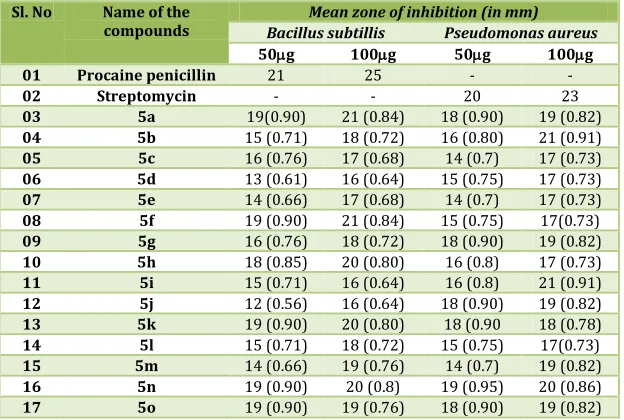
The test compounds 5a, 5f, 5h, 5k, 5n and 5o showed better antibacterial activity against Bacillus substillis (gram +ve) at lower and higher concentration .compounds, 5a, 5g, 5n, 5o and 5j promiting antibacterial activity againsty Pseudomonas aureus (gram –ve) at higher and lower concentration. Compounds 5c, 5e, 5f, 5l and 5o showed promising antibacterial activity against Strphylococus aureus (gram +ve). Compounds 5a, 5b, 5e, 5f, 5l and 5o showed better antibacterial activity against E. coli (gram –ve). The above screened compounds were tested for antifungal activity against Candida albicans and Aspergillus
comparatively better antifungal activity against Aspergellus niger at both
concentration compare to standard griseofulvin. Compounds 5a, 5f, 5h, 5n and 5o showed better antifungal activity against candida albicans compared to griseofulvin.
Table No. 1: Physical data of Compounds 4a-4i
Compound Molecular Formula R R1 Molecular Weight (gms) M.P (0C) %Yield Rf value
4a C16H12N2O2 H H 264.09 137-139 69 0.73
4b C16H14N2O2 Cl H 298 181-183 72 0.82
4c C17H14N2O2 H CH3 278 193-195 68 0.63
4d C17H13N2O2Cl Cl H 312 153-155 75 0.59
4e C17H14N2O2 CH3 H 278 186-188 82 0.73
4f C18H16N2O2 CH3 CH3 292 187-189 80 0.72
4g C16H11N3O4 4-NO2 H 309 225-227 76 0.57
4h C17H13N3O4 3-NO2 CH3 323 183-185 74 0.63
4i C16H11N2O2Cl H Cl 298 167-169 69 0.57
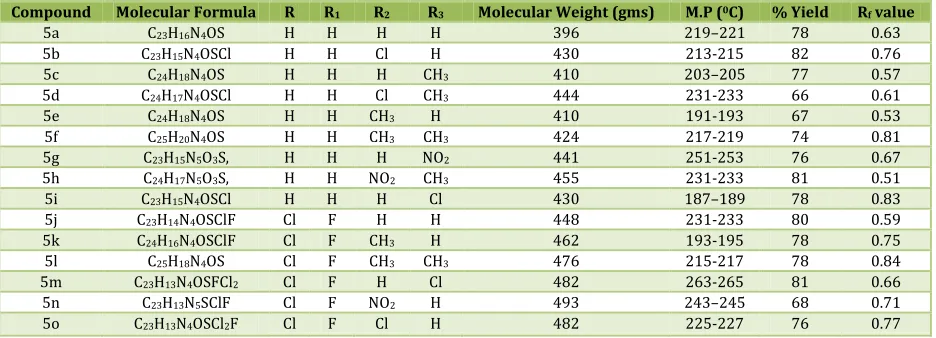
Table No. 2: Physical data of (5a-5o)
Compound Molecular Formula R R1 R2 R3 Molecular Weight (gms) M.P (0C) % Yield Rf value
5a C23H16N4OS H H H H 396 219–221 78 0.63
5b C23H15N4OSCl H H Cl H 430 213-215 82 0.76
5c C24H18N4OS H H H CH3 410 203–205 77 0.57
5d C24H17N4OSCl H H Cl CH3 444 231-233 66 0.61
5e C24H18N4OS H H CH3 H 410 191-193 67 0.53
5f C25H20N4OS H H CH3 CH3 424 217-219 74 0.81
5g C23H15N5O3S, H H H NO2 441 251-253 76 0.67
5h C24H17N5O3S, H H NO2 CH3 455 231-233 81 0.51
5i C23H15N4OSCl H H H Cl 430 187–189 78 0.83
5j C23H14N4OSClF Cl F H H 448 231-233 80 0.59
5k C24H16N4OSClF Cl F CH3 H 462 193-195 78 0.75
5l C25H18N4OS Cl F CH3 CH3 476 215-217 78 0.84
5m C23H13N4OSFCl2 Cl F H Cl 482 263-265 81 0.66
5n C23H13N5SClF Cl F NO2 H 493 243–245 68 0.71
5o C23H13N4OSCl2F Cl F Cl H 482 225-227 76 0.77
Table No. 3: Antibacterial activity
Sl. No Name of the
compounds
Mean zone of inhibition (in mm) Staphylococcus aureus Escherichia coli
50g 100g 50g 100g
01 Procaine penicillin 20 25 - -
02 Streptomycin - - 20 23
03 5a 14 (0.7) 18 (0.72) 19 (0.90) 21(0.91)
04 5b 14 (0.7) 18 (0.72) 19 (0.90) 21 (0.91)
05 5c 19 (0.90) 22 (0.88) 13 (0.65) 16 (0.69)
06 5d 15 (0.75) 18 (0.72) 13 (0.65) 16 (0.69)
07 5e 19 (0.90) 22 (0.88) 19 (090) 21 (0.91)
08 5f 18 (0.86) 21 (0.84) 19 (0.90) 21 (0.91)
09 5g 15 (0.90) 19 (0.76) 12 (0.6) 17 (0.73)
10 5h 14 (0.90) 18 (0.72) 12 (0.6) 17 (0.73)
11 5i 15 (0.75) 18 (0.72) 13 (0.65) 15 (0.65)
12 5j 15 (0.75) 19 (0.76) 13 (0.65) 16 (0.69)
13 5k 14 (0.7) 18 (0.72) 12 (0.6) 15 (0.65)
14 5l 19(0.90) 22(0.88) 19 (0.90) 21 (0.91)
15 5m 14 (0.7) 19 (0.76) 12 (0.6) 15 (0.65)
16 5n 13 (0.65) 16 (0.64) 12 (0.65) 15 (0.65)
17 5o 19 (0.90) 22 (0.88) 19 (0.90) 21 (0.91)
Text compound Activity index = ---
Table No. 4: Antibacterial activity
Sl. No Name of the
compounds Bacillus subtillis Mean zone of inhibition (in mm) Pseudomonas aureus
50g 100g 50g 100g
01 Procaine penicillin 21 25 - -
02 Streptomycin - - 20 23
03 5a 19(0.90) 21 (0.84) 18 (0.90) 19 (0.82)
04 5b 15 (0.71) 18 (0.72) 16 (0.80) 21 (0.91)
05 5c 16 (0.76) 17 (0.68) 14 (0.7) 17 (0.73)
06 5d 13 (0.61) 16 (0.64) 15 (0.75) 17 (0.73)
07 5e 14 (0.66) 17 (0.68) 14 (0.7) 17 (0.73)
08 5f 19 (0.90) 21 (0.84) 15 (0.75) 17(0.73)
09 5g 16 (0.76) 18 (0.72) 18 (0.90) 19 (0.82)
10 5h 18 (0.85) 20 (0.80) 16 (0.8) 17 (0.73)
11 5i 15 (0.71) 16 (0.64) 16 (0.8) 21 (0.91)
12 5j 12 (0.56) 16 (0.64) 18 (0.90) 19 (0.82)
13 5k 19 (0.90) 20 (0.80) 18 (0.90 18 (0.78)
14 5l 15 (0.71) 18 (0.72) 15 (0.75) 17(0.73)
15 5m 14 (0.66) 19 (0.76) 14 (0.7) 19 (0.82)
16 5n 19 (0.90) 20 (0.8) 19 (0.95) 20 (0.86)
17 5o 19 (0.90) 19 (0.76) 18 (0.90) 19 (0.82)
Text compound Activity index = ---
Standard compound
Table No. 5: Antifungal activity
Sl. No Name of the
compounds Candida albicans Mean zone of inhibition (in mm) Aspergillus niger
50g 100g 50g 100g
01 Griseofulvin 21 25 21 25
02 5a 19 (0.90) 22(0.88) 19(0.90) 22 (0.88)
03 5b 13 (0.61) 16 (0.64) 14 (0.66) 18 (0.72)
04 5c 12 (0.56) 16 (0.64) 13 (0.61) 18 (0.72)
05 5d 12 (0.56) 16 (0.64) 12 (0.57) 15 (0.6)
06 5e 13 (0.61) 18 (0.72) 13 (0.61) 18 (0.72)
07 5f 18 (0.85) 23 (0.92) 19(0.90) 23 (0.92)
08 5g 13 (0.61) 16 (0.64) 13 (0.61) 19 (0.76)
09 5h 20(0.95) 22(0.88) 20 (0.95) 23 (0.92)
10 5i 12 (0.56) 16 (0.64) 15 (0.71) 18 (0.72)
11 5j 12 (0.56) 15 (0.6) 14 (0.66) 19 (0.76)
12 5k 20(0.95) 21 (0.84) 20(0.95) 22(0.88)
13 5l 12 (0.56) 16 (0.64) 14 (0.66) 19 (0.76)
14 5m 13 (0.61) 18 (0.74) 14 (0.66) 20 (0.8)
15 5n 20 (0.95) 21 (0.84) 20 (0.95) 22 (0.84)
16 5o 11 (0.51) 14 (0.56) 14 (0.66) 19 (0.76)
Text compound Activity index = ---
Standard compound
CONCLUSION
A
series of novel Benzothiazole derivatives containing Indole moieties has been synthesized in good yield and screened for their antimicrobial activity. Most of the synthesized compounds showed significant antimicrobial activity. Anti bacterial activity of 5a, 5f, 5h, 5k, 5n and5o showed better against Bacillus substillis (gram +ve) at lower and higher concentration when compare with procaine penicillin. compounds, 5a, 5g, 5n, 5o and 5j promiting antibacterial activity againsty Pseudomonas aureus (gram –ve) at higher and lower concentration when compare with streptomycin. Compounds 5c, 5e, 5f, 5l and 5o showed promising antibacterial activity against Strphylococusaureus (gram +ve).when compare with procaine penicillin Compounds
5a, 5b, 5e, 5f, 5l and 5o showed better antibacterial activity against E. coli (gram –ve).when compare with streptomycin. the compounds tested
5a, 5f, 5h, 5k and 5k showed comparatively better antifungal activity against Aspergellus niger at both concentration compare to standard griseofulvin. Compounds 5a, 5f, 5h, 5n and 5o showed better antifungal activity against candida albicans compared to griseofulvin.
REFERENCES:
1. A. Catalano, J.-F. Desaphy, G. Lentini, A. Carocci, A. Di Mola, C. Bruno,R. Carbonara, A. De Palma, R. Budriesi, C. Ghelardini, M.G. Perrone, N.A. Colabufo, D. Conte Camerino, C. Franchini. J Med Chem 2012;55:1418e1422.
2. A. Carocci, A. Catalano, A. Lovece, G. Lentini, A. Duranti, V. Lucini, M. Pannacci, F. Scaglione, C. Franchini. Bioorg Med Chem
2010;18:6496e6511.
4. Gaware Vinayak M, Dhamak Kiran B and Kotade Kiran B. reported by Synthesis and Evalution of Benzothiazole derivatives for Anthelmintic activity. Eur J Pharm Med Res
2016;3(5):454-459.
5. MM. Cavalluzzi, C. Bruno, G. Lentini, A. Lovece, A. Catalano, A. Carocci, C. Franchini. Tetrahedron: Asymmetry 2009;20: 1984e1991.
6. N. Siddiqui, A. Rana, SA. Khan, MA. Bhat, SE. Haque. Synthesis of benzothiazole semicarbazones as novel anticonvulsants-the role of hydrophobic domain. Bioorg Med Chem Lett 2007 ;17:4178-4182.
7. Kaur H, Kumar S, Singh I, Saxena KK. and Kumar A. Synthesis, Characterization and Biological Activity of Various Substituted Benzothiazole Derivatives. Digest J Nanomater & Biostruct
2010;5(1):67-76.
8. Jayachandra E, Nargund LVG, Shivakumar B, Kamal Bhatia. Oriental chem 2003;19(1):139-142.
9. Gopkumar P, Jayachandran E, Nagappa AN, Shivkumar B, Nargund LVG, Gurupadiah BM. Ind J Heterocyclic Chem
2001;11:39-42.
10. Gurupadaiah BM, Jayachandran E, Shivakumar B, Nagappa AN, Nargund LVG. Ind J Heterocyclic Chem 1998;7:213.
How to cite this article:
Rajareddy Aleti, Srinivasa Murthy Muppavarapu. SYNTHESIS AND CHARACTERIZATION OF NOVEL BENZOTHIAZOLE DERIVATIVES CONTAINING INDOLE MOIETIES WITH ANTIMICROBIAL ACTIVITIES. J Sci Res Pharm 2018;7(10):118-123.
DOI:https://doi.org/10.5281/zenodo.1473391
Conflict of interest: The authors have declared that no conflict of interest exists.