GSJ: Volume 7, Issue 10, October 2019, Online: ISSN 2320-9186
www.globalscientificjournal.comAUTOMATED
CONSTRUCTION
MANAGEMENT
SYSTEM
Olowookere Sunday A.
1, Ayangbekun Oluwafemi J.
2, JohnBosco Agbaegbu
3, Omotosho Lawrence O.,
Ogunbukola Kolawole Noah
51, 5
Department of Computer Science, Oyo State College of Agriculture & Technology, Igboora. Oyo State, Nigeria.
2Department of Computer Science, Redeemer’s College of Technology & Management, Mowe. Ogun State, Nigeria.
3
School of Computer Science Mathematics and Information Technology, Houdegbe North American University, Republic of Benin.
4
Department of Information & Communication Technology, Osun State University Osogbo, Nigeria.
E-mail: [email protected]
ABSTRACT
Despite the growing popularity in construction industry, construction management software still remained virtually an un-tapped technology among construction firms as popularly adopted by oil and gas sector. However, construction management software is a project management platform that helps companies in processes like budget management, communication, decision-making, de-sign, and job scheduling with the main goal of making the construction business processes a lot easier through software automation procedures. This research work is primarily aimed to develop a construction management system for construction companies, project managers, civil engineers, public and private organizations and corporate individuals to solve construction challenges between clients and Construction Company. It provides an efficient way for clients and contractors to interact confidently and confidentially without the access of any third party. In this research, an online based approach was employed for accessibilities of the automation to stake-holders using HTML, CSS, JavaScript, PHP and Xamp as developmental tools.
Keywords
Automation, Building, Construction, Project, Software
1.0 INTRODUCTION
Despite its growing popularity among builders big and small, construction management software has remained a virtually un-tapped technology for many construction companies. Construction management software by definition is a project management tool designed specifically for construction professionals. It offers a range of benefits to members of the construction industry, streamlining processes that used to be done manually, which include communication, decision-making and job scheduling, among others. A notable rise in construction management software demand is seen to come from the oil and gas sector. This is owing to the fact that it helps boost transparency in brownfield, onshore, and shale construction projects. In the same manner, the software also helps in maintaining oil and gas plants and deep-water oil and gas developments. This demand is also seen to fuel the construction management software market.
of a project; time, cost and scope. Due to these, there is a need for construction management system to alleviate the problems encoun-tered by these companies in order to get resources that will be sustainable for their construction projects.
1.2 Research Goal
This research is aimed at developing a construction management system for construction companies, construction project manag-ers, civil enginemanag-ers, public and private organizations and corporate individuals. The scope of this project will also provide the follow-ing:
Defines the project objectives and targets of particular relevance to the construction phase Describes the process for identification and control of risks specific to the construction phase
Details the proposed strategy for the construction phase of a project, with particular regard to establishment resourcing, site organization and construction controls.
2.0 LITERATURE REVIEW
According to Knoepfel (1992), construction is a key sector of every society, economy and culture. Most of the management, design, construction and maintenance activities are carried out by small and medium-size private companies. Large construction com-panies are undertaking a considerable share of the market in construction projects. It requires knowledge of modern management as well as an understanding of the design and construction process. Construction projects have a specific set of objectives and constraints such as a required time frame for completion. The construction industry plays a central role in national welfare, including the devel-opment of residential housing, office buildings and industrial plants, and the restoration of the nation's infrastructure and other public facilities.
However, Trading companies that implement construction projects must focus on the basic guidelines of project management such as effective coordination, established project goals, time/cost management factor, risk analysis and human resource management; among others..
2.1 Design and Construction Process
Design is an integrated process cutting across creating the description of a new facility, installation and other forms of con-struction artefact being represented by detailed plans and specifications. Meanwhile, Concon-struction planning is a process of identifying activities and resources required to make the design a physical reality via implementation of design envisioned by architects, civil en-gineers and specialty enen-gineers. Good project management in construction process must pursue the efficient utilization of labour, ma-terial and equipment.
With an automated construction management system, efficient documentation of daily activities involving the use of Diaries, logs, and daily field reports in keeping track of the daily activities on a job site each day is taken into consideration by the systems developer [5]. This is often refers to as the capital project management software, computer construction software, construction man-agement software, project manman-agement information systems. . This lead to a more enhanced software-application field of construction collaboration technology which has been developed to apply information technology to construction management [3].
However, the software developer critically looks into the Risk management aspect of the proposed system. This consists of a series of steps that help a software development team to understood and manage uncertain problems that may arise during the course of software development and can plague a software project.
2.2 Risk Analysis
In the developmental phase, it is beneficial to perform a comprehensive risk assessment [9] of all threats that can realistically occur to the organization now and in the future (Table 1).
Table 1: Risk Consideration
Risk Type Remedies/Plans
Hardware Failure Back up must be taken at each specific interval
Schedule Spillage Reorganize team so that there is proper understanding of project and people therefore understand each other’s job.
3.0 METHODOLOGY
Project management methodology adopted involving planning and scheduling for this research is as follows: Work breakdown structure
Project network of activities
Critical Path method (CPM) Resource Management Resource Leveling Risk Assessment
3.1 Architectural Requirements
Based on the functional requirements, the architectural roles required by the Engineer for this research involves:
Work inspection
Change orders
Review payments
Materials and samples
Shop drawings
3.2 Brief Existing and Proposed System Settings
In the existing system, records such as construction data, employee details, customer details, product details, sales and pur-chase of land and buildings, materials and tools are maintained manually [7]. This involves handling of large record books consisting of both relevant and irrelevant information; thus making it difficult to find out the required information as per necessity. Meanwhile for the proposed settings, this research is designed with a goal to making the existing system more informative, reliable, fast and easier thereby reducing the burden of managing large construction data.
3.3 System Requirements
Dual Core (minimum) multimedia system with higher memory Web server: Wamp/Xamp server.
OS : Windows/Linux
Language : PHP, HTML, CSS, MYSQL(Back-end) Editor : Notepad++ Editor
Browser : All
4.0 USE-CASE DIAGRAM
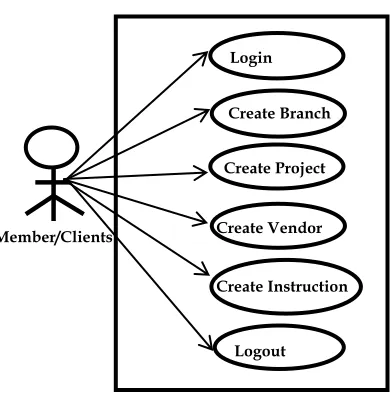
4.1 Member/Client
Fig. 1: Member/Clents Phases
4.2 Administrator
The system administrator managing the autonomous system for the organization however performs the following roles/ activ-ities (Fig. 2)
Fig 2: System Administrator’s roles
Member/Clients
Logout Create Branch
Create Project
Create Vendor
Create Instruction Login
Administrator
Mange Database
Logout Create Member
5.0 SYSTEM FLOW
The system flowchart showing the overall system functionalities / operations (Fig. 3) is depicted below
Fig. 3: Overall System Flow
5.1 Software Design
Software design is a model of a real world system that has many participating entities and relationships. It acts as a basis for de-tailed implementation and as a communication medium between the designers of subsystems by providing information to system maintainers about original intentions of the system designer. The system Database design produces a detailed logical data model for physical storage of parameters needed to generate a design in a data definition language which can be used to create a database.
5.2 Physical design
This was the physical realization of logical design. Tables, forms and reports were created and relationships defined among the-se tables and the-security constrains the-set. During the physical design, expected schemas were translated into actual databathe-se structures for mapping the followings:
i.
Entities to tablesii.
Relationship to foreign key constraintsiii.
Attributes to columns primary unique identifiers to primary key constraintsiv.
Unique identifiers to unique key constraintsv.
SELECT TASK MAIN MENU
LOGIN
ADMIN/CLIENT
VALIDATION
DATABASE
EXIT PRINT REPORT
START
NEXT TASK
6.0 SYSTEM IMPLEMENTATION/DEVELOPMENTAL PHASE
This involved putting together or building various elements of a system. In this stage the actual system was recognized. The technical architecture defined in the design stage was the baseline for developing the system. The interface was designed using HTML, PHP and Java script languages. The database was designed in MYSQL basing on Xamp Server software. MYSQL provides a high level of security to the database, that is, authentication is carried out during the logging in to the database or on DML commands.
6.1 The Homepage
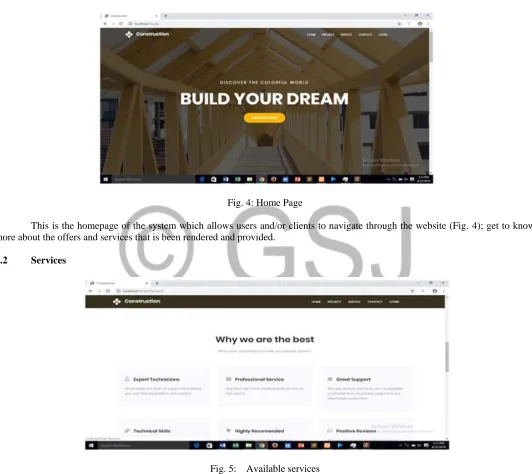
Fig. 4: Home Page
This is the homepage of the system which allows users and/or clients to navigate through the website (Fig. 4); get to know more about the offers and services that is been rendered and provided.
6.2 Services
Fig. 5: Available services
6.3 Contact Page
Fig. 6: Contact services
The contact page (Fig. 6) allows clients to send directly to and for us. It provides a platform whereby users can give feedback or ask questions from the company via email. It makes the system more interactive.
6.4 Login Page
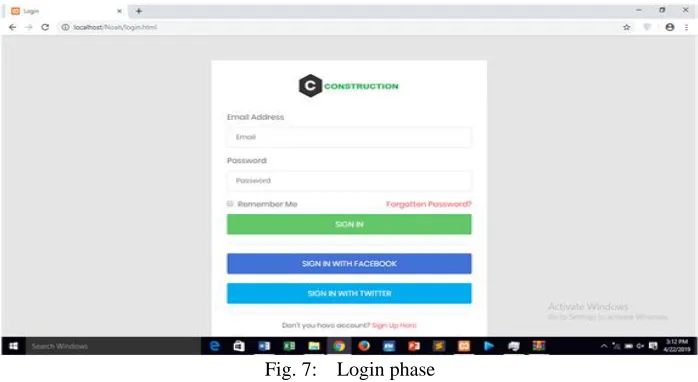
Fig. 7: Login phase
This is the login page that gives clients access to their profile (fig. 7) where they can view existing, ongoing and completed projects that is been carried out by the construction company.
6.5 Admin Dashboard
Fig. 8: System Dashboard
6.6 Progress Report
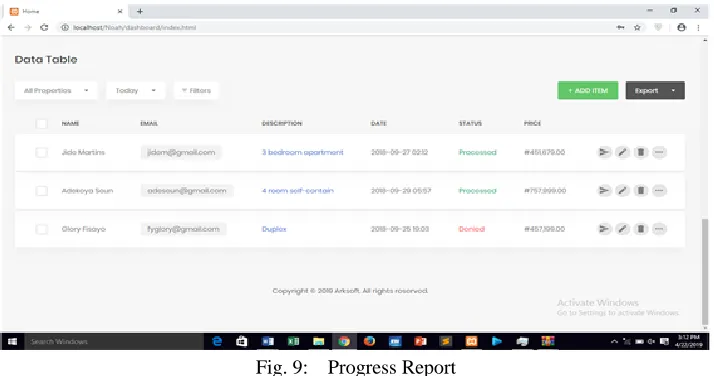
This is the progress chart displaying the progress per % of each ongoing project (Fig. 9).
Fig. 9: Progress Report
This is the data table for each client showing the status of their projects, which also includes the total amount spent and time left for completion of the project
CONCLUSION
REFERENCES
[1] Barbara J. Jackson (2010). Construction Management Jumpstart (2nd ed.). Indianapolis, Indiana: Wiley.3. Gerardo Viera (September 2008). "What Is Construction Project Management? "(http://www.pmhut.com/what-is-construction-project man-agement). PM Hut. Archived (https://web.archive.org/web/20100420205521/http://www.pmhut.com/what-is construction-project-management )from the original on 2010-04-20. Retrieved 2010-07-04.
[2] Iwhiwhu E.B (2005). The future of records management in Nigeria. The Nigerian archivist. Journal of the society of Nigeria archivist 1 (2$3).
[3] Liberatore, M. J., Pollack-Johnson, B., and Smith, C. A. 2001. “Project management in construction: software use and re-search directions.” J. Constr. Eng. Manage., 127pg, 101–107.
[4] Maike, J.P. (2014). Construction management in the construction industry. Available at: http://www.mobil-tum.vt.bgu.tum.de/fileadmin/w00bqi/www/Session_Poster/Puhe.pdfAccessed 16th October 2014
[5] Omenyi A.S.(1997). Effective record management: a tool for effective councelling in the school system. Journal of councel-ling and communication.
[6] Oketunji S.F.(2002). Information provision to academic research and development organization in the 21st century. The in-formation manager 2 (1)
[7] Popoola S.O. (2000). Records management program in Nigeria: a survey of the Osun state civil service.
[8] Shuchi, G. (2008). Explain the Phased Waterfall Model. Available at: http://www.careerride.com/testingphased-waterfall-model.aspx