Original Research Article
Formal education about hygienic aural care and the relationship
between aural hygiene awareness and practices: a cross-sectional study
from a super-speciality hospital in West Bengal, India
Saikat Samaddar
1, Arup Chakraborty
2*, Sangita Bhattacharya Samaddar
3, Arista Lahiri
2,
Saumendra Nath Bandyopadhyay
4INTRODUCTION
The word “hygiene” is derived from Hygeia, the goddess of health in Greek mythology. Hygiene is defined as “the science of health and embraces all factors which contribute to healthful living”.1
Hygienic practices is a key to health. Otolaryngology has expanded beyond
horizon. New generation otolaryngology practice has brought cure to the incurable. But extensive search across standard otolaryngology text book does not yield the definition of aural hygiene. Neither there are any proper guidelines to the practice of hygienic ear care behaviours. This leads to lack of information among the physicians and health care providers at various tiers. Compounding
ABSTRACT
Background: The result of poor ear care and hygiene behaviours are often encountered in otology practice. There is also lack of any proper guideline of hygienic ear care behaviours. The present study aims to assess the awareness and practice of hygienic ear care behaviours of the community, in the light of the guidelines as per WHO Primary Ear and Hearing Care Training Resources-Basic level.
Methods: A cross-sectional descriptive study was conducted at Baruipur Sub-Divisional Hospital serving semi urban population of South 24 Parganas, West Bengal, India. Patients and parents (in case of children below the age of six years) were interviewed. Maintaining the inclusion and exclusion criteria after obtaining informed consent 480 participants were included in the study who responded to a validated self-reported semi structured questionnaire. Results: The mean age was 32.44 (±18.95) years. Around 51.3% were male, 81.25% were professionals. Majority belonged to nuclear family (52.083%) and Islam (53.333%). Around 88.958% of the population had practice of ear care behaviour which was poor. Joint family had an odds of 2.86 (p value=0.002) and Islam by religion had an odds of 1.99 (p value=0.044) for a higher level of awareness. Educated group had an odds of 4.07 (p<0.001) for higher awareness. Aware group had an odds of 19.95 (p<0.001) in favour of having hygienic ear care practices.
Conclusions: The study demonstrated lack of formal education regarding ear hygiene at the community level. Dearth in formal knowledge leading to poor practices is compounded with several socio-cultural issues.
Keywords: Aural hygiene, Aural care, Awareness, Formal education, Practices
1
Department of ENT, Purulia Government Medical College and Hospital, Purulia, West Bengal, India
2
Department of Community Medicine, Medical College and Hospital, Kolkata, West Bengal, India
3
Department of Respiratory Medicine, Purulia Government Medical College and Hospital, Purulia, West Bengal, India
4
Department of ENT, Medical College and Hospital, Kolkata, West Bengal, India
Received: 18 May 2019 Revised: 16 July 2019 Accepted: 17 July 2019
*Correspondence: Dr. Arup Chakraborty,
E-mail: [email protected]
Copyright: © the author(s), publisher and licensee Medip Academy. This is an open-access article distributed under the terms of the Creative Commons Attribution Non-Commercial License, which permits unrestricted non-commercial use, distribution, and reproduction in any medium, provided the original work is properly cited.
ignorance amongst the population residing in third world countries. So, a community which might be deficient of adequate knowledge regarding hygienic care of ear
invites ear related morbidities. World Health
Organisation (WHO) has estimated that 250 million people in the world is living with disabling hearing loss with more than 50% of them staying in developing countries.2 The result of poor ear care behaviours are often encountered in otology practice. To address this problem there is a vehement need to define ear hygiene, implement primary and secondary preventive measures against sources or practices that causes deterioration of ear hygiene. “Primary Ear and Hearing Care Resources” has been developed by the World Health Organisation to deal with this issue.2 The Resource module consists of Basic, Intermediate and Advanced level training booklets. The basic training manual can be used for interactive and culturally appropriate training of the village health workers, teachers, parents and other members of the community. The Basic manual intends to address the urgent need. The present study aims to assess the awareness and practice of hygienic ear care behaviours of the community, in the light of the guidelines as per WHO Primary Ear and Hearing Care Training Resources- Basic level.
METHODS
A cross-sectional descriptive study was conducted at Baruipur Sub-Divisional Hospital serving semi urban population of South 24 Parganas, West Bengal, India, between August 2017 to August 2018. Patients attending general outpatient department of the hospital on Monday of each week (fifth Monday of the month, if any was excluded) were considered. Patients with informed consent fulfilling the inclusion criteria were taken as study population selected through systematic random sampling. Parents were interviewed in case of children below the age of six years. Health care professionals and mentally challenged person were excluded from the study. Number of subjects included in the study was 480. The study population was put through a validated
self-reported semi structured questionnaire to note age, gender, religion, occupation, family type, education (elementary education), formal knowledge regarding
aural hygiene imparted by health care
professionals/teacher, awareness and practice regarding aural hygiene. Socioeconomic status was calculated by Modified B G Prasad Scale 2017, where category I and II were clubbed upper and III, IV, V were clubbed as lower socio-economic status. Do‟s and Dont‟s of ear hygiene as per Primary Ear and Hearing Care Training Resource, Basic Level by WHO was considered for determining the adequacy of practicing hygienic ear care behaviours. Accordingly, they were asked if they used only prescribed medicine for ear, use clean towel to dry the ear, habit of putting anything in the ear, cleaning the ear with hairpin, tooth picks or anything else, letting water get into the ear, leaving cotton wool in the ear unless advised to do so, specify any other practice to take care of the ear. Practice was categorised as „Good‟ if all the basic criterions were followed, inadequate if few were followed and poor if none were followed. Further inadequate and poor practice was clubbed under „not good‟. The data was tabulated and analysed using Microsoft Excel version 2007 and SPSS version 21 respectively.
RESULTS
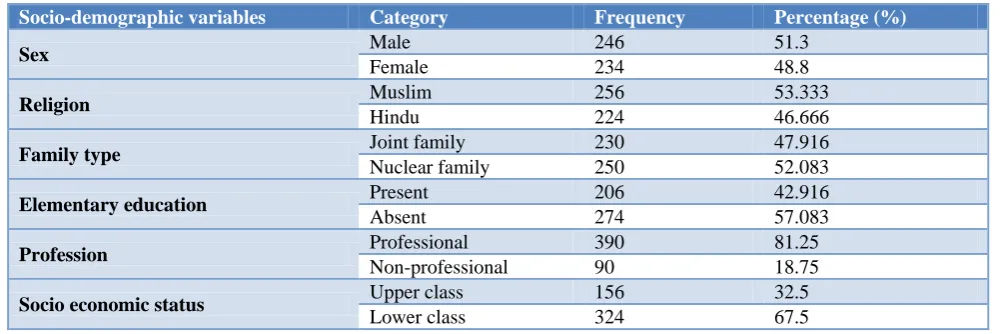
The minimum age of the study population was one year and the maximum of 70 years. Mean age being 32.44 years (SD 18.952 years). Around 51.3% on the study population were male. 81.25% were professionals and rest were non-professional (student, others). The population predominantly belonged to nuclear family (52.083%) and Islam in religion (53.333%).The socio-economic status of the population was analysed in accordance to Modified B. G. Prasad scale 2017. 9.583, 22.916, 48.75, 18.75 percent of the population belonged to categories I, II, III, IV respectively. None belonged to category V. 84.38% of the population denied any exposure to formal education regarding ear hygiene. Table 1 shows the socio demographic profile of the study population.
Table 1: Socio-demographic profile of the study population (n=480).
Socio-demographic variables Category Frequency Percentage (%)
Sex Male 246 51.3
Female 234 48.8
Religion Muslim 256 53.333
Hindu 224 46.666
Family type Joint family 230 47.916
Nuclear family 250 52.083
Elementary education Present 206 42.916
Absent 274 57.083
Profession Professional 390 81.25
Non-professional 90 18.75
Socio economic status Upper class 156 32.5
Table 2: Relationship of aural hygiene awareness and socio-demographic profile of the participants.
Awareness
Present Absent P value Chi sq. Odds ratio
Family type Joint 29 201 0.002 9.35 2.86
Nuclear 12 238
Socio economic status Upper 15 141 0.559 0.34 1.21
Lower 26 298
Religion Hindu 13 211 0.044 4.03 1.99
Muslim 28 228
Elementary education Present 30 176 0 16.749 4.07
Absent 11 263
Profession Professional 41 349 0.002 9.043 0
Non-Professional 0 90
Ear hygiene education Present 41 34 0 235.13 0
Absent 0 405
Awareness about do‟s and don'ts to maintain ear hygiene were present in 8.541% of the study population and absent in the rest. Around 88.958% of the population had practice of ear care behaviour which were poor and thus considered „not good‟.
A relation was drawn with respect to socio demographic profile and the awareness regarding aural hygiene and shown in Table 2. Relation with respect to family type revealed that the awareness level is 2.86 times higher by virtue of staying in joint family than nuclear family. The association is statistically significant (p=0.002). Awareness level is 1.21 times higher among the upper socio-economic class (according to Modified B. G. Prasad scale, 2017) than lower socio-economic class. But the association is not statistically significant (p=0.559). Awareness level is 1.99 times higher among Muslim population than Hindus, which was statistically significant (p=0.044).
Figure 1: Distribution of participants according to formal ear care education and awareness.
It has been seen that people who did not receive any formal education regarding ear hygiene, were not aware about hygienic ear care practices and vice versa. The association was statistically significant (p<0.001) (Figure 1). Awareness level was 4.07 times higher among the
educated group than the un-educated population, which was statistically significant (p<0.001). People who were not professionally occupied (students and others), were not sufficiently aware about aural hygiene and vice versa (p=0.002).
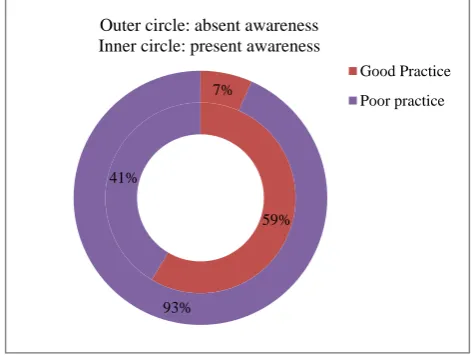
Figure 2: Distribution of participants according to awareness and practice of hygienic ear care
behaviour.
As has been discussed the hygienic ear care practice is categorised as good and not good. The practice category was tested against the awareness level. Good practice was observed in 19.95 times in the aware group rather than non-aware group which was statistically significant (p<0.001) (Figure 2).
DISCUSSION
Socio demographic analysis revealed, participants staying in joint family had higher awareness (2.86 times) level probably due to sharing more information. Awareness level is higher in upper socioeconomic class (1.21 times), but the relation is not statistically significant. This may be
0% 10% 20% 30% 40% 50% 60% 70% 80% 90% 100%
Formal ear care education present
Formal ear care education absent
Awareness absent Awareness present
59% 41%
7%
93%
Outer circle: absent awareness Inner circle: present awareness
due to increased literacy, increased health care seeking attitude in both upper and lower socioeconomic class.
Literacy level was related to awareness level. Awareness was 4.07 times higher in educated population. This may be related to imparting basic knowledge regarding personal hygiene at school level. Paul et al in their study associating personal hygiene with common morbidities among upper primary school children in rural Odisha, concluded that most of the morbidities were higher in children lacking proper personal hygiene. They opined the importance of deploying programmes for developing personal hygiene.3 According to Olaosun, studying educated young adults in Nigeria, self-ear-cleaning is universal. Prevalence was high irrespective of socio-demographic class. Most of the population is therefore at risk. He found that medical advice against self-cleaning is not commonly known.4
Professionals were more aware of the hygienic practice probably due to increased incidence of literacy amongst them and acculturation with wide variety of population at their work place. A cross sectional study conducted by Adoga et al to determine ear care: knowledge, attitude and practice amongst health professionals at the Jos university teaching hospital, showed poor knowledge and attitude towards the practice of ear care. Common object inserted in the ear was ear bud (89.1%) to clean the ear. 9.3% recorded injury while cleaning. 68.8% had no prior knowledge that it was wrong to insert objects in the ear.5 There was significant negative association between self-ear cleaning and knowledge score of the respondents and a strong association between knowledge score and occupation was found in a study conducted by Oladeji et al among health workers at Tertiary Hospital La Connaissance De.6
A large proportion of the study population (84.38%), denied any exposure to formal education regarding ear hygiene. Visiting doctors at the nearest health care facility, attending community health assistants, school health assistants did not impart any advice regarding the same voluntarily. None of the study population admits being showed any booklet demonstrating do‟s and don'ts of hygienic ear care practice. Only 8.541% of the study population received information about it either from school teachers or from ENT consultants while attending the doctor with issues related to the ear. People not receiving formal education about ear care had less awareness level about maintaining ear hygiene.
Hygienic ear care practice was not good in 88.958% of the study population. Paediatric population had a habit of putting feathers, ear buds in ear canal. Repeated itching of the ear canals with finger nails is a common practice. Children accepted that they have seen their elders pricking the ear. Probably this might have influenced their habit. The mothers admit putting in food grade oil, unknown chemicals advised by quack doctors, juice of various leaves, in the ear canal to clean it. They usually
use ear buds, metal objects like safety pins to remove ear wax. Even some of the mothers had least concern about discharging ear of their babies. They considered it as normal variation. Shrikanth et al conducted a study in Southern India, and concluded, disregarding ear ache (26.4%) of paediatric population by care givers led to high prevalence of otitis media. These were treated with home remedies (67.2%), while doctor‟s opinion was sought only in case with ear discharge (50%).7 Study conducted by Mukara et al to corelate knowledge and care seeking practice for ear infections among parents of under five children in Kigali, Rwanda, showed respondents to be 33% less likely to practice medical pluralism if they were familiar with the infection. Urban dwellers were more likely to know ear infection than rural population. Contrary to our study, most of the respondents had good knowledge and positive attitude and practice about ear infection. However medical pluralism was common.8
Adult population practiced bathing in pond water, self-administration of ear drops procured over the counter, along with oil and other unknown chemicals. Self-ear cleaning and getting the ear cleaned by indigenous ear cleaners in villages is common. The practice of aural hygiene when correlated to awareness level showed good practice 19.95 times in aware group than in non-aware group. Similar study conducted by Dosemane et al in Costal Karnataka, India demonstrated that, most of the adults (48.3 to 75%) administered ear drops available at their home during ear pain and discharge. Use of oil was a routine practice to treat itchy ear and to keep the ear clean. 74% of their study population was cleaning the ear on a daily basis. Illiterates (89.3%) used sticks, whereas educated people (100%) preferred using cotton bud to clean the ear.9
In conclusion, it is sufficient to mention that the study demonstrated lack of formal education regarding ear hygiene at the community level. Primary health care workers, nursing assistants and the doctors did not voluntarily impart guidelines for ear care as per WHO Primary Ear and Hearing Care Training Resources- Basic level. Dearth in formal knowledge is compounded with faulty socio-cultural beliefs to clean ear. Poor awareness level leads to poor practice of ear care. Poor practice in turn leads to ear related morbidity. This has direct effect not only on the adult but also on the paediatric population. Higher literacy, upper socio-economic class, acculturation at work place and staying in joint family increases awareness about hygiene. Health education programs targeting improvement in aural hygiene may be considered apt.
ACKNOWLEDGEMENTS
like to acknowledge the help and support extended by the OPD support staffs during the period of data collection.
Funding: No funding sources Conflict of interest: None declared
Ethical approval: The study was approved by the Institutional Ethics Committee
REFERENCES
1. Park K. Concept of Health and Disease, Park‟s Textbook of Preventive and Preventive and Social Medicine, Banarasidas Bhanot, Jabalpur India. 2009;20E:43.
2. Harvest S, Smith A, Hasselt PV. Primary Ear and Hearing Care: Training Resource (Basic Level). Geneva, World Health Organisation; 2006.
3. Paul K, Panigrahi S, Reddy A, Sahu T, Association of personal hygiene with common morbidities among upper primary school children in rural Odisha. J Family Med Prim Care. 2017;6(3):509-12. 4. Olaosun AO. Self ear cleaning among educated young adults in Nigeria. J Family Med Prim Care. 2014;3:17-21.
5. Adoga A, Nimkur L. Ear care: Knowledge, attitude
and practice amongst health professionals at the Jos University teaching hospital. East African J Public Health. 2013;10:274-81.
6. Oladeji SM, Babatunde OT, Babatunde LB, Sogebi
OA. Knowledge of cerumen and effect of ear self-cleaning among health workers in a Tertiary Hospital La Connaissance De. J The West Afr college Surgeons. 2015;5(2):117-33.
7. Srikanth S, Rita I, Rebekah G, Rupa V, Knowledge, attitude and practices with respect to risk factors for otitis media in a rural South Indian community. Int J Paed Otorhinolaryngol. 2009;73:1394–98.
8. Mukara K, Waiswa P, Lilford R, Tucci D,
Knowledge and care seeking practice for ear infections among parents of under five children in Kigali, Rawanda: a cross sectional study, BMC Ear Nose Throat Disorders. 2017;17(7):1-9.
9. Dosemane D, Ganapathi K, Kanthila J. Knowledge,
Attitude and Practice of Ear Care in Coastal Karnataka. J Clin Diagn Res. 2015;9(12):1-4.
Cite this article as: Samaddar S, Chakraborty A,
Samaddar SB, Lahiri A, Bandyopadhyay SN.Formal