Driver Drowsiness Detection using change in
Eye Blink Rate
Arti1, Hitesh2, Neha Sahu3*
1Scholar, M. Tech., CDAC, Noida, India
E-mail: [email protected]
2Assistant Professor, CSE/IT, The North Cap University, Gurugram, India
E-mail: [email protected]
3Assistant Professor, CSE/IT, The North Cap University, Gurugram, India
*Corresponding Author E-mail: [email protected]
Abstract: A novel approach of Driver drowsiness detection using Skin color and Circular Hough Transform is proposed in this paper, so that the rate of road accidents due to drowsiness could be reduced. Driver drowsiness has become a serious problem for us so as 10,000 crashes are occurring annually according to NHTSA. These numbers give importance for finding the solution of this problem. This paper proposed approach user can take his/her own run time video as input or also can give already stored video as input for testing or detection purpose. The main aim of this paper is to provide a better and faster result for driver’s drowsiness condition.
Keywords: Face Detection, Eye Detection, Circular Hough Transform, Blink Detection
I. INTRODUCTION
Drowsiness is ablated level of consciousness characterized by somnolence and issue in remaining alert however straightforward arousal by stimuli. It’s going to be caused by a scarcity of sleep, medications, misuse, or a cerebral disorder [10]. Driver drowsiness detection could be a safety technology that prevents accidents once the driving force is obtaining drowsy. Current systems learn driver patterns and might notice once a driver is turning into drowsy. Driver fatigue could play a vital role in increasing of auto accidents [1]. Annually an average of 1,544 fatalities are occurring.
Causing sleeping during driving is a hidden killer for drivers particularly whereas driving on expressway. a tremendous reality obtained from an outsized range of traffic accidents is that concerning two hundredth of traffic accidents square measure because of drivers’ drowsy driving [11]. Additionally, sleeping during driving is the reason for 22%-30% of critical traffic accidents leading to death, ranking it because the high of the cause list [2]. These factors make this problem very critical and its solution should also be a real-time system.
Characteristics of fall-asleep crashes area unit listed in below [3].
• Usually occur late at night (Morning time: 7:00) or in midafternoon(2-4pm)
• Usually occur when a single vehicle running off the road.
• Usually occur on high-speed expressway.
• Driver is driving alone.
• Driver is driving alone.
• Driver is usually a young male driver (age lies in between 16-25 years)
• No indication of braking.
A. Major Factors related to driver drowsiness are: • Sleep deprivation, acute and chronic
• Alcohol/sedating medications
• Age: Childish behavior
• Sex: Male driver
• Occupation: commercial truck drivers, night-shift workers, and medical house workers
• Diseases: OSA and different sleep disorders [12]
The continuing construction of roads and improvement of auto performance have created it doable for driver drives in a fancy way. [3]. Nowadays, it's doable to observe the driving force fatigue state with the event of the machine vision technology. Particularly face recognition technology square measure leads quickly; individuals will use machine vision to observe the standing of driver [9].
Fatigue in driver is detected early by observing eyes of driver and that helps in reducing accident. By collecting sequence of pictures of face and also by observing eyes of eye movements and blink patterns. Below given Table1 [3] provides completely different doable techniques for somnolence identification. Numbers 1,2,3,4 art used here for poor, average, good, very good. One might mix many of the techniques for its identification purpose; however, this method is mistreatment solely reflex detection here for the identification purpose.
This system had faced two types of faults. The first one is computer cannot acknowledge the decreasing level of driver’s alertness, the opposite one is it is also troublesome to awake up the motive force once driver is falling asleep. But to avoid these issued we have used a high speed configured system and an audio alarm, which will ring for 5 times continuously so as to awake the driver.
II. TECHNIQUESUSEDFORDETECTINGDROWSINESSINDRIVERS.
During the study of “Driver drowsiness detection”, we went through various research papers and web contents that are relevant to identify drowsiness condition of the driver. These techniques help us in understanding different ways, which we can use to find the driver’s drowsiness situation, and then raising an alarm so as to alert him/her.
The problem of driver drowsiness can be divided into following three parts:
• Face detection
• Eye state detection
For these parts we have different possible techniques available. In this we will study few of these possible techniques with their advantages and disadvantages.
Table1. Different detection techniques
Detection Techniques
Description Detection
Accuracy
Practicality Extendibility
Sensing of
human psychological phenomenon
Sensing of
human physiological phenomenon
Sensing of
driving operations
Sensing of
vehicle’s operations Travelling Conditions Driver’s response Physiological signals and physical reactions Physical reactions Driving Operations Vehicle’s operations Day/Night Time
Response of drivers
Changes detected in brain waves, heart rate up
and down,
pulse rate
Changes in
position of driver’s head, different frequency at
which eye
closed etc.
Changes in
operations eg. Braking frequency,
changes in
speed etc.
Changes in
vehicle detected during
driving of
vehicle.
Changes in
travelling
time and
conditions.
Changes found during periodic request for response. 4 4 3 3 2 1 2 4 1 1 4 4
A. Techniques for face detection:
Broadly face detection techniques can be divided into following for classes. These are:
• Feature invariant ways target is to seek out structural options that exist even once the perspective or lighting conditions vary and then used them to find faces.
• In a Template-based ways to notice a face in an exceedingly new image, 1st the top defines, that is fairly systematically roughly elliptical, is detected exploitation filters, edge detectors, or silhouettes.
• Appearance-based ways believe a predefined model, this ways define giant numbers of facial expression and features examples and representational process totally different variations of faces form etc.
Face detection may be well-achieved exploitation any of the subsequent techniques, voila jones techniques, color detection etc.
• Techniques for eye detection:
For eye detection we can use technique to extract eye features like eye pupil center, iris radius, eye corner localization etc. We can also use Ada boost with weak classifiers technique for eye feature extraction [4]. Another technique for eye could be Face geometry, as we always know that eyes will always be found in the upper half part of the correct detected face.
• Techniques for eye state detection:
Eye state detection techniques could be used to identify whether the eyes of the driver is open or closed. Based on that of the pattern generated by eye state detection we can judge whether the driver is drowsy or not. This could be done using optical flow technique [5], using psychological signals and different physical changes like driver’s head movement, inclination of driver head on the steering[3], victimization vertical projection histogram[6], victimization eye horizontal symmetry, finding intensity change[8] etc.
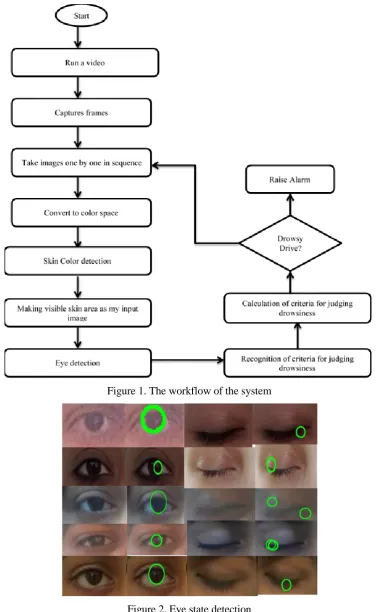
The workflow of this system starts with running a video. This video could be taken using following two ways:
• Static video (already stored in system)
• Dynamic video (taken by user himself using webcam installed in the system)
This system provides the capability to make your own video as specification provided in the GUI. This system also has capability of setting different formats of your video, which could differ, from user’s to user’s choice. Large format videos have high frame rate as compared to small format videos. This video could be anywhere (preferably in matlab’s directory) in the system.
Also, we have a button, which can store the frames of whole video as per our chosen location. This could help us to view the backend on which the whole calculation is going on.
After we select video file on which we want to find out drowsiness factor the system start working.
Figure 1. The workflow of the system
Figure 2. Eye state detection
Table 2. Factors used to find out open or closed eyes.
Sr. No Image types No of circles
detected
Radius
1.
2.
Closed images Open images
1 or more than 1 1
10<=radius<20
radius>=20
III. JUDGEMENTOFDROWSINESS
As we all know that factors used for drowsiness detection should be accurate enough so as to detect drowsiness correctly. There could be a number approaches possible. “0” and “1” are used to show that eye is open or closed resp. Under normal conditions, the person's eye wink in every 5-6 second. Hence on an average a person blinks for 10-12 times in a minute. Also in general an eye blink rest only for less than 400 milliseconds. In a second there are 1000 milliseconds which mean less than half of a second. Hence for example if the framerate at a time is 20 frames/sec then only for 7-8 frames the eye blink will rest for. The process that changes to “1” from “0” means that driver’s eyes gape once. therefore the times of driver’s gape are often counted by the days of modification to “1” from “0”. As there are some limitations in this system hence one change from 1 to 0 could not be decided as an eye blink. Hence we have set a limit of minimum 2 consecutive 1’s before a 0 comes. This will result in one eye blink. So for the complete video of such groups are less than 5 then we can say that the driver is getting drowsy and we will raise an alarm which will go for 5 times consecutively at medium pitch so as to awake the driver and one message box will arrive. Otherwise the driver will not get drowsy and one message box will be displayed with same message on it.
Figure 3. Message Box
IV. CONCLUSION
Various methods of Driver Drowsiness Detection have been studied and different approaches have been written in the paper but the method chosen is more efficient and robust for Driver Drowsiness Detection with higher accuracy. The projected approach looks to be terribly promising in detective work the attention blinks of a driver. As we've got detected an eye fixed blink properly then live like blinking rate is definitely obtained. In future work, we are able to proceed towards the development of a quicker and strong approach for this application to cut back the number of your time needed for blink detection and proper blinking detection even once the motive force isn't wanting straight. There square measure variety of problems that might be taken into thought within the somnolence detection system. These embody improvement of its ability to changes in close brightness, assurance of reliability and attainment of an additional compact system style.
Conflict of interest: The authors declare that they have no conflict of interest.
Ethical statement: The authors declare that they have followed ethical responsibilities.
REFERENCES
[2] Zafer savas (2005). Real-time detection and tracking of human eyes in video sequences. thesis submitted to the graduate school of natural and applied sciences of middle east technical university, 2005
[3] Hiroshi Ueno, Masayuki Kaneda, Masataka Tsukino (1994). Development of Drowsiness Detection system. IEEE Vehicle Navigation & Information Systems Conference proceedings, 1994
[4] Peng Wang, Matthew B. Green, Qiang Ji James Wayman (2005) Automatic Eye Detection and Its Validation IEEE workshop on Computer vision and pattern recognition, 2005.
[5] T. N. Bhaskar, Foo Tun Keat & Surendra Ranganath and Y. V. Venkatesh (2003). Blink Detection and Eye Tracking for Eye Localization. conference on convergent technologies for Asia-Pacific region, 2003, pp 821-824
[6] Andrea Cristiani, Marco Porta, Davide Gandini, Gian Mario Bertolotti and Nikola Serbedzija (2010). Driver drowsiness identification by means of passive techniques for eye detection and tracking. Fourth IEEE International Conference on Self-Adaptive and Self-Organizing Systems Workshop, 2010
[7] Taner Danisman, Ian Marius Bilasco, Chabane Djeraba, Nacim Ihaddadene (2010). Drowsy Driver Detection System Using Eye Blink Patterns. International Journal Conference on Machine and Web intelligence (ICMWI), 2010 , pp 230-233
[8] Neeta Parmar, Drowsy Driver Detection System Design, project at Department of Electrical and Computer Engineering, Ryerson University, 2002.
[9] Yang Ying , Sheng Jing and Zhou Wei. The Monitoring Method of Driver’s Fatigue Based on Neural Network. International Conference on Mechatronics and Automation, 2007.
[10] Available at: http://medical-dictionary.thefreedictionary.com/drowsiness
[11] Available at: https://www.altera.com/content/dam/altera-www/global/en_US/pdfs/literature/dc/_2_4-2005_china_2nd_southchinau-web.pdf