Application of Multi Objective Optimization in Prioritizing
and Machine Scheduling: a Mobile Scheduler Toolkit
Sunita Bansal Manuj Darbari
Research Scholar, JJTU BBD University
,
Jhunjhunu, Rajasthan Lucknow
ABSTRACT
This paper presents a new multi objective algorithm to determine optimal configurations of multi-state, multi-task production systems based on availability analysis. A multi-task production system is one in which different subsets of machines can be used to perform distinct functions or tasks. The performance of a manufacturing system is greatly influenced by its configuration. Availability can be used in the context of multi-task production systems to select a particular configuration that maximizes the probability of meeting a required demand for each specific task, or the expected productivity for each task. A particular configuration may not simultaneously maximize the probability of meeting demand for each of the individual tasks, and thus, the problem is treated as a multi-objective optimization problem. The solution to this problem is a set of promising solutions that provides a trade-off among the different objective functions considered.
Keywords
Multi-state, multi-task, manufacturing systems, performance, availability, feasibility, optimization, priority scheduling
1.
INTRODUCTION
The multi objective optimization problem is, without loss of generality, there is no single solution and it should be best when measured on all objectives/ solution. It simultaneously minimize components ƒk, k = 1, . . . , n, of a possibly non-linear vector function f of a general decision variable x in a universe U, where
f(x) = (f1(x), . . . , fn(x))
If there exists no, perfect, feasible, unique solution but a set of non dominated alternate solution called Pareto Optimal Set. A general formulation of a multi-objective optimization problem consists of a number of objectives with a number of inequality and equality constraints. Mathematically, the problem can be written as
f(x) = (f1(x),….,fn (x))
The problem usually has no unique, perfect (or Utopian) solution, but a set of non-dominated, alternative solutions, known as the Pareto-optimal set. Assuming a minimization problem, dominance is defined as follows: Pareto dominance - a vector u = (u1, un) is said to dominate v= (v1,……vn) if and only if u is partially less than v (u p < v), i.e.
!i: {1, ….,n}, u< v #i : {1,……,n} : u v
Pareto Optimality - A solution Xu : u is said to be Pareto optimal if and only if there is no xv : u for which v = f(xv) = (v1,……,vn) dominates u = f(xu) = (u1,……,un)
Hence no single best solution exists, but a set of compromise solutions. The complete set of compromise solutions is referred as the no dominated or Pareto-optimal set of solutions.
They represent the best solutions to the problem and are characterized by the definition that no other solution exists that is superior in all objectives.
2. PROPOSED MODEL
This expert system uses multi-objective optimization algorithms to determine multi-state, multi-task production systems based on availability analysis. The performance of a manufacturing system is greatly influenced by its configuration. Availability can be used in the context of multi-task production systems to select a particular configuration that maximizes the probability of meeting a required demand for each specific task, or the expected productivity for each task.
3. AIM OF THE WORK
A product manufacturing company manufactures a product using multi-production units and sub-production units. In order to make a newer version of the existing product company has to undergo various changes to adapt to the new features that might include improvisation of the existing production units or advanced technologies. The problem that arises is the newer version may
not be feasible but since the manufacturing units for various components are working it is wasting the time, energy and the resources of the company. While at the same time this could be avoided by
introducing an expert system that will calculate if the newer version of the product is feasible or not and if it is then optimizing the prior scheduling of the manufacturing units to achieve the best.
The solution to this problem is a set of promising solutions that provides a trade-off among the different objective functions considered.
The accuracy provided by this expert system that does all the thinking for human based on pure calculations and zero assumptions makes it worthwhile software for any company to consider.
Hence, for future perspective it is a promising solution to the adverse conditions faced by various manufacturing companies.
4. WE HAVE DEVELOPED A TOOL
NOKIA SCHEDULER EXPRESS
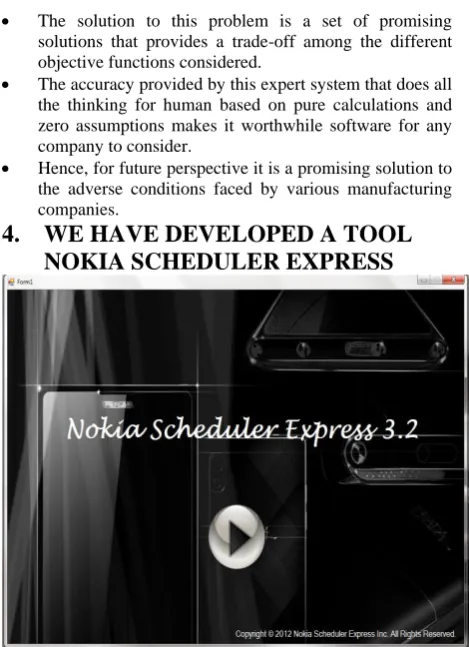
Fig 1: Start-up page of the Nokia Scheduler Express 3.2.
Fig 2: Enter the unique name of the product and press the
forward button
.
Figure 2 shows the name of the product to be designed. Next step is to select the budget and the quantity to be produced shown in figure 3. Finally select the default and secondary feature of the product which is shown by figure 5 and 6. The last step confirms the choice being made. The tool automatically generates the selected product part with their name and their associated priority and weight (figure 7)
Fig 3: Select the amount of the budget and the number of
products to be produced.
Fig 4: Select the parts required and press save button.
Fig 5: After pressing the save button pop up box will appear displaying the message “project is feasible” or
Fig 6: Confirmation Box
Fig 7: all choices, their weight and priority are displayed in the form of table.
Fig 8: Evaluated result will be displayed in the form of pie chart. Each section denotes the weight-age given to each
Using the concept of Multi objective Optimization, we have Minimized f1(x) = Cost function and Machine Sequencing Maximize f2(x) = Profit
Subject to: Parts > 12, (As 12 is the Basic number of points required)
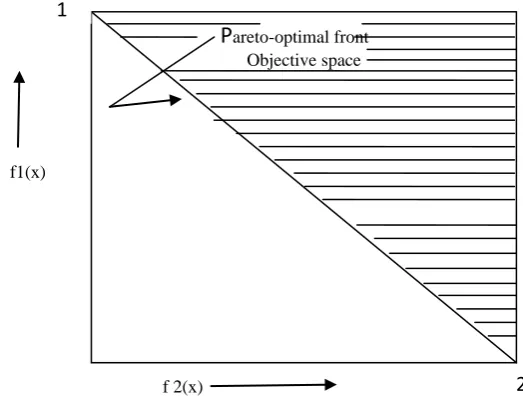
Fig 9: It shows the objective space i.e. production feasibility w.r.t the product to be manufactured.
The weight and the priority are the two variables on which we have applied the genetic operator removing the redundancy. Redundancy exists when there are several different representations for the same individual. Interpolation with the data we get a smooth representation of the Pareto set. The method of parallel coordinates which consists of associating an integer index „ ‟ to each objective, in this case the objective is to feasibility and machine scheduling based on the previous set of readings the competition is being developed to change the order of the job done at the shop floor. Figure 10 shows the visualization which is concerned with ordering of the objectives automatically on the basis of some measure of competition. Based on the several runs it produces number of approximate non-dominated solutions. The quality of trade – off description by each sum depends on two factors i.e. choosing of real trade-off surface and non-dominated points they cover it. The general framework of evolutionary optimizer is defined as:
f
2(x)
f
1(x)
2
f1(x)P
areto-optimal front Objective space1
(Objective of Minimizing Cost + Maximizing Productivity)
10: Multi Objective Analyzer
Artificial neural network produces new objective sets based on the production requirements. Evolutionary algorithms reciprocate to change in the objective values.
Consider optimization of Plant as the vector function „f‟ with some decision variable „x‟.
Let n = [ n, ….. np ] be the variables of newer version. O = [o, …… op ] be the variables of older version. Next step is to follow the principle of Preferability Vector “new version” is preferable to “Older version” given a new solution set “s” where
s = [s1…………sp] (n é 0) iff s
w o Where =1 y ((new version) < (old version) ) o
n o n n n n n n
{( n = o) & [(n o) o (n < o ) ] }
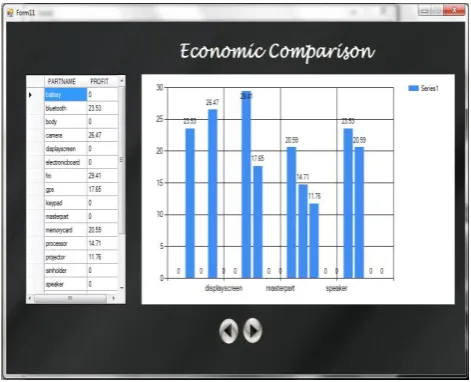
Where the symbol “ “ and “ “ indicates the economic comparison shown in figure 11 has new version and old version comparison in terms of their components to be used for manufacturing mobile handset with the highest priority. In case both new and old version meets all the goal with this
priority, then the next priority level (-1) is considered. This iteration is carried out till priority 1 is reached, there result is decided by comparing the priority 1 components of two vectors i.e. new and old version using Pareto principle.
Fig 11: shows the economic comparison of the older version with a newer version, displaying the estimated
profit or loss accordingly.
Fig 12: Final result displaying the correct sequence (priority) of the machines to combine the following
products
5. CONCLUSION
This software will enable any manufacturing / production company to check for the feasibility and machine scheduling priority before adding any new characteristics to older versions of the product or deciding on the new product. Once the user has entered all the details he will be provided with the Feasibility status as well as the Priority for Machine scheduling. It also provides the economic comparison with the previous product launched in market so that one can determine the profit on that product.
required specimen. It solves the problem of optimization which was occurring in previous models.
It also keeps the budget and estimated production cost in mind and calculates the result i.e. order of the machines in the priority manner without causing them the damage.
The solution to this problem is a set of promising solutions that provides a trade-off among the different objective functions considered.
The accuracy provided by this expert system that does all the thinking for human based on pure calculations and zero assumptions makes it worthwhile software for any company to consider.
It is also advantageous as –on the basis of older versions of the product, it can calculate the profit or loss that a company may endure because of the added characteristics to its new product.
It also shows the economic comparison charts between the older and newer versions and how by manufacturing a newer product will profitable.
Hence, one of its kinds, our software will be of greater demand with all the advantages it shows that claims to save their, time, money, resources and experimentation of all the manufacturing/ production companies.
6. REFERENCES
[1] Altenberg, L. 1994. The evolution of evolvability in genetic programming. In Kinnear, Jr., E., editor, Advances in Genetic Programming, complex Adaptive Systems, chapter 3, pages 47-74. MIT Press, Cambridge, Massachusetts.
[2] Bently, P.J. and Wakefield, J.P. 1997. Finding acceptable solutions in the Pareto optimal range using multi objective genetic algorithms. In P.K. Chawdhry, R. Roy and R.K. Pant (Eds), Soft Computing in Engineering Design and Manufacturing, Part 5, pp. 231-240. London, UK: Springer-Verlag
[3] Ben-Tal, A. 1980. Characterization of Pareto and lexicographic optimal solutions Booker, L. 1987. Improving search in genetic algorithms. In Davis, L., editor, Genetic Algorithms and Simulated Annealing, Research Notes in Artificial Intelligence, chapter 5, pages 61-73. Pitman, London.
[4] Box., M.J. 1965. A new method of constrained optimization and a comparison with other methods. Computer Journal 8(1), 42-52
[5] Coelio, C.A. C 1999. A comprehensive survey of evolutionary-based multiobjective optimization
techniques. Knowledge and Information Systems 1(3), 269-308
[6] Coello, C.A.C and Christiansen, A.D 1999 MOSES: A multi objective optimization tool for engineering design. Engineering Optimization 31(3), 337-368
[7] Deb, K Multi-objective evolutionary algorithms: 2001 Introducing bias among Pareto optimal solutions. In A. Ghosh and S. Tsutsui (Eds) theory and Application of Evolutionary Computation Recent trends London: Springer Verlag
[8] Deb, K. and Goel, T. 2001. A hybrid multi-objective evolutionary approach to engineering shape design. In Proceedings of the First International Conference on Evolutionary Multi – Criterion Optimization (EMO-2001), pp. 385-399
[9] Fandel, G. and Gal, T., editors 1980. Multiple Criteria Decision Making Theory and Application, volume 177 of Lecture Notes in Economics and Mathematical Systems. Springer-Verlag, Berlin. Gembicki, F. W. (1974). Vector Optimization for Control with Performance and Parameter Sensitivity Indices. PhD thesis, Case Western Reserve University, Cleveland, Ohio, USA.
[10] Horn. J. 1997. Multi criterion decision making. In T. Back, D. Fogen and Z. Michalewicz (Eds), Handbook of Evolutionary computation, pp. F1. 9: 1-15. Bristol: Institute of Physics Publishing and New York Oxford
University Press.
[11] Louis, S. J. and Rawlins, G. J. E. 1993. Pareto optimality, GA-easiness and deception. In (Forrest, 1993), pages 118-123.
[12] Parmee, I.C. Cevkovic, D. Watson, A. W. and Bonham, C.R. 2000. Multiobjective satisfaction within an interactive evolutionary design environment. Evolutionary Computation Journal 8(2), 197-222
[13] Rajeshwar S. Kadadevaramath, K. M. Mohanasudaram 2007, “Multi-Objective Trade-off Analysis: State of art: Methods, Applications, and future Research Directions in Production and Operations Management”