Original Research Article
Sexual behaviour among rural women in Ondo state, Nigeria:
do cultural and gender norms matter?
Chukwuechefulam K. Imo*, Oyewole O. Olusanya, Ifeoluwa E. Oluwatuase
INTRODUCTION
Risky sexual behaviours are those which increase the chances of contracting sexually transmitted infections (STIs) and experiencing unintended pregnancies.1-3 In Nigeria, study has confirmed that such behaviours are associated with young people like early debut in sexual activities, sex with many partners, low and inconsistent use of condoms and indulgence in unsafe sexual practices.4 These are influenced by individual level factors and the key among these is the reason for engaging in risky sexual activities in marriage.5 Young
and postpartum women who were not through with their childbearing described worries about fear of contraceptive side effects which is burdened with misinformation and misperceptions.6-10
In Nigeria, unintended intercourse is the primary cause of unwanted pregnancies and many women decide to end them by abortion.11 The unequal power over sex displayed by men’s unwillingness to practice safe sex and demands in that regard by women is often portrayed as a sign of mistrust or infidelity.12,13 The prevalence of modern contraceptives use is stagnating at 10% among
ABSTRACT
Background: The issues of sexual behaviour that increase risk of a negative outcome among women have been
debated. This paper explored the influence of cultural and gender norms on sexual behaviour among rural childbearing married women in Akoko, Ondo State, Nigeria.
Methods: The study utilized exploratory study design and purposively recruited 394 and 30 childbearing married women for quantitative and qualitative studies, respectively through which data were generated. The analyses were carried out with Stata software (version 13.0) for quantitative data using descriptive and chi-square statistics, while thematic content analysis was used for qualitative data.
Results: About two-third of the respondents did not use contraceptive methods, which was a significant predictor of
unplanned pregnancies among the women at p<0.05. Alluding to cultural preference of children and male roles in sexual behaviours, the qualitative data revealed that desire for large family sizes by partners, cultural norms, men’s superiority on sexual matters and partners’ disapproval of contraceptive usage predict women’s inability to negotiate sex with partners.
Conclusions: Therefore, risk reduction strategies aimed at enlightening childbearing married women on their
imperative positions in sexual relationships within marriages should be initiated to facilitate the achievement of sustainable development goals should be intensified.
Keywords: Sexual behaviour, Women, Cultural and gender norms, Sustainable development
Department of Sociology, Adekunle Ajasin University, Akungba-Akoko, Ondo State, Nigeria
Received: 03 October 2018
Revised: 01 November 2018
Accepted: 03 November 2018
*Correspondence:
Dr. Chukwuechefulam K. Imo, E-mail: [email protected]
Copyright: © the author(s), publisher and licensee Medip Academy. This is an open-access article distributed under
the terms of the Creative Commons Attribution Non-Commercial License, which permits unrestricted non-commercial use, distribution, and reproduction in any medium, provided the original work is properly cited.
currently married women and 20.4% for Ondo State which is the second lowest compared with other South-western states in Nigeria.14
Although, studies have shown that cultural practices influence sexual behaviour and these include culture that impedes equality between men and women on sexual decisions; and adherence to traditional gender roles related to sexual activity is stronger among females than males.15,16 Also, fear of being neglected by one’s husband and losing husband to other women accounted for the compromise of women’s positions in issues of reproduction.17 The adverse effect of this on mothers’ health can influence the health of children. Consequently, because men’s power is rooted in cultural norms and values that place married women subordinate to men, efforts to avoid risky sex by women might be construed by men as infringement on their conjugal rights.18
Education empowers women by increasing opportunities for employment and incomes that enable them to adopt behaviours that enhance gender equality in sexual matters.19 Economic independence of women increases the power they have in marital and sexual decisions, which could protect them from engaging in sexual behaviours might expose them to unwanted pregnancies and STIs.20 However, the paucity of knowledge on cultural and gender norms influencing sexual behaviour among childbearing women in the study area is critical in preventing high rate of unintended pregnancy and population boom in Nigeria, where fertility issue continues to be a daunting and great concern. Thus, this study contributes to knowledge by exploring cultural and gender norms influencing sexual behaviour among childbearing married women in Akoko communities of Ondo State, Nigeria to fill this gap.
METHODS
The study utilized exploratory study design involving social survey with a purposive sample size of 400 married women of childbearing age 15–49 years, who had given birth to at least one child in the last five years preceding the study. A multi-stage sampling technique was adopted in purposively selecting the respondents from Akungba and Oka communities of Akoko South West Local Government Area, Ondo State, Nigeria. Akoko is large Yoruba cultural sub-group in the Northeastern part of Yorubaland. Its headquarters are in the town of Oka, with an area of 226 km2 and estimated population of 229,486 at the 2006 census.21 The procedures adopted in the selection of the respondents included a simple random sampling technique of two rural areas which are Akungba and Oka communities. A total of 394 women who completed the questionnaire were included in the analysis. The in-depth interview included 30 women (currently married and had given birth to at least one child in the last three years) who were purposively selected based on their willingness to share
information on the subject matter. The study was carried out between the period of June 2017 and January 2018.
Data analysis
Statistical Data (Stata) version 13.0 was used for quantitative data analysis at univariate and bivariate levels. As regards the qualitative data, thematic manual content analysis was used by sorting and codifying the major themes as well as the use of verbatim quotation. Interviews were transcribed and translated into English and the reason was to understand holistically the generated results from quantitative assessment.
RESULTS
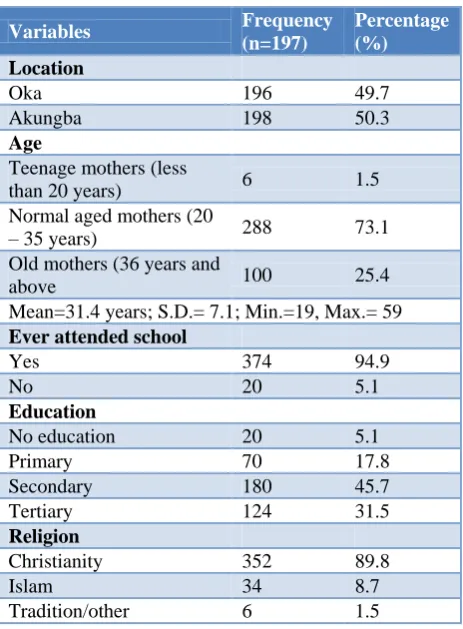
Table 1: Distribution of the respondents by some socio-demographic backgrounds.
Variables Frequency
(n=197)
Percentage (%)
Location
Oka 196 49.7
Akungba 198 50.3
Age
Teenage mothers (less
than 20 years) 6 1.5 Normal aged mothers (20
– 35 years) 288 73.1 Old mothers (36 years and
above 100 25.4
Mean=31.4 years; S.D.= 7.1; Min.=19, Max.= 59 Ever attended school
Yes 374 94.9
No 20 5.1
Education
No education 20 5.1
Primary 70 17.8
Secondary 180 45.7
Tertiary 124 31.5
Religion
Christianity 352 89.8
Islam 34 8.7
Tradition/other 6 1.5
Distribution of the respondents by some socioeconomic backgrounds
31.5% had tertiary; while the largest proportion attained secondary level of education (45.7%), only 5.1% had no formal education. Christians (89.8%) were more than 8 in 10 of the total respondents, 8.7% were Islamic faith adherents; while about 1 in 20 were practicing traditional and other religions (1.5%).
Distribution of respondents by knowledge and usage of contraceptive
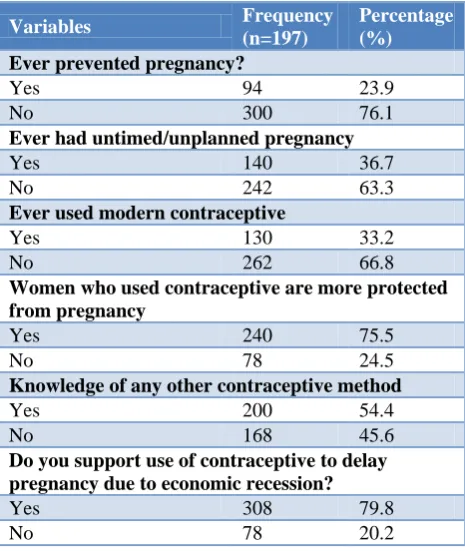
In Table 2, more than 1 in 5 had ever prevented pregnancy (23.9%), while majority had never (76.1%). However, more than a third had (36.7%) of the respondents ever had untimed/unplanned pregnancy, while majority had never (63.5%). About 33% of the respondents reported to have ever used modern contraceptives (33.2%), while the remaining two-third never used contraceptives (66.8%). About three-quarter were of the opinion that women who use contraceptives are more protected from pregnancy (75.5%), while the remaining a quarter had different opinion (24.5%). More than one-half of the respondents had knowledge of other contraceptives apart from modern method (54.4%) relative to 45.6% who reported not to have known other methods.
Table 2: Distribution of respondents by contraceptive usage.
Variables Frequency
(n=197)
Percentage (%)
Ever prevented pregnancy?
Yes 94 23.9
No 300 76.1
Ever had untimed/unplanned pregnancy
Yes 140 36.7
No 242 63.3
Ever used modern contraceptive
Yes 130 33.2
No 262 66.8
Women who used contraceptive are more protected from pregnancy
Yes 240 75.5
No 78 24.5
Knowledge of any other contraceptive method
Yes 200 54.4
No 168 45.6
Do you support use of contraceptive to delay pregnancy due to economic recession?
Yes 308 79.8
No 78 20.2
Distribution of respondents by sexual activities after childbirths
Table 3 shows that about 1 in 20 reported five months for abstinence from sexual activity after childbirth (5.6%), 17.3% reported six months, a large proportion of them
reported more than six months (29.4%). A large proportion of the respondents (62.2%) were the decision-makers on timing of childbirth. More than one-half of the respondents reported not to have resumed sexual activity before menstruation after childbirth (51.6%) compared to 48.4% who resumed sexual activity before menstruation after childbirth. About 36% reported to have ever had unplanned pregnancy due to short abstinence without contraception, while 64.2% had never. The largest proportion of the respondents (42.6%) who reported to have had unplanned pregnancy cited fear of failure of using contraceptives as the reasons for unplanned pregnancy after birth, 22.1% cited obedience to their spouses, while more than a third attributed it to miscalculation of ovulation (35.3%). The above results are in line with some respondents’ opinions that the failure to use contraceptives and obedience to their spouses resulted to unplanned pregnancy. Some of the respondents put their opinions this way: -
… to be honest, I have not been using contraceptives and this has resulted to two unplanned pregnancies. Though, my husband does not subscribe to the use of contraceptives and as his wife, insisting on it might cause
me my marriage (Oka-Akoko, respondent aged 37).
Table 3: Distribution of respondents by sexual activities after childbirths.
Variables Frequency
(n=197)
Percentage (%)
Months of abstinence after childbirth
1 month 62 15.7
2 months 24 6.1
3 months 58 14.7
4 months 44 11.2
5 months 22 5.6
6 months 68 17.3
More than 6 months 116 29.4 Decision-making on timing of childbirth
Self 244 62.2
Husband 148 37.8
Resume sex before menstruation after birth
Yes 180 48.4
No 192 51.6
Short postpartum abstinence without contraceptive usage leads to an unplanned pregnancy
Yes 256 70.3
No 108 29.7
Ever experienced unplanned pregnancy
Yes 136 35.8
No 244 64.2
Reason for this mistake Failure to use
contraceptive 58 42.6 Obey my spouse’s
instruction 30 22.1 Miscalculation of
Another respondent stated that: -
My husband warned me against using any thing (contraceptives) to avoid or delay pregnancy. Therefore, I decided to obey him in order not to accuse me of suspecting his sexual life. Some men would feel that you are suspecting them to be having mistresses outside and
this could endanger one‟s marriage (Oka-Akoko,
respondent aged 40).
Selected socio demographic factors and contraceptive usage of the respondents
The results in Table 4 present information on the interplay between selected socio-demographic factors and contraceptive usage of the respondents. The proportion of respondents who did not use contraceptives cuts across the education categories. This could be a function of fear of using contraceptives to control childbirth as expressed by some of the participants during one of the IDIs.
Using modern contraceptives is good, but it is not advisable for women who are still bearing children. It is better to know how to calculate one‟s safe and unsafe periods as using contraceptives could affect a woman‟s
womb and cause barrenness (Oka-Akoko, respondent
aged 33).
Another respondent from Oka community stated that: -
… I learnt from my friend‟s experience. In fact, she used a particular pill to delay pregnancy, but the aftermath effect when she wanted to conceive was disheartening. To me, a woman‟s educational background should not be used to judge her level of contraceptives usage. In spite of the fact that I am a university graduate, using contraceptives is not in my agenda because of what
people suffer after using them (Oka-Akoko, respondent
aged 39).
Table 4: Distribution of respondents by selected socio demographic factors and contraceptive use.
Variable Ever used contraceptive Total χ2
Yes No
Age N (%) N (%) N (%)
Teenage mothers 2 (33.3) 4 (66.7) 6 (100)
0.0692 Normal aged mothers 96 (34.0) 186 (65.9) 282 (100)
Old mothers 32 (32.0) 68 (68.0) 100 (100) Education
No education 10 (50.0) 10 (50) 20 (100)
3.9768
Primary 30 (44.1) 38 (55.8) 68 (100)
Secondary 56 (31.5) 122 (68.5) 178 (100) Tertiary 34 (28.9) 88 (72.1) 122 (100) Religion
Christianity 116 (33.5) 230 (66.4) 346 (100)
1.5337
Islam 12 (35.3) 22 (64.7) 34 (100)
Traditional 0 (0.00) 8 (100.0) 8 (100.0)
Table 5: Distribution of respondents by sexual activity after childbirth and contraceptive usage.
Variable Ever used modern contraceptive
Yes No Total χ2
Ever had untimed pregnancy N (%) N (%) N (%)
Yes 68 (48.6) 72 (51.4) 140 (100)
13.501*
No 56 (23.3) 180 (76.3) 236 (100)
Months of abstinence after childbirth
Less than 7 months 106 (39.0) 166 (61.0) 272 (100)
22.619*
7 + 24 (21.0) 92 (79.0) 116 (100)
Decision on timing of births
Mine 84 (35.0) 156 (69.8) 240 (100)
0.486
Husband 44 (30.1) 102 (65.0) 146 (100)
Resume sex before menstruation
Yes 48 (27.3) 128 (72.1) 176 (100)
2.801
No 74 (38.9) 116 (61.1) 190 (100)
Spouse opinion on contraceptive use
Approved 86 (37.0) 148 (63.3) 234 (100)
1.0318*
Disapproved 40 (29.4) 96 (71.0) 136 (100)
Respondents’ sexual activities after childbirth and contraceptives usage
Table 5 showed respondents’ sexual activities after childbirth and contraceptives usage. Overall, there is a statistically significant relationship between use of contraceptive and untimed pregnancy (p<0.05). The results revealed that a little above one-half of the respondents who experienced untimed/unplanned pregnancies never used modern contraceptive. Surprisingly, the majority of the respondents (57.6%) who reported to have ever used contraceptive had untimed/unplanned pregnancy. This could be attributed to failure in the use of contraceptives which is in line with the submissions made by some of the participants during IDIs. Some of the participants’ put their opinions this way;
„When I used a particular contraceptive in order to delay pregnancy for 6 months, I still got pregnant when I did not plan to have a baby. But when I was ready to have a child after I had stopped using the contraceptive I
experienced some kind of delay for 6 years‟
(Akungba-Akoko, respondent aged 36). Another respondent reported as thus:
We should know that using contraceptives does not guarantee that a woman could not get pregnant. There have been cases of that and I would not want to fall a victim. Hence, I have decided not to use contraceptives with respect to avoiding pregnancy. I am mature and should know how to handle my sexual activity without
contraceptives (Oka-Akoko, respondent aged 42).
In addition, the short period of abstinence from sexual activity after childbirth as reported by some respondents, which negates the recommendation of health workers that child bearing mothers should abstain for 6 weeks could be as a result of fear of incurring the wraths of their partners, as well as losing them to other women. Some of their assertions are couched this way;
“I abstain for a week because I do not want my husband to go elsewhere. So anytime he demands for sex I give to him since he could not hold himself when he had sexual
urge” (Akungba-Akoko, respondent aged 30).
Another respondent reported that
“…even the Bible made us to understand that the husband is the head of the family and a woman is expected to be under her husband. Besides, after a man had paid the bride price of a woman, it is a sin denying
him of his sexual right anytime he requests for it”
(Oka-Akoko, respondent aged 24).
The majority of the respondents (69.8%) whose positions in timing of childbirth were superior never used contraceptives. The alluded reasons for such sexual
behavior could be hinged on the fact that they want more children as opposed by their partners and fear of the side effect of using modern contraceptive when the respondents want more children. This is in line with some of IDI respondent’ opinion as stated below;
‘How can I use contraceptive when I am not done with
giving birth to children? It is those who have given birth to their desired number of children that should use it. Moreover, I am afraid of using contraceptive because I don‟t want anything to jeopardize my chances of having more children, coupled with my partner‟s disapproval of
using contraceptives (Oka-Akoko, respondent aged 24).
Another respondent posited that
After my first child, I have been seriously looking for another child. So how could I be looking up to God for another child and at the same time be altering conception? Besides, my husband would not be happy to hear that I used any contraceptive method to avoid
pregnancy (Oka-Akoko, respondent aged 40)
About 71% of the respondents whose spouses disapproved of using contraceptives never used them. Hence, there is a statistically significant relationship between spousal opinions and modern contraceptive usage.
Distribution of respondents by fertility preference and contraceptive usage
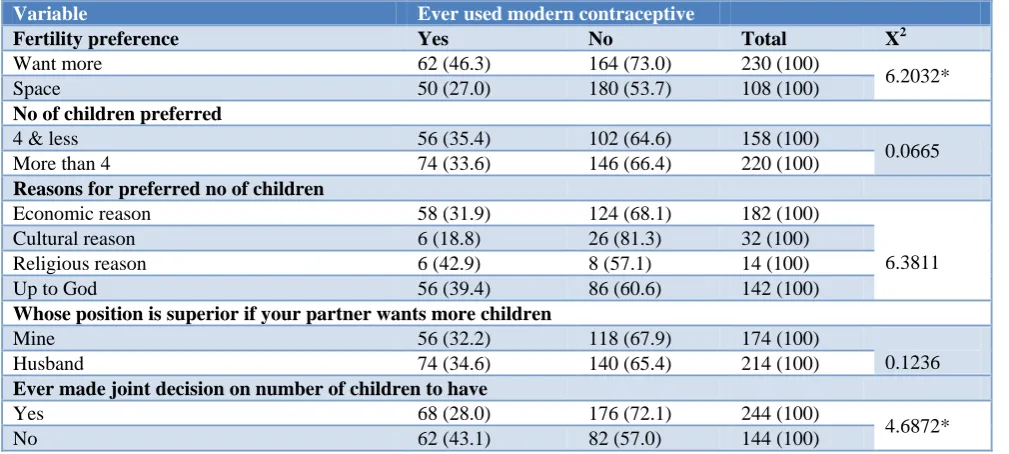
Table 6 presents information on fertility preference and contraceptives usage. The Table revealed that majority of the respondents (73.0%) who wanted more children never used contraceptives. Overall, there is a statistically relationship between use of contraceptive and fertility preference (p<0.05).
The majority of respondents who reported never to have used contraceptives (59.1%) preferred more than 4 children. The reason for not using contraceptives among women who desired large family size could be a function of preference for a large family size as revealed from the IDIs excerpts:-
„You do not know the number of children in your body and so the number of children one will have is up to God. God who gives will provide what will be used to cater for
them‟ (Akungba-Akoko, respondent aged 24).
In a related response, another respondent posited that
Man has no say on the issue of birth, it is what the Lord gives you that you take and also children are gift from
God, so they must be received when they come
(Oka-Akoko, respondent aged 30).
their husband stance. The results showed that childbearing married women tend to adhere to their husbands’ disapproval of using contraceptives. This is in line with the experiences of some respondents during IDIs: -
„I cannot use contraceptives at all, because my husband does not support it and I will not allow it to create
problem in my house. One of my friends used a particular
contraceptive method without her husband‟s approval and she is not finding it rosy again in her marriage. Her
experience taught me a lesson (Oka-Akoko, respondent
aged 30).
Another respondent posited thus: -
…. I must not talk about using contraceptives to delay or avoid pregnancy before my husband because he would not find it funny with me. This must have caused a lot of problems in some homes and I would not want my
marriage to experience such (Oka-Akoko, respondent
aged 30).
Table 6: Distribution of respondents by fertility preference and contraceptive usage.
Variable Ever used modern contraceptive
Fertility preference Yes No Total X2
Want more 62 (46.3) 164 (73.0) 230 (100)
6.2032*
Space 50 (27.0) 180 (53.7) 108 (100)
No of children preferred
4 & less 56 (35.4) 102 (64.6) 158 (100)
0.0665
More than 4 74 (33.6) 146 (66.4) 220 (100)
Reasons for preferred no of children
Economic reason 58 (31.9) 124 (68.1) 182 (100)
6.3811 Cultural reason 6 (18.8) 26 (81.3) 32 (100)
Religious reason 6 (42.9) 8 (57.1) 14 (100)
Up to God 56 (39.4) 86 (60.6) 142 (100)
Whose position is superior if your partner wants more children
Mine 56 (32.2) 118 (67.9) 174 (100)
0.1236
Husband 74 (34.6) 140 (65.4) 214 (100)
Ever made joint decision on number of children to have
Yes 68 (28.0) 176 (72.1) 244 (100)
4.6872*
No 62 (43.1) 82 (57.0) 144 (100)
*The asterisked indicates significant relationship at 5% margin of error.
DISCUSSION
This study revealed that the respondents’ mean age is a reflection that most women in the sample were sexually active and in the prime childbearing age. Our analyses showed that an over-whelming proportion of the women had no formal education and indulged in risky sexual behavior as a result of fear of side effects using any contraceptive. The quantitative and qualitative results validate previous observations that young childbearing women described worries about fear of contraceptive side effects, especially that those contraceptives would cause infertility considering the cultural value for children in the area.6-10 This is in spite of the approval of the respondents to use contraceptives to delay pregnancy This calls for urgent attention from concerned authority and stakeholders in addressing the issue of cultural influence on risky sexual behaviours among childbearing married as well as fear of side effects for contraceptives usage in remote communities.
Our quantitative and qualitative results showed that the respondents who reported to have abstained from sexual activities within 6 weeks after childbirths, as well as
those who had unplanned pregnancy hinged their reasons on failure of using contraceptives and obedience to their spouses. This implies that fear of being disappointed after using contraceptives and negotiating safer sex with partners in marriages which contradicts African cultural practices could predispose a woman towards indulging in negative sexual behavior. This is in line with observations that demands for safer sex by women is often as a result of culturally impedes equality between men and women on sexual decisions.12
cultural practices, fear of being neglected by one’s husband and losing him to other women influenced sexual behaviour which is the reason for engaging in risky sexual activities in marriage.15,16 Consequently, the superiority of husband in reproductive decision has implication on mothers’ health which adversely affect the health of children.17
CONCLUSION
The study concluded that the extent of sexual behaviours among childbearing married women is explained by cultural and gender norms. Also, fear of negotiating safer sex with partners in marriages that negates cultural practices, desire for large family sizes and the beliefs that men’s opinions are superior in sexual matters within the family are predisposing factors to risky sexual behaviors among married women. The fact that many women do not have the autonomy to make decisions about their sexual and reproduction health suggests that traditional cultural values persist in the study area. Our findings suggested that a considerable proportion of childbearing married women are at a high risk of unplanned pregnancies and STIs which becomes inimical to the achievement of sustainable development. There is the need to step up campaigns and embark on periodic enlightenment of childbearing married women on the reliability of modern contraceptives, as well as their imperative positions in sexual relationships, and also enlightening married men to embrace the concept of women empowerment in sexual and reproductive decisions.
ACKNOWLEDGEMENTS
The authors acknowledged all the women who participated in the study. We also appreciate and thank the community women leaders who helped in facilitating the collection of data.
Funding: No funding sources Conflict of interest: None declared
Ethical approval: The study was approved by the Institutional Ethics Committee
REFERENCES
1. Chialepeh WN, Susuman AS. Risk factors of inconsistent condom use among sexually active youths: Implications for human immunodeficiency virus and sexual risk behaviours in Malawi. Journal of Asian and African Studies 2015;52(4):484-49. 2. Nakaie N, Tuon S, Nozaki I, Yamaguchi F, Sasaki
Y, Kakimoto K. Family planning practice and predictors of risk of inconsistent condom use among HIV-positive women on anti-retroviral therapy in Cambodia. BMC Public Health 2014;14(1):614-70. 3. Arowojolu AO, Ilesanmi AO, Roberts OA, Okunola
MA. Sexuality, contraceptive choice and AIDS
awareness among Nigerian undergraduates. Afr J Reprod Health 2002;6(2):60-70.
4. Federal Ministry of Health. National HIV/AIDS Reproductive Health Survey. Abuja, Nigeria, 2007. 5. Wusu O, Isiugo-Abanihe UC. Understanding sexual
negotiation between married partners: A study of the Ogu families in South Western Nigeria. Afr Pop Stud. 2010;23(2):151–71.
6. Burke HM, Ambasa-Shisanya C. 2011. Qualitative Study of Reasons for Discontinuation of Injectable Contraceptives among Users and Salient References Groups in Kenya. Afr J Reprod Health. 2011;15(2):67–78.
7. Diamond-Smith N, Campbell M, Madan S. Misinformation and fear of Side-effects of Family Planning. Cult Health Sex. 2012;14(4):421–33. 8. Hindin MJ, McGough LJ, Adanu RM.
Misperceptions, Misinformation and Myths about Modern Contraceptive Use in Ghana. J Fam Plann Reprod Health Care. 2014;40(1):30–5.
9. Ochako R, Mbondo M, Aloo S, Kaimenyi S, Thompson R, Temmerman M, et al. Barriers to Modern Contraceptive Methods Uptake among Young Women in Kenya: A Qualitative Study. BMC Public Health 2015;15(1):2991.
10. Pasha O, Goudar SS, Patel A, Garces A, Esamai F, Chomba E, Goldenberg RL. Postpartum Contraceptive Use and Unmet Need for Family Planning in Five Low Income Countries. BMC Reproductive Health 2015;12 (2):1–7.
11. Otoide VO, Oronsaye F, Okonofua FE. Why Nigerian Adolescents seek abortion rather than contraception: evidence from focus group Discussions. Int Perspect Sex Reprod Health. 2011;27(2):77-81.
12. Falola T, Heaton MM. HIV illness and African wellbeing. Rochester: University Rochester Press; 2007: 1-62.
13. Ayiga N. Rates and Predictors of Consistent condom use by people living with HIV/AIDS on antiretroviral treatment in Uganda. J Health Popul Nutr. 2012;30(3):270–80.
14. National Population Commission (NPC) [Nigeria] and ICF International. Nigeria Demographic and Health Survey 2013. Abuja, Nigeria, and Rockville, Maryland, USA; 2014: NPC and ICF International. 15. Browne FA, Wechsberg WM, Bowling JM, Luseno
WK. Correlates of male condom use skills among high risk women in South Africa. Journal of Sex Research 2012;49(2-3):255–63.
16. Part K, Rahu K, Rahu M, Karro H. Gender differences in factors associated with sexual intercourse among Estonian adolescents. Scand J Public Health. 2011;39(4):389-95.
18. Adamczyk A, Greif M. Education and Risky Sex in Africa: unraveling the link between women’s education and reproductive health behaviour in Kenya. Social Sci Res. 2011;40(2):654–66.
19. Haberland NA. The case for addressing gender and power in sexuality and HIV education: A comprehensive review of evaluation studies. Guttmacker Institute. 2015;4(3):311–51.
20. Osuafor GN, Mturi AJ. Attitudes towards sexual control within conjugal union in the era of the HIV/AIDS epidemic in Mahikeng, South Africa. Afr Pop Stud. 2014;28(1):538–50.
21. National Population Commission (NPC) (Nigeria). Population figures for Nigeria States for 2006 Population and Housing Census. Abuja NPC.
Cite this article as: Imo CK, Olusanya OO,