Original Research Article
Impact of conditional cash transfer scheme (MAMATA) on the
prevalent MCH care practices in rural areas of Ganjam district,
Orissa: a descriptive study
Syed Irfan Ali
1, Jarina Begum
1*, Manasee Panda
2INTRODUCTION
India’s impressive economic growth in the post-liberalisation era has been accompanied by a much slower decline in the numbers of Maternal and Child sufferings (IMR-37, MMR- 167).1,2 Many well-planned programs have been designed to address this issue, but service utilization in such programs have been abysmally low, partly due to the unfavourable Socio-cultural conditions prevalent in the country. Conditional benefit
schemes around the world are set up to address these issues. MAMATA is one such scheme aiming to bring around radical changes in maternal and child conditions.3 Launched in October 2011 it rewards pregnant and lactating women with an incentive of Rs.5000 if they utilize certain services during their antenatal and postnatal periods. This partial wage compensation is provided in form of four instalments, spread over a period of 12 months (from 6 months of gestation period till the infant is 9 months of age). Many questions arise about the
ABSTRACT
Background: RMNCH services are provided in an integrated manner to it’s beneficiaries under the premise of Primary Health Care. The utilization rates for such services have remained abysmally low and stagnated over the years. The problem lies in failure to generate a demand for such services among it’s beneficiaries. MAMATA a conditional cash transfer scheme implemented in Odisha, aims to bring around radical changes by addressing the issue of demand generation. The objectives of the study were to assess the implementation of MAMATA scheme services in the study area and to assess the impact made by the scheme in their life.
Methods: The study was conducted on 200 women, who were randomly selected from the 903 pregnant women registered under Mamata Scheme from a randomly selected block of Odisha. They were then followed up for a period of 15 months.
Results: Implementation of the scheme in the district was smooth, the instalments were paid regularly in most of the cases without any delay. Impact of the scheme- 98% got adequate rest during pregnancy, because of the scheme. 95% utilized the money for purchasing nutritious food and procuring medicines. The scheme has also helped develop a health seeking attitude in most of the beneficiaries (85%). 97% felt a sense of empowerment and independence compared to the past.
Conclusions: The benefits of MAMATA scheme percolated beyond the boundaries of demand generation. It also brought about a sense of empowerment and independence among it’s beneficiaries.
Keywords: Conditional cash transfer, MCH care, Conditionalities, Instalment, MAMATA scheme
Department of Community Medicine, 1NRI Institute of Medical Sciences, Sanghivalsa, Vishakhapatnam, Andhra Pradesh, 2Balangir Medical College, Balangir, Orissa, India
Received: 17 May 2018
Revised: 27 June 2018
Accepted: 28 June 2018
*Correspondence:
Dr. Jarina Begum,
E-mail: dr.jarina @gmail.com
Copyright: © the author(s), publisher and licensee Medip Academy. This is an open-access article distributed under the terms of the Creative Commons Attribution Non-Commercial License, which permits unrestricted non-commercial use, distribution, and reproduction in any medium, provided the original work is properly cited.
scheme’s implementation- can it be successfully implemented on the platform of ICDS? The scheme is stretched over a period of 15 months, with a gap of several months between two consecutive instalments. Considering this, would it develop a sense of fatigue amongst its beneficiaries, how would they adapt to its forced conditionalties? Will they be benefited by the scheme and assess all the MCH services available to them? If yes, what impact will the scheme have in their life?
The present study is a descriptive study involving the beneficiaries of MAMATA scheme in Kukudakhandi block of Ganjam district which is intended to see the impact of the scheme (MAMTA) on the current MCH practices and perception of the beneficiaries towards the scheme.
Objectives
To assess the implementation of MAMATA scheme
services in the study area.
To assess the impact the scheme had on it’s beneficiaries.
METHODS Place of study
Rural areas of Ganjam district.
Study period
2 years i.e. from October 2011 to November 2013
Study area
Out of 22 rural blocks in the district, the, Kukudakhandi block was randomly selected for the purpose of this study.
Study design
Community based observational study.
Details of sampling
The pregnant mothers of the block registered under MAMATA scheme i.e. 903 constituted the study population. Considering the long period of follow-up and
constraints of resources, a sample of 200 beneficiaries was perceived to be adequate for the study. (20% of the total study population i.e. 180 & an additional 10% of the sample size i.e. 20 to account for non-response, loss of Follow up for 15 months and abortion, still birth or infant death). For administrative purposes, Kukudakhandi block is divided into 7 sectors, with roughly 25 AWCs in each sector. In order to have proper representation from all sectors of the block, registered beneficiaries from 12 AWCs of each of 7 sectors (total of 84 AWCs) of Kukudakhandi block were selected. They formed the sampling frame (432) for the study. From the sample frame of 432 beneficiaries randomly 200 pregnant mothers were selected to constitute the sample population, after subjecting them to the following exclusion and inclusion criteria’s.
Inclusion criteria
Inclusion criteria were the beneficiary should be a resident of Kukudakhandi block; she should be willing to stay in the block for the entire period of follow-up (15 months); she should give informed consent to participate in the study.
Exclusion criteria
Exclusion criteria were those who did not plan on staying in the study area for the period of follow-up; those who had abortions, still births or infant deaths during the course of study.
They were followed up till they received their last instalment under MAMATA scheme. The data was collected and analysed using appropriate statistical methods to draw conclusions.
RESULTS
At the end of the study period, all 200 pregnant and lactating mothers and their child were alive. All of them (100%) had fulfilled all the 20 preconditions necessary for availing the four instalments under the scheme. Also all of them had opted for safe delivery, even though it was not a precondition under the scheme. There was no attrition among the sample population. Instalments were being paid regularly in most of the cases. Delay in receiving of instalments were noticed in 37.5%, 25.5%, 27%,30% of the cases for 1st, 2nd, 3rd and 4th instalments respectively (Table 1).
Table 1: Regularity of instalments (n=200).
SL Regularity of instalment
First instalment (%)
Second instalment (%)
Third instalment (%)
Fourth instalment (%)
1 Paid within 1 month of usual time 125 (62.50) 149 (74.50) 146 (73.00) 140 (70.00)
2 Payment was delayed 75 (37.50) 41 (25.50) 54 (27.00) 60 (30.00)
Table 2: Reasons for delay in payment (n=200).
SL Reasons for delay
First instalment (%)
Second instalment (%)
Third instalment (%)
Fourth instalment (%)
1 Late fulfilment of conditionality 156 (78.00) 184 (92.00) 164 (82.00) 188 (94.00)
2 Issue of savings account by bank 146 (73.00) 0 (0) 0 (0) 0 (0)
3 Sharing of information by AWW 6 (3.00) 12 (6.00) 22 (11.00) 8 (4.00)
4 Dissemination of information at the
CDPO office 12 (6.00) 4 (2.00) 14 (7.00) 4 (2.00)
5 Delayed disbursement of payment by the
Govt 0 (0) 0 (0) 0 (0) 0 (0)
Table 3: Utilization of money from the scheme.
SL Money utilized for Number of beneficiaries (n=200) (%)
1 Transport to the health facility 92 (46.00)
2 In procuring medicines/ diagnostic procedures 194 (97.00)
3 For nutrition of mother and child 190 (95.00)
4 For future savings 134 (62.00)
5 Household purposes 68 (34.00)
6 Other activities 130 (65.00)
Table 4: Withdrawal of money from savings account (n=200).
Sl Money withdrawn by First instalment (%)
Second instalment (%)
Third instalment (%)
Fourth instalment (%)
1 Beneficiary 19 (9.50) 89 (44.50) 110 (55.00) 126 (63.00)
2 Husband 74 (37.00) 20 (10.00) 22 (11.00) 22 (11.00)
3 Others 107 (53.50) 91 (45.50) 68 (39.00) 52 (26.00)
Total 200 (100) 200 (100) 200 (100) 200 (100)
Table 5: Important messages of counselling sessions.
SL Message Number of beneficiaries (n=200) (%)
1 To take Adequate rest and Nutrition 194 (97.00)
2 Child rearing practices like what to do and what not to 112 (56.00)
3 To exclusively Breast feed the Child 52 (26.00)
4 Other Health issues like- Malaria, Diarrhoea, ARI prevention 190 (95.00)
5 Contraception and Breast feeding 26 (13.00)
The major reason attributed to it was delay in fulfilment of conditionality’s on the part of beneficiary (78%, 92%, 82%, 94% for 1st, 2nd, 3rd, 4th instalments) (Table 2).
No delay was noticed in disbursement of money from the Govt side. In depth interview of the CDPO and the Supervisors revealed that all effort were made to avoid any delay in payment of instalments. For monitoring and supervision the CDPO and Supervisor randomly checked 20 cases every month. No instances of corruption either on the part of Government officials or the ICDS staff were noticed during the study period.
Majority of the beneficiaries utilized the money for purchasing nutritious food (95%) and procuring
medicines or undertaking diagnostic procedures (97%) with the money (Table 3).
Majority of cases the money from first instalment (Rs.1500) was utilized for ultrasound of the baby (97%), and those from the second and third instalment were spent on procuring child’s medications or for immunizing him with additional vaccines. A high proportion of money was also spent on procuring complementary foods for the child (95%). The 4th instalment was mostly saved for future (62%).
In majority of the counselling session’s issues concerning maternal rest and nutrition (97%), specific diseases like malaria, diarrhoea and ARI (95%) and healthy child rearing practices (56%) were discussed. Key issues like contraception and breast feeding (13%) were rarely discussed during the counselling sessions (Table 5).
Frequent stock-out of vaccines especially the Measles vaccine and IFA tablets was a grave concern in the block. 42.5% beneficiaries faced such problems. While about 15% of the beneficiaries sighted lack of co-operation from their own family member and discrimination or abuse by staff as a major problem (Table 6).
Table 6: Problems faced by beneficiaries.
Sl Problem faced
Number of beneficiaries (n=200) (%)
1 Problems relating to corruption 0 (0)
2
Problems relating to discrimination/ abuse by health? ICDS staff
29 (14.50)
3 Health/ service centres located
far away from home 15 (7.50)
4
Problems of Irregularity in services/ stock out of essential items like- Vaccines, IFA tablets etc.
85 (42.50)
5 Problems of co-operation from
own family members 34 (17.00)
Among the sample population over 80% of the beneficiaries were uncomfortable with the mandatory
condition of having to attend Counselling sessions. (Table 7).
Table 7: Conditions beneficiaries were uncomfortable with.
SL Conditionality
Number of Beneficiaries (n=200) (%)
1 Pregnancy registration & ANC
check up 16 (8.00)
2 To attend ANC counselling
sessions 160 (80.00)
3 To attend IYCF Counselling
Sessions 160 (80.00)
4 To breastfeed exclusively for
6 months 167 (83.50)
5 To give vitamin –A first dose 37 (18.50)
6 To weigh the child regularly 29 (14.50)
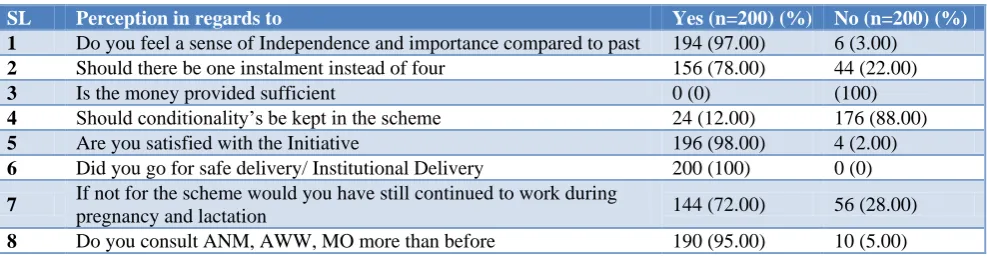
As per Table 8, 72% of the study population stated that the monetary incentive provided by the scheme helped them in having adequate rest during pregnancy and spend sufficient time with their infant. 97% of the study population felts a sense of empowerment and independence compared to the past. However all of them felt that the money provided (RS.5000 for 12 months) was too little and barely addressed their needs. Similarly most of the beneficiaries (78%) and health personnel wanted a single bulk instalment instead of four and 88% wanted the money with-out any conditionality. All the beneficiaries (100%) had gone for institutional deliveries. 95% of the study population now consults with the Government health employees like Medical officer and ANM. Compared to prior behaviour.
Table 8: Perception of the beneficiary towards scheme.
SL Perception in regards to Yes (n=200) (%) No (n=200) (%)
1 Do you feel a sense of Independence and importance compared to past 194 (97.00) 6 (3.00)
2 Should there be one instalment instead of four 156 (78.00) 44 (22.00)
3 Is the money provided sufficient 0 (0) (100)
4 Should conditionality’s be kept in the scheme 24 (12.00) 176 (88.00)
5 Are you satisfied with the Initiative 196 (98.00) 4 (2.00)
6 Did you go for safe delivery/ Institutional Delivery 200 (100) 0 (0)
7 If not for the scheme would you have still continued to work during
pregnancy and lactation 144 (72.00) 56 (28.00)
8 Do you consult ANM, AWW, MO more than before 190 (95.00) 10 (5.00)
DISCUSSION
Much of Public Health in general is arguably about MCH and truly much about global health is about MCH. Our current era of globalization, war, and socioeconomic unrest has revealed public health as a worldwide concern and a major frontier for social justice with maternal and child health at its epicentre.4 Every year around 8 million children die of preventable causes, and more than
the age of 35, reiterating the importance of RCH services to this country.6 Though an impressive progress has been made in various parameters of MCH care, for a country as diverse as India, there are several road blocks ahead in achieving the goals of MDG 4 and 5. Special efforts were taken by NRHM to address the crucial issue of MCH care in the state. Being an EAG state, it receives added focus and incentive from the Government. However the delivery of these services to the beneficiaries face considerable amount of road blocks leading to heightened MMR (212 per 1 lakh live birth) and IMR (62 per 1000 live births in rural areas).7 Increasingly, maternal and Child Health (MCH) experts are exploring ways in which demand-side barriers (the barriers women and their families face to seeking care) can be overcome. CCT’s are one type of demand-side program that has been used to overcome cost barriers. CCTs use cash transfer both as mechanism to allow parents to provide financially for their children needs and as incentive for the parents to invest in their health and well-being.8
Most of the CCT programs are broad, aiming to alleviate poverty. However, “narrow” CCT – programs that transfer cash only for the utilization of specific services- are becoming more common; for example, India’s Janani Suraksha Yojana (JSY) and Nepal’s Safe Delivery Incentive Program (SDIP) specifically target MCH.9 The JSY aims to reduce maternal and neonatal mortality through the promotion of institutional births by providing cash incentives to mothers on giving birth in a health institution.10 The Government of Nepal initiated Safe Delivery Incentive Programme (SDIP) under maternal health financing policy on July 2005 as a cost sharing scheme to increase access of women to safe delivery services.11 CCT is found out to be better outcomes than unconditional case benefit schemes.
Our study throws light on MAMATA scheme which revealed that the Instalments were being paid regularly in most of the cases (i.e. within the 10th of the next month after verification of fulfilment of required conditionality’s by ICDS staff). Beyond the obvious problem of getting a savings account in bank which was responsible for the majority of first instalments delay (73%), late fulfilment of requisite conditionality’s by the beneficiary themselves contributed to much of delays in subsequent instalments. This highlights the fact that the existing machinery for money distribution in MAMATA scheme is quite efficient and whatever delays happened, could be taken care at the level of beneficiaries themselves.
In their study “Towards universalisation of Maternity Entitlements: An exploratory case study of the Dr. Muthulakshmi Maternity Assistance Scheme, Tamil Nadu” the PHRN group noted that the beneficiaries faced no problems in getting a bank savings account. However the issue of incentives were delayed.12 Similarly the DMMAS scheme proposes for monetary assistance in two instalments one before pregnancy and other after. The study group noted that none of the beneficiary
received the first instalment before delivery. The amount due to financial delay was paid in bulk during the second instalment. Even there was a delay in 14% of the cases, failure of the scheme to adhere to its regularity of paying instalments, led to no significant changes in the nutrition and LBW status of the beneficiaries compared to the rest of the population.13
MAMATA provides for a partial wage compensation of Rs.5000, to pregnant and lactating mothers. The beneficiary is expected to use these incentives along with the money they receive in JSY for the welfare of mother and child. A good proportion of beneficiaries (above 95%), utilize the money for purchasing nutritious food and procuring medicines or undertaking diagnostic procedures, immunizing child with additional vaccines also on procuring complementary foods for the child. Similar observations were made by the PHRN group in their study of utilization of services in DMMAS scheme. The women reported that the money was mainly spent on medical expenses (39%), savings and investment for the child’s future (31%) and food items (29%).
Further the study revealed that in 53.5% of cases the withdrawal of the first instalment from the bank was usually made with the help of others (generally AWW or ASHA). Less than 10% of the beneficiaries were able to handle their account themselves during this period. This coupled with the fact that only 5.5% of them had a savings account in their name before the launch of MAMATA and 88% of them had to face difficulty in opening a savings account shows the existing low levels of gender empowerment in the study area. An increasing trend of beneficiaries managing their own account is seen in cases of 2nd, 3rd and 4th instalments (from 9.5% to 63%). Most of them felt a sense of empowerment and up-liftment on being able to manage their own savings account.
Attendance of pregnant and lactating women in counselling sessions (ANC, VHND, IYCF) is a precondition for all of the four instalments. A disturbing trend is seen in regards to interest of beneficiaries in attending these sessions. In fact majority of them (over 70%) have confessed to not attending these sessions had they not been made mandatory by the scheme.
themes discussed during the counselling sessions of DMMAS scheme were nutrition for the mother during pregnancy and after childbirth. Other like breastfeeding, rest during pregnancy, mother and child care were also discussed frequently. However no mention was made of wage compensation or exclusive breastfeeding during these sessions.
Corruption was a non-issue in this scheme. MAMATA Scheme is carried out on the platform of ICDS which is often blamed for poor implementation and malpractices. Given the fact that over 45 lakh rupees was disbursed during the study period, with zero corruption and malpractice, tells a lot about the smooth implementation of the scheme. Similarly no evidence of corruption or leakages were found in the DMMAS study by PHRN.
MAMATA like other Conditional Cash Transfer (CCT) schemes is designed primarily to address the “Demand” side of the problem. However for smooth implementation of such programs the “Supply” side of the problems need to be addressed as well. Frequent stock-out of vaccines especially the Measles vaccine and IFA tablets is a grave concern in the block. Such stock outs usually lead to delayed fulfilment of conditionality eventually leading to delay in getting Instalment. 42.5% beneficiaries faced such problems. A little more effort on the part of health officials especially AWW and ANM would effectively prevent such problems in the future.17% of the beneficiaries sighted lack of co-operation from their own family member as a major problem. In most of these cases the service centres or banks were located far away from the beneficiary’s house and they needed someone to accompany them.
Over 80% of the beneficiaries were uncomfortable with the mandatory condition of having to attend Counselling sessions. The scheme mandates the beneficiary to attend a minimum of eight counselling sessions during the period of twelve months. Many women faced problems attributed to cultural barriers in fulfilling this conditions as they are not allowed to step out of house fearing untoward superstitions. The repeated counselling on same topics like malaria, diarrhoea by the AWW also did not help in arousing interest in them. Most of the beneficiaries consider it as a waste of time. Less than 15% had problems with repeated weighing of their child. Most of them used to weigh their child during the immunization sessions.
Provision of counselling by home visit of a health personnel might mitigate some of the barriers. Further proper training of AWW and ANM in matters related to counselling, and MAMATA Scheme is urgently required in most of the cases.
98% of the study population welcomed the initiative of MAMATA and stated that the monetary incentive provided by the scheme helped them in taking adequate
infant instead of worrying of joining work (72%). 97% of the study population felts a sense of empowerment and independence compared to the past. Most of them (97%) were happy of the fact that they possessed their own individual savings account and were able to manage it independently. However almost all of them felt that the money provided (RS.5000 for 12 months) was too little and barely addressed their needs. National Alliance for Maternal Health and Human Rights (NAMHHR) in their study on utilization of MCH services under IGMSY scheme observed the same.14 They computed that the money provided would only provide less than a month of rest (Roughly 25 days wages for unskilled labour at Rs 160 per day). Similarly MAMATA scheme would be able to provide a rest of 31.25 days only.
The planning commission held a meeting on June 2nd 2010 for presentation and discussion on Dr. Muthulaksmi maternity assistance scheme findings made by PHRN group. It was recommended to provide a monetary compensation equivalent to minimum wages permissible under 6th Pay Commission and should be of universal application, with no conditionality’s. Whether such financial undertaking can be taken by Odisha, one of the poorest state of India is speculated for further consideration.
Most of the beneficiaries (78%) and health personnel wanted a single bulk instalment instead of four with-out any conditionality (88%). But the importance of conditionality could be perceived by the fact that so far all of the beneficiaries had fulfilled them although some admit that they would not have done so had it not been mandatory under the scheme. The conditionality’s in the scheme is a good way of making sure that the services offered are indeed utilized and therefore should not be parted with.
Considering similar demands DMMAS, started paying them in one time bulk payment of Rs. 6000 instead of 3 instalments and the results of such modifications were drastic with beneficiaries using all of the money at once leading to early initiation of work by them thus diminishing the period of maternal rest- the primary aim of the scheme. Due to this the DMMAS was again revoked into a scheme providing monetary benefits in three instalments (of Rs. 4000 each).
CONCLUSION
Fulfilment of conditionalities with in stipulated time is added to test their awareness of the scheme and reluctance in fulfilling any conditionalities is also assessed to understand the importance of conditionalities in such scheme. All beneficiaries fulfilled their conditionalities and received their incentives at the end of the study. So, when compared to AHS-2011 there was a drastic improvement especially those parameter which were a pre-condition for incentive showed 100% fulfilment. However not all of them were fulfilled with in stipulated time and most beneficiaries needed to be
tracked down by AWW for fulfilling these
conditionalities. The study also points out to the reluctance on part of beneficiary to fulfil such conditionalities. Which as per them won’t have been fulfilled had it not been mandatory to draw incentives. It also shows that most beneficiaries were lured into joining the scheme by its monetary incentives, but over a period of time it brought about positive changes in them. The current fund flow mechanism is quite transparent and has blocked the pilferage. Most of the beneficiaries welcomed the initiative of MAMATA scheme and felt a sense of independence and importance due to this. They felt that the scheme has enabled them to get proper rest and spend more time with their child. The scheme seems to have brought about a change in the health seeking behaviour of the beneficiaries with all of them going for institutional delivery and most of them seeking the help of government health staff in case of ailments.
ACKNOWLEDGEMENTS
The author is very much thankful to MKCG medical college authorities for giving permission to conduct the study and all staff of department of Community Medicine for their help and support. The author also extends his sincere thanks to the CDPO, Supervisors, AWWS and the beneficiaries of Kukudakhandi block for their co-operation and assistance.
Funding: No funding sources Conflict of interest: None declared
Ethical approval: The study was approved by the Institutional Ethics Committee
REFERENCES
1. The world fact book CIA. Available at:
https://www.cia.gov/library/publications/the-world-factbook/rankorder. Accessed on 3 April 2018. 2. Sample registration system report 2011. Available
at: http://www.censusindia.gov.in/vital_statistics/ SRS_Reports.html. Accessed on 3 April 2018.
3. MAMATA Scheme. Available at: www.wcdorissa.
gov.in/download/MAMATAGuideline_English.pdf. Accessed on 5 April 2018.
4. Rosenfield A, Caroline J. Min: A History of International Cooperation in Maternal and Child Health in Maternal and Child Health: Global Challenges, Programs, and Policies by John Ehiri,1st edition, Springer US; 2009: 1-3.
5. Global Strategy for Women, and Children Health United Nations Secretary-General Ban Ki-moon, 2010. Available at: http://www.who.int/pmnch/ activities/jointactionplan/201009_gswch_execsum_ en.pdf. Accessed on 3 April 2018.
6. Census, 2011, India. Available at
http://censusindia.gov.in/. Accessed on 3 April 2018.
7. SRS Bulletin October 2007, available at -
http://www.censusindia.gov.in/vital_statistics/SRS_ Bulletins/SRS_Bulletins_links/SRS_Bulletin_-_October_2007-1.pdf. Accessed on 3 April 2018. 8. Das, J, Do Q, Ozler B. Reassessing conditional cash
transfer programs (English). The World Bank Res Observer. 2005;20(1):57-80.
9. Glassman A, Duran D, Fleisher L, Singer D, Sturke R, Angeles G, et al. Impact of Conditional Cash Transfers on Maternal and Newborn Health. J Health Population Nutr. 2013;31(4 Suppl 2):S48-S66.
10. Randive B, Diwan V, De Costa A. India’s
Conditional Cash Transfer Programme (the JSY) to Promote Institutional Birth: Is There an Association between Institutional Birth Proportion and Maternal Mortality? PLOS ONE. 2013;8(6):e67452.
11. Safe delivery incentive program under maternal health financing policy of nepal: a case of kailali district in nepal by Anjalina Karki, Available at-http://www.mppgnsu.org/attachments/396_Anjalina %20Karki_MPPG__final_report_September%20%2 81%29.pdf Accessed on 3 March 2018.
12. Towards Universalisation of Maternity Entitlement:
An Exploratory Case Study of the Dr.
Muthulakshmi Maternity Assistance Scheme, Tamil Nadu. Available at: https://www.researchgate.net /publication/281232597_Towards_Universalisation _of_Maternity_Entitlement_An_Exploratory_Case_ Study_of_the_Dr_Muthulakshmi_Maternity_Assist ance_Scheme_Tamil_Nadu. Accessed on 3 April 2018.
13. Executive Summary of DMMAS Study –PHRN
Available at: http://phrsindia.org/wp-content/ uploads/2015/09/AdvocacyExSummDMMAS.pdf. Accessed on 7 April 2018.
14. “Maternity Entitlements in India: A Question of Women's Health, Nutrition and Rights” by National Alliance for Maternal Health and Human Rights (NAMHHR) and Sahyog 2011. Available at: https://aditigondal.files.wordpress.com/2012/06/mat ernity-entitlements-in-indiaa-question-of-womens-health-nutrition-and-rights.pdf. Accessed on 3 April 2018.