Original Research Article
Study of domestic violence against married women in the field practice
area of urban health training centre, Aurangabad, Maharashtra
Hrishikesh A. Khadilkar, Apeksha P. Paunikar*, Mohan K. Doibale, Bina M. Kuril,
Arvind V. Gaikwad, Smita P. Andurkar, Vinod D. Mundada
INTRODUCTION
Domestic violence is a global issue, reaching across national boundaries as well as socio-economic, cultural, racial and class distributions. It is a widespread, ingrained evil, causing serious impact on woman’s health and well-being. Domestic violence can be described as the power, misused by one adult in a relationship, to control another. It is perpetrated by and on both men and women.
However, mostly the victims are women and the perpetrators are their husbands.1 Domestic violence is among the most underreported crimes worldwide. In 1993, the United National General Assembly adopted a declaration, which for the first time offers an official UN definition of gender-based abuse. According to Article I of declaration, violence against women includes; any act of gender-based violence that results in, or is likely to result in, physical, sexual or psychological harm or
ABSTRACT
Background: Domestic violence is a global issue. It has a serious impact on woman’s health and well-being. So the
present study was carried out to study domestic violence against married women in the field practice area of urban health training centre (UHTC). The objective of the study was to find out the magnitude of domestic violence in married women in last one year and to find out the type of violence to which females are subjected and factors associated with it.
Methods: The present community based cross-sectional study was carried out in married women residing in
catchment area of UHTC. Sample size was first estimated with help of epi info, which came out to be 275 by considering 23.6% as the prevalence of domestic violence from NFHS-4. 282 women of age 15-49 years were finally included in study who was interviewed by predesigned pretested questionnaire by female investigator. The questions were asked related to ‘do they suffer from domestic violence, type of domestic violence and from whom they suffer such type of violence.’
Results: The prevalence of married women experiencing domestic violence in last one year in the field practice area
of UHTC is 21.63%, of which 57.71% and 50% experienced physical and psychological violence by partner respectively. Also the study revealed that education and occupation of couple plays an important role in domestic violence.
Conclusions: Domestic violence represents the hidden iceberg in the society and hence more community awareness
about domestic violence is needed.
Keywords: Domestic violence, Married women, Urban health training centre
Department of Community Medicine, Government Medical College, Aurangabad, Maharashtra, India
Received: 06 December 2017
Revised: 14 January 2018
Accepted: 16 January 2018
*Correspondence:
Dr. Apeksha P. Paunikar,
E-mail: [email protected]
Copyright: © the author(s), publisher and licensee Medip Academy. This is an open-access article distributed under
the terms of the Creative Commons Attribution Non-Commercial License, which permits unrestricted non-commercial use, distribution, and reproduction in any medium, provided the original work is properly cited.
suffering to women including threats of such acts, coercion or arbitrary deprivation of liberty, whether occurring in public or private life.2
National Family Health Survey (NFHS – 4) 2015-16, for India has found that, nationwide 23.6% of women in urban area and 31.4% of women in rural area experience violence after marriage.3 In India, 34% of women of reproductive age group have ever experienced physical domestic violence.4 Research suggests that physical violence in intimate relationships is often accompanied by psychological abuse and in one third to over one-half of cases by sexual abuse.5
The women may not want to disclose the confidential matter for reasons of shame, fear, guilt, or simply because they do not want to be disloyal to their partners mainly in India. Hence, there is a serious gap in public health policy making and lack of appropriate programs.6
Thus the violence against women within the family, until now, has received little attention as either a social or a public health issue.5 The sensitivities and stigma associated with domestic violence, the perception that it is primarily a legal issue, and the lack of data on the dimensions of abuse, have hampered understanding and the development of appropriate interventions. So the present study was carried out in the field practice area of urban health training centre, Aurangabad to study the magnitude of domestic violence against married women, the type of violence they suffer from and the factors associated with it.
METHODS
The present community based cross sectional study was planned in married women residing in catchment area of UHTC of Government Medical College Aurangabad. First the sample size was estimated with the help of Epi info version 7 by taking 23.6% as prevalence of domestic violence as per NFHS-4. Sample size derived was 277 with 95% confidence interval. Data was collected by visiting households by female investigator with the help of predesigned pretested proforma. Simple random sample sampling method was used. With the help of random number table, households were selected randomly from catchment area according to their house number. After reaching the household, the purpose of the study was explained to them and initial rapport was built with the help of female community workers and the women were taken into confidence.
Investigators planned to enroll more than 277 samples to take care of the non-response rate. Initially few of the married women were hesitant to take part in study due to some social inhibitions and fear of in laws. These ladies were called in UHTC for the sake of health checkup and motivated to open up and asked to participate in study. There were such 32 women, who were non respondents.
Out of 32 non respondents, 23 women could be convinced to enroll them. Out of the total 291 woman of age 15-49 years who were contacted for the study, finally 282 women were included in study. The study duration was of 6 months, from December 2016 to May 2017. The study protocol was approved by the institutional ethical committee.
The information gathered was based on self-administered pre-designed, pre-tested questionnaire. The identity of women was not revealed. The questionnaire was given serial numbers for record keeping purpose. Questionnaire was made in local language (hindi) as majority of the respondents were hindi speaking. The questionnaire included questions on socio-demographic information relating to age of women, educational status of women and their husbands, occupational status of women and their husbands, and also the questions such as ‘do the women suffer from domestic violence, type of domestic violence and from whom they suffer such type of violence and the factors associated with domestic violence. In case of illiterate participants questionnaire was filled up with the help of female health workers. Informed verbal consent was taken initially. They were also assured that anonymity and strict confidentiality would be maintained. Forms with complete details were taken into consideration. All the information was collected, compiled and analyzed by applying suitable tests. Statistical analysis was done by simple proportions and percentages. Microsoft Word and Excel have been used to generate graphs, tables etc. Chi square and Mcnemar tests were used to determine the distribution of domestic violence according to different socio-demographic parameters.
RESULTS
Out of 282 women interviewed, 61 (21.63%) women had experienced some type of domestic violence. Figure 1 shows that out of this 282 women, 42.62% women suffered from any one type of violence, 34.43% women from any two types of violence and 22.95% women suffered from three types of violence.
Figure 1: Percentage of domestic violence among victims.
42.62%
34.43% 22.95%
women suffered from any one type of violence
So far as the types of violence were concerned, physical violence by partner was the most common form of domestic violence observed in 35 (57.38%) women followed by emotional violence by partner in 31 (50.82%). The perpetrators were mostly husbands followed by other members in family like mother-in–law, father-in-law. Physical violence by in laws was experienced by 26.23% women while emotional violence by in laws was experienced by 19.67% women. 7 (11.48%) women experienced economic violence by partner and though least in percentages, 5 (8.2%) reported, sexual violence also as shown in Table 1.
Table 1: Type of domestic violence among victims (n=61).
Type of violence Number Percentage
(%) Physical violence by
partner 35 57.38
Psychological violence by
partner 31 50.82
Physical violence by in
laws 16 26.23
Psychological violence by
in laws 12 19.67
Economic violence by
partner 7 11.48
Sexual violence by partner 5 8.2
*multiple responses.
Among the major factors associated with domestic violence, some serious issues came out such as, alcohol addiction of the husband; dowry related problems, as well as some inconspicuous reasons like not cooking properly or not having a male child or talking with neighbors etc. as shown in Figure 2.
Figure 2: Distribution of study subjects according to main reasons cited for domestic violence.
*multiple responses
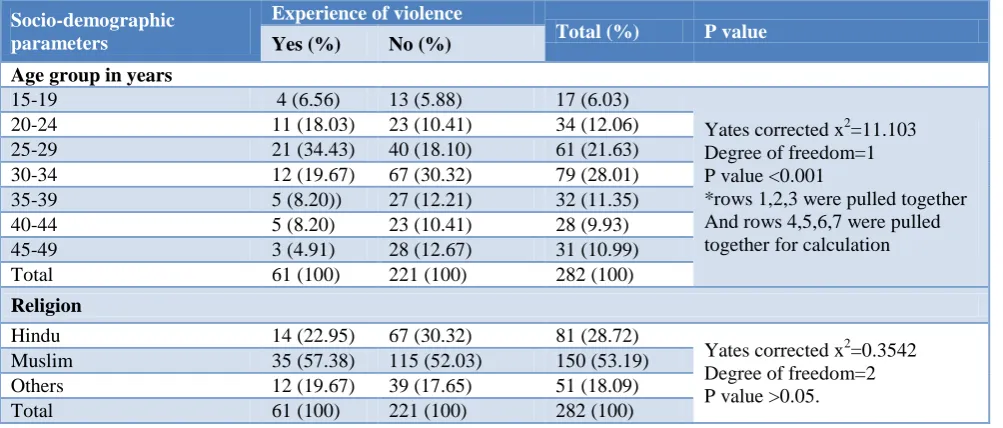
Table 2 depicts that experience of domestic violence was found to be significantly associated with young age of women, lower literacy status of the woman, unemployment of women and those living in joint family. On the contrary no significant statistical association was observed between the experience of domestic violence and the religion. The analysis showed that younger women experienced more domestic violence as compared to older women. 59.02% women of age 15-29 years experienced domestic violence as compared to 40.98% women of age 30-49 years and the difference was statistically significant (p<0.05). About 63.93% of women with no education had experienced violence, as compared with about 36.07% of women who were literate. The analysis of data disclosed that women who were engaged in any occupation were less exposed to violence as compared to women who were not engaged to any outside work. Around 83.61% of unemployed women exposed to violence as compared to 16.39% women who were doing any work and difference is statistically significant (p<0.05).
Table 2: Distribution of women according to socio-demographic parameters and experience of domestic violence.
Socio-demographic parameters
Experience of violence
Total (%) P value
Yes (%) No (%)
Age group in years
15-19 4 (6.56) 13 (5.88) 17 (6.03)
Yates corrected x2=11.103 Degree of freedom=1 P value <0.001
*rows 1,2,3 were pulled together And rows 4,5,6,7 were pulled together for calculation 20-24 11 (18.03) 23 (10.41) 34 (12.06)
25-29 21 (34.43) 40 (18.10) 61 (21.63) 30-34 12 (19.67) 67 (30.32) 79 (28.01) 35-39 5 (8.20)) 27 (12.21) 32 (11.35) 40-44 5 (8.20) 23 (10.41) 28 (9.93) 45-49 3 (4.91) 28 (12.67) 31 (10.99) Total 61 (100) 221 (100) 282 (100)
Religion
Hindu 14 (22.95) 67 (30.32) 81 (28.72)
Yates corrected x2=0.3542 Degree of freedom=2 P value >0.05. Muslim 35 (57.38) 115 (52.03) 150 (53.19)
Others 12 (19.67) 39 (17.65) 51 (18.09) Total 61 (100) 221 (100) 282 (100)
16
12
31
14
12
0 5 10 15 20 25 30 35
Not cooking properly
Talking to neighbours
Influence of alcohol
Dowry related
Socio-demographic parameters
Experience of violence
Total (%) P value
Yes (%) No (%)
Education of women
Illiterate 39 (63.93) 76 (34.39) 115 (40.78)
Yates corrected x2=16.0778 Degree of freedom=1 p-value <0.001
rows 2,3,4,5,6 were pulled together for calculation Primary 7 (11.48) 38 (17.19) 45 (15.96)
Secondary 6 (9.84) 45 (20.36) 51 (18.09) High 5 (8.20) 37 (16.74) 42 (14.89) Intermediate 2 (3.28) 19 (8.60) 21 (7.45) ≥Graduate 2 (3.28) 6 (2.72) 8 (2.84) Total 61 (100) 221 (100) 282 (100)
Occupation of women
Unemployed 51 (83.61) 141 (63.80) 192 (68.09)
Yates corrected x2=7.7425 Degree of freedom=1 p-value=<0.01
rows 2,3,4,5,6 were pulled together for calculation Unskilled 4 (6.56) 31 (14.03) 35 (12.41)
Semiskilled 3 (4.93) 30 (13.57) 33 (11.70) Skilled 1 (1.64) 6 (2.71) 7 (2.48) Clerk/shop owner/farmer 1 (1.64) 8 (3.62) 9 (3.19) ≥Semiprofessional 1 (1.64) 5 (2.27) 6 (2.13) Total 61 (100) 221 (100) 282 (100)
Type of family
Nuclear 11 (18.03) 76 (34.39) 87 (30.85) Yates corrected x2=5.2528 Degree of freedom=1 p<0.05
Joint 50 (81.97) 145 (65.61) 195 (69.15) Total 61 (100) 221 (100) 282 (100)
Table3: Distribution of couples subjected to domestic violence according to educational status.
Educational status Domestic violence
Males illiterate Males literate Total
Females illiterate 35 4 39
Females literate 19 3 22
Total 48 13 61
Mcnemar test with Yates correction x2=8.522; Degree of freedom=1, p<0.01
Table 4: Distribution of couples subjected to domestic violence according to occupational status.
Occupational status Domestic violence
Males unemployed Males Employed Total
Females unemployed 29 22 51
Females employed 07 03 10
Total 36 25 61
Mcnemar test with Yates correction x2 = 6.76; Degree of freedom=1, p<0.01
Table 3 shows that in which couples involved in domestic violence were classified according to their educational status. Though there were 19 couples with husbands as illiterate and wives as literate status against 4 couples where husbands were literate and wives were illiterate. Mcnemar test showed significant difference.
Table 4 shows where couples involved in domestic violence were studied according to occupational status. Slightly lower than half of sample had discordant couples. Of these significantly more couples (n=22) had husband employed and wife unemployed than couples where husband unemployed and wife employed (n=07).
DISCUSSION
Difference in prevalence of domestic violence observed in present study and reported by other studies could be due to difference in geographical distribution, socio demographic factors, different timings when the study undertaken and willingness to report their experience of violence. Very few females recognize themselves as victims because they may consider their experiences as family disputes that just got out of control.
In the present study women also suffered from more than one type of violence. This was similar with the findings of Bhattacharya et al where the reported violence was multiple in nature and most of the women were subjected to more than one type of violence.7
So far as the types of violence were concerned, 57.38% women experienced physical violence by partner, followed by 50.82% women who experienced emotional violence by the partner and only 8.2% experienced sexual violence by partner. Sinha et al, a study conducted in Kolkata slum from 159 married women observed prevalence of physical violence as 35.84% and emotional 54% and respectively which supports our findings.1 Emotional violence was the most common form of domestic violence observed in 86.1% women followed by physical violence in 63.4% and sexual violence in 23.8% in Shrivasta and Shrivasta study in an urban slum of Mumbai which was not observed in present study.6
In the present study the risk factors associated with domestic violence found were mainly alcohol addiction by husband which in agreement with findings of Begam et al, Kumar et al followed by risk factors like not cooking properly, talking with neighbours which were consistent to the study findings in Sinha et al.1,4,8
In the present study, we found that younger women were more at risk of domestic violence than older women who are similar to the findings of Shrivasta and Shrivasta study and contrary to the findings of Bhattacharya et al which concluded older women suffer from more domestic violence as compared to younger women.6,7 The analysis of the data disclosed that there is no significant difference between the religions as far as prevalence of violence concerned. Similar result was found in a study carried out by Vachhani et al in Surendranagar district of Gujarat.2
We found that education of women plays an important in domestic violence. The prevalence of domestic violence decreased as education levels of women increased which is similar to the findings of Vachhani et al, Kumar et al but contrary to the findings of Sinha et al who suggest that modest increase educational attainment will not substantially alter the risk of domestic violence.1,2,8 Also the study revealed that economically productive role of women confer some protection to them against domestic violence which is corresponding to the findings of Vachhani et albut contrary to the findings of Sinha et al,
Kumar et alwhich suggested that earning women having sufficient power to change traditional gender roles, and it is at this point that violence is at its highest.1,2,8
The prevalence of violence appears to be higher in joint families as compared to nuclear families which were found statistically significant, which is similar to the findings of Vachhani et al.2
When couples involved in domestic violence were studied according to educational and occupational status, it was underlined by significant Mcnemar test that association between education and domestic violence, occupation and domestic violence showing if women are educated or earning member of house, then there was less prevalence of domestic violence in them than uneducated and unemployed women.
The high levels of domestic violence during pregnancy highlight the need to develop screening and intervention strategies at this time. Further, women should be screened not only for physical violence but also psychological violence given that psychological violence may result in distinct negative consequences. Educating and empowering women and upgrading their socioeconomic status may abate the incidence of IPV. There is a need of integrating services to such victims by a team of women help groups, psychiatrists, counsellors, police, legal aids, and medical social workers.9 The question which still remains unanswered after so much research done is whether there is any permanent effective social intervention to protect such affected women of reproductive age who must be given utmost attention during vulnerable periods of their life. Thus intervention trials or clinical trials which can give assuring psychosocial interventions in prevention of domestic violence should be promoted.
CONCLUSION
Overall prevalence of domestic violence was found 21.63%. More than half 57.38% women experienced physical violence by partner, followed by 50.82% women who experienced emotional violence by the partner. 8.2% narrated that they were sexually abused by partner. Most of the victims of domestic violence are uneducated, economically disadvantaged. Women need to be empowered through education, employment opportunities. This should be coupled with better social support system for aggrieved women. It is necessary to plan a media strategy for bringing a massive awareness and education on the issue of domestic violence against women.
Funding: No funding sources Conflict of interest: None declared
Ethical approval: The study was approved by the
REFERENCES
1. Sinha A, Mallik S, Sanyal D, Dasgupta S, Pal D, Mukherjee A. Domestic violence among ever married women of reproductive age group in a slum area of Kolkata. Indian J Public Health. 2012;56(1):31-6.
2. Vachhani PV, Bhimani NR, Purani SK, Kartha GP. Epidemiology of domestic violence among married women: a community based cross-sectional study. Int J Community Med Public Health. 2017;4(4):1353-59.
3. NFHS-IV: Violence against Women in India. Available at rchiips.org/NFHS/nfhs4.shtml. Accessed on 10 February 2016.
4. Begum S, Donta B, Nair S, Prakasam CP. Socio-demographic factors associated with domestic violence in urban slums of Mumbai. Indian J Med Res. 2015;141(6):783-8.
5. Rajkumari B, Rajkumar BS, Keisham A. Violence against Women- An Emerging Health Issue in North East India. Ann Int Med Den Res. 2016;2(6):05-11.
6. Shrivastava PS, Shrivastava SR. A study of spousal domestic violence in an urban slum of Mumbai. Int J Prev Med. 2013;4(1):27-32.
7. Bhattacharya A, Basu M, Das P, Sarkar AP, Das PK, Roy B. Domestic violence: A hidden and deeply rooted health issue in India. South East Asia J Public Health. 2013;3(1):17-23.
8. Kumar S, Jeyaseelan L, Suresh S, Ahuja R. Domestic violence and its mental health correlate in Indian women. British J Psychiatry. 2005;187(1):62- 7.
9. Shidhaye PR, Giri PA. Domestic violence during pregnancy: a neglected and unseen public health problem. Int J Community Med Public Health. 2014;1:1-3.
Cite this article as: Khadilkar HA, Paunikar AP,