Review Article
REVIEW ON METHOD
DEVELOPMENT AND
VALIDATION
Gokul S. Sanap*, Nilesh S. Zarekar,
Sarita S. Pawar
Sanjivani College of Pharmaceutical Education and Research, Kopargaon, Dist-Ahmednagar
Date Received: 27th April 2017; Date accepted:
9th May 2017; Date Published: 12nd May 2017
Abstract
High performance liquid chromatography is most accurate methods widely used for the qualitative and quantitative analysis of drug product. Analyti-cal method development and validation play im-portant roles in the Drug discovery, Drug devel-opment and Manufacture of pharmaceuticals. It involves detection of the purity and toxicity of a drug substance. A number of chromatographic parameters have been evaluated in order to optim-ize the methods in the analysis of method devel-opment in HPLC. An appropr- iate mobile phase, column, column tempe- rature, wavelength and gradient are develop- ped. Force degradation stu-dies are helpful in development and validation of stability-indicating studies, determination of de-grad- ation pathways of drug substances and drug products. Validation of an analytical proce-dure is to demonstrate that it is suitable for its in-tended purpose. The parameters described here are according to ICH guidelines and include accu-racy, precision, specificity, limit of detection, limit of quantitation, linearity, range, ruggedness and robustness. The objective of this paper is to review the method development, optimize method para-meters and validation of method for drug product from developm- ental stage of formulation to commercial batch of product.
Keywords: Qualitative, Quantitative, Force degra-dation, Method development, Stability, ICH.
Introduction:
Chromatography is a procedure that is used for separating a complex mixture into its individual particular fractions or compon- ents. It is a separa-tion technique and the separated compounds can be identified by using any analytical technique like UV-visible, Infrared, Mass spectroscopy, NMR etc. "Chromato" "graphy" derives its name from two words as chromo means colour and graphy means to write i.e. colour bands are formed in the proce-dure which are measured or analyzed. These co-lour bands are formed due to the separation of individual compounds.[1] Analytical chemi- stry deals with methods for identification, separation, and quantification of the chemical components of natural and artificial materials. [2][3][4] HPLC is the method of choice for checking peak purity of new chemical moieties, reaction monitoring and eva-luating new formulations. The official test methods that result from these processes are used by quality control laboratories to ensure the identity, purity, potency, and performance of drug products. In the modern pharmaceutical industry, high-performance liquid chromato- graphy (HPLC) is the major and integral analytical tool applied in all stages of drug discovery, development, and pro-duction.[5] The Goal of HPLC method is to try & separate, quantify the main drug, any reaction im-purities, synthetic intermediates and any degrada-tion products. HPLC principle is the soludegrada-tion of sample is injected into a column of porous material (stationary phase) and liquid phase (mobile phase) is pumped at higher pressure through the column. The principle of separation followed is the adsorp-tion of solute on staadsorp-tionary phase based on its af-finity towards stationary phase.[6][7][8]
Main features of HPLC:[7]
High resolution
Small diameter, Stainless steel, Glass column
Rapid analysis
Relatively higher mobile phase pressure
Controlled flow rate of mobile phase
Phases of chromatography:[4]
Normal phase chromatography:
In Normal Phase mode the stationary phase is po-lar and the mobile phase is non-popo-lar in nature. In this technique, non-polar compounds travel faster and are eluted first. This is because of the less af-finity between the non-polar compounds and the stationary phase. Polar compounds are retained for longer times because of their higher affinity with the stationary phase. These compounds, due to affinity with stationary phase take more times to elute.[9]
Reversed phase chromatography:
It is the popular mode for analytical and prepara-tive separations of compound of interest in chemi-cal, biologichemi-cal, pharma- ceutichemi-cal, food and biomed-ical sciences. In this mode the stationary phase is non polar hydrophobic packing with octal or octa-decyl functional group bonded to silica gel and the mobile phase is polar solvent. The polar compound gets eluted first because of less affinity for statio-nary phase and non-polar compounds are retained for longer time. As most of the drugs and pharma-ceuticals are polar in nature, they are not retained for longer times and hence elute faster.[10]
Analytical Method Development:
Analytical method development and validation play important roles in the discovery, development and manufacture of pharma- ceuticals. These me-thods used to ensure the identity, purity, potency, and safety of drug products. The goal of the HPLC method is to separate, quantify the main active drug, any reaction impurities, all available synth- etic inter-mediates and any degradants.[11][12]
Need for developing a method:[13]
Available method may be too expensive, time con-suming or energy intensive, or that may not be easily automated.
Existing method may be too much error, contami-nation prone or they may be unreliable.
There may be need for an alternative method to confirm, for legal or scientific reasons, analytical data originally obtained by existing methods.
There may not be a suitable method for a particu-lar analyte in the specific sample matrix.
Existing method may not provide adequate sensi-tivity
For regulatory requirements it is required.
Newer instrumentation and techniques may have evolved that provide opportunities for improved methods, including improved analyte identific- ation or limit of detection, greater accuracy or bet-ter return on investment.
Requirements for new Method Development:
• The drug or drug combination may not be official in any pharmacopoeias.
• A proper analytical procedure for the drug may not be available in the literature due to patent regulations.
• Analytical methods may not be available for the drug in the form of a formulation due to the interference caused by the formulation ex-cipients.
• Analytical methods for a drug in combination with other drugs may not be available.
• The existing analytical procedures may require costly reagents and solvents. It may also in-volve cumbersome extraction and separation procedures and these may not be reliable.
Steps in method development:[2][14]
Physicochemical properties of drug molecule
Selection of chromatographic conditions
Developing the approach of analysis
Preparation sample
Method optimization
Method validation
Physicochemical properties of drug molecule:
important tool. It helps an analyst, to decide the solvent and composition of the mobile phase. Se-lection of diluents is based on the solubility of ana-lyte. The acidity or basicity of a substance is mainly determined by its pH value. Selecting a proper pH for ionizable analytes often leads to symmetrical and sharp peaks in HPLC.[15][16]
Selection of chromatographic conditions:
During initial method development, a set of initial conditions (column, mobile phase and detector) is selected. In most cases, these are based on re-versed-phase separations on a C18 column with UV detection. A decision on developing either an iso-cratic or a gradient method should be made at this point.
It includes:
1. Selection of column:[17][18][19][20]
The principle part of a HPLC system is the column. Changing a column will have the greatest effect on the resolution of analytes during method devel-opment. An appropri- ately selected column can produce a good chromatographic separation and it provides accurate and reliable analysis. An impro-perly used column can often generate confusion, difficulties, and poor separations which can lead to results that are invalid or complex to interpret. There are several types of matrices for support of the stationary phase, including silica, polymers, alumina, and zirconium. Silica is the most com-monly used matrix for HPLC columns. Silica ma-trices are robust, easily derivatized, manufactured to consistent sphere size.[21]
2. Chromatographic conditions:
Next step in the method development is to select appropriate chromatographic condi- tions. It in-cludes selection of composition of mobile phase, selection of temperature, pH of mobile phase and Flow rate etc. A decision on developing either an isocratic or a gradient method should be made at this point. In most cases, these are based on re-versed-phase separations on a C18 column with UV detection.[22]
3. Optimization of mobile phase:
The most useful solvents are Acetonitrile, Metha-nol and Tetrahydofuron. The selection of organic modifier is depending on the elution of the mole
cules and peak shapes and buffers present in mo-bile phase. Choosing a proper momo-bile phase for the given analyte is the most important stage in devel-oping a method for HPLC. A mobile phase which has the capability of pulling the analyte from the column is chosen. When dealing with weak acids and bases, we have to adjust the pH also as it af-fects the retention.
Role of buffer in mobile phase selection:
Buffer and its strength play a major role in decid-ing the peak symmetries and separations. The re-tention time depends on molar strength of buffer. Molar strength is proportional to retention time.
pH of the Buffer:
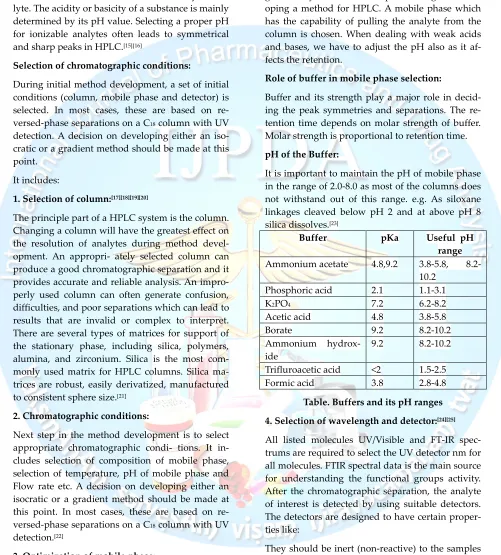
It is important to maintain the pH of mobile phase in the range of 2.0-8.0 as most of the columns does not withstand out of this range. e.g. As siloxane linkages cleaved below pH 2 and at above pH 8 silica dissolves.[23]
Buffer pKa Useful pH
range
Ammonium acetate 4.8,9.2 3.8-5.8, 8.2-10.2
Phosphoric acid 2.1 1.1-3.1
K2PO4 7.2 6.2-8.2
Acetic acid 4.8 3.8-5.8
Borate 9.2 8.2-10.2
Ammonium hydrox-ide
9.2 8.2-10.2
Trifluroacetic acid <2 1.5-2.5 Formic acid 3.8 2.8-4.8
Table. Buffers and its pH ranges
4. Selection of wavelength and detector:[24][25]
All listed molecules UV/Visible and FT-IR spec-trums are required to select the UV detector nm for all molecules. FTIR spectral data is the main source for understanding the functional groups activity. After the chromatographic separation, the analyte of interest is detected by using suitable detectors. The detectors are designed to have certain proper-ties like:
They should be inert (non-reactive) to the samples injected and the mobile phases passing through it.
Should be able to produce quick and quantitative response.
Reliable, uniform and reproducible detection and analytic data.
Compatible with all types of compounds under testing.
Should have good sensitivity (Ability to detect compounds at very low concentration in the ranges below μg, ng, etc.)
Types of HPLC detectors:
UV detectors: UV wavelength range of absorption is specific for sample.
Fluorescent detectors: In this detector the fluores-cence rays emitted by sample after absorbing inci-dent light is measured as a function of quality and quantity of the sample.
Electrochemical detectors: The principle is that when compound is either oxidized or reduced, the chemical reaction produces electron flow. This flow is measured as current which is the function of type and quantity of compound.
Photo diode-array detectors (PDA): It measures the entire absorption range i.e. it gives the scan of the entire spectrum.
Refractive index detectors: These are detectors which measure the change of refractive index of the eluant from the column with respect to pure mobile phase.
Developing the approach for analysis:
The selections of various chromatographic parame-ters like selection of mobile phase, selection of col-umn, selection of flow rate of mobile phase, selec-tion of pH of mobile phase. All of these parameters are selected on the basis of trials and followed by considering the system suitability parameters. Typ-ical parameters of system suitability are e.g. reten-tion time should be more than 5 min, the theoreti-cal plates should be more than 2000, the tailing factor should be less than 2, resolution between 2 peaks should be more than 5 %, R.S.D. of the area of analyte peaks in standard chromatograms should not be more than 2.0 %.[16]
Sample preparation:
The prepared sample should be an aliquot
relative-ly free of interferences that is suitable with the HPLC method and that will not damage the col-umn.[26][27]
Method optimization:
The mobile and stationary phase compositions need to be taken into account. Optimization of mo-bile phase parameters is always considered first as this is much easier and convenient than stationary phase optimization. To decrease the number of trial chromatograms involved, only the parameters that are likely to have a significant effect on selectivity in the optimization must be examined.[19][21]
Method validation:
The methods were validated according to Interna-tional Conference on Harmonization (ICH) guide-lines for validation of analytical procedures. Vali-dation is required for any new drug or amended method to ensure that it is capable of giving repro-ducible, precise and reliable results.[14]
Method validation:
“Validation of an analytical method is the process by which it is established by laboratory studies, that the performance characteristics of the method meet the requirements for the intended analytical application.[16][28][29] “Guidelines from the USP, ICH, FDA etc., can provide a framework for validations of pharmaceutical methods. The methods were validated according to International Conference on Harmonization (ICH) guidelines for validation of analytical procedures. Validation is required for any new drug or method to ensure that it is capa-ble of giving reproducicapa-ble and reliacapa-ble results, when used by different operators employing the same equipment in the same or different laborato-ries.[14]
Why is analytical method validation re-quired?[30][31]
For achieving the approval of the products by the international agencies.
For assuring the quality and safety of the product.
It is a mandatory requirement for accreditation as per ISO 17025 guidelines.
Validation not only improves the processes, but also confirms that the process is properly devel-oped.
Importance for the manufacturer:
It decreases the risk of preventing problems.
It decreases the risk of defect costs.
It decreases the risk of regulatory failure.
A fully validated process may require less in-process controls and final product testing.
Advantages:
The biggest advantage of method validation is that it builds a degree of confidence, not only for the developer but also to the user.
Although the validation exercise may appear costly and time consuming, it results inexpensive, elimi-nates frustra- ting repetitions and leads to better time management in the end.
Minor changes in the conditions such as reagent supplier or grade, analytical setup are unavoidable due to obvious reasons but the method validation absorbs the shock of such conditions and pays for more than invested on the process.
It builds confidence for not only the developer but also the user.
Types of analytical procedures:[32]
Discussion of the validation of analytical proce-dures is directed to the four most common types of analytical procedures:
Identification tests
Quantitative tests for impurities content
Limit tests for the control of impurities
Quantitative tests of the active moiety in samples of a drug substance.
Types of analytical parameters:
• Accuracy • Precision • Repeatability
• Intermediate precision • Reproducibility • Linearity • Detection limit • Quantitation limit
• Specificity • Range
• Robustness and Ruggedness • System suitability determination • Forced degradation studies • Solution stability studies
Accuracy:
It is sometimes termed as trueness. Accuracy is a measurement of closeness between the measured and real value. Comparison to reference standard. Recovery of analyte spiked into blank matrix stan-dard addition of the analyte. The reported limits for accuracy for drug substances and products are 98.0 – 102.0 % and 97.0 – 103.0 % respectively. For the impurity determination, range from 50 - 150 % of average recovery may be accepted.[33]
Precision:[22]
Precision of an analytical procedure expresses the closeness of agreement between a series of mea-surements obtained from multiple sampling of the same homogeneous sample under the prescribed conditions of Repeatability, Intermediate precision, Reproducibility.[34]
To ensure precision of method for major analytes, RSD should be 2 %. For low level impurities, RSD of 5-10 % is usually acceptable.
Repeatability:
Repeatability means the methods performs in one lab and on one instrument, within a given day. It is useful to calculate the ‘Repeatability limit’. Per-formed by prepa- ring a minimum of 6 determi- nations at 100% of the test concentration.
Reproducibility:
Reproducibility refers to how that method per-forms from lab to lab, day to day, analyst to analyst and from instrument to instrument again in both qualitative and quantitative terms. It is useful to calculate the ‘reproducibility limit’, R.
Intermediate precision:
Linearity:
The linearity of an analytical procedure is its abili-ty to obtain test results which are directly propor-tional to the concentration of analyte in the sample. Test results should be evaluated by appropriate statistical methods. For example, by calculation of a regression line by the method of least squares. [27]
Level Acceptance criteria
Assay (5 levels,
50-150% of label claim)
Correlation coeffi-cient,
R2 = 0.999
Dissolution
(5-8 levels,
10-150% of label claim)
% y intercept NMT 2.0%,
R2 = 0.99
Related substances (5 levels, LOQ to accep-tance)
% y intercept NMT 5.0%,
R2 = 0.99
Table: Linearity ranges and Acceptance criteria for various pharmaceutical methods
Detection limit: [34][35]
The detection limit of an individual analytical pro-cedure is the lowest amount of analyte in a sample which can be detected but not necessarily quanti-tated as an exact value.
The formula for calculating LOD is,
LOD= 3.3 × δ/S
Where,
δ = standard deviation of intercepts of calibration curves.
S = the slope of linearity plot.
Detection limit can be determined visually
Signal to Noise ratio
Standard Deviation of the Response and the Slope
Quantitation limit:[35]
The quantitation limit of an individual analytical procedure is the lowest amount of analyte in a sample which can be quantitatively determined
with suitable precision and accuracy. The quantita-tion limit is a parameter of quantitative assays for low levels of compounds in sample matrices, and is used particularly for the determination of impur-ities and degradation products. It can be deter-mined by following formula,
LOQ = 10 × δ/S
Where,
δ = standard deviation of response.
S = Mean of slopes of the calibration curves.
Specificity:
Specificity is the ability to measure the desired ana-lyte in the presence of components which may be expected to be present. Typically it may include impurities, degradants, matrix, etc. The peak puri-ty value must be more than 0.999 (for Agilent sys-tem) or purity angle is less than threshold (for Wa-ters system) in every case.[35]
Range:
The range of an analytical procedure is the interval between the upper and lower concentration of ana-lyte in the sample for which it has been demon-strated that the analytical procedure has a suitable level of precision, accuracy and linearity.[36]
Robustness:
The robustness of an analytical procedure is a measure of its capacity to remain unaffected by small, but deliberate variations in method parame-ters and provides an indication of its reliability during normal usage. The variable method para-meters in HPLC technique may include flow rate, column temperature, sample temperature, pH and mobile phase composition.[37][17]
System suitability:
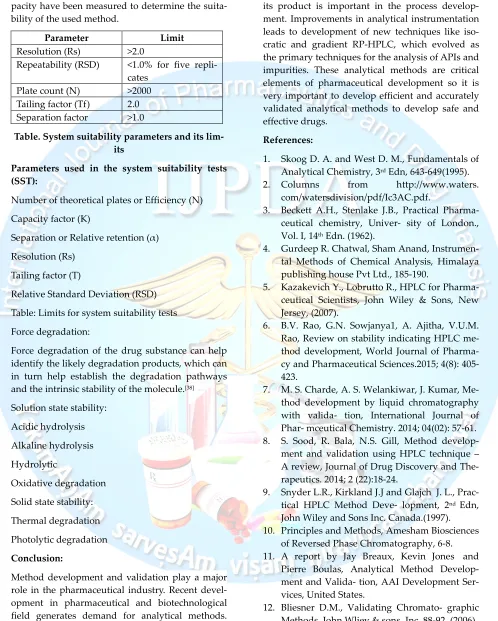
ca-pacity have been measured to determine the suita-bility of the used method.
Parameter Limit
Resolution (Rs) >2.0
Repeatability (RSD) <1.0% for five repli-cates
Plate count (N) >2000 Tailing factor (Tf) 2.0 Separation factor >1.0
Table. System suitability parameters and its lim-its
Parameters used in the system suitability tests (SST):
Number of theoretical plates or Efficiency (N)
Capacity factor (K)
Separation or Relative retention (α)
Resolution (Rs)
Tailing factor (T)
Relative Standard Deviation (RSD)
Table: Limits for system suitability tests
Force degradation:
Force degradation of the drug substance can help identify the likely degradation products, which can in turn help establish the degradation pathways and the intrinsic stability of the molecule.[38]
Solution state stability:
Acidic hydrolysis
Alkaline hydrolysis
Hydrolytic
Oxidative degradation
Solid state stability:
Thermal degradation
Photolytic degradation
Conclusion:
Method development and validation play a major role in the pharmaceutical industry. Recent devel-opment in pharmaceutical and biotechnological field generates demand for analytical methods. Rapid and accurate qua- ntification of the drug and
its product is important in the process develop-ment. Improvements in analytical instrumentation leads to development of new techniques like iso-cratic and gradient RP-HPLC, which evolved as the primary techniques for the analysis of APIs and impurities. These analytical methods are critical elements of pharmaceutical development so it is very important to develop efficient and accurately validated analytical methods to develop safe and effective drugs.
References:
1. Skoog D. A. and West D. M., Fundamentals of Analytical Chemistry, 3rd Edn, 643-649(1995). 2. Columns from http://www.waters.
com/watersdivision/pdf/Ic3AC.pdf.
3. Beckett A.H., Stenlake J.B., Practical Pharma-ceutical chemistry, Univer- sity of London., Vol. I, 14th Edn. (1962).
4. Gurdeep R. Chatwal, Sham Anand, Instrumen-tal Methods of Chemical Analysis, Himalaya publishing house Pvt Ltd., 185-190.
5. Kazakevich Y., Lobrutto R., HPLC for Pharma-ceutical Scientists, John Wiley & Sons, New Jersey, (2007).
6. B.V. Rao, G.N. Sowjanya1, A. Ajitha, V.U.M. Rao, Review on stability indicating HPLC me-thod development, World Journal of Pharma-cy and Pharmaceutical Sciences.2015; 4(8): 405-423.
7. M. S. Charde, A. S. Welankiwar, J. Kumar, Me-thod development by liquid chromatography with valida- tion, International Journal of Phar- mceutical Chemistry. 2014; 04(02): 57-61. 8. S. Sood, R. Bala, N.S. Gill, Method
develop-ment and validation using HPLC technique – A review, Journal of Drug Discovery and The-rapeutics. 2014; 2 (22):18-24.
9. Snyder L.R., Kirkland J.J and Glajch J. L., Prac-tical HPLC Method Deve- lopment, 2nd Edn, John Wiley and Sons Inc. Canada.(1997). 10. Principles and Methods, Amesham Biosciences
of Reversed Phase Chromatography, 6-8. 11. A report by Jay Breaux, Kevin Jones and
Pierre Boulas, Analytical Method Develop-ment and Valida- tion, AAI DevelopDevelop-ment Ser-vices, United States.
13. Sethi PD, HPLC Quantitative Anal-ysis of Pharmaceutical Formulations. 1st Edn., New Delhi: CBS Publishers & Distributors (2001). 14. Breaux J, Jones K, Boulas P., Understanding
and implementing efficient analytical methods develop- ment and validation. Pharm Technol Anal Chem Test. 2003; 5:6-13.
15. FDA Guidance for Industry, Analytical Proce-dures and Methods Validation (draft guid-ance), August 2000.
16. K. Huynh-Ba, Development of Stability indi-cating methods, Handbook of Stability Testing in Pharmaceutical Development, Sprin- ger. 2009; 153.
17. Christain GD, Analytical Chemistry, 6th Edn. USA: John Wiley & Sons Inc, (2001).
18. Columns from http://www.waters. com/watersdivision/pdf/Ic3AC.pdf.
19. Columns from www.agilent.com. 20. Columns from www.phenomenex. com. 21. B. Prathap, G.H.S. Rao, G. Devdass, A. Dey, N.
Harikrishnan, Review on Stability Indicating HPLC Method Development, International Journal of Innovative Pharmaceutical Re-search. 2012; 3(3): 229-237.
22. M.W. Dong, Modern HPLC for prac- ticing scientists, John Wiley & Sons, New Jersey, (2006).
23. Separations Solutions: Mobile Phase pH, U.D. Neue, American Labora- tory, March 60.1, (1999).
24. How do I Develop an HPLC Method. www.sgc.com.
25. Vibha G et al., Development and validation of HPLC method a review. International Re-search Jour- nal of Pharmaceutical and Ap-plied Sciences. 2012; 2(4):22-23.
26. N. Toomula, A. Kumar, S. D. Kumar, V.S. Bheemidi, Develop- ment and Validation of Analytical Methods for Pharmaceuticals, J. Anal. Bioanal. Techniques. 2011; 2(5): 1-4. 27. B. Nigovic, A. Mornar, M. Sertic,
Chromato-graphy-The Most Versatile Method of Chemi-cal Analysis, Intech. 385-425 (2012).
28. K. Kardani, N. Gurav, B. Solanki, P. Patel, B. Patel, RP-HPLC Method Development and Va-lidation of Gallic acid in Polyherbal Tablet Formulation, Journal of Applied Pharmaceuti-cal Science. 2013; 3(5): 37-42.
29. International Conference on Harmonization, Draft Guidance on specifications, Test proce-dures and acceptance criteria for new drug substances and products, Chemical Sub-stances. Fed. Regist. 2000; 3(5): 83041-63. 30. Putheti RR, Okigbo RN, Patil SC, Advanapu
MS, Leburu R. Method development and vali-dations, Characterization of critical elements in the development of pharma- ceuticals. Int J Health Res. 2008; 1:11-20.
31. Wood R. How to Validate Analytical Methods. Trends Analyt Chem. 2005; 54: 149-58.
32. Vessman J. Selectivity or specifi- city? Valida-tion of analytical methods from the perspec-tive of an analytical chemist in the pharma-ceutical industry. J Pharm Biomed Analyt, 1996; 14:867-9.
33. Hearn Perkin Elmer RA. www.standardbase.com., A Guide to Valida-tion in HPLC Based on the Work of G. M. Hol-land.
34. Lindner W, Wainer IW, Require- ments for initial assay validation and publication in J Chromatltography B. J Chromatogr. 2006; 707: 1.2.
35. Validation of Compendial Proce- dures, Unit-ed State Pharmacopeia, USP 36 NF, 27 (2) (2010).
36. Validation of Analytical Procedures: Text and Methodology, International Conferences on Harmonization, Draft Revised (2005), Q2 (R1).
37. Boulanger B, Chiap P, Dewe W, Crommen J,