ISSN Online: 2327-5227 ISSN Print: 2327-5219
DOI: 10.4236/jcc.2017.510007 Aug. 28, 2017 66 Journal of Computer and Communications
Predictive Block-Matching Algorithm for
Wireless Video Sensor Network Using
Neural Network
Zhuge Yan, Siu-Yeung Cho, Sherif Welsen Shaker
Department of Electrical and Electronic Engineering, Faculty of Science and Engineering, University of Nottingham Ningbo China, Ningbo, China
Abstract
This paper proposed a back propagation neural network model for predictive block-matching. Predictive block-matching is a way to significantly decrease the computational complexity of motion estimation, but the traditional predic-tion model was proposed 26 years ago. It is straight forward but not accurate enough. The proposed back propagation neural network has 5 inputs, 5 neu-trons and 1 output. Because of its simplicity, it requires very little calculation power which is negligible compared with existing computation complexity. The test results show 10% - 30% higher prediction accuracy and PSNR improve-ment up to 0.3 dB. The above advantages make it a feasible replaceimprove-ment of the current model.
Keywords
Wireless Sensor Network, Predictive Block-Matching, Neural Network, High Efficaciously Video Coding
1. Introduction
A good wireless multimedia sensor network (WMSN) must be energy efficient, for the possibility of operating in harsh environment and lack of maintenance [1] [2][3]. However, video encoding requires massive amount of calculation power. Taking H.264 standard as an example, processing an HDTV (720P) video signal in real time requires a 3600 GIPS processor with 5570 GB/s memory band-width [4][5], which exceeds the computing power of most desktop processor. Apart from implementing more advanced processers with higher energy efficiency ratio, which will increase the hardware cost, using more efficient encoding algorithm is a more How to cite this paper: Yan, Z.G., Cho,
S.-Y. and Shaker, S.W. (2017) Predictive Block-Matching Algorithm for Wireless Vid-eo Sensor Network Using Neural Network. Journal of Computer and Communications, 5, 66-77.
https://doi.org/10.4236/jcc.2017.510007
Received: June 15, 2017 Accepted: August 25, 2017 Published: August 28, 2017
Copyright © 2017 by authors and Scientific Research Publishing Inc. This work is licensed under the Creative Commons Attribution International License (CC BY 4.0).
http://creativecommons.org/licenses/by/4.0/
DOI: 10.4236/jcc.2017.510007 67 Journal of Computer and Communications practical option.
For a video encoding system, predictive coding is the key part and requires more calculation than other parts such as entropy coding. Motion estimation plays an important role in predictive coding [6] [7]. Therefore, in the field of video stream transmission for WMSNs, an energy-efficient block-matching algorithm is of high importance. There are variety of block-matching search algorithms for motion estimation, such as three-step search, four-step search, diamond search, modified diamond-square search and gradient descent search, etc. [6][7]. Pre-diction technique proposed by Zhang and Zafar [8], [9] uses a simple prediction model to reduce the search windows size for block-matching, therefore signifi-cantly reduced the calculation complexity of motion estimation, with only small sacrifice on image quality. It has been widely used by many researchers in dif-ferent block-matching algorithms [10][11][12]. The prediction model proposed by Zhang and Zafer is straight forward, simply assuming that the current block has the same motion vector as the block at the same place in the previous frame or around it in the same frame. However, in our test the model did not provide high prediction accuracy. Instead of taking a mean value, we believe the reference mo-tion vectors have certain weights. Therefore, we thought of artificial neural net-work (ANN).
An ANN mimics somewhat the learning process of a human brain. Instead of complex rules and mathematical routines, ANNs are able to learn the key infor-mation patterns within a multidimensional inforinfor-mation domain [13][14]. In this report we aim to use a simple back propagation neural network instead of the traditional prediction model, to improve the prediction accuracy. The results show that the proposed neural network can significantly improve the prediction accuracy and leads to better image quality. Because of the simplicity of the neur-al network, the required cneur-alculation is little.
2. Background Research
2.1. Motion Estimation
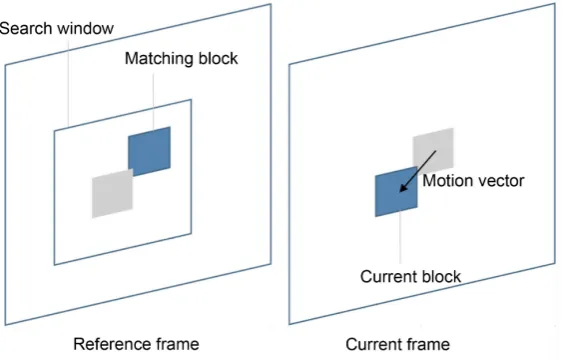
The principle of block-matching motion estimation is to find out the movement of each microblock compared with the previous frame. Getting motion vector is the first step to do predictive encoding for video compression. To find out the movement information, the current frame is divided into 16 × 16 pixels micro- blocks. Each microblock is compared to the reference frame in a search window of a certain size, therefore locate a microblock which has a minimum MAD (mean absolute difference) value as is shown in Figure 1. The lengths of the mi-croblock moved along the x axis and y axis in pixels are the motion vectors.
2.1.1. Three Step Search
DOI: 10.4236/jcc.2017.510007 68 Journal of Computer and Communications Figure 1. Block-matching motion estimation.
of ±7. If the search window is larger than ±7, then this algorithm needs more than 3 steps to finish the search. TSS uses a coarse-to-fine search pattern. Starting from the initial point, TSS compares 8 search points around it with a certain search step and finds the direction of block movement, then perform a more ac-curate search by reducing the search step. The description of TSS algorithm is detailed as follows:
Step 1: The step size is set as half of (search window size −1). Together with the initial point, the SAD values of 8 search points at the distance of step size are compared.
Step 2: The point which has the minimum SAD value is picked as the new ini-tial point, the step size is halved.
Step 1 and 2 are repeated until the step size is smaller than 1. Figure 2 shows the search pattern of TSS algorithm.
2.1.2. Enhanced Modified Orthogonal Search
Orthogonal search (OS) algorithm was introduced by Soongsathitanon et al.[16] in 2005. The search pattern is horizontally and vertically conducted alternatively (Figure 3(a)). It may be considered as improved TSS algorithm, which takes less number of search points. However, this algorithm has the same disadvantage as TSS does: it is inefficient for small motion estimation.
Modified Orthogonal search (MOS) algorithm was introduced by Metkar et al.[17] in 2010, meant to solve the small motion estimation problem. It adds 8 new search points as a 3 × 3 square around the initial point in the first search step (Figure 3(b)). The added 8 search points improve its performance on small motion estimation.
DOI: 10.4236/jcc.2017.510007 69 Journal of Computer and Communications Figure 2. Three-step search algorithm (search window ±7).
Figure 3. Search algorithms for motion estimation [18]. (a) Orthogonal search algorithm; (b) Modified orthogonal search algo-rithm; (c) Enhanced modified orthogonal search algorithm.
Step 1: An extra small diamond search pattern around the initial point is added in addition to the original horizontal search points in the first step of OS algorithm. If the initial point (0, 0) of the search window has the minimum SAD value, the block is assumed to have zero movement and search will be terminated. Other-wise, the point which has the minimum SAD value is selected as the new initial point.
[image:4.595.62.538.348.542.2]DOI: 10.4236/jcc.2017.510007 70 Journal of Computer and Communications compared. The initial point is moved to the winning point.
Step 3: Two points in the vertical direction at a distance of the step size from the initial point are compared with the initial point. The initial point is moved to the winning one.
Step 4: Halve the step size until it is smaller than 1, etc.
The early termination of the algorithm at step 1 helped to reduce the compu-tations significantly also retain the simplicity and regularity of EMOS algorithm. The number of search points needed to find the motion vector for EMOS as com-pared with the MOS, OS and TSS algorithms.
2.2. Predictive Block-Matching Motion Estimation Scheme
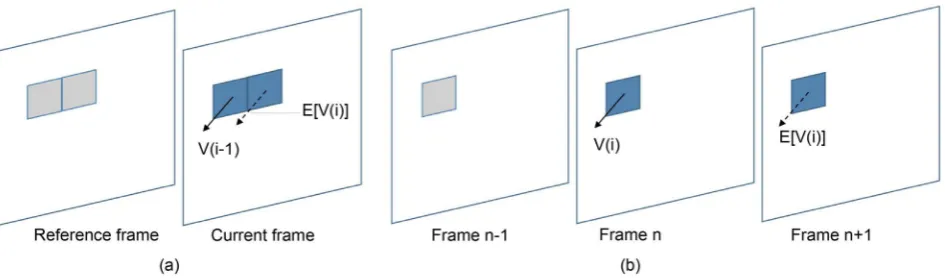
Predictive block-matching motion estimation scheme was introduced in 1991, namely predictive pattern search (PPS) [8] [9]. PPS has two prediction modes: inter-block prediction and inter-frame prediction. Inter-block prediction assumes neighboring blocks usually have the same or similar moving direction and dis-tance. Therefore, via the reference of a nearby motion vector, the search window for the current block can be reduced, hence reduces the number of search points. Inter-frame prediction assumes a current block moves to the same or similar di-rection at the same or a similar distance compared with the corresponding block in the previous frame. Figure 4 demonstrates the way inter-block and inter-frame prediction works.
Predictive Enhanced Modified Orthogonal Search (PEMOS), performs both inter-block and inter-frame prediction. The estimation of the current vector can be calculated using an autoregressive model given by [8][9]:
(
)
{
1}
,(
)
,
, ,
i p q i
p q
E V m n V m q n q
θ
α
+
∈
=
∑
− − (1)where
{ }
α
p q, is a set of prediction coefficients and θ can be a causal, semi-causal or noncausal set defined by [8]:
Causal set: θ=
{
p q q, : > ∀0 p} {
p q q, : =0,p>0}
Semi-causal set: θ=
{
p q q, : > ∀0 p} {
p q q, : = ∀ ≠0, p 0}
[image:5.595.62.535.554.693.2]Noncausal set:
θ
={
p q, :∀(
p q,)
∈δ
}
DOI: 10.4236/jcc.2017.510007 71 Journal of Computer and Communications According to [8] and [9], for inter-block prediction, a casual model is used. For inter-frame prediction, any one of the three might be used.
Predictive search scheme has been added to different search algorithms and proved effective. For example, [10] proposed predictive three step search, which adds predictive block-matching scheme to three step search. The results show that predictive three step search significantly reduces computational complexity, with negligible decrease on image quality.
Another example is [11], which added predictive block-matching scheme to EMOS. EMOS is believed to be one of the most efficient block-matching algo-rithms [6]. According to [11], the proposed algorithm used Zhang and Zafer’s prediction model to estimate the motion vectors, therefore the first step of EMOS can be skipped, i.e., a smaller search window is used. If the estimated motion vector is very small, an even smaller search pattern will be used. As a result, PEMOS can reduce computational complexity up to 30%, also with very slight decrease on image quality.
2.3. Back Propagation Neural Network
[image:6.595.267.482.444.707.2]Rumelhart and McCelland published a book namely Parallel Distributed Processing [19], discussed the algorithm Error Back Propagation in detail. Today back prop-agation neural network has become one of the most widely used artificial neural network models [13]. It is widely used in the field of function approximation, pat-tern recognition, data mining, system identification, automation technology and so on [14].
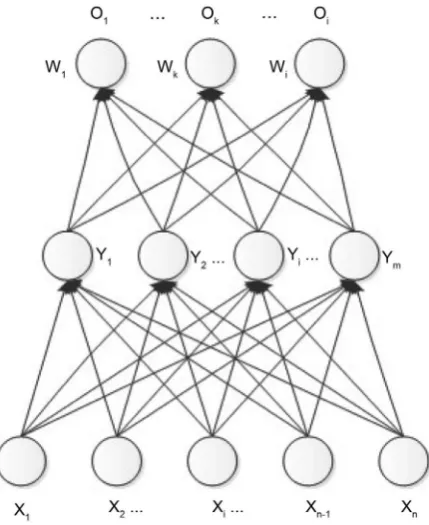
Figure 5 shows a typical single hidden layer back propagation neural network
DOI: 10.4236/jcc.2017.510007 72 Journal of Computer and Communications model. It includes an input layer, a hidden layer and an output layer.
For the hidden layer, we have:
( )
, 1, 2, ,i j
y = f net j= m (2)
where
0
, 1, 2, , n
j ij i
i
net v x j m =
=
∑
= (3)For the output layer, we have:
(
)
, 1, 2, ,k k
o = f net k= l (4)
where
0
, 1, 2, , m
k jk j
j
net w y k m =
=
∑
= (5)In Equations (2) and (3), the transform function f (x) can be sigmoid func-tions similar as Equafunc-tions (7) or (8), according specific applicafunc-tions.
( )
11 e x
f x = −
+ (6)
( )
1 e1 e x
x f x
−
−
− =
+ (7)
3. Proposed Neural Network for Predictive Block-Matching
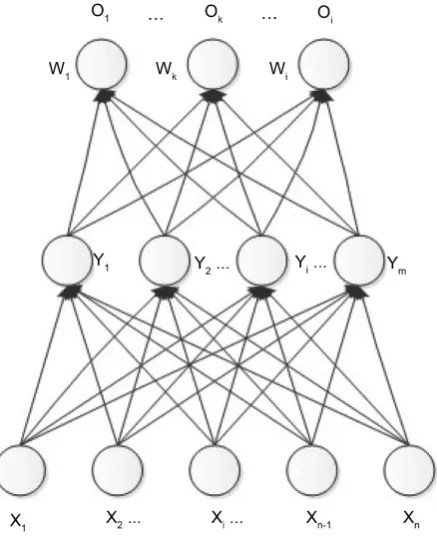
[image:7.595.266.485.439.708.2]A back propagation neural network model with 5 inputs, 1 hidden layer which contains 5 neutrons, and 1 output is used in this report (Figure 6).
DOI: 10.4236/jcc.2017.510007 73 Journal of Computer and Communications The five inputs are: the motion vector at the same place in the previous frame, the motion vectors at top left, top, top right and left of the current block in the current frame. The number of hidden neutrons is decided applying the following equation [20]:
(
)
Number of hidden neurons 1
inputs outputs number of training patterns 2
= + ⋅ (8)
The number of training patterns was assumed to be 4. Although the actual training patterns are more than 4, in order to keep the simplicity of neural net-work model, we consider motion vector values (positive, positive), (positive, nega-tive), (negative, posinega-tive), (negative, negative) as 4 patterns. The training data con-tains 2000 sets of values generated using full search in the platform MATLAB. A linear transform function is used for computation simplicity.
4. Results and Discussion
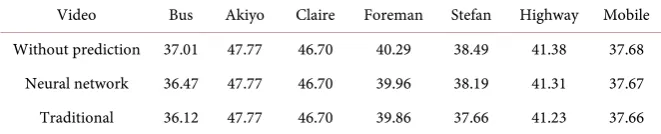
In order to find out the effectiveness of neural network prediction, three block-matching algorithms introduced in Section 0were tested, respectively full search, three step search and enhanced modified orthogonal search. We recorded prediction accu-racy with different prediction schemes, image quality in terms of peak signal to noise ratio (PSNR) and energy efficiency in terms of average search points required per block.
In our test, for traditional prediction scheme, the mean value of inter-block and inter-frame prediction is used for the estimation of motion vector E V i+1
(
m n,)
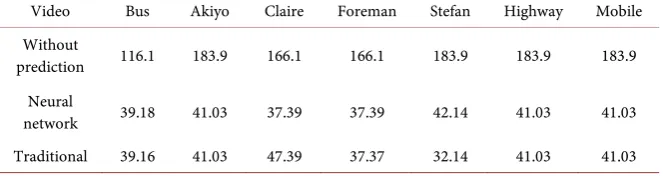
. [image:8.595.207.540.558.617.2] [image:8.595.207.538.652.719.2]Several videos were tested using different block-matching search algorithms. Table 1 shows the prediction accuracy of the proposed back propagation neural network compared with traditional prediction scheme. Tables 2-7 illustrate av-erage search points needed per block, and the avav-erage peak signal-to-noise ratio (PSNR) which represents the image quality for different video and different search algorithms.
Table 1. Prediction accuracy comparison between neural network and traditional method.
Video Bus Akiyo Claire Foreman Stefan Highway Mobile
Neural
network 54.3% 91.1% 52.4% 74.5% 39.6% 85.9% 55.7%
Traditional 84.9% 97.3% 78.0% 91.9% 61.9% 95.2% 86.1%
Table 2. PSNR (dB) performance with full search (search window ±7).
Video Bus Akiyo Claire Foreman Stefan Highway Mobile
Without prediction 37.01 47.77 46.70 40.29 38.49 41.38 37.68
Neural network 36.47 47.77 46.70 39.96 38.19 41.31 37.67
DOI: 10.4236/jcc.2017.510007 74 Journal of Computer and Communications Table 3. Average search points per block with full search (search window ±7).
Video Bus Akiyo Claire Foreman Stefan Highway Mobile
Without
prediction 116.1 183.9 166.1 166.1 183.9 183.9 183.9
Neural
network 39.18 41.03 37.39 37.39 42.14 41.03 41.03
[image:9.595.208.539.213.300.2]Traditional 39.16 41.03 47.39 37.37 32.14 41.03 41.03
Table 4. PSNR (dB) performance with three step search (search window ±7).
Video Bus Akiyo Claire Foreman Stefan Highway Mobile
Without
prediction 36.54 47.74 46.69 40.05 38.22 41.13 37.59
Neural
network 36.28 47.56 46.51 39.75 37.71 41.14 37.54
[image:9.595.208.539.334.422.2]Traditional 36.22 47.62 46.55 39.74 37.55 41.14 37.32
Table 5. Average search points per block with three step search (search window ±7).
Video Bus Akiyo Claire Foreman Stefan Highway Mobile
Without
prediction 20.05 20.89 19.34 19.60 21.03 21.20 20.96
Neural
network 15.91 15.72 15.27 15.51 15.84 16.02 15.79
[image:9.595.208.539.455.543.2]Traditional 15.93 15.72 15.27 15.50 15.84 16.02 15.78
Table 6. PSNR (dB) performance with EMOS (search window ±7).
Video Bus Akiyo Claire Foreman Stefan Highway Mobile
Without
prediction 36.22 47.62 46.55 39.75 37.55 41.08 37.58
Neural
network 36.22 47.70 46.63 39.73 37.73 41.08 37.59
[image:9.595.207.539.576.664.2]Traditional 36.14 47.70 46.63 39.75 37.54 41.06 37.29
Table 7. Average search points per block with EMOS (search window ±7).
Video Bus Akiyo Claire Foreman Stefan Highway Mobile
Without
prediction 11.03 6.35 6.72 9.74 10.61 11.48 110.49
Neural
network 8.60 4.67 5.02 7.80 7.70 7.80 6.75
Traditional 8.80 4.67 5.01 8.03 7.87 8.18 7.75
DOI: 10.4236/jcc.2017.510007 75 Journal of Computer and Communications with videos with smaller movements such as “Akiyo” and “Claire”. However the average search points decrease to around a quarter using predicting schemes. Compared with traditional prediction scheme, neural network prediction can provide slightly higher image quality, because of its higher prediction accuracy as is shown in Table 1.
[image:10.595.206.540.661.730.2]Using predictive block-matching schemes on three step search and EMOS shows similar results, as is illustrated in Tables 4-7. Orthogonal search (OS) can be seen as an improved version of TSS, and EMOS is improved OS. EMOS is al-ready one of the most efficient block-matching algorithms. However, using pre-dictive schemes is still an effective way to further improve its efficiency. Using neural network to predict the motion vector again is more accurate than the tra-ditional approach, and leads to higher image quality without adding too much computation complexity.
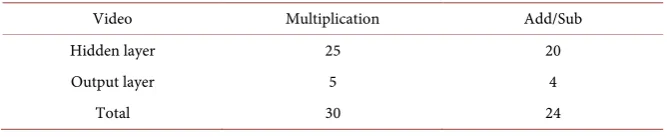
Table 8 illustrates the computational complexity of the neural network for each block. Take EMOS as an example, assuming number of required search points per block is 7. The required numerical operation includes 3584 add or sub and 1792 absolute value for each block. The additional calculation complexity for the neural network is negligible compared with the existing calculation. Con-sidering the improvement on prediction accuracy and image quality, it is very feasible to use neural network for motion vector prediction.
5. Future Work
As the proposed back propagation neural network requires little calculation, in the future, implementation on real-time system might be carried out. The sim-plicity of the neural network model makes it not difficult to be implemented on either FPGA systems or embedded systems with general processors. Its perfor-mance in practice is to be found out and compared with the MATLAB simula-tion results after that.
6. Conclusion
This report proposed a predictive model for block-matching based on neural net-work. This model is a back propagation neural network with 5 neutrons, aiming to improve the prediction accuracy of predictive block-matching schemes, with lit-tle computation cost. The results approve that the proposed model is effective. Firstly, Compared with the traditional predictive scheme, neural network shows great advantage in prediction accuracy, especially when the video has large movements. In addition, we did three sets of tests, respectively: without using prediction,
Table 8. Computational complexity of back propagation neural network.
Video Multiplication Add/Sub
Hidden layer 25 20
Output layer 5 4
DOI: 10.4236/jcc.2017.510007 76 Journal of Computer and Communications using neural network prediction, and using traditional prediction scheme. For each case, three widely used block-matching algorithms were tested. Using neur-al network results in better image quneur-ality than using traditionneur-al prediction, and the value average search points stay the same or become less. In some cases, the image quality is better than without using prediction. Because of the simplicity of the neural network model, it can be easily implemented on existing designs, and requires very little computational power. In conclusion, using the proposed neural network is an effective way to improve the image quality of video encoding sys-tems using predictive block-matching algorithms, and the cost on computational complexity is very small.
Acknowledgements
The work was partly supported by the Zhejiang Natural Science Foundation un-der grant No. LY13F010014.
References
[1] Akyildiz, I.F., Melodia, T. and Chowdhury, K.R. (2007) A Survey on Wireless Mul-timedia Sensor Networks. Computer Networks, 51, 921-960.
https://doi.org/10.1016/j.comnet.2006.10.002
[2] Akyildiz, I.F., Melodia, T. and Ghosal, D. (2008) Wireless Sensor Network Survey.
Computer Networks, 14, 32-39.
[3] Yick, J., Mukherjee, B. and Chowdhury, K.R. (2007) Wireless Multimedia Sensor Networks: A Survey. IEEE Wireless Communications, 52, 2292-2330.
[4] Chen, T.C., Lian Jr, C. and Chen, L.G. (2007) Hardware Architecture Design of an H. 264/AVC Video Codec. Proceedings of the 2006 Asia and South Pacific Design Automation Conference, Yokohama, 24-27 January 2006, 750-757.
[5] Chen, T.C., Chien, S.Y. and Huang, Y.W. (2006) Analysis and Architecture Design of an HDTV720p 30 Frames/s H. 264/AVC Encoder. IEEE Transactions on Circuits and Systems for Video Technology, 16, 673-688.
https://doi.org/10.1109/TCSVT.2006.873163
[6] Chee, C.S., Jambek, A.B. and Hussin, R. (2012) Review of Energy Efficient Block- Matching Motion Estimation Algorithms for Wireless Video Sensor Networks. 2012
IEEE Symposium on Computers & Informatics (ISCI), Penang, 18-20 March 2012, 241-246. https://doi.org/10.1109/ISCI.2012.6222702
[7] Huang, Y.W., Chen, C.Y. and Tsai, C.H. (2006) Survey on Block Matching Motion Estimation Algorithms and Architectures with New Results. Journal of VLSI Signal Processing Systems for Signal, Image and Video Technology, 42, 297-320.
https://doi.org/10.1007/s11265-006-4190-4
[8] Zafar, S., Zhang, Y.Q. and Baras, J.S. (1991) Predictive Block-Matching Motion Es-timation for TV coding. I. Inter-Block Prediction. IEEE Transactions on Broad-casting, 37, 97-101. https://doi.org/10.1109/TBC.1991.1492730
[9] Zhang, Y.Q. and Zafar, S. (1991) Predictive Block-Matching Motion Estimation for TV Coding. II. Inter-Frame Prediction. IEEE Transactions on Broadcasting, 37, 102-105. https://doi.org/10.1109/11.99095
DOI: 10.4236/jcc.2017.510007 77 Journal of Computer and Communications Vision and Image Processing (MVIP), Zanjan, 10-12 September 2013, 48-52.
https://doi.org/10.1109/IranianMVIP.2013.6779948
[11] Yan, Z.G. and Welsen, S. (2016) Predictive Enhanced Modified Orthogonal Search Algorithm with Two Patterns for Wireless Video Sensor Network. Asia Pacific Conference on Multimedia and Broadcasting, Bali, 17-19 November 2016, 60-65. [12] Ahmed, Z., Hussain, A.J. and Al-Jumeily, D. (2011) Mean Predictive Block
Match-ing (MPBM) for Fast Block-MatchMatch-ing Motion Estimation. 3rd European Workshop on Visual Information Processing, Paris, 4-6 July 2011, 67-72.
[13] Demuth, H.B., Beale, M.H. and De Jess, O. (2014) Neural Network Design, Martin Hagan.
[14] Schmidhuber, J. (2015) Deep Learning in Neural Networks: An Overview. Neural Networks, 61, 85-117.
[15] Koga, T. (1981) Motion-Compensated Interframe Coding for Video Conferencing.
Proceedings of National Telecommunication Conference, New Orleans, 29 No-vember-3 December 1981, G5.3.1-G5.3.5.
[16] Soongsathitanon, S., Woo, W.L. and Dlay, S.S. (2005) Fast Search Algorithms for Video Coding Using Orthogonal Logarithmic Search Algorithm. IEEE Transactions on Consumer Electronics, 51, 552-559.
[17] SMetkar, S.P. and Talbar, S.N. (2010) Fast Motion Estimation Using Modified Or-thogonal Search Algorithm for Video Compression. Signal, Image and Video Processing, 4, 123-128.https://doi.org/10.1007/s11760-009-0104-9
[18] Pandian, S., Bala, G.J. and Anitha, J. (2011) Enhanced Modified Orthogonal Search for Motion Estimation. Recent Advances in Intelligent Computational Systems, Trivandrum, 22-24 September 2011, 907-910.
[19] Rumelhart, D.E. and McClelland, J.L. (1988) Parallel Distributed Processing. [20] Kalogirou, S.A. and Bojic, M. (2000) Artificial Neural Networks for the Prediction
of the Energy Consumption of a Passive Solar Building. Energy, 25, 479-491.
Submit or recommend next manuscript to SCIRP and we will provide best service for you:
Accepting pre-submission inquiries through Email, Facebook, LinkedIn, Twitter, etc. A wide selection of journals (inclusive of 9 subjects, more than 200 journals)
Providing 24-hour high-quality service User-friendly online submission system Fair and swift peer-review system
Efficient typesetting and proofreading procedure
Display of the result of downloads and visits, as well as the number of cited articles Maximum dissemination of your research work
![Figure 3. Search algorithms for motion estimation [18]. (a) Orthogonal search algorithm; (b) Modified orthogonal search algo-rithm; (c) Enhanced modified orthogonal search algorithm](https://thumb-us.123doks.com/thumbv2/123dok_us/1577332.703952/4.595.263.484.69.312/algorithms-estimation-orthogonal-modified-orthogonal-enhanced-orthogonal-algorithm.webp)