Research Article
CODEN: IJPNL6
A SCIENTIFIC ANALYSIS OF THE ALIQUOT METHOD OF WEIGHING
Michalakis Savva PhD
8 Thessalias street, Ilioupolis – Athens, Attica 16342, Greece
*Corresponding author e-mail:
[email protected]
ABSTRACT
A comprehensive description of the application of the aliquot method of weighing in two different method examples is presented and the potential errors associated with the drug concentration in the powder mixture and in finished products are compared.
Keywords: Aliquot method, least allowable weight, maximum potential error, sensitivity requirement
INTRODUCTION
The aliquot method of weighing is quite a clever approach, which is invited to solve the problem of having to weigh an amount of drug less than the least allowable weight (LAW) within a maximum allowable error (MAE) using a weighing balance of inadequate sensitivity. As the word implies, in the aliquot method of weighing, the drug is initially weighed in quantities much higher than those requested in the master formula and then mixed with an appropriate amount of vehicle to form the maternal or stock mixture. The amount of excipient added should be such that the ratio of the drug to the stock mixture is the same as the ratio of the total dose to the powder mixture specified in the original master formula. From the stock mixture, an aliquot or a
portion that was calculated to provide the desired quantity of the drug is weighed again to prepare the batch. The method is quite flexible about the amount of the maternal mixture we prepare, provided that at the end we use the right portion from the stock mixture containing the desired dose of the drug, so that the error in drug concentration does not exceed the maximum allowable error. Although the method is in the learning objectives of the pharmaceutical compounding labs, there was never a comprehensive analysis of the method and the potential errors that result from its application in the drug dose in the literature. We present next this difficult but useful method using an example of a drug compounding preparation.
THE METHODS
Example: Prepare 12 capsules, each weighing 300 mg, of the following formulation within a 5 % MAE in the unit dose using a balance of sensitivity requirement (SR) equal to 6 mg.
Drug x 2 mg excipient, l 298 mg
Method 1 (new):
Drug (x) needed to fill 12 capsules = 24 mg Excipient (l) needed to fill 12 capsules = 3576 mg Total mixture (F) needed to prepare the batch = 3600 mg
%
25
100
24
6
100
%
mg
mg
value
desired
SR
error
(> MAE = 5 %) eq. 1International Journal of Pharmacy
Since the error is bigger than the MAE we employ the aliquot method of weighing. We first identify the number of weighings that involve the drug, assign symbols to them using uppercase letters and to the corresponding potential errors using lowercase letters. The total cumulative error in drug dose is set
to be equal to the MAE. The total number of drug measurements involved in the preparation is three: (1) the drug that is going to be mixed with the excipient to form the stock powder, (2) the aliquot and (3) the mixture contained in each capsule.
Let,
Q: the drug quantity that is going to be mixed with pure excipient, l, to form the stock powder, S; q is the error associated with Q.
A: the aliquot quantity that will be taken from the stock powder, S; is the error associated with A.
F: the final mixture that is used to fill the capsules, i.e., 3.6 g.
M: the contents of each capsule, equal to 300 mg; m is the error associated with M.
MAE = q + + m = 5 % eq. 2
The error incurred in the measurement of each capsule is,
100
2
%
300
6
mg
mg
m
.We set A = F = 3.6 g to obtain all the mixture we need to prepare the batch. Since there is no dilution involved in the preparation of the aliquot the drug concentration is the same as that in the stock powder from which it is taken from and thus, the aliquot measurement doesn’t contribute to the dose error ( = 0). Substituting these errors on eq. 2 yields, q = 3 % and using eq. 1 we calculate
Q
mg
100
200
mg
3
6
as the adjusted Least WeighableQuantity (LAW).
Finaly, we build a ratio and determine the stock mixture S, so that a portion of it equal to 3.6 g (aliquot A) contains the drug total dose (24 mg).
S
Q
A
D
eq. 3
⇒
mixture
of
mg
S
drug
of
mg
mixture
of
mg
drug
mg
200
3600
24
⇒S
30
g
of stock mixtureBut S = l + Q ⇒ l = S – Q = 29800 mg
In total, we make 30 g of total mixture by weighing and mixing 200 mg of drug and 29800 mg of excipient. From this mixture, we use an aliquot equal to 3600 mg, which contains exactly 24 mg of drug.
Method 2 (old): The initial steps are the same but instead of setting up A = F, A is set to be equal to Q (LAW) or some multiple of D ≥ Q close to the value of the LAW. We are going to use A = Q = LAW, because it is used most commonly in some textbooks. The adjusted MAE = 5 – 2 = 3 %, LAW = 200 mg and we calculate the stock mixture
S using eq. 3.
mixture
of
mg
S
drug
of
mg
mixture
of
mg
drug
mg
200
200
24
⇒S
1666
.
7
mg
and l1 = 1466.7 mgMethod 2 carries an additional step. The aliquot has to be diluted with more excipient (l2= 2400 mg) to make the final mixture equal to 3.6 g. This action effectively changes the concentration of the drug in the aliquot as related to that in the stock powder and causes an additional error () to the final drug dose.
Total % Error = q + + m = 3 + 3 + 2 = 8 %
In order to achieve a total error in the dose equal to 5 % we need to double Q (and A; Q = A) to effectively halve the respective errors associated with these two measurements.
⇒ q + = 3 % , q = ⇒ q = 1.5 % = and
Q
A
mg
100
400
mg
5
.
1
6
Using equation 3,
mixture
of
mg
S
drug
of
mg
mixture
of
mg
drug
mg
400
400
24
⇒
S
6666
.
67
mg
, l1 = 6266.67 mg, l2 = 3200 mg and ltotal = 9466.67 mgThe process has as follows: we weigh 400 mg of drug and 6266.67 of excipient and mix it to form 6.6667 g of stock powder. From the stock, we weigh an aliquot of 400 mg and mix it with 3200 mg of lactose (l2) to make 3600 mg of powder mixture required to fill the capsules (F).
RELIABILITY CHECK OF THE METHODS
Method 1: Considering that we have performed two independent drug weighings, pure drug 200 mg and the powder corresponding to each capsule (300 mg), the sum of the two errors should yield the total error associated with the drug in the dose. We already know that the error associated with the measurement of the capsule is 2 %. We could find the percent error associated with the measurement of the drug using eq. 1.
3
100
200
6
mg
mg
% error
The total error in the final dose is 2 % + 3 % = 5 %.Alternatively, we can calculate the error associated with the drug concentration in the mixture (the drug concentration is the same in the stock powder, aliquot or final mixture) by first defining the variation of drug in the mixture. [1]
l
x
x
C
eq. 4The relative error associated with the drug concentration when drug and excipients are measured on instruments of same sensitivity is calculated by equation 5.
03
.
0
200
6
mg
mg
Q
SR
C
dC
eq. 5
03
.
0
C
dC
is called the relative error, it is unitless and it is related to the absolute error dC with equation 6,
drug
the
of
value
ideal
error
absolute
error
relative
eq. 6The absolute error is,
dC
C
0
.
03
0
.
0002
mg
/
mg
300
2
03
.
0
.In order to make sense of our answer we need to recognize that C and dC have units of concentration, weight per weight. Accordingly, the weight concentration of the drug in the stock mixture or in the aliquot or in the final powder mixture (F), is equal to,
The drug quantity in the final mixture is found by multiplying the drug concentration with the aliquot. Therefore the minimum and maximum concentration values of the drug would be,
Cmin = Cave – 0.0002 = 0.006467 < Cave = 0.006667 < Cmax + 0.0002 =0.006867 Similarly, the minimum and maximum quantities of the drug, D- and D+, are,
D- = A ∙ Cmin = 3600 mg 0.006467 mg/mg = 23.28 mg
D+ = A ∙ Cmax = 3600 mg 0.006867 mg/mg = 24.72 mg and
Dave = A ∙ Cave = 3600 mg 0.006667 mg/mg = 24 mg The percent errors associated with these two quantities are,
%
0
.
3
100
24
24
28
.
23
%
error
,100
3
.
0
%
24
24
72
.
24
%
error
⇒
3
%
2
%
error
ave
error
error
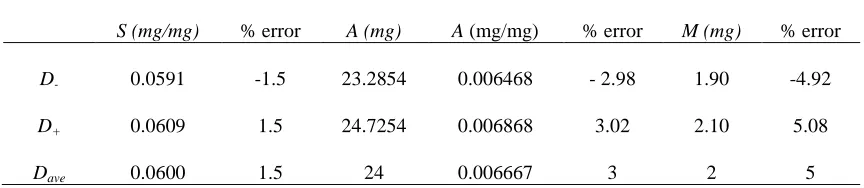
Method 2: In total we have 5 different measurements Q, l1, A, l2 and M but, only 3 of them contain the drug (Q, A and M). As we mentioned before, because the aliquot is diluted with excipient, its drug concentration changes and thus it contributes to the total error of the dose in the final preparation. The proof that the total potential error in drug dose is 5 % is given below in the Table (last column).
Table 1: Drug quantity, concentration and errors of Method 2 with Q = A = 400 mg
S (mg/mg) % error A (mg) A (mg/mg) % error M (mg) % error
D- 0.0591 -1.5 23.2854 0.006468 - 2.98 1.90 -4.92
D+ 0.0609 1.5 24.7254 0.006868 3.02 2.10 5.08
Dave 0.0600 1.5 24 0.006667 3 2 5
The symbols in the first column D-, D+ and Dave represent the minimum, maximum and average drug quantity (fourth and seventh column) or concentration (second and fifth column of Table 1).
The second and third columns represent the drug concentration in mg per mg of mixture and the percent error in the stock powder. Drug concentration in stock mixture is calculated from
mg
mg
mg
S
Q
67
.
6666
6
400
. For example,mg
mg
mg
mg
mg
/
0591
.
0
67
.
6666
6
400
.
The fourth, fifth and sixth columns represent the drug quantity, drug concentration and percent error associated with the drug in the mixture. Drug quantity in the aliquot is calculated by multiplying the aliquot mass with the drug concentration in the stock mixture (second column). For example,
mg
mg
mg
mg
0
.
0609
24
.
7254
406
. Drugconcentration in the aliquot is calculated by dividing the drug amount in the aliquot (fourth column) with the powder needed to fill 12 capsules. For example,
mg
mg
mg
mg
/
006868
.
0
3600
7254
.
24
in the mixture needed to fill the capsules (fifth column) with the mass of each capsule. For Dave,
mg
mg
mg
mg
0
.
006667
2
300
.COMPARISON OF THE TWO METHODS
The differences between the two methods are summarized in the next Table. Table 2: Comparison of the two Aliquot Methods of Weighing
Method 1 Method 2
Number of measurements less more
Drug quantity less more
Excipient quantity more less
Maximum potential error lower higher
Use of Stock mixture easy more complicated
Arbitrary decisions in the method none yes
Applicability wide limited
Method 1 is easier and faster since there is one less weighing in the process. Unlike method 2, which arbitrarily fixes Q = A essentially doubling the LAW, method 1 is more flexible and resourceful. It encourages rational thinking and creativity and there is no subjectivity in the method. In method 1, we always use an aliquot quantity that is equal to the powder mixture (F) required to fill the compounding formula and calculate the excipient quantity needed to make the stock powder (S), so that the drug dose-to-capsule ratio is always the one specified in the Master manufacturing or compounding formula. It needs to be emphasized once more that in method 1,
F is used solely to calculate S. You don’t have to
actually weigh F. This approach renders the method extremely easy to use for smaller or larger batches of the master formula, without having any effect on the maximum potential error in the drug dose. All that is required is to weigh more mixture from the existing stock powder. Contrary to that, preparation of fewer or more capsules using method 2 requires new calculations, since the drug-to-excipient ratio in the aliquot changes, affecting anew the maximum potential error in drug dose.
Regarding the potential use of the stock mixture in the future, since the drug and excipient
quantity is much higher and much lower, respectively, in method 2, the stock mixture is more concentrated with respect to drug. There are two advantages in this: first a more concentrated stock mixture has more chances to be used in another compounded formulation that calls for the same drug and excipient, and second, it is easier to be stored. However, the fact that the stock mixture of method 1 is so easy to use, as is, for the same customer in the future, it makes it more likely to be reused sooner. As far as expenses are involved, usually the best way to minimize the cost of the prescription is to reduce the drug quantity in the stock mixture as drugs are always more expensive than excipients. Method 1 always requires lower drug amount than method 2. In our formulation examples, the difference in drug quantity in the two methods was twofold but we have used approximately 3 times more excipient in method 1. If the excipient is not at least 1.5 times cheaper than the drug, the cost of the preparation using method 1 will be higher.
CONCLUSION
Although both methods are of educational value, method 1 maintains a clear advantage over method 2.
REFERENCES: