
Original Article
Enhancement of Dissolution rate of Ciprofloxacin by using various
Solid Dispersion Techniques
Kameswararao Sankula
*, Saieswar Kota, Srinath Nissankarrao
Department of Pharmaceutics, Sri Siddhartha Pharmacy College, Ammavarithota, Nvzvidu-521201, Andhra Pradesh, India
A R T I C L E I N F O A B S T R A C T
_________________________________________________________
Corresponding author *
E-mail address: [email protected] (Kameswararao Sankula)
1. INTRODUCTION
The poor solubility and low dissolution rate of poorly
water soluble drugs in the aqueous gastro-intestinal
fluids often cause in sufficient bioavailability rather
International Journal of Pharma Research and Health Sciences
Available online at
www.pharmahealthsciences.net
Received: 13 Feb 2014 Accepted: 24 Feb 2014
Key words:
Solid dispersions, Solubility, Dissolutionrate,Ciprofloxacin, Croscarmellose sodium. .
than the limited permeation through the epithelia and
the formulation of poorly soluble drugs for oral
delivery now presents one of the major challenges tom
formulation scientists in the industries 1. The term
solubility is defined as maximum amount of solute that
can be dissolved in a given amount of Solvent
quantitatively it is defined as the concentration of the
solute in saturated solution at a certain temperature in
qualitative terms, solubility may be defined as
spontaneous interaction of two or more substances to
form a homogenous molecular dispersion 2.
Mechanism of action
Ciprofloxacin is a semi-synthetic (partially man-made),
oral antibiotic in the cephalosporin family of
antibiotics that stops bacteria from multiplying by
preventing bacteria from forming the walls that
surround them and it inhibit the cell wall synthesis. The
walls are necessary to protect bacteria from their
environment and to keep the contents of the bacterial
cell together; bacteria cannot survive without a cell
wall 3.
Solid dispersions
The term solid dispersion refers to a group of solid
products consisting of at least two different
components, generally a hydrophilic matrix and a
hydrophobic drug. The matrix can be either crystalline
or amorphous. The drug can be dispersed molecularly,
in amorphous particles (clusters) or in crystalline
particles 4 .Therefore, based on their molecular
arrangement, six different types of solid dispersions
can be distinguished. They are described in Table 2.
Moreover, certain combinations can be encountered,
i.e. in the same sample; some molecules are present in
clusters while some are molecularly dispersed 5.
Moreover, not the preparation method but the
molecular arrangement governs the properties of solid
dispersions 6.
Advantages of solid dispersion
Particles with reduced particle size, Particles with
improved wettability, Particles with higher porosity,
Drugs in amorphous state 7.
Preparation methods of solid dispersions 8
(a) Solid dispersion techniques.
(b) Solvent evaporation method.
(c) Fusion method/melting method.
(d) Hot melt extrusion.
(e) Supercritical fluid technology (SCF).
(f) Dropping method.
(g) Electrostatic Spinning Method.
(h) Co-precipitation method.
2. MATERIALS AND METHODS
2.1 Materials
Ciprofloxacin (Pellets Pharma Ltd), Croscarmellose
Sodium (Diocon Pharma Ltd), Distilled Water,
Methanol, Di - Chloro methane, Potassium
Di-hydrogen Phosphate, Sodium Hydroxide.
Instruments used
Digital Balance – Semsung AN ISO 9001-2004, Tray
Dryer – ELITE scientific, Dissolution apparatus –
VEEGO, U-V spectrophotometer – Spectro 2080 plus
Analytical technologies limited, Distillation Tank –
JSGW double distillation plant.
2.2 Experimental methods
2.2.1 Estimation of Ciprofloxacin
A Simple Sensitive and accurate Spectrophotometric
method was used for the measurement of Ciprofloxacin
at a λ max 288nm.The absorbance of standard dilutions
were measured at 288nm.
procedure
The standard solutions of Ciprofloxacin were
subsequently diluted with pH 7.2 Phosphate buffer to
obtain series of dilutions containing 5,10,15,20, and 30
µg of Ciprofloxacin solution 9. The absorbances of
above dilutions were measured in Spectro 2080 plus
Analytical technologies limited U-V
blank. The concentration and the corresponding
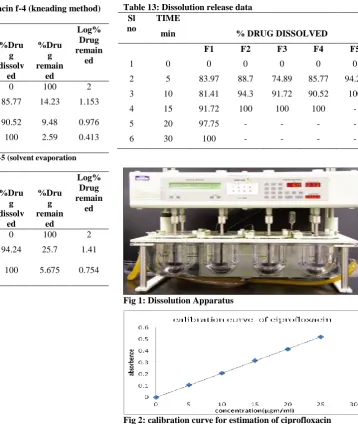
absorbance values were given in Table 5. The
absorbance values were plotted against concentration
of Ciprofloxacin as shown in Figure -2.
2.2.2 Drug release studies
Dissolution studies on each formulation were
performed in a calibrated eight station dissolution test
apparatus equipped with paddles employing pH 7.2
phosphate buffers as medium. The paddles were
operated to rotate at 75 rpm and the temperature was
maintained at 37± 10c throughout the experiment.
Samples were withdrawn at regular intervals up to 60
min and replaced with equal volume to maintain the
constant volume of dissolution medium throughout the
experiment 10. Drug content of the samples was
determined by Spectro 2080 plus Analytical
technologies ltd UV Spectrophotometer at 288nm after
suitable dilution of samples 11. Necessary corrections
were made for the loss of drug due to each sampling.
The drug dissolved experiments were conducted in
triplicate. The dissolution profile were depicted in
Table-12 to 13 and shown in Fig-13. The zero order
and first order plots and their corresponding release
constant were given in Table – 6 to 10 and shown in
Figure-3 to 12.
Dissolution Test Acceptance Criteria
Acceptance criteria for dissolution tests are set on the
basis of requirements for a percent quantity of drug to
be released after a certain period of time in the
dissolution apparatus. Since each test is usually
conducted using six individual dosage units,
acceptance criteria must be established on this basis.
The compendia recognize that reasonable tolerances
are required to ensure that criteria are not prohibitive,
but at the same time, they need to discriminate between
acceptable and unsatisfactory batches of products. The
approach developed within various compendia is now
harmonized for immediate release and extended
release—though not for delayed release—and allows
for three levels of staged testing. For immediate release
products, acceptance criteria are based on a single time
point and a single value, expressed as a Q value [11].
Then, at each of the three stages, the specification
requires that mean values not be less than Q, but a set
number of individual units are allowed to release a
percent quantity of active which may be as low as Q -
25% for one unit at stage three 12.
For extended release products, specifications are based
on three or four time points. For the intermediate time
points, the requirements are based on ranges; for the
final time point, they are usually based on a single
value. Therefore, the acceptance criteria at each stage
are expressed in terms of variances around ranges for
intermediate time points and minimum acceptable
release at the final time point 13.
2.2.3 Determination of amount of drug content
The amount of drug substance present in the given
dissolution samples were determined with the help of
UV-Spectrophotometer at a wavelength of 288nm. The
obtained absorbance values were substituted in the
given equation to get the amount of drug substance at
different time intervals of dissolution.
Test o.d
Amount= ×
dilution factor ×900 /1000
Standard o.d
2.2.4 Procedure for Assay
The amounts of drug present in the taken oven
formulations were determined with the help of U-V
Spectrophotometric method. For each batch 100 mg of
sample was taken in to the volumetric flask and add
methanol and the mixer was diluted with the pH 7.2
phosphate buffer. The dilutions are made as 5, 10, 15,
20 and 25 µg/ml. The absorbance of solution was
resultant drug content and practical yield was shown in
the Table 11.
2.2.5 Different formulation batches
Formulation 1 - PURE DRUG (100mg)
Formulation 2 – DRUG: POLYMER (1:1)
Croscarmelose sodium
Physical Mixing
Accurately weighed required amount of Ciprofloxacin
and Croscarmelose Sodium (carrier) in 1:1
drug-to-carrier weight ratio were mixing thoroughly in a mortar
until a homogeneous mixture was obtained for 3 min.
The product was kept in desiccators at room
temperature until for further study or investigation
Co-grinding Technique
Required quantity of drug was accurately weighed and
transferred in to mortar to this adds requires quantity of
Croscarmelose sodium in the ration of 1:1 were mixing
thoroughly until a homogenous mixer was obtained.
Triturating was carried in 10 -15 min to form a
homogenous mixer. The product is packed and kept in
a dedicator at room temperature until for further study
or investigation.
Formulation3-DRUG:POLYMER(1:1)Croscarmelosesodium
Kneading method
Drug and polymer was mixed with the small amount of
the solvent i.e. water to form a thick paste by kneading
and hence it was dried at 45ºC in a tray dryer. The
mass was passed through the sieve no. 30 and stored in
the desiccators. The product is packed and kept in a
dedicator at room temperature until for further study or
investigation.
Formulation 5– DRUG: POLYMER (1:1)
Croscarmelose sodium
Solvent evaporation method
Required amount of drug is accurately weighed and
transfer in to mortar. The drug and the polymer were
dissolved in sufficient volume of dichloromethane with
continuous stirring. The solvent was then completely
evaporated at room temperature with continuous
stirring to obtain dry granules. The resulting solid
dispersion was stored in airtight container till further
use.
Table 1: Formulation 2 (physical mixing).
S.NO INGREDIENTS QUANTITY
1
Ciprofloxacin
100mg
2
Croscarmelose
sodium
100mg
Table 2: Formulation 3 (Co-grinding technique)
S.NO INGREDIENTS QUANTITY
1 Ciprofloxacin 100mg
2 Croscarmelose sodium 100mg
Table 3: Formulation 4 (kneading method)
S.NO INGREDIENTS QUANTITY
1 Ciprofloxacin 100mg
2 Croscarmelose sodium 100mg
3 Distilled Water Quantity sufficient
Table 4: Formulation 5 (solvent evaporation method)
S.NO INGREDIENTS QUANTITY
1 Ciprofloxacin 100mg
2 Croscarmelose sodium 100mg
3 Dichloromethane Quantity sufficient
3. RESULTS AND DISCUSSION
Trial-1
This trail was done by using pure drug; it has shown
poor dissolution property because of less solubility of
drug in the dissolution medium.
Table 6: Kinetic profile of Ciprofloxacin F-1(Pure drug)
Amount of drug dissolve
d
Log% Drug remaine
d S.N
O Tim
e
OD %Drug
dissolve d
%Drug remaine
d
1 0 0 0 0 100 2
2 5 0.19
5
83.97 84.78 15.22 1.182
3 10 0.20
3
81.41 88.25 11.75 1.07
4 15 0.21
3
91.72 83.34 16.66 1.221
5 20 0.22
7
97.75 98.69 1.31 0.117
Table 7: kinetic profile of ciproploxacin f-2(physical mixing) solid dispersion
Amount
of drug dissolve
d
Log%
Drug remaine
d S.N
O
Tim e
OD %Drug
dissolve
d d
1 0 0 0 0 100 2
2 5 0.20
6
88.7 89.17 10.83 1.034
3 10 0.21
9
94.3 94.8 5.2 0.716
4 15 0.22
2
100 - - -
Table 8: kinetic profile of ciprofloxacin f-3 (cogrinding) solid dispersion Amount of drug dissolve d Log% Drug remaine d S.N O Tim e
OD %Drug
dissolve d
%Drug remaine
d
1 0 0 0 0 100 2
2 5 0.21
3
88.7 74.89 25.11 1.4
3 10 0.23
2
97.38 91.72 8.28 0.918
4 15 0.23 99.04 100 0 -
Table 9 : kinetic profile of ciprofloxacin f-4 (kneading method) solid dispersion Amou nt of drug dissolv ed Log% Drug remain ed S.N O
Time OD %Dru
g dissolv ed %Dru g remain ed
1 0 0 0 0 100 2
2 5 0.19
9
85.69 85.77 14.23 1.153
3 10 0.21 90.43 90.52 9.48 0.976
4 15 0.22
6
97.32 100 2.59 0.413
Table 10:kinetic profile of ciprofloxacin f-5 (solvent evaporation method) solid dispersion
Amou nt of drug dissolv ed Log% Drug remain ed S.N O
Time OD %Dru
g dissolv ed %Dru g remain ed
1 0 0 0 0 100 2
2 5 0.18
3
78.8 94.24 25.7 1.41
3 10 0.20
1
96.52 100 5.675 0.754
Table 11: Assay of Ciprofloxacin S.N O Formulat ion Drug conte nt Practic al yield
1 F1 94
mg 93
2 F2 89.8
mg
91.6
3 F3 90.7
2
91.03
4 F4 90.2
8
91.33
5 F5 93.3
1
94.18
Improvisation: As pure drug has shown poor
dissolution property, in order to enhance the
dissolution rate we used different methods for
preparing solid dispersions.
Table 12: Dissolution parameters S.N
O
TRAI LS
ZERO ORDER FIRST ORDER
PD 10
T50 Regress
ion
Ko Slop
e
R K1
(%) (mi
n)
(R) (mg/
ml)
(b) (mi
n -1)
1 F-1 88.
25
4 0.898 1.88 0.09
17 0.99
42 0.0
87
2 F-2 94.
8
3.3 0.982 4.79 0.12
8 0.96
08 0.0
22
3 F-3 100 3 0.992 2.73 0.10
8 0.99
8 0.0
77
4 F-4 90.
52
3.5 0.899 0.762 0.09
87 0.97
02 0.1
26
5 F-5 100 3 0.991 10 0.12
46 0.99
95 0.5
5
Table 13: Dissolution release data Sl
no
TIME
min % DRUG DISSOLVED
F1 F2 F3 F4 F5
1 0 0 0 0 0 0
2 5 83.97 88.7 74.89 85.77 94.24
3 10 81.41 94.3 91.72 90.52 100
4 15 91.72 100 100 100 -
5 20 97.75 - - - -
6 30 100 - - - -
Fig 1: Dissolution Apparatus
Fig 3: zero order kinetic profile of ciprofloxacin f-1(pure drug)
Fig 4: zero order kinetic profile of ciprofloxacin f-2(physical mixing) solid dispersion.
Fig 5: zero order kinetic profile of ciprofloxacin f-3 (cogrinding) solid
dispersion
Fig 6: zero order kinetic profile of ciprofloxacin f-4 (kneading method) solid dispersion
Fig 7: zero order kinetic profile of ciprofloxacin f-5 (solvent
evaporation method) solid dispersion
Fig 8: first order kinetic profile of ciprofloxacin f-1(pure drug)
Fig 9: first order kinetic profile of ciprofloxacin f-2(physical mixing)
solid dispersion.
Fig 10; first order kinetic profile of ciprofloxacin f-3 (cogrinding) solid
dispersion
Fig 11: first order kinetic profile of ciprofloxacin f-4 (kneading method) solid dispersion.
Fig 12: first order kinetic profile of ciprofloxacin f-5 (solvent
evaporation method) solid dispersion
Fig 13: comparative first order dissolution profile Fig14: comaritive dissolution profile
Trial -2
In this trail solid dispersion of drug was prepared by
using Croscarmelose sodium as a disintegrant in the
ratio of 1:1 and by using Physical mixing method.
Maximum drug release was observed at time 15 min.
Improvisation: Further this formula was optimized for
enhancing the drug release by using other technique.
Trial-3
In this trail solid dispersion of drug was prepared by
using Croscarmellose sodium as a disintegrant in the
ratio of 1:1 and by using Co–grinding method.
Maximum drug release was observed at time 15 min.
Improvisation: Further this formula was further
optimized for enhancing the drug release by using
other technique.
Trial-4
In this trail solid dispersion of drug was prepared by
using Croscarmellose sodium as a disintegrant in the
ratio of 1:1 and by using kneading method. Maximum
drug release was observed at time 20 min.
Improvisation: Further this formula was further
optimized for enhancing the drug release by using
other technique.
Trail-5
In this trail solid dispersion of drug was prepared by
using Croscarmellose sodium as a disintegrant in the
ratio of 1:1 and by using Solvent evaporation method.
Maximum drug release was observed at time 10 min.
Hence the trial 5 which was prepared by using
Croscarmellose sodium and drug by the ratio of 1:1 by
using solvent evaporation was found to be optimized
formula.
4. CONCLUSION
This study was undertaken with an aim to formulate an
Anti-Biotic drug in the form solid dispersion to
overcome the poor solubility drawback of the drug.
The selected Antibiotic agent was Ciprofloxacin. The
water, under class 2 of BCS of classification of drug its
solubility was tried to increase by formulating in the
form of solid dispersion with polymer by using various
techniques. Solid dispersions were prepared by using
the Crosscarmelose sodium as a disintegrant in 1:1
ratio of different techniques.
Among the four different techniques used for
preparation o solid dispersions solvent evaporation
technique has shown the increase in dissolution rate
that is the Trail-5 was found to have a faster solubility
and dissolution property which was prepared by using
Croscarmellose sodium as a disintegrant in the ratio of
1:1. Hence finally it was concluded that Trail-5 as an
optimized formula with an increased rate of dissolution
rate and solubility. Trail 5 which is prepared by using
drug and disintegrant ratio of 1:1 ratio by using solvent
evaporation techniques
.
5. REFERENCES
1. Amidon GL, Lennernas H, Shah VP , Crison JR.
Theoretical basis for a biopharmaceutical drug
classification: the correlation of in vitro drug
product dissolution and in vivo bioavailability,
Pharm Res 1995; 12(3): 413-420.
2. Breitenbach J. Melt extrusion from process to
drug delivery system. Pharm Res 2002; 12:
1269-1292.
3. Broman E, Khoo C, Taylor LS. A Comparison
of alternative polymer excipients and processing
methods for making solid dispersion of poorly
water soluble drug. Int J Pharm 2001; 221(1):
139-151.
4. Buck ton G, Darcy P. The use of gravimetric
studies to asserts the degree of crystalanity of
predominantly crystalline powder. Int J Pharm
1995; 123: 265-271.
5. Chiou WL, Riegelman S. Pharmaceutical
applications of solid dispersion systems. J Pharm
Sci 1971; 60(9): 1281-1302.
6. Ford JL. The current status of solid dispersions.
Pharm Acta Helv 1986; 61: 69-88
7. Ghaderi R, Artursson P, Carifors J. Preparation
of biodegradable micro particles using solution
enhanced dispersion by supercritical fluids
(SEDS). Pharm Res 1999; 16: 676-681.
8. Karavas E, Ktistis G, Xenakis A, Georgarakis E.
Effect of hydrogen bonding interactions on the
release mechanism of felodipine from
nanodispersions with polyvinylpyrrolidone, Eur J
Pharm Biopharm 2006; 63: 103-114
9. Leuner C, Dress man J. Improving drug
solubility for oral delivery using solid dispersions
Eur J Pharm Biopharm 2000; 50: 47-60
10. Luenberger H. Spray freezed drying the process
of choice for low water soluble drugs, J nano
partical research 200; 4: 111-119.
11. Patil et al. Improvement in dissolution efficiency
of poorly soluble naproxen. The Eastern
pharmacist 2001; 521: 107‐110.
12. Arora SC. Development, characterization and
and solubility and solid dispersions of
Ciprofloxacin by solvent method. Int J drug del
res 2010; 2, 424- 430.
13. Sethia S, Squillante E. Physiochemical
Characterization of solid dispersion of
Carbamazepine formulated by supercritical
carbon dioxide and conventional solvent
evaporation method. J Pharm Sci 2002; 91(9):

![Nucleotide supplementation: a randomised double blind placebo controlled trial of IntestAidIB in people with Irritable Bowel Syndrome [ISRCTN67764449]](data:image/gif;base64,R0lGODlhAQABAIAAAP///wAAACH5BAEAAAAALAAAAAABAAEAAAICRAEAOw==)