ISSN (e): 2250-3021, ISSN (p): 2278-8719
Vol. 09, Issue 10, October. 2019, Series -IV, PP 44-48
NDE Techniques for In-Situ Concrete Structures
Vanisri Gunnala 1B S.Susmita 2
Department of Civil Engineering, Geetanjali College of Engineering & Technology,Hyderabad,India. Received 16October 2019; Accepted 31 October 2019
Abstract.
In this paper an attempt was made to establish Non destructive Evaluation Technique(NDE)for assessment of compressive strength of in-situ concrete by conducting UPV and Rebound Hammer tests on Various concretes of mixes M15, M20, M25, M30.The various concretes like Plain concrete, Recycled Aggregate concrete, concrete with replacement of fly ash with10%,20%,30%.were designed as per Sp23.Concrete cubes of size 150x150x150mm were cast and tested for compressive strength at 7days,14 days,28 days,56 days and 90 days. Before conducting compression test, UPV test and Rebound Hammer tests were conducted on the same cubes for assessment of compressive strength .A comparative study was made among the compressive strength, Pulse velocity, and Rebound Number for all types of concrete of various mixes and curves were drawn. Regression analysis was also made for the tests being conducted and kept them ready for assessment of compressive strength of in-situ concrete structures .It is observed the Pulse velocity and Rebound Number increases with the age of concrete increases. it is concluded that the equations obtained from regression analysis for compressive strength of various concretes of different mixes can be incorporated in the IS codes for future reference.Keywords:
Non destructive evaluation, in-situ concrete, UPV test, Rebound Hammer test, Regression curvesI.
INTRODUCTION
Nondestructive testing (NDT) has been defined as comprising those test methods used to examine an object, material or system without impairing its future usefulness. The term is generally applied to non medical investigations of material integrity. Nondestructive tests in great variety are in worldwide use to detect variations in structure, minute changes in surface finish, the presence of cracks or other physical discontinuities, to measure the thickness of materials and coatings and to determine other characteristics of industrial products. The demands on integrity assessment and life management of ageing infrastructure such as old buildings bridges and Dams are providing continuous impetus for development of reliable testing methods. These methods not only provide information on the necessity for repairs, but also frequency of future inspections/repairs as they sense damages at micro level. However, while assessing the capabilities and limitations of various non-destructive testing (NDT) and evaluation (NDE) techniques that can be applied to concrete structures, it has been fount that, in many cases, the data obtained are qualitative rather than quantitative and hence efforts are being made to overcome this limitation.
II.
NDE TECHNIQUES FOR ASSESSMENT OF CONCRETE STRUCTURES
The following Table: 1 gives the capabilities of some of the NDT & NDE techniques for assessment of concrete structures. It is clear that ultrasonic methods are superior methods in the sense that they are capable of providing more information on concrete parameters as compared to the other methods.
Techniques Stre n g th E last ic Mo d u lu s T h ick n ess C rac k d ep th C rac k wid th C rac k d is tr ib u tio n C rac k Dev elo p m en t H o n ey co m b in g & v o id s L am in atio n s B ar lo ca tio n B ar s ize B ar C o rr o sio n
Ultrasonic
Pull out
Rebound Hammer
Penetration resistance
Thermography
Radiography
Acoustic emission
Magnetic or eddy current
Half cell potential
Photography
III.
EXPERIMENTAL INVESTIGATIONS:
The experimental work is carried out on Plain concrete, recycled aggregate concrete and fly ash concrete with 10%,20%,30% replacement. The materials used for preparation of concrete are as per codal provisions. Cement (43 Grade),Sand(Zone III),Coarse aggregate(crushed granite passes through 20mm and retained on 4.75mm),W/C ratio:0.5 and Fly ash ( Vijayawada Thermal Power Station),Recycled Aggregate from buildings demolished debris,were used and Mixes M15, M20, M25,M30 were designed as per SP:23. Concrete cubes of size 150x150x150mm were cast and cured and tested for 7days,14 days,28 days,56 days, 90 days compressive strength. Before testing for compressive strength, Ultrasonic Pulse Velocity (UPV) and Rebound Hammer tests were conducted on the same cubes for assessment of strength of concrete.
3.1 Ultrasonic Methods:
The ultrasonic methods refers to transmission and reflection of mechanical stress waves through a medium in the frequency range of 20kHz to 2 MHz. Ultrasonic Pulse Velocity technique uses the relationship between the quality of concrete and the velocity of an ultrasonic pulse that passes through the material. The velocity of the ultrasonic waves in an isotropic medium is a function of the elastic modulli and the density of the material. The ultrasonic pulse velocity method involves measurement of travel time over a known path length of a pulse of ultrasonic waves. Ultrasonic pulse velocity is also used to determine the extent of determination of concrete structure. If there are no changes in materials, concrete mix or construction procedure within a concrete structure, any reduction in ultrasonic pulse velocity in a given region indicates defective or deteriorated concrete in that region. A curve between Pulse Velocity and Compressive strength was drawn and regression analysis was also made and shown in Fig. 1.
3.2 Rebound Hammer Technique:
The Schmidt rebound hammer test basically a surface hardness measurement with little apparent theoretical relationship between the strength of concrete and the rebound number of the hammer.. However within certain constraints, empirical correlations have been established between strength properties and the rebound number. The correlation between Rebound Number(N) and Compressive strength ( C ) aws shown in Fig.2 and it will vary from one researcher to another.
C= a+ b N
Where a and b are constants depends on moisture content of concrete, age of concrete and type of cement also.
The accuracy of method varies in the range of 15% to 20%, due to many variables that influence the
strength of the concrete.
y = 64.34x - 269.7 R² = 0.394
0 10 20 30 40 50 60 70 80
4.6 4.7 4.8 4.9 5 5.1 5.2
C
o
m
p
re
s
s
iv
e
S
tr
e
n
g
th
(M
P
a
)
Pulse Velocity (km/s)
Combination methods have also been developed and was shown in Fig.3, for estimation of the strength of the concrete with improved accuracy by using moiré that one technique. If moisture content in concrete increases the pulse velocity (V) increases but Rebound Number (N) decreases. The following empirical relationship has been developed for estimation of concrete compressive strength(C)
C= R0 + R1 N + R 2 V
Where R0, R1, R2 are regression coefficients.
IV.
RESULTS
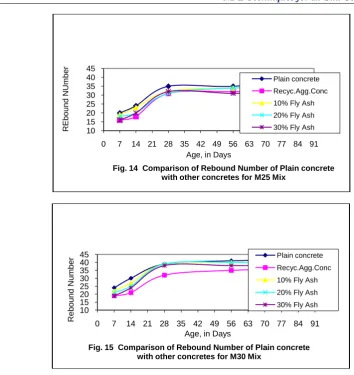
Tests were conducted on plain concrete, Recycled aggregate concrete and fly ash concrete of mixes M15,M20, M25 and M30 and curves ( fig.4 to 15) are drawn for depicting the values of compressive strength, Pulse velocity and Rebound Number against the Age of concrete for 7,14,28,56 ,90 days. It is observed that the Recycled aggregate concrete has shown 30% less strength with Plain concrete and 20% less with fly ash
concrete.
V.
CONCLUSIONS
1. It is observed that Recycled aggregate concrete has shown 30% less strength than Plain concrete and fly ash
concrete has shown about 15% less strength than plain concrete.
2. It is found that Pulse Velocity and Rebound Number increase with the age of concrete.
3. The actual strength of plain concrete obtained from the destructive testing is more than that predicted based
on the charts supplied by the manufacturer
4. NDE (Combined Method of UPV and Rebound Hammer) technique developed here is more effective and
REFERENCES
[1]. N.J.Carino, (1994) “Non Destructive Testing of Concrete: History and Challenges in concrete technology
Past Present and Future”, ed. P.K.Mehta,SP-144-30, ACI, Detroit, pp.623-678
[2]. Francois Buyle-Bodin, (2003)” Contribution of coupling non-destructive methods for diagnosis of
concrete structures”, International symposium (NDTCE-2003), p.p.264-272
[3]. Anish Kumar,etal, (2002),”NDT&E International,Vol.35, pp.213-220
[4]. BTI, Non Destructive testing of concrete structures, 2001,www.mint.gov
[5]. T.Jayakumar,etal, (2003) “Integrity assessment of concrete structures using Non Destructive Evaluation
Techniques”, INCONTEST -2003, p.p175-184
[6]. M.C Nataraja,T.V.Anil Kumar,(2003) “A study on Plain and fly ash concrete using Non Destructive
testing Techniques”, INCONTEST -2003, p.p137-147
10 15 20 25 30 35 40 45
0 7 14 21 28 35 42 49 56 63 70 77 84 91
R
E
b
o
u
n
d
N
U
m
b
e
r
Age, in Days
Fig. 14 Comparison of Rebound Number of Plain concrete with other concretes for M25 Mix
Plain concrete
Recyc.Agg.Conc
10% Fly Ash
20% Fly Ash
30% Fly Ash
10 15 20 25 30 35 40 45
0 7 14 21 28 35 42 49 56 63 70 77 84 91
Reb
o
u
n
d
Nu
m
b
e
r
Age, in Days
Fig. 15 Comparison of Rebound Number of Plain concrete with other concretes for M30 Mix
Plain concrete
Recyc.Agg.Conc
10% Fly Ash
20% Fly Ash
30% Fly Ash