R E S E A R C H
Open Access
Localization of acoustic sources using
a decentralized particle filter
Florian Xaver
1*, Gerald Matz
1, Peter Gerstoft
2and Christoph Mecklenbräuker
1Abstract
This paper addresses the decentralized localization of an acoustic source in a (wireless) sensor network based on the underlying partial differential equation (PDE). The PDE is transformed into a distributed state-space model and augmented by a source model. Inferring the source state amounts to a non-linear non-Gaussian Bayesian
estimation problem for whose solution we implement a decentralized particle filter (PF) operating within and across clusters of sensor nodes. The aggregation of the local posterior distributions from all clusters is achieved via an enhanced version of the maximum consensus algorithm. Numerical simulations illustrate the performance of our scheme.
Keywords:source localization, acoustic wave equation, distributed state-space model, sequential Bayesian estima-tion, decentralized particle filter, argumentum-maximi consensus algorithm
I Introduction
Background and state of the art
In this paper, we use a physics-based model and a Baye-sian approach to develop a decentralized particle filter (PF) for acoustic source localization in a sensor network (SN). In a decentralized PF, the processing is done locally at the sensors without using a fusion center. Thereby, the estimated position is known at every sen-sor in consequence of this decentralized process.
The problem formulation in this paper is motivated by indoor localization of an acoustic source. A hallway is modeled including basic boundary conditions for win-dows (membranes) and walls.
The source localization problem has been studied, e.g., in [1-3], [[4], p. 4089 ff], [[5], p. 746 ff] and [6], all of which use a sequential Bayesian estimator [7] to infer the source position states from observations using mul-tiple sensors. These papers build on a state-space transi-tion equatransi-tion describing the global source state trajectory over time and the measurement equation between these states and the measurements. The under-lying model of the physical process is modeled in the measurement equation. A decentralized approach aims
at identifying global source states that are common to all decentralized units. Each decentralized unit typically consists of a sensor and a Bayesian estimator associated with the sensor’s neighborhood.
A different approach consists of incorporating the par-tial differenpar-tial equation (PDE) describing the dynamics of the physical process. In source tracking applications, this implies that the field itself becomes part of the state, which thus is distributed over all space. For instance, the acoustic wave field is described by a hyper-bolic PDE for pressure and hence the state vector com-prises the spatio-temporal pressure field. This approach is used in (ocean) acoustic models [8,9] and geophysical models [[4], p. 4089 ff], [10-13]. For localization, the model is augmented with a source model providing a relation between global source states, e.g., position, and distributed field states, i.e., pressure.
Our approach belongs to the realm of the second approach. The novel aspects include the formulation of a source model suitable for distributed processing, the design of a distributed particle for the estimation of the posterior distribution of field and source states, and the development of a modified version of the maximum consensus (MC) algorithm [14] for the maximum a-pos-teriori (MAP) estimation of the source location. For sev-eral loosely connected agents, a consensus algorithm * Correspondence: [email protected]
1Institute of Telecommunications (ITC), Faculty of Electrical Engineering and
Information Technology, Vienna University of Technology, 1040 Vienna, Austria
Full list of author information is available at the end of the article
makes the agents to converge to a group decision based on local information.
Contributions and outline
We consider inference problems in spacer and timet which are modeled via partial differential equations (PDE) of the form [15,16]
L{p(r,t)}=s(r,t), (1a)
B{p(r,t)}= 0, (1b)
whereLdenotes the PDE operator;Bthe boundary/ initial conditions;p(r,t) the quantity of interest, ands(r, t) the source term. If the PDE parameters, the source term, and the boundary/initial conditions are known, determiningp(r, t) is the forward problem. In contrast, inverse problems amount to estimating PDE parameters or states like source locations from measurements ofp (r,t).
Discretization of (1) and extending to a stochastic pro-cess leads to the state transition equation
xk+1=gk(xk,uk,wk), k∈Z, (2)
where kdenotes discrete time, xk is the state vector
(incorporating samples ofp(r, t)),ukis the input vector
(here corresponding to the sources), wk is a random
noise vector (process noise), andgkis the state transition
mapping. The state transition equation is complemented by the measurement equation
yk=hk(xk,uk,vk). (3)
Here, yk is the observation, vk denotes the
measure-ment noise, and the mapping hkcharacterizes the
mea-surement. Taken together, (2) and (3) constitute the state-space model, see Section II and [17].
In the Gaussian case, Bayesian estimation based on the state-space model (2), (3) leads to various kinds of Kalman filters [1,7,18]. Here, the Bayesian estimator builds on the particle filter (PF) framework due to (i) various possible geometries and (ii) the non-linearity of the state-space model. After discussing a centralized PF for source localization and tracking in Section III, we develop a decentralized implementation of the PF by splitting the nodes of the sensor networks (SN) into clusters. The clustered SN architecture entails a corre-sponding decomposition of the state-space model, and the decentralized PF performs intra-cluster computation and inter-cluster communication on the decomposed state-space model (see Section IV).
The decentralized PF yields local posterior distribu-tions within each cluster. Localization of the acoustic sources amounts to finding the maxima of the global posterior distribution. To this end, we propose a
modified maximum consensus algorithm in Section V. After a summary in Section VI, in Section VII, we describe extensive numerical simulations that illustrate the properties and performance of our source localiza-tion method.
II System model
In this section, we develop a state-space model from the PDE of the spatio-temporal acoustic field using the finite difference method (FDM) [15,19] to obtain a dis-cretization in space and time.
A Forward model–spatio-temporal field
In the following, we consider an acoustic problem char-acterized by the hyperbolic PDE (scalar wave equation) [16,19,20]:
1 c2∂
2
tp(r,t)− ∇2p(r,t) =s(r,t), r∈, (4a)
Here,p(r,t) denotes pressure,∂tis the partial
deriva-tive with respect to time, ∇2the Laplace operator,cthe sound speed, s(r, t) is the source, andΩ⊂ℝ2is the 2-D region of interest. Hereafter, let the initial conditions be
p(r,t) = 0, r∈, t= 0, (4b)
∂tp(r,t) = 0, r∈, t= 0. (4c)
From three basic boundary conditions
1
c∂tp(r,t)−∇p(r,t)·n= 0, r∈∂1, (4d)
p(r,t) = 0, r∈∂2, (4e)
∂tp(r,t) = 0, r∈∂3, (4f)
we use (4d) and (4f) for modeling a hallway. ∂Ω1 is the transparent part of the boundary ofΩ (with normal vector n) modeling an infinite domain for the behind uncovered area. The boundary∂Ω2 (disjoint from∂Ω1 models windows, whereas ∂Ω3 (disjoint from∂Ω1 and
∂Ω2) models walls. The choice of these boundary condi-tions indeed affects the resulting state-space model but does not change the general formulation of the decen-tralized approach.
B Finite difference method
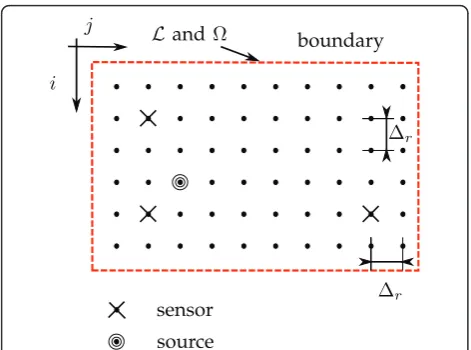
To obtain a space-time-discrete model, the differential operators are approximated by finite differences, see Fig-ure 1. We assume a rectangular region in two dimen-sions (i.e., r = (x, y)) and use a spatial sampling set
given by the finite square lattice
spatial sampling interval. For simplicity, we assume identical sampling intervals in both coordinates, but using different sampling intervals for each coordinate is straightforward (Different sampling intervals influence the accuracy of the field approximation only but not the principal features of the decentralized estimator). For simplicity, we assume that there are R sensors whose locations form a subsetRof the latticeL.
For the Laplace operator, we then obtain the discrete approximation
Similarly, for the second-order temporal derivative, we have
Here,kis the discrete time index, and Δtis the
tem-poral sampling period. It is upper bounded by Δr/cto
ensure numerical stability. The right choice of Δt is
beyond the scope of our paper, so that we refer our reader to [16].
C Forward model
We introduce the auxiliary functionq(x, y,t) = ∂tp(x,y,
t) and define the pressure vectorpk= vec{Pk} with [Pk]ij
=p(iΔr,jΔr,kΔt). The source vectorskand the pressure
derivative vector qk are defined similarly. Applying the
FDM to (4) then leads to the following linear system of equations:
The diagonal matrix F11 results from the boundary condition (4d). Its diagonal elements are
[11]ii=
1 for inner nodes and
nodes on the boundary∂1, 0 nodes on the boundary∂3
depends on the boundary condition (4f). Similarly, the sparse matrixF12stems from (4a) and is given by
[12]ij=
We assume that there are S sources whose positions form a subset S of the discretization lattice L, i.e.,
s[i,j,k] =sl=1s0[k−kl]δ(i−il,j−jl), where s0[k] is a
known waveform, but the positions (il,jl) and activation
timesklare unknown. These unknowns are captured via
the integer variablesn[i, j,k] that describe, for a lattice point (i,j), the time between the source occurrence and the current time instantk, i.e., for the lth source there is n[il,jl, k] = max{k - kl, 0}. If there is no source at
posi-tion (i,j), thenn[i,j,k] = 0.
Clearly, the source life span satisfies the state transi-tion equatransi-tion
timek. Arranging the variablesn[i,j,k] into a vectornk
similarly topk,qk, and sk, we obtain
nk+1=nk+δSk, (6)
where the elements ofδSkare zero or one depending
on whether a source is active at the corresponding posi-tion and at time instantk, i.e.,
[δSk]i+(j−1)I =
1, (i,j)∈Sk,
0, else. (7)
Note that the state vector nk has at mostS non-zero
elements. Using the convention s0[0] = 0, the source vectorskin (5) is rewritten as
Land Ω
Figure 1The FDM model showing the discretization lattice,
boundaries, sources, and sensors.Lis the discretization lattice,
sk=s0[nk], (8)
thereby linking the state Equation 6 and the forward model (5).
E Noise model
So far, no process noise has been considered and speci-fied. Since the source function depends on time and space, these are the only quantities that suffer from noise and are modeled in the following: The temporal noise models the perturbation of a source’s life span by an additional term in (6), while this is not possible for the spatial perturbation. This is due to the fact that the position of sources is coded into the sub-vector nkby
placing its elements. From a practical perspective, this is done by a time-dependent matrix Dk which displaces
the elements of a vector to other positions (jitter) according to the mapping between grid and sub-vector nk.
Equation 6 becomes
nk+1=Dk(nk+δSk+δSkn’). (9)
Here, n’ is a random integer perturbation,⊙ is the Hadamard (element-wise) product, and the lth column of the displacement matrix Dk is given byel+d(l), with
the canonical column unit vector
[el]n=
1,l=n, 0, else,
and a random integer jitter d(l) whose probability mass is concentrated about zero.
Because of linearity, (9) is rewritten as
nk+1=Dknk+DkδSk+Dkdiag{δSk}n’. (10)
F Augmented state-space model
We next combine the state-space model (5) with (8) and (10) to obtain an augmented state-space model for the extended state vector
This gives the state transition equation
xk+1=kxk+kuk+Gkn’k (11)
Note that non-linearity is inherent in (11).
To complete the state-space model, the measurement equation is introduced. Since the actual observations are given by noisy samples of the pressure field at the sen-sor positions(il,jl)∈R, the measurement equation is
yk=Cx˜ k+vk=Cpk+vk, (14)
wherevkdenotes measurement noise and
˜
witheldenoting thelth unit vector.
III Bayesian estimation
Our aim is to perform sequential Bayesian estimation of the state vector nk that characterizes the source
posi-tions and activation times.nkis one of the state vectors
xk in (11). The data yk is specified in (14). A PF
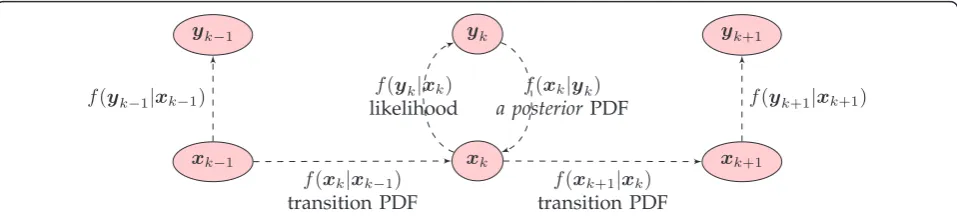
approach [7], i.e., a Monte Carlo approach based on importance sampling, is pursued. This approach exploits that our state-space model (11)-(14) is a hidden Markov model (cf. Figure 2), where (11) implies a state transi-tion distributransi-tionf(xk|xk-1) and (14) leads to a
measure-ment distribution (likelihood function)f(yk|xk), which
both are assumed known in the following.
A Particle filter
To perform Bayesian estimation (e.g., MAP or MMSE) of (part of) the state vector xk given the past
observa-tions y1:k= [yT
1...yTk]T, the posterior distributionf(xk |y1. k) is compute sequentially.
Using the Bayesian theorem and the fact thatyk+1and y1:k are statistically independent (due to the Markov
chain assumption) givenxk+1, we have
f(xk+1|y1:k+1) =f(xk+1|yk+1,y1:k)
which is known as the update step. While the mea-surement PDF f(yk+1|xk+1) in (15) is known, f(xk+1|y1:k)
f(xk+1|y1:k) =
f(xk+1|xk)f(xk|y1:k)dxk. (16)
Here, the transition PDFf(xk+1|xk) is known and f(xk
|y1:k) has been computed in the previous time step.
Since the integral in (16) typically is infeasible, it is usually approximated using a Monte Carlo technique known as importance sampling. The approximate sequential computation of the posterior distribution f (xk|y1:k) based on importance sampling using the
tran-sition PDFf(xk|xk-1) as importance (or, proposal)
dis-tribution q(xk) leads to the particle filter. Here, the
desired PDFs are approximated in terms of particles, i.e., samples x[kl]and associated weightsω[l]
whereLis the number of particles. The new samples for the subsequent time instant are generated using the proposal distribution
q(xk+1) =f(xk+1|xk=x[kl]),
where for the generation of each new particlex[kl+1], the previous particlex[kl]is chosen randomly with probability
ωk[l]. Sampling fromq(xk+1) can be achieved by
generat-ing a noise realizationw[kl]and invoking the state transi-tion Equatransi-tion 11, i.e.,
xk[l+1] =k[l]x[kl]+k[l]u[kl]+Gk[l]n’[kl]. (18) u[kl]can be computed from the particle x[kl]according to (13). The dependency of the matrices on k issues from spatial noise.
The unnormalized weight for each new particle is
˜ wherefv(vk) is the distribution of the measurement
noise and we used the measurement Equation 14. For i.
i.d. Gaussian measurement noise with varianceσ2
v
Once all unnormalized weights have been obtained, the actual weights are computed via the normalization ω[l]
k+1. Particle filters suffer from a gen-eral problem termed sample degeneracy, i.e., after some-time only few particles have non-negligible weights. This problem is circumvented using resampling [21]. With sampling importance resampling (SIR), new
sam-ples are drawn from the distribution
L
and all weights are identical, i.e.,
ω[l]
k = 1/L.
To obtain initial particlesx[l]
0, samples of the state vec-tor are needed. S random realizations of source posi-tions and activation times are generated according to the prior distributions. Then, we apply the noise-free version of the state-space model (11)kstarttimes, i.e.,
x[0l]=kstart the source parameters (cf. (13) and Section II-D). The random variable kstart denotes the time duration between source occurrence and activation of the estimator.
B Source localization
Using (17), the posterior PDF ofnk(i.e., the last IJ
ele-ments ofxk) is approximated as
f(nk|y1:k)≈
(Note thatnkcontains all information about position
and activation time of the sources.)
yk−1 yk yk+1
The probabilityP{Sk|y1:k}for sources to be active at
the coordinate setSkat time kis obtained via
marginali-zation:
P{Sk|y1:k}=
l∈k
ω[l]
k , k=
l:Q(n[kl]) =δSk
. (22)
Here, the functionQ: ℝIJ ® {0, 1} sets all entries of n[kl]to 1 which are unequal to 0. In the case of one source and a SIR PF withw[kl]= 1/L, the probability for a source at position (i, j) at time k is approximately obtained as
Ps(i,j,k) = P{source at (i,j,k)|y1:k}= Li,j,k
L , (23)
where Li,j,k is the number of particles for which [n[kl]]i+(j−1)I>0.
IV Decentralized scheme
The particle filter developed in the previous section is centralized in nature since it requires all pressure mea-surements and the observation modalities described by the globally assembled likelihood function and operates on the full state vector xk in a fusion center.
Addition-ally, the computed estimates are inherently unknown on the individual sensor nodes. In a SN context, such con-straints are undesirable since they imply a large commu-nication overhead to collect the measured data, a high computational effort due to the high-dimensional state vector, a feedback to the sensor nodes to spread the estimates, and a central knowledge of measurement noise. Therefore, a decentralized scheme that distributes the data collection and computational costs among sev-eral clusters of sensor nodes is developed. This is achieved by splitting the state-space model (11), (14) into lower-dimensional sub-models (each corresponding to a cluster), cf. with [22,23]. Due to the sparsity of the state-space matricesF andΓ, these sub-models are only loosely coupled, thus a decentralized PF that requires
little communication between the clusters can be developed.
A SN clusters and partitioned state-space model
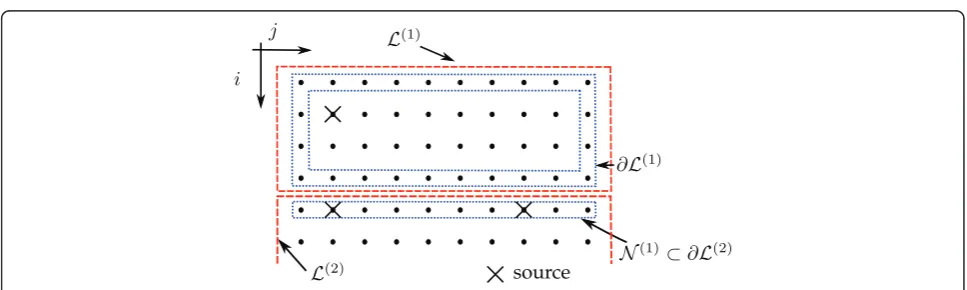
We start with partitioning the region of interestΩinto M disjoint subregionsΩ(m). The sampling lattice corre-sponding to each subregion is given byL(m)=L∩(m) with its boundary nodes∂L(m), see Figure 3. The sensors within each subregion form clusters, denoted by
R(m)=R∩(m)⊂L(m). To each subregion, we associ-ate a subset of elements of the stassoci-ate vectorxkgiven by
x[km]= ⎡ ⎢ ⎣
q(km) p(km) n(km)
⎤ ⎥
⎦ (24)
where
p(km)= [p(ir,jr,kt)](i,j)∈L(m)
and the superscsript(m)refers to regionm.
Except for F12, all of the blocks in the state-space matricesFkand Γkare diagonal or zero (cf. (12)). Thus,
there is no coupling between the sub-vectors p(km)from different subregions and similarly for the sub-vector q(km). Coupling between state vectors from different regions, induced by the non-diagonal structure ofF12, is between the sub-vectors q(km)in one subregion and the sub-vectors p(km)in the adjacent subregions (in fact, this coupling is limited to samples at the boundaries of the subregions). The same applies for the sub-vectorsn(km) due to the spatial noise. This gives
x(km+1)=k(m)x(km)+ξ(km) +(km)uk(m)+γ(km) +G(km)n’(km),
yk(m)=C(m)pk(m)+v(km).
(25)
L(1)
L(2)
∂L(1)
N(1)⊂∂L(2)
j
i
source
This coupling Equation 25 is only possible for the time-independent part of these matrices. However, for uncorrelated noise between clusters, the time-dependent part, i.e., Dk, is calculated separately according to
Sec-tion II-E on every cluster at each time step, see below. The coupling terms between neighboring subregions are given by diagonals of F12 are extremely sparsely populated; in fact, (26) contains only few non-zero terms correspond-ing to adjacent pressure samples and the change of sources from one to another cluster.D(km,m)is generated from every cluster m’ such that the composition of all submatricesD(km)andDk(m,m)equals Dk. From a practical
perspective, elements of D(km)are calculated separately on every cluster by means of spatial noise with addi-tional triggering of a message to neighbor clusters whenever a source hop (migration) from one cluster to another is detected (this takes over the purpose of D(km,m)and supersedes (28)). Furthermore, the coupling term ξ(km)means that pressure samples at subregion boundaries are exchanged between neighboring clusters in order to compute the finite differences.
Boundary conditions do not play a role in the decom-position step as long as (i) they do not depend on adja-cent neighbors and (ii) their numerical solution fits into (5). In the first situation, an additional term(11m,m)or (m,m)
21 arises in matrix.T (m,m)
k .
B Decentralized particle filter
For the decentralized PF, we need to distribute the sam-pling (particle generation) step and the weight computa-tion step. Based on the local particles and weights, each cluster can then compute posterior source probabilities in a similar manner as in Section III-B.
1) Particle Generation:Sub-particlesx[kl,m]within clus-terR(m)are generated according to (25), cf. also (18), n’[kl,m]is a (local) noise vector realization. Furthermore, ξ[l,m]
k , respectively. In order to
compute the latter, only elements of x[kl,m]that corre-spond to pressure samples from the boundaries of adja-cent subregions are exchanged, and in the event of source hopping from one to another cluster, a message is sent.
2) Weights: Assuming independent measurement noise
in the individual subregions, i.e.,
fv(vk) =
M
m=1fv(m)(v(km)), the weight update (19) is
com-puted in each cluster as
˜
where the partial weights
¯
are computed within each cluster and then are shared among all clusters to obtain the final unnormalized weight [24] and [25] are treating the issue of computa-tion of the global factorizable likelihood by means of distributed protocols. If these take longer than the time span between two estimator iterations, the particle filter converts to a particle predictor.
3) (Re)sampling:A remaining problem with the decen-tralized PF is that the sampling (particle generation) step (30) requires that the clusters pick local particles x[kl,m]m = 1, ..., M, that correspond to the same global particle x[l]
k . This choice is made at random according to
the weights ω[l]
k . The same problem occurs for the
and initialize those with the same seed, thereby ensuring that all clusters perform the same (re)sampling (cf. with [24] and [26]).
V Decentralized source localization
The PF yields the posterior PDF of the sources’position and life span. To obtain the current MAP position esti-mates
(ˆik,ˆjk) = arg max
(i,j)∈LPs(i,j,k), (32) the maximum and the maximizing state of the poster-ior PDFPs(i, j,k) in (23) must be found. In the decen-tralized scheme, each cluster disposes only of the local posterior PDF for the state sub-vector x(km). To find the global maximizing state, each cluster determines the local maximizing state and afterward the clusters use a distributed consensus protocol to determine the global maximum. For simplicity, this procedure is here devel-oped for one source.
For the centralized PF, the posterior probability for a source to be active at timekat position (i,j) is given by (23). In the decentralized case, each cluster determines a similar probability according to
Ps(m)(i,j,k) =
underlying the MAP estimates (32) is
Pk,max= max determined within each cluster, the global maximization with regard tom requires communication between the clusters. Since sharing the local maxima among all clus-ters via broadcast transmissions requires a large coordi-nated transmission, we compute the global maximum via the maximum consensus (MC) algorithm [14]. For the MC algorithm, we assume that only neighboring clusters communicate with each other. Thus, each clus-ter sends to the adjacent clusclus-ters a message which con-tains the local maximum and the position for which the local maximum is achieved. In the subsequent steps, each cluster compares the incoming “maximum”
messages with their current estimate of the global tion and retain the most likely and its associated posi-tion. In the next iteration, this message will be sent to the neighboring clusters.
Denote the current estimate of the maximum Pk,max for cluster m by Pˆ(km,max) and let(iˆ(km),ˆj(km))be the asso-ciated position estimate (initially,Pˆk(m,max) =Pk(m,max) ). In our MC algorithm, termed argumentum-maximiconsensus (AMC), at time instantk, each cluster performs the fol-lowing steps:
1) Send a message containing the estimatesPˆk(m,max) and
(ˆi(km),ˆjk(m))to the neighbor clustersN(m).
2) Receive corresponding messages from the neighbor cluster, if a neighbor m∈N(m)remains silent, then
ˆ
Pk(m,max) =Pˆ(km−1,max) .
3) Update the maximum probability and position as
ˆ When the maximum is fixed, all clusters converge to the true maximum after some iterations (depending on the diameter of the cluster communication graph). Here, the position of the maximum moves as the distributed PF evolves and the AMC will then allow the clusters to jointly track the maximum.
VI Algorithm summary A Dimensions and trade-offs
Since we are estimating the 2-D position and activation time for each of theSsources, the number of unknowns equals 3S. This is relevant for the choice of the number of particles, cf. [4]. For the calculation of the forward model (state transition), however, the dimension of the state vector xk is relevant which equals 3IJ. In the
decentralized case, the computational complexity of the forward model is distributed across all clusters.
We now face the behavior of a high number of clus-ters. Generally, the volume of a polytope (cluster)L(m) with edge lengths ei(m) in a d-dimensional lattice L⊂Zd is given by|L(m)|=d
Generally, the dimension per cluster of the equation system to be calculated is3|L(m)|which, in comparison, equals in the centralized case3|L|.
|L(m)|=IJ/M
iMj. WhenM ® ∞, then the dimension of the equation system, which specifies the amount of computation, becomes inO(1/M)[27]. Thus the compu-tational effort per cluster decreases when the number of clusters increases. On the other hand, an increasing number of clusters leads to a larger number of bound-aries and hence to a larger communication overhead (i. e., message exchange between adjacent clusters).
Algorithm 1: Global initialization
generate priorsX0; // Equation
(20)
decomposeX0to{X0(m)}; // Equation (24) choose seeds0 (Section IV-B3);
form= 1toM paralleldo
DD-SIR-PF(X0(m),s0) of clusterm;
Algorithm 2: DD-SIR-PF(): Decentralized distribu-ted SIR particle filter of clusterm
input:X0(m),s0 k¬1;
wait while no signal sensed and no wake-up call; send wake-up call to other clusters;
whileestimatingdo
wait until reception from other
clusters;
B Communication between clusters
The variables that are broadcast by clusterm are sum-marized by the set
the local PF weights, while
μ(i,m)
k collects all pressure sub-state particles on the
boundary. The third,μ(ki,m), signifies a message about sources which migrate across boundaries from one clus-ter to another. Every message includes the new location and the current time duration since the occurrence of the sources. The last two terms stem from the AMC algorithm whereSˆk(m)= (ˆik(m),ˆj(km)).
Note that the cardinality of (34) which is a measure of the amount of transmission per cluster is given by the sum
L (W¯k(m)to all clusters) +|∂L(m)|L (Pk(m)to adjacent clusters) +2M (Pˆk(m,max) andSˆk(m)to adjacent clusters)
Here, theμ(ki,m)messages are disregarded. The amount of transmission in the decentralized case to adjacent neighbors forMi® ∞andMj® ∞is inO(1 Mi)and
O(1 Mj), respectively. The transmission of weights is in
O(M)for M ® ∞, while the overall communication load is inO(M2).
Note that there is no approximation compared to the centralized method and thus neither source coding nor approximations reducing the weight communication have been considered. For the communication of the weights, either the graph needs to be fully connected or the clusters need to act as relay. A summary is drawn in Table 1.
C Algorithm
The algorithm of the decentralized and distributed SIR PF together with the AMC is drawn in Algorithms 1-4. Compare it with that one in [28] and note that the for-loop can be parallelized.
The joint setup of the computational nodes is shown in Algorithm 1 which consists of the calculation of the priors and the synchronization of the pseudo-random generator. Subsequently, each individual PF is launched (Algorithm 2). Two important sub-routines are plotted in their own tableaus:
•Algorithm 3 calculates particles and sends mes-sages when a source jumps over to another cluster.
Table 1 Necessary message exchange
Neighbor Not neighbor
pk Boundary elements
nk Source migration*
w[kl,m] All (All if not relaying/forwarding) ˆ
S(m)
k All
Pk(m,max) All
•Algorithm 4 adds states from the neighbor clusters according to (25) and calculates the overall weight (31).
Algorithm 3:SI(): sample importance part
Input:Xk(−m1),y(km)
if source(s) cross(es) boundarythen
send message to adjacent cluster ¯
Algorithm 4:modify(): contribution of the neigh-bors. T(m)is a mapping from neighbors’pressure sub-states to the own sub-sub-states withT(m)P(N(m))
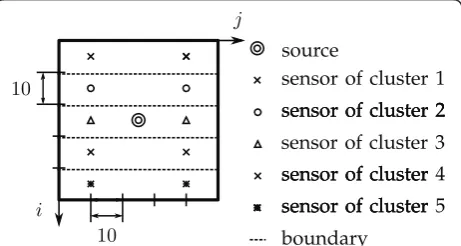
In this section, we present simulations illustrating the performance of the proposed Algorithms 1-4. The con-figuration used in the simulations is shown in Figure 4 with parameters in Table 2 (N{μ,σ2}denotes the Gaus-sian distribution with meanμand variances2). In parti-cular, we used M= 5 subregions Ω(m)corresponding to 5 clusters each with 2 sensors. We considered a single source located in Ω(3) at the lattice point (i0, j0) = (25,
25); it is modeled by choosing the source function ass0 [n] =s0(nΔt) wheres0(t) is a time-shifted Ricker wavelet.
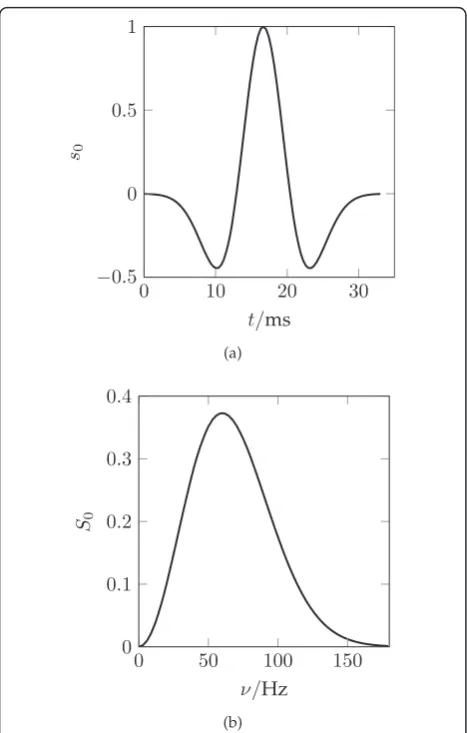
A Ricker wavelet [29] is defined by the negative second derivative of a Gaussian function such that
ricker(t) =!1−2π2ν2t2"exp!−π2ν2t2". (35) Here, νis approximately the peak frequency. A Ricker wavelet shifted by 16.7 ms withν = 60 Hz is used, i.e.s0 (t) = ricker(t -16.7 ms), see Figure 5. The acoustic pres-sure field is simulated using the FDM introduced in Sec-tion II. A snapshot of the field at timek= 160 is shown in Figure 6.
The parameters used in the decentralized PF are sum-marized in Table 3 (U{a,b}represents a discrete uni-form PDF with support [a, b]). For the fixed source position, we used a discrete uniform distribution on the 50 × 50 lattice. The spatio-temporal noise and the observation noise are drawn from a Gaussian distribu-tion. The PF is initialized at time k= 0, and the source is assumed to become active at time instant k< 0. The maximum value of the random variable kstart is a prior and is proportional to the maximal possible time dura-tion between source arise and first detecdura-tion (cf. (20)). Larger values ofkstartnecessitate a larger number of par-ticles to cover the time interval [-kstart, 0] and thus to achieve the same approximation accuracy.
A Estimation of posterior PDF
For the centralized PF, Figure 7a shows an example of the posterior PDF Ps(i, j, k) for the source position
obtained with the centralized particle filter at time instant k = 160 (cf. (23)). For comparison, Figure 7b shows the result obtained with the decentralized PF, i.e., the composition5
m=1P (m)
s (i,j,k)of the local posterior
PDF obtained by each cluster. It is seen that the centra-lized and the decentracentra-lized PF obtain similar results, and both yield a posterior PDF which is well concen-trated about the true position (i0,j0) = (25, 25) of the source.
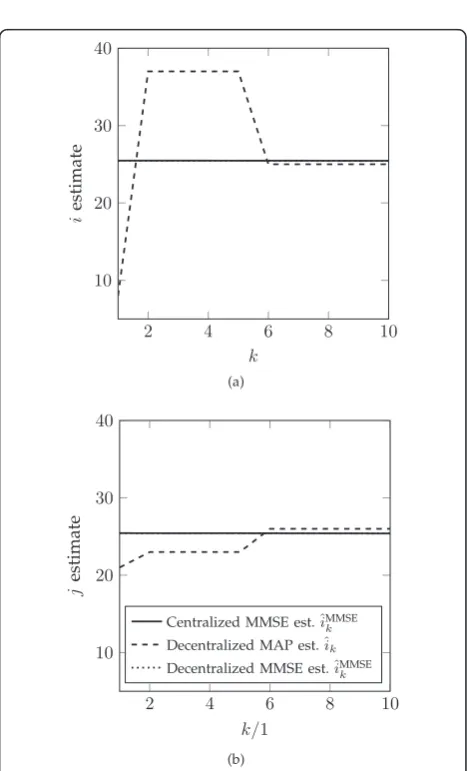
Figure 8a, b shows the MAP and MMSE of the source’si coordinate andj coordinate, respectively. The
10
10
source
sensor of cluster 1 sensor of cluster 2 sensor of cluster 2 sensor of cluster 2 sensor of cluster 3 sensor of cluster 4 sensor of cluster sensor of cluster sensor of cluster 5 sensor of cluster sensor of cluster
j
i
boundary
Figure 4Simulation setup comprising sensors, a single source, and SN cluster structure.
Table 2 Parameters for simulated hallway
FDM Δt 371 ns
MAP estimates(ˆik,ˆjk)are given by (32); the MMSE
esti-mates(ˆiMMSEk ,ˆjsMMSEk )are obtained as conditional means of the source coordinates obtained with the conditional posterior PMFPs(i, j, k) for given k. Since the prior of
the source location is a discrete uniform distribution,
MMSE estimates at k = 0 equal
(ˆiMMSEk ,ˆjsMMSEk ) = (I 2,J 2) = (25, 25). Hence, in this specific case, the MMSE estimates outperform the MAP estimates for small k. After a certain number of PF iterations (aroundk> 6), however, the MAP estimates match the true source position better than the MMSE estimates. The variance of Ps(i, j, k) for any given k
(which can be interpreted as MMSE) is shown in Figure 9 and corroborates that for small-to-medium k, the i coordinate estimate is more reliable; this can be attribu-ted to the specific sensor arrangements which favors betteri-resolution (cf. Figure 4).
B Decentralized MAP source localization
This subsection illustrates the decentralized source loca-lization using the AMC algorithm proposed in Section V (simulation setup unchanged). Recall that with AMC, each cluster has estimatesPˆk(m,max) of the MAP probability and(ˆi(km),ˆj(km))of the associated position. Figure 10a shows the local MAP probabilitiesP(km,max) (cf. (33)) for all five clusters; clearly, only the third cluster builds up a distinguished maximum over time, which indicates that the source is located withinΩ(3).
All clusters track the global MAP probability, Figures 10b and 11, and eventually agree on the source position provided by cluster 3 whose behavior over time resem-bles the global estimates using the centralized PF (cf. Figure 8a, b).
After about 6 iterations, the PF achieves a localization accuracy on the order of the lattice spacing Δr. These
estimates could be further improved (with higher com-putational complexity) by refining the discretization lat-tice and increasing the number of particles.
VIII Conclusions
We proposed a scheme for the localization of multiple acoustic sources in a sensor network (SN). The method uses an augmented non-linear non-Gaussian state-space
0 10 20 30
−0.5 0 0.5 1
t/ms
s0
(a)
0 50 100 150
0 0.1 0.2 0.3 0.4
ν/Hz
S0
(b)
Figure 5Ricker wavelet shifted by 16.7 ms withν= 60 Hz (a) in the time domain and (b) its Fourier transform.
10 20 30 40 50
10
20
30
40
50
j
i
0 2 4
Figure 6Pressure field from finite difference modeling after
41,750 time steps (corresponding to estimation timek= 160).
Table 3 PF parameters
Particles L 20,000
Space/time jitter x,y N{0,2
r 82}
t N{0,2
t 82} v i.i.d.N{0, 5 mPa} Priors kstart U{0, 41345}
model for the acoustic field and on a particle filter (PF) for sequential Bayesian estimation of source positions. This state-space representation for the wave equation gives additional prior physical knowledge and incorpo-rates perturbations and distortion like echoes, thereby resulting in improved estimation accuracy. In addition to the source positions, our PF implicitly provides an estimate of the acoustic field itself. We further devel-oped a decentralized PF in which the computational complexity is distributed over several clusters of the SN. The decentralized PF exploits the sparsity of the matrices involved in the state-space model. In fact, the loose coupling between the components of the state vec-tor allows separate and parallel computation of equation sub-systems of much smaller dimension in each cluster
10 20 30 40 50
10
20
30
40
50
j
i
(a)
10 20 30 40 50
10
20
30
40
50
j
i
0 2·10−2 4·10−2 6·10−2 8·10−2 0.1
(b)
Figure 7Posterior source position PDFPs(i,j,k) at timek= 160 obtained with (a) centralized and (b) decentralized PF.
0 50 100 150
0 50 100 150 200
k
mean
squar
ed
err
or
σ2
i
σ2
j
Figure 9 Variance of posterior distributionPs(i,j,k) with
respect toiandjcoordinates.
2 4 6 8 10
10 20 30 40
k
i
estimate
(a)
2 4 6 8 10
10 20 30 40
k/1
j
estimate
Centralized MMSE est.ˆiMMSE
k Decentralized MAP est.ˆik Decentralized MMSE est.ˆiMMSE
k
(b)
Figure 8MAP and MMSE estimate of theiandjcoordinate of the source (note that the lines of the centralized and
heads. To determine the global MAP estimate of the position of a source, we proposed an argumentum-max-imi-consensus algorithm in which the clusters exchange their best MAP probability and source position.
Acknowledgements
This work is funded by Grant ICT08-44 of“Wiener Wissenschafts-,
Forschungs-und Technologiefonds”(WWTF). This work in part was previously presented at the Asilomar Conference on Signals, Systems and Computers, Pacific Grove, CA, Nov. 2010.
Author details
1Institute of Telecommunications (ITC), Faculty of Electrical Engineering and
Information Technology, Vienna University of Technology, 1040 Vienna, Austria2Marine Physical Laboratory, Scripps Institution of Oceanography,
University of California, San Diego, CA, USA
Competing interests
The authors declare that they have no competing interests. Received: 19 January 2011 Accepted: 12 September 2011 Published: 12 September 2011
References
1. B Ristic, S Arulampalam, N Gordon,Beyond the Kalman Filter: Particle Filters for Tracking Applications, (Artech House, Boston) (2004)
2. O Hlinka, P Djuric, F Hlawatsch, Time-space-sequential distributed particle filtering with low-rate communications, inProceedings 43rd Asilomar Conference on Signals, Systems, and Computers,(Pacific Grove, CA) (2009) 3. O Hlinka, O Slučiak, F Hlawatsch, PM Djurić, M Rupp, Likelihood consensus:
Principles and application to distributed particle filtering, inProceeding 44th
Asilomar Conference on Signals, Systems, and Computers(Pacific Grove, CA)
(Nov. 2010)
4. P van Leeuwen, Particle filtering in geophysical systems. Mon Weather Rev. 137, 4089 (2009). doi:10.1175/2009MWR2835.1
5. C Yardim, P Gerstoft, WS Hodgkiss, Tracking of geoacoustic parameters using kalman and particle filters. J Acoust Soc Am.125, 746 (2009). doi:10.1121/1.3050280
6. A Ihler, J Fisher III, R Moses, A Willsky, Nonparametric belief propagation for self-localization of sensor networks. Sel Areas Commun, IEEE J.23(4), 809–819 (2005)
7. S Kay, inFundamentals of Statistical Signal Processing, Estimation Theory, vol. 1. (Pearson Education, New Jersey, 1993)
0 50 100 150
0 2·10−2 4·10−2 6·10−2 8·10−2 0.1
k
P
(
m
)
k,
max
cluster 1 cluster 2 cluster 3 cluster 4 cluster 5
(a)
0 50 100 150
0 2·10−2 4·10−2 6·10−2 8·10−2 0.1
k ˆP
(
m
)
k,
max
(b)
Figure 10Local (a) MAP probabilitiesP(m)
k,maxin comparison with (b) MAP probability estimatesPˆ
(m)
k,maxobtained by the individual
clusters using the AMC algorithm. In the latter case, the maximum time difference between two lines equals two.
2 4 6 8 10
10 20 30 40
k
ˆi
(
m
)
k
(a)
2 4 6 8 10
0 10 20 30 40
k
ˆj
(
m
)
k
cluster1 cluster2 cluster3 cluster4 cluster5
(b)
8. F Xaver, CF Mecklenbräuker, P Gerstoft, G Matz, Distributed state and field estimation using a particle filter, inProceeding 44th Asilomar Conference on
Signals, Systems, and Computers(Pacific Grove, CA, Nov. 2010)
9. J Candy, E Sullivan, Model-based identification: An adaptive approach to ocean-acoustic processing. Oceanic Eng IEEE J.21(3), 273–289 (2002) 10. L Rossi, B Krishnamachari, C Kuo, Distributed parameter estimation for
monitoring diffusion phenomena using physical models, inIEEE Communications Society Conference on Sensor and Ad Hoc Communications
and Networks (SECON)(2004)
11. T Zhao, A Nehorai, Distributed sequential Bayesian estimation of a diffusive source in wireless sensor networks. IEEE Trans Signal Process.55(4), 1511 (2007)
12. F Sawo, Nonlinear state and parameter estimation of spatially distributed systems, Ph.D. dissertation, Universität Karlsruhe (2009)
13. F Sawo, M Huber, U Hanebeck, Parameter identification and reconstruction for distributed phenomena based on hybrid density filter, inInformation Fusion, 2007 10th International Conference on, pp. 1–8 (2007)
14. D Bauso, L Giarré, R Pesenti, Non-linear protocols for optimal distributed consensus in networks of dynamic agents. Sys Control Lett.55(11), 918–928 (2006). doi:10.1016/j.sysconle.2006.06.005
15. A Tarantola,Inverse Problem Theory and Methods for Model Parameter Estimation,(Society for Industrial and Applied mathematics, Philadelphia, 2005)
16. F Jensen, W Kuperman, M Porter, H Schmidt,Computational ocean acoustics, American Institute of Physics Press, New York, 1994) 17. T Kailath,Linear Systems(Prentice-Hall, New Jersey, 1980)
18. A Doucet, S Godsill, C Andrieu, On sequential monte carlo sampling methods for bayesian filtering. Stat Comput.10(3), 197–208 (2000). doi:10.1023/A:1008935410038
19. R Mattheij, S Rienstra, J ten Thije Boonkkamp,Partial Differential Equations:
Modeling, Analysis, Computation(Society for Industrial and Applied
mathematics, Philadelphia, 2005)
20. M Zhdanov,Geophysical Inverse Theory and Regularization Problems(Elsevier Science Ltd, Amsterdam, 2002)
21. JD Hol, TB Schön, F Gustafsson, On resampling algorithms for particle filters, inNonlinear Statistical Signal Processing Workshop, 2006 IEEE, Sept., Ed. IEEE, pp. 79–82 (2006)
22. F Sawo, K Roberts, U Hanebeck, Bayesian estimation of distributed phenomena using discretized representations of partial differential equations. in3rd International Conference on Informatics in Control, Automation and Robotics (ICINCO), 16–23 (2006)
23. F Sawo, V Klumpp, U Hanebeck, Simultaneous state and parameter estimation of distributed-parameter physical systems based on sliced gaussian mixture filter, inInformation Fusion, 2008 11th International Conference on, 1–8 (2008)
24. S Farahmand, S Roumeliotis, G Giannakis, Particle filter adaptation for distributed sensors via set membership, inAcoustics Speech and Signal Processing (ICASSP), 2010 IEEE International Conference on. IEEE, 3374–3377 (2010)
25. B Oreshkin, M Coates, Asynchronous distributed particle filter via decentralized evaluation of gaussian products, inProceedings of the Sixth International Conference of Information Fusion(IEEE, Edinburgh, Scotland, July 2010)
26. M Coates, Distributed particle filters for sensor networks, inProceedings of the 3rd international symposium on Information Processing in Sensor
Networks(ACM, 2004), pp. 99–107
27. D Knuth, Big omicron and big omega and big theta. ACM Sigact News. 8(2), 18–24 (1976). doi:10.1145/1008328.1008329
28. M Arulampalam, S Maskell, N Gordon, T Clapp, A tutorial on particle filters for online nonlinear/non-Gaussian Bayesian tracking. IEEE Trans. Signal Process.50(2), 174–188 (2002). doi:10.1109/78.978374
29. H Ryan, A choice of wavelets. CSEG Recorder (09 Sept. 1994)
doi:10.1186/1687-1499-2011-94
Cite this article as:Xaveret al.:Localization of acoustic sources using a
decentralized particle filter.EURASIP Journal on Wireless Communications
and Networking20112011:94.
Submit your manuscript to a
journal and benefi t from:
7Convenient online submission 7Rigorous peer review
7Immediate publication on acceptance 7Open access: articles freely available online 7High visibility within the fi eld
7Retaining the copyright to your article