A Robust Signal Selective TDOA Estimation
Algorithm for Cyclostationary Signals Source
Location
Yang LiuDalian University of Technology, Dalian, 116024, China Inner Mongolia University, Huhhot, 010021, China
Email: [email protected]
TianShuang Qiu
Dalian University of Technology, Dalian, 116024, China Email: [email protected]
Abstract—For the problem of estimation time-difference-of-arrival (TDOA) for cyclostationary signals in the presence of interference and impulsive noise, a new robust multi-cycle signal-selective algorithm is introduced. By fusing second-order cyclic moments and fractional lower-order statistics, a novel cyclic fractional lower-order statistics is developed. The proposed algorithm combines the benefits of cyclostationarity based method and fractional lower-order statistics based estimator, by exploiting cyclostationarity property of signals with cyclic fractional lower-order statistics. Simulation results indicate that the new method is highly tolerant to interference and impulsive noise and gives higher estimation accuracy than conventional TDOA estimation methods.
Index Terms—cyclostationarity, impulsive noise, fractional lower-order statistics, time-difference-of-arrival (TDOA)
I. INTRODUCTION
The problem of locating a Mobile Station (MS) has drawn considerable interest in recent years. A variety of wireless location schemes have been extensively investigated in [1], [2]. One typical method used to estimate the mobile location is time-difference-of-arrival (TDOA) which does not require knowledge of the transmit time of the received signal from the transmitter and has better accuracy than angle of arrival (AOA) [3], [4]. Although several techniques are used to reduce the effects of interference and noise in communication systems [3], it is necessary to develop effective TDOA algorithms.
Most man-made signals encountered in radar, sonar, and communication systems are appropriately modeled as cyclostationary time series [5]. A class of signal-selective TDOA methods for passive location is introduced by Gardner et al. [6], [7]. These methods that exploit inherent cyclostationarity of signals are highly tolerant to both interference and Gaussian noise, which are neither cyclostationary signals, nor exhibiting the same cycle frequency of the source signal. Since almost man-made
signals in communication systems have more than one cycle frequency [5], some modified multi-cycle algorithms which exploit more than one cycle frequency are developed in [8-10]. The multi-cycle methods can achieve better performance than single-cycle estimators which utilize only one cycle frequency [10].
The primary single-cycle and multi-cycle methods focus on the case where the environment noise is assumed to follow the Gaussian distribution model. However, many types of noises encountered in practice such as atmospheric noise, multiuser interference and some man-made noise in urban region are heavy tailed non-Gaussian impulsive processes [11], [12]. Studies and experimental measurements have shown that alpha-stable distribution is more suitable for modeling noise of impulsive nature than Gaussian distribution in communication, telemetry, radar, and sonar systems [13], [14]. The alpha-stable model is of a statistical-physical nature, arising under very general assumptions satisfies the stability and the Generalized Center Limit Theorem [16], [17]. It can be described conveniently by four parameters, in which the characteristic exponent
(0 2)
α < ≤α determines the heaviness of its tail. A
small positive value of α indicates severe impulsiveness, while a value of α close to 2 indicates a more Gaussian type behavior. When α =2 , the stable distribution reduced to the Gaussian distribution. So the alpha-stable model is more suitable for modeling noise than Gaussian distribution in real signal processing applications. Several TDOA methods take account the impulsive noise using fractional lower order statistics (FLOS) have been proposed in literature [15].
non-Gaussian noise [15], the interfering signals which occupy the same spectral band as the source signal can severely degrade the performance of these methods. To extend the signal-selective and FLOS based methods and achieve high accuracy of TDOA estimation, a robust TDOA algorithm which combines multi-cycle estimator with fractional lower-order statistics is proposed in this paper. The new method takes advantages of both multi-cycle estimator and FLOS method can exploit cyclostationarity in the presence of interference and S Sα impulsive noise. Simulation results demonstrate that the proposed algorithm can acquire high accuracy of TDOA estimation.
The rest of this paper is organized as follows: The modeling of the signal measurement is briefly described in Section Ⅱ. In Section Ⅲ, the cyclic fractional
lower-order moment and fractional lower-lower-order multi-cycle TDOA algorithm are proposed. The performance of the new algorithm via Monte Carlo simulations is presented in Section Ⅳ. Finally, conclusions are given in Section Ⅴ.
II.SIGNAL MODEL
In general, for a signal radiating from a remote source through a channel with interference and noise, the model for time difference of arrival estimation between received signals at two base stations is given by
( ) ( ) ( )
x t =s t +n t (1)
( ) ( ) ( )
y t =rs t−D +m t (2)
where s t( ) is the signal of interest (SOI), n t( ) and m t( ) are the signals not of interest (SNOI), including interference and noise, D is the TDOA to be estimated, and parameter r represents the magnitude mismatch between two receivers. To simplify the problem, it is assumed that s t( ) is statistically independent of SNOI,
( )
n t and m t( )do not share the same cycle frequency as that of the SOI. However, since n t( ) and m t( ) may contain the same interfering signals (with different times of arrival), they can be statistically dependent [6].
III. THE PROPOSED FRACTIONAL LOWER ORDER
MULTI-CYCLE TDOAESTIMATION METHOD
Some single-cycle signal-selective TDOA estimation algorithms based on the second-order cyclostationarity are proposed in [6]. Since the cycle frequency for most communication signals are not unique, the single-cycle estimators cannot achieve the best performance. It was introduced in [8] and [10] that multiple single-cycle estimators can be fused together to form a multi-cycle estimator,
*
( ) i( )( i( ))
i
i yx x
A
gε w Rε u Rε u du
ε
τ τ
∈
+
∑ ∫
(3)where εi is one element in the cycle frequency set A of
( )
s t , wi is the weight and wi =1. According to the
definition in [6], the cyclic autocorrelation function of
( )
s t at cycle frequency ε is defined as
2
( ) ( / 2) ( / 2) j t s
Rε τ s t+τ s t∗ −τ e− πε (4)
where lim(1/ ) T/2/2( ) T
T→∞ T − dt
⋅ =
∫
⋅ is the time-averagingoperation, and “∗” denotes the conjugation.
The multi-cycle estimator (3) makes better use of the cyclostationarity features and acquires more accurate estimates of TDOA. However, Due to the thick tails, stable distributions do not have finite second-order moments, except for the limiting caseα =2. If the received noises contain stable processes, the second-order cyclic moments such as cyclic autocorrelation function in (4) will not be applicable. Thus, the conventional multi-cycle estimator (3) based on the cyclic correlations will degrade severally in impulsive noise environments
.
In order to outperform the drawbacks of the conventional multi-cycle algorithm, we define a new cyclic fractional lower-order statistics and propose a new signal-selective estimator by utilizing cyclic fractional lower-order statistics instead of second-order cyclostationarity. Considering the random process ( )s t , the cyclic fractional lower-order autocorrelation function at cycle frequency ε is defined as
/2
, * 2
/2
* 2
1
( ) lim [ ( / 2)] [ ( / 2)]
[ ( / 2)] [ ( / 2)]
T
p p j t
s T
T
p j t
R s t s t e dt
T
s t s t e
ε πε
πε
τ τ τ
τ τ
〈 〉 ∗ −
− →∞
〈 〉 ∗ −
+ −
+ −
∫
(5)where 1≤ <p α and z〈 〉k = zk−1z∗. In equation (5), the
convention k k 1
z〈 〉= z − z∗ can also be rewritten in a polar form as
1
k k k j
z〈 〉=r −z∗ =r e−θ (6)
where z=rejθ . Equation (6) demonstrates that convention k
z〈 〉 contains fractional restrain magnitude but maintain period of random variablez. Thus, cyclic fractional lower-order autocorrelation function (5) and conventional cyclic correlation (4) share the same cycle frequency. In other words, k
z〈 〉 attenuates only the magnitude value ofz, but it maintains the periods ofz. Both of them exhibit the same cyclostationarity property.
Note that the cyclic autocorrelation ( )Rs
ε τ could be
expressed as the conventional cross correlation for the pair of time series ( )u t and ( )v t [6],
2
0
( ) ( / 2) ( / 2)
( / 2) ( / 2) = ( )
j t s
uv
R s t s t e
u t v t
R
ε τ τ τ πε
τ τ
τ
∗ −
∗
+ −
= + − (7)
where
( ) ( ) j t
u t s t e−πε (8)
( ) ( ) j t
are obtained by frequency shifting ( )s t . By substituting (8) and (9) into (5), with the properties of
( )
k j t j t k
z〈 〉e±πε = ze∓πε 〈 〉 and ( )z∗ 〈 〉k =(z〈 〉k )∗ , the cyclic fractional lower-order autocorrelation ,p( )
s
Rε τ can be re-expressed as
, ( ) [ ( / 2)] [ ( / 2)]
( ).
p p
s
p uv
R u t v t
R
ε τ τ τ
τ
∗ 〈 〉
= + −
= (10)
Equation (10) reveals that the cyclic fractional lower-order autocorrelation can be expressed as conventional fractional lower-order cross-correlation of the frequency-shifted versionsu t( ) and v t( ) ofs t( ).
It should be noted that by using signed-power nonlinearity k
z〈 〉, impulsive noise components in u t( ) and v t( ) are reduced to fractional powers. Unlike cyclic
autocorrelationRs( )
ε τ , even if the received noise in n t( )
and m t( ) are S Sα distribution impulsive processes, the cyclic fractional lower-order autocorrelation ,F( )
s
Rε τ is also applicable. Thus, the cyclic fractional lower-order autocorrelation function can be expected to exploit spectral correlation in the presence of impulsive noise. In particular, for ε=0 , cyclic fractional lower-order autocorrelation ,p( )
s
Rε τ becomes conventional fractional lower-order autocorrelation p( )
s
R τ . And for p=2 , it reduces to the conventional second-order cyclic autocorrelationRs( )
ε τ . Substitute (1) and (2) into (5) and
assume that r is a real number, the cyclic fractional lower-order autocorrelation and cross correlation functions are given by
,p( ) ,p( )
x s
Rε τ =Rε τ (11)
,p( ) p ,p( ) j D
yx s
Rε τ =r〈 〉Rε τ−D e−πε . (12) To overcome the drawbacks of conventional signal-selective methods, we propose a new algorithm based on cyclic fractional lower-order correlations. As an alternative, the new estimator
, ,
, ( ) i ( )( i ( ))*
i
p p
p
M i yx x
A
gε w Rε u Rε u du
ε
τ τ
∈
+
∑ ∫
(13)is called fractional lower-order statistics multi-cycle estimator (FLOS-MCE). By substituting the idealized measurements (11) and (12) into (13), we obtain the ideal function of the FLOS-MCE
, ,
, ( ) i i ( )( i ( ))
i
j D p p
p p
M i s s
A
gε r w e πε Rε D u Rε u du
ε
τ 〈 〉 − τ ∗
∈
=
∑
∫
− + .(14)It follows from (14) that
, ,
,
2 ,
( ) ( )( ( ))
( ) .
i i i
i
i
i
j D p p
p p
M i s s
A
p p
s A
g r w e R D u R u du
r R u du
πε ε ε
ε
ε
ε ε
τ 〈 〉 − τ ∗
∈
∈
= − +
≤
∑
∫
∑ ∫
(15)It is noted that only if τ =D can the equality in (15) hold. When j iD
i
w =eπε andτ=D, we have
2 ,
, ( ) i ( )
i
p
p p
M s
A
gε D r Rε u du
ε
〈 〉
∈
=
∑ ∫
. (16)Assume r is a real number, thenr p = rp,
2 ,
, ( ) i ( ) max , ( )
i
p p
p p
M s M
A
gε D r Rε u du gε
ε∈ τ
=
∑ ∫
= . (17)To see that ,p( ) M
gε τ does indeed peak atτ =D , the solution of FLOS-MCE is given by
2 ,
arg max{ p( )}, j iD
M i
D gε w e πε
τ τ
= = . (18)
Since the true value of D is unknown, wi can not be computed directly in real applications. In order to obtain accurate estimate ofD, it should let wi =1 get the initial
,
ˆ ( )p M
gε τ and ˆD, then estimate wi through iteration [9]. Note that when p=2 the FLOS-MCE reduces to the
conventional multi-cycle estimator (MCE).
VI. SIMULATION RESULTS
In this section, we present the results of a simulation study designed to compare the performance of the above algorithms for TDOA estimation. Simulation results are provided to demonstrate the effectiveness and robustness of the proposed method. We consider a real simulated BPSK signal [7], [9] with uncorrelated S Sα noise added to the two received signals. The carrier frequency of the BPSK signal is fc =0.25 /Ts , keying rate of
0.0625 /Ts
ε = with chip width To =16Ts and sampling incrementTs. The TDOA between two received signals is fixed atD=48Ts. The length of the received signals is
1024 32× baud. As the stable distribution makes the
standard SNR meaningless, then a new generalized SNR (GSNR) is defined asGSNR 10log 2
s n
σ γ
= , where 2
s σ is the variance of the signal, γn is the dispersion parameter of the S Sα noise.
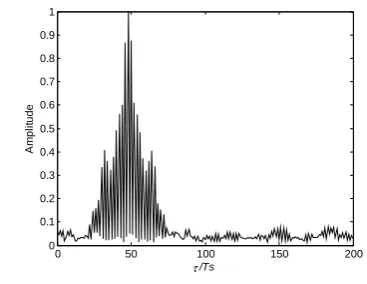
to give correct estimation in this case where alpha-stable impulsive noise is present. The dominant peak of the single-cycle estimator is atτ =56Ts. And the peak of interest is only one of many peaks, any one of which might be taken as the TDOA estimate. Similarly, the highest peak of the multi-cycle estimator is also at the wrong TDOA valueτ =52Ts.
0 20 40 60 80 100 120 140 160 180 200 0
0.1 0.2 0.3 0.4 0.5 0.6 0.7 0.8 0.9 1
τ /Ts
A
m
pl
it
ude
Figure 1. TDOA estimation function of the single-cycle estimator with cycle frequencyε=0.0625 /Ts.
0 20 40 60 80 100 120 140 160 180 200 0
0.1 0.2 0.3 0.4 0.5 0.6 0.7 0.8 0.9 1
τ /Ts
A
m
pl
it
ude
Figure 2. TDOA estimation function of the conventional MCE with cycle frequenciesε,2ε, and 2fc.
In contrast to this, the TDOA estimation functions of the proposed double-cycle and triple-cycle FLOS-MCE algorithms are shown in Fig. 3 and Fig. 4. It is clear that both the double-cycle and triple-cycle FLOS-MCE estimators are highly robust to the impulsive noise. The peak of interest is only one, and the highest peak is at the correct TDOA value τ = =D 48Ts . Furthermore, the TDOA function of the triple-cycle FLOS-MCE has sharper peaks than that of the double-cycle FLOS-MCE.
0 20 40 60 80 100 120 140 160 180 200 0
0.1 0.2 0.3 0.4 0.5 0.6 0.7 0.8 0.9 1
τ /Ts
A
m
pl
it
ude
Figure 3. TDOA estimation function of the FLOS-MCE with cycle frequenciesεand2ε.
0 50 100 150 200
0 0.1 0.2 0.3 0.4 0.5 0.6 0.7 0.8 0.9 1
τ /Ts
A
m
pl
it
ude
Figure 4. TDOA estimation function of the FLOS-MCE with cycle frequenciesε,2ε and 0.
To illustrate the robustness of the new multi-cycle algorithm to the impulsive noise, the performances of the FLOS-MCE, MCE and FLOS [15] methods are given in Fig. 5 when GSNR is -5 dB. The cycle frequencies exploited by the algorithms are keying rateε =0.0625 /Ts, 2ε, and 0
.
Fig. 5 shows that the FLOS-MCE and FLOS methods greatly outperform the MCE method in impulsive noise condition. The MCE outperforms FLOS-MCE and FLOS only when the additive noise is Gaussian (α =2). This is due to the fact that the effect of impulsive noise is diminished by fractional lower-order statistics.
1 1.2 1.4 1.6 1.8 2
10-3 10-2 10-1 100 101 102 103 104
α Value
MS
E
FLOS
ε=0,1/Tc,2/Tc;MCE
ε=2/Tc;FLOS-MCE
ε=0,1/Tc;FLOS-MCE
ε=0,1/Tc,2/Tc;FLOS-MCE
Figure 5. Performance of the proposed and conventional TDOA estimation algorithms when GSNR= -5 dB.
-12 -9 -6 -3 0 3 10-4
10-2 100 102 104
GSNR (dB)
MS
E
α=1.2
α=1.4
α=1.6
α=1.8
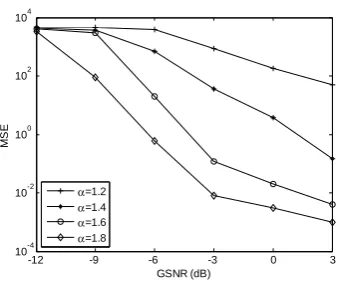
Figure 6. TDOA estimation accuracy of the proposed double-cycle FLOS-MCE in the presence of impulsive noise
-12 -9 -6 -3 0 3
10-4 10-2 100 102 104
GSNR (dB)
MS
E
α=1.2
α=1.4
α=1.6
α=1.8
Figure 7. TDOA estimation accuracy of the proposed triple-cycle FLOS-MCE in the presence of impulsive noise.
B. Multiple Interference
In this case, the interference [4] consists of five AM signals with carrier frequencies of f1 =0.156 /Ts ,
2 0.203 / s
f = T , f3=0.266 /Ts , f4 =0.313 /Ts , and
5 0.375 / s
f = T , with bandwidths of B1=0.04 /Ts , 2 0.05 / s
B = T , B3=0.045 /Ts , B4=0.04 /Ts , and
5 0.08 / s
B = T , and corresponding TDOAs of τ =1 28Ts, 2 68Ts
τ = , τ =3 78Ts , τ =4 38Ts , and τ =5 58Ts . The signal-to-interference ratio (SIR) of each AM signal is 0 dB and GSNR is 0 dB, which yields a total signal-to-noise ratio (SNR) of -8 dB. The cycle frequencies exploited by the algorithms are ε =0.0625 /Ts ,
2εand 2fc. The characteristic exponent ofS Sα noise is
1 1.1 1.2 1.3 1.4 1.5 1.6 1.7 10-2
10-1 100 101 102 103 104
p
MS
E
FLOS
ε=1/To;FLOS-MCE
ε=1/To,2/To;FLOS-MCE
ε=1/To,2/To,2fc;FLOS-MCE
Figure 8. TDOA estimation accuracy in multiple interference and S Sα impulsive noise environment.
1.6
α = . From definition (5) we find that the value of p has an impact on the performance of FLOS-MCE. In Fig. 8, the performance of the FLOS-MCE and FLOS methods [15] is evaluated in the presence of multiple interference and impulsive noise as p changing from 1 to 1.7. It can be seen that FLOS-MCE is substantial tolerant to the multiple interferences and impulsive noise as p changing from 1 to 1.4. The estimation accuracy using FLOS has the worst performance among these methods. It is clear that in order to acquire reliable TDOA estimate, the parameter p of the FLOS-MCE should be set to bep<1.3.
C. Narrowband Interference
The interfering signal [5] is a BPSK signal with carrier frequency of f1 =0.2 /Ts, keying rate ofε =1 0.025 /Ts, and TDOA ofτ =1 58 /Ts. The characteristic exponent of S Sα noise isα =1.8. The cycle frequency used by the algorithms areε =0.0625 /Ts, 2ε and 2fc. Even though the interference is the same type of SOI, it does not exhibit spectral correlation atε, 2ε and 2fc.
-15 -12 -9 -6 -3 0 3 6 9 10-4
10-2 100 102 104
GSNR (dB)
MS
E
ε=1/To;MCE
ε=1/To,2/To;MCE
ε=1/To,2/To,2fc;MCE
ε=1/To;FLOS-MCE
ε=1/To,2/To;FLOS-MCE
ε=1/To,2/To,2fc;FLOS-MCE
Figure 9. TDOA estimation accuracy for narrowband interference and impulsive noise environment.
The TDOA estimation accuracy results are shown in Fig. 9. It can be seen that the accuracy of conventional MCE approximates very close to the new FLOS-MCE when GSNR < -12 dB. Whereas GSNR > -12 dB, the MCE are inferior to the new FLOS-MCE. Furthermore, it is clear that the double-cycle FLOS-MCE performs better than single-cycle estimator, but is inferior to the triple-cycle one.
V. CONCLUSION
proposed algorithm is a class of methods parameterized byp, include the conventional multi-cycle estimator (3) as a special case ( p=2). Simulation results illustrate
that the new FLOS-MCE estimator provides better accuracy for TDOA estimation compared with conventional single-cycle and multi-cycle signal-selective estimators and FLOS method. And the FLOS-MCE algorithm exhibits robustness in a wide range of interference and noise environments.
ACKNOWLEDGMENT
This work was supported by National Science Foundation of China under Grant 60872122.
REFERENCES
[1] T. S. Rappaport, J. H. Reed, B. D. Woerner, “Position
location using wireless communications on highways of the future”, IEEE Communication Magazine, vol.34, No.10, 1996, pp. 33-41.
[2] A. H. Sayed, A. Tarighat, N. Khajehnouri, “Network-based
wireless location: Challenges faced in developing techniques for accurate wireless location information”, IEEE Signal Processing Magazine, vol.22, No.4, 2005, pp. 22-40.
[3] L. Cong, W. Zhuang, “Hybrid TDOA/AOA mobile user
location for wideband CDMA cellular systems”, IEEE Transactions on Wireless Communications, vol.1, No.3, 2002, pp. 439-447.
[4] K. Yang, J. An, X. Bu, G. sun, “Constrained total
least-squares location algorithm using time-difference-of-arrival measurements”, IEEE Transactions on Vehicular Technology, vol.59, No.3, 2010, pp. 1558-1562.
[5] W. A. Gardner, A. Napolitano, L. Paura,
“Cyclostationarity: Half a century of research”, Signal Processing, vol.86, No.4, 2006, pp. 639-697.
[6] W. A. Gardner, C. K. Chen, “Signal–selective
time-difference-of-arrival estimation for passive location of man-made signal sources in highly corruptive
environments, Part 1: Theory and method”, IEEE
Transactions on Signal Processing, vol.40, No.5, 1992, pp. 1168-1184.
[7] C. K. Chen, W. A .Gardner, “Signal–selective
time-difference-of-arrival estimation for passive location of man-made signal sources in highly corruptive
environments, Part 2: Algorithms and performance”, IEEE
Transactions on Signal Processing, vol.40, No.5, 1992, pp. 1185-1197.
[8] W. A. Gardner, C. M. Spoooner, “Detection and source
location of weak cyclostationary signals: Simplifications of the maximum-likelihood receiver”, IEEE Transactions on Communications, vol.41, No.6, 1993, pp. 905-916.
[9] Z. Huang, Y. Zhou, “Multi-cycle estimator for
time-difference-of-arrival (TDOA) and its performance”, IEE Proceedings Radar Sonar and Navigation, vol.153, No.5, 2006, pp. 381-388.
[10]Z. Huang, Y. Zhou, W. Jiang, “TDOA and Doppler
estimation for cyclostationary signals based on multi-cycle frequencies”, IEEE Transactions on Aerospace Electronic System, vol.44, No.4, 2008, pp. 1251-1264.
[11]K. Gulati, A. Chopra, B. L. Evans, K. R. Tinsley,
“Statistical modeling of co-channel interference”, Proceeding of Global Telecommunication Conference, Holulu, HI, vol.1, 2009, pp. 1-6.
[12]C. L. Nikias, M. Shao, Signal processing with
Alpha-Stable Distributions and Applications, Wiley, New York, 1995.
[13]R. F. Brcich, D. R. Iskander, A. M. Zoubir, “The stability
test for symmetric alpha-stable distributions”, IEEE Transactions on Signal Processing, vol.53, No.3, 2005, pp. 977-986.
[14]J. G. Gonzalez, J. L. Paredes, G. R. Arce, “Zero-order statistics: A mathematical framework for the processing and characterization of very impulsive signals”, IEEE Transactions on Signal Processing, vol.54, No.10, 2006, pp. 3839-3851.
[15]X. Ma, C. L. Nikias, “Joint estimation of time delay and
frequency delay in impulsive noise using fractional lower order statistics”, IEEE Transactions on Signal Processing, vol.44, No.11, 1996, pp. 2269-2687.
[16]G. A. Tsihrintzis, C. L. Nikias, “Evaluation of the
FLOS-based detection algorithm on real sea-clutter data”, IEE Proceedings Radar, Sonar, and Navigation, vol.144, No.1, 1997, pp. 29-38.
[17]P. G. Georgious, P. Tsakalides, “Alpha-stable modeling of
noise and robust time-delay estimation in the presence of impulsive noise”, IEEE Transactions on Multimedia, vol.1, No.3, 1999, pp. 291-301.
Yang Liu Liaoning Province, China.
Birthdate: Feb, 1981. is Communication Engineering M.S. graduated from Dept. Electronic Engineering Inner Mongolia University. He is currently working toward the PhD degree in Electronic Engineering at faculty of Electronic Information and Electrical Engineering of Dalian University of Technology. He is a lecturer of Dept. Electronic Engineering Inner Mongolia University.
TianShuang Qiu was born in 1954,