6
I
January 2018
Optimal Tuning of PSS and SVC-Based SMIB
System Using Hybrid PSO-GSA Algorithm
Reena Joshi1, Kapil Parkh2, Raunak Janjid3, Sagar Trivedi4
1
M.tech Scholar Electrical Engineering SITE,NathdwaraNathdwara,India
2, 3, 4
Assistant Professor Electrical Engineering SITE,NathdwaraNathdwara,India
Abstract: In modern power systems, the problem of stability plays an important role in the electrical system. We have improved the dynamic stability of the power system by simultaneously controlling all depreciation based PSS controller and SVC with the PSO-GSA hybrid algorithm. HPSO-GSA is applied to find optimal driver configurations. The Optimization of Optimization Particle Swarm (PSO) is motivated by the social flocks of birds, and the gravity Search algorithm (GSA) is based on the intersection of gravity and mass. Single-machine infinite bus system (SMIB). The base depreciation controllers of PSS and SVC are equipped with different fault conditions such as three-phase fault, single phase-to-ground fault, double phase-to-ground fault, phase-to-phase fault phase and different load under nominal conditions, light loads and heavy loads. Finally, it is detected that the optimized HPSOGSA parameters provide superior perfomance and reduce the establishment time of the power system. Different simulation results can be obtained under various disturbances and operating conditions.
Keywords: Static Synchronous Compensator; PowerSystem Stabilizers; HybridPSO-GSA Algorithm; Single Machine Infinite-Bus
I. INTRODUCTION
The FACTS device is an electronic device that is an effective and useful tool to improve the stability of the power system and dampen oscillation between zones. FACTS devices are very expensive and additional controllers can be designed for each device to increase the attenuation of the particular electromechanical oscillation mode. The FACTS team plays a key role in improving the dynamic stability of the electrical system and improving the oscillation between zones.
In addition to adjusting the real and reactive power of the transmission line, the FACTS device can also adjust the voltage at the connected points[15]. These play an important role in controlling the flow of reactive power in electrical networks, resulting in voltage fluctuations and stability [1].
A stable SVC compensator is a set of powerful tools to provide fast reactive power of a high voltage transmission network. The SVC AC transmission system is part of a family of flexible devices. A certain SVC is a combination of controlled reactors and has a bypass capacitor in parallel. The purpose of SVC is to maintain the received voltage by changing the normal reactive power of the transmission system and changing the firing angle of the receiver. Currently, the demand for electricity is constantly increasing, and the transmission capacity of the transmission line increases, so the oscillation of the power angle is essential to the attenuated power supply system. This can be achieved with the help of an effective driver. If the adjustment between the controllers is appropriate, a more powerful system can be made and the lack of an adequate adjustment can affect the stability of the system [8]. The static change compensator (SVC) is a generator or static absorber in derivation. It is used to improve the AC system voltage and the reactive power condition.
proportion to this distance. This article shows that the hybrid algorithm has a better ability to evade local optimums with a faster convergence than with the PSO and GSA standards[18].
II. SYSTEMMODEL
[image:3.612.76.399.111.252.2]A. Overview of SVC and its Control System
Fig 1Functional block diagram model of SVC
Fig.1 shows an infinite bus system on a single machine with SVC. The system consists of a plant that includes the synchronous generator, the double line transmission line, the transformer and the infinite bus. The transmission line is compensated by the FACTS device in the middle of the line. The power system is naturally non-linear and a wide range of transient conditions that arise from low frequency low voltages and power swing. It is difficult to control the oscillation. VT represents the voltage across the generator, VB represents the infinite bus voltage and T / F represents the transformer. SVC is a static bypass generator whose output exchanges the capacity system or inductive (current) reactive power to control specific variables in the power system.
III. THE PROPOSED APPROACH
A. Structures of SVC based damping controllers and PSS
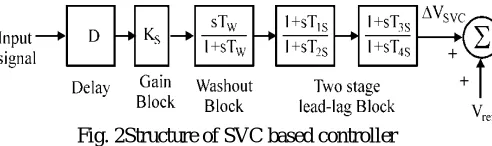
[image:3.612.188.434.445.518.2]Fig. 2 shows the SVC-based damper controller when designing an additional SVC driver, a delay compensator (Leag-lag) is used and the controller must include a gain block, a wash block and a controller. The wash block provides a high pass filtering, which allows signals associated with the signal of the input signal and the phase compensator to provide inputs that provide a phase delay. The output signal is supplied to the internal controller SVC[8].
Fig. 2Structure of SVC based controller
[image:3.612.181.436.575.636.2]The structure of power system stabilizer consists of two-stage compensation blocks, gain block, washout block. The grid compensation module (T1P, T2P, T3P, and T4P with time variables) provides enough phase change to compensate for phase shift between the input and output signals.
Fig.3Structure of power system stabilizer
B. Problem formulation
SVC delay (lead-lag) structure parameters such as T1s, T2s, T3s, T4s and PSS lead-lag structure parameters such as T1p, T2p, T3p, T4p are optimized by HPSOGSA technology. In this study, the integration error (ITAE) of the speed difference is converted into the objective function J
J = ∫ |∆ω|∙t∙dt (1)
IV. THEHYBRIDPSOGSAALGORITHM
Within the case of the hybridization method, algorithms may be hybridized. Hybrid in the upper or decrease level by way of homogeneous or heterogeneous relays or convolution techniques. Hybrid PSO and GSA use heterogeneous low-stage co-precipitated hybrids. Hybrid is heterogeneous because it combines the capabilities of the 2 algorithms. Since it does no longer use each algorithm in order, it's miles scalable in not unusual. In other phrases, they work in parallel. It’s far heterogeneous due to the fact there are distinct algorithms that integrate to obtain the very last result. PSOGSA offers the concept of combining social questioning talents in PSO with the nearby search competencies of GSA. The mixture of those algorithms ends in the subsequent outcomes: in the case of the hybridization technique, two algorithms can be hybridized. They hybridize on the top or lower level using homogeneous or heterogeneous relays or co-evolution techniques. We hybridize PSO and GSA use low degree heterogeneous co-brought about hybrids. Hybrid is heterogeneous as it combines the features of each algorithm. As it does not use the two algorithms, so as, it is joint evolutionary. In different phrases, they run in parallel. Its miles heterogeneous due to the fact there are extraordinary algorithms that integrate to reap the very last end result. PSOGSA offers the idea of combining the social questioning abilities in PSO with the neighborhood seek competencies of GSA. The mixture of these algorithms results in the following consequences:
In the case of the hybridization method, two algorithms can be hybridized. Hybrid in the upper or lower level by homogeneous or heterogeneous relays or convolution methods.Hibridan PSO and GSA use heterogeneous low-level co-induced hybrids. Hybrid is heterogeneous because it combines the functions of the two algorithms. Since it does not use both algorithms in order, it is scalable in common. In other words, they work in parallel. It is heterogeneous because there are two different algorithms that combine to obtain the final result. PSOGSA offers the idea of combining social thinking skills in PSO with the local search capabilities of GSA. The combination of these two algorithms leads to the following results: In the case of the hybridization method, two algorithms can be hybridized. They hybridize at the upper or lower level using homogeneous or heterogeneous relays or co-evolution methods. We hybridize PSO and GSA use low level heterogeneous co-induced hybrids. Hybrid is heterogeneous as it combines the functions of both algorithms. Because it does not use the two algorithms in order, it is joint evolutionary. In other words, they run in parallel. It is heterogeneous because there are two different algorithms that combine to obtain the final result. PSOGSA offers the idea of combining the social thinking capabilities in PSO with the local search capabilities of GSA[18]. The combination of these two algorithms results in the following results:
( + 1) = × ( ) + × × ( ) + × × ( − ( ))(2)
The PSOGSA step.
In PSOGSA, the answer function (aptitude) is taken under consideration during the replace system. Sellers close to the correct way to attempt to appeal to different agents to search the quest space. If all dealers method an amazing answer, the agent actions very slowly. In this situation, they are very beneficial to develop the high-quality of the arena. PSOGSA uses memory to register the best answer determined to date, so that you can get right of entry to it at any time. Each agent can have a look at the great answer to this point and be sensitive to it. You could stability the worldwide seek and local seek functions with the aid of adjusting c1 and c2
V. RESULTANDDISCUSSIONS
The simpower device toolboxes are used for evaluation and expand the electricity gadget model. That is a totally beneficial tool for modeling and simulation. This tool carries the powerlib library. Several blocks are to be had within the library, including generators, exclusive styles of machines, power electronic converter, excitation system, different drives, transformers, transmission lines etc.
A. SMIB system with PSS
[image:5.612.157.469.321.484.2]Fig. 5 suggests the MATLAB version of a SMIB system with SVC controller. The device comprises of a producing unit of 2100 MVA, 13.8 KV, 60 HZ. This generator is offering an endless bus thru a step-up transformer of 21 MVA 13.8/500 KV. A 3-section breaker is hooked up close to bus B1 prior to a 3-phase load of 250 MW so that the effect of small disturbance may be demonstrated via momentarily disconnecting the load of 250 MW with the help of this breaker. The SVC is attached close to bus2 and the score is 500 KV, ±100MVAR. The double circuit transmission line length is 300 km between bus-2 and bus3. The generator is so introduced with a hydraulic turbine & the governor (HTG) and excitation device. For applying various faults a block is attached between the bus b2 and bus b3 on the transmission line.
[image:5.612.72.553.325.685.2]Fig. 5 Single-machine infinite-bus power system with SVC [18]
Table 1 : HPSOGSA optimized SVC controller parameters for SMIB System
S.N. System
HPSOGSA Optimized SVC Controller Parameters
Ks T1S T2S T3S T4S
1. SMIB system 20 .035 0.12 .03 0.22
Table 2: HPSOGSA optimized for PSS System
S.N. System
HPSOGSA Optimized PSS Controller Parameters
K T1 T2 T3 T4P
1. PSS System 40 0.01 0.0125 2 3
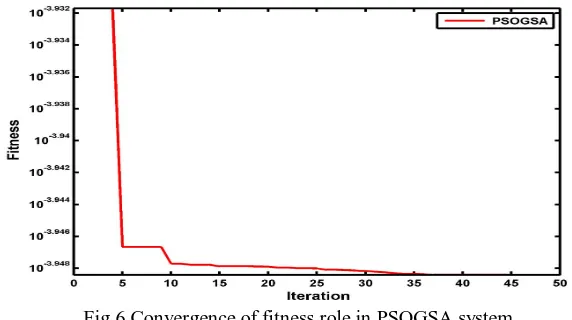
[image:5.612.52.563.509.693.2]Fig.6 Convergence of fitness role in PSOGSA system
B. Simulation result for SMIB(PSS+SVC) power system
The effects of the evolved simulation fashions beneath diverse contingencies are provided and mentioned below. The evolved model is simulated without PSS and SVC controller and with PSS and SVC controller (tuned by HPSOGSA). The responses with and without controller are accessed for reading the effectiveness and toughness of the SVC damping controller and its overall performance over a massive range of operating conditions for extraordinary faults. The simulation analysis has been conceded out for SMIB system. SMIB machine the conduct of the HPSOGSA tuned SVC controller is examined under one-of-a-kind running situations viz. nominal loading, light loading & heavy loading and we reap various graphs as a power angle deviation, speed deviation, line power deviation, reference voltage deviation, stabilizing signal deviation by means of applying distinct stability and unbalance fault.
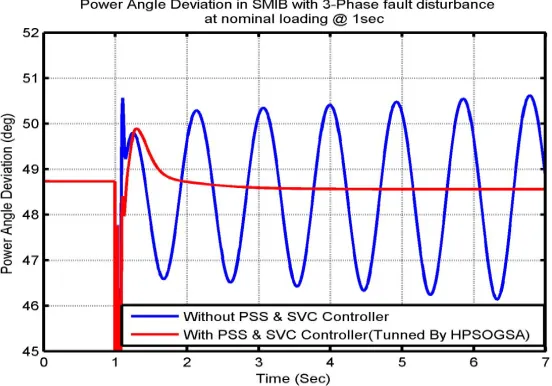
1) Case-1: Normal loading, 3-phase fault disturbanceThe effectiveness of HPSOGSA optimized SVC controller for damping the oscillation and stability enhancement is first accessed at nominal loading condition (Pe = 0.85pu, δ0 = 51.510) under three phase faults. A 3-phase, 3 cycle fault is created in the middle of one transmission line linking bus2 and bus3 shown in fig. 5 at time t=1 second the fault line is tripped in order to clear the fault and is automatically reclosed after 3 cycles. The response, without control (without PSS and SVC controller) is shown with blue line and respond to control (with SVC and PSS controller tuned HPSOGSA) is shown with a red line is superior response. The original system condition is regained after fault clearance. The response of the system under this fault is shown in fig. 6 to fig.10.
Fig. 7Power Angle Deviation in SMIB System with 3-phase Fault disturbance at Nominal Loading
Fig. 8Line Power Deviation in SMIB System with 3-phase Fault disturbance at Nominal Loading
[image:7.612.157.440.309.491.2]Fig.10: PSS Stabilizing Signal Deviation in SMIB System with 3-phase Fault diturance at Nominal Loading
2) Case-2: Light loading, 3-phase fault disturbance: The effectiveness of the HPSOGSA optimized SVC controller for damping the oscillation and stability enhancement is accessed at light loading condition (Pe = 0.5 pu, δ0 = 29.330) under different faults
and small disturbances.In this situation, the strength of the controller is verified by loading the generator to light loading situation. The response of the system under this fault is shown in fig 11 to fig 13. shows the speed deviation and power angle deviation at three phase fault the system response under this contingency is highly oscillatory in the lack of SVC and PSS controller, but though SVC and PSS controller tuned by HPSOGSA gives better performance and improves the system stability by damping out the oscillations and enabling the system to settle down quickly after a 3-phase fault
Fig. 12 : Power Angle Deviation in SMIB System with 3-phase Faultdisturbance at Light Loading
Fig. 13 : Line Power Deviation in SMIB System with 3-phase Fault disturbance at Light Loading
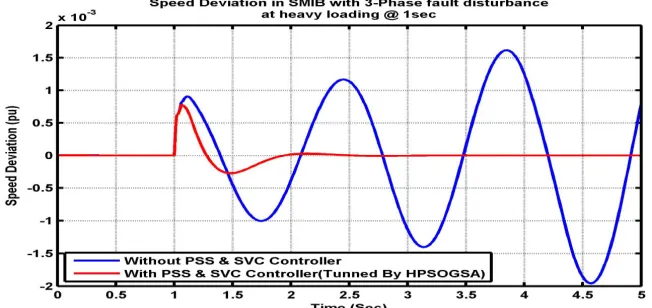
3) Case-3: Heavy Loading, 3-phase fault disturbance: The effectiveness of HPSOGSA optimized SVC controller for damping the oscillation and stability enhancement is in heavy loading condition (Pe = 1.0 pu, δ0 = 60.730) under different faults and small disturbances. In this situation, the strength of the planned controller is verified by set the loading of the generator to heavy loading conditions under small interruption. From fig. 14 to 16 shows the system response under this contingency is highly oscillatory in the lack of SVC and PSS controller, but though SVC and PSS controller tuned by HPSOGSA gives better performance and improves the system stability by damping out the oscillations and enabling the system to settle down quickly after a 3-phase fault. Since oscillations are damped out and the speed deviation becomes zero
Fig. 15 : Power Angle Deviation in SMIB System with 3-phase disturbances at Heavy Loading
Fig. 16 : Line Power Deviation in SMIB System with 3-phase Fault disturbance at Heavy Loading
VI. CONCLUSIONS
This paper, optimized values of PSS and SVC controller are evaluated using theHybrid PSOGSA algorithm. For examining the robustness of this controller, simulation is analyzed on SMIB system. The Simulation outcome shows the effectivity of the SVCoptimized controller. Finally the speed deviation and power angle deviation, line power deviation, terminal voltage deviation are carried out in single machine infinite bus (SMIB) system under different operating condition and shows superior response and settle down quickly when apply PSS and SVC damping controller (tuned by HPSOGSA)
REFERENCES
[1] M. C. Pandya and J. G. Jamnani , "Coordinated control of SVC and PSS in multi machine power system employing particle swarm optimization," IEEE International Conference on Power Electronics, Drives and Energy Systems (PEDES), Trivandrum, 2016, pp. 1-4.
[2] O. M. Benaissa, S. Hadjeri and S. A. Zidi, "Impact of PSS and SVC on the power system transient stability," 8th International Conference on Modelling, Identification and Control (ICMIC), Algiers, 2016, pp. 303-307
[3] K. S. T. Nguyen, H. Zhu, Y. Zhang and T. T. Han, "Damping controllability of a hybrid model static var compensator in a power system," IEEE Information Technology, Networking, Electronic and Automation Control Conference, Chongqing, 2016, pp. 91-97.
[4] De Vargas Fortes, Elenilson, Percival Bueno de Araujo, and Leonardo H. Macedo. " Coordinated tuning of the parameters of PI, PSS and POD controllers using a Specialized Chu–Beasley's Genetic Algorithm." Electric Power Systems Research 140 ( November2016): 708-721.
[5] Jolfaei, Mohammad Ghanbari, Adel M. Sharaf, Seyed Mohammad Shariatmadar, and Mohammad Bayati Poudeh. " A hybrid PSS–SSSC GA-stabilization scheme for damping power system small signal oscillations." International Journal of Electrical Power & Energy Systems 75 (2016): 337-344.
[6] Milla F, Duarte-Mermoud MA. Predictive optimized adaptive PSS in a single machine infinite bus. ISA transactions. 2016 Jul 31;63:315-27.
[8] Narendra Kumar Yegireddy, S. Panda, R. Bonthu and Acharyulu B. V. S, "Simultaneous tuning of a PSS and SVC based damping controllers employing NSGA-II for Power system stability problem,"International Conference on Electrical, Electronics, Signals, Communication and Optimization (EESCO), Visakhapatnam, 2015, pp. 1-6.
[9] M.Shafiullah, M. S. Alam, M. I. Hossain and M. N. Hasan,"Transient performance improvement of power system by optimal design of SVC controller employing genetic algorithm," 8th International Conference on Electrical and Computer Engineering, Dhaka, 2014, pp. 540-543.
[10] Hossein Hosseini, Behrooz Tusi,avid Razmjoo a, and Mohsen Khalilpoor “Optimum Design of PSS and SVC Controller for Damping Low Frequency Oscillation,” The 2nd International Conference on control ,Instrumentation and Automation, Shiraz, 2011 , pp.62-67.
[11] K. Sebaa and M. Boudour, "Power system dynamic stability enhancement via coordinated design of PSSs and SVC-based controllers using hierarchical real coded NSGA-II," 2008 IEEE Power and Energy Society General Meeting - Conversion and Delivery of Electrical Energy in the 21st Century, Pittsburgh, PA, 2008, pp. 1-8.
[12] V. K. Chandrakar, S. N. Dhurvey and S. C. Suke, " Performance Comparison of SVC with POD and PSS for Damping of Power System Oscillations," 2010 3rd International Conference on Emerging Trends in Engineering and Technology, Goa, 2010, pp. 247-252.
[13] R. Narne, P. C. Panda and J. P. Therattil, "Genetic algorithm based simultaneous coordination of PSS and FACTS controllers for power oscillations damping,"
IEEE Third International Conference on Sustainable Energy Technologies (ICSET), Kathmandu, 2012, pp. 85-90.
[14] Abhishek Paliwal,Kapil Parikh and Raunak Jangid’ “Optimization and simulation of simultaneous tuning of static var compensator and power system stabilizer to improve power system stability using particle swarm optimization technique” International Journal of Scientific Research Engineering and Technology(IJSRET),ISSN 2278-0882 Volume 3, Issue 7,October 2014.
[15] Kundur,Power system stablity and control,mcraw-hill,New Delhi,1994.
[16] Jagadeesh, P., & Veerraju, M. S. (2016, February). Particle swarm optimization based power system stabilizer for SMIB system. In Emerging Trends in Engineering, Technology and Science (ICETETS), International Conference on (pp. 1-6). IEEE.
[17] Suresh, R., & Baskaran, J. (2016). OPTIMIZATION OF REACTIVE POWER FLOW–PERFORMANCE COMPARISON OF GSA AND BB-BC ALGORITHMS. Int J Adv Engg Tech/Vol. VII/Issue III/July-Sept, 24, 29.
![Fig. 5 Single-machine infinite-bus power system with SVC [18]](https://thumb-us.123doks.com/thumbv2/123dok_us/8295887.852837/5.612.157.469.321.484/fig-single-machine-infinite-power-system-with-svc.webp)