Technology(IJRASET)
Innovative Brick Material
M.Scinduja
1, S.Nathiya
1, C.V.Shudesamithronn
1, M. Harshavarthana Balaji
1,T.Sarathivelan
1, S. Jaya pradeep
21
Assistant Professor, 2U .G Student ,
Department of Civil Engineering, Knowledge Institute of Technology, Kakkapalayam, Salem –637 504, Tamil Nadu, India
I. INTRODUCTION
Since the large demand has been placed on building
material industry especially in the last decade owing to the
increasing population which causes a chronic shortage of
building materials, the civil engineers have been
challenged to convert the industrial wastes to useful
building and construction materials. This experimental
study which investigates the potential use of waste paper
for producing a low-cost and light weight composite brick
as a building material. These alternative bricks were made
with papercrete.
II. OBJECTIVES
The major Objective of the project is replacing the costly
and scarce conventional building bricks by an innovative
and alternative building bricks, which satisfies the
following characteristics,
Required
Cost effective
Environmental friendly
Less weight
Inflammable
Less water absorption
Easily available
The main objective of this project is optimize the
papercrete mix with desirable properties, which satisfies
the above mentioned needs.
III. MATERIALS USED
In this project waste materials were utilized to produce
building bricks. The following materials were used in this
investigation
CEMENT: Cement is one of the binding materials in this
project. Cement is the important building material in
today’s construction world 53 grade Ordinary Portland
Cement (OPC) conforming to IS: 8112-cement used.
Properties of cement
Description of
test
Test results
obtained Requirements of
IS: 8112 1989
Initial setting
time 65 minutes Min. 30minutes
Final setting time 270 minutes Max. 600minutes
Fineness 412.92
m2/kg Min. 225 m
2
[image:2.612.71.571.203.590.2]/kg
Fig . Cement
GROUND GRANULATED BLAST FURNACE SLAG
(GGBS): Ground-granulated blast-furnace slag (GGBS) is
a byproduct which is obtained during the manufacturing
process of pig iron in blast furnace. This process produces
a glassy, homogeneous, non-crystalline material that has
www. ijraset.com
SJ Impact Factor-3.995
International Journal for Research in Applied Science & Engineering
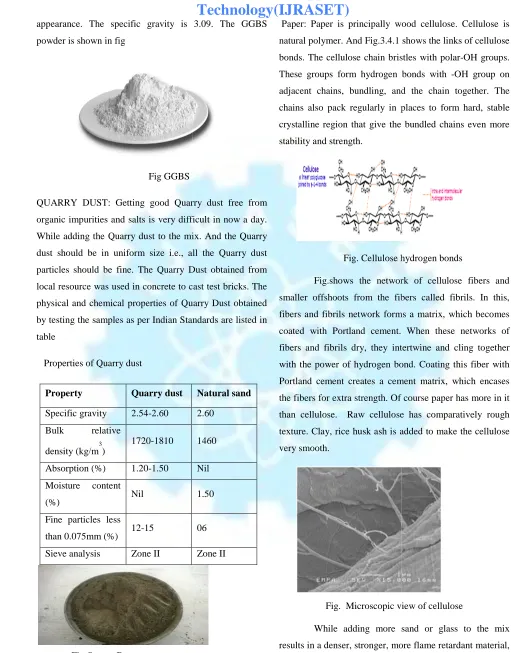
appearance. The specific gravity is 3.09. The
powder is shown in fig
Fig GGBS
QUARRY DUST: Getting good Quarry dust free from
organic impurities and salts is very difficult in now a day.
While adding the Quarry dust to the mix. And the Quarry
dust should be in uniform size i.e., all the Quarry dust
particles should be fine. The Quarry Dust obtained from
local resource was used in concrete to cast test bricks. The
physical and chemical properties of Quarry Dust obtained
by testing the samples as per Indian Standards are listed in
table
Properties of Quarry dust
Property Quarry dust
Specific gravity 2.54-2.60
Bulk relative
density (kg/m
3
)
1720-1810
Absorption (%) 1.20-1.50
Moisture content
(%) Nil
Fine particles less
than 0.075mm (%) 12-15
[image:3.612.57.568.63.716.2]Sieve analysis Zone II
Fig Quarry Dust
www. ijraset.com
Special Issue
3.995
ISSN: 2321
International Journal for Research in Applied Science & Engineering
Technology(IJRASET)
appearance. The specific gravity is 3.09. The GGBS
Getting good Quarry dust free from
organic impurities and salts is very difficult in now a day.
While adding the Quarry dust to the mix. And the Quarry
dust should be in uniform size i.e., all the Quarry dust
The Quarry Dust obtained from
local resource was used in concrete to cast test bricks. The
physical and chemical properties of Quarry Dust obtained
an Standards are listed in
Natural sand 2.60 1460 Nil 1.50 06 Zone II
Paper: Paper is principally wood cellulose. Cellulose is
natural polymer. And Fig.3.4.1 shows the links of cellulose
bonds. The cellulose chain bristles with polar
These groups form hydrogen bonds with
adjacent chains, bundling, and the chain together. The
chains also pack regularly in places to form hard, stable
crystalline region that give the bundled chains even more
stability and strength.
Fig. Cellulose hydrogen bonds
Fig.shows the network of cellulose fibers and
smaller offshoots from the fibers called fibrils. In this,
fibers and fibrils network forms a matrix, which becomes
coated with Portland cement. When these networks of
fibers and fibrils dry, they intertwine an
with the power of hydrogen bond. Coating this fiber with
Portland cement creates a cement matrix, which encases
the fibers for extra strength. Of course paper has more in it
than cellulose. Raw cellulose has comparatively rough
texture. Clay, rice husk ash is added to make the cellulose
very smooth.
Fig. Microscopic view of cellulose
While adding more sand or glass to the mix
results in a denser, stronger, more flame retardant material,
but adds weight and reduces
R-Special Issue-1, October 2014
ISSN: 2321-9653
International Journal for Research in Applied Science & Engineering
Paper is principally wood cellulose. Cellulose is
natural polymer. And Fig.3.4.1 shows the links of cellulose
bonds. The cellulose chain bristles with polar-OH groups.
These groups form hydrogen bonds with -OH group on
adjacent chains, bundling, and the chain together. The
chains also pack regularly in places to form hard, stable
crystalline region that give the bundled chains even more
Cellulose hydrogen bonds
Fig.shows the network of cellulose fibers and
smaller offshoots from the fibers called fibrils. In this,
fibers and fibrils network forms a matrix, which becomes
coated with Portland cement. When these networks of
fibers and fibrils dry, they intertwine and cling together
with the power of hydrogen bond. Coating this fiber with
Portland cement creates a cement matrix, which encases
the fibers for extra strength. Of course paper has more in it
than cellulose. Raw cellulose has comparatively rough
lay, rice husk ash is added to make the cellulose
Microscopic view of cellulose
While adding more sand or glass to the mix
results in a denser, stronger, more flame retardant material,
Technology(IJRASET)
Heavy mixes with added sand, glass etc.,increases strength and resistance to abrasion, but also
reduces flexibility somewhat, adds weight and may reduce
R-value. So the trick is finding the best mix for the
application. This mould was collected from ACC brick
suppliers in the size of 230mm length, 110mm wide and
80mm deep. The papers, which were collected, cannot be
used directly. It should be made into paper pulp before
mixing with other ingredients.
Water: Water is an important ingredient of papercrete as it
actively participates in the chemical reaction with cement.
It should be free from organic matter and the pH value
should be between 6 to 7.
Fig Materials Used
WATER PROOFING COMPOUND FOR CONCRETE
AND PLASTER
Fig. Water Proofing Compound
Dr. Fixit Pidiproof LW+ is specially formulated
integral liquid waterproofing compound composed of
surface active plasticizing agents, polymers & additives. It
is used as an additive for cement concrete, mortar &
plasters. It makes concrete cohesive and prevents
segregation.
Features & Benefits:
Corrosion resistant - Makes concrete more cohesive, hence protects steel better against corrosion.
Compatibility – Being a liquid, easily dispersible & compatible with concrete/mortar mixes.
Permeability – It reduces the permeability of water into concrete.
Strength –. The setting time and compressive strength of the concrete remains within the specification limits
Shrinkage –Reduces shrinkage crack development in plaster & concrete.
Workability –Improves workability of freshly mixed cement concrete.
Durability – Increases durability by improving waterproofing of concrete.
MODIFIER CUM BONDING COMPOUND: Dr. Fixit
Super Latex is a highly potent and versatile SBR based
liquid for high performance applications in waterproofing
and repairs.
Features & Benefits:
Excellent Coverage - 70-80 sq.ft per kg/ in 2 coats
Less material wastage- material does not fall baclV rebound
Highly cost effective due to better coverage & lesser wastage
High Bonding Strength
Prevents leakages & dampness
[image:4.612.59.580.96.701.2] Enhances strength & provides durability
www. ijraset.com
Special Issue-1, October 2014
SJ Impact Factor-3.995
ISSN: 2321-9653
International Journal for Research in Applied Science & Engineering
Technology(IJRASET)
IV. MATERIAL CHARACTERISTICS BRICKS
The bricks are obtained by moulding clay in a rectangular
block of uniform size and then by drying and burning the
blocks. As the bricks are of uniform size, they can be
properly arranged and further, as they are in lightweight,
no lifting appliance is required for them. The common
brick is one of the oldest building materials and it is
extensively used at present as a leading material in
construction. In India, process of brick making has not
changed since many centuries except some minor
refinements. There has been hardly any effort in our
country to improve the brick-making process for
enhancing the quality of bricks.
A brick is generally subjected to the following
tests to find out its suitability for the construction work.
ABSORPTION
A brick is taken and it is weighed dry. It is then
immersed in water for a period of 24 hours. It is weighed
again and the difference in weight indicates the amount of
water absorbed by the brick. It should not, in any case,
exceed 20% of weight of dry brick.
CRUSHING STRENGTH
The crushing strength of a brick is found out by
placing it in a compression-testing machine. It is
compressed till it breaks, as per BIS: 1077-1957, the
minimum crushing strength of brick is 3.50 N/mm2 .The
brick with crushing strength of 7-14 N/mm2 are graded as
‘A’ and those having above 14 N/mm2is graded as ‘AA’.
HARDNESS
In this test, a scratch is made on the brick surface
with the help of finger nail. If no impression is left on the
surface, the brick is treated to be sufficiently hard.
PRESENCE OF SOLUBLE SALTS
The soluble salts, if presents in brick will cause
efflorescence on the surface of bricks. For finding out the
presence of soluble salts in brick, it is immersed in water
for 24 hours. It is then taken out and allowed to dry
sunshade. The absence of grey or white deposits on its
surface indicates absence of soluble salts.
If the white deposit covers about 10% surface, the
efflorescence is said to be slight and it is considered as
moderate, when the white deposit cover about 50%
surface. If grey or white deposits are found on more than
50% of surface, the efflorescence becomes heavy and it is
treated as serious, when such deposits are converted into
powdery mass.
SHAPE AND SIZE
In this test, a brick is closely inspected. It should
be of standard size and its shape should be truly
rectangular with sharp edges. For this purpose, 20 bricks of
standard size (190mm X 90mm X 90mm) are selected at
random and they are stacked length wise, along the width
and along the height.
For a good quality brick, the results should be
within the following permissible limits:Length: 3680mm
to 3920mm
Width : 1740mm to 1860mm
Height: 1740mm to 1860 mm
SOUNDNESS
In this test, two bricks are taken and they are
struck each other. The bricks should not break and a clear
ringing sound should be produced.
STRUCTURE
A brick is broken and its structure is examined. It
should be homogeneous, compact and free from defects
such as holes, lumps etc.
PAPERCRETE
Papercrete is a tricky term. The name seems to
imply a mix of paper and concrete, hence papercrete. But
more accurately, only the Portland cement part of concrete
is used in the mix-if used at all. Arguably, it could have
been called “paperment” papercretemay be mixed in many
Technology(IJRASET)
waste paper. Up to now, there are no hard and fast rule, butrecommended standard will undoubtedly be established in
future.
The basic constituents are waste nearly any kind of paper,
board, glossy magazine stock, advertising brochure, junk
mail or just about any other types of “mixed grade” paper
is acceptable. some types of paper work better than other,
but all types of works, newsprint are the best. Water
proofed paper and card board, such as butcher paper, beer
cartons ect., are hard to break down in water. Catalogs,
magazines and other publication are fine in and of
themselves, but some have a stringy, rubbery, sticky spine,
which is also water resistance. Breaking down this kind of
material in the mixing process can’t be done very well.
Small fragments and strings of these materials are almost
always in the final mix.
When using papercrete containing the unwanted material
in a finish, such as stucco or plastering ,the unwanted
fragment some time shown up on the surface, but this is
not the serious problem.
In the optimization work the admixture like conplast
WP90, Dr.Fixt 105 water proof and polymer like
nitrobond SBR are as the water repellent agents
Papercrete’s additives can be,
Cement
GGBS
Quarry dust
Paper
Papercrete is having the following derivatives,
Fibrous concrete
Padobe
Fidobe
FIBROUS CONCRETE
Fibrous concrete is a mixture of paper, Portland
cement, water. There are on harmful by-products or
excessive energy use in the production of papercrete.
While it can be argued that the Portland cement is not
environmental friendly, it is not used in all types of
papercrete, and when it represents a fairly small percentage
of cured material by volume. Once of the most
advantageous properties of papercrete is the way paper
fibers hold the Portland cement or perhaps the way
Portland cement adheres to paper fibers when the water
added to the Portland cement drains from the mix, it come
out almost clear.
There is no messy eco-unfriendly cement sediment left on
the ground, running in to waterways ect., papercrete can be
produced using solar energy. The only power needed is for
mixing and pumping water. Its R-value is in 2.0-3.0 per
inch. Since walls in a one or two storey house will be12-16
inch thick, the long energy saving of building with
papercrete will be a bonanza for the home owner and the
environmental.
PADOBE
Padobe has on Portland cement. it is admix paper,
water, earth with clay. Here clay is binding material
instead of using the cement, earth is used in this types of
brick. This earth should have clay content more than 30%.
With regular brick, if clay content is too high the brick
may crack while drying, but adding paper fiber to the earth
mix strengthens the drying block and give some flexibility
helps to prevent cracking.
FIDOBE
Fidobe is like padobe,but it may content other
fibrous materials
ECO –FRIENDLY
Phenomenal growth in the construction industry
www. ijraset.com
Special Issue-1, October 2014
SJ Impact Factor-3.995
ISSN: 2321-9653
International Journal for Research in Applied Science & Engineering
Technology(IJRASET)
Production of building materials lead to irreversible
environmental impacts. Using eco-friendly materials is the
best way to build an eco-friendly building. Eco-friendly,
describes a product that has been designed to do the least
possible damage to the environment.
V. EXPERIMENTAL PROCEDURE
MANUFACTURING OF BRICKS
There was no clear past details about the project. And there
is no hard procedure for casting the bricks. So the
procedure that is given below was followed by our own.
And the equipments which were used in this project are for
our convenience only.
MOULD PREPARATION
After collecting all the materials, a mould was
prepared. A typical mould is shown in the below figure.
Fig. Mould
This mould was non-water absorbing in the size
of 230mm length, 110mm wide and 80mm deep. The
shorter sides of the mould are slightly projecting to serve
as handle. And joints were made without any hole or gap
to avoid leakage.
5.3 PULP GENERATION
The papers, which were collected cannot be used
directly. It should be made into paper pulp before mixing
with other ingredients. The following are the steps
involved in the generation of pulp.
First the pins, threads and other materials in the papers were removed.
Then the papers were teared into small pieces of papers.
Then, a 200 litre water tank was taken. And 2/3 rdof it was filled with water.
Then the small pieces of paper were immersed in the water tank. The paper pieces were immersed
individually not in a bulky manner in order to make
the pieces completely wet. Before immersing it into
the water, the papers were weighed. The figure shows
the papers were being immersed in the water tank.
[image:7.612.59.567.167.710.2]Fig. Immersed Paper
Technology(IJRASET)
The papers were kept in the tank for 2 to 3 days otherwiseuntil the papers degrade into a paste like form. Then the
paper was taken out from water and taken to the mixer
machine to make it as a paper pulp.
The pulp generating process was tedious and time
consumption. For lab purpose only these procedures were
followed. While going for mass production, the Tow
mixers were recommended to reduce the cost. The Tow
mixers have sharp blades and it can operate mechanically
or electrically. Table : PAPERCRETE MIX RATIO
MIXING: After all the ingredients were ready, the mixing
was done. In this project, mixing was done manually. The
mixing process of fibrous concrete bricks and padobe
bricks are different, and that processes are given below.
The exact mix proportion was not known. So, trial
[image:8.612.50.575.73.716.2]proportions were used in this project.
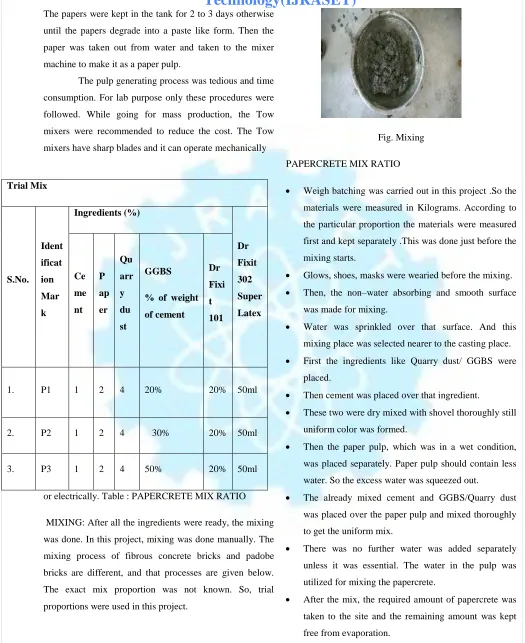
Fig. Mixing
PAPERCRETE MIX RATIO
Weigh batching was carried out in this project .So the materials were measured in Kilograms. According to
the particular proportion the materials were measured
first and kept separately .This was done just before the
mixing starts.
Glows, shoes, masks were wearied before the mixing.
Then, the non–water absorbing and smooth surface was made for mixing.
Water was sprinkled over that surface. And this mixing place was selected nearer to the casting place.
First the ingredients like Quarry dust/ GGBS were placed.
Then cement was placed over that ingredient.
These two were dry mixed with shovel thoroughly still uniform color was formed.
Then the paper pulp, which was in a wet condition, was placed separately. Paper pulp should contain less
water. So the excess water was squeezed out.
The already mixed cement and GGBS/Quarry dust was placed over the paper pulp and mixed thoroughly
to get the uniform mix.
There was no further water was added separately unless it was essential. The water in the pulp was
utilized for mixing the papercrete.
After the mix, the required amount of papercrete was taken to the site and the remaining amount was kept
free from evaporation.
Trial Mix
S.No.
Ident
ificat
ion
Mar
k
Ingredients (%)
Dr
Fixit
302
Super
Latex Ce
me
nt P
ap
er Qu
arr
y
du
st
GGBS
% of weight
of cement
Dr
Fixi
t
101
1. P1 1 2 4 20% 20% 50ml
2. P2 1 2 4 30% 20% 50ml
www. ijraset.com
Special Issue-1, October 2014
SJ Impact Factor-3.995
ISSN: 2321-9653
International Journal for Research in Applied Science & Engineering
Technology(IJRASET)
CASTING OF BRICKS
Fig. Manufacturing of Brick
After mixing, it should be placed in the mould
within 30 minutes. So, two moulds were used at the time to
make the process very fast. The bricks were moulded
manually by hand and on the table. The following are the
steps involved in molding,
The mould was over a table
The lump of mix was taken and it was placed in the mould.
The extra or surplus mix was removed either by wooden strike or the metal strike or frame with wire.
The casted papercrete bricks dried for 14 days.
VI. RESULT & DISCUSSION
After casting the bricks, they were analyzed for
using as a brick. Various tests were carried out to check
the properties of the bricks. And the results of the test were
analyzed with the existing and standard results. The
following tests were carried out to check the strength of
the brick.
WEIGHT
Table : Weight of Papercrete Bricks
S.No.
Identification
Mark
% 0f
GGBS Dry
Weight
(kg.)
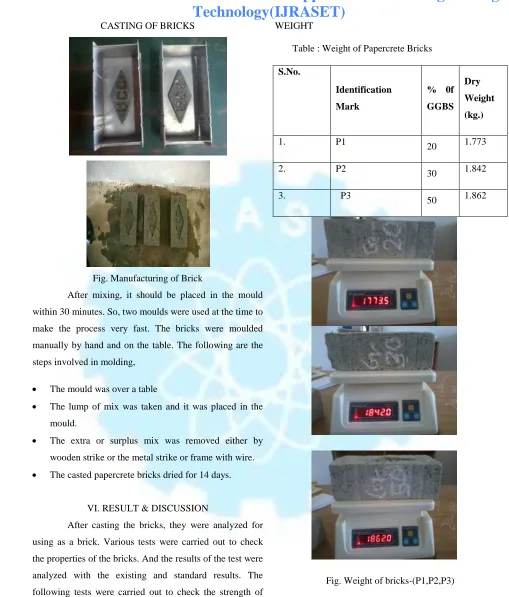
1. P1 20 1.773
2. P2 30 1.842
[image:9.612.61.570.61.658.2]3. P3 50 1.862
Fig. Weight of bricks-(P1,P2,P3)
The ordinary conventional bricks weight varies
from 3 to 3.5 Kg but the fibrous concrete and padobe
bricks weight varies from 1 to 2 Kg. The maximum weight
having 1/3 rdof the conventional brick weight only. Sand
based bricks are having weight 2/3 rdof conventional brick
weight only. So this bricks are light weight and it will also
reduce total cost of construction due to the reduction in
dead load.
WATER ABSORBTION TEST : Dry the specimen in
ventilated oven at a temperature of 105
attains substantially constant mass. Cool the specimen to
room temperature and obtain its weight (M
warm to touch shall not be used for this purpose. Immerse
completely dried specimen in clean water at a temperature
of 27+2C for 24 hours. Remove the specimen and swipe out any traces of water with damp cloth and weigh the
specimen after it has been removed from water (M
TABLE WATER ABSORPTION TEST
PAPECRETE BRICKS
Fig. Water absorption test for Trial Mix
0 5 10 15 20 25 30 35 40 45
P1 P2 P3
40.11
%
33.85
24 HOURS
WATER ABSORPTION TEST
Trail
Mix
Water Absorption result in % (24
hours)
20% 30%
40.11% 33.85%
Technology(IJRASET)
the conventional brick weight only. Sandof conventional brick
weight only. So this bricks are light weight and it will also
reduce total cost of construction due to the reduction in
Dry the specimen in
ventilated oven at a temperature of 105C to 115C till it attains substantially constant mass. Cool the specimen to
room temperature and obtain its weight (M1) specimen too
warm to touch shall not be used for this purpose. Immerse
mpletely dried specimen in clean water at a temperature
C for 24 hours. Remove the specimen and swipe
out any traces of water with damp cloth and weigh the
specimen after it has been removed from water (M2)
WATER ABSORPTION TEST OF
[image:10.612.58.569.49.699.2]COMPRESSION TEST
Fig. Compression test
The test was carried out by a
Testing Machine. This test was carried out on 14th day
from the date of casting papercrete brick. While testing
the papercrete brick great care must be taken, because
papercrete brick never failed catastrophically, it just
compressed like squeezing rubber. So load was applied up
to half compression.
When papercrete brick failed at the higher load,
the structure was not fully collapsed. Only the outer faces
cracked and peeled out. The papercrete brick are having
elastic behavior and less brittleness.
The following steps were followed for compression
testing.
First the irregularities in the surface were removed.
The brick was placed centrally on the bottom plate of the universal testing machine.
Then the upper plate of the universal testing machi was lowered down up to the brick was hold tightly
without any movement.
Then the load was applied axially at a uniform rate
This load was applied till the half of the brick.
Three bricks from same proportion were tested every time.
WATER ABSORPTION TEST
G-20%
G-30%
G-50%
Water Absorption result in % (2450%
23.74%
COMPRESSION TEST
Compression test
The test was carried out by a Compression
Testing Machine. This test was carried out on 14th day
from the date of casting papercrete brick. While testing
the papercrete brick great care must be taken, because
papercrete brick never failed catastrophically, it just
ezing rubber. So load was applied up
When papercrete brick failed at the higher load,
the structure was not fully collapsed. Only the outer faces
cracked and peeled out. The papercrete brick are having
eness.
The following steps were followed for compression
First the irregularities in the surface were removed.
The brick was placed centrally on the bottom plate of
the universal testing machine.
Then the upper plate of the universal testing machine
was lowered down up to the brick was hold tightly
Then the load was applied axially at a uniform rate
This load was applied till the half of the brick.
www. ijraset.com
SJ Impact Factor-3.995
International Journal for Research in Applied Science & Engineering
And the compressive strength was calculated by this formula,
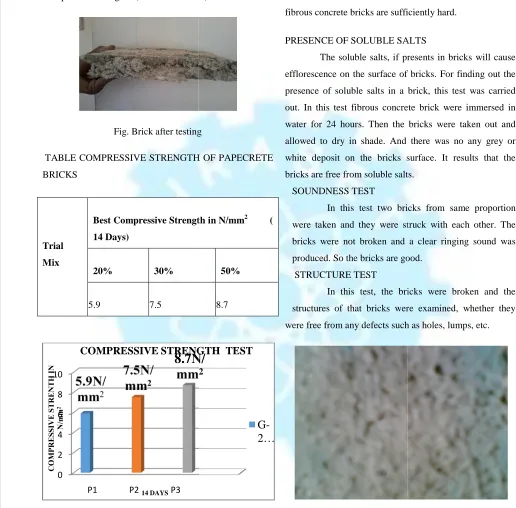
[image:11.612.51.567.125.633.2]Compression strength= (load/surface area)
Fig. Brick after testing
TABLE COMPRESSIVE STRENGTH OF PAPECRETE
BRICKS
Fig. Compression test for Trial Mix
HARDNESS TEST
In this test, a scratch was made on brick surfaces.
This test was carried out for all the three proportions of
0 2 4 6 8 10
P1 P2 P3
7.5N/
8.7N/
214 DAYS
COMPRESSIVE STRENGTH TEST
Trial
Mix
Best Compressive Strength in N/mm
14 Days)
20% 30%
5.9 7.5
www. ijraset.com
Special Issue
3.995
ISSN: 2321
International Journal for Research in Applied Science & Engineering
Technology(IJRASET)
trength was calculated by this
Compression strength= (load/surface area)
Fig. Brick after testing
COMPRESSIVE STRENGTH OF PAPECRETE
In this test, a scratch was made on brick surfaces.
This test was carried out for all the three proportions of
brick. While the scratch was made with the help of finger
nail on the bricks, very light impression was left on the
fibrous concrete brick surface. So this test results that
fibrous concrete bricks are sufficiently hard.
PRESENCE OF SOLUBLE SALTS
The soluble salts, if presents in bricks will cause
efflorescence on the surface of bricks. For fi
presence of soluble salts in a brick, this test was carried
out. In this test fibrous concrete brick were immersed in
water for 24 hours. Then the bricks were taken out and
allowed to dry in shade. And there was no any grey or
white deposit on the bricks surface. It results that the
bricks are free from soluble salts.
SOUNDNESS TEST
In this test two bricks from same proportion
were taken and they were struck with each other. The
bricks were not broken and a clear ringing sound was
produced. So the bricks are good.
STRUCTURE TEST
In this test, the bricks were broken and the
structures of that bricks were examined, whether they
were free from any defects such as holes, lumps, etc.
Fig. Inner structure of fibrous concrete brick
In this test fibrous concrete brick were cut into
equal parts. The fibrous concret
homogenous, compact, and free from defects and this brick
pieces look like a cake piece.
8.7N/
2
COMPRESSIVE STRENGTH TEST
G-2
…
Best Compressive Strength in N/mm2 (
50%
8.7
Special Issue-1, October 2014
ISSN: 2321-9653
International Journal for Research in Applied Science & Engineering
brick. While the scratch was made with the help of finger
impression was left on the
fibrous concrete brick surface. So this test results that
fibrous concrete bricks are sufficiently hard.
PRESENCE OF SOLUBLE SALTS
The soluble salts, if presents in bricks will cause
efflorescence on the surface of bricks. For finding out the
presence of soluble salts in a brick, this test was carried
out. In this test fibrous concrete brick were immersed in
water for 24 hours. Then the bricks were taken out and
allowed to dry in shade. And there was no any grey or
n the bricks surface. It results that the
bricks are free from soluble salts.
In this test two bricks from same proportion
were taken and they were struck with each other. The
bricks were not broken and a clear ringing sound was
the bricks are good.
In this test, the bricks were broken and the
structures of that bricks were examined, whether they
were free from any defects such as holes, lumps, etc.
Inner structure of fibrous concrete brick
fibrous concrete brick were cut into
equal parts. The fibrous concrete brick piece structure was
Technology(IJRASET)
NAILINGFig. Nail in the brick
Fibrous concrete bricks are less hard when
compare to conventional bricks. So this test was carried
out to find out whether bricks hold the nail or not. A nail
was hammered in the brick and a screw is also screwed in
the brick. In this two (Fig.6.8), fibrous concrete brick did
not hold nails any better than dry wall, but screws worked
well and hold a considerable weight. So, the screws are the
anchors of choice for fibrous concrete bricks.
CUTTING AND GLUE
Fig. Brick pieces
In site lot of bricks are wasted while cutting only.
The labors could not able to cut the bricks exactly what
they need. But, fibrous concrete bricks can be cut into
exactly two pieces (Fig. 6.9.1) by using conventional saw
blades. So, we can get any shape and size of fibrous
concrete brick.
Fig.6.9.2 Joined brick pieces
Many cut bricks are wasted in now a day. But the
two fibrous concrete brick pieces can be hold together by
putting a medium amount of glue on the bottom piece.
This will not come apart (Fig.6.9.2). This would seem to
indicate that papercrete could be used in application
calling for quick assembly by cutting the pieces to size in
advance and letting the user simply glue them together.
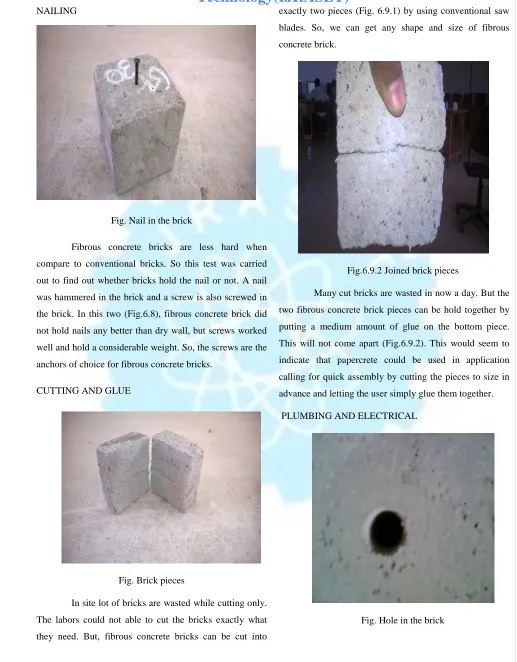
[image:12.612.57.574.76.738.2]PLUMBING AND ELECTRICAL
www. ijraset.com
Special Issue-1, October 2014
SJ Impact Factor-3.995
ISSN: 2321-9653
[image:13.612.57.573.63.736.2]International Journal for Research in Applied Science & Engineering
Technology(IJRASET)
Fig.Channel in the brick
Installing plumbing lines requires cutting holes
and channels in papercrete. It was very easy in fibrous
concrete bricks. Electrical runs were cut with a circular
saw or chain saw. To make holes for outlets, horizontals
and vertical slits was cut with a circular saw. Then
unwanted pieces were removed with a screwdriver.
Outlet boxes can be angle screwed directly into the
papercrete. Home fires start, where the wiring enters the
outlet boxes. So, nonflammable mortar should be put
behind the outlet boxes for safety. Once the electrical
wiring and outlets are installed and then tested, the
channels for the electrical runs are for filled with
papercrete.
FIRE
Fig. Fire test
A brick which is used for construction should
not flammable in open flame, so this test was carried out
for the bricks. This test was carried out only for fibrous
concrete bricks not for padobe brick. Because padobe brick
was already heatedin kiln at high temperature so, it won’t
burn. The following are the steps involved in this test,
First, the brick was wiped with cloths and all the foreign matters were removed.
Then the flammable sticks were fired. After that, the bricks were held on the flame for five minutes.
After five minutes fixing was stopped and the bricks were observed.
From the above test, it was observed that the
fibrous concrete bricks did not burn with an open flame.
They smoldered like charcoal. But these brick would be
reduced to ashes after burning several hours. If the interior
plaster and exterior stucco is provided on the fibrous
concrete bricks, the bricks won’t burn. The only weak
point is inside the block, near electrical outlets, switches
and other places where wires gives through walls, into
boxes etc.,. Properly wired places never cause fire. If we
apply the plaster without any hole or leakage on the bricks,
it won’t burn or smolder inside. Because there will be lack
of oxygen for burning.
VII. CONCLUSIONS
From the above experimental studies we can conclude that,
Papercrete bricks are suitable for non-load bearing walls only.
The weight of this brick is 1/3rd to 2/5th lesser than conventional clay brick.
These bricks are not suitable for water logging and external walls. It can be used in inner partition walls.
Due to less weight of these bricks, the total dead load of the building will be reduced.
Since, these bricks are relatively light weight and more flexible, these bricks are potentially ideal
material for earthquake prone areas.
Papercrete brick does not expand or contract, so sheets of glass or glass block can be embedded in and
Technology(IJRASET)
The papercrete bricks are good sound absorbent, hence paper is used in these bricks. So, these bricks
can be used in auditoriums.
Since, the waste materials are used, it will reduce the landfills and pollution.
Using the papercrete brick in a building, total cost will be reduced from 20% to 50%.
REFERENCES
[1] B J Fuller, AFafitis and J L Santamaria. (May 2006)
“The Paper Alternative”, ASCE Civil Engineering
Vol. 75 No.5 pp. 72-77.
[2] J Pera and J Ambroise (2005) “Properties of Calcined
Paper Sludge”, Construction and Building
MaterialsV0l.21, No.5 pp 405-413.
[3] Lex Terry, (2006)“Papercrete Construction”-Building
Environment and Thermal Envelope Council
(BETEC) Symposium was held on 13th to 16th
October 2006 at the Northen New mexico Community
College in EIRito.
[4] M O’Farrell and S Wild. (2006) “A New Concrete
incorporating Watepaper Sludge Ash (WSA)” Cement
& Concrete CompositesVol.17, No.3 pp 149-158. ,
[5] ParvizSoroushian et al (February 1994) “Durability
and Moisture Sensitivity of Recycled Wastepaper –
Fiber – Cement Composites”, Cement & Concrete
Composites Vol. 16 No.2 pp 115-128.
[6] R.Garcia et al (2008) “Pozzolanic Properties of Paper
Sludge Waste”, Construction and Building Materials,
Vol.22 No.7, July 2008, pp 1484 –1490.
[7] Tarun R Naik et al (January 2004) “Concrete
Containing Pulp and Paper Mill Residuals”,
Proceedings of International Conference on Fibre
Composites, High Performance Concretes and Smart
Materials, Chennai, pp 515-525.
[8] IS: 3495-1992 (Part 1 to 4), “Methods of Tests for
Burnt Clay Bricks”, Bureau of Indian Standards, Third
Revision, New Delhi.
[9] IS: 383-1970, “Specification for coarse and fine
aggregates from natural sources for concrete”, Bureau