comment
reviews
reports
deposited research
interactions
information
refereed research
Review
Can sequence determine function?
John A Gerlt* and Patricia C Babbitt
Addresses: *Departments of Biochemistry and Chemistry, University of Illinois, Urbana, IL 61801, USA. Departments of Biopharmaceutical
Sciences and Pharmaceutical Chemistry, University of California, San Francisco, CA 94143, USA. E-mail: [email protected]; [email protected]
Abstract
The functional annotation of proteins identified in genome sequencing projects is based on similarities to homologs in the databases. As a result of the possible strategies for divergent evolution, homologous enzymes frequently do not catalyze the same reaction, and we conclude that assignment of function from sequence information alone should be viewed with some skepticism.
Published: 8 November 2000
GenomeBiology2000, 1(5):reviews0005.1–0005.10
The electronic version of this article is the complete one and can be found online at http://genomebiology.com/2000/1/5/reviews/0005 © GenomeBiology.com (Print ISSN 1465-6906; Online ISSN 1465-6914)
The functional assignment of proteins identified in genome sequencing projects is a major problem in post-genomic biology: approximately 40% of the open reading frames (ORFs) initially identified in the genomes of even the most intensively studied eubacteria, notably Escherichia coli [1] and Bacillus subtilis[2], as well as in other microbial species and the more complex eukaryotes, have unknown functions, because their sequences are judged to be unrelated to those of functionally characterized proteins. Although the initial deficits are being resolved slowly in prokaryotes, the func-tions of an even larger percentage of ORFs in eukaryotes remain unpredictable [3]. Until functions are assigned to the unknown ORFs, an organisms capabilities cannot be com-pletely described: the unknown ORFs may encode genes in essential metabolism that remain to be discovered; other unknown ORFs that are species-specific probably determine the unique characteristics of that organism. The promise of post-genomic biology will be elusive until functional assign-ment to the unknown ORFs is complete. At that point, inte-gration of the functions encoded by complete genomes can be performed.
In some cases, functional assignment of unknown eubacter-ial ORFs is assisted by their physical proximity to ORFs of known function, because these genes are found either in operons or clustered in proximal transcriptional units that encode proteins that participate in related metabolic func-tions. In other cases, phylogenomic analyses [4] may allow
functional assignment of unknown genes: the intermediates in metabolic pathways are likely to be more conserved than the enzymes that catalyze the reactions, thereby focusing the search for missing enzymes. In other cases, single-domain proteins in some organisms may be present as components of multidomain proteins in other organisms [5], thereby pro-viding insights into the functions of unknown domains in the multidomain proteins. In eukaryotes, ORFs encoding pro-teins of linked function are not clustered, so in these genomes unequivocal functional assignment will probably require a number of diverse but complementary experimen-tal approaches, including analysis using DNA microarrays, two-hybrid and other approaches for detecting protein-protein interactions, exhaustive screening of substrate libraries for catalytic activity, and gene knockouts.
of this problem and will regard such functional assignments as established fact. As new genomes are sequenced and homologs of functionally annotated proteins are identified, problems in functional assignment will escalate, perhaps to the point where annotation is meaningless [6].
The origins of homologous enzymes
The available information about sequence, structure, and func-tion for homologous enzymes can be correlated with three dis-tinct strategies that have led to divergent evolution of enzyme function. Each is initiated by the duplication of a progenitor gene; the strategies then diverge in significant detail. The ter-minology we use in this review is defined in Box 1.
Substrate specificity is dominant
In this case, the duplicated gene evolves to provide the sub-strate for the enzyme encoded by the progenitor gene [7,8]. The corollary is that (anabolic) pathways evolve backward: when the precursor metabolite is depleted, a new enzyme is required to synthesize it from available molecules. The origi-nal and evolved enzyme will share the ability to bind the same molecule (as substrate and product) but the mecha-nisms of the transformations need not be related. Such homologous proteins are members of metabolically linked suprafamilies. Examples include successive steps in both the tryptophan [9] and histidine biosynthetic pathways [10].
Chemical mechanism is dominant
Here, the progenitor gene is selected because its encoded protein provides the structural strategy for stabilizing intermediates/transition states required for the desired
new transformation [11,12]. The simplest situation is that the progenitor and new enzyme catalyze the same reaction but with differing specificities, as is the case for the members of the specificity diverse serine protease super-family [13]. Alternatively, the progenitor and new enzyme may catalyze different reactions that utilize the same type of intermediate, such as the enolic intermediates in reac-tions catalyzed by members of the mechanistically diverse enolase superfamily [14]. Irrespective of the situation, the progenitor may be promiscuous and may catalyze low levels of the new reaction [15,16]. Divergent evolution will enhance the promiscuous reaction, probably at the expense of the original reaction. Such homologous proteins are members of mechanistically diverse superfamilies.
Active-site structure is dominant
In this case, the progenitor gene is selected because the func-tional groups present in the active site can catalyze a different reaction, perhaps with no or limited change in the identities of the amino-acid residues directly involved in catalysis [17]. The reactions catalyzed by the original and evolved enzyme differ in both mechanism and substrate specificity. Such homologous proteins are members of metabolically distinct suprafamilies. An example of this paradigm is apparently provided by the homologous orotidine 5-phosphate decar-boxylase and D-arabino-hex-3-ulose 6-phosphate synthase (J.A.G. and P.C.B., unpublished observations) [18].
Each of these strategies for divergent evolution of enzyme function can therefore be seen to make the functional assign-ment of homologs unreliable: the available sequence/function information indicates that incorrect annotations are possible even when the sequence divergence is low (more than 80%
Box 1
A glossary for divergent evolution
Analogs:proteins that catalyze the same reaction but are not structurally related.
Homologs:proteins derived from a common ancestor. By definition, these are structurally related.
Orthologs:homologs in different species that catalyze the same reaction.
Paralogs:homologs in the same species that diverged after speciation and do not catalyze the same reaction.
Family: a group of orthologous enzymes that catalyze the same reaction; often, they share more than 30% pairwise sequence identity, but in some cases structural information may be required to detect their homology.
Specificity diverse superfamily:homologous enzymes that often have less than 30% pairwise sequence identity and catalyze the same reaction with different substrate specificities.
Mechanistically diverse superfamily:homologous enzymes, generally having less than 50% pairwise sequence iden-tity, which catalyze different overall reactions with common mechanistic attributes. Such superfamilies also have con-served active-site elements that perform these common mechanistic functions in all members of the superfamily.
Metabolically linked suprafamily: homologous enzymes that catalyze mechanistically distinct reactions in the same metabolic pathways and have conserved active-site residues that perform different functions in different members of the suprafamily.
comment
reviews
reports
deposited research
interactions
information
refereed research
sequence identity [19]) but more frequently when the sequence divergence is large (less than 25% sequence iden-tity). Another source of difficulty is that orthologs can share surprisingly low levels of sequence homology that are often indistinguishable from those found in paralogs. Because the level of sequence divergence at which functional divergence occurs can be highly variable [15], even within homologous families of a single superfamily, the level of sequence similar-ity required for reliable prediction of function from sequence cannot be specified with confidence.
In the remainder of this review, we describe examples of why sequence homology alone is an insufficient criterion for making functional assignments. We will focus on groups of enzymes that share elements of mechanism but catalyze different reac-tions (mechanistically diverse families and superfamilies) and those that catalyze mechanistically unrelated reactions (meta-bolically linked and meta(meta-bolically distinct suprafamilies).
A mechanistically diverse ‘family’: different
oxidation reactions without significant sequence
divergence
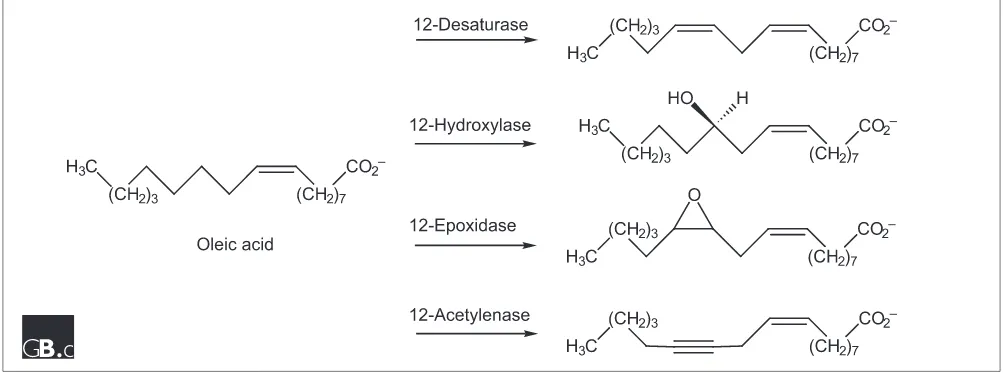
[image:3.609.53.556.510.701.2]Although functional diversity is almost always associated with significant divergence in sequence so that the definition of superfamily or suprafamily (less than 50% sequence identity) clearly applies, Somerville and coworkers [19] have described a family of closely related enzymes found in plants that catalyze different oxidative reactions and appear to be responsible for the diversity in seed storage fatty acids. These enzymes use oleate as their common substrate but catalyze desaturation, hydroxylation and epoxidation reactions (Figure 1). They are members of a larger functionally diverse superfamily that includes enzymes such as alkane hydroxy-lase, xylene monooxygenase, carotene ketohydroxy-lase, and sterol
methyloxidase, all of which are nonheme-iron enzymes that utilize a diiron center for catalysis and have three conserved histidine residues that probably bind the metal ions.
An oleate hydroxylase from Lesquerella fendleri shares 81% sequence identity with an oleate desaturase from Arabidopsis thaliana but 71% identity with an oleate hydroxylase from Ricinus communis. These relationships suggest that diver-gence of function is facile and may have occurred many times in the speciation of higher plants. Noting that seven residues were conserved in oleate desaturases from multiple species but diverged in hydroxylases, Somerville and coworkers [19] constructed libraries of mutants in which these conserved residues were replaced. Interestingly, as few as four substitu-tions were able to convert an oleate 12-desaturase into a hydroxylase; in the opposite direction, six substitutions con-verted a hydroxylase into a desaturase. Bearing in mind that the substrates for the hydroxylases and desaturases are the same, we conclude that different reaction mechanisms and products can result from subtle changes in active-site geome-try that may reposition the substrate relative to the diiron center or alter the coordination geometry or hydrogen-bonding network in the active site. Irrespective of the precise structural explanation, these findings illustrate that mecha-nistic diversity does not require a large significant divergence in sequence, and underscore that high levels of sequence identity do not guarantee the same enzymatic function.
Mechanistically diverse superfamilies: different
reactions forming thioester enolate anions as
intermediates
The >-oxidation pathway for the catabolism of fatty acids is encoded by most genomes. A key step in the pathway is the hydration of enoyl CoA esters, which is catalyzed by enoyl
Figure 1
CoA hydratase (also called crotonase). The reaction catalyzed by crotonase has been subjected to mechanistic scrutiny [20-22]; several high-resolution structures are available for the rat mitochondrial enzyme [23,24]. As a result of these studies, the mechanism is known to involve two glutamate residues that function as acid/base catalysts: in the direction of hydration of enoyl CoAs, Glu144 activates a water molecule for nucleophilic attack and Glu164 delivers a proton to the =
carbon. Although never observed directly, the mechanism probably involves the transient formation of a thioester enolase anion intermediate that is stabilized by enhanced hydrogen-bonding interactions with an oxyanion hole [25]. As judged by the structures of complexes with substrate analogs/products, the oxyanion hole is formed by two pep-tidic NH groups that bind the thioester carbonyl group.
Database searches with the sequence of the structurally characterized crotonase yield many hits, as judged by con-served consensus sequences for both halves of the oxyanion hole [26,27]. The reactions catalyzed by some of these hits have been biochemically characterized, leading to the dis-covery that crotonase is a member of a mechanistically diverse superfamily: the reactions can be explained by a mechanism that involves the transient formation and stabi-lization of a thioester enolate anion intermediate.
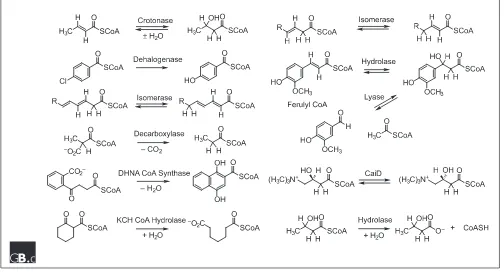
In addition to crotonase, structurally characterized members of the superfamily include (Figure 2): 4-chlorobenzoyl CoA
dehalogenase, which catalyzes a nucleophilic aromatic substitution [28]; ,3,5, ,2,4-dienoyl CoA isomerase, which
catalyzes a 1,5-proton transfer reaction [29]; and methyl-malonyl CoA decarboxylase, which catalyzes a decarboxyla-tion reacdecarboxyla-tion [30]. In the case of the dehalogenase, homologs of Glu144 and Glu164 in crotonase are missing, but the func-tional groups involved have been identified and subjected to mechanistic scrutiny assisted by site-directed mutagenesis. In the case of the isomerase and decarboxylase, the sequences of both contain a homolog for either Glu144 or Glu164 but not both; the mechanisms of the reactions are not yet certain.
[image:4.609.56.560.428.703.2]Biochemically characterized members of the superfamily for which no structure is yet available include (Figure 2): 1,4-dihydroxynaphthoyl CoA synthase, which catalyzes for-mation of a carbon-carbon bond in a Dieckman reaction [31]; 2-ketocyclohexyl CoA hydrolases, which catalyzes cleavage of a carbon-carbon bond in a retro Dieckman reac-tion [32]; 3,2-trans-enoyl CoA isomerase, which catalyzes a 1,3-proton transfer reaction [33]; feruloyl CoA hydratase/lyase, which catalyzes successive hydration and carbon-carbon bond cleavage reactions [34]; and carnitinyl CoA epimerase, which inverts the configuration of an unacti-vated carbon by an unknown mechanism [35]. The hydratase/lyase and epimerase contain homologs of both Glu144 and Glu164 in crotonase; as a result, the mechanisms of both may involve hydration/dehydration partial reactions
Figure 2
involving a thioester enolase anion intermediate. Mecha-nisms involving carbon-carbon bond cleavage reactions via retroaldol mechanisms are also possible, however. Irrespec-tive of the precise reaction coordinates that describe the reactions catalyzed by these enzymes, all probably involve the formation and transient stabilization of a thioester enolate anion intermediate.
The database searches also yield members of the crotonase superfamily that catalyze reactions that probably do not involve formation of a thioester enolate anion but, instead, an anionic tetrahedral intermediate in thioester or peptide bond hydrolysis that would be stabilized by the conserved oxyanion hole (Figure 2): 3-OH isobutyryl CoA hydrolase [36] and the ClpP protease [37,38]. The hydrolase occurs in the catabolic pathway for valine; the preceding enzyme in the pathway, also a member of the crotonase superfamily, catalyzes the hydration of =-methacryl CoA using homologs of Glu144 and Glu164 in rat mitochondrial crotonase. Although structure/function relationships have not yet been characterized in detail for the protease, the structure allows the suggestion that the functional groups are configured in a catalytic triad (Ser-His-Glu) structurally analogous to those found in other examples of analogous serine proteases [38]. That the hydrolase and protease are members of the cro-tonase superfamily provides compelling evidence that the underlying chemical strategy supported by the =/> fold is stabilization of oxyanion intermediates.
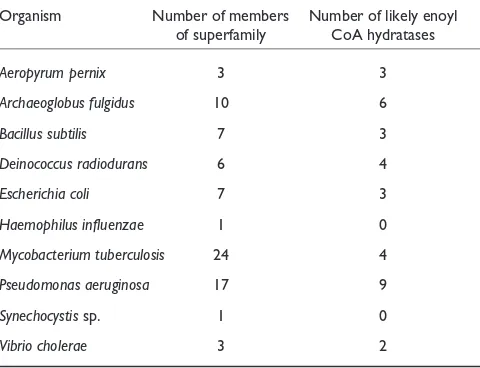
We therefore conclude that structure/function relationships in the crotonase superfamily cannot be extrapolated simply to newly discovered members from the sequence and avail-able structures. Database annotations indicate, however, that newly discovered members of this superfamily are probable enoyl CoA hydratases/isomerases. Table 1 com-pares the number of members of the crotonase superfamily encoded by several microbial genomes, as assessed by the presence of consensus sequences for the oxyanion hole, with the number of proteins that could catalyze an enoyl CoA hydratase reaction, as assessed by the presence of homologs of both Glu144 and Glu164 in rat mitochondrial crotonase. Despite the differences, the databases invariably include the members of the superfamily that do not contain homologs of Glu144 and Glu164 in rat mitochondrial crotonase as likely or probable enoyl CoA hydratases/isomerases. We believe that, in many cases, these annotations are incorrect or mis-leading. Although we recognize this problem, given our expertise in structure/function relationships for several members of this superfamily, most users of the sequence databases will not. The likely consequences are that annota-tions of genome sequences completed in the future will use these incorrect annotations and continue to misrepresent the functions of orthologous ORFs that are identified, and that novel metabolic pathways involving members of the cro-tonase superfamily will be ignored or assigned incorrect functions. Both types of incorrect assignment will undermine
the considerable potential of genome sequencing projects in defining new metabolic capabilities.
Mechanistically diverse superfamilies: different
reactions forming metal-coordinated enediolate
anions as intermediates
Members of mechanistically diverse superfamilies are common in the ORFs encoded by microbial genomes. For example, the microbial sequence databases contain many members of the enolase superfamily [14], with virtually all sharing three conserved carboxylate ligands for an essential divalent metal ion. The conservation of these elements is persuasive evidence that the underlying catalytic strategy employed by all members of the enolase superfamily is elec-trostatic stabilization of a geminal enediolate anion derived from a carboxylate substrate by abstraction of a proton from the = carbon. The members of the superfamily can be divided into three groups: those most homologous to enolase, those most homologous to mandelate racemase (MR), and those most homologous to muconate lactonizing enzyme (MLE). High-resolution structures are available for each of these, and reveal that, in enolase Lys345 is the general base; in MR, Lys166 in a Lys164-X-Lys166 motif is the (S)-specific base and His297 hydrogen-bonded to Asp270 is the (R)-specific base; and in MLE, Lys169 in a Lys 167-X-Lys 169 motif and Lys 273 are positioned on opposite faces of the active site, although which of these is the expected general base has not been unequivocally assigned. Alignments of sequence and structural superposi-tions reveal that Lys345 (enolase), Asp270 (MR), and Lys273 (MLE) are homologous residues, and that the Lys164-X-Lys166 motif (MR) and the Lys167-X-Lys169 motif are also homologous.
comment
reviews
reports
deposited research
interactions
information
[image:5.609.313.553.558.742.2]refereed research
Table 1
Members of the crotonase superfamily encoded by microbial genomes, and the likely enoyl CoA hydratases
Organism Number of members Number of likely enoyl of superfamily CoA hydratases
Aeropyrum pernix 3 3
Archaeoglobus fulgidus 10 6
Bacillus subtilis 7 3
Deinococcus radiodurans 6 4
Escherichia coli 7 3
Haemophilus influenzae 1 0
Mycobacterium tuberculosis 24 4
Pseudomonas aeruginosa 17 9
Synechocystissp. 1 0
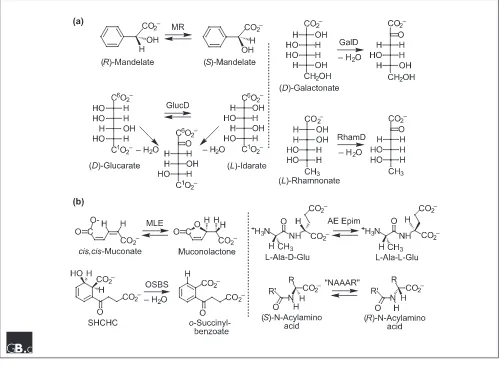
Database searches disclose that the E. coli genome encodes three members of the enolase superfamily that are most homologous to MR (Figure 3). MR catalyzes a 1,1-proton transfer reaction using Lys166 and His297 of the His297-Asp270 dyad as general/acid base catalysts that abstract protons from and deliver protons to the =carbon of the car-boxylate anion substrate/product; the mechanism of the reac-tion is well understood in terms of the structure of the active site. Biochemical studies have established, however, that the three homologs of MR encoded by the E. coligenome catalyze the dehydration of acid sugars: (D)-glucarate/(L)-idarate dehydratase (GlucD) [39,40]; (D)-galactonate dehydratase (GalD) [41,42]; and (L)-rhamnonate dehydratase (RhamD; B.K. Hubbard, J. Delli and J.A.G., unpublished observations). We note that the incomplete Streptomyces coelicolor genome-sequencing project has discovered at least seven homologs of MR, some annotated as racemases and others as dehy-dratases. A priori, we and, we assume, others cannot assign the correct function to these ORFs without biochemical evi-dence that must involve screening these ORFs for both racem-ization and dehydration reactions on a library of acid sugars.
[image:6.609.57.557.349.715.2]The E. coli genome also encodes two members of the enolase superfamily that are most homologous to MLE (Figure 3). MLE catalyzes a reversible cycloisomerization reaction involving intramolecular addition/elimination to a conjugated enoic acid. Biochemical studies have established that one of these homologs is o-succinylbenzoate synthase (OSBS), which catalyzes an exergonic dehydration reaction in the biosynthesis of menaquinone [43]. The other homolog is a dipeptide epimerase that is specific for L-Ala-(D/L)-Glu (AE Epim), although other dipeptides are epimerized (D.Z. Schmidt, B.K. Hubbard and J.A.G., unpublished observations); we hypothesize that the epimerase is involved in either recycling or remodeling of cell-wall-derived peptides. We have noted that characteriza-tion of the gene encoding OSBS in E. coli has not allowed the functional assignment of orthologs in other microbial genomes [15]. For example, the genome of B. subtilis encodes a pathway for menaquinone biosynthesis, but the gene encoding OSBS was variously annotated as similar to muconate cycloisomerase and similar to N-acylamino acid racemase. The sequences of orthologous OSBSs are highly
Figure 3
diverged but can be identified unequivocally when their proximal genome context includes genes encoding other enzymes in the menaquinone biosynthetic pathway [44]. The orthologous OSBSs retain invariant residues only for the three metal ion ligands and the Lys167-X-Lys169 motif and Lys273 in MLE. The reason for this extreme divergence may be related to the extreme exergonicity of this OSBS reaction. Interestingly, the OSBS from a species of Amyco-laptosiswas initially characterized as an N-acylamino acid racemase, an enzyme catalyzing a reaction needed to achieve a commercial enzymatic conversion of racemic N-acylamino acids to chiral amino acids [45]. Kinetic char-acterization of this protein revealed that it is promiscuous, catalyzing both the racemase and OSBS reactions, although the latter reaction is approximately 1,000-fold more effi-cient, as assessed by the values of kcat/Km [15].
Unfortu-nately, the less efficient and, presumably, physiologically irrelevant racemase reaction continues to be used in the annotation of newly sequenced OSBSs.
A metabolically linked suprafamily: the evolution
of biosynthetic pathways for tryptophan and
histidine
We expect that functional annotations of newly discovered members of mechanistically diverse superfamilies will con-tinue to be problematic. Mechanism-oriented biologists will still be able to derive some value from such annotations, however, if they are aware of the existence of such superfam-ilies. An essential element of mechanism is retained as a consequence of the chemical mechanism-dominant strategy that nature used in their evolution; presumably, the same catalytic strategy will be employed by the misannotated gene products. A more serious problem of functional ambiguity is associated with annotation of members of suprafamilies in which conserved elements of active-site architecture are used in different ways to catalyze different reactions.
Two structurally documented examples of divergent evolu-tion supporting Horowitzs hypothesis [7,8] that metabolic pathways evolve backward are available. Interestingly, these examples are functionally intertwined, further illustrating difficulties in assigning function from sequence. In both the tryptophan and histidine biosynthetic pathways (Figure 4), the immediate precursors of the cyclization reactions that form the pyrrole and imidazole rings, respectively, are obtained by Amadori rearrangements in which substituted 1-amino ribose 5-phosphates are isomerized to 1-amino ketose 5-phosphates (TrpF and HisA, respectively). In the tryptophan pathway, the Amadori product undergoes a poorly understood decarboxylation/dehydration reaction to form a carbon-carbon bond, yielding the pyrrole ring (TrpC); in the histidine pathway, the Amadori product with ammonia derived from a glutamine cosubstrate undergoes amination/transaldimination to form the imidazole ring (HisF). Thus, while the Amadori rearrangements employ the
same mechanisms and logically could be catalyzed by homo-logous enzymes (members of a specificity diverse superfam-ily), the cyclization reactions are mechanistically distinct.
The sequences of the enzymes catalyzing the Amadori rearrangements, HisA and TrpF in the histidine and trypto-phan biosynthetic pathways, show little, if any, homology, however. In contrast, the sequences of TrpF and TrpC show significant levels of sequence identity: 22% in the case of the individual domains in the bifunctional and structurally char-acterized protein encoded by the E. coli genome; both domains of this protein have the (>/=)8fold [46].
Indepen-dent evidence that these enzymes are related by divergent evolution was provided by Fersht and coworkers [9], who retained the barrel of TrpC but randomized the sequences of two of the loops that connect the >strands with the following
=helices. Selection by complementation of a mutant strain of E. coliand repeated rounds of DNA shuffling yielded an in vitro evolved TrpF that exceeded the wild-type TrpF in the measured value of kcat/Km.
Presumably an analogous directed evolution strategy could mimic nature by converting HisF to HisA. The structurally characterized enzymes from Thermotoga maritima share 25% sequence identity; each has the (>/=)8fold [10].
Inter-estingly, these structures confirm the presence of a two-fold repeat first predicted from sequence analysis, in which the first and second halves of the barrel are symmetrically dis-posed [47,48]. Presumably, the ancestral gene encoded a four-stranded half-barrel, which was duplicated and fused in tandem to produce each gene that encodes HisA and HisF.
Remarkably, despite undetectable levels of sequence identity, TrpF and HisA that catalyze the Amadori rearrangements can be interconverted by directed evolution: starting with TrpF, a single point mutation at the end of the fifth >strand was found to confer the ability to catalyze the HisA reaction while retain-ing the TrpF reaction [49]. This experiment, which relates the functions of enzymes in distinct pathways, implies that HisA/F and TrpF/C could have been derived from a common ancestor and provides persuasive evidence for the suggestion that the design of the (>/=)8fold, including its possible origin
from half-barrels, was exploited by nature in the divergent evolution of new enzymatic functions.
These examples confirm the importance of Horowitzs hypo-thesis [8,9] that substrate specificity can dominate divergent evolution to produce members of metabolically linked suprafamilies. Although the levels of sequence identity that relate TrpF with TrpC and HisA with HisF, approximately 25%, are likely to be sufficient for correct functional assignment of orthologs in newly sequenced genomes, the established impor-tance of this strategy for divergent evolution increases the pos-sibility that members of metabolically linked suprafamilies occur in other metabolic pathways, thereby confounding the functional annotations of the genes that encode these proteins.
comment
reviews
reports
deposited research
interactions
information
A metabolically distinct suprafamily: the
breadth of reactions catalyzed by the (
>>
/
==
)
8fold
Given the confirmation of substrate-specificity-driven diver-gent evolution of enzymes to create metabolic pathways (gen-erating metabolically linked suprafamilies), the importance of divergent evolution of enzymes that catalyze mechanistically distinct reactions in different metabolic pathways (generating metabolically distinct suprafamilies) must be considered. Although such evolution would confound functional annota-tions on the basis of sequence alone, it would provide impor-tant insights into the processes by which nature selected progenitors for the evolution of new enzymes.
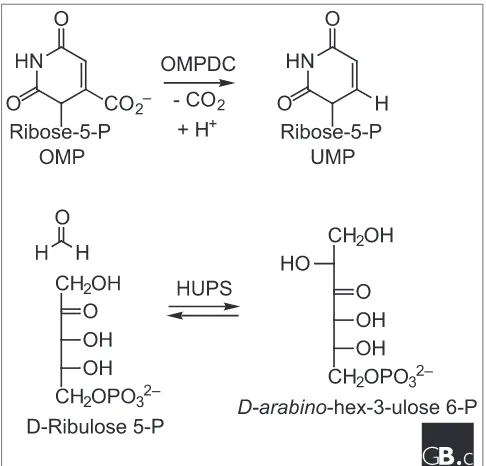
We are aware of one unequivocal example of a metabolically distinct suprafamily and, as expected, annotation of function based on sequence appears problematic. Orotidine 5-phos-phate decarboxylase (OMPDC) catalyzes the last step in the biosynthesis of UMP (Figure 5). This enzyme has attracted considerable recent attention in the enzymological commu-nity, because it is the most proficient of any enzyme studied to date [50]. Four independent structural studies of OMPDCs from each of the three kingdoms of life have been published in recent months (Saccharomyces cerevisiae, Methanobac-terium thermoautotrophicum, B. subtilisand E. coli); each has a dimeric structure in which the active sites are located at the carboxy-terminal ends of (>/=)8 domains [51-54].
Remarkably, only five residues are absolutely conserved in the known OMPDCs, and they are located in the active site. Of these, an aspartate is located at the end of the first >
strand, a lysine is located at the end of the second >strand, and an Asp-X-Lys-X-X-Asp motif is located at the end of the third >strand; all of these residues directly contact the OMP substrate. Although the mechanism is not yet certain, the functional groups in the Asp-X-Lys-X-X-Asp motif shared between both active sites in the functional dimer probably destabilize the substrate carboxylate group and deliver a proton to carbon-6 in an SE2 reaction that avoids the
forma-tion of an unstable vinyl carbanion intermediate.
[image:8.609.55.298.86.370.2]Distant homologs of OMPDC that contain some homologs of the residues listed above can be identified in the sequence databases. One of these has been identified as D-arabino -hex-3-ulose 6-phosphate synthase (HUPS), the enzyme that fixes formaldehyde in methylotrophic bacteria that can utilize either methylamine or formaldehyde as their sole carbon source (J.A.G. and P.C.B, unpublished observations; Figure 5) [18]. Although OMPDC does not utilize a divalent metal ion [55,56], HUPS is reported to do so [57]. Because the HUPS-catalyzed reaction can be rationalized by a mecha-nism involving the transient formation and stabilization of an enediolate intermediate, an intermediate that is impossible in the OMPDC-catalyzed reaction, we conclude that OMPDC and HUPS constitute a metabolically distinct suprafamily. While their substrates contain phosphate groups and the active site may contain homologous phosphate-binding sites, the metabolic pathways are distinct and the reactive portions of the substrates are not structurally similar.
Figure 5
[image:8.609.314.557.461.694.2]Reactions catalyzed by OMPDC and HUPS in a metabolically distinct suprafamily. See text for details.
Figure 4
Reactions catalyzed by members of the metabolically linked suprafamilies in the (a)tryptophan and (b)histidine biosynthetic pathways. N O OH HO —2O 3PO H —O 2C N OH O HO —2O 3PO H H H —O 2C N OH O HO —2O 3PO H H H N OH H HO H H —2O 3PO —O 2C TrpF TrpC Ribose-5-P O H2N
N N H H Ribose-5-P O H2N
N N H H O OH HO —2O
3PO OH
O HO —2O 3PO H H Ribose-5-P O H2N
The sequence databases contain homologs of OMPDC/HUPS that are annotated as probable hexulose phosphate syn-thases or hexulose phosphate synthase homologs, isologs, or related proteins; several of these are under investigation in our laboratories, and we have concluded that they are not hexulose phosphate synthases. Although our studies are too premature to provide more details about these homologs and the reactions they catalyze, we include this example to illus-trate that metabolically distinct suprafamilies exist and that correct annotation of the members of these will be difficult.
In summary, although an enzymes membership in mecha-nistically diverse family or superfamily can provide useful information about the nature of the reaction that is catalyzed, membership in a suprafamily will provide few, if any clues, about the identity of the reaction. Unfortunately, if the anno-tators of genome sequencing projects are unaware of both the range of strategies nature uses to evolve homologous enzymes and the associated functional implications, annota-tions of function will provide misleading interpretaannota-tions of sequence data that will be propagated as additional genomes are annotated. This situation will diminish both the intellec-tual and practical importance of sequence data that have the potential to provide heretofore impossible-to-achieve insights into the molecular details of cellular function and speciation.
Acknowledgements
We thank the National Institutes of Health for financial support (grants GM-60595 to P.C.B.; GM-40570, GM-52594 and GM-58506 to J.A.G.).
References
1. Blattner FR, Plunkett G, 3rd, Bloch CA, Perna NT, Burland V, Riley M, Collado-Vides J, Glasner JD, Rode CK, Mayhew GF, et al.: The
complete genome sequence of Escherichia coliK-12.Science
1997, 277:1453-1474.
2. Kunst F, Ogasawara N, Moszer I, Albertini AM, Alloni G, Azevedo V, Bertero MG, Bessieres P, Bolotin A, Borchert S, et al.:The com-plete genome sequence of the gram-positive bacterium
Bacillus subtilis.Nature1997, 390:249-256.
3. Genome sequence of the nematode C. elegans: a platform
for investigating biology. The C. elegansSequencing
Consor-tium.Science1998, 282:2012-2018.
4. Eisen JA: Phylogenomics: improving functional predictions
for uncharacterized genes by evolutionary analysis.Genome
Res1998, 8:163-167.
5. Pellegrini M, Marcotte EM, Thompson MJ, Eisenberg D, Yeates TO: Assigning protein functions by comparative genome
analy-sis: protein phylogenetic profiles.Proc Natl Acad Sci USA1999,
96:4285-4288.
6. Karp PD: What we do not know about sequence analysis and
sequence databases.Bioinformatics1998, 14:753-754.
7. Horowitz NH: On the evolution of biochemical syntheses.Proc Natl Acad Sci USA1945, 31:153-157.
8. Horowitz NH: Evolving Genes and Proteins. New York: Academic Press, 1965.
9. Altamirano MM, Blackburn JM, Aguayo C, Fersht AR: Directed evolution of new catalytic activity using the
alpha/beta-barrel scaffold.Nature2000, 403:617-622.
10. Lang D, Thoma R, Henn-Sax M, Sterner R, Wilmanns M: Structural evidence for evolution of the beta/alpha barrel scaffold by
gene duplication and fusion.Science2000, 289:1546-1550.
11. Babbitt PC, Gerlt JA: Understanding enzyme superfamilies. Chemistry as the fundamental determinant in the evolution
of new catalytic activities.J Biol Chem1997, 272:30591-30594.
12. Gerlt JA, Babbitt PC: Mechanistically diverse enzyme super-families: the importance of chemistry in the evolution of catalysis.Curr Opin Chem Biol1998, 2:607-612.
13. Perona JJ, Craik CS: Evolutionary divergence of substrate specificity within the chymotrypsin-like serine protease fold. J Biol Chem1997, 272:29987-29990.
14. Babbitt PC, Hasson MS, Wedekind JE, Palmer DR, Barrett WC, Reed GH, Rayment I, Ringe D, Kenyon GL, Gerlt JA: The enolase super-family: a general strategy for enzyme-catalyzed abstraction
of the alpha-protons of carboxylic acids. Biochemistry 1996,
35:16489-16501.
15. Palmer DR, Garrett JB, Sharma V, Meganathan R, Babbitt PC, Gerlt
JA: Unexpected divergence of enzyme function and
sequence: “N-acylamino acid racemase” is
o-succinylben-zoate synthase.Biochemistry1999, 38:4252-4258.
16. O’Brien PJ, Herschlag D: Catalytic promiscuity and the
evolu-tion of new enzymatic activities.Chem Biol1999, 6:R91-R105.
17. Gerlt JA, Babbitt PC: Divergent evolution of enzyme function: mechanistically diverse superfamilies and functionally dis-tinct suprfamilies.Ann Rev Biochem2001, 70: in press.
18. Traut TW, Temple BR: The chemistry of the reaction deter-mines the invariant amino acids during the evolution and
divergence of orotidine 5’-monophosphate decarboxylase.J
Biol Chem2000, 275:28675-28681.
19. Broun P, Shanklin J, Whittle E, Somerville C: Catalytic plasticity of fatty acid modification enzymes underlying chemical diver-sity of plant lipids.Science1998, 282:1315-1317.
20. Bahnson BJ, Anderson VE: Isotope effects on the crotonase
reaction.Biochemistry1989, 28:4173-4181.
21. D’Ordine RL, Bahnson BJ, Tonge PJ, Anderson VE: Enoyl-coen-zyme A hydratase-catalyzed exchange of the alpha-protons of coenzyme A thiol esters: a model for an enolized
inter-mediate in the enzyme-catalyzed elimination? Biochemistry
1994, 33:14733-14742.
22. Hofstein HA, Feng Y, Anderson VE, Tonge PJ: Role of glutamate 144 and glutamate 164 in the catalytic mechanism of
enoyl-CoA hydratase.Biochemistry1999, 38:9508-9516.
23. Engel CK, Mathieu M, Zeelen JP, Hiltunen JK, Wierenga RK: Crystal structure of enoyl-coenzyme A (CoA) hydratase at 2.5 angstroms resolution: a spiral fold defines the CoA-binding
pocket.EMBO J1996, 15:5135-5145.
24. Engel CK, Kiema TR, Hiltunen JK, Wierenga RK: The crystal structure of enoyl-CoA hydratase complexed with octanoyl-CoA reveals the structural adaptations required for binding
of a long chain fatty acid-CoA molecule. J Mol Biol 1998,
275:859-847.
25. Gerlt JA, Gassman PG: An explanation for rapid enzyme-cat-alyzed proton abstraction from carbon acids: the
impor-tance of late transition states in concerted mechanisms.J
Am Chem Soc1993, 115:11552-11569.
26. Xiang H, Luo L, Taylor KL, Dunaway-Mariano D: Interchange of catalytic activity within the 2-enoyl-coenzyme A hydratase/isomerase superfamily based on a common active
site template.Biochemistry1999, 38:7638-7652.
27. Haller T, Buckel T, Retey J, Gerlt JA: Discovering new enzymes and metabolic pathways: conversion of succinate to propi-onate by Escherichia coli.Biochemistry2000, 39:4622-4629. 28. Benning MM, Taylor KL, Liu RQ, Yang G, Xiang H, Wesenberg G,
Dunaway-Mariano D, Holden HM: Structure of 4-chlorobenzoyl coenzyme A dehalogenase determined to 1.8 Å resolution:
an enzyme catalyst generated via adaptive mutation.
Bio-chemistry1996, 35:8103-8109.
29. Modis Y, Filppula SA, Novikov DK, Norledge B, Hiltunen JK, Wierenga RK: The crystal structure of dienoyl-CoA iso-merase at 1.5 Å resolution reveals the importance of
aspar-tate and glutamate sidechains for catalysis. Structure 1998,
6:957-970.
30. Benning MM, Haller T, Gerlt JA, Holden HM: New reactions in the crotonase superfamily: structure of methylmalonyl CoA
decarboxylase from Escherichia coli.Biochemistry2000,
39:4630-4639.
31. Sharma V, Suvarna K, Meganathan R, Hudspeth ME: Menaquinone (vitamin K2) biosynthesis: nucleotide sequence and
expres-sion of the menB gene from Escherichia coli.J Bacteriol1992,
174:5057-5062.
32. Pelletier DA, Harwood CS: 2-Ketocyclohexanecarboxyl coen-zyme A hydrolase, the ring cleavage encoen-zyme required for
anaerobic benzoate degradation by Rhodopseudomonas
palustris.J Bacteriol1998, 180:2330-2336.
comment reviews reports deposited research interactions information
33. Muller-Newen G, Janssen U, Stoffel W: Enoyl-CoA hydratase and isomerase form a superfamily with a common active-site
glutamate residue.Eur J Biochem1995, 228:68-73.
34. Gasson MJ, Kitamura Y, McLauchlan WR, Narbad A, Parr AJ, Parsons ELH, Payne J, Rhodes MJC, Walton NJ: Metabolism of ferulic acid to vanillin. A bacterial gene of the enoyl-SCoA hydratase/isomerase superfamily encodes an enzyme for the hydration and cleavage of a hydroxycinnamic acid SCoA
thioester.J Biol Chem1998, 273:4163-4170.
35. Eichler K, Bourgis F, Buchet A, Kleber HP, Mandrand-Berthelot MA: Molecular characterization of the cai operon necessary for
carnitine metabolism in Escherichia coli. Mol Microbiol 1994,
13:775-786.
36. Hawes JW, Jaskiewicz J, Shimomura Y, Huang B, Bunting J, Harper ET, Harris RA: Primary structure and tissue-specific expres-sion of human beta- hydroxyisobutyryl-coenzyme A
hydro-lase.J Biol Chem1996, 271:26430-26434.
37. Murzin AG: How far divergent evolution goes in proteins.Curr Opin Struct Biol1998, 8:380-387.
38. Wang J, Hartling JA, Flanagan JM: The structure of ClpP at 2.3 Å resolution suggests a model for ATP- dependent proteoly-sis.Cell1997, 91:447-456.
39. Palmer DR, Gerlt JA: Evolution of enzymatic activities: multi-ple pathways for generating and partitioning a common enolic intermediate by glucarate dehydratase from
Pseudomonas putida.J Am Chem Soc1996, 118:10323-10324. 40. Palmer DR, Hubbard BK, Gerlt JA: Evolution of enzymatic
activ-ities in the enolase superfamily: partitioning of reactive intermediates by (D)-glucarate dehydratase from
Pseudomonas putida.Biochemistry1998, 37:14350-14357. 41. Babbitt PC, Mrachko GT, Hasson MS, Huisman GW, Kolter R, Ringe
D, Petsko GA, Kenyon GL, Gerlt JA: A functionally diverse enzyme superfamily that abstracts the alpha protons of
car-boxylic acids.Science1995, 267:1159-1161.
42. Wieczorek SW, Kalivoda KA, Clifton JG, Ringe D, Petsko GA, Gerlt
JA: Evolution of enzymatic activities in the enolase
super-family: identification of a “new” general acid catalyst in the
active site of D-galactonate dehydratase from Escherichia
coli.J Am Chem Soc1999, 121:4540-4541.
43. Kwon O, Bhattacharyya DK, Meganathan R: Menaquinone (vitamin K2) biosynthesis: overexpression, purification, and properties of o-succinylbenzoyl-coenzyme A synthetase from Escherichia coli.J Bacteriol1996, 178:6778-6781.
44. Thompson TB, Garrett JB, Taylor EA, Meganathan R, Gerlt JA, Rayment I: Evolution of enzymatic activity in the enolase superfamily: structure of o-succinylbenzoate synthase from
Escherichia coli in complex with Mg2+ and
o-succinylben-zoate.Biochemistry2000, 39:10662-10676.
45. Tokuyama S, Hatano K: Purification and properties of
ther-mostable N-acylamino acid racemase from Amycolatopsis
sp. TS-1-60.Appl Microbiol Biotechnol1995, 42:853-859.
46. Wilmanns M, Priestle JP, Niermann T, Jansonius JN: Three-dimen-sional structure of the bifunctional enzyme phosphoribosy-lanthranilate isomerase: indoleglycerolphosphate synthase
from Escherichia colirefined at 2.0 A resolution. J Mol Biol
1992, 223:477-507.
47. Fani R, Lio P, Lazcano A: Molecular evolution of the histidine
biosynthetic pathway.J Mol Evol1995, 41:760-774.
48. Fani R, Tamburini E, Mori E, Lazcano A, Lio P, Barberio C, Casalone E, Cavalieri D, Perito B, Polsinelli M: Paralogous histidine
biosyn-thetic genes: evolutionary analysis of the Saccharomyces
cerevisiaeHIS6 and HIS7 genes.Gene1997, 197:9-17.
49. Jurgens C, Strom A, Wegener D, Hettwer S, Wilmanns M, Sterner
R: Directed evolution of a (beta alpha)8-barrel enzyme to
catalyze related reactions in two different metabolic
path-ways.Proc Natl Acad Sci USA2000, 97:9925-9930.
50. Radzicka A, Wolfenden R: A proficient enzyme. Science 1995, 267:90-93.
51. Harris P, Navarro Poulsen JC, Jensen KF, Larsen S: Structural basis for the catalytic mechanism of a proficient enzyme:
oroti-dine 5’-monophosphate decarboxylase. Biochemistry 2000,
39:4217-4224.
52. Appleby TC, Kinsland C, Begley TP, Ealick SE: The crystal struc-ture and mechanism of orotidine 5’-monophosphate
decar-boxylase.Proc Natl Acad Sci USA2000, 97:2005-2010.
53. Wu N, Mo Y, Gao J, Pai EF: Electrostatic stress in catalysis: structure and mechanism of the enzyme orotidine
monophosphate decarboxylase. Proc Natl Acad Sci USA 2000,
97:2017-2022.
54. Miller BG, Hassell AM, Wolfenden R, Milburn MV, Short SA: Anatomy of a proficient enzyme: the structure of orotidine 5’-monophosphate decarboxylase in the presence and
absence of a potential transition state analog. Proc Natl Acad
Sci USA2000, 97:2011-2016.
55. Miller BG, Smiley JA, Short SA, Wolfenden R: Activity of yeast orotidine-5’-phosphate decarboxylase in the absence of
metals.J Biol Chem1999, 274:23841-23843.
56. Cui W, DeWitt JG, Miller SM, Wu W: No metal cofactor in
oro-tidine 5’-monophosphate decarboxylase. Biochem Biophys Res
Commun1999, 259:133-135.
57. Kato N, Ohashi H, Tani Y, Ogata K: 3-Hexulosephosphate
syn-thase from Methylomonas aminofaciens 77a. Purification,