Optimizing handover of asbuilt data using
BIM for highways
Bayar, M.S, Aziz, ZUH, Tezel, BA, Arayici, Y and Biscaya, S
Title Optimizing handover of asbuilt data using BIM for highways Authors Bayar, M.S, Aziz, ZUH, Tezel, BA, Arayici, Y and Biscaya, S
Type Conference or Workshop Item
URL This version is available at: http://usir.salford.ac.uk/40138/ Published Date 2016
USIR is a digital collection of the research output of the University of Salford. Where copyright permits, full text material held in the repository is made freely available online and can be read, downloaded and copied for noncommercial private study or research purposes. Please check the manuscript for any further copyright restrictions.
OPTIMIZING HANDOVER OF AS-BUILT DATA USING
BIM FOR HIGHWAYS
M.Sanem Bayar1, Dr Zeeshan Aziz2 , Dr Algan Tezel 3, Prof Yusuf Arayici4, Dr Sara Biscaya5
1University of Salford,Manchester UK
2University of Salford,Manchester UK
3University of Huddersfield,UK
4Hasan Kalyoncu University ,TR
5University of Salford,Manchester,UK
Abstract
An efficient maintenance of the UK’s transportation network is of critical importance to the country’s economy and among the top priorities of the government and public agencies (e.g. Network Rail, Highways England). The public transportation agencies have huge data sets related to asset management and maintenance. However, those data sets are usually held in disparate platforms and have been historically developed using multiple standards and formats. As a result, full value of such data is often not fully realized. Effective management of asset data and availability of reliable information as and when needed, could bring in key benefits for effective management of the transportation network. This paper aims to present the initial findings of a research effort understanding the potential of Building Information Modelling (BIM) in handover processes for a more efficient maintenance of highways assets, and discuss the way forward. The research methodology applied is systematic literature review and two recent best practice cases in the Highways Sector. The research findings suggest that efficient data management through BIM could provide a structured framework to improve asset handover and maintenance. However, it is important to capture the current handover practices between the construction and maintenance phase, and maintenance processes in the UK’s highways sector, both of which seem to be absent in the literature at the moment.
Keywords: BIM, Handover, Asset, As-built Data, Highways
Introduction
the network’s maintenance (NAO, 2014) amidst a serious public dissatisfaction with the current level of road conditions and significant budget cuts from the government (Glaister, 2013; NAO, 2014). A study undertook in the US revealed that there are huge costs associated with inadequate interoperability and mismatch among design software, and software systems and processes used in capital facilities/asset management (NIST, 2004), which suggests a cost reduction opportunity in capital asset management practices through better synchronizing asset life-cycle data management (from end to end) by using BIM.
In May 2011 the UK Government Construction Strategy was published detailing the government’s intention to require BIM in all of its capital projects by 2016 through a 5 year staged implementation plan. BIM has been seen as central to the government’s objective in achieving 20% saving in asset costs and higher value for money (Cabinet Office, 2011). The 2016 version of the strategy further emphasizes the importance of using BIM in the entire asset lifecycle (Cabinet Office, 2016). Highways England (HE), the main body managing the strategic highways network, is an active participant in the BIM Task Group which is supporting and helping deliver the Construction Strategy objectives.
Despite its significant potential for an improved project-life cycle performance, research on the data requirements for BIM-based asset management have remained scarce (Becerik-Gerber et al., 2011; Love et al, 2014). Beyond building assets, this scarcity is even more notable for large civil infrastructural assets. Recent industry surveys also show that the use of BIM is still relatively low both among asset managers and for asset management purposes (McGraw Hill Construction, 2014; Malleson, 2016). Given the UK government’s and large client organizations’ (i.e. Highways England, Network Rail) vision to further penetrate BIM into the life-cycle project management of large infrastructure assets (i.e. railways, highways etc.), it can be stated that there is a clear need to better understand the data requirements for a BIM based-asset management for large infrastructural assets to guide the current handover practices, to improve the overall asset management performance for a higher end-user satisfaction and to reduce the associated asset management costs, as explained by Kemp (2016); “the need for accurate asset information for large infrastructure managers (e.g. utility companies, Highways England, Network Rail, Environment Agency) is an essential enabler for the safe and efficient operation and maintenance of those assets and for decision support.”
The opportunities of BIM based asset management for large infrastructure assets are also in line with the broader vision of “smart spaces” or “smart cities”, in which digital data should freely flow among inanimate objects (capital assets) mostly through sensor networks, wireless communication and mobile devices, for informed decision making (Perera et al., 2014; Zanella et al., 2014). For the construction industry, the digital asset is becoming as important as the physical asset. Therefore, the asset data cannot be regarded as proprietary but need to be passed on between the project-life cycle stages as accessible (e.g. open to stakeholders and free of interoperability issues), trusted (timely, correct, impartial and complete), and just enough in detail and content (Kemp, 2016). Managing assets means to have continuous and reliable data on the asset inventory, condition and performance. The infrastructure sector needs to catch up with the building sector in terms of its BIM implementation maturity. However, with many visible and invisible assets (e.g. underwater or underground) and nonlinear maintenance patterns (deteriorations), operating, for instance, a highways network is a complex matter, requiring best use of data from multitude sources such as traffic data, casualty/accident data, asset report and so on (NAO, 2014). BIM can provide an analytical approach to data management which enables multiple analysis, thereby, enabling decision makers to use it for a variety of purpose. In this context, data handover should be considered as a life cycle component like any asset and therefore, specific data handover manuals for BIM based infrastructure asset management operations are required.
recent BIM-based asset management efforts, illustrates some best practices and discusses the way-forward for research on the subject matter. The following sections present those initial findings.
Current handover situation at the highways supply chain
In current practice, the maintenance and operational handover of a major highways project from the project team (construction contractor) to the Network Delivery and Development service delivery team (maintenance and operations teams) should take place on the date of project completion/road opening. However, the project team will retain responsibility for issues arising from the construction during the defect period. According to HE’s project control framework (Highways England, 2013), those documents are normally required for the handover; (i) as built drawings/documentation, (ii) updated health and safety file from the option selection stage prior to the preliminary design stage, (iii) template for handover schedule, (iv) civil assets maintenance handover certificate – including outstanding matters checklist, (v) technology commissioning plan, (vi) technology assets maintenance documentation and certificate, (vii) operational handover documentation and certificate for traffic management and regional control center, and (viii) updated permit to connect from the construction preparation stage. The documents have been developed starting from the design phase through the end of the construction phase in a highways project.
Documents required for the handover are generally deposited in Highways England’s document management system (SHARE). Some documents for certain assets may be stored in other relevant Highways England systems such as Highways Pavement Management System (HAPMS) or Structures Management Information Systems (SMIS). Also, mandatory road safety audit reports are produced during the development and construction phases of a major project to help identify potential safety issues and mitigate these where possible. The project control framework underlines the importance of coordination between the project team and maintenance/ operational bodies from the very early stages of the project-life cycle. There are efforts to integrate the fragmented data management systems at HE and promote automatic digital data collection for assets through sensor-fitted highways plant (Aggregate Industries, 2015). The degree of data loss in-between the phases and the compatibility of the current practice with the BIM vision are not well-known.
UK public sector transportation clients have a huge portfolio of aging assets. Historically, their data sets have been usually held in disparate platforms and developed utilizing multiple standards and formats. As a result, full value of such great data is not fully realized. Aging assets require economic life extension through efficient data management. With the increasing portions of smart systems and structures, the current network is becoming even more complex. According to Aziz (2016), newly generated information in new formats such as RVT, PLN, IFC is a great challenge for industry stakeholders that are already struggling to make sense of the CAD file formats (DWG,DGN, DXF etc.). As with the CAD formats, these are often proprietary and undocumented. It also presents a great challenge that the current closed and open formats are in need of specific versions of tools to work with. As per multi-decade lifespans, it is a huge bottleneck. Previously generated data are held disparate media; in the model, in CAD files, PDFs, printed paper, in spreadsheets and in the binders. Also, the current condition of asset information is hard to quality check. Stakeholders of the data handover of assets have limited BIM knowledge and experience. The industry’s traditional habits and resistance to change are also forming other challenges. Additionally, what should be delivered, at what cost, and the ownership of information raise legal/contractual challenges.
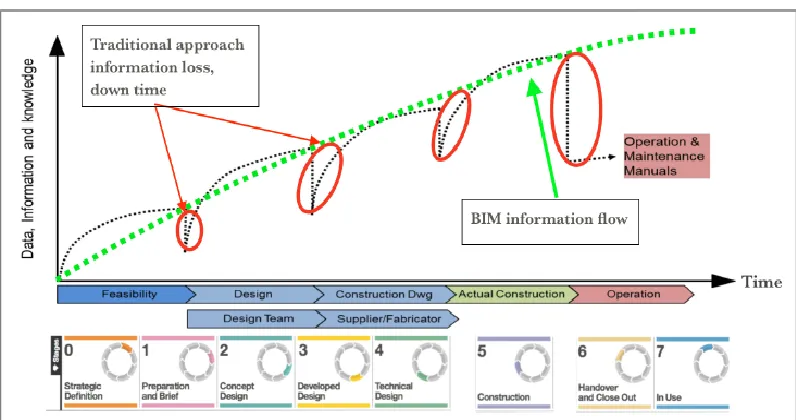
is BIM's greater ability to control projects with a minimized risk of errors and data loss at the handover for complex and specific built assets (see Fig.1).
Figure 1: Reducing data losses at handover stages using standardised workflows (adapted from Aziz (2016))
The current situation in the highways sector raises issues that are mainly related to information losses, duplication of work and unreliable asset information due to disparate formats and archives. The current issues associated with the situation at Highways England and its Tier 1 suppliers are (Aziz, 2016):
Asset surveys done over many years –data held on disparate platforms and not easily accessible;
Asset database are legacy –over 15 years;
Asset information is often poor, fragmented and cannot be relied upon for decision making;
Reliance on the ‘find a patch and amend it ‘approach. Lacking of a long-term view;
Asset data often maintained by service providers;
Data degradation at the handover stage;
Lack of a clear definition of client need leading to scope creep;
Data structure and formats used in the project design and delivery differ from those used in asset management;
HE currently manages its assets within 14 areas throughout the country. These 14 areas cover the 6 regions in England. Approaches used in the data management are often not consistent;
Use of different data formats and structures in scheme design, delivery and operations;
Key project staff leave before project completion resulting in loss of tacit knowledge;
Getting as-built information is challenging;
Design/Construction/Operations teams use different technical languages;
Data requirements are not defined at the beginning.
Initiatives to support BIM based asset handover
PAS 1192: 3 specificationstheir assets and numerous pieces of information about those assets to enable creation of the asset information model. The key elements of standard information being available, transferable and having integrity. It includes how a Project Information Model (PIM) is transferred to become an Asset Management Model (AIM) (NBS, 2015). This is an important step in the project lifecycle, as the user of the information changes meaning information should be mature enough for the purpose.
Government Soft Landing (GSL) policy
Another way to enable whole life cycle information management and prevent information losses at the project handover stage is to use the GSL policy (Cabinet Office, 2012). Created in 2012, it sought to align design and construction better with operation and asset management. The client is involved at an early stage, engaging with design and construction teams to identify their requirements and expectations at the end of the process (NBS, 2015). HE needs to ensure capturing all the information it requires, and that it engages with its stakeholders, in order to be able to meet their expectations as the network operates. As HE currently seeks to update its asset management policies, it may not be able to initially implement a PAS 1192:3 model but it can certainly begin to adopt some aspects of GSL practices, such as stakeholder engagement to inform information requirements and to ensure smooth delivery. GSL makes information available to the client prior to the handover so that they understand the asset before they are tasked with operating it and work together with client team for optimizing asset performance.
The GSL framework and PAS 1192:3 standards provide structures, which can inevitably help HE and its supply chain deliver more efficient information as they are supported by a formal process. In order for these processes to be effective, early and active client engagement and support is essential. Teams involved need to have a clear understanding of Asset Information Model required to effectively operate and manage assets. Information in the final models will naturally mature through the design and construction process, provided the teams maintain it throughout, so it is effective and ready to use at the point of handover. These processes should enable a project team to compile and transfer project information for handover in a manner that flows.
Common Data Environment (CDE)
Common Data Environment (CDE) is defined as a “single source of information for the project, used to collect, manage and distribute documentation, the graphical model and non-graphical data to the whole project team” (Boxall, 2015). This collaboration of data helps minimise risks and avoids mistakes/duplication. Creation of a CDE is also recognized in the PAS 1192:2 framework where cloud-based sharing uses an accessible project server or piece of software to store and share the data, creating a shared knowledge resource. Implementing a CDE across all HE schemes will ensure that there is a consistency in which assets are constructed and information is shared. Consistent data from multiple projects could enable easier access to information and cross comparisons between different projects/asset classes.
Best practice examples
In this section, two recent best practice examples from HE’s database with respect to highways handover will be presented. The best practices suggest that despite some efforts, BIM based asset handover in the highways supply chain is currently in its infancy.These two major best practice examples form initial lessons learned cases for future projects.
M1 J33 handover pilot
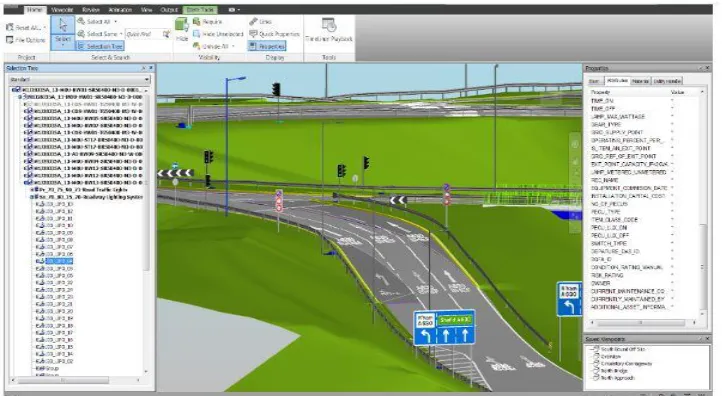
January – April 2014. The project team worked with the management team and supply chain through collaborative monthly workshops, to develop the model which contains detailed design and contractual information, existing management asset data, pavement data, as-built information and the contents of the Health and Safety File. Good collaborative relationships were maintained throughout the development and construction phases of the project between all parties. This led on to a smooth handover of the scheme into maintenance, due in part to the development of the BIM model. The model is now being used as an asset maintenance tool for the first time in the country. Important lessons learned include; (i) current HE databases are very high level and do not capture the granularity of data available, as required by the maintainers, (ii) further work is needed to capture all stakeholder requirements, so that a comprehensive recording system can be developed, which will enable maintainers and stakeholders to better interrogate and use captured data.
Figure 2: Screenshot of the M1J33 BIM Model (Mouchel Consulting,2015)
M1 J32-35a pilot
[image:7.595.113.475.246.444.2](a)
(b)
Figure 3: Material data sheets (a) and digital surfacing data metrics (b)
Future research
[image:8.595.114.479.477.682.2]While the value of capturing accurate data is starting to be realized, it is important for captured data to be retained, enhanced and accessible at the handover stage. Inefficiency costs resulting from inadequate interoperability between various legacy software systems and poor transfer of data and information from the design and construction stage into operations sum up to millions of British Pounds. This highlights the need for client organizations to spell out clearly their information needs and develop an integration strategy to ensure data adds value to their daily operations. As a consequence, clients often maintain and operate asset, without sufficient knowledge and understanding of assets that have been built. Traditional approaches to data handover present many difficulties, including failed opportunities to optimise performance and life spans of assets (see Figure 4).
Figure 4: As information artefact grows through the project life cycle stages, more effort is required to maintain the data and more time consuming to access it
(adapted from Hardin et al (2015))
solutions shall provide a better understanding in the long term challenges and maintenance of current construction infrastructure.
Following on the discussion presented in the paper, a handover guide for BIM based digital handover of different highways assets with respect to their data requirements, data responsible, level of detail, data format etc. seems to be needed. The guide should hold a project-life cycle view clearly defining the responsibilities of each project phase. The first step towards identifying the handover guide will be to map the current handover data flow in the highways supply chain. Another important aspect to the guideline will be a detailed requirement analysis for BIM based highways management. The handover guideline will need to be validated by expert view and preferably an implementation case.
Conclusion
BIM provides a systematic approach to collate design, construction and product specifications data in a single information model. Effective information management, as enabled by BIM could offer numerous potential benefits to HE. Firstly, simply capturing up to date, accurate information means the work that follows will be of value with waste reduced; information is accurate, up to date and accessible. Taking a road surfacing example, looking at what the road was constructed of, how it was repaired, how long it took, what materials were used, what the cost was, capturing potential reasons for degradation (i.e. weather, increased traffic flow) a valuable knowledge base that can be taken into account on future projects. Accurate information can be fed into electronic collaborative workspaces allowing HE and their supply chain to work together more efficiently. Developments in cloud computing and intelligent design modelling using BIM, further allows for seamless integration of asset information from diverse sources into a single source, to support operations and future planning.
Use of interoperable systems and standards are crucial for data continuity across the life-cycle as the main data structures, formats and uses in the delivery of projects differ from those used in asset management. Existing processes involve data submittals using variety of formats including CAD Drawings, PDFs and Excel spreadsheets. It has to be noted that employing BIM alone will not work but an increased effort to involve operations teams in early stages of projects will help. In addition, there needs to be a handover process to check whether quality data is being handed over. More importantly, HE needs to constantly foster skills to use and update project data in operations. This effectively means maintenance staff could effectively pull up the model on iPad and be on site with all the information they need to locate and correct a maintenance issue, helping to prevent network downtime.
References
Azhar, S. (2011). Building information modeling (BIM): Trends, benefits, risks, and challenges for the AEC industry. Leadership and Management in Engineering, 11(3), 241-252.
Aziz, Z. (2016). A lean journey through Highways England business plan, Technical report to Highways England, University of Salford, UK (ISBN: 978-1-907842-81-8)
Aggregate Industries (2015). Intelligent paving and compaction equipment. Available at: http://www.instituteofasphalt.org/library/papers/24_1.pdf
Barlish, K., & Sullivan, K. (2012). How to measure the benefits of BIM—A case study approach. Automation in construction, 24, 149-159.
Becerik-Gerber, B., Jazizadeh, F., Li, N., & Calis, G. (2011). Application areas and data requirements for BIM-enabled facilities management. Journal of construction engineering and management, 138(3), 431-442.
Boxall, E. (2015). Common Data Environment (CDE): What you need to know for starters, available at: http://www.aconex.com/blogs/2015/08/common-data-environment-cde-tutorial.html
Bryde, D., Broquetas, M., & Volm, J. M. (2013). The project benefits of building information modelling (BIM). International Journal of Project Management, 31(7), 971-980.
BSI (2014). PAS 1192-3: Specification for information management for the operational phase of assets using building information modelling. BSI, London, UK
Cabinet Office (2011), Government Construction Strategy 2011-2015, UK Government Report, Cabinet Office, London
Cabinet Office (2016), Government Construction Strategy 2016 - 2020, UK Government Report, Cabinet Office, London
Department for Transport (DfT) (2011). Cost of maintaining the Highways Agency’s
motorway and A road network per lane mile. Available at:
https://www.gov.uk/government/publications/cost-of-maintaining-the-highways-agency-s-motorway-and-a-road-network-per-lane-mile (last accessed: 28.06.2016) Eastman, C., Eastman, C. M., Teicholz, P., Sacks, R., & Liston, K. (2011).BIM handbook:
A guide to building information modeling for owners, managers, designers, engineers and contractors. John Wiley & Sons.
Glaister, S. (2013). The economics of road maintenance: A RAC foundation review, Industry Report, RAC Foundation, UK.
Hardin, B., & Mcool, D (2015).BIM and Construction Management: Proven tools, methods and workflows, John Wiley and Sons.
Kemp, A. (2016). BIM - the wider landscape of infrastructure, and the convergence with geospatial, National BIM Report, Industry Report, NBS, UK, 4-7
Love, P. E., Edwards, D. J., Han, S., & Goh, Y. M. (2011). Design error reduction: toward the effective utilization of building information modeling.Research in Engineering Design, 22(3), 173-187.
Love, P. E., Matthews, J., Simpson, I., Hill, A., & Olatunji, O. A. (2014). A benefits realization management building information modeling framework for asset owners. Automation in construction, 37, 1-10.
Malleson, A. (2016). BIM survey: Summary of findings, National BIM Report, Industry Report, NBS, UK, 28-42
McGraw-Hill Construction (2014) The business value of BIM for construction in major global markets: How contractors around the world are driving innovation using Building Information Modelling, Industry Report, McGraw-Hill Construction, USA. National Audit Office (NAO) (2014) Maintaining strategic infrastructure: Roads,
Department of Transport and Highways Agency
Perera, C., Zaslavsky, A., Christen, P., & Georgakopoulos, D. (2014). Sensing as a service model for smart cities supported by internet of things.Transactions on Emerging Telecommunications Technologies, 25(1), 81-93.
Succar, B. (2009). Building information modelling framework: A research and delivery foundation for industry stakeholders. Automation in construction,18(3), 357-375. Zanella, A., Bui, N., Castellani, A., Vangelista, L., & Zorzi, M. (2014). Internet of things