A New Efficient Authenticated ID-Based Group Key
Agreement Protocol
Morteza Arifi1, Mahmoud Gardeshi1 and Mohammad Sabzinejad Farash2
1
Fath research center, Imam Hussein University, Tehran, Iran,
2
Department of Mathematics and Computer Sciences, Tarbiat Moallem University, Tehran, Iran.
[email protected], [email protected], [email protected]
Abstract
Group key agreement (GKA) protocols Play a main role in constructing secure multicast channels. These protocols are algorithms that describe how a group of parties communicating over a public network can gain a common secret key. ID-based authenticated group key agreement (AGKA) cryptosystems based on bilinear pairings are update researching subject because of the simplicity of their public key management and their efficiency. The key agreement protocol is a good way to establish a common session key for communication. But in a group of member’s communication, we not only need to establish a common session key, but also need to concern the member changing situation. In this paper we propose a protocol based on Weil pairing, ID-based authentication and complete ternary tree architecture. We show that our protocol satisfies all known security requirements, and therefore it is more secure and efficient than the compared group key exchange protocols that we discuss in this article.
Keywords
Group key agreement, ID-based Authentication, Pairing, Ternary Tree.
1.
Introduction
A group key agreement is a protocol which allows a group of users to exchange information over public and insecure network to agree upon a common secret key which a group session key can be derived. This group session key can be used to achieve desirable security goals, such as authentication, confidentiality and data integrity.
There are two methods to generate a session Key: key distribution and key agreement. Key distribution needs a group controller to hold the information of the whole users in the group, if the group controller is stopped or attacked, then the group fail. At the same time as the group members have dynamic changing, the group controller may be effectiveness in this situation. In contrast, key agreement does not need the group controller; all users in the group generate the session key by key agreement. The session key includes information of all users so that no user can control or predict the session key.
The first key agreement protocol was proposed by Diffie-Hellman [3]. It can guarantee the security of communication between the two users. But it does not authenticate users; hence it is vulnerable to the “man-in-the-middle” attack. Joux [4] gave another direction
of key agreement. He implements a tripartite key agreement protocol using Weil pairing. When three users want to agree upon a common session key, only one message must be delivered by each user in the protocol. But, Joux’s protocol does not authenticate the users, and is vulnerable to “man-in-the-middle” attack too.
one of the protocols that extend the Diffie-Hellman protocol to a group key agreement protocol with one-way function trees.
Reddy and Divya Nalla [5] extend the Identity Based two-party authenticated key agreement protocol to an authenticated group key agreement protocol, using the one-way function trees to generate the first ID-based group key agreement protocol. In their protocol the leaves of the tree denote individual users of group. Sheng-Hua Shiau et al.’s protocol [10], also use a key tree structure. But they use complete binary tree structure i.e. each node in the tree represent one user. A ternary tree based protocol was proposed by Barua et al. [8] that extend the basic Joux's [8] protocol to multi-party setting. In their protocol the leaves of the tree denote individual users and each internal node corresponds to a representative that represents set of users in the sub tree rooted at that node. But their protocol was unauthenticated also. Dutta et al. [7] authenticate this unauthenticated protocol using multi-signatures.
In this paper, we propose a group key agreement protocol based on Weil pairing. In our protocol, we use the ID-based authentication and complete ternary Tree architecture such that every node in the tree represents a user of the group. If there are some users want to join or leave the group, not all users in the group need to renew their all computations to get secret key; so it is suit for dynamic changing environment. This paper is organized as followings: Section 2 proposes the notations and assumptions. Section 3 is the proposed protocol. We show the analysis of some security properties that we concerned in section 4. Section 5 describes the comparison of computation overhead with other protocols. Finally, section 6 shows our result.
2.
Preliminaries
Assume be an additive group with a prime Order and be a multiplicative group with the order . is a generator of . We assume that the discrete logarithm problem (DLP) is intractable in and . And e is a bilinear mapping between two groups . This bilinear map must satisfy the following properties:
1. Bilinear: for all and , we have
.
2. Non-degenerate: if P is a generator of , then
.
3. Computable: There is an efficient algorithm to compute for all .
For using bilinear mappings for implementation protocol, there are some problems and assumptions [8] as followings:
1. (Decisional Diffie-Hellman) Problem [2] in : Given for some
, decides whether or not. The problem can be solved in polynomial time by
Assumption: There is not any polynomial time algorithm to solve the problem in .
2. (Hash Decisional Diffie-Hellman) Problem [6] in : Given and a hash function
, decides if .
HDH assumption: There is no polynomial time algorithm to solve the HDH problem in . 3. (Bilinear Diffie-Hellman) Problem:
Given , compute .
BDH assumption: There is no polynomial time algorithm to solve the BDH problem.
4. (Decisional Hash Bilinear Diffie- Hellman) Problem: Given and a hash function , decides if
.
DHBDH assumption: There is no polynomial time algorithm to solve the DHBDH problem.
3.
The proposed protocol
In this section, we propose our new protocol. In Order to perform ID-based authentication, each user needs to register to the KGC (Key Generation Center) in initial phase. We separate our protocol into three phases: the initial phase, the key agreement phase and the member changing phase.
3.1.
The initial phase
In this subsection we show that how each user can registers to the KGC. After registering to the KGC
every member can perform the key agreement phase to compute the group session key. For this purpose at first KGC selects a random number then
compute and publish as his or her public
key. KGC keeps s as his or her master key secretly. The identity of each user and his or her long-term public key are respectively and
. Each user will use to register to the KGC
from secure channel by the following steps: Step 1: User sends to KGC.
The public parameters of the protocol are:
. Where
H , , and
are cryptographic hash functions.
3.2.
The key agreement phase
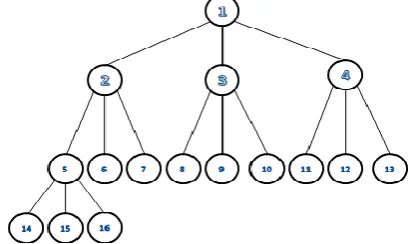
In this subsection, we show that how permissible users collaborate to compute a common session key. In our protocol, the key agreement process is based on complete ternary tree structure. Each node in that tree is representing one user; Figure 1 is an example of 16 users.
Fig. 1. A complete ternary tree 0f a group with 16 users
Assume there are n users in this group, every user ( ) has his/her long-term public/private key users will choose a random number as short-term private key in each new run of the protocol. There are four kinds of nodes in a complete ternary tree: the leaf node, the internal node with one left child only, the internal node with two children (Boy & Girl) and the forth kind is internal node with three children.
Case1. The node is a leaf (3i > n). 1.1. Sets .
1.2. User sends to his (her) parent and his (her) sibling node (brother or sister).
Case2. The node only has one Boy child (3i-1 = n) 2.1. User selects another random number ́
additionally.
2.2. User sends messages ́ to the user
, where , ́ ́ and
́ .
User sends messages to the
user , where and .
2.3. User verifies the following equation
and user verifies the following equation
( ́) .
2.4. If the equations in 2.3 hold, computes
́ and computes ́ .
Note that ́ .
2.5. If , then the session key is , else user
sets and sends to his parent, sibling nodes and sibling’s children in the group.
Case3. The node has two children ( . In this case three users and and simply do the
tripartite one round key agreement.
3.1. User sends messages to the users
and User sends messages
to the user , and and finally
User sends messages to the user
, and where in general and
3.2. In this step in general each User verifies the received messages , from the two other users with the following equation:
.
3.3. If the equation in step 3.2 holds,
Computes:
computes:
computes:
.
It is clear that .
3.4. If , the session key is , else user sets
and sends to his parent, sibling nodes and sibling’s children in the group. Case4. The node has three children.
Previous cases (case1, case2 and case3) that we explained before are somehow like complete binary cases that Sheng et al. proposed in their protocol [10] (in this paper we used different equation for authentication that needs two pairing whereas their authentication needs three pairing).
This case which is the main contribution of the paper and the most important part of the key agreement phase of the complete ternary tree is as follows: 4.1. Each user chooses then computes
and .
Sends the message to the users
, and .
Also sends the message
to the users , and .
Also sends messages to the
Also sends messages to
the user , and .
4.2. Each user verifies the messages received in the previous step.
Generally, the user verifies the received messages by the following equation:
(1)
Notice that each user verifies the three other users simultaneously.
4.3. If the verification relation (1) holds for users and then:
Computes and sends the messages
́ , ́ and
́ to users , and
respectively.
also computes and sends the message
́ to the user .
Generally, and ́ .
4.4. In general, each user verifies the received message ́ by the following equation:
( ́ ) ( ( ) ) (2)
4.5. Finally, if the equation (2) holds, each user computes the secret key as follows:
( )
It is clear that all the computed keys are equal, i.e. .
4.6. If , it means that the users reached to the root of the tree and the session key is , else sets and sends to his parent, sibling nodes and sibling’s children in the group.
Each user performs the above process until reaching the root, thus all users in the group can get a common session key .
3.3.
The member changing phase
It is possible that users may want to join or leave the group during a communication. For the security considerations, the users before joining and after
leaving the group must be unable to get the messages delivered in the group. Therefore we must perform some actions for the users that want to join or leave the group.
3.3.1.The join protocol
Assume that, there are n users in the group before Any member joins the group. The position of the newcomer user will be at th node of the complete ternary tree. (S)he will perform the following steps:
1. User sends the information of the group which contains the number of the users in the group and the public key of all users, to the user (the
newcomer).
2. User choose random number
as his/her short-term private key, then computes and broadcasts and the
signature .
3. According to the following moods the new session key will be generated. Each key kept by the node on the path from th node to root of the tree will be changed.
When the user joins into the group with n user,
there are three possible moods in the original group: Mood1. or .
The last parent has three children after the user
joins into the group. See the figure 2.
Fig.2 There are 15 (n=3k) users in the group originally, the 16th node is the newcomer.
Let ⁄ , is the parent of the newcomer user
. In this case has three children and the
process of computing the session key is like Case4 in the key agreement phase, and in this situation
acts as in Case4. At the end of Case4:
Computes
computes
computes
computes
It is clear that:
If , then the session key is , else sets
and broadcasts to his parent, sibling nodes and sibling’s children in the group. Then he continues the key agreement phase to reach the root.
Fig.3 There are 13 (n=3k+1) users in the group originally, the 14th node is the newcomer.
Mood2. or .
The last parent has one child after the user joins
into the group. See the figure 3.
Let ⁄ , is the parent of the newcomer user and now has just as his child. Like
the Case2 in the key agreement phase,
User selects another random number ́ additionally and computes , ́ ́ and ́ then sends the
message ́ to the user .
User also computes and then sends
the message to the user .
and verify their received messages same
as step 2.3 of Case2. If verification is valid then computes ́ , and
computes ́ . Note that ́ .
If , then session key is , else user set
, and sends to his parent, sibling nodes and sibling’s children in the group and then continues the key agreement phase until reaching the root.
Mood3. or .
It means that the last parent in the ternary tree has two children after that user joins into the group. See
the figure 4.
Fig.4 There are 14 (n=3k-1) users in the group originally, the 15th node is the newcomer
Let ⁄ , is the parent of the newcomer user , in this case has two children and the
process of computing the session key is like Case3 in the key agreement phase, after performing steps 3.1 and 3.2,
Computes
computes
computes
It is clear that . If , then
session key is , else sets and sends
to his parent, sibling nodes and sibling’s children in the group. And then continues the key agreement phase until reaching the root.
Fig.2 when user join the group values and
will change.
As mentioned before for refreshing the session key, each session key kept by the node on the path from th node to first (root) node will be changed. So for all three cases explained in the join protocol, the session keys and consequently will be changed. Figure 5 shows the path of these changes when user joins into the group.
3.3.2.The leave protocol
Suppose that, there are n users in the group
and compute a new session key. According to the position of , there are three moods as follow. Mood1.
In this mood, the leaving user is the last node in the ternary tree. The protocol can delete the last node directly, and generate a new common session key. 1. If , let ⁄ . In this case
after left the group, has two children.
selects a new random number ́ as his short-term private key and performs same as Case3 in the key agreement phase.
computes ́ ́ and ́ ́
́ , then sends the message ́ ́ to users and and finally computes
́ ́
User after verifying the message ́ ́
computes
́ ́
User also after verifying the message
́ ́ computes
́ ́
If , then the session key is , otherwise sets and sends to his parent, sibling nodes and sibling’s children in the group and then continues the key agreement phase until reaching the root. 2. If , let ⁄ . In this case after that
left the group, has one child and same as the Case2 in the key agreement phase selects another random number ́ additionally.
computes , ́ ́ and
́ and sends the message
́ to the user .
User also sends the message
to the user , where and .
and verify their received messages
like step 2.3 of Case2. If verification relations hold, computes ́ ́ ,
and computes
́ ́ , where
́ ́ .
If , then the session key is , else sets
and sends to his parent, sibling nodes and sibling’s children in the group and then continues the key agreement phase until reaching the root.
3. If , let ⁄ . In this case after that left the group, does not have any children so he chooses a new random number ́ as his short-term private key and replaces with
́ then sends ́ ́ and ́ ́ ́ ́. Finally refreshes and then continues the key agreement phase until reaching the root.
Mood2.
In this mood, the position of the leaving user is the root of the ternary tree. So the protocol deletes the root node and replaces the root with the last node then performs as mood 1 in the leave protocol which we explained to generate a new common session key.
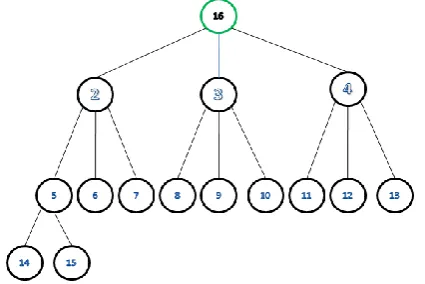
Figure 6 shows an example for a group with 16 users originally and left the group.
Fig. 3. The leaving node is node, replaced root with the last node 16.
Mood3.
In this mood, the protocol replaces with (the last node in the ternary tree), and continues as mood 1 in the leave protocol to generate a new common session key.
4.
Security Analysis
In this section we show the analysis of some security properties of our proposed protocol. These security properties are as following:
(1) Known session key security:
This property states that if one session key has been compromised, the security of the current run of the protocol should not be affected. Assume that there are four users in the group, and the previous session key is
, if the adversary wants to extract certain short-term private key (e.g. ), then (s)he must solve the BDHP in , which is supposed to be hard. Also, the session key depends on random numbers selected by the users in each run of the key agreement phase, so the session key will be different each time.
that only legitimate users can perform the protocol and establish the group session key.
(3) Forward secrecy:
If any long-term private key of the users has been revealed the security of the previous session keys should not be affected. In the proposed protocol, the long-term private key is used only for the authentication, and the protocol does not use the long term private key of the users to compute the common session key. So it is clear that our protocol satisfies the forward secrecy.
(4) key-compromise impersonation resilience: This security property prevents the adversary who obtains a long-term key of a user from being able to impersonate other users. We note that long-term keys are usually private keys which used either for signature generation or decryption; so long-term keys are used primarily for the purpose of authentication rather than the actual computation of the group key. So we do not need to concern for this attack.
(5) Key control: The property of key control says that there is no any legitimate user in the group whom pre-determines or influences the value of the session key. In our protocol, the common session key is determined by the collaboration of all users in the group, so no one can control or pre-determinate the session key.
5.
Performance
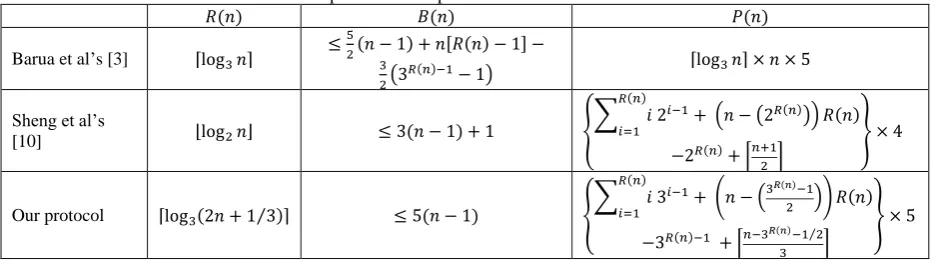
We compare the computations and
communications of our protocol with Sheng et al.’s protocol [10] and Barua et al.’s protocol [7] as Table 1. Both of these protocols use a key tree structure. But in the later each user is represented in the leaf node, also (s)he needs to hold the secret value from leaf node to the root. Barua et al used ternary tree structure but the former uses complete binary tree structure and each node in the tree represent one user. In our proposed protocol we use complete ternary tree structure also and each node in the tree represent one user. In contrast with Barua et al.’s protocol [7] our protocol is based on the identity of the users so we omit the expenses of PKI.
To compute the total number of pairings we sum the total number of pairings which the leaf nodes compute and the total number of pairings that internal nodes compute. To compute the session key, leaf nodes should continue the computation procedure which explained in section 3.2 (according to his case) until reaches the root of the tree. So the user who is in the Leaf node of tree should repeat the computations for times where is the number of protocol's round, and there are ( ( )) leaf nodes in the leaves, but we should note that there may be leaf nodes which are not in the last level ( ) and they may be in the [ ]-th level so they repeat the computations one round less than the leaf
nodes which lie in the -th level. So we should minus the number of them from the
( ( )) , and we can check that there
are ⌈ ⁄⌉ leaf nodes that are not in the last level. For the internal nodes, in each level we have users. Each of them repeat the procedure which explained in section 3.2 for times until get the session key, so the total number from level 0 to level is ∑ . Finally the total number of repetitions of procedure which we explain in section 3.2 is
∑
( ( ))
⌈ ⁄ ⌉
(3)
and for getting the common secret in procedure 3.2 we need 4 pairing for authenticating the messages and one for computing the . So we should multiply the equation (3) by the number 5. We can check that our protocol is more efficient in computation cost comparing with the two other protocols when the number of users is high, but when then number of users is not high their computation cost may be close to our protocol.
For computing the total numbers of messages that users will deliver, each internal node send 9 messages and each leaf node send 4 messages, by multiplying the total number of internal nodes and also the total number of the leaf nodes, by 9 and 4 respectively and adding them together we can find that the is almost . Our protocol is better than Barua et al’s [3] protocol in the communication cost. In the table1:
R(n): total number of rounds that can be performed concurrently.
B(n):total numbers of messages delivering.
P(n): total numbers of pairings.
6.
Conclusion
Table 1. The comparison of computational and communication overhead
Barua et al’s [3] ⌈ ⌉ [ ]
( ) ⌈ ⌉
Sheng et al’s
[10] ⌊ ⌋ {
∑
( (
))
⌈ ⌉
}
Our protocol ⌈ ⁄ ⌉ {
∑
( (
))
⌈ ⁄
⌉
}
Acknowledgment
I would like to thank Iran Telecommunication Research Center (ITRC) for supporting this research.
References
[1] D.A. McGrew and A.T. Sherman. "Key establishment in large dynamic groups using one-way function trees". Manuscript, 1998.
[2] D. Boneh and M. Franklin. "Identity-Based Encryption from the Weil Pairing." In Advances in Cryptology - CRYPTO ’01, LNCS 2139, pages 213-229, Springer-Verlag, 2001.
[3] Diffie W, Hellman M. “New directions in cryptography,” IEEE Transactions on Information
Theory, Vol. 22, 1976, pp. 644-654.
[4] Joux A., “A one-round protocol for tripartite Diffie-Hellman,” Proc. Fourth algorithmic Number Theory Symposium, Lecture Notes in Computer Science, Springer-Verlag, Vol. 1838, 2000, pp. 385-394. [5] K. C. Reddy and D. Nalla, “Identity Based
Authenticated Group Key Agreement Protocol,” in Proceedings of INDOCRYPT’02, vol. LNCS 2551, 2002, pp. 215–233
[6] M.Abdalla, M.Bllare and P.Rogaway. DHIES "An encryption scheme based on the Diffie-Hellman problem," CT-RSA 2001 : 143-158
[7] R. Dutta, R. Barua and P. Sarkar. “Provably Secure Authenticated Tree Based Group Key Agreement,” Proc. of ICICS’04, LNCS 3269, Springer 2004, pp. 92-104.
[8] R. Barua, R. Dutta, P. Sarkar, "Extending Joux's Protocol to Multi Party Key Agreement," 3rd International Cryptology Conference in India -- Indocrypt'2003, LNCS 2904, Springer-Verlag, 2003, pp. 205--217.
[9] Shamir A. “Identity-based cryptosystems and signature schemes,” Advances in Cryptology-Crypto’84, LNCS 196, Springer-Verlag, 1984, pp. 47-53.
[10] Sheng-H, R Hwang, M Lin, "Key Agreement Protocol Based on Weil Pairing," aina, vol. 1, pp.597-602 [11] Y. Kim, A. Perrig, and G. Tsudik. "Simple and fault