International Journal of Emerging Technology and Advanced Engineering
Website: www.ijetae.com (ISSN 2250-2459, ISO 9001:2008 Certified Journal, Volume 9, Issue 10, October 2019)
Fertilizer Recommendation System based on Soil
Macronutrients Analysis using WSN & Cloud Computing
Santosh Priya
1, Tripti Saxena
21,2
Department of Computer Science & Engineering, Lakshmi Narain College of Technology, Bhopal, India
Abstract - Agriculture in India has a significant history .It
is still considered as the lifeline of the Nation’s economy. India is a land of variety of soils. The quality of soil plays a very crucial role in agricultural production by optimizing fertilizer utilization. Combining Cloud computing with other technologies like Wireless sensor networks, and Data Mining provides new applications of cloud services. This paper proposes a fertilizer recommendation system based on soil macronutrient content using Wireless sensor network and Cloud computing.
Keywords – WSN, Cloud Computing, Agriculture, Soil
Macronutrients, Fertilizers
I. INTRODUCTION
Cloud computing is an emerging technology where computer resources (servers, storages, N/w applications) are treated as services rather than products over a network. Cloud computing technology provides on demand access to shared pool of configurable computer resources over a network. Within no time Cloud computing has positively affected almost all areas of applications including industry, academics, business government as well as agriculture. Cloud computing delivers applications as services efficiently [11].
In September 2011, NIST [11] defined cloud computing as a model for enabling ubiquitous, convenient, on demand network access to shared pool of configurable computing resources (e.g. Network, servers, storage, applications and services) that can be rapidly provisioned and released with minimal management effort or service provider interaction. This cloud computing model is composed of five essential characteristics that are on demand self-service, broad network access, resource pooling, rapid elasticity and measured service. This model is formed of three service models that are software as a service (SaaS), platform as a service (PaaS), and infrastructure as a service (IaaS) and further categorized in four deployment models that are private cloud, community cloud, public cloud and hybrid cloud.
Virtualization technology goes hand in hand with Cloud computing. We implemented cloud with the help of virtualization technology. In Cloud computing dynamic virtual machines are created to provide access to actual resources from remote location. Virtual machine is basically a software emulation of a computer that executes the series of instructions or programs just like a physical machine. VM ware workstation is important virtualization software working on both Windows and Linux OS. The virtual machine used in implementation in present case is VM ware workstation on Windows.
A. Cloud simulators
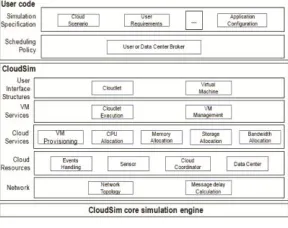
[image:1.612.372.516.535.649.2]Cloud simulators are simulation software which provides simulation and modeling of the actual cloud infrastructures and application services [23]. Cloud simulators are widely used by researchers for evaluation of algorithms and for getting results for a variety of parameters before deploying them on real clouds as accessing real cloud incur costs in real currency. Calheiros [14,15] and Buyya [16] proposed CloudSim which is a simulation software that provides support for modeling and simulation of virtualized Cloud-based data center environments which also includes interfaces to manage VM's memory, storage, bandwidth etc. This tool is invented and developed as CloudBus Project at the University of Melbourne, Australia. The CloudSim architecture is shown:-
International Journal of Emerging Technology and Advanced Engineering
Website: www.ijetae.com (ISSN 2250-2459, ISO 9001:2008 Certified Journal, Volume 9, Issue 10, October 2019)
B. Cloud computing in Agriculture
As per the Census of 2011, nearly 70% of the country‟s population still resides in rural areas and agriculture is the principal source of income in rural India. Research work should focus on how technology can be inculcated in agriculture for ever increasing sustainable production. If agricultural crop productivity increases nation's GDP will rise as agriculture is the main source of income in our country. In short we can say in the welfare of a farmer lies the welfare and prosperity of the whole nation .Rural India has been ignored for more than 60 years. Although Israel is a land of desert but still the crop productivity of the nation is much better than India. Their agricultural tools and techniques are advanced and world famous. The cloud technology can be visualized as a promising tool required bridging the gap between rural India and Urban India, thus improving the Indian rural economy.
Cloud computing in Agriculture helps in the storage and processing of large amount of agriculture information rapidly and at low cost hence increasing the productivity and also provides decision making capability. It has the potential to become great boon to Indian farmers and ultimately to Indian economy.
C. Wireless sensor network
A Wireless sensor network (WSN) comprises of a number of sensors which are spatially distributed and are capable of computing, communicating and sensing. These sensors are deployed to sense environmental conditions like temperature, soil characteristics, pressure and humidity [17]. There are varieties of sensors nodes in a WSN .Some sensors are simple sensors which monitor physical conditions, collect and communicate data while others are more complex and powerful sensors having in sensor computation capability. These powerful sensors can perform analysis, correlation, and aggregation on its own data as well as data received from other neighborhood sensors.
[image:2.612.371.500.132.266.2]Wireless sensor networks are gaining popularity in the field of agriculture .WSN‟s are used to monitor environmental conditions like humidity, temperature, pressure as well as soil characteristics like soil pH, soil nutrient content etc., transmitted over a network and later processed over internet using cloud technology to enable farmers make proper decisions regarding fertilizer application, irrigation etc. At the end the result is increased and sustainable productivity. WSN's are proving to be great boon in the field of agriculture as they provide cost effective, sustainable solutions for smart farming and increased agricultural productivity.
Fig. 2. Wireless sensor network
D. NS2
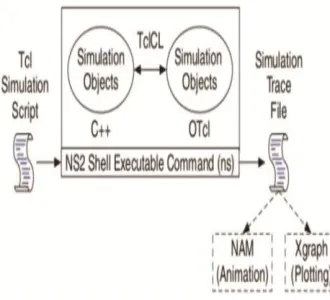
Network Simulator (Version 2), is a wireless sensor network simulation tool. NS2 is an event- driven simulation tool that is helpful in studying the dynamics of wired and wireless communication networks. NS2 is capable of simulation of wired as well as wireless network functions and protocols (routing algorithms, TCP, UDP). NS2 is a very popular simulation tool in network research area because of its modularity and flexibility [18], [20]. ns is an executable command which take on input argument, which is the name of a Tool Command Language (TCL)simulation scripting file. Network Animator (NAM) is a TCL based animation tool for viewing network simulation traces. A simple wireless sensor network consisting of 25 nodes is simulated for sensing, communicating and computing of soil macronutrient content and thereby recommend suitable fertilizers depending upon soil type.
[image:2.612.357.522.510.660.2]International Journal of Emerging Technology and Advanced Engineering
Website: www.ijetae.com (ISSN 2250-2459, ISO 9001:2008 Certified Journal, Volume 9, Issue 10, October 2019)
II. METHODOLOGY
A. Creating a WSN (wireless sensor network) for sensing soil's macronutrients. (N, P, K).
[image:3.612.346.544.314.457.2]NS2 SIMULATORS: A wireless sensor network (WSN) consisting of 25 nodes is being created using simulation tool NS2. These sensors are spatially distributed and are capable of sensing; computing, communicating .NS2 provides users with executable command ns which take on input argument, which is the name of a Tool Command Language (TCL) simulation scripting file. Network Animator (NAM) is a TCL based animation tool for viewing network simulation traces and real world packet traces. The simulation output of a wireless sensor network of 25 nodes can be seen using network animator tool (NAM). It is depicted in fig 4.
Fig. 4. Data collection and data aggregation in WSN.
B. Data collection and data aggregation in WSN.
In a wireless sensor network some sensors are simple which collect information from the environment and communicate them while other sensors are powerful and are capable of processing data collected in its own node as well as the data communicated from other nodes in the neighborhood. Sensor networks have high node density which subsequently results in redundancy as same data is being sensed by several sensors. Data aggregation is an energy efficient technique in WSNs. Data aggregation technique is being used to eliminate redundancy in WSN while routing packets from source nodes to base station.
C. Transferring the packets from source to main server updating the soil sensor status to the network.
Now the data being collected, aggregated from the WSN is now transferred to the main server on the cloud. The soil macronutrients (N,P,K) status being updated to the main network server.
D. Cloud environment is created
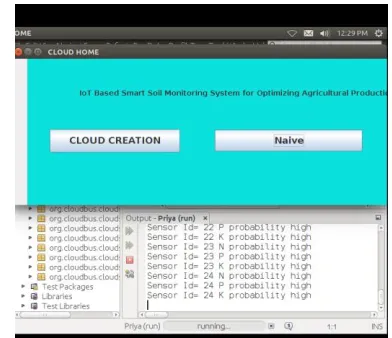
[image:3.612.79.258.316.460.2]Cloud simulators- CloudSim 3.0 simulation tool is being used to create cloud computing environment to perform the experiment. The soil macronutrient status is being updated to the main server. The data sets received by the main server are being processed using CloudSim tool. Cloud simulators play a very important role in the research environment as it greatly reduces the complexity of the cloud infrastructure. Hence experiments can be performed with the help of simulation tool. Cloud computing works with virtualization. VM workstation software is used for virtual machine creation for accessing computers by end users or developers from remote location. Overall performance of the infrastructure can also be measured using cloud simulators.
Fig. 5. Virtual Machine Creation
E. Using the data mining techniques soil sensor status and nutrient level data is being classified and appropriate class of fertilizers is being recommended.
[image:3.612.347.543.512.681.2]
International Journal of Emerging Technology and Advanced Engineering
Website: www.ijetae.com (ISSN 2250-2459, ISO 9001:2008 Certified Journal, Volume 9, Issue 10, October 2019)
Naive Bayes: A Naive Bayes classifier is one of the classifiers in a family of simple probabilistic classification techniques in machine learning. It is based on the Bayes theorem with independence features. Each class labels are estimated through probability of given instance. It needs only small amount of training data to predict class label necessary for classification.
III. IMPLEMENTED ALGORITHM A. Algorithm 1: Naive Bayes Algorithm
1) D: Set of tuples
a) Each tuple is an „n‟ dimensional attribute vector b) X : (x1,x2,x3,……xn)
c) Where xi is the value of attribute Ai 2) Let there are „m‟ Classes : C1,C2,C3,……Cm 3) Bayesian classifier predicts X belongs to Class to
Class efficiency
Above,
P(c|x) is the posterior probability of class (c, target) Given predictor (x, attributes).
P(c) is the prior probability of class.
P (x|c) is the likelihood which is the probability of predictor given class.
P(x) is the prior probability of predictor. P(Ci|X)>P(Cj|X) for 1<=j<=m , j!= i Maximum Posteriori Hypothesis
B. Algorithm 2 : Fertilizer Recommendation
INPUT: soil macronutrients (N, P, K) OUTPUT: Fertilizer recommendation.
1) while 1 do
2) NPK ← Record the values of N,P,K from the sensor (NPK sensor) ⊲ NPK sensor is used to record the NPK values into the database.
3) Bayes Classifier ← Posterior probability (NPK) ⊲ Find the probability of each macronutrients from the database.
4) Predict← predict (Posterior probability (recorded, Ground Truth)) ⊲ Based on posterior probability the necessary group of fertilizers are recommended to the user.
IV. RESULTS AND ANALYSIS
Wireless sensor networks are used to monitor soil macronutrient content. NS2 is being used to simulate the wireless sensor network of 25 nodes. These nodes are NPK sensors. Based on the sensor values stored in the database soil is classified and appropriate fertilizer group is being recommended performance metrics like end to end delay, packet delivery ratio, throughput and energy consumption are being measured .Simulation results are collected in the form of X-graph taking simulation parameter along X-axis and the performance metrics in Y-axis.
Packet Delivery Ratio (PDR) - Packet Delivery Ratio (PDR) is defined as the ratio of number of packets transmitted and number of packets received between a CBR traffic source and CBR traffic sink respectively.
International Journal of Emerging Technology and Advanced Engineering
Website: www.ijetae.com (ISSN 2250-2459, ISO 9001:2008 Certified Journal, Volume 9, Issue 10, October 2019)
Throughput- Throughput is defined as the ratio of the total amount of data receiving between the sender and the receiver to the total time taken by the receiver to receive the last packet .
Energy efficiency - Energy efficiency is defined as a period of time for which network can maintain a specific performance levels. It is also called as the network lifetime. Energy efficiency is calculated not only by the power consumption but it can be measured by the period of time for which network can maintain a certain performance level.
After data is being collected, it is aggregated and sensor status is being sent to the cloud server. Naive based classifier is used to classify the soil type and recommend appropriate fertilizers. Performance metrics are being measured.
V. CONCLUSION
This system proposes an advanced model for farming using the techniques of Cloud Computing, WSN and data
With the help of this system farmers can be informed of required fertilizers in their field. This system will increase crop productivity by suitable fertilizer recommendation and reduces fertilizer wastage.
REFERENCES
[1] Fan Tong Ke,”Smart Agriculture Based on Cloud Computing and IOT”, Journal of Convergence Information Technology (JCIT), Volume 8, Number 2, Jan 2013
[2] Abbas .I, Kapila. R, Kumaran. B, S.Raja3 and Mr.Balaji.G2, Soil Monitoring and Crop Identification Using IOT, International Journal on Recent and Innovation Trends in Computing and Communication , Volume: 6 Issue: 3 87 – 92, IJRITCC | March 2018,
[3] Aditi Rai, Santosh Priya & Sumit Kumar Sar, “IoT Based Smart Soil Monitoring System for Optimizing Agricultural Production”, International Journal of Management, Technology And Engineering, Volume IX, Issue III, MARCH/2019, pp 1133-1137.
[4] Hak-Jin Kim, Kenneth A. Sudduth b, John W. Hummel, “Soil macronutrient sensing for precision agriculture”, Journal of Environment Monitoring, 2009.
[5] Patel, R. & Patel, M. (2013) "Application of Cloud Computing in Agricultural Development of Rural Indiaǁ", International Journal of Computer Science and Information Technologies, Vol. 4, No.6, pp. 922-926.
[6] Hori, M., Kawashima, E. and Yamazaki, T., (2010) "Application of cloud computing to agriculture and prospects in other fields", Fujitsu Science and Technology Journal, Vol.46, No.4, pp.446–454. [7] Narain B. Study for Data Mining techniques in classification of
agricultural land soils. Journal of Advanced Research in Computer Engineering. 2011 Jan-Jun; 5(1):35–7.
[8] Zhao Liqiang, Yin Shouyi, Liu Leibo, Zhang Zhen, Wei Shaojun, ʊ A crop Monitoring System Based on Wireless Sensor Networkۅ ELSEVIER, Procedia Environmental Sciences-2011.
[9] YingliZhua*, JingjiangSonga , Fuzhou Donga, ʊ Applications of Wireless sensor network in the agriculture environment monitoringۅELSEVIER,Procedia Engineering Sciences-2011. [10] WaltenegusDargie and Christian Poellabauer,”, Fundamentals Of
Wireless Sensor Networks”, John Wiley & Sons, Ltd, pp.25-30, 2010.
[11] Mell and T. Grance, “The NIST Definition of Cloud Computing,” Recommendations of the National Institute of Standards and Technology, vol. 800-145, pp. 1–7, 2011.
[12] Colheiro R. N., (May 2011). “CloudReport: A CloudSim-based Tool for Modelling and Analysis of Large Scale Cloud Computing Environments”, MEDC Project by RajkumarBuyya Project Supervisor Report.
[13] Colheiro R. N., (May 2011). “CloudReport: A CloudSim-based Tool for Modelling and Analysis of Large Scale Cloud Computing Environments”, MEDC Project by RajkumarBuyya Project Supervisor Report.
[14] Calheiros, R.N., Ranjan, R., Beloglazov, A., De Rose, C.A.F., Buyya, R.: CloudSim: a toolkit for modeling and simulation of cloud computing environments and evaluation of resource provisioning algorithms. Software: Practice and Experience 41, 23{50 (Jan 2011), ISSN: 0038-0644, Wiley Press, New York, USA.
International Journal of Emerging Technology and Advanced Engineering
Website: www.ijetae.com (ISSN 2250-2459, ISO 9001:2008 Certified Journal, Volume 9, Issue 10, October 2019)
[16] Buyya, R., R. Ranjan, and R.N. Calheiros,(2009) " Modeling and Simulation of Scalable Cloud ComputingEnvironments and the CloudSim Toolkit: Challenges and Opportunities. Proceedings of the 7th High PerformanceComputing and Simulation Conference (HPCS 2009, ISBN: 978-1-4244-4907-1, IEEE Press, New York, USA), Leipzig, Germany, June 21-24.
[17] Waltenegus Dargie and Christian Poellabauer,” Fundamentals Of Wireless Sensor Networks”, John Wiley & Sons, Ltd, pp.25-30, 2010
[18] Teerawat Issariyakul, Ekram Hossain,” Introduction to Network Simulator 2”, Springer US,2008, pp 1-18
[19] https://en.wikipedia.org/wiki/Agriculture_in_India [20]
*Introduction-to-network-simulator2”ns2blogger.blogspot.in/”,2014/04. [21] https://en.wikipedia.org/wiki/Precision _agriculture. [22] http://farmer.gov.in
[23] http://www.cloudbus.org/cloudsim [24] http://cloudsim-setup.blogspot.in [25] http://greencloud.gforge.uni.lu/