
© 2016, IRJET | Impact Factor value: 4.45 | ISO 9001:2008 Certified Journal | Page 6
SEARCHING RULE SET FOR THE FUZZY CONTROLLER BASING ON PI
CONTROLLER WITH APPROACHING HEDGE ALGEBRAS AND GENETIC
ALGORITHM
Nguyen Tien Duy
1, Nguyen Tuan Anh
21
Thai Nguyen University of Technology, Thai Nguyen University
2
University of Information and Communication Technology, Thai Nguyen University
---***---Abstract –
In the past few years, the fuzzy controller together with its advantages has been widely applied in the automatic control systems. The effectiveness of the fuzzy controller mainly depends on the rule set. Therefore, it is particularly important to gain a proper and optimal rule set. Generally, the rule set is gathered from many different sources of knowledge and mostly depends on expert experience. In this paper, we present a study of searching linguistic rule set with the approaching of hedge algebra that is combined with genetic algorithms. A fuzzy controller using hedge algebra approach based on rule set found will be designed and optimized parameters in order to replace the classic PI controller. The input of the search algorithm is the working dataset of PI controller for DC-motor, the output is the qualitatively linguistic law set. It can be seen in the simulation, the controller based on hedge algebra with the optimal parameters proved its superiority in the comparision to PI controller in some criteria such as response time, time set, and overshoot.Key Words: Hedge Algebras Controller, Data mining,
Knowledge-based systems, Genetic Algorithm.
1. INTRODUCTION
As we know that in the automatic control system, it is control quality of the system that depends on the controller. Classic PID controller has advantages and is widely used in industry because of its simplicity. Different methods in calculating the coefficients KP, KI, KD for the controller can be used. However, there is a lack of flexibility of the PID controller because the coefficients KP, KI, KD are unchangeable during the system work process. This is a drawback of the PID controller, especially for nonlinear systems. To remedy this, in many scientific projects proposed alternatives such as using fuzzy system to adjust the coefficients KP, KI, KD [1]; use the smart
controller through fuzzy logic [2], neural networks [3] or access of hedge algebra (HA – Hedge Algebras) [4] – [8]. The fuzzy controller has been studied and widely applied in many automatic control systems and often brings a better control quality than classic PID controller due to its adaptation to the system. Fuzzy controller is capable of handling uncertain and unclear signals. Besides, we can design a fuzzy controller without knowing the mathematical model of the object [4] – [8].
HA theory was developed and is considered as a tool to calculate the value of the variable semantic language [9] - [11]. According to BP, we can model the system language laws (LRBS - Linguistic Rule Base System) based on the semantics of the language value. Using quantitative semantic content (SQMs - quantifying Semantically Mapping) to quantify the value of the semantic value of language and ensure the order based on their semantics, each fuzzy rules will be moved to a point in "super face" real. It can be considered "hypersurface" as appropriate mathematical models of control knowledge for LRBS original performances. Then, this approximation methodology in control is passed to an interpolation method on a "hypersurface" real.
An important issue in designing a fuzzy controller that is using the control law set. Control law sets are usually built based on intellectual and professional knowledge and experience of the operater and the designer of the controller. A law set has been built; however, its correctness, completeness, consistency and accuracy is not high. Therefore, using this law set lead to the control quality which is not good. The method of evaluation and assessment of knowledge in this case should be used to get a better rule set. However, It can't be denied that the evaluation and assessment of knowledge is a large and complex problem [12] – [15].
© 2016, IRJET | Impact Factor value: 4.45 | ISO 9001:2008 Certified Journal | Page 7 the controller. In principle, this rule set is to ensure the
correctness, completeness, accuracy and consistency of the set. The fuzzy controller works with this law can give us the quality control that is not higher than it for PI controller, but it has its advantages as outlined above. Next, we conducted to optimize fuzzy parameters of HA by GA to achieve a better control quality.
Through the evaluation of control quality, it can be shown that the rule set was received by exploring rule set based on a data set of system work and it is an useful law set, ensure the correctness, completeness, consistency and correct for the controller to access HA.
2. CONTROLLER BASED ON HEDGE ALGEBRA
2.1 Hedge Algebras
Suppose that there is a set of linguistic values of any
linguistic variable that includes
These linguistic values appear in the language rules (LRB - Linguistic Rule Base) of approximately reasoning problems based on knowledge. So it is necessary to have a strict computing architecture which preserves order relation of the inherent linguistic value. Since then the semantic relationship of the linguistic value in the rules can be calculated.
HA [9], [10] is a mathematical structure which has the order of collection of linguistic items, the order relationship is defined by the semantics of the linguistic items from this collection. The quantification of semantics value of linguistic items through Semantically Quantifying Mappings - SQMs allows performing a full description and showing rule set model and approximate inference process of inference in a logical and coherent way. In this section, we present briefly some basics about HA and its application in control [4] – [8].
Define 1 [9]: Hedge Algebra of the linguistic variable can be represented as an algebraic structure which,the set of 5 components , X is a set of items in X; ≤ denotes the naturally semantic order relationships of the items in X; , , called the generating elements; C = {0, W, 1} is the set of constants, with the range , to indicate the elements that has the smallest, largest and neutral elements.The set of
hedges , with is the
set of positive hedges , is the positive hedges.
It can be seen that the set consists of linguistic items which has the order of the linguistic variable is generated by the impact of hedges on the generating
elements , as and the elements in .
. The components in has some following properties:
- : or .
- If then is the permanent element. We
have .
- then , ; then
, .
- , if (or ).
- , if (or ).
- , , is positive for if (or ), is negative for if (or ).
From the above characteristics, we can define a function as follows:
Define 2 [9]: : . With , ,
1) and
2) and
3) if or
if and
if or
if . or
.
4) if is positive for
( ) and if is
negative for ( ).
5) if .
Fuzzy measurement of a concept is measured equal to the radius of the set , denoted as and can be calculated recursively from the fuzzy measurement of the generating elements , and the fuzzy measurement of the hedges , , called the fuzzy parameters of . which is defined recursively as follows:
Define 3 [9]: , where:
1) , , (1)
2) with , ,
3) , (2)
this ratio does not depend on and it characterizes the fuzzy measurement of the hedge , denoted as .
With , , , . We have the
characteristics of and as follows:
1) 3(
)
2) 4(
)
3) 5(
© 2016, IRJET | Impact Factor value: 4.45 | ISO 9001:2008 Certified Journal | Page 8 4)
( 6 )
5) và , with and (
7 )
With advance , and ,
specifically, semantically quantifying value is recursively determined by the semantically quantifying mapping function as follows:
Define 4 [9]:
1) 8(
)
2) 9(
)
3)
( 1 0 )
4)
( 1 1 ) Where:
,
2.1 Application of Hedge Algebras in control
Considering the fuzzy model given as LRBS:
R1: If then
R2: If then
…
Rn: If then
(12)
With are linguistic variables, each one belongs to background space and linguistic variable belongs to the background space ; , ( ) are the values of corresponding background space. With every rule "If ... then" we can determine one "fuzzy point" in the space . There, (12) can be seen as a "hypersurface" in this space. According to the theoretical approach HA, HA structure is built for linguistic variables using SQMs function to convert each above fuzzy point into one real point in semantic space . Meanwhile, (12) are respectively represented as a real “hypersurface” . The "hypersurface" can be seen as a mathematical representation of LRBS which each fuzzy concept (linguistic value) of the fuzzy valuables (linguistic variables) are quantified as its semantic value (QRBS – Quantified Rule Base System). Then, (12) respectively are represented as a "super side" really S_real ^ (m + 1). Can
see "super face" real S_real ^ (m + 1) as a mathematical representation of each concept LRBS fuzzy (linguistic values) of fuzzy variables (linguistic variables) were quantified value their semantics (QRBS - Quantified Rule Base System).
Considering the inputs which belong to corresponding background space are the input values of the controller ,, using normalization for those values to the domain of values of HA we have , respectively. After carrying out the problem of approximation inference by interpolation method on , we received the interpolation value in the range as semantically quantifying value of output linguistic variable which is converted to real variable domain (background space of variable )) of the control value at the output by the denormalization.
Model of the controller based on HA approaching is described as in Fig -1.
Fig -1: The diagram of the controller based on HA approaching
- LRBS: Linguistic rule based system of the controller. - QRBS: Quantifying rule based system of linguistic values
which is computed by mapping function SQM ( ). - Normalization: standardize values of the variables in
the semantic domain.
- IRMd (Interpolation Reasoning Method): Interpolation on the “hypersurface” .
- Denormalization: convert semantic control value to the domain of variable real value of the output variable.
Steps of designing the controller based on hedge algebra as follows:
Step 1: Design , ( ) and for the variables
and .
Step 2: Determine the control rule set with linguistic items in HA.
Step 3: Compute the semantically quantifying value for the linguistic labels in the rule set. Build the "hypersurface"
.
Step 4: Select interpolation method on the "hypersurface" for approximation inference.
3. PI CONTROLLER FOR DC-MOTOR
QRBS ( )
LRBS
IRMd
© 2016, IRJET | Impact Factor value: 4.45 | ISO 9001:2008 Certified Journal | Page 9 In this paper, we study a typical control system that is
DC-motor, described in Fig -2. The speed controllers and current selected are PI-controllers.
Fig -2: Diagram for control system DC-motor
State equation of the given system:
(13)
Where: và ; are
the parameters of the system (see
Appendix A
).The objective of this study aims at finding a good LRBS enough to build fuzzy controller based on accessing HA (HA-speed controller) with the input components are e (error) và ce (change error) to replace for PI-speed controller. In order to do this, first we simulate the system on Matlab / Simulink. Simultaneously, we observe the model of input data , and outputs of the PI-speed controller u_PI when changing on a wide range and save the data model into a data base to be used for search algorithms of rule set. Some simulation data samples are obtained as in Table -1.
Table -1: The database obtained No
1 0.9424 120.8860 10.6888
2 0.9579 136.4032 11.0060
3 0.9733 136.2810 11.3400
4 0.9883 135.9072 11.6854
5 1.0026 135.2069 12.0351
… … … …
The variability of the simulation data sample are corresponding inputs , and outputs are shown in Fig -3.
Fig -3: Input and output of PI-speed controller
4. FIND THE RULE BASE FOR HA-SPEED
CONTROLLER WITH GA
4.1 Design the HA-speed controller
HA-speed controller replacing PI-speed controller of a closed-loop control system (see Fig -2) is designed with two inputs and one output. The inputs include the information of control error e and the variable speed of the control error. Output is the quantity that controls u.
The input linguistic variables, denoted as , (corresponding to the real variable , ) include 5 linguistic value. Output linguistic variable is (corresponding to the real variable ) contains 7 linguistic values. The linguistic values are orderly arranged by their semantics as follows:
, : : Note:
Step 1: Design HA for the variables , and - HA structure:
Set of generating elements:
Set of the hedges: and
- The fuzzy parameters of hedge algebras corresponding to variables includes the fuzzy measurement of the generating elements and its of the hedge measure. According to hedge algebras' structure for the variable built as above variables, we need to choose the fuzzy measurement of the negative generating elements
( ) and the
fuzzy measurement of the negative hedges
( ). Fuzzy parameters for variables are initial selected as the experience in Table -2.
Table -2: Fuzzy parameters
0.5 0.5 0.5
0.5 0.5 0.5
- The sign of the generating element, hedge and signal relation between the hedges are determined basing on semantic nature of the linguistic items. For example, we have , . Besides, it can be seen
that .
. Considering the other linguistic items as the same way and according to Define 2, we can determine the signal relation as in Table -3.
Table -3: Signal relation PI current
Controller Power converter
DC-motor PI speed
© 2016, IRJET | Impact Factor value: 4.45 | ISO 9001:2008 Certified Journal | Page 10 Step 2: Determine the law:
It is control rule set that is the main component we need to search. Based on the sample of working data set of PI-speed controller, optimal search algorithm based on GA will give us the rule set that from the sample of input values, the inference set will calculate the output value with the smallest "error". Details of the algorithm will be shown in the next section.
Step 3: Compute semantically quantifying values of linguistic items.
With the fuzzy parameters selected as in Table -2 and signal relationship between hedges to one another, between hedges and generating elements in Table -3, apply (8) – (11)we have the semantically quantifying value of linguistic items in the linguistic variables , và as follows:
Step 4: Interpolation method selected is linear interpolation.
With the HA-speed controller designed as above, the next step we need to do is to implement algorithm that searches for the right rule set based on GA for controllers to work effectively.
4.2 Find the Rule Base with GA
In the proposed scope of this study, we first need to find a basis rule set according to semantically quantifying value (QRBS , ) that is optimal for the control system. Basing on the finding of set QRBS, corresponding to every semantic value, we can identify its linguistic value and build LRBS for the controller.
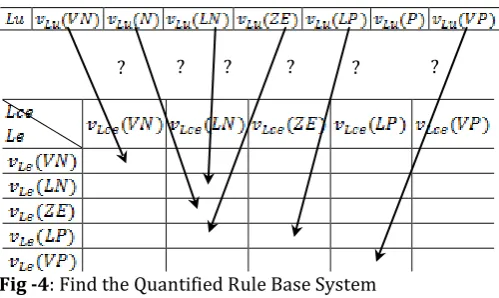
[image:5.595.309.559.178.327.2]The linguistic values of the input and output linguistic variables was quantified with semantic value. The construction of a QRBS is the way to choose semantically quantifying value for the cells in the table law from the semantically quantifying value of the output variable .
Fig -4: Find the Quantified Rule Base System
According to the design with the number of five linguistic values of each input variable and 7 linguistic values of the output variable, our linguistic rule set LR will contain rules. Presenting QRBS as a 25-cell table respectively (see Fig -4). Semantically quantifying value for each cell will include 7 different choices from the set of semantically quantifying value of . The total of options will be . This is a too large search space. Therefore, if we apply the normally exhaustive search algorithm, it is not politically feasible option. (it is difficult to meet the requirements in terms of time). There is an efficient choice that is using optimization algorithms and inheriting the additional information in the searching process. It's the intelligent optimization algorithms modeled after the biological mechanisms such as GA, swarm optimization algorithm (PSO - Particle Swarm Optimization),... In this study, we use GA - one of optimal algorithms which has often been used by the scientists recently.
GA is the optimal search method based on the mechanism of natural selection. It simulates the evolution process including genetics and evolution [17], [18]. Each solution is an individual that is selected so that it can be adaptable for the process of natural selection (in the sense of being the best). The adaptation of each individual is measured through its gene sequence structure. The crossover and mutate method of evolution process are done randomly to exchange information about the gene sequence structure. The adaptation of the individuals in the next generation inherits the information in the past of the previous generation to orient new search point. Through long-term evolution process, the next generation will have a gene sequence structure that is asymptotic to the answer to the problem. Thus, the objective of the GA is just to propose the relatively optimal option, but not exactly optimal one.
© 2016, IRJET | Impact Factor value: 4.45 | ISO 9001:2008 Certified Journal | Page 11 Encoding gene (performing options): In Fig -4, It can be
found that QRBS corresponds to a "reticulated" Each point on "reticulated" is defined by (from) a linguistic rule which their coordinate components are computed based on SQMs. Thus, for each semantic rule which has the identified inputs (including and ) we need to find a component of the output. An answer to the problem is QRBS in which the cells in the table are all selected. Presenting QRBS as a tabular (matrix), including 25 cells and 7-element array Lu. Thus, with each QRBS [i, j] it is necessary to choose an
index to gain .
According to the GA implementation proposal by Holland [17], we have chosen binary encoding to the solution (plan) to be searched. is encoded by a chromosome as a binary string of 25 gene segments, each gene segment has the length of 3-bits encoded for index l that is needed to find (see Fig -5
).
The total length of the chromosomes will be . The gene fragment with number will determine the index.
Fig -5: gen structure
(fitness() function) is determined by the minimum squared deviation between the output of the inference (control) corresponding to each rule set compared with the output data sample of the data base. Computable formula is defined as follows:
(14)
Where:
is the output of k in order of approximate inference
is the output component of 𝑘 in order of data set sample.
is the total of data samples of model data set.
GA's operations corresponding to the basic evolutionary processes of nature are Selection, Crossover and Mutate.
Selection: This operation chooses the good parents individual in the populations with the sense of a high level of adaptation (fitness) in order to participate in the process of breeding the next generation. In this study, we used the selection method of roulette wheel. Crossover: This operation implements to generate new
individual, inherited the properties from individual parents. In view of the search, this operation creates options in the vicinity of the solutions corresponding to the individual parents.
Mutate: This operation also simulate based on mutation phenomena in the nature. It can create
individuals which have characteristics different from their parents. In view of the search, this operation generated plans outside the local partial area and turn towards the extremum that has adapted value better than those in the search space.
The implementation of the searching algorithm according to GA can be described as follows:
find_QRBS(data_set){
input: the working data set of PI-speed controller output: Quantified Rule Base System
method:
Step 1: <initialize population>; Step 2: while (repeat condition){
<evaluate fitness>; // calculate fitness() <selection>; // selection
<crossover>; // crossover <mutate>; // mutate }
Step 3: output result }
5. OPTIMIZING FUZZY PARAMETERS HA-SPEED
CONTROLLER
The fuzzy controller according to HA approach is built in the model of MISO (Multi Input - Single Output) with 2 input linguistic variables which are , and an output linguistic variable that is .. The HAs for 3 above linguistic variables are selected with the structures in which they include 2 generating elements and 2 hedges as follows:
The set of generating elements: The set of hedges: and
Depending on the deviation degree of the component compared to the value Zero and its deviation variation , the controller can compute the suitable output value . Therefore, it is necessary to choose semantically quantifying value of the element Zero Because there is only one negative element in the structure of the and a positive hedge , we just need to optimize fuzzy
parameter ( ). Thus, three
parameters of HAs for the input/ output linguistic variables should be optimized.
The objective function optimizing fuzzy parameters is minimizing control deviation component of the control deviation . Computable formula is defined as follows:
(15)
Where:
is the deviation data sample during the simulative circle in order.
is the value of the reference speed at the input.
110 101 … 011 … 100
© 2016, IRJET | Impact Factor value: 4.45 | ISO 9001:2008 Certified Journal | Page 12 is the value of the speed response to DC-motor.
is the total of data samples of a simulation
6. RESULT
Performing find_QRBS() with the parameter settings including: generation number = 2,000; popsize = 200; Crossover probability Pc = 0.75%; Mutate probability Pm = 0.01%; we get the results shown in Table -4 and objective function (14) that reaches the value:
Table -4: Result of QRBS
0.125 0.375 0.500 0.75 0.875 0.125 0.125 0.125 0.875 0.375 0.125 0.375 0.125 0.125 0.125 0.125 0.500 0.500 0.875 0.125 0.500 0.750 0.875 0.750 0.500 0.375 0.875 0.875 0.875 0.875 0.125 0.125 0.750 0.875 0.875
According to the QRBS received as shown in Table -4and semantically quantifying value of the cells in the table, we can infer the corresponding linguistic rule set as shown in the below Table -5.
Table -5: Results of QRBS
VN LN ZE LP VP
VN VN VN VP LN VN
LN VN VN VN VN ZE
ZE VP VN ZE P VP
LP ZE LN VP VP VP
VP VN VN P VP VP
The rules in Table -5 can be defined as belows: R1: if Le=VN and Lce=VN then Lu=VN
R2: if Le=VN and Lce=LN then Lu=VN …
Having implemented the program of optimizing fuzzy parameters based on GA with the settings: generation number = 1,000; popsize = 100; Crossover probability Pc = 0.75%; Mutate probability Pm = 0.01%, we get the result that is presented in Table -6.
Table -6: Optimal fuzzy parameters
0.3673 0.6429 0.4631
With set of optimal fuzzy parameters received in Table -6, computing semantically quantifying value for the linguistic items of linguistic variables , and according to (8) - (11), we obtain op_QRBS as shown in Table -7.
Table -7: Result of op_QRBS
0.0638 0.3852 0.5000 0.6148 0.9362
0.2002 0.1442 0.1442 0.8558 0.3757 0.1442 0.3838 0.1442 0.1442 0.1442 0.1442 0.5000 0.5000 0.8558 0.1442 0.5000 0.7315 0.8558 0.6162 0.5000 0.3757 0.8558 0.8558 0.8558 0.7998 0.1442 0.1442 0.7315 0.8558 0.8558
Relationship surface I / O corresponding to the op_QRBS Table -7 is the same with it in Fig -6.
Fig -6: surface
When we carry out simulating the control system DC-motor in Matlab / Simulink environment with the variable reference value over the time which is set as in Table -8. The load torque is increased in the 6th second.
Table -8: Simuliation reference(s)
Time [s] 0 – 0.1 0.1 - 12 12 - 18
[rad/s] 0 20 100
The simulation results are displayed by the responding diagram of speed DC-motor from Fig -7 to Fig -9. Some other numerical results are summarized in Table -9.
© 2016, IRJET | Impact Factor value: 4.45 | ISO 9001:2008 Certified Journal | Page 13 Fig -8: a) Responding at 20 ; b) Increasing load
torque at 6th second.
Fig -9: Responding at 100
Table -9: Results
PI-speed
controller controller HA-speed
9.2052 3.3891
Overshoot
( ) 20.94 (4.7 %) 20.5 (2.5 %)
Overshoot
( ) 100.9 (0.9 %) 100.3 (0.3 %)
Undershoot
(load) 19.42 (2.9 %) 19.83 (0.85 %)
7. DISCUSSIONS
After finding QRBS (see Table -4) and the optimal fuzzy parameters (see Table -6), it can be seen that response of our speed to HA-speed controller is quite good compared with PI-speed controller according to simulation systems. Overall observation in Fig -7is that response of our speed of DC-motor to the controllers all follow reference values. In Fig -8, Fig -9and values measured in Table -9
,
we found that the overshoot for HA-speed controller (blue line) is lower than that of the PI-speed controller overshoot (green line).Similarly, if we increase the load at the 6th second, the level of undershoot for HA-speed controller is also much lower than that of PI-speed controller. N static bias for both controllers. The total control deviation in the entire simulation time for HA-speed controller is also much smaller than the PI-speed controller. However, there is a drawback that is the speed response to HA-speed controller with small oscillations around the reference value. The speed oscillation of the DC-motor can affect the quality of transmission and reliability of mechanical structure of the system. It it possible to explain the existence of oscillations is due to HA-speed controller's output has the high value as the input values have small variations. To remedy this problem, we can manually adjust rule set and fuzzy parameters with small input variation, then the output of the controller is smaller than that before. This adjustment can make a negative impact on the indicators to assess the control quality.
According to HA approach, it can be seen from QRBS (see Table -4) on the semantic domain that a LRBS can be respectively interpreted (see Table -5
).
Observing this LRBS in a qualitative way, we see that most of these laws are appropriate to the control rules except from 3 rules: “if Le=VN and Lce=ZE then Lu=VP”, “if Le=VN and Lce=LP then Lu=LN” v{ “if Le=VN and Lce=VP then Lu=VN”. Along the first input value Le = VN, the second one Lce of the above rules tend to rise but the output Lu is decreased. As taking these results into consideration, we believe that there are two reasons. The first reason is the data set used for find_QRBS () has a few values relating to the above rules, so it is unlikely to affect the objective function.The controller designed through HA has shown the correctness and reasonable representation method for mathematical model LRBS. Under this approach, the orderly relationship of the linguistic values is always guaranteed based on their semantics. Basing on SQMs function, LRBS is transferred to QRBS that is a real "hypersurface" and describles input/ output relationships between variables sufficiently and properly. Therefore, the process of approximate reasoning is close and logical. Methods of approximate reasoning used are interpolated. When an interpolation method is chosen, the result of approximate reasoning just depends on the fuzzy parameters in HA which includes fuzzy measurement of generating elements and hedges. The number of these parameters is just small, so it is easy to improve the quality of controller by applying optimization algorithms. In addition, the design is simple, intuitive, reasonings using interpolation give a good result with a very high speed because the computational complexity is small.
In addition to the above results, we find that there are some problems that need to be studied more to get proper and accurate LRBS. If that, proposed method will become stricter, they are:
- It is essential to do experiment with many different datasets or more efficient data sets as long as every input/ output value on their variable domain appears. - Carry out GA with generation number and larger
popsize.
- Test optimal algorithm PSO in the hope of reducing time of carrying out program.
- Executing QRBS and the set of fuzzy parameters of HAs simultaneously.
- Experimenting on physical system to properly evaluate the received results. Then it enable us to apply the results in systems in practice.
8. CONCLUSIONS
PI-© 2016, IRJET | Impact Factor value: 4.45 | ISO 9001:2008 Certified Journal | Page 14 speed controller with the finding of LRBS. The parameters
of the controller have been also optimized by GA.
Through simulation and evaluation of quality control, it can be seen that the LRBS received is a useful rule set. HA-speed controller bring a good control quality enough to compare to PI-speed controller.
The obtained results show that, using the GA to search LRBS for fuzzy controller is a correct proposal. With this proposal, we are entirely possible to find a LRBS that matches with specific system but not relies on expert knowledge or experience of the system designer.
Appendix A
In the control model in Fig -2, DC-motor has a capacity of 1.1 kW, with the following parameters:
; ; ; ;
; ; . Và:
; ; ; ; ;
; ; ; ;
; ; .
REFERENCES
[1] Quoc Khanh Bui, Quang Vinh Doan, Huu Phuoc Nguyen, “PI Fuzzy Controller for T-D dynamic system with varied parameter J", Journal of Science and Technology, vol. 23, Da Nang University, Da Nang, 2007.
[2] Zadeh L. A., “Fuzzy sets”, Inform. and Control, vol. 8, pp. 338-353, 1965.
[3] M. Ren, J. M. F. Wang, Y. Ren, “Application of Fuzzy Neural Network PID Controller in Sewage Treatment”, Journal of Jilin University (Information Science Edition), vol. 29, no. 6, pp. 595-599, 2011. [4] N.C.Ho, V.N.Lan and L.X.Viet, “Quantifying Hedge
Algebra, Interpolative reasoning method and its application to some problems of fuzy control”, Wseas Transactons on Computer, vol. 5, no. 11, pp. 2519-2529, 2006.
[5] Nguyen Cat Ho, Vu Nhu Lan, Le Xuan Viet, “Optimal hedge-algelbras-based controller: Design and application”, Fuzzy Sets and Systems, vol. 159, 968-989, 2008.
[6] C.H. Nguyen, D.A. Nguyen, N.L. Vu, “Fuzzy Controllers Using Hedge Algebra Based Semantics of Vague Linguistic Terms”, in: D. Vukadinović (Ed.), Fuzzy Control Systems, Nova Science Publishers, Hauppauge, pp. 135-192, 2013.
[7] Cat Ho Nguyen, Nhu Lan Vu, Tien Duy Nguyen, Thiem Pham Van, “Study the ability of replacing fuzzy and PI controllers with the Hedge - Algebras - Based controller for DC motor”, Journal of science and technology, vol. 52, no.1, 35-48, 2014.
[8] Dinko Vukadinović, Mateo Bašić, Cat Ho Nguyen, Nhu Lan Vu, Tien Duy Nguyen, “Hedge-Algebra-Based Voltage Controller for a Self-Excited Induction Generator”, Control Engineering Practice, vol. 30, pp. 78-90, 2014.
[9] Ho N.C., Wechler W., “Hedge algebra: An algebraic approach to structures of sets of linguistic truth values”, Fuzzy Sets and Systems, vol. 35, pp. 281-293, 1990.
[10]Ho N.C., Wechler W., “Extended hedge algebras and their application to fuzzy logic”, Fuzzy set and system, vol. 52, pp. 259-281, 1992.
[11]Zheng Pei, Da Ruan, Jun Liu, Yang Xu, “Chapter 3: Hedge Algebras of Linguistic Values”, Linguistic Values Based Intelligent Information Processing:
Theory, Methods, and Application, Atlantis
Computational Intelligent Systems, vol. 1, ISSN: 1875-7650, 2009.
[12]Adrian A.Hopgood. Knowledge-based systems for Engineers and Scientists. The Open University – CRC Press. Boca-Raton Ann-Arbor London Tokyo 1998. [13]Jiawei Han, Micheline Kamber, Datamining Concepts
and Techniques, Morgan Kaufmann Publishers, 2nd
edition, 2006.
[14]Gang Feng, “A Survey on Analysis and Design of Model-Based Fuzzy Control Systems”, IEEE Transactions on Fuzzy Systems, vol. 14, no. 5, October 2006.
[15]DL Olson, Yanhong Li, "Mining Fuzzy Weighted Association Rules," Proceedings of the 40th Hawaii International Conference on System Sciences, 2007. [16]Van Thong Hoang, Cat Ho Nguyen, Duc Du Nguyen “A
multi-objective evolutionary method generates Mamdani fuzzy rule-based systems with linguistic terms of qualitative semantics for regression problems”, The researches, development and application of information technology, vol. 1, no.12, 2014.
[17]Holland, “Genetic Algorithms in Search”, Optimization and Machine Learning, Addison-Wesley Longman Publishing Co., Inc., Boston, MA, USA, 1975.
[18]Goldberg D.E., Genetic Algorithms in Search, Optimization, and Machine Learning, Addison-Wesley, 1989.
BIOGRAPHIES
© 2016, IRJET | Impact Factor value: 4.45 | ISO 9001:2008 Certified Journal | Page 15 Vietnam, 2001. Undergraduate:
Electrical Engineering, Thainguyen University of Technology, Vietnam, 1998. He is working at Faculty of Electronics Engineering, Thainguyen University of Technology, Thainguyen, Vietnam. Research interests: Engineering controls, Fuzzy logics, Fuzzy control and Computing.
![1953 1958 Yearbook of Foreign Trade Statistics by Countries of Origin and Destination [General coverage but contains ACP statistics]](data:image/gif;base64,R0lGODlhAQABAIAAAP///wAAACH5BAEAAAAALAAAAAABAAEAAAICRAEAOw==)