© 2016, IRJET | Impact Factor value: 4.45 | ISO 9001:2008 Certified Journal
| Page 2100
Design of Power Aware AODV Routing Protocol
Payel Ray
1, Ranjan Kumar Mondal
2, Debabrata Sarddar
31
Department
of Computer Science & Engineering,
University of Kalyani, WB, India
2
Department of Computer Science & Engineering,
University of Kalyani, Kalyani, India
3
Assistant Professor, Department of Computer Science & Engineering,
University of Kalyani, Kalyani, India
---***---Abstract –A mobile adhoc network is a group of wireless
mobile nodes that communicate with one another without any fine-tuned networking infrastructure. Since the nodes in this network are mobile, the puissance management and energy conservation become very critical in mobile adhoc network. The nodes in this network have constrained battery power and circumscribed computational power with a modicum of recollection. Such nodes must conserve energy during routing to perpetuate their usefulness and increment network lifetime. Power management is one of the most paramount issues in manet (Mobile Ad-Hoc Network). Computation & routing in manet is vigorously co-cognate with Power resources which in this particular case only Battery. Resent trend is to minimize the puissance consumption and maximizing the computation without hampering the quality of accommodation of a manet. There are many subsisting energy conservation protocol predicated on electing a routing backbone for ecumenical connectivity are oblivious to durability of the network. Then it will be more energy efficient if we could utilize the battery resource of a node that has more power than its neighbour nodes for routing and computation. So here we focus to distribute the work load and the routing load of a node has lower energy to other nodes which have comparatively higher energy. By this way it will endeavor to obviate the node; having low battery; go down as much as possible. Hence this will increment the network durability. Moreover if an energy consumption strategy for particular computation job could be engendered to distribute the work load with considering the routing energy then it will be more efficient.
Key Words:Adhoc network, Mobile Ad Hoc Network, AODV
routing protocol.
Introduction
As the paramountcy of computers in our quotidian life increases it withal sets incipient demands for connectivity. Wired solutions have been around for a long time but there is incrementing demand on working wireless solutions for connecting to the Internet, reading and sending E-mail
© 2016, IRJET | Impact Factor value: 4.45 | ISO 9001:2008 Certified Journal
| Page 2101
infrastructure. In cellular networks, there is a networkinfrastructure represented by the base-stations,
Radio network controllers,… etc. In ad hoc networks every communication terminal (or radio terminal RT) communicates with its partner to perform peer to peer communication. If the required RT is not a neighbour to the initiated call RT (outside the coverage area of the RT), then the other intermediate RTs are habituated to perform the
[image:2.595.82.513.209.343.2]communication link. This is called multi hope peer to peer communication. This collaboration between the RTs is very paramount in the ad hoc networks. In ad hoc networks all the communication network protocols should be distributed throughout the communication terminals (i.e. the communication terminals should be independent and highly cooperative).
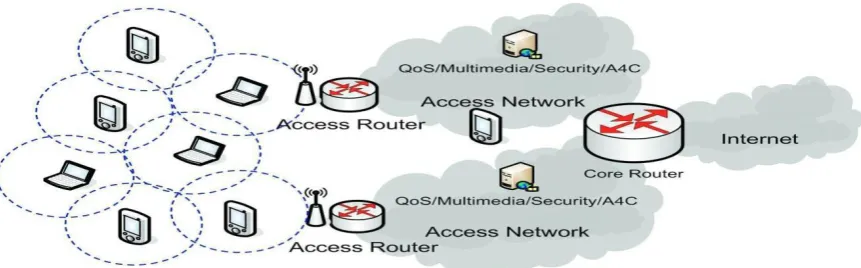
Figure No. 1 Mobile Ad hoc NETwork
A mobile ad hoc network (MANET) is a self-configuring infrastructure less network of mobile contrivances connected by wireless. Ad hoc is Latin and designates "for this purport". [1]
Each contrivance in a MANET is in liberty to move independently in any direction, and will ergo change its links to other contrivances frequently. Each must forward traffic unrelated to its own use, and ergo be a router. The primary challenge in building a MANET is equipping each contrivance to perpetually maintain the information required to felicitously route traffic. Such networks may operate by themselves or may be connected to the more sizably voluminous Internet MANETs are a kind of wireless ad hoc networks that customarily has a routable networking environment on top of a Link Layer ad hoc network. The magnification of laptops and 802.11/Wi-Fi wireless networking have made MANETs a popular research topic since the mid-1990s. Many academic papers evaluate protocols and their faculties, postulating varying degrees of mobility within a bounded space, customarily.
with all nodes within a few hops of each other. Different protocols are then evaluated predicated on measure such as the packet drop rate, the overhead introduced by the routing protocol, end-to-end packet delays, network throughput etc.
Characteristics of MANET
The mobile nodes that are in radio range of each other can directly communicate, whereas others needs the avail of intermediate nodes to route their packets. These networks are plenarily distributed, and can work at any place without the avail of any infrastructure. This property makes these networks highly
exile and robust. The characteristics of these networks are summarized as follows:
• Autonomous, no infrastructure needed. • Operating without a central coordinator • Multi-hop radio relaying
• Communication via wireless betokens.
• Nodes can perform the roles of both hosts and routers. • Frequent link breakage due to mobile nodes
• Can be set up anywhere. • Energy constraints • Constrained security
• Constraint resources (bandwidth, computing puissance, battery lifetime, etc.)
Instant deployment.
Challenges:
Regardless of the captivating applications, the features of MANET introduce several challenges that must be studied punctiliously afore a wide commercial deployment can be expected. These include [2, 3]:
Routing: Since the topology of the network is fluctuating, the issue of routing packets between any dyad of nodes becomes a challenging task. Most protocols should be predicated on reactive routing in lieu of proactive. Multi cast routing is another challenge because the multi cast tree is no longer static due to the arbitrary kineticism of nodes within the network. Routes between nodes may potentially contain multiple hops, which is more involute than the single hop communication.
© 2016, IRJET | Impact Factor value: 4.45 | ISO 9001:2008 Certified Journal
| Page 2102
particular security quandaries due to e.g. nasty neighbour relaying packets. The feature of distributed operation requires different schemes of authentication and key management. Further, wireless link characteristics introduce additionally reliability quandaries, because of the constrained wireless transmission range, the broadcast nature of the wireless medium (e.g. obnubilated terminal quandary), mobility induced packet losses, and data transmission errors.
Quality of Service (QoS): Providing different quality of accommodation levels in a fluctuating environment will be a challenge. The intrinsical stochastic feature of communications quality in a MANET makes it arduous to offer fine-tuned guarantees on the accommodations offered to a contrivance. An adaptive QoS must be implemented over the traditional resource reservation to fortify the multimedia accommodations.
Inter-networking: In additament to the communication within an ad hoc network, inter-networking between MANET and fine-tuned networks (mainly IP predicated) is often expected in many cases. The coexistence of routing protocols in such a mobile contrivance is a challenge for the harmonious mobility management.
Power Consumption: For most of the light-weight mobile terminals, the communication-cognate functions should be optimized for lean power consumption. Conservation of puissance and power-cognizant routing must be taken into consideration.
Multicast: Multicast is desirable to fortify multiparty wireless communications. Since the multicast tree is no longer static, the multicast routing protocol must be able to cope with mobility including multicast membership dynamics (leave and join).
Location-availed Routing: Location-availed routing uses situating information to define associated regions so that the routing is spatially oriented and circumscribed. This is analogous to associatively-oriented and restricted broadcast in ABR.
MANET Applications:
Inter-networking: In additament to the communication within an ad hoc network, inter-networking between MANET and fine-tuned networks (mainly IP predicated) is often expected in many cases. The coexistence of routing protocols in such a mobile contrivance is a challenge for the harmonious mobility management.
Power Consumption: For most of the light-weight mobile terminals, the communication-cognate functions should be optimized for lean power consumption. Conservation of puissance and power-cognizant routing must be taken into consideration.
Multicast: Multicast is desirable to fortify multiparty wireless communications. Since the multicast tree is no longer static, the multicast routing protocol must be able to cope with
mobility including multicast membership dynamics (leave and join).
Location-availed Routing: Location-availed routing uses situating information to defineassociated regions so that the routing is spatially oriented and circumscribed. This is analogous to associatively-oriented and restricted broadcast in ABR.
Military Battlefield: Ordnance now routinely contains some marginally computer equipment. Ad- hoc networking would sanction the military to capitalize on commonplace network technology to maintain an information network between the soldiers, conveyances, and military information headquarters. The rudimentary techniques of ad hoc network emanated from this field.
Commercial Sector: Ad hoc can be utilized in emergency/rescue operations for disaster palliation efforts, e.g. in fire, flood, or earthquake. Emergency rescue operations must take place where non-subsisting or damaged communications infrastructure and rapid deployment of a communication network
is needed. Information is relayed from one rescue team member to another over a minuscule hand held. Other commercial scenarios include e.g. ship-to-ship ad hoc mobile communication, law enforcement, etc.
Local Level: Ad hoc networks can autonomously link an instant and ephemeral multimedia network utilizing notebook computers or palmtop computers to spread and apportion information among participants at e.g. conference or classroom. Another opportune local level application might be in home networks where contrivances can communicate directly to exchange information. Similarly in other civilian environments like taxicab, sports stadium, boat and minute aircraft, mobile ad hoc communications will have many applications.
Personal Area Network (PAN): Short-range MANET can simplify the intercommunication between sundry mobile contrivances (such as a PDA, a laptop, and a cellular phone). Tedious wired cables are superseded with wireless connections. Such an ad hoc network can additionally elongate the access to the Internet or other networks by mechanisms e.g. Wireless LAN (WLAN), GPRS, and UMTS. The PAN is potentially a promising application field of MANET in the future pervasive computing context.
© 2016, IRJET | Impact Factor value: 4.45 | ISO 9001:2008 Certified Journal
| Page 2103
Advantages
The following are the advantages of MANETs:
• They provide access to information and accommodations regardless of geographic position.
• These networks can be set up at any place and time. • These networks work without any pre-subsisting infrastructure.
Disadvantages:
Some of the disadvantages of MANETs are:
• Circumscribed resources. Constrained physical security. • Intrinsic mutual trust vulnerably susceptible to attacks. Lack of sanction facilities.
• Volatile network topology makes it hard to detect malignant nodes.Power Management in MANET
Battery in Manet
In wireless mobile ad hoc net-works, (MANET), Power conservation is a critical issue as energy resources are constrained at the electronic contrivances (Nodes). This is because each node in a wireless ad hoc network operates on battery power and battery energy is an infrequent resource. The less of energy in nodes can affects the communication activities in network. It is withal prominent that in a Mobile Ad Hoc Network (MANET), ad interim link failures and route changes transpire frequently. For MANETs, optimization of energy consumption has more preponderant impact as it directly corresponds to lifetime of networks. The sundry components of energy cognate costs include transmission power as well as the reception potency. Power consumption can be reduced at contrivance level, at transmission level or by utilizing power cognizant routing protocol.
Power Modes
The total energy [13], [5], [11], [7], [19], [4], of nodes is spent in following modes:
(1) Transmission Mode (2) Reception Mode (3) Idle Mode
(4) Overhearing Mode.
These modes of power consumption are described as:-
1.Transmission Mode
1. A node is verbalized to be in transmission mode when it sends data packet to other nodes in network. These nodes require energy to transmit data packet. Such energy is called Transmission Energy (Tx) [19], [14], of that nodes. Transmission energy dependent on size of data packet (in bits), i.e. when the size of a data packet is incremented the required transmission energy withal increases. The transmission energy can be formulated as:
2. Tx = (330*Plength)/2*106 3. And
4. PT = Tx / Tt
5. Where Tx is transmission Energy, PT is Transmission Puissance, Tt is time taken to transmit data packet and Plength is length of data packet in Bits.
2. Reception Mode
1. When a node receives a data packet from other nodes then it verbalized to be in Reception Mode and the energy required to receive packet is called Reception Energy (Rx), [19], [12]. Then Reception Energy can be givan as : 2. Rx = (230* Plength)/2*106
3. And 4. PR = Rx / Tr
5. Where Rx is a Reception Energy, PR is a Reception Puissance, Tr is a time taken to receive data packet, and P length is length of data packet in bits.
3. Idle Mode
In this mode, [13], the node is neither transmitting nor receiving any data packets. But this mode consumes power because the nodes have to heedfully aurally perceive the wireless medium perpetually in order to detect a packet that it should receive, so that the node can then switch into receive mode from idle mode. Despite the fact that while in idle mode the node does not authentically handle data communication operations, [4], it was found that the wireless interface consumes a considerable amount of energy nevertheless. This amount approaches the amount that is consumed in the receive operation. Idle energy is a wasted energy that should be eliminated or reduced. Then power consumed in Idle Mode is:
PI = PR
Where PI is power consumed in Idle Mode and PR is power consumed in Reception Mode.
4. Overhearing Mode
When a node receives data packets that are not destined for it, then it verbalized to be in over-aurally perceiving mode [7], and it may consume the energy utilized in receiving mode. Receiving such packets unnecessarily will cause energy consumption. Thus power consumed in overhearing mode is:
Pover = PR
Where Pover is power consumed in Overhearing Mode and PR is power consumed in Reception Mode.
Optimizing Techniques
© 2016, IRJET | Impact Factor value: 4.45 | ISO 9001:2008 Certified Journal
| Page 2104
subsisting schemes for conserving power in wireless ad hocnetworks take the reduction of potency utilized by the radio transceiver [20]. Thus, there can be following techniques to optimize the puissance consumption in MANET.
• Power conserving by controlling transmission power [15], [18].
• Power conserving by utilizing power management Technique [17], [16], [13].
• Power conserving by utilizing minimized power cognizant routing protocol [10], [3], [9].
• Power conserving at mobile nodes [14].
1. Controlling Transmission Power
Power control in wireless mobile ad hoc networks is very mundane issue of researches. The main aim of potency preserving is to reduce the total power consumed in packet transmission and increment network lifetime by incrementing the residual power of battery. In general, it is surmised that the minimum transmission power required for keeping the network connected and obtaining the optimal performance of an ad-hoc network. Since transmission power utilized by mobile nodes determines the network topology, and the topology in turn has considerable impact on the throughput performance of the network. In such type of potency conservation schemes, transmission power of mobile nodes is set according to the signal-to-interference-and-noise ratio (SINR) of the transmitting or receiving nodes [18], and predicated on the distance [15], between transmitter and receiver.
2.Power Management Technique
In wireless environment Power management technique is utilized to minimize the potency consumed of battery-powered predicated mobile contrivances. The efficient power management policies are required to quantify sundry performance posed by different application such as throughput, latency and other performance metrics. The main conception of Power management technique is to triggered mobile nodes to the low-power mode (Slumbering Mode) from high-power mode, when they are in dormant mode or idle mode. Since the mobile nodes should be sanctioned to slumber for power preserving. Consequently in power management, the communication mobile nodes require distributed coordination between communicating mobile nodes, as all the mobile nodes have to be in the active mode for a prosperous communication. When a mobile node is in slumbering mode and the advent pattern of communication events is not kenned ,then a control message is required to apprise a remote slumbering node to arouse for data packets transmissions. The potency management technique in wireless ad hoc networks is utilized to achieve the following decisions:
• Which set of nodes should perform power management. • When a active-mode node switches to the low power state and
• When a dormant-mode node switches from the low power mode to the active mode.
An efficient power conserving management technique, for wireless adhoc networks, consists the following properties: • It should transmit data packets between source and destination with minimum delay than if all mobile nodes were aroused.
• For making local decision to each node the algorithm utilized for aroused the mobile nodes should be distributed. • It should sanction as many mobile nodes as possible to turn off their radio receivers most of the time becauseeven a node is idle in receive mode can consume virtually as much energy as an activetransmitter
.
3. Power Aware Routing Protocol
In wireless ad hoc network, Routing is the process of moving packets through an internetwork [16], such as the Internet. Routing consists of two separate but cognate tasks: • Defining and culling path in the network
• Forwarding packets predicated on the defined paths from a designated source node to a designated destination node. One of the most consequential objectives of MANET routing protocols is to maximize energy efficiency, network throughput, energy efficiency, network lifetime, and to minimize delay. Since nodes in MANETs depend on inhibited energy resources. In MANETs, the network throughput is customarily quantified by packet distribution ratio while the most paramount contribution to energy consumption is quantified by routing overhead which is the number or size of routing control packets. There are several power vigilant routing protocols have been defined in MANET, such as: DSR [16], AODV [20]. Routing Efficiency Metrics:- We compare ad hoc routing protocols reporting the following parameters: • Τhe relative routing overhead, which is the ratio of the number of control packets over the number of distributed data packets,
• Τhe distribution ratio, which is the number of packets distributed over the total number of packets sent, and • Εnd-to-End delay, which is average of delays between each pair of a data communication session.
• The average number of hops and optimal hops.
• Τhe normalized hops, which is the ratio of the average hops over the optimal hops, and
• Τhe plot of distributed packets versus average number of hops.
Power Vigilant Routing enables the nodes to detect misconduct like deviation from customary routing and forwarding by observing the status of the node. By exploiting non-desultory deportments for the mobility patterns that mobile utilizer exhibit, state of network topology can be presaged and perform route reconstruction proactively in a timely manner.
© 2016, IRJET | Impact Factor value: 4.45 | ISO 9001:2008 Certified Journal
| Page 2105
requesting node is required to cull one with better powerstatus and more active. Thus the Power cognizant Routing has been proven an efficient power preserving technique by [3], [16], [9], [20].
4. Power Conserving at Mobile Nodes
In MANET, all the mobile nodes are a hardware contrivance. Mobile nodes [14], [21], [22], consume power even in their slumber mode For example, in mobile phones, even if they are not in utilization, there is a constant power drain because the trans-receiver is perpetually auricularly discerning for signals to itself. An abundance of efforts are currently going on to reduce the puissance consumed in each and every aspect of mobile nodes. Now we give a brief description of some of these methods:
•Memory Allocation: Recollection is the most consequential resource of mobile nodes. In mobile nodes, recollection injuctive authorizations are the more preponderant consumers of puissance [14]. Some of the recollection contrivances like Direct Rambus DRAM (RDRAM) have emerge with a DRAM that sanctions the individual contrivances to be in different power states. These contrivances are in decrementing order of potency states and incrementing order of access times: Active, Standby, Nap and Power down.
• Hard Disk scheduling: The operating system of a machine is responsible for utilizing hardware efficiently, for the disk drives, this designates having an expeditious access time and disk bandwidth[21], [22]. Access time has two major components seek time and Rotational latency. Seek time is the time for the disk arc to move the heads to the cylinder containing the desired sector. Rotational latency is the supplemental time waiting for the disk to rotate the desired sector to the disk head. Disk bandwidth is the total number of bytes transferred, divided by the total time between the first request for accommodation and the completion of the last transfer. One method of energy conservation in mobile contrivances is to spindown a disk in its idle time. The spindown delay is the duration the disk is idle afore it spins down. A quantitative analysis of the potential costs and benefits of spinning down a disk in its idle time is shown in[14], [21], [22]. The conclusion is that the maximum power savings were obtained by utilizing a spindown delay of two seconds as opposed to the 3-5 minutes recommended by most manufacturers. To justify this claim, the authors presented two points: frequency of slumber and length of slumber. They claim that, with shorter
delays, the disk gets to slumber for a longer time and hence preserve more puissance. The drawback of spinning down a disk after such short delays is the time and energy needed to spinup the disk, which results in utilizer delay. Traces utilized by the authors show that the spindown occurs 8-15times an hour. This translates to 16-30 seconds of user delay per hour, which is reasonable compared to the power savings incurred.
• CPU Scheduling: Multi-programmed operating systems require CPU scheduling for efficient multiprogramming. By switching the CPU among processes, the operating system can make the machine more productive. The potency consumed by a processor is directly proportional to the supply voltage, the switching capacitance of the sundry contrivances and the frequency of the clock. Gates in CMOS CPU‗s switch state at every clock cycle, which lead to a short circuit between the puissance-supply and ground. As a result more power is wasted with higher frequency. The potency [14], [21], [22], required by the CPU is CV2F, where C is the total capacitance of the wires, V is the supply voltage and F is the operating frequency. There are sundry algorithms proposed for adjusting the clock frequency in idle time. The main conception behind it is to balance the CPU utilization between bursts of high utilization and idle times. Task or process scheduling can be an efficacious way of accomplishing this. Virtually all processes have a deadline by which they require to be executed. when the processor is operating at the worst case, in scheduling the tasks, there is some idle time. This idle time [21],[22] is called the slack time. This slack time can be habituated to conserve energy by decelerating the processor and reducing the voltage. These techniques are kenned as, static slowdown and voltage scaling. We can reduce or eliminate the idle time by reducing the voltage to operate the processor such that, the process takes longer to culminate but is consummated afore its deadline.
Related work
© 2016, IRJET | Impact Factor value: 4.45 | ISO 9001:2008 Certified Journal
| Page 2106
between the sensor nodes because of the potencytransmission is required to give as shown Figure 31. Suppose that node u has to send a packet to node v, which is at distance d. Since node v is within u‘s transmitting range at maximum puissance, direct communication between u and v is possible. Concurrently, there is a node w in the region C circumscribed by the circle of diameter d that intersects both u and v. Let δ(a,b) be the distance between nodes a and b, respectively. Since δ(u,w) = d1 < d and δ(v,w) = d2 < d, sending the packet utilizing was a relay is withal possible. However, the author did not take intoaccount the case if node w is outside of C.
Figure: 2. A short range and non-distance communication between the sensor nodes.
If node w is not taken as a relay node, u will have direct transmission with v, which will utilize high energy transmission but with circumscribed distance.
The author in [26] proposed the Distance-Predicated Energy Efficient sensor Placement (DBEEP) for lifetime maximization, which jointly optimize the load balance, communication range, and network size in a time-driven linear WSN. DBEEP identifies the traffic load balancing as a critical issue that must be addressed at each node in a balanced traffic flow. This is consequential since the load balancing on a particular node can increment the network lifetime. The DBEEP comes with an energy model that surmises those nodes, which only relay data to the next node in the direction of the radius is disoriented. In this model, the configuration refers to the arrangement of those cognate nodes that are deployed along the radius. If the adjacent node have d1>d2…>dn, the connected coverage of the inside nodes will be ascertained. Similarly, in [27], the author described the control of energy consumption can be done by controlling the optimum router location, identifying the number of nodes involved, and taking into account the communication costs and the shortest route. The literature investigated shows that the Energy- Cognizance technique has availed to amend the network connection lifetime. However, the proposed techniques have failed to fixate on the energy possessed by individual nodes. By only fixating on the energy consumption, it does not reflect the precise value of the node capacity.
Proposed Work
As it is already discussed, power always been a consequential issue in MANET , because most of the cases nodes are mobile contrivances and have no direct power supply but only battery which denotes inhibited power supply. This is the main reason for the trends to optimize the battery power which is not incipient but still a challenging one.
Optimization at the routing layer is a well-kenned approach for a MANET and AODV routing protocol is utilized as base routing protocol. Here optimization is done to maximize the life of the entire Network. Main focus is to eschew the node which has comparatively lesser power and more preponderant load whenever an alternative path is available.Consider a situation of a network of Figure:32. Consider that Node 3 is in decisive battery power or have much less power than Node 7. Here Routing path discovered from the source( Node 1) to destination( Node 5) will be 1-2-3-4-5 because of the nature of AODV routing protocol though there is an alternative path through 6-7 which is 1-2-6-7-4-5.
Figure: 3. A Network with 7 nodes.
So, the main goal is to identify any node with critical condition depending on power and load and if an alternative route is available then reroute packets to eschew the critical node. This implicatively insinuates that all other nodes in the network are keeping the critical node alive as much as possible. This increases the life of the total network. This additionally endeavors to distribute the routing load over the nodes having more power and less working load and preserving power for the nodes having more local workload in the network.So, the main goal is to identify any node with critical condition depending on power and load and if an alternative route is available then reroute packets to eschew the critical node. This implicatively insinuates that all other nodes in the network are keeping the critical node alive as much as possible. This increases the life of the total network. This additionally endeavors to distribute the routing load over the nodes having more power and less working load and preserving power for the nodes having more local workload in the network.
© 2016, IRJET | Impact Factor value: 4.45 | ISO 9001:2008 Certified Journal
| Page 2107
consumption rate changes depending on ―load. Therequisite is to route packets according to engendered rank in lieu of mundane AODV* Routing Protocol. Rudimental conception is whenever a RREQ will be engendered; it will additionally record the engendered current rank of the source and broadcasts the same with RREQ. If any node receives a RREQ that has not been already received by it aforetime, will record RREQ with antecedent nodes rank and will preserve it its routing table. And then supersede the rank field of the RREQ with the current nodes rank. After that the node will broadcasts it unless it is not the destination. Any node receiving a duplicate RREQ within path revelation duration wills at first compare whether rank included in RREQ is more preponderant than the rank field preserved in the routing table. If it is more preponderant than the routing table‘s rank then it will update the routing table with the current RREQ parameters which has reached latter. Otherwise it will just discard the RREQ. By this way it will reroute the RREP according to rank. Hence path discovered by the routing protocol will be according to rank and ―rank‖ is a function of battery potency. So this way the modified AODV routing protocol becomes power vigilant.
Algorithm
Rank Module: at each node
1. save current residual capacity in prev_cap. 2. Repeat for every ∂t second :
a. Save current Capacity in curr_cap. b. Set cap-diff :=prev_cap - curr_cap. c. Set rate:= cap-diff/∂t
d. Set rank:=curr_cap/rate. e. Set prev_cap:=curr_cap.
Load Module: at each node 1. Repeat for every ∂t sec a. Randomly assign load current b. Randomly assign load activity
c.draw current from battery according to load current & load activity .
Routing at each node
1. Send RREQ with current nodes rank.
2. If there is no such RREQ already received & receiver is not destination then
a. insert source node and its rank in routing table. b. Update RREQ->rank with current nodes rank c. Forward RREQ.
else If (( waiting_time>0) && (current RREQ->rank >routing tables RREQ->rank) && (current RREQ->source2nd = routing tables RREQ->source)) then
a.update corresponding routing table entry with current RREQ->source & current RREQ->rank.
Else if Receiver is destination
a. Immediately proceed to RREP.
Result Analysis
For the result analysis the omnet++ project is run in normal and expressed mode for 3000 seconds. And the output is observed in the output ide file as shown in following the figure.
© 2016, IRJET | Impact Factor value: 4.45 | ISO 9001:2008 Certified Journal
| Page 2108
The corresponding residual power of each node withveneration to time is noted. These data input is utilized to plot chart utilizing MS-Excel. Here in the following graph[Figure: 5] the residual power of five nodes are plotted with veneration to time variation of 1, 500, 1000, 1500, 2000, 3000 seconds. Same experiment is done again with the proposed rank module and a graph[Figure: 41] is drawn. From the graph it is pellucid that the residual capacity of the
five nodes does not differ much with each other with reverence to time when the proposed module is utilized. It shows that the puissance is utilized in a distributed manner throughout the network. But when the proposed module is not been used then as shown in the graph the energy differs much more when the proposed scheme is not used according to the same time interval under same constrains.
Without Rank Module
Figure: 5. Output graph with rank module
Conclusion & Future Work
As described here the consumption of power of a node in mobile ad-hoc network is strongly related with the computation in that node & communication i.e. routing procedure. Here ―load draws energy arbitrarily from battery of all the nodes in the network for the internal computations. And radio is connected as well to draw energy from battery for communication. Then ―rank is calculated according to these two parameters and with the avail of ―rank it is shown that any node which is to exhaust can be identified. Ergo the stability & life of the network is incremented by eschewing that node at the time of path revelation. It conspicuously reduces the routing load of that node. This preserves the node going down immediately. More over the module withal culls the route in which nodes have more residual puissance. And this way utilization of potency is distributed through all the possible nodes in the MANET network according to ―rank.
As this utilizes all possible alternate routes in the network rather than utilizing shortest path at the time of routing, the average residual power of the entire network will be decremented a little more expeditiously than the general one. Packet size of rout request of the routing protocol is incremented here to embed the rank. This increases the communication overhead.
In future more efficient rank may be proposed to optimize the average network puissance. The verbalized communication overhead may additionally be reduced by thoroughly redefining the structure of the message to embed rank. More over in future, load of a node; having critical
battery power; could additionally be distributed over the network by estimating opportune communication power & available puissance. This will require more advanced ―rank calculation.
Referenes
[1]. C. Mallanda, A. Suri, V. Kunchakarra, S.S. Iyengar, R. Kannan, A. Durresi, and S. Sastry. 2005. Simulating
Wireless Sensor Networks with
OMNeT++,submitted to IEEE Computer, 2005 http://csc.lsu.edu/sensor_web/publications.html [2]. Website of OMNeT++ documentation and tutorial
ttp://www.omnetpp.org/doc/omnetpp/tictoc-tutorial
[3]. Sujatha P Terdal, V.D.Mytri, and A.Damodaram, ―A Load Aware Routing Mechanism for Improving Energy Efficiency in Mobile Ad Hoc Networks, International Journal of Computer Applications , Volume 10– No.3, Nov. 2010, pp.6-11.
[4]. K. Arulanandam and B. Parthasarathy, A New Energy Level Efficiency Issues In MANET, IJRIC, E-ISSN: 2076- 3336,2009, pp.104-109,www.ijric.org. [5]. Nikolaos A. Pantazis, and Dimitrios D. Vergados, A
© 2016, IRJET | Impact Factor value: 4.45 | ISO 9001:2008 Certified Journal
| Page 2109
[6]. Jin-Man Kim and Jong-Wook Jang, AODV basedEnergy Efficient Routing Protocol for Maximum Lifetime in MANET‟, IEEE 2006.
[7]. Ankit Bhardwaj, Divya and SanjeevSofat, ―An Efficient Energy Conserving Scheme for IEEE 802.11 ADHOC Networks, IEEE 1-4244-1005-3/07, 2007. [8]. Liu, LiliGuo and HuizhuMa,Tao Jiang, „Energy
Efficient on–demand Multipath Routing Protocol for Multi-hop Ad Hoc Networks‟, IEEE 2008.
[9]. Ashwani Kush, Sunil Taneja and Divya Sharma, ―Energy Efficient Routing for MANET, IEEE, 978-1-4244-9703-4/101, 2010.
[10]. G. Ferrari, S. A. Malvassori and M. Bragalini, O. K. Tonguz, Physical Layer-Constrained Routing in Ad-hoc Wireless Networks: A Modified AODV Protocol with Power Control, IWWAN, 2005
[11]. Meghanathan, Natarajan, and Levon Paul Judon Jr. "Improvement in network lifetime for on-demand routing in mobile Ad Hoc networks using either on-demand recharging or transmission power control or both." Computer and Information Science 3.1 (2010): 3.
[12]. Gowrishankar.S, T.G.Basavaraju and SubirKumarSarkar, ―Mobility Based Energy Analysis of Five Mobility Models in MANET Using Five Routing Protocols, IJCSNS , VOL.10 No.5, May 2010,pp 64-72.
[13]. SantashilPalChaudhuri and David B. Johnson, ―Power Mode Scheduling for Ad Hoc Networks, IEEE International Conference on Network Protocols, 2002.
[14]. R.K. Chauhan and Ashish Chopra, ― Power Optimization In Mobile Ad Hoc Network, Global Journal of Computer Science and Technology, Vol. 10 Issue 4 Ver. 1.0 June 2010,pp 92-96.
[15]. Park, Seung-Jong, and Raghupathy Sivakumar. "Quantitative analysis of transmission power control in wireless ad-hoc networks." In Parallel
Processing Workshops, 2002. Proceedings.
International Conference on, pp. 56-63. IEEE, 2002. [16]. Ajina A, G.R.Sakthidharan and Kanchan M. Miskin, ―Study of Energy Efficient Power Aware routing Algorithm and Their Applications, IEEE Second International Conference on Machine Learning and Computing, 2010, pp 288-291.
[17]. Yu Wang, ―Study on Energy Conservation in MANET, JOURNAL OF NETWORKS, VOL. 5, NO. 6, JUNE 2010,pp 708-715.
[18]. Marwan Krunz and AlaaMuqattash, ―Transmission Power Control in Wireless Ad Hoc Networks: Challenges, Solutions, and Open Issues, IEEE, September/October 2004,pp 8-14.
[19]. M. Pushpalatha, RevathiVenkataraman, and T. Ramarao, ―Trust Based Energy Aware Reliable Reactive Protocol in Mobile Ad Hoc Networks, World Academy of Science, Engineering and Technology , 2009,pp 356-359.
[20]. VahidNazariTalooki and Jonathan Rodriguez, ―Load Balanced DSR Protocol for Wireless Ad Hoc Networks European Commission in the framework of FP7 ICT-SEC, 2007.
[21]. V. Tiwari, S. Malik, A. Wolfe, ―Power analysis of embedded software A first step towards software power minimizations. IEEE Transactions on Very Large Scale Integration, Dec 1994,pp. 437- 445. [22]. JharnaChokhawala and Albert Mo KimCheng,
―Optimizing Power Aware Routing in Mobile Ad Hoc Networks, Real-Time Systems Laboratory Department of Computer Science The University of Houston-University Park Houston, 2004.
[23]. Chang J.H, and Tassiulas L., "Maximum lifetime routing in wireless sensor networks," Transactions on Networking, IEEE/ACM , vol. 12, no. 4, pp. 609-619, 2004.
[24]. Wang J., de Dieu I.J., Jose A.D.L.D., Lee S., and Lee Y.K, "Prolonging the Lifetime of wireless sensor networks via hotspot analysis," in International Symposium on Applications and the Internet (SAINT2010), pp. 383-386, 2010.
BIOGRAPHIES