integrated CDROM / workbook package
as part of a vocational degree programme
Smith, C, Crozier, SJ and Dean, D
Title The development and evaluation of an integrated CDROM / workbook package as part of a vocational degree programme
Authors Smith, C, Crozier, SJ and Dean, D
Type Conference or Workshop Item
URL This version is available at: http://usir.salford.ac.uk/2018/ Published Date 2004
USIR is a digital collection of the research output of the University of Salford. Where copyright permits, full text material held in the repository is made freely available online and can be read, downloaded and copied for noncommercial private study or research purposes. Please check the manuscript for any further copyright restrictions.
The Development and Evaluation of an Integrated CD-ROM /
Workbook Package as Part of a Vocational Degree Programme
Christine Smith, [email protected], Simon Crozier, [email protected],
David Dean, [email protected]
Abstract
A self-directed, flexible CD-ROM / Workbook package was developed to supplement current teaching resources to enhance students’ learning within the vocational degree programme of Physiotherapy. This was developed with particular reference to neurological assessment and bridging the gap between University and practice-based learning, as well as improving the student’s preparation for module assessment. The package was piloted with both Full-time (n = 70) and Part-Time (n = 28) cohorts of students. Evaluation of the new teaching resource via a structured questionnaire proved very positive and demonstrated the benefit of the package. Areas were identified for improvement and how it could be further developed to meet the needs of a vocational degree programme.
Background
Students attending vocational degree programmes such as physiotherapy undertake a variety of work-based placements. These placements are aimed at transferring skills gained within the University setting into clinical or work-based practice. Traditionally students studying within physiotherapy programmes have found it difficult to make the links between university and practice-based learning. The transference of these practical and clinical reasoning skills is often problematic due to the sparsity of patient contact prior to their placement. Students find it difficult to visualise techniques and examples of problems that they might encounter in the future. Patient analysis also comprises part of the assessment package for the neurology module to ensure curriculum alignment and clinical relevancy. Video is one medium that has been used within existing tutorial and practical sessions and has been found to be beneficial on the current programme. No facility was available for the students to use this medium outside of lectures or in association with any self-directed learning.
ISBN 0902896660
A grant was obtained from the University of Salford Teaching and Learning Quality Improvement Scheme to develop two CD-ROM / Workbook packages to enhance students’ learning and skill acquisition within two core areas of the BSc (Hons) Physiotherapy degree. This study relates to the development of one of these packages focusing on assessment of neurological patients.
From initial discussions, the project team identified 3 key areas that they wanted to address and developed three aims for the study. They were to:
Produce a CD-ROM / workbook package to enhance student learning, with particular reference to bridging the gap between University and practice-based learning
To improve the students’ preparation for the assessment process by offering a learning resource that is not currently available, and which meets the needs of the current module assessment.
To provide a flexible, self-paced learning tool to supplement teaching mechanisms which will allow for individual learning styles
The aim of this paper is to show how the CD-ROM / workbook package was developed. This included an initial student evaluation for appropriateness with regard to ease of use and relevant content, in order to facilitate preparation for modular and practice-based assessment
Methodology
Design
Based on the study aims a survey design was deemed the most appropriate. Quantitative and qualitative data was obtained using a questionnaire (Brady-Boyce & Winne, 2000) which was modified to meet the needs of the study. This was peer reviewed prior to being used in the study by educators working within the field of neurology. Further modification of the questionnaire was made at this stage.
Participants
Questionnaires were distributed to 59 physiotherapy students from the full-time cohort and 15 of the part-time cohort on the BSc (Hons) Physiotherapy programme in semester 2, 2003. The ages of the students ranged from 19 to 45, with a ratio of females to males being 3:2. Participants were selected on a convenience sample basis via attendance at a modular session.
Apparatus / Materials
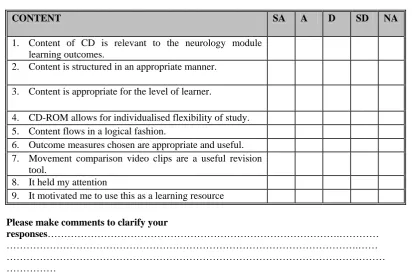
As previously documented a modified questionnaire was used. This consisted of domains (see Figure 1 for example) which looked at the student’s level of satisfaction in relation to CD design, content, navigation, assessment resource and workbook design and content. A domain was also included that related specifically to the second and third aims of the study. Following each domain, space was left for individual comments. Other individual questions were asked such as marketability, type of format preferred and other additional resources required.
Please tick the box for each item that best describes your rating of the CD-ROM and workbook. Please add any additional comments at the bottom of each table.
SA = strongly agree; A = agree; D = disagree; SD = strongly disagree; NA = not applicable.
CD-ROMs
CONTENT SA A D SD NA
1. Content of CD is relevant to the neurology module learning outcomes.
2. Content is structured in an appropriate manner.
3. Content is appropriate for the level of learner.
4. CD-ROM allows for individualised flexibility of study. 5. Content flows in a logical fashion.
6. Outcome measures chosen are appropriate and useful. 7. Movement comparison video clips are a useful revision
tool.
8. It held my attention
9. It motivated me to use this as a learning resource
Please make comments to clarify your
responses……….…………
[image:4.595.102.521.168.446.2]……….…… ……… ………
Figure 1
ISBN 0902896660
The videoing of the patient took place at the Physiotherapy Department, Queens Park Hospital, Blackburn. Ethical consent was obtained from the hospital trust and informed consent from the patient prior to filming.
Procedure
The students received the package halfway through the module and instruction was given in its use. This was in addition to attending existing sessions on neurological assessment. This was then followed by two further sessions on assessment that utilised the package. The questionnaire was distributed at the end of the module.
Data Analysis
The analysis of the questionnaire data was completed in two ways. Quantitative analysis of the domain responses was undertaken to establish if there were any differences with the student's satisfaction between cohorts and whether there were any differences within cohorts across the 7 identified domains. This was done by allocating the responses a numerical value i.e. Strongly Agree (SA) – 4, Agree (A) – 3, Disagree (D) – 2, Strongly Disagree – 1, Not Applicable – 0. Each domain therefore received a numerical total. Because of the large difference in cohort sizes, 20 of the full-time responses were randomly selected by taking every third questionnaire from the total. These were then compared with the 15 part-time responses.
As well as evaluating the 7 domains, overall satisfaction with the package and the domain relating to aims two and three was quantified by using percentages. Qualitative thematic analysis of the associated comments was also undertaken to evaluate individual student responses. Analysis was then undertaken comparing the scores generated from each domain to compare the level of satisfaction between both cohorts. Unpaired t-tests were used to analyse the normally distributed data
Results
Quantitative Analysis
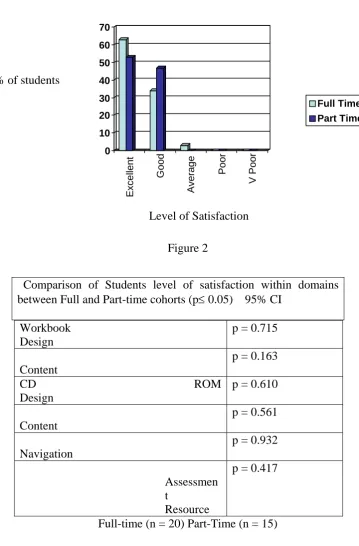
To gain a general impression of the students’ level of satisfaction regarding the package, students were asked to rate it as a learning resource. Responses mainly fell within the Excellent and Good bands (Figure 2).
0 10 20 30 40 50 60 70
E
xce
lle
n
t
G
ood
Av
er
ag
e
Poo
r
V P
oor
Full Time Part Time % of students
Level of Satisfaction
Figure 2
Workbook Design
p = 0.715
Content
p = 0.163
CD ROM Design
p = 0.610
Content
p = 0.561
Navigation
p = 0.932
Assessmen t Resource
p = 0.417
Full-time (n = 20) Part-Time (n = 15)
[image:6.595.123.483.80.627.2]Comparison of Students level of satisfaction within domains between Full and Part-time cohorts (p 0.05) 95% CI
Figure 3
The results showed that there was no significant difference with the students’ level of satisfaction between both cohorts within any of the domains. Students demonstrated a high level of satisfaction across both cohorts in relation to the domains.
Copyright for all the contributions in this publication remains with the authors
using a one-way analysis of variance and post hoc using Scheffe's test. P-values obtained for both cohorts ranged from 0.525 – 1.00. Percentages of the domain scores were used for comparison as there were a different number of questions within each domain.
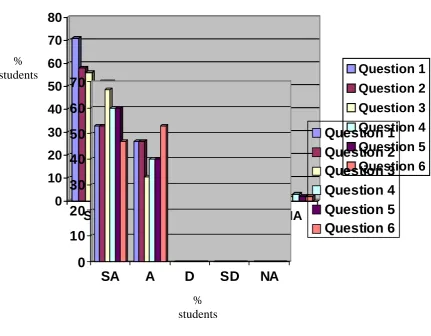
Questions relating to aims two and three produced results presented within Figure 4a for the full-time cohort and Fig 4b for the part-time cohort. The questions asked were related to the aims of the study looking at how useful the resource was as:
1. An additional learning resource for the neurology module; 2. Preparation for clinical education placements;
3. Part of preparation for the neurology exam; 4. To enhance your critical thinking;
5. For developing your movement analysis skills; 6. For enhancing your general patient assessment skills.
Figure 4a Full-time Responses Level of satisfaction
[image:7.595.104.536.372.708.2]ISBN 0902896660
Figure 4b %
students
% students 0
10 20 30 40 50 60 70 80
SA A D SD NA
Question 1 Question 2 Question 3 Question 4
Question 5 Question 6
0
10
20
30
40
50
60
70
Question 1
Question 2
Question 3
Question 4
Question 5
Question 6
Part-time Responses
Qualitative Analysis
Written comments were copied verbatim and grouped within their respective questionnaire domains, separately for both cohorts. It was clear on closer inspection that comments made did not exclusively relate to the domain as laid out on the questionnaire. For clarity of interpretation therefore, students’ comments were amalgamated and analysed for emergent themes as related to the CD-ROM or Workbook respectively. The comments were grouped under the following three broad headings: compliments, criticisms and recommendations. Sample comment extracts are included to illustrate some points raised.
CD-ROM Compliments
Students appreciated the ease of use and flexibility that the CD-ROM structure and content afforded, allowing them to individualise its use with their own learning preference. The format was seen as a useful resource in 'bringing everything together' in a novel and interesting way. The ability to pause the video and simultaneously compare movement strategies with a video of an unimpaired model were seen by several as 'invaluable':
Level of satisfaction
It was helpful in gaining an idea of structured assessments as neurology assessments seemed very daunting at first.
Criticisms
Technical difficulties dominated the feedback with just over half the students experiencing problems. Navigation around the second CD was generally seen as good. Lack of fast-forward/re-wind capability together with some long video sequences caused quite widespread frustration. Other comments reported more general playback problems ranging from a lack of ‘auto start’ facility, through to the screen 'freezing' with the first CD. Quiet sound amplification with respect of the patient, combined with his Scottish accent made hearing and understanding of his responses quite difficult:
Sometimes if I paused [the footage] for too long the video would stop & I’d have to start again!
Recommendations
ISBN 0902896660
should be available with VHS-video format out voting DVD by 2:1. Greater playback flexibility including FF/RW/Slow-motion facility were identified as the major technical recommendations:
Could use actual narration by 3rd party by way of explanation – sometimes didn’t know if I was on the right lines; therefore need a guide as to the general ‘answers’.
Workbook Compliments
The workbook was found to relate well to the CD-ROM helping to break down the assessment process and document it. 'Handy-hints' were identified as a useful aid to 'get you thinking':
Liked the structured way the workbook followed the CD…the questions asked got you thinking.
Criticisms
The workbook was seen by many as repetitive in layout and content. Indeed several people commented on both the length of the neuro-assessment process (video footage overall) and the length of time it took to complete the workbook:
All sections need to be completed, does not allow individual to concentrate on aspect they would like to.
Recommendations
As mentioned above the presence of more guidance notes/quiz/answers sections were suggested. Greater space for writing responses, together with an overall ‘flashier’ look to the package was also recommended:
Maybe a few more clues along the way to structure thinking – prompts.
General Comments
Responses related to the timing of when the package should be issued in the module was split equally between mid-way through the module (as had been issued this time), and at the beginning. An overwhelming majority of respondents would recommend purchase of the package confirming the overall positive regard in which it was held.
No appreciable difference in tenor was observed between the part-time and full-time cohort responses hence a combined report has been given.
Discussion
Broadly speaking the CD-ROM and Workbook package was very well received by both the full-time and part-time cohort of students. No significant difference was detected between the two groups’ levels of satisfaction with each domain, which indicated that the package was an equally valuable resource for students on programmes necessitating different types of attendance. A similar result was apparent when the levels of satisfaction were compared within cohorts, indicating that there was no particular part of the package that proved either weaker or stronger than the rest.
One of the perceived strengths was the flexibility of the package, which enabled the students to take the package home thus allowing them to work through it at their own pace. Feedback confirmed the interactive nature of the package as being of great benefit, confirming the findings of similar studies that used interactive media (Sultana et al, 2001). Students across cohorts however, highlighted a desire for more tutorial based guidance in interpreting and validating their findings. The perceived lack of feedback regarding clinical reasoning could be due either to a deficiency in the package design or to a psychological need for tutorial style debriefs. Whether interactive self-directed packages can ever ‘stand alone’ in terms of feedback, remains to be established (Taverner et al, 2000).
Format and technical issues hampered the use of the first CD-ROM and highlighted difficulties some students had in accessing the video footage. The use of the CD-ROM necessitated reasonably high specification IT equipment. Having the package available in other formats including video, DVD and access via the web would help this and also increase its flexibility and equity of use amongst students (Bowser, 1997).
The development of the package has been a lengthy process. The project development, as well as being costly in terms of time, has also stretched existing technical abilities and resources. As reflected in studies, these factors need to be considered before embarking on a similar project. Studies have highlighted the need for up-front equipment, training and ongoing technical support (Bowser, 1997). Following this initial resource investment, changes can now be made to enhance the existing package in light of student feedback, and in the development of future projects.
The study substantiates the educational value of the package as a flexible, self-paced, self-directed additional teaching and learning resource. The use of video footage lends itself to vocational programmes showing it to be a mechanism by which students can enhance their learning (Sultana et al, 2001, Taverner et al, 2000, Minardi & Ritter, 1999, Bowser, 1997). It is inherently difficult during vocational programmes to provide students with a true representation of what they are likely to encounter, especially in the area of neurological assessment. However, the students’ responses indicate that the package does go some way to meeting this aim.
ISBN 0902896660
With reference to the first aim for the study, the package was deemed to be effective in ‘bridging the gap’ between the university and practice-based learning. The extent of this cannot be confirmed until the students have completed a subsequent clinical placement in neurology. Evaluation of the students’ perceptions following a clinical placement would provide additional insight into the degree to which the package had aided their development. The package will also require further evaluation by clinical educators of physiotherapy students in order to further validate the relevance and currency of the package. Analysis of the qualitative data indicated that aims two and three had been met. However, further quantifiable data would need to be collected in order to further substantiate this claim.
Conclusion
In summary, the CD-ROM / Workbook package has been well received by both full-time and part-time cohorts. Evaluation of student questionnaires has demonstrated a high degree of satisfaction with the package as a useful and novel learning resource. The package was originally distributed to the students half way through the Neurology module. Student opinion was equally split regarding when the package should have been issued. Half favoured the beginning of the module whilst the remainder felt that half way through the module was most appropriate to avoid information overload.
A significant proportion of students recommended greater interactivity and guidance in relation to their clinical analysis. This could be addressed via more overt signposting within the package or within a tutorial setting. Initial modification of the package alone and subsequent re-evaluation should then determine whether it can be utilised as a pure self-directed learning tool.
With reference to the first aim of the study future quantitative research aiming to evaluate the impact of the package on students’ learning is postulated. This could be achieved by splitting a cohort into two groups. One group would be provided with the package early in the module, followed by testing of the whole cohort’s ability to assess a neurological patient at the modular mid point. The package would then be made available to the other group, as distributed in the present study, to satisfy equity of provision. The cohort would then be retested at the end of the module and the groups’ results compared. Recommendations for future studies include further evaluation of students’ learning in light of completing a clinical placement in neurology.
It is intended to improve the CD-ROM / Workbook in light of student feedback. Existing resources within the University are being explored to assist with these developments. Examples include collaborative working to redesign the workbook and technical improvements regarding video sequence navigation.
The development of the CD-ROM / Workbook has proved to be a flexible, self directed learning resource for students irrespective of mode of undergraduate study. Despite an initial resource intensive period, a framework for enhancements has now been established that could be transferred to similar projects in this and other vocational programmes.
Acknowledgements
This project was made possible by funding from the University of Salford Teaching and Learning Quality Improvement Scheme. Thanks go to the patients and staff from the Physiotherapy Department, Queens Park Hospital, Blackburn for their help and support in developing the video footage.
We are also grateful, for Chris Tivey's filming expertise and for being able to transform our thoughts into practical reality.
References
Anderson B & Hrycak N. (1986) Video- a teaching strategy for learning group process.
Nursing Papers. 18 (1) 5-19
Berksy AK (1987) Learning interdisciplinary and assessment skills through videotaped client interviews and collaborative planning. Journal Of Nursing Education 26 (5) 202-204
Bernhardt J, Bate PJ, Matayas TA (2001) Training novice clinicians improves
observation accuracy of the upper extremity after stroke. Archives of Physical Medicine & Rehabilitation. 82 (11) 1611-1618
Birdsall C, Barker K, Setti K (1995) Developing a teaching video on mechanical ventilation weaning to facilitate effective nursing research. Journal of Continuing Education in Nursing. 26 (6) 272-275
Bowser JC. (1997) The development of the use of technology-enhanced learning in associate degree nursing program at the Davidson County Community College. The University of North Carolina at Greensboro. ED.D 150
Brady Boyce BA, Winne MD (2000) Developing an evaluation tool for instructional software programs. Nurse Educator 25 (3) 145-148
English T, Harrison AL, Hart AL (1998) A distance learning model in a physical therapy curriculum. Journal of Allied Health. 27 (4) 228-232
Gibbs G. (1990) Improving student learning project: surface and deep approaches to learning, CNAA 3-15.
Marton F & Saljo R (1976) “On qualitative differences in learning I – outcome and process” British Journal of Educational Psychology. 46: 4-11.
Mathews R & Veins DC (1985) Evaluating basic nursing skills through group video testing. Journal Of Nursing Education. 27 (1) 44-46
Minardi HA & Ritter S (1999) Recording skills practice on videotape to enhance learning – a comparative study between nursing lecturers and nursing students.
Journal of Advanced Nursing. 29 (6) 1318-1325
Moss BR (2000) Death studies at University: new approaches to teaching and learning.
Mortality. 5 (2) 205-214
Papa K (2000) Students need interaction not videos-Teaching techniques column in the November/December 1999 issue, titled “Using video to upgrade competencies”.
Radiologic Technology. 71 (3) 231
Ram P, Grol R, Rethans JJ, Schouten B, Van Der Vleuten C, Kester A (1999) Assessment of General Practitioners by video observation of communicative and medical performance in daily practice: issues of validity, reliability and feasibility.
ISBN 0902896660
Copyright for all the contributions in this publication remains with the authors
Stringfield YN (1995) Videos and film clips as a medium for enhancing critical thinking. ABNF Journal. 6 (6) 158-161
Sultana CJ, Levy J, Rogers R Jnr (2001) Video v CD-ROM for teaching pelvic anatomy to third-year medical students: a comparison. Journal of Reproductive Medicine. 46 (7) 675-677
Taverner D, Dodding CJ, White JM (2000) Comparison of teaching methods for teaching clinical skills in assessing and managing drug-seeking patients.