56 Int. J. Intelligent Systems Technologies and Applications, Vol. 13, Nos. 1/2, 2014
Recursive Gauss-Newton based
for
neural network modelling of
rotorcraft dynamics
training
algorithm
an
unmanned
Syariful S. Shamsudin
Department of Aeronautical Engineering,
Faculty of Mechanical and Manufacturing Engineering, Universiti Tun Hussein Onn Malaysia,
86400 Parit Raja, Batu Pahat, Johor, Malaysia E-mail: [email protected]
XiaoQi Chen*
Mechanical Engineering Department, University of Canterbury,
Christchurch 8041, New Zealand Telephone: +64 3 3642987 ext. 7221 Fax: +64 3 364 2078
E-mail: [email protected] *Corresponding author
Abstract: The ability to model the time varying dynamics of an unmanned rotorcraft is an important aspect in the development of adaptive flight controller. This paper presents a recursive Gauss-Newton based training algorithm to model the attitude dynamics of a small scale rotorcraft based unmanned aerial system using the neural network (NN) modelling approach.
It
focuses on selectionof optimised network for recursive algorithm that offers good generalisation performance with the aid of the cross validation method proposed. The recursive method is then compared with the off'-line Levenberg-Marquardt (LM) training method to evaluate the generalisation performance and adaptability ofthe model. The results indicate that the recursive Gauss-Newton (rGN) method gives slightly lower generalisation perfbrmance compared with its off-line counterpart but adapts well to the dynamic changes that occur during flight. The proposed recursive algorithm was found effective in representing helicopter dynamics with acceptable accuracy within the available computational time constraint. Keywords: Artificial neural network; system identification; rotorcraft dynamics; unmanned aerial system; recursive Gauss-Newton.
Reference to this paper should be made as follows: Shamsudin, S.S. and Chen, X.Q. (2014) 'Recursive Gauss-Newton based training algorithm for neural network modelling of an unmanned rotorcraft dynamics', Int. J. Intelligent
Systems Technologie,r and Applications, Vol. 13, Nos. 1/2, pp.56-80.
Biographical notes: S.S. Shamsudin received the BEng (Hons.) in Aeronautical Engineering and MEng in Mechanical Engineering from the Universiti Teknologi
rGN based training algorithmfor neural netvvork modelling
Malaysia, Skudai, Johor, Malaysia, in 2003 and 2007, respectively. He is currently a PhD candidate at the Mechanical Engineering Department, University of Canterbury, Christchurch, New Zealand. His current research interests include aircraft and rotorcraft system identification, intelligent adaptive control and unmanned aerial system design.
X.Q. Chen received the BE from South China University
of
Technology, Guangzhou, China,in
1984, the MSc from Brunel University, Uxbridge, UK,in
1986, and the PhD from the University of Liverpool, Livelpool, UK, in1989. He is currently a Professor with the Mechanical Engineering Department, University ofCanterbury, Christchurch, New Zealand. Research interests include: mobile robots including unmanned aerial vehicle, unmanned underwater vehicle, GPS-guided autonomous land vehicle, walking machines and climbing robot; human-robot collaborative systemi resources and environmental measurement, monitoring, management and control; assistive device for rehabilitation; machine health monitoring, diagnosis and prognosis; vibration-based energy harvesting for wireless instrumentation; manufacturing process automation; machine vision; bio-instrumentation and control; precision measurement and inspection; 3D printing of bio-scaffolds. He received the Singapore National Technology Award in 1999. He was a recipient of China-UK Technical Cooperation Award. This paper is a revised and expanded version of a paper entitled 'Recursive Gauss-Newton Based Training Algorithm for Neural Network Modelling of an Unmanned Helicopter Dynamics' presented at l9th International Conference on Mechntronics and Machine Vision In Practice - Il[ ' V1P, Auckland, New Zealand, 28-30 November. 2012.
1
Introduction
Rotorcraft based unmanned aerial systems (RUAS) are a commonly used platform of
unmanned aerial vehicles (UAV) and this platform configuration have been widely used in numerous applications ranging from surveillance to safe and rescue operation. The rotorcraft or helicopter platform possesses the unique manoeuvring capabilities that can hover above
or near targets, which make
it
more suitable than fixed wing aircraft for high building structural inspection. Research efforts had been directed in this field to enable the UAV to execute these application autonomously which subsequently could eliminate accident risks to human pilots and increase higher chances of successful mission implementation.58
S.S. Shamsudin and X.Q. Chenapproaches with successful implementation in real flight tests (Kendoul, 2012). However, the capability of the RUAS automatic ffight controller can be further improved with the development of self tunable and flexible controllers such as the NN based flight controller that can be deployed and integrated into different rotorcraft platforms in shorter development time. Another benefit ofNN based controller includes the ability to adapt to platform changes such as payload, sensors or changes in the dynamic system.
In recent development of real-time adaptive control system, the NN approach has found growing success in the development of automatic flight control system due to their ability to leam complex mapping from the flight data. This would make the representation of the system dynamics much more straight forward, whereas the complex mathematical model is much more difficult to develop. The NN calculation is parallel in nature, which leads to faster calculation speed in an intensive computation problems (Balakrishnan and Weil, 1996). Furthermore, the NN has the ability to adapt well to a changing environment which makes
it
suitable for adaptive control application. Typical NN based control schemes can be categorised into six main classes as follows (Norgaard, 2000):a
a
a
a
a
a
direct inverse controller internal model controller (IMC)
feed-forward controller with inverse model feedback linearisation controller
optimal controller
NN based model predictive controller (NNMPC).
Samal (2009), Norgaard (2000) and Agarwal (1997) suggested that the first five types
ofNN
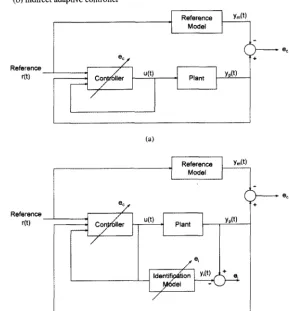
controller schemes fall under direct adaptive control class where the NN is used to update the controller parameters. Whereas, the NMPC is an indirect type of adaptive controller where the NN model is used to aid the existing conventional MPC controller to achieve the desired reference trajectory. Figure
I
shows the basic configuration structure of the direct and indirect adaptive control system for a dynamic system. In direct adaptive controllers, the control parameters are updated directly to minimise the tracking error. The calculationof the controller parameters or gains does not rely on the dynamic system to update the controller parameters. Whereas in the indirect adaptive control configuration, a dynamic model is used to predict the response of the dynamic plant. The prediction from the dynamic model is assumed to be identical to the actual response and this information is used to minimise the tracking error of the system.
The non-linear and high order dynamics behaviour of a rotorcraft is typically hard to model using first principle modelling approach (direct physical understanding of forces and moments balance
of
the vehicle), and such approach can be inaccurate (Budiyonoet
al.,2N9).
Dynamic model obtained using thefrst
principle approacb depends on many parameters which needs to be carefully identified through direct measurements ofgeometrical or structural data. For aerodynamic parameters estimation, detailed experiment needs to be performed using wind tunnel facilities. The principle modelling approach requires considerable amount of theoretical knowledge and experiences about the rotorqaft
flight
and potentially would not producea highly
accurate results unless performedrGN based training algorithm
for
neural networkmodelling
59 dynamic behaviours is unsatisfactory because ofthe accumulated uncertainty and modelling simplification (Mettler, 20031 Kendoul, 2012).Figure
1
The configuration of adaptive conroi system: (a) direct adaptive controller and (b) indirect adaptive conffollerSince the helicopter dynamics is nonlinear, the NN based system identification approach using the NNARX (Neural Network-Auto Regressive structure with eXtra inputs) model structure can be used
to
address sucha
problem. Here, the linear model structure such asARX
model structure was introduced as the basicNN
model structure whilestatic feed-forward multi-layered perceptron
(MLP)
network was usedto
introduce non-linearityinto
the model estimation. Similarto
stability featuresof ARX
model structure, the predictionfrom
theNNARX
model was considered stable since there60
S.S. Shamsudin and X.Q. Chenand Chen (2012) where the findings exhibit the capability ofneural network approach and its effectiveness in modelling the dynamic response accurately using second order method such as the Levenberg-Marquardt (LM) method.
Although the NN
is
superiorin
termsof it
prediction accuracy, the dynamic model identified from NN can be inaccurate due to many problems such as incorrect model structureselection, incorrect input vectors selection and over-fitting due to the excessive number
of
neurons. Previous attempts to model the non-linear unmanned helicopter dynamics using the off-line NN modelling has successfully modelled the dynamics of the helicopter, resulting in low mean or standard deviation of the residual values (Samal, 2009; Putro et al., 2009). However, past efforts in identifying the helicopter dynamics did not include the effect
of
embedded memory or model order of the NNARX networks on generalisation performance for the modelling problem considered. The validation methods introduced in this work can be used to ensure that the NNARX model fits well with observations and aid the neural network modeller to select the optimised network structure for prediction with an acceptable accufacy.
Furthermore, most NN based modelling techniques attempt to model the time varying dynamics of an UAS helicopter system using
offline
modelling approach. The model which is generated and trained once from previously collected data is not able to represent the entire operating points of the flight envelope very well (Samal, 2009). Several attempts such as Samal (2009), Samal et al. (2008, 2009) were made to update the NN prediction model during flightusing mini-batch LM training (LM training with small numberof data samples). However due to a limited amount of processing power available in the real-time processor, such methods can only be employed to relatively small networks and they are limited to model uncoupled helicopter dynamics. In order to accommodate the time-varying properties of helicopter dynamics which changes frequently during flight, a recursive based learning algorithm is required to properly track the dynamics of the system under consideration. Furthermore, the usage of recursive algorithms such as recursive Gauss-Newton (rGN) or recursive Levenberg-Marquardt (rLM) reduces the computation complexity of the off-line training method without having to invert thefull
Hessian matrix in every iteration (Ngia and Sjoberg, 2000).The present study is concemed with the modelling and identification of a helicopter based UAS. The multiJayer perceptron (MLP) network architecture is considered for this purpose and different network structures are compared and analysed
to
determine the optimised network structure, with good generalisation performance using the aid of the cross validation method proposed. Based on the network structure selection, a recursive prediction error algorithm such as the recursive Gauss-Newton method is proposed to train the neural network model. The generalisation and adaptability performance of the recursive algorithm is then compared with the off-line algorithm to verifyif
the prediction quality has improved over its off-line counterpart.2
Platform
description
The UAV platform which was used in this research is a conventional electric model helicopter
rGN based training algorithm
for
neural networkmodelling
6l
[image:6.594.150.376.221.364.2] [image:6.594.101.429.396.476.2]responses. Furthermore, TREX600 was also equipped with a high efficiency high torque brushless motor that allows the helicopter to carry about 2 kg payloads with an operation time of about 15 m. The basic UAV platform shown in Figure 2 had been modified to make room for installing necessary electronic equipments which gathers flight data for dynamic modelling and control system design. Some key physical parameters
of
TREX600 RC helicopter are given in Table 1.Figure
2
The TREX600 helicopter used in the system identification experiment withinstrumentation equipment fitted between fuselage and landing gear (see online version lbr colours)
Tabte
I
The specification of the TREX600 ESP helicopterSpetifications TREX6OO ESP
Length Height
Main Rotor Diameter Tail Rotor Diameter Weight
Endurance
l.16 m 0.4 m 1.35 kg 0.24 m 3.3 kg
l-5 min
3
Collection
offlight
data
The flight test was conducted on the UAV helicopter platform in calm weather conditions. Different flight manoeuvres were conducted to excite the desired dynamic of interest. For example, after the helicopter reached steady and level condition, the yaw dynamics was excited using only tail collective pitch command while other input commands were used to balance the helicopter in such a way to make the vehicle oscillate roughly around the operating point of interest.
Training and validation data were collected from specifically designed frequency swept excitation signal suggested in Tischler and Remple (2006). This type of signal is commonly used to collect experimental flight data
in
aircraft and rotorcraft system identification.62
S.S. Shamsudin and X.Q. ChenIt
is recommended that the pilot executes two good low frequency cycle inputs (20 s) and then gradually increase the swept frequency to mid and higher frequencies before ending the manoeuvre in the trim position. Starting and ending the recordin
aircraft trim state enables concatenating flight data collected from several test runs while at the same time ensuring rich signal content.All
measurements of the helicopter's state variables were collected using an inertial measurement unit (IMU) where the data that were recorded during test were Euler angles:roll
/,
pitch 0 and yaw V; angular rates in body coordinate frame: roll rate, p, pitch rate, q and yaw rate,r
and body accelerations: o", ao, a".The control inputs measured during the experiment were the stick deflection from the pilot's collective pitch 6,,,1, pedal 57,ea,longitudinal cyclic 56n and lateral cyclic d1o1. The four servomotor signals
":
lsette
sAUx sELE"rrof'
.can be translated to pilot's stick positions (Input range =
*1),
6:
l6u.6Lot 6"ot5r.o)'
,by means of a linear transformation:
6
:
A-r
("
- tr,o^)
(1)where .s1,;,, are the servo signals at trim values which indicate the necessary pulse width values to level the swash plate position. Matrix ,4 (mixing gains) has to be determined through the measurement
of
servo signalsfor
different stick positions to get the exact relationship between pulse width commands sent to the servos and the requested control inputs.The common frequency range
for
the excitation signal usedin
rotorcraft system identification and control are between 0.3-20 rad/s. It is also recommended in Tischler and Remple (2006) that an identical filter should be used for all output and input signals with a cut-off frequency 5 times higher than the maximum excitation signal frequency. Hence to reduce the noise in sensors data, thecuroff
frequency of the low pass filter used in this study was selected atl5
Hz. The sampling rate of the sensors was selected at 100 Hz which was at least 25 times higher than the maximum excitation frequency.4
Neural network model
structure
rGN based training algorithm
for
neural networkmodelling
63 The NN input-output relationship of a dynamic system described in this research was adapted from standard ARX (Autoregressive structure with extra inputs) model structure asin Ljung ( 1999). In a NN based ARX (NNARX) model structure, the variable to be estimated and other influencing variables including their time lags are typically fed into a static feed-forward network such as multi-layer perceptron (MLP) network (Samarasinghe, 2007). The
conceptual diagram of NNARX model structure used to identify the non-linear relationship of helicopter's attitude dynamics is shown in Figure 3. Note that the regression vector or inputs vector to the network is typically chosen to include ny past output measurement data and
n,
past input data. The number of past output and input data to be fed to the network is left for user choice.Figure
3
The NNARX model structure with preselected regression vectors (see online version for colours)Output Layer
Hidden Layer
lnput I Input 2
The fully connected MLP network architecture containing only one hidden layer, was chosen to leam the nonlinear relationship of the NNARX model. The output calculation from the
MLP structure to represent the NNARX predictor is given as follows:
'i
(tlo)
:
hi
(p, o)(i,r,^,,(i,^,,,
*
u,)
\fi
"\Fi
I
-D
- ri
*
br)
/
with,
h
:
I,2,3.-.
H
i,:1,2,3...n
(2)64
S.S. Shamsudin and X.Q. Chenand the parameter and regression vectors are given by:
0
:
l*ni
Wn
bI b2]e Q)
:
lP''Pr
" '
q,,]
:
fu(t),y(t
-
r),
"',aft -
n),
t\t),u(t-
1),..
.,rt(t
- n)]
where tr.r6; is the weights matrix between the input layer and the hidden layer and
I4l;'
is the weights matrix between the hidden layer and the output layer. The functionsf
iQ") andf;(*)
are non-linear activation function for neurons in each hidden and output layers. Thesymbol 11 denotes the number ofneurons in the hidden layer while bL and,b2 are the bias elements for the input layer and output layer. The number of inputs and outputs ofthe neural network are presented by rn. and n respectively.
5
Crossvalidation method
The choice
of
higher numberof
past output and inputwill
resultsin
a larger network architecture thatwill
have a lower MSE but poor generalisation ability (Billings et al., 1992). This means that the network model predicts the estimation data set (training set) withgreat accuracy but fails to represent a new data that was not used in the training process. Large assignment of hidden neurons also contributes to poor generalisation performance (Wilamowski, 2009).
Cross validation is a statistical method that is normally used in data mining problems to determine the model sffucture selection and to compare generalisation performance of
different learning methods. The simplest method to conduct validation analysis is to use the hold-out method where the measurement data is divided into training and test sets with user defined split ratio. Subsequently, the training set is used for model training and the test set data for error rate estimation of the trained model. However, the downside of this method is that the model evaluation can produces a high variance error. Depending on how the split ratio is defined, the prediction error evaluation may be inconsistent for different partitions of data that forms the training and test sets (Kohavi, I 995).
To overcome this problem and utilising the available overall data, the k-fbld cross-validation method was used to reduce the variance by averaging error over & data segments. Kohavi (1995) suggested that cross validation
with
10-20 folds would gives reasonable estimate with low bias and variance error. In this method, the measurement dataN
is splitinto
k
approximately equalM
size data segments. Then, the training and validation are performed for /c-iterations where within each iteration, a single portion of the data segment at a certain index location shown in Figure 4will
be used for validation after the trainingof the remaining k
-
1 data segments are completed. For each validation, the prediction MSE is calculated for the specific segment. The MSEs from each validation segment are averaged and combined together at the end of the iteration process using percentage root mean square error (% RMSE) as follows:(3)
RMSE:
r-t r/2
-l
-l
x100
I
N
KIVI
tf:,
Dlj,
(gt(t)
-
at(t))
(4)
rGN based training algorithmfor neural network
modelling
65 where9;(t)
denoted the predictedNN
model output from a specific /c-validation data segment,y;(l)
indicated the k-validation data segment andy(t)
is the mean value of the measurement data.Figure
4
The procedure of ft-fold cross-validation for A:
5 (see online version for colours)k=2
rtl
I
TI
-NOVh oooo@ uilud{ ooooo a0qoa
k:3
I"-,I
k=4
l-vl
k=5
I".
Training
Validation
6
Systemidentification
methodsThe system identification
for
inferring the helicopter dynamic model can be conducted using off-line (batch) and recursive based system identification methods. The estimation of a dynamic model in the off-line NN identification method involves the training process being canied out over some finite data gathered beforehand. Over the whole length of the data record, we determine the best weights (parameters vector 0) that give the best fit forthe measurement data over repetitive iterations. Obviously, the off-line methods have a disadvantage such as
it
is unsuitable for tracking time varying dynamics, as the amountof computation time for the training phase
in
each iteration might exceed the available processing time (Norgaard,2000). The adaptive control is an example where a model needsto be identified at the same time as a control law is calculated to compensate the time varying control variables. Even though the off-line training methods are not suitable for
66
S.S. Shamsudin and X.Q. ChenTo overcome the disadvantages of the off-line training methods, the recursive based system identification methods can be used in tracking time varying dynamics. The recursive model estimation
is
a system identification technique that enables us to infer a model that adapts to time-varying dynamics based on real-time data coming from the system. In contrast to off-line training method, the recursive methods enforce update to NN parameter vector based only on a single data at current sample t. To achieve real-time implementationof
the neural network based system identification, the estimationof
neural network's parameter vector d can be carried out using recursive algorithms as described in Billingset
al. (1992), Norgaard (2000), Youmin andLi
(1999), Ljung and Soderstrom (1983)' The recursive identification algorithms have several advantages over the batch methods. The implementation of the method is simpler, less memory-consuming with faster convergence since the redundancy in the data set is effectively utilised (Norgaard, 2000).Recursive algorithm can also be implemented similar to the
offline
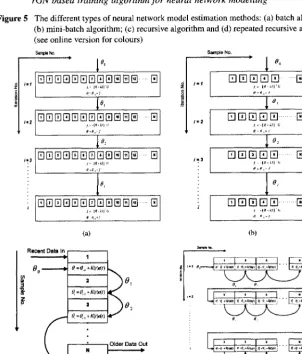
training where the recursive training is repeated several time on the finite training set Z N , collected in advance (Norgaard, 2000; Billings et al., 1991, 1992). Figure 5 shows the difference between the batch algorithm, mini-batch algorithm, on-line recursive algorithm and repeated recursive algorithm. The parameter vectord
updating process usually startwith initial
random weights andit
is carried out forward to the next iteration as computation progress. The implementation of batch and mini-batch algorithm is similar but differs in the number of data samples used for training. In the recursive algorithm methods, the parameter vector update is obtained in real-time as the measurement data become available from the instrumentation system. Figure 5(d) shows the implementation of recursive algorithm as anoffline
method. The parameter vector 0 is updated at each time samplet
over a fixed data sample. At the end of first iteration, the last parameter vector d is used as the initial update to the second iteration step. This iteration processwill
stoppedifthe
mean square criterion converges to pre-defined threshold as in batch training algorithm implementation.6.1
Off-Iine systemidentificationwith
neural networkAfter selecting the model structure, the next step in the system identification process is to determine the best weights (vector parameters d) that give the best fit between the NNARX
model and measurement data. This is achieved by minimisation
of
error cost function. As mentioned in Norgaard (2000), the measurement of prediction's closeness to the true outputs of the system is given by mean square elror (MSE) type criterion:,
1rt
v11(g,z1y.):
*Dla@-a(le)1',
(5)t:1
with linear approximation of prediction error given by:
e(t,0)=a(t)-0(tl0)
(6)rGN based training algorithmfor neural netvvork
modelling
67 Figure5
The different types of neural network model estimation methods: (a) batch algorithm;(b) mini-batch algorithm; (c) recursive algorithm and (d) repeated recursive algorithm
(see online version for colours)
Sreh No
i.t
:
:
I
EEEAEENEEEEE
Et. lt.ttl c
d fr,rl
p
EEEEEEEENEEE
Et "11'rt\ o
e'e,tl
0
EEEEEEEEEAEE
Et' l['rl .
A
NEEOEEEEEEAE
Et. tr. ill r
t t tt
0,,
trtrtrtrE]
tr
t . lP.;il (;
trtrtrtrtr
tr
| , lR,itl c
0.
trtrEtrtr
tr
I lR-itl i
0
trtrtrtrtr
tr
t -1e,il\ L
In
order to minimise the cost functionin
equation (5), the Levenberg-Marquardt (LM) iterative search algorithm was used for the neural network training process. The optimisation processis
carried out iteratively over a given data setto
achieve the minimum error criterion. TheLM
optimisation algorithm uses the Gauss-Newton GradientG(d)
and Hessian E(d) matrices, which were derived specifically for the neural network model in Yu and Wilamowski (2011), Ngia and Sjoberg (2000) and Norgaard (2000). These important matrices are represented in the following equations:lJl
G(0):
*> ,v(tl0)le(t,0)l
(7)t\t 4
- t:7
R (o)
:
*
f
,ll elo) bt)(tlo)f
(s)NL''' t:l
where
t!(tl|)
is the Jacobian matrix that represent the first derivative of the one-step ahead prediction with respect to parameters vector 0. The procedure to calculatematix
l!(tl9)
is68
S.S. Shamsudin and X.Q. Chengiven in detailed in Yu and Wilamowski (2011) and Norgaard (2000). The Hessian matrix
R(d) has a dimension of d
x
d and Gradient vector G(0) with dimension of dx
1, where d is the total number of elements (weights + biases) in the parameter vector d.We could find the minimum of the error criterion by iteratively solving the following
equations:
g(t+l)-6Q.)ay()
ln
(ot,';
+
r(o)1] yter:
-c
(oto)
(e)
(10)
where
/(t)
is the search direction vector,l
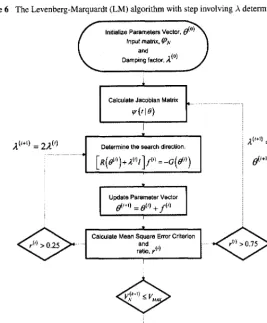
is the identity matrix and A(t) is a damping factor used for deciding the step size. In order to determine),
the indirect method used in Norgaard (2000) is adopted by calculating the following ratio to determine the accuracy ofapproximation:
(11)
eduction approximation
The main purpose of introducing the ratio calculation is to measure how well the reduction
of the criterion V1,1(0,
Zy)
matches the reduction predictedby
approximation terms in denominatorof
ratio calculationin
equation (11). The damping factorl
is
adjusted accordinglyto
the ratior(t) by
some factor (Norgaard, 2000). The procedureof
theLM
algorithm with indirect method to determine,\
is givenin
Figure 6. The reduction approximation (denominator term in equation (11)) is most likely a close approximation to error criterion Vy (0, Zy),
if
the ratior{t)
value is close to one and parameter)
should be reduced by some factor. However,if
the ratio r'(t) is small or a negative value, parameter)
should be increased. Additional stopping criterions are normally introduced to this algorithm to prevent minimisation problems or to force early stopping such as stopping criteria based on maximum number of iterations, sum of square error that drops below a certain threshold, upper bound for gradient and maximum weight change, maximum value of parameter ,\ or early stopping criterion due to training time constraint.6.2
Recursive system identification with neural networkRecursive model estimation is a system identification technique that enables us to infer a model that adapts to time-varying dynamics based on real-time datacoming from the system. To achieve real-time implementation of NN based system identification, the estimation of
neural network's parameter vector 0 can be carried out using recursive algorithms such as
described in Billings et al. (1992) and Youmin and
Li
(1999). Batch method described in the previous section is deemed unsuitable for tracking time varying dynamic as the amountof computation time
for
the training phasein
each iteration might exceed the available processing time (Norgaard, 2000).The recursive system identification method builds a model of the system at the same time as the measurement data is collected. The model is then updated at each time step, as
rGN based training algorithm
for
neural network modellingrecursive Gauss-Newton (rGN) method. For every data sample, the parameter vector d(f )
is updated by the recursive algorithm using the following equations:
69
e(t):
a(t)
-0(t)
R(t)
:
R(t
-
r)
+'y(t)1,/,
(t)rr-'
ft)',p' (t)
-
n(l
-
1)lA
til
:
A(t
-
1.)+
1,G)R-t
Q),1'(t)
i-t
1t1e 1t1(12) (13) (14)
where ,R(t) is an approximation of Gauss-Newton Hessian matrix, dt is the estimation of
pilameter vector of the NN model.
A-r (i;
is the weighting matrix and1(/)
is the gain sequence at the current time step f . The simplest choice of weighting matrixA-r
(l)
is an identity matrix as suggested by Billings et al. (1992). The forgetting factor)(f
) is definedas a constant scalar variable which accounts for the amount of past data information to be included
in
the error criterion function.If
the forgetting factoris
I(t)
<
1, the term would make the estimation more adaptable to changes and sensitive to noise. Whereas,if
[image:14.593.129.397.330.654.2]I(r)
-+
1 as time increases, more old data are included in the criterion and the adaptation would fluctuate less during the learning process (Youmin andLi,
1999).Figure
6
The Levenberg-Marquardt (LM) algorithm with step involving ^determination
lnitialize Parametes V*tor, B(o) tnput matnx, Qtt
ano Damping factor, 2(o)
1(i+tl _ 27(r)
r {rl
.1,+ll A' ' A'
'=-t
o(i+tl
-
0o Calculate Jacobian Matrixv(tlo)
ln(d")+,r(4r]l(') =
-c(di,)
Calculate lrean Squae Error Crllerlon and
70
S.S. Shamsudin and X.Q. ChenIn practice, equations (12)-(14) are not calculated straightforward with inversion of matrix
/i-
1 (r) which requires computational complexity of O(d3) (Ngia and Sjoberg, 2000). Ljung and Soderstrom (1983) had shown that using marix inversion theorem, the generalised rGN algorithm is rewritten to avoid full Hessian matrix inversion as follows:
p (t)
:
lp
(t-
1)-
L(t)
s*'
(r)Lr
(il)
l^(t)
s(r)
:
1!r(q
P Q-
t)
t:(r)
+
^
(r)
^(t)
L
(t)
:
P (r-
1) 4)(t)
S-1 (t)0(q:A(r-1)+
L(t)e(t)
(ls)
(16) (17) (18)
Note that the inversion of matrix
R-'(t)
had been reduced fromfull
inversion of dx
d matrix to S - I ( t ) withn
x
n dimension . Note that n denotes the number of outputs predicted in the model.Equations (15)-(18) indicates that initial value of
P(0)
(dx
d matrix) and parametervector
d(0)
need to be suppliedby
user at the beginningof
the iteration. The initialparameter
n".tot
d10; is usually selected as random values or pre-determined weights resulting from the off-line training. A common choice for P(0) isP(0)
:
pI
with p being a large positive number (i.e., 102-+
104) indicating little confidence in A1O;. This would cause the estimation to rapidly increase in the transient phase for a short period of timedl
(Ljung and Soderstrom, 1983). As the estimation of parameters are quite poor at the beginning of the iteration, a lower forgetting factor should be selected at the initial stage for rapid adaptation and approaching unity as the time increases. The following strategies introduced by Ljung and Soderstrom (1983) is used for updating the forgetting factor term:)(l):)")(t-1)+(1-)")
(1e)where .\n and
)(0)
are design variables. The typical values of )o is 0.99 and .\(0) is in the rangeof 0.95< )(0) <
1.According to Ljung and Soderstrom (1983), the recursion ofequation (15) is numerically unstable due to round-off errors which build up and influence
P(l)
to become indefinite. The numerical problem involving matrixP(t)
can also be corrected using several matrix factorisation techniques such as Potter's square root algorithm, Cholesky decompositionor
UD factorisation whichin
turn gives better numerical properties compared with the straightforward calculationof
P(t)
(Ljung and Soderstrom, 1983). The factorisation algorithmsrequiredroughly the same amountof computationtoupdateP(l)
inequation (15) (Bierman, 1977).ln
this work, the Potter's square root algorithmis
consideredfor
the problem because of the algorithm's simple implementation.The Potter's square root algorithm describes matrix P(f
)
in
termsof
the following factorisation:P
(t):
Q(t)Q'ft)
Qa)rGN based training algorithm
for
neural network modelling Table2
Potter's square algorithm7l
a) Initialise P(0)
:
Q(0)Q"'(0) at timet
:
0b) For each time step t, update Q(t
-
l)
by performing step 1-61. /(r)
:
Q'r (t-
r)Ik1)2.
p(t):
)(,)
+f''
(t)lG)
3
a(t):rtval+
J0@^ft-q]
4.
L(t)
:
Q (t-
r) .f (t)s.
Q (t):
lq
(t-
1) -_o (t) L (t)fr
(t)l
I\/^(t)
6'
Q @:'iffitria
Q) + p,,","1 c) Compute parameter vector as:A(r:
A(i
-
1) +L(t)le(t) lp@l
Figure
7
The recursive Gauss-Newton (rCN) algorithm with Potter's square root factorisationCalculat€ Jaobian Matdx
v {tlo)
72
S.S. Shamsudin and X.Q. ChenNotedthatthe manx
P(t)
inequation (15) mayhappentobe singularornearly singularif the model set contains too many parameters orif
the input signal is not general enough (Ljung and Soderstrom, 1983). This problem can be overcome by introducing a lower and upper bounds on the eigenvalues of P(f ). Several variations of recursive Gauss-Newton algorithms such as Constant Trace (CT) and Exponential Forgetting and Resetting Algorithm (EFRA) have been proposed in various examples to overcome the unstable numerical P(1) recursion (Norgarud, 2000; Salgado et al., 1988).By
using the CT method, Step 6in
Table 2 is introduced to bound the eigenvalues of theP(l).
Thep-o"
and p^rn are the maximum and minimum eigenvalues respectively, and the values are selected so thatp*o,
f p^nn=
L05. The initial Q(0) should be selected as a diagonal matix,p*inl
< 8(0) 3 P^o,l.
7
Results and discussionThe experimental data from different flight manoeuvres was collected and concatenated into a single recording with the measurements of the servo PWM signals were rescaled to the appropriate pilot's input command range. The flight test data were divided into training. validation and test data sets. The training and validation data sets were used for purpose of
NN training and model structure selection. The test data set was used for the final evaluation
of
theNN
model prediction accuracy. The pilot's input command rangeis
normalised between-
1 to + 1 for longitudinal cyclic, lateral cyclic and yaw pedal cyclic inputs, while the collective cyclic input is scaled between 0 to*1.
Using the collected data, the suitable regression vector structure and hidden neurons size were determined using the k-fold cross validation technique previously discussed.The lowest error resulting from the ,k-fold cross validation was used as the network structure
for
the recursive training algorithm.A fully
connected MLP architecture was used for the NN training in cross validation with the number of hidden neurons gradually increased. The tangent hyperbolic and linear activation functions were used in the hidden and output layer of the NN model. In this study, the flight data obtained from the experiment was divided into 10 approximately equal segments. In the validation stage, the error calculation was then storedfor
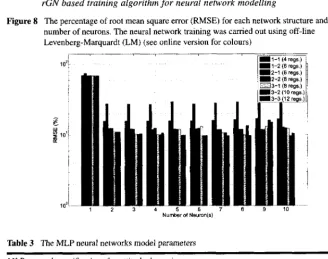
every network structure and hidden neuron case. Subsequently, the stored error calculation was then retrieved at the end of the validation cycle for RMSE computation.The results of k-fold cross validation for the off-line NN model is given in Figure 8. For each neuron size, different network structures were tested and compared with each other. From the plot, network sti'ucture with 3 past outputs and
I
past input (regression vector or input nodes with dimension size of 8) gives the lowest RMSE value for neurons size,fr,
:
4. This network structure was then used as the basic architecture for comparing the generalisation performance of the recursive Gauss-Newton method with theoffline
NN model. Note that the neuron size D,:
8 gives a comparable low RMSE values. However,rGN based
taining
algorithmfor
neural netvvork modellingFigure
8
The percentage of root mean square elror (RMSE) for each network structure and number of neurons. The neural network training was carried out using offJine Levenberg-Marquardt (LM) (see online version for colours)Thble
3
The MLP neural networks model parameters MLP nenvork specifications for attitude dynamics Number ofpast outputsNumber of past inputs
Number of neurons in hidden layer Activation function at hidden layer Activation function at output layer Number of regressors
Total number of weights Weight decay
73
3
I
^ Tanh Linear
a
46 0.0001
An example ofthe one-step ahead prediction ofthe angular rate responses that are estimated from the
offline
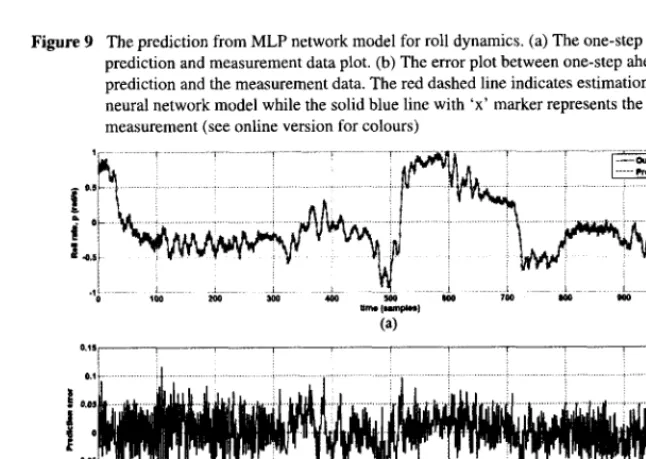
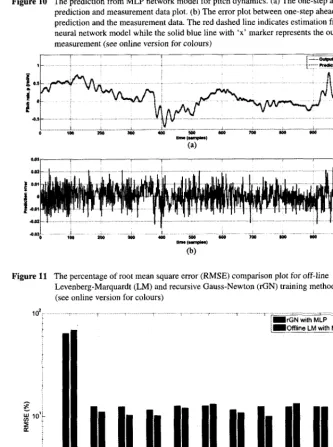
neural network system identification is shown in Figures 9 and 10. The network is trained using the nearly optimal structure from Table 3. These predicted responsesfrom neural network identification
(NNID)
are overlaidwith
the measured helicopter responses. The results indicate that one-step ahead NNID predictions overlap the test data almost perfectly as indicated by the magnitude orderof
the prediction error plot. This usually happens when the sampling frequency of the data collected is high compared with the frequency ofthe dynamic system as suggested in Norgaard (2000).This work also utilised the ,k-fold cross validation method to identify the efficiency
of
the selected neural networkraining
methodsin
estimating the attitude dynamicsof
74
S.S. Shamsudin and X.Q. Chenthis plot, we consider a network structure of 3 past output and
I
past input as a network structure for both training algorithms. The recursive training algorithm (rGN) exhibits aslightly higher generalisation error in cross validation compared with the off-line method. This indicates that training performed over a large data set would give better generalisation performance over the recursive method.
Even though the generalisation error of rGN is slightly higher than the
offline
LM, the rGN is more adaptive to the changes in dynamic properties. As a comparative study of the adaptability between the off-lineLM
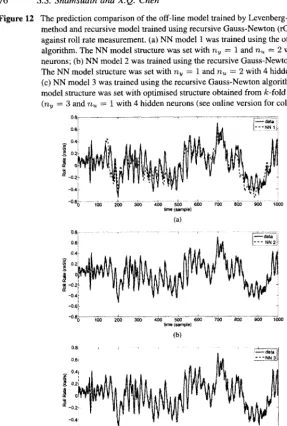
and rGN methods, the roll rate measurement from a new data set is considered. Figure 12 shows the prediction from a pre-trained model using off-line LM and rGN method. The corresponding error statistics for these prediction models is given in Thble 4. In Figure 12(a) and (b), the offJine model (NNl)
is pre{ained using 1 past output and 2 past inputs with 4 hidden neurons (training with746 samples) while the recursive model (NN 2) is also trained with the same model structure. The training ofrGN is carried out using the sliding window method where older data is discarded from the window to allow present data to enter. Thus, it can be seen that the off-line model follows the output measurement accurately at the beginning of the data length and its prediction begins to deteriorate for the remaining data. Whereas, the prediction from the model trained using rGN algorithm adapts well to the dynamic changes that occur during flight even though
it
was not trained using the optimal structure. In Figure 12(c), the prediction model (NN 3) using the optimal model structure
(n,
:
3, n.u:
I
with 4 hidden neurons) gives the best RMSE accuracy with t9.454% and 11.611% for roll rate and pitch rate respectively. Note thar the RMSE values for recursive training (NN3) is slightly higher than results obtained [image:19.592.91.415.398.628.2]in Figure I
I
since the recursive training is done with a single pass to the data compared with the results obtained in reoeated recursive trainins.Figure
9
The prediction from MLP network model for roll dynamics. (a) The one-step aheadprediction and measurement data plot. (b) The error plot between one-step ahead
prediction and the measurement data. The red dashed line indicates estimation from the neural network model while the solid blue line with 'x' marker represents the output measurement (see online version for colours)
hlm9L.) (a)
(b) I
t
It
rGN based training aQortthmfor neural netvvork
modelling
75 Figure10
The prediction from MLP network model for pitch dynamics. (a) The one-step aheadprediction and measurement data plot. (b) The error plot between one-step ahead
prediction and the measurement data. The red dashed line indicates estimation from the neural network model while the solid blue line with 'x' marker represents the output measurement (see online version for colours)
Figure
11
The percentage of root mean square error (RMSE) comparison plot for offJine Levenberg-Marquardt (LM) and recursive Gauss-Newton (rGN) training methods (see online version for colours)I
i
a
s
hlr$b) (b)
IIrGN
withMLP
i]llofiine
LM with MLP I'l
I
ltilltilililililll
2345678910
76 S.S. Shamsudin and X.Q. Chen
Figure
12
The prediction comparison of the off-line model trained by Levenberg-Marquardt (LM) method and recursive modei trained using recursive Gauss-Newton (rGN) method against roll rate measurement. (a) NN model I was trained using the off-line LM algorithm. The NN model structure was set with ny:
1 and nu:
2 wrth 4 hidden neurons; (b) NN model 2 was trained using the recursive Gauss-Newton algorithm. The NN model structure was set with as:
I
and nu:
2 \rtith 4 hidden neurons and (c) NN model 3 was trained using the recursive Gauss-Newton algorithm. The NN model structure was set with optimised structure obtained from ft-fold cross validation(n,
:
3 andrtu:
1 with 4 hidden neurons (see online version for colours)2@ 300
16o s6o
6b
zh tffi (smpl6)(a)
t-*-t
l--- NN2ile
E
t 42i
-0.1f
-0.61
"o r00 2m 3m 100 5@ 6@ 76 8m m 1@0 tm (smpl6)
(b)
tfr (smple) (c)
In on-line system identification for adaptive control application, the training time for NN model needs to be less than the sampling time of the control loop. This is essential since the control decisions need to be updated at the specific timing requirement (less than 22 ms). There are two type of recursive algorithm method exists to approximate the non-linear dynamics in real-time:
mini-batch methods (Samal, 2009; Puttige, 2009)
recursive prediction methods as presented in previous section.
{
E fi
-0.8
0.81
o4i
0.2
a
rGN based training algorithm
for
neural networkmodelling
77For mini-batch wise methods, the off-line training such as
LM
algorithm was used to train the NN in real-time by choosing smaller data length to achieve faster convergence time. Typically, a fixed amountof
input-output data is collected and storedin
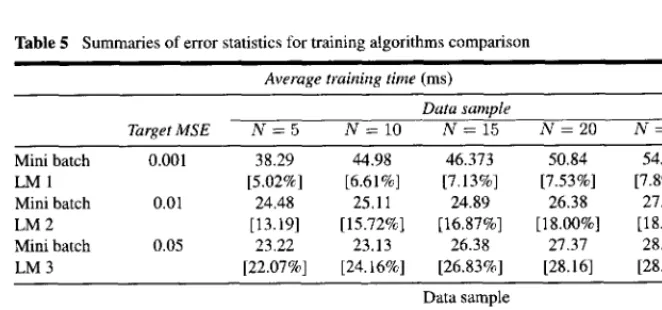
a queue. Table 5 shows the average training time for mini-batchLM
and rGN training algorithms for attitude dynamics identification using the optimal NN model structure(r4
:
3,rlu
: I
with 4 hidden neurons). The minimum criterion enor (MSE) was selected at 0.001, 0.01 and 0.05 as stopping criteria for mini-batch
LM
training. The training time comparison test was conducted using a 400 MHz National Instrument's real-time embedded controller. Result from the comparison test shows that faster training convergence is achieved with smaller batch sizes. However, mini-batch methodstill
requires alot
more computation resources and would not finish within targeted sampling period (22 ms). Attempts to reduce the training timeof
the NN training through manipulationof
target MSE values could improve the algorithm training performance, but at the expenseof
poor training error. A recursive training algorithm such as rGN usually demonstrates faster prediction updates and offers rapid computation of weight adaptation with average training time of 3.88 ms. The average training time forrGN algorithm is well below the control loop sampling period (22 ms) and this indicates that such recursive training algorithms are well suited for real-time applications.Table
4
Summaries of error statistics fbr training algorithms comparison Error statistic'sTraining System responses RMSE RMSE (Vo\ R"
NNI
p q 0.08891 0.03495 42.376 16.65'7 0.8506 0.964'7 NN2 D q 0.04907 0.03665 23.366 t7.454 0.9451 0.969r NN3 D q 0.09289 0.04244 19.454 I 1.61 10.9620 0.9863
Table
5
Summaries of error statistics for training algorithms comparison Average training time (ms)Target MSE Mini batch
LMI
Mini batch L]|d2 Mini batch
LM3
0.001
0.01
0.05
[image:22.594.100.431.332.436.2] [image:22.594.100.431.468.623.2]38.29
44.98[5.02Eo]
16.617o)24.48
25.11t13.i9l
l15.72qol23.22
23.13 122.0'7%ol [24.r6%al46.373 50.84
54.78[1.I3Eol
11.53%ol
l7.89Voj24.89
26.38
27.53116.8'lEol
[18.007o]
U8.47126.38
27.37
28.86l26.83Sal
t28.161
t28.481 Data sampleN=1
rGN 3.88
78 8
S.S. Shamsudin and X.Q. Chen
Conclusion
The methods and results presented in this paper indicate the suitability and effectiveness
of
offline
and recursive based neural network modellingfor
representing coupledUAS helicopter dynamics
with
acceptable accuracy. Results indicate that although the generalisation error of rGN is slightly higher than off-lineLM,
the rGN is more adaptiveto
the changesin
dynamic properties. The rGN methodis
also capable to produce a satisfactory prediction quality even-though the model structure was incorrectly selected. The generalisation and adaptability performance can be further improved by properly selecting the optimised network structure with the aid of k-fold cross validation method. It can also be concluded that the recursive method presented here is suitable to model the UAS helicopterin real-time within the computational resource constraints. These models can be further used for the design of adaptive flight controllers for autonomous flight.
Acknowledgement
S.S. Shamsudin acknowledges financial support
from Ministry
of
Higher Education, Malaysia underIPTA
Academic Training Scheme. The authors wouldlike to
thank technicians in Mechanical Engineering Department, University of Canterbury, in particular, Julian Mulphy and David Read for their invaluable assistance and support to our research project. The authors alsolike
to thank the reviewersfor
their suggestions which have improved the quality of the presentation.References
Agarwal, M. (1997) 'A systematic classification of neural-network-based control', Control Systerns,
IEEE,YoI. 17, No. 2, pp.75-93.
Balakrishnan, S.N. and Weil, R.D. (1996) 'Neurocontrol: a literature suruey', Mathematical and ComputerModelling,Yol.23,Nos. l-2,pp.l0l-117,doi:10.1016/0895-7177(95)00221-9. Bierman, G.J. (1977) Factorization Methods
for
Discrete Sequential Estimation, Volume 128,Academic Press, New York.
Billings, S.A., Jamaluddin, H.B. and Chen, S. (1991) 'A comparison of the backpropagation and recursive prediction error algorithms for training neural networks', Mechanical Systems and Signal Processing, Vol 5, No. 3, pp.233-255.
Billings, S.A., Jamaluddin, H.B. and Chen, S. (1992) 'Properties of neural networks with applications to modelling non-linear dynamical systems'. International. Journal of Control, Vol. 55, No. 1,
pp.193-224.
Budiyono, A., Joon, YK. and Daniel, F.D. (2009) 'Integrated identification modeling of rotorcraft-based unmanned aerial vehicle', lTth Mediterranean Conference on Control and Automation, 24-26 June, IEEE, Thessaloniki, Greece, pp.898-903.
Calise, A.J. and Rysdyk, R.T. ( 1998) 'Nonlinearadaptive flightcontrol using neural networks' , Control
Systems, IEEE,YoI. 1 8, No. 6, December, pp. 14-25, ISSN 1066-033X, doi: 10.1 109/37.736008.
rGN based training algorithm
for
neural networkmodelling
79 Jiang, 2., Han, J.D., Wang, YC. and Song, Q. (2006) 'Enhanced LQR control for unmanned helicopterin
hover', Ist International Symposium on Systems and Control in Aerospaceand Astronautics, 2006. ISSCM 2006. Ianuary. Harbin, China, pp.1438-l'143' doi:
10. 1 10945SCAA.2006. l 627s08.
Kendoul, F. (2012)'survey of advances in guidance, navigation, and control of unmanned rotorcraft systems', Joumal of Field Robotics, Vol. 29, No. 2, pp.315-378, ISSN 1556-4967.
Kohavi, R. (1995) 'A study of cross-validation and bootstrap for accuracy estimation and model selection',I/re 1995 InternatiortalJointConferenceonArtificiallntelligence,MorganKaufmann Publishers Inc., San Francisco, CA, USA, pp. I 137-1 145.
Ljung, L. (1999) System Identifcation: Theory for the lJser,2nd ed., Prentice Hall information and system sciences Series, Prentice Hall PTR, Upper Saddle River, NJ.
Ljung, L. and Soderstrom, T. (1983) Theory and Practice of Recursi't,e ldentifcation, The MIT Press series in signal processing, optimization, and control, MIT Press, Cambridge, Mass.
Mettler, B. (2003) Identification Modeling and Characteristics of Miniature Rotorcraft,
ls|
ed.,Kluwer Academic Publishers, Boston.
Ngia, L.S.H. and Sjoberg, J. (2000) 'Efficient training of neural nets for nonlinear adaptive filtering using a recursive levenberg-marquardt algorithm', IEEE Transactions on Signal Processing, Vol. 48, No. 1 , pp.19l5-1927 .
Norgaard,
M.
(2000) Neural. Nerworksfor
Modelling and Controlof
funamit' Systems: A Practitioner's Harulbook,2nded.,Advanced textbooks in control and signal processing, Springer, Berlin, New York.Putro, I.E., Budiyono, A., Yoon, K.J. and Kim, D.H. (2009) 'Modeling of unmanned small scale
rotorcraft based on neural network identification', 2008 IEEE International Conference on Robotics and Biomimetics, Bangkok, Thailand, pp. 1938-1943.
Puttige, V.R. and Anavatti, S.G. (2006) 'Real-time neural network based online identilication technique for a UAV platform', Intenwtional Conference on Computational futellig,ence
for
Modelling, Control and Automation, 2006 and International Confurence on InteLligent Agents, Web Technologies and Intemet Commerce, Sydney, NSW p.92-92.Puttige, V.R. (2009) Neural Nenvork based Adaptive Conftol for Autonomous Flight of Fixed Wing (Jnnanned AerietlVehicles,PhDThesis, School ofAerospace, Civil andMechanicalEngineering, Australian Defence Force Academy, University of New South Wales, August 2009, URL: http://handle.unsw.edu.au/l 959. 41 437 36.
Salgado, M.E., Goodwin, G.C. and Middleton, R.H. (1988) 'Modified least squares algorithm incorporating exponential resetting and forgetting', Intemational Journal of Control, Yol. 47, No.2, pp.477491, URL: http://wwwtandfonline.com/doi/abs/10.1080/00207178808906026. Samal, M.K., Anavatri, S. and Garratt, M. (2009) 'Real-time neural network based identification of a
rotary-wing UAV dynamics forautonomous flight' , IEEE International Conference on Industrial Technology,2009. ICIT 2009, Gippsland, VIC, pp.1-6.
Samal, M. (2009) Neural Network based Identification and Control of an Unmanned Helicopter,PhD Thesis, School of Engineering and Information Technology, University of New South Wales, Sydney. NSW Australia.
Samal, M.K., Anavatti, S. and Ganatt, M. (2008) 'Neural network based system identification for autonomousflightofaneaglehelicopter', lTthWorMCongressThelntemationaLFederationof Autotnatic Co n trol, Yol. 17, pp.7 421-7 426.
Samarasinghe, S .(2007) Neural NetworksforApplied Sciences and Engineering: From Fundamentals
to Complex Pattern Recognition,
lst
ed.. Auerbach Publications, Boca Raton, FL, ISBN08493337 5X, 97 808493 33750.
80
S.S. Shamsudin and X.Q. ChenShim, D.H. (2000) Hierarchical Flight Control System Synthesis for Rotorcraft based Unmanned Aerial Vehicles, PhD Thesis, University of California, Berkeley.
Sjoberg, J., Zhang, Q.H., Ljung, L., Benveniste, A., Delyon, B., Glorennec, P-Y., Hjalmarsson, H. and Juditsky, A. (1995) 'Nonlinear black-box modeling in system identification: a unified overview',
Automatica Vol. 31, No. 12, pp.169l-1724.
Suresh, S., Kumar, M.V., Omkar, S.N., Mani, V. and Sampath, P (2002) 'Neural networks based
identification of helicopter dynamics using flight data', 9th International Conference on Neural Information Processing ICONIP (2002),Vol. I, pp.l0-14.
Tischler, M.B. and Remple, R.K. (2006) A ircraft and Rotorcraft Systenr ldefiirtcafion : Engineering Metlnds with Flight-T?st Examples, AIAA education series. American Institute of Aeronautics and Astronautics. Reston, VA, 2006.
Wilamowski, B.M. (2009) 'Neural network architectures and learaing algorithms', Industrial Electronics Magazine, IEEE, Vol. 3, No. x, pp.56-63.
Youmin, Z. and R. Li. X. (1999) A fast U-D factorization-based leaming algorithm with applications to nonlinear system modeling and identilication' , IEEE Transactions on Neural Neflt,orks,Yol.10,
No.4, pp.930-938.