c
⃝T ¨UB˙ITAK
doi:10.3906/elk-1307-204 h t t p : / / j o u r n a l s . t u b i t a k . g o v . t r / e l e k t r i k /
Research Article
Modified particle swarm optimization for economic-emission load dispatch of
power system operation
Mohd Noor ABDULLAH1,2,3,∗, Abd Halim ABU BAKAR1, Nasrudin ABD RAHIM2,
Hazlie MOKHLIS2,3 1
Department of Electrical Power Engineering, Faculty of Electrical and Electronic Engineering, Universiti Tun Hussein Onn Malaysia, Batu Pahat, Johor, Malaysia
2
UM Power Energy Dedicated Advanced Centre, Wisma R&D UM, University of Malaya, Jalan Pantai Baharu, Kuala Lumpur, Malaysia
3
Department of Electrical Engineering, Faculty of Engineering, University of Malaya, Kuala Lumpur, Malaysia
Received: 25.07.2013 • Accepted/Published Online: 30.09.2013 • Printed: 31.12.2015
Abstract:This paper proposes a modified particle swarm optimization considering time-varying acceleration coefficients for the economic-emission load dispatch (EELD) problem. The new adaptive parameter is introduced to update the particle movements through the modification of the velocity equation of the classical particle swarm optimization (PSO) algorithm. The idea is to enhance the performance and robustness of classical PSO. The price penalty factor method is used to transform the multiobjective EELD problem into a single-objective problem. Then the weighted sum method is applied for finding the Pareto front solution. The best compromise solution for this problem is determined based on the fuzzy ranking approach. The IEEE 30-bus system has been used to validate the effectiveness of the proposed algorithm. It was found that the proposed algorithm can provide better results in terms of best fuel cost, best emissions, convergence characteristics, and robustness compared to the reported results using other optimization algorithms.
Key words: Economic-emission load dispatch, fuzzy satisfying method, particle swarm optimization, Pareto front solution, weighted sum method
1. Introduction
Nowadays the awareness of environmental pollution is increasing around the world. Many campaigns and
promotions have been launched to reduce the environmental pollution as well as greenhouse gases. Among the
major contributors of environmental pollution is the burning of fossil fuel in power generation [1]. Hence, it is
crucial to minimize the amount of emission releases from power generation.
Traditionally, power generation is determined solely based on minimizing fuel cost (called economic load
dispatch) [2]. However, regarding the awareness of environmental issues, the emission amount releases (i.e.
SOX, NOX) by thermal power generation should be considered in power dispatch. In [3,4], the economic load
dispatch problem was solved considering the emission level as a constraint, but it cannot provide the tradeoff
information between fuel cost and emission amount. By considering the emission level of the power generation, the electric power dispatch problem becomes a multiobjective optimization problem that requires optimization
of fuel cost and emission amount simultaneously [5].
There are two different ways to solve economic-emission load dispatch (EELD) problems. The first
ap-proach is called the multiobjective optimization method, directly applied to multiobjective optimization
prob-lems. Algorithms such as modified adaptive θ-particle swarm optimization (MA θ-PSO) [6], θ-multiobjective
teaching learning based optimization (θ-MTLBO) [7], hybrid multiobjective optimization (MO-DE/PSO) [8],
and strength Pareto evolutionary algorithm (SPEA) [9] have been applied for EELD problem. The second
approach is transforming the multiobjective problems into single-objective problems by using the price penalty
factor (PPF) approach. In this approach, the weighted sum method (WSM) is commonly applied to obtain a
Pareto optimal solution [10]. The modified bacterial foraging algorithm (MBFA) [11], charged system search
algorithm (CSS) [12], genetic algorithm (GA) [13], and gravitational search algorithm (GSA) [14] have been
used to solve EELD problems based on this approach. In addition, the conic scalarization method (CSW) was
first implemented in [15] for EELD problems and can be an alternative approach to the WSM.
In multiobjective problems, no single solution can be found, and thus a set of possible solutions called
nondominated solutions (or Pareto front solutions) should be obtained in order to satisfy the desired objective
function (i.e. total fuel cost and emission amount). In [14,16,17], the best compromise solution (in the set
Pareto front solution) was obtained by implementing fuzzy set theory. It can help the system operator choose
the best compromise solution among multiple solutions obtained by the multiobjective optimization method.
In the literature, the PSO algorithm is widely applied in power system optimization problems [18–20].
This is due to the advantages of PSO such as less complexity, fast convergence, and free-derivative algorithm. However, the classical PSO algorithm may converge at local minima, especially for complex problems with
multiple local minima. Many PSO variants were proposed in [21–25] in order to enhance the searching capability
of classical PSO.
In this paper, a new variant of PSO named modified particle swarm optimization considering
time-varying acceleration coefficients (MPSO-TVAC) is proposed for the EELD problem. A new adaptive parameter
is introduced for updating the particle movement in order to prevent the particle being trapped at a local
solution (premature convergence). The PPF approach is adopted to transformed the multiobjective EELD
problem into a single-objective problem. Then the weighted sum method is applied in order to capture a set of Pareto front solutions. The best compromise solution is obtained by using fuzzy set theory. The results found
by the MPSO-TVAC algorithm are compared with the results obtained by other algorithms in the literature.
This paper is arranged as follows. Section 2 describes the mathematical formulation of the EELD problem.
Section 3 reviews some PSO algorithms and explains the proposed MPSO-TVAC. Section 4 describes how to apply MPSO-TVAC for solving the EELD problem. The performance analysis and the comparison study with
the results of existing algorithms are provided in Section 5. Section 6 draws the conclusions.
2. Problem formulation
2.1. Objective functions
2.1.1. Economic load dispatch problem
The main objective of this problem is to distribute the power demand to the scheduled generator at a minimum
total fuel cost (FC). With Ng scheduled generators to operate, the totalFC can be formulated as
F C = N g ∑
i=1
F Ci(Pi) = N g ∑
i=1
wherePi = real power output of ith generator (MW);ai,bi, and ci = fuel cost coefficients of the ith generator;
and F Ci = fuel cost for the ith generator.
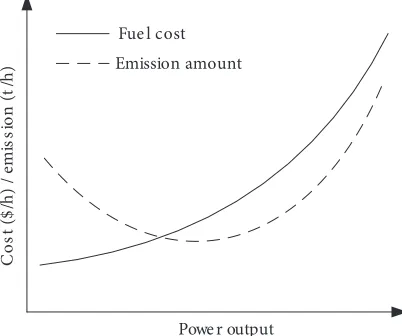
The fuel cost characteristics of the thermal generator are shown in Figure 1 (solid line).
Powe r output
C
o
s
t
($
/h
)
/
em
is
s
io
n
(t
/h
)
Fue l cost
[image:3.612.176.377.148.316.2]Emission amount
Figure 1. Fuel cost and emission function of the thermal generator.
2.1.2. Emission dispatch problem
The main objective of this problem is to distribute the power demand to the scheduled generator at minimum
total emission amount (EM) caused by the thermal generator (i.e. SOX, NOX) . The total emission amount
can be modeled as a combined quadratic and exponential function as shown in Figure 1 (dashed line) and
formulated as [26]:
EM =
N g ∑
i=1
EMi(Pi) = N g ∑
i=1
10−2(αiPi2+βiPi+γi) +ξiexp(λiPi)t/h, (2)
where αi, βi, γi, ξi, and λi = pollution coefficients of the ith generator, and EMi = emission amount for
the ith generator.
2.2. System and operational constraints
The minimization of both problems is subjected to the following constraints:
Power balance constraints: The total generated power must be equal to the total power demand (PD)
and transmission loss (PL) as given in Eq. (3).
N g ∑
i=1
Pi=PD+PL (3)
There are two methods that can be used to calculate the transmission loss: the power flow method [27] and the
B-coefficients method (Kron’s formula) [23]. In this paper, the B-coefficients method is adopted in line with the
previous research done in [12,16,26] based on following formula:
PL= N g ∑
i=1 N g ∑
j=1
PiBijPj+ N g ∑
i=1
where Bij, Bi0, and B00 = the loss coefficient matrix.
Generation limit constraints: The power output of the scheduled generator is limited by the minimum
limit (Pmin
i ) and maximum limit (Pimax) for stable operation as follows:
Pimin≤Pi ≤Pimax. (5)
2.3. Economic-emission load dispatch problem
The total fuel cost and emission amount in Eqs. (1) and (2) should be minimized simultaneously in order to
satisfy both objectives mentioned in Section 2.1. Figure 1 shows the behavior of the fuel cost and emission characteristics of the thermal generator. These two conflicting objectives give a set of possible optimal solutions
instead of one optimal solution. Therefore, this problem can be solved by transforming the multiobjective
optimization problem into a single-objective function by using the appropriate PPF [14]. The PPF is used to
blend the emission level into cost level as described in [28]. The new objective function (OF) for the EELD
problem can be formulated as:
M inOF =k×F C+ (1−k)×ppf×EM (6)
where k = weight factor for total fuel cost (FC) and total emission (EM).
A set of Pareto front solutions can be produced by assigning the weight factor kbetween 0 to 1 [12,14,29].
Ifk is set to 1,OF represents the minimizing fuel cost only, whereas if k is set to 0,OF is to minimize emission
only.
The minimization of Eq. (6) is subjected to the constraints in Eqs. (2) to (4). The k value is increased
from 0 to 1 by an increment step of 0.1 in order to achieve the set of Pareto front solutions. This set of solutions called Pareto front solutions can provide multiple solutions to the decision-makers in order choose a desired
solution based on their preferences. In addition, the best compromise solution can be selected based on fuzzy set theory as explained in the next section.
2.4. Best compromise solution based on fuzzy theory
To help the system operator make a balanced decision between two objectives in the multiobjective EELD
problem, the best compromise solution can be determined by using the fuzzy satisfying method. In this approach,
each objective function (Fi) will be transformed into a fuzzy set (membership function) to represent the degree
of membership in fuzzy sets based on a value within 0 to 1 [30]. It can be calculated by using the following
equation:
µ(Fi) =
1 Fi≤Fmin
i Fmax
i −Fi Fmax
i −Fimin
Fimin< Fi< Fimax
0 Fi≥Fimax
, (7)
whereFimin and Fimax = the lower and higher value of each Fi, respectively; µ(Fi) = 1 and means the
membership function is completely satisfied with the sets; and µ(Fi) = 0 and means the membership function
is unsatisfied with the sets.
The sum of the membership function for all objective functions is computed in order to evaluate each
M number of nondominated solutions and represented as a fuzzy cardinal priority ranking (µk) as follows:
µk=
∑N i=1µ
k Fi ∑M
k=1 ∑N
i=1µkFi
, (8)
where i = number of objective functions (i= 1,2,. . .N) and k = number of nondominated solutions (k=
1,2,. . . ,M) .
Therefore, the best compromise solution among the nondominated solutions is selected according to the
highest value of .(Max µk ; (k= 1,2,. . . ,M)) .
3. Proposed MPSO-TVAC algorithm
3.1. The PSO algorithm
PSO is one of the metaheuristic methods that is widely implemented in optimization problems. This
population-based approach was first introduced by Kennedy and Eberhart in 1995 [31]. The principle operation of PSO is
inspired by the behavior of fishes schooling and birds flocking.
In PSO, a population consists of a number of particles that represent the possible solution. Every particle
will move around dth dimensional solution space for finding an optimal solution. The movement of a particle
is guided by it best personal experience (pbest) and best group experience (gbest). In the jth iteration, the ith
particle in a population has memorized its own position and velocity, presented as vector xji = [xji1,xji2,. . . ,xjid]
and vji= [vji1, vij2,. . . ,vjid], respectively. Thus, the particle will be updated according to the previous experience
based on the following equations:
vidj+1=wjvjid+c1r1(pbestjid−x j
id) +c2r2(gbestjd−x j
id), (9)
xjid+1=xjid+vjid+1, (10)
where r1 and r2 are independent random numbers between 0 and 1. c1 and c2are the cognitive acceleration
coefficient and the social acceleration coefficient, respectively. pbestis the individual best position represented as
pbestji= [pbestji1,pbestji2,. . . , pbestjid]. gbest is the group best position or the global best position represented
as gbestjd= [gbestj1, gbestj2,. . . , gbestjd]. w is the inertia weight factor and can be calculated using Eq. (11) [32]:
wj =wmax− (
wmax−wmin jmax
)
×jj = 1,2,. . . itermax, (11)
Wherewmin and wmax = the initial and final inertia weights, respectively, and jmax = maximum iteration
number.
The inertia weight should vary linearly from 0.9 to 0.4 during the iterative process as suggested in [32,33]
for better exploration and exploitation of the global search.
3.2. Review of PSO-TVAC algorithm
Since the parameter selection ofc1 and c2 affects the performance of the PSO algorithm, PSO with time-varying
the value ofc2 decreases linearly according to the iteration number. The varying of these coefficients is calculated as follows:
c1(j) =c1i+ (c1f−c1i)× j jmax
, (12)
c2(j) =c2i+ (c2f−c2i)× j jmax
, (13)
wherec1i and c1f = the initial and final values of the cognitive coefficient andc2iand c2f = the initial and final
values of social coefficient.
3.3. Proposed MPSO-TVAC
To improve and enhance the performance and robustness of the aforementioned PSO, MPSO-TVAC is proposed.
An adaptive parameter is introduced into Eq. (9) for updating the particle movement and is defined as a best
neighbor particle (rbest). The idea is to enhance the exploration and exploitation of the algorithm by providing
extra information to each particle.
In this approach, each particle has its own rbestji= [rbestji1, rbestji2,. . . , rbestjid], which is randomly
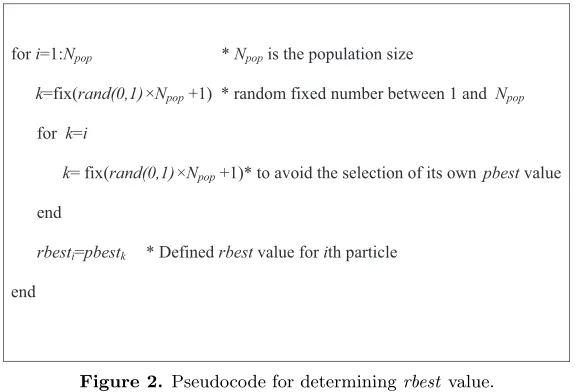
selected from the best position (pbest) of other particles. The pseudocode for determining an adaptiverbesti
value for the ith particle is shown in Figure 2.
for i=1:Npop * Npop is the population size
k=fix(rand(0,1)×Npop +1) * random fixed number between 1 and Npop
for k=i
k= fix(rand(0,1)×Npop +1)* to avoid the selection of its own pbest value
end
rbesti=pbestk * Defined rbest value for ith particle
[image:6.612.134.423.351.547.2]end
Figure 2. Pseudocode for determiningrbest value.
Presenting an adaptive parameter in Eq. (9), the new updated velocity can be formulated as follows:
vjid+1=wjvidj +c1r1(pbest j id−x
j
id) +c2r2(gbest j d−x
j
id) +c3r3(rbest j id−x
j
id), (14)
wherec3 = the acceleration coefficient that pulls the particle towardsrbest.
As mentioned in [31], a high value of c1and small value of c2 in early iterations will push the particle
to move the entire solution space and high values of c2 and small values of c1 in later iterations will pull the
particle to a local solution (premature convergence).
Therefore, in MPSO-TVAC, the values of c1 and c2 vary according to the iteration number, similar as
PSO-TVAC, by using Eqs. (12) and (13), while the value of c3 varies according to the following equation:
Presenting the best neighbor particle (rbest) and TVAC approach for all acceleration coefficients in Eq. (14)
will encourage every particle to converge at the global/near-to-global solution. The extra information provided
by therbest parameter enhances the searching behavior and avoids convergence at local solutions. Therefore,
the proposed algorithm can improve the solution quality and produce consistent results after different trials.
4. MPSO-TVAC algorithm for solving EELD problems
The implementation step of the MPSO-TVAC algorithm for EELD is discussed in this section. The following
steps should be performed in order to determine the optimal generator output considering the minimization of fuel cost and emission amount simultaneously.
Step 1: Input data required for EELD problem.
Step 2: Initialize the MPSO-TVAC parameters such as acceleration coefficients (c1i, c1f, c2i, c2f, and
c3) , inertia weight (wmax and wmin) , population size (Npop) , and maximum iteration ( jmax) .
Step 3: Define the problem variables. In EELD, the real power output (Pid) is a problem variable
in the dth dimension. The ith particle for each generator is randomly generated according to Eq. (5) as
Pid =Pidmin+rand× (P max id −P
min id ) .
Step 4: Evaluate the fitness function. Each possible solution is evaluated based on the given fitness
function. The fitness function is to integrate theOF in Eq. (6) with the penalty function in order to meet the
real power demand constraint in Eq. (3). It is required to be minimized and formulated as follows:
Fitnessf(Pi) =
N g ∑
i=1
OFi+α×abs (N g
∑
i=1
Pi−(PD+PL) )
, (16)
where α = the penalty factor for satisfying the real power demand constraints.
Step 5: Based on the calculated fitness function the pbest, gbest, and rbest values are determined as explained Section 3.
Step 6: The particle movement (for the next iteration) is updated by utilizing Eqs. (14) and (15).
Step 7: Constraint handling. If the updated position (Pidj+1) is violating the generation limit in Eq. (4) it will replace its limit value as follows:
Pidj+1=
Pidj +vidj+1 if Pmin
d ≤P
j+1 id ≤P
max d Pmin
d if P
j+1 id ≤P
min d Pmax
d if P
j+1
id ≥Pdmax
. (17)
Step 8: Repeat Steps 4–7 until maximum iteration is reached. Then the best optimum solution is selected.
Step 9: In EELD, Steps 1–8 should be repeated for each value ofk by changing the value ofkin steps of
0.1 (0 ≤k≤ 1). The best results obtained are recorded in an array according to the value of k, which known
as a set of Pareto optimal solutions.
5. Simulation results and discussion
To validate the performance of the proposed MPSO-TVAC, 50 different trials are carried out for each case study.
The results obtained are compared with PSO-TVAC and other algorithms in the literature. The algorithms are performed using MATLAB 7.6 on a Core 2 Quad processor, 2.66 GHz and 4 GB RAM.
5.1. Power system benchmark
The IEEE 30-bus six-generator system [8,9] is used as a test system to validate the effectiveness of the
MPSO-TVAC algorithm. The total load demand of the system is 2.834 p.u. There are two case studies considered as
follows:
Case 1: For simplicity, the test system without transmission losses is considered in order to compare
[image:8.612.91.463.283.386.2]with reported results in the literature. All data are presented in Table 1 [8].
Table 1.Fuel cost and emission data for IEEE 30 bus six system.
Gen. Cost coefficients Emission coefficients Gen. limit
a b c α β γ ζ λ Pmin Pmax
1 100 200 10 4.091 –5.554 6.49 2.0E-4 2.86 0.05 0.50
2 120 150 10 2.543 –6.047 5.638 5.0E-4 3.33 0.05 0.60
3 40 180 20 4.258 –5.094 4.586 1.0E-6 8.00 0.05 1.00
4 60 100 10 5.326 –3.55 3.38 2.0E-3 2.00 0.05 1.20
5 40 180 20 4.258 –5.094 4.586 1.0E-6 8.00 0.05 1.00
6 100 150 10 6.131 –5.555 5.151 1.0E-5 6.667 0.05 0.60
Case 2: In this case, the same test system with transmission losses is considered. The transmission
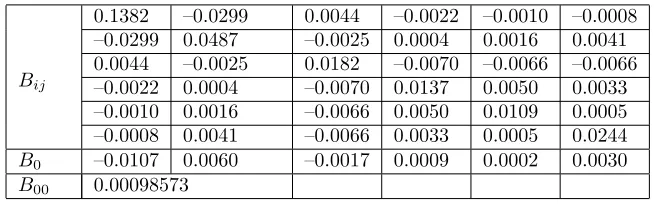
[image:8.612.112.439.458.560.2]losses are calculated according to Eq. (4). Table 2 shows the B-loss coefficient matrix for this case study [8].
Table 2. B-loss coefficients for IEEE 30 bus system.
Bij
0.1382 –0.0299 0.0044 –0.0022 –0.0010 –0.0008
–0.0299 0.0487 –0.0025 0.0004 0.0016 0.0041
0.0044 –0.0025 0.0182 –0.0070 –0.0066 –0.0066
–0.0022 0.0004 –0.0070 0.0137 0.0050 0.0033
–0.0010 0.0016 –0.0066 0.0050 0.0109 0.0005
–0.0008 0.0041 –0.0066 0.0033 0.0005 0.0244
B0 –0.0107 0.0060 –0.0017 0.0009 0.0002 0.0030
B00 0.00098573
5.2. Parameter setting
The best parameter settings for the PSO-TVAC and MPSO-TVAC algorithms used in this paper are presented in Table 3. These values were obtained by several experiments in order to produce the best results for solving
the IEEE 30-bus six-generator system.
Table 3.Parameter setting for the selected algorithm.
Algorithm c1 c2 c3 wmin wmax Npop jmax
MPSO-TVAC c1i= 1.0c1f = 0.2 c2i= 0.2c2f = 1.0
c3=c1∗
0.4 0.9 50 500
(1-exp(−c2∗j))
Table 4 shows the effect of population size (Npop) of the proposed algorithm for minimization of fuel
cost and emission amount. Increasing the Npop size produced the same results. However, the simulation time
[image:9.612.74.479.176.264.2]is increased according to Npop size.
Table 4. Effect of the population size using proposed MPSO-TVAC (case 2).
Npop Best fuel cost Best emission
Cost ($/h) Emission (t/h) Time (s) Emission (t/h) Cost ($/h) Time (s)
10 606.0009 0.220934 0.90 0.194179 646.2279 0.88
20 605.9984 0.220730 1.75 0.194179 646.2072 1.75
30 605.9984 0.220729 2.69 0.194179 646.2070 2.68
40 605.9984 0.220729 3.55 0.194179 646.2070 3.53
50 605.9984 0.220729 4.47 0.194179 646.2070 4.47
5.3. Simulation results
The proposed MPSO-TVAC algorithm has been tested according to the following objectives:
i. Minimize fuel cost function only.
ii. Minimize emission function only.
iii. Minimize fuel cost and emission function simultaneously.
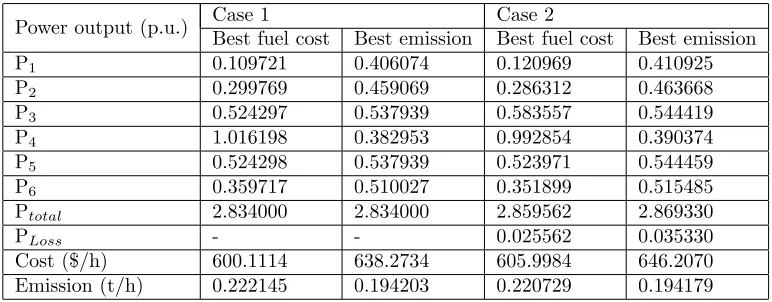
Table 5 presents the optimal power output for the best fuel cost and the best emission obtained by the
MPSO-TVAC algorithm. It shows that the generator output produced satisfies all the constraints in Eqs. (3)
[image:9.612.83.469.506.657.2]and (5).
Table 5. The best individual fuel cost and emission obtained by MPSO-TVAC algorithm.
Power output (p.u.) Case 1 Case 2
Best fuel cost Best emission Best fuel cost Best emission
P1 0.109721 0.406074 0.120969 0.410925
P2 0.299769 0.459069 0.286312 0.463668
P3 0.524297 0.537939 0.583557 0.544419
P4 1.016198 0.382953 0.992854 0.390374
P5 0.524298 0.537939 0.523971 0.544459
P6 0.359717 0.510027 0.351899 0.515485
Ptotal 2.834000 2.834000 2.859562 2.869330
PLoss - - 0.025562 0.035330
Cost ($/h) 600.1114 638.2734 605.9984 646.2070
Emission (t/h) 0.222145 0.194203 0.220729 0.194179
The comparison of convergence characteristics of MPSO-TVAC and PSO-TVAC for minimizing fuel cost
600 605 610 615 620 625 630 635
0 50 100 150 200 250 300 350 400 450 500
Fuel cost (
$/h)
Iterations
[image:10.612.165.390.92.226.2]MPSO-TVAC PSO-TVAC
Figure 3. Convergence characteristics of MPSO-TVAC and PSO-TVAC (case 2).
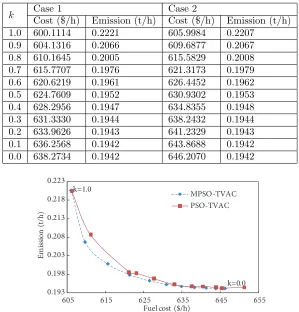
In order to minimize the combined fuel cost and emission function, the value of k in Eq. (6) is varying
from 0.0 to 1.0 with steps of 0.1 for each simulation. The results obtained by the proposed MPSO-TVAC are presented in Table 6. Figure 4 shows the comparison of the Pareto optimal solution achieved by the
MPSO-TVAC and PSO-MPSO-TVAC algorithms according to different k values. This set of solutions can be used by system
[image:10.612.128.424.349.667.2]operators to choose the best solution based on their preferred objective according to the k value.
Table 6. Optimal fuel cost and emission solution using proposed MPSO-TVAC.
k Case 1 Case 2
Cost ($/h) Emission (t/h) Cost ($/h) Emission (t/h)
1.0 600.1114 0.2221 605.9984 0.2207
0.9 604.1316 0.2066 609.6877 0.2067
0.8 610.1645 0.2005 615.5829 0.2008
0.7 615.7707 0.1976 621.3173 0.1979
0.6 620.6219 0.1961 626.4452 0.1962
0.5 624.7609 0.1952 630.9302 0.1953
0.4 628.2956 0.1947 634.8355 0.1948
0.3 631.3330 0.1944 638.2432 0.1944
0.2 633.9626 0.1943 641.2329 0.1943
0.1 636.2568 0.1942 643.8688 0.1942
0.0 638.2734 0.1942 646.2070 0.1942
0.193 0.198 0.203 0.208 0.213 0.218 0.223
605 615 625 635 645 655
E
m
is
si
on
(t
/h)
Fuel cost ($/h)
MPSO-TVAC PSO-TVAC k=1.0
[image:10.612.126.425.351.663.2]k=0.0
Figure 4. The optimal solution according to weight factor (case 2).
as compared to PSO-TVAC. Moreover, the total objective function (OF) in Eq. (6) obtained by the proposed
[image:11.612.100.451.148.326.2]algorithm is smaller than that obtained by PSO-TVAC.
Table 7. The best compromise solution according to fuzzy set theory.
Output Case 1 Case 2
MPSO-TVAC PSO-TVAC MPSO-TVAC PSO-TVAC
P1 0.261014 0.239199 0.252759 0.336156
P2 0.375496 0.417883 0.371616 0.376469
P3 0.539481 0.636733 0.565826 0.573600
P4 0.686269 0.678224 0.689033 0.645759
P5 0.539481 0.452467 0.549576 0.501686
P6 0.432258 0.409495 0.431222 0.429128
Ptotal 2.834000 2.834000 2.860033 2.862798
PLoss - - 0.026033 0.028798
Cost ($/h) 610.1645 611.2755 615.5829 621.1694
Emission (t/h) 0.200527 0.201460 0.200841 0.198514
PPF 5928.71345 5928.71345 5928.71345 5928.71345
OF 725.9048 727.90069 730.6115 732.3225
5.4. Comparison of the best results
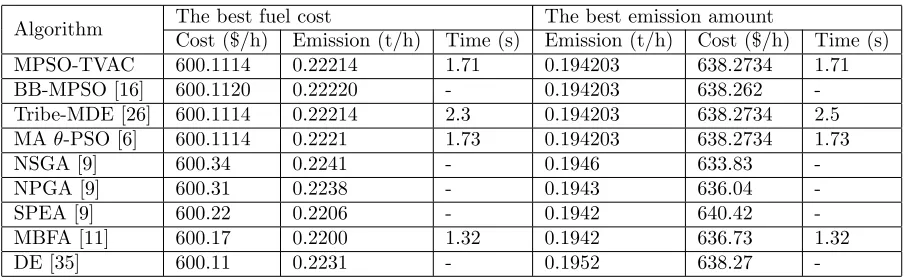
To verify the performances of the MPSO-TVAC algorithm, the best results obtained are compared with some
reported results in the literature. In case 1, the best fuel cost and emission amount obtained by the proposed
solution are compared with the results of BB-MPSO [16], Tribe-MDE [26], MA θ-PSO [6], NSGA [9], NPGA
[9], SPEA [9], MBFA [11], and DE [35] as given in Table 8.
Table 8. The best results obtained by various algorithms (case 1).
Algorithm The best fuel cost The best emission amount
Cost ($/h) Emission (t/h) Time (s) Emission (t/h) Cost ($/h) Time (s)
MPSO-TVAC 600.1114 0.22214 1.71 0.194203 638.2734 1.71
BB-MPSO [16] 600.1120 0.22220 - 0.194203 638.262
-Tribe-MDE [26] 600.1114 0.22214 2.3 0.194203 638.2734 2.5
MAθ-PSO [6] 600.1114 0.2221 1.73 0.194203 638.2734 1.73
NSGA [9] 600.34 0.2241 - 0.1946 633.83
-NPGA [9] 600.31 0.2238 - 0.1943 636.04
-SPEA [9] 600.22 0.2206 - 0.1942 640.42
-MBFA [11] 600.17 0.2200 1.32 0.1942 636.73 1.32
DE [35] 600.11 0.2231 - 0.1952 638.27
-‘-’: not mentioned in the reference.
In terms of fuel cost, the best results achieved by the proposed algorithm are better than with other
algorithms and equal to the latest results obtained Tribe-MDE [26] and MA θ-PSO [6]. For the best emission
amount, the result obtained is essentially the same as the results of BB-MPSO [16], Tribe-MDE [26], and MA
θ-PSO [6].
In case 2, the comparison of best fuel cost and emission amount produced by the proposed algorithm are
presented in Table 9. It was compared with the results of BB-MOPSO [16], Tribe-MDE [26], MA θ-PSO [6],
[image:11.612.50.505.449.589.2]algorithm to achieve the best fuel cost and emission amount is 1.75 s. However, the simulation time obtained by published results is not reported in order to make a comparison.
The individual best fuel cost and emission amount achieved by the proposed algorithm is slightly better
than other algorithms and the same as the best results obtained by Tribe-MDE [26] and MA θ-PSO [6]. When
analyzing the results in Table 9, some results are violating the power balance constraints in Eq. (3), where the
value of ∆P (PD−∑(Pi)−PLoss) is not equal to zero. From these comparisons, MPSO-TVAC is capable of
obtaining the best results as well as satisfying power balance constraints ( ∆P= 0) effectively.
5.5. Robustness analysis
In order to show the consistency results produced by the proposed algorithm, 50 different trials have been
conducted for each algorithm. This analysis is important to analyze the performance of metaheuristic algorithms like PSO due to the random number involved during optimization processes. The algorithm is more robust when
it is capable of producing consistent results (at global solutions) after several trials.
Figures 5 and 6 show the distribution of the optimal results obtained by the proposed MPSO-TVAC and
PSO-TVAC during 50 different trials. It clearly shows that the MPSO-TVAC algorithm can produce consistent results at the lowest fuel cost and emission.
605 606 607 608 609 610 611 612 613
0 5 10 15 20 25 30 35 40 45 50
Fuel cost (
$/h)
Trials PSO -TVAC
MPSO-TVAC
0.1954
0.1952
0.1950
0.1948
0.1946
0.1944
0.1942
0.1940
0 5 10 15 20 25 30 35 40 45 50 Trials
Emi
ssio
n (t
/h
)
PSO-TVAC
[image:13.612.41.517.340.479.2]MPSO-TVAC
[image:13.612.270.499.341.476.2]Figure 5. Best fuel cost after 50 different trials (case 2). Figure 6. Best emission after 50 different trials (case 2). Table 10 presents the best, mean, worst, and standard deviation (Std) values of the results obtained by
the proposed MPSO-TVAC algorithm compared with PSO-TVAC. It shows that the MPSO-TVAC algorithm can produce lower best values as well as mean values for the total fuel cost and emission amount compared
to other algorithms. Moreover, the smallest Std obtained shows the best quality of results produced by the
[image:13.612.47.507.606.658.2]proposed algorithm.
Table 10. Statistical results for minimizing fuel cost and emission function separately (case 2).
Algorithm Fuel cost function Emission function
Best Mean Worst Std Best Mean Worst Std
MPSO-TVAC 605.9984 605.9984 605.9984 0.0000 0.194179 0.194179 0.194179 0.00000
PSO-TVAC 606.0191 606.6471 612.2694 0.9607 0.194179 0.194336 0.195164 0.000204
6. Conclusion
The MPSO-TVAC algorithm has been proposed for the EELD problem. In MPSO-TVAC, a new adaptive
improve its robustness. Moreover, the value of acceleration coefficients changes according to the iteration number instead of a fixed value. The EELD problem is transformed into a single-objective problem by using the PPF
and a weighted sum method is applied for finding a set of Pareto solutions. Fuzzy set theory is implemented to determine the best compromise solution. The simulation results show that the proposed algorithm has improved
the convergence characteristics and is more robust compared to PSO-TVAC. By comparing with the results of the published algorithm, it shows that the best results obtained with MPSO-TVAC are better than those
of many other algorithms. Therefore, it can be used as an alternative approach for solving EELD problems effectively.
Acknowledgments
The authors would like to acknowledge the Universiti Tun Hussein Onn Malaysia (UTHM) and Minister of
Higher Education of Malaysia (MOHE) for supporting this research work.
References
[1] Alves LA, Uturbey W. Environmental degradation costs in electricity generation: the case of the Brazilian electrical matrix. Energ Policy 2010; 38: 6204–6214.
[2] Sayah S, Hamouda A, Zehar K. Economic dispatch using improved differential evolution approach: a case study of the Algerian electrical network. Arab J Sci Eng 2013; 38: 715–722.
[3] Ramanathan R. Emission constrained economic dispatch. IEEE T Power Syst 1994; 9: 1994–2000.
[4] Abou El Ela AA, Abido MA, Spea SR. Differential evolution algorithm for emission constrained economic power dispatch problem. Electr Pow Syst Res 2010; 80: 1286–1292.
[5] Hamedi H. Solving the combined economic load and emission dispatch problems using new heuristic algorithm. Int J Elec Power 2013; 46: 10–16.
[6] Niknam T, Doagou-Mojarrad H. Multiobjective economic/emission dispatch by multiobjective θ-particle swarm optimisation. IET Gener Transm Dis 2012; 6: 363–377.
[7] Niknam T, Golestaneh F, Sadeghi MS.θ-Multiobjective teaching-learning-based optimization for dynamic economic emission dispatch. IEEE Syst J 2012; 6: 341–352.
[8] Gong DW, Zhang Y, Qi CL. Environmental/economic power dispatch using a hybrid multi-objective optimization algorithm. Int J Elec Power 2010; 32: 607–614.
[9] Abido MA. Multiobjective evolutionary algorithms for electric power dispatch problem. IEEE T Evolut Comput 2006; 10: 315–329.
[10] Niknam T, Narimani MR, Jabbari M, Malekpour AR. A modified shuffle frog leaping algorithm for multi-objective optimal power flow. Energy 2011; 36: 6420–6432.
[11] Hota PK, Barisal AK, Chakrabarti R. Economic emission load dispatch through fuzzy based bacterial foraging algorithm. Int J Elec Power 2010; 32: 794–803.
[12] ¨Ozy¨on S, Temurta¸s H, Durmu¸s B, Kuvat G. Charged system search algorithm for emission constrained economic power dispatch problem. Energy 2012; 46: 420–430.
[13] Ya¸sar C, ¨Ozy¨on S. Solution to scalarized environmental economic power dispatch problem by using genetic algorithm. Int J Elec Power 2012; 38: 54–62.
[14] Mondal S, Bhattacharya A, Nee Dey SH. Multi-objective economic emission load dispatch solution using gravita-tional search algorithm and considering wind power penetration. Int J Elec Power 2013; 44: 282–292.
[15] Ya¸sar C. A pseudo spot price of electricity algorithm applied to environmental economic active power dispatch
[16] Zhang Y, Gong DW, Ding Z. A bare-bones multi-objective particle swarm optimization algorithm for environmen-tal/economic dispatch. Inform Sciences 2012; 192: 213–227.
[17] Koodalsamy C, Simon SP. Fuzzified artificial bee colony algorithm for nonsmooth and nonconvex multiobjective
economic dispatch problem. Turk J Electr Eng Co 2013; 21: 1995–2014.
[18] Abdelaziz AY, Mohammed FM, Mekhamer SF, Badr MAL. Distribution systems reconfiguration using a modified particle swarm optimization algorithm. Electr Pow Syst Res 2009; 79: 1521–1530.
[19] Zwe-Lee G. Particle swarm optimization to solving the economic dispatch considering the generator constraints. IEEE T Power Syst 2003; 18: 1187–1195.
[20] Mostafa HE, El-Sharkawy MA, Emary AA, Yassin K. Design and allocation of power system stabilizers using the particle swarm optimization technique for an interconnected power system. Int J Elec Power 2012; 34: 57–65. [21] Chaturvedi KT, Pandit M, Srivastava L. Self-organizing hierarchical particle swarm optimization for nonconvex
economic dispatch. IEEE T Power Syst 2008; 23: 1079–1087.
[22] Chaturvedi KT, Pandit M, Srivastava L. Particle swarm optimization with time varying acceleration coefficients for non-convex economic power dispatch. Int J Elec Power 2009; 31: 249–257.
[23] Safari A, Shayeghi H. Iteration particle swarm optimization procedure for economic load dispatch with generator constraints. Expert Syst Appl 2011; 38: 6043–6048.
[24] Cai J, Li Q, Li L, Peng H, Yang Y. A hybrid CPSO–SQP method for economic dispatch considering the valve-point effects. Energ Convers Manage 2012; 53: 175–181.
[25] Abedinia O, Amjady N, Ghasemi A, Hejrati Z. Solution of economic load dispatch problem via hybrid particle swarm optimization with time-varying acceleration coefficients and bacteria foraging algorithm techniques. Int T Electr 2013; 23: 1504–1522.
[26] Niknam T, Mojarrad HD, Firouzi BB. A new optimization algorithm for multi-objective economic/emission dis-patch. Int J Elec Power 2013; 46: 283–293.
[27] Victoire TAA, Jeyakumar AE. Reserve constrained dynamic dispatch of units with valve-point effects. IEEE T Power Syst 2005; 20: 1273–1282.
[28] Bhattacharya A, Chattopadhyay PK. Application of biogeography-based optimization for solving multi-objective economic emission load dispatch problems. Electr Pow Compo Sys 2010; 38: 340–365.
[29] Slimani L, Bouktir T. Economic power dispatch of power system with pollution control using artificial bee colony
optimization. Turk J Electr Eng Co 2013; 21: 1515–1527.
[30] Dhillon JS, Parti SC, Kothari DP. Stochastic economic emission load dispatch. Electr Pow Syst Res 1993; 26: 179–186.
[31] Kennedy J, Eberhart R. Particle swarm optimization. In: Proceedings of IEEE International Conference on Neural
Networks; 27 November–1 December 1995; Perth, Australia. New York, NY, USA: IEEE. pp. 1942–1948.
[32] Jong-Bae P, Ki-Song L, Joong-Rin S, Lee KY. A particle swarm optimization for economic dispatch with nonsmooth cost functions. IEEE T Power Syst 2005; 20: 34–42.
[33] Jeyakumar DN, Jayabarathi T, Raghunathan T. Particle swarm optimization for various types of economic dispatch problems. Int J Elec Power 2006; 28: 36–42.
[34] Ratnaweera A, Halgamuge SK, Watson HC. Self-organizing hierarchical particle swarm optimizer with time-varying acceleration coefficients. IEEE T Evolut Comput 2004; 8: 240–255.
[35] Perez-Guerrero RE, Cedeno-Maldonado JR. Differential evolution based economic environmental power dispatch.