Interactive learning in a level 1 module
Booth, KM and James, BW
Title Interactive learning in a level 1 module
Authors Booth, KM and James, BW
Type Conference or Workshop Item
URL This version is available at: http://usir.salford.ac.uk/2109/ Published Date 2004
USIR is a digital collection of the research output of the University of Salford. Where copyright permits, full text material held in the repository is made freely available online and can be read, downloaded and copied for noncommercial private study or research purposes. Please check the manuscript for any further copyright restrictions.
Conference Proceedings
Interactive Learning in a Level 1 Module
Kathryn Booth, [email protected] Brian James, [email protected]
Abstract
Changes were made to the teaching method and examination paper for a Level 1 Mechanics module taken by a cohort of physics students with the aim of encouraging deep learning. The co-operative learning approach of Johnson et al (1991) was used to pose conceptual questions for interactive discussion. Quantitative and qualitative methods were used to evaluate the effect of the change on student learning. Analysis of the quantitative data showed that there was no discernible overall development of deep learning. However, analysis of the qualitative data showed that experience of the module by both students and lecturer had been greatly improved by the changes.
Introduction
Through interactions with our social and physical worlds, humans learn to see others, themselves and their physical surroundings in new ways. When interactions do not occur, learning is inhibited. (Roth et al, 1999)
We build up our picture of the world through everyday events and we constantly re-adjust our picture in the light of new knowledge and experiences. This process is not instantaneous and it benefits from the opportunity for discussion and debate with others.
In universities the formal lecture is usually central to the teaching of science and engineering, supported by tutorial and laboratory classes and, in later years, student projects. In this environment the opportunities for discussion are often restricted to the ‘supporting’ activities and generally have to be student initiated. This can create a number of problems for both lecturer and students: the lecturer may be unaware of difficulties that students are having, and students are not able to discuss those difficulties.
In a world where workplace needs are rapidly changing, transferable skills are essential. One of these is the ability to learn without the benefit of formal teaching. Also, in the workplace, ‘learning’ is more than the memorisation of facts and figures. It involves true internalisation of information to create a more complete picture. This is a deep learning approach. Added to the limitations of the formal lecture, the primary assessment method of unseen written examinations often explicitly requires little more than the detailed and accurate reproduction of knowledge and ideas (Black, 1997). It is known that this tends to promote only short-term acquisition of facts and formulae. This is a surface learning approach. We wanted to investigate how learning might be improved by emphasising the deeper, more conceptual, aspects of the subject and encouraging discussion and debate during lectures at the time when initial difficulties arise. In this way we hoped to improve both students’ understanding of the subject and their ability to learn.
Conference Proceedings
of Kolb suggests that growth and development occur by moving around all four learning styles (the learning cycle). We felt that a more interactive teaching style would enable a wider range of preferred learning styles to be accommodated, creating a better experience for students who were not assimilators. This was supported by the knowledge that, until recently, it was thought that emotion (affective) skills played no part in cognitive skill development but it is now recognised that 'attitude' is also important in learning and development (Goleman, 1996).
The New Style of Teaching
The new teaching style was used in the 1998/99 academic year for students on a Level 1 Mechanics module, which ran for 12 weeks in Semester 1. The module was one of six running in that semester. Each week the students attended a double lecture (2×50 minutes with a 10 minute break), and in alternate weeks they attended a 50-minute problem-solving class. We chose the informal cooperative learning approach (Johnson et al, 1991) to initiate class discussion. With informal co-operative learning, the lecture is broken up by periods of active student participation. Typically, the lecturer presents material for 15 minutes, and then there is an activity requiring class participation for 5 minutes. For this module, the activity was a Class Question that developed conceptual understanding of the current topic. Apart from any other benefits the activity provided a natural break within the lecture, limiting the length of time for which students were required to concentrate
Additionally, concept questions were included on the sheets used in the problem-solving classes and particular care was taken over the choice of numerical problems, so that they required an understanding of the basic concepts in order to correctly formulate the solution, as opposed to just the direct application of simple formulae.
The assessment methodology of the module was already defined. The majority of the module mark was derived from a 1½ hour formal examination and there was a small coursework element. The examination paper consisted of a compulsory section of short questions and a choice of two from four long questions. In setting the examination paper, care was again taken to probe conceptual understanding of the subject.
The printed lecture notes from the previous year’s (1997/98) delivery of the module were revised. It was decided not to make major changes to the syllabus content but to take the time that had previously been used for worked examples in class and use it for the Class Questions.
Conference Proceedings
In the first lecture we gave a presentation to the students explaining that the module was part of a research project. They were told about the changes made to the teaching method. They were also told that they would be asked to complete a number of questionnaires, before, during and after the module. We also asked for volunteers to act as Class Representatives, who we met at regular intervals. These students were able to provide us with feedback on the feelings of the class about the way that the changed module was progressing. We also attended all classes as observers.
Co-operative Learning in Practice
Part of a lecture on rotational motion is summarised in Table 1. Figure 1 shows one of the Class Questions. Applying the method of informal co-operative learning, the Class Questions were displayed and the students were asked to think about the question silently, on their own, for one minute, and then discuss their solution briefly with a partner. The quiet period was to allow all students an opportunity to think about the question. The partner provided (i) a person for discussion, (ii) the possibility of exposure to different views and approaches, and (iii) support because any answer was based on the thoughts of two people. After student discussion, a member of the class was randomly selected to answer the question. Sometimes the lecturer might ask for a second opinion, or for comment on the solution, or for a show of hands on differing suggested solutions. Discussion following responses to the question was encouraged, particularly if the solutions indicated some difficulty with the concept involved. The questions posed sometimes provoked more extensive discussion than at first envisaged.
Place the following shapes in order of increasing moment of inertia about an axis ormal to the surface passing through the center of shape. (All the shapes have the ame thickness and surface area, and are of constant mass per unit volume.)
n s
Figure 1 A Class Question on Moment of Inertia.
(b)
(a)
(c)
Conference Proceedings
Section Outline Class Question
Centre of mass
Rotations about an axis
Rotational kinetic energy
In the treatment of linear motion all masses were treated as point masses. Therefore the material on rotational motion was prefaced by a discussion of distributed mass, and the concept of the centre of mass.
This established the equations describing rotational motion, drawing parallels with the equations of linear motion.
This established the equation for rotational kinetic energy and, by analogy with linear motion, the concept of moment of inertia and its relationship to mass in linear motion.
A template of mainland Britain is cut out of plywood. How would you find the centre of mass of this shape?
This question required the students to think about the fact that the force (of gravity) acts along a line joining the point of suspension and the centre of mass.
A tangential acceleration implies a tangential force. Where does this force come from?
This question followed a demonstration of rotational motion.
Place the following shapes in order of increasing moment of inertia about an axis normal to the surface passing through the centre of the shape. (All the shapes have the same thickness and surface area, and are of constant mass per unit volume).
The shapes are shown in Figure one. The answer to this question required the students qualitatively to study the distribution of mass for each of the shapes. The similarity of the shapes was chosen to promote discussion about the distribution of the mass.
Conference Proceedings
Evaluation
The evaluation had three components: the knowledge and learning styles of the students before taking the module, their knowledge and learning styles upon completion of the module, and a summative descriptive evaluation.
The students completed a Contrasted Groups Design Learning Styles (CGDLS) questionnaire (James and Turner, 1998) and a Learning Styles Inventory (LSI) (Kolb, 1985) during the first teaching week. The CGDLS questionnaire allows students to describe, in a systematic way, how they go about studying. The aim of the questionnaire was to establish a deep learning index for each student. The LSI established their own feelings about their preferred learning style. During the same period the students also undertook a multiple-choice test called the Force Concept Inventory (FCI) (Hestenes et al, 1992). For comparison, the previous cohort (1997/98) of physics students also completed the CGLS and the FCI questionnaires.
The Level 1 students also completed the CGDLS and FCI questionnaires again in the first week of the second semester and their Mechanics examination scripts were analysed to see how they performed on the conceptual and traditional sections of the paper. The Mechanics examination results of the previous cohort were used for comparison.
The summative descriptive evaluation took three forms: at the end of the lecturing period the students completed the standard University Module Evaluative Questionnaire; before the examination the module lecturer wrote a reflection on his feelings about the good and bad features of the changes that had been made; after the examination results were known a Focus Group Enquiry with a self-selected sample group of ten students was conducted by a lecturer from another department.
The outcomes of the evaluation are summarised below. A more detailed discussion of the statistical analysis may be found in Booth and James (2001).
Quantitative Results and Discussion
Force Concept Inventory
The FCI test results for the previous cohort (1997/98) were significantly better than those for the 1998/99 cohort. Statistical analysis of the 1997/98 subgroup who did the FCI test indicated that they were representative of the cohort that took the Mechanics module. This suggested that the difference in results was not just because the weaker students did not progress from Level 1 to Level 2. Statistical analysis of the FCI test results for the 1998/99 students showed that there was no improvement in the results between the pre- and post-module tests, which was disappointing.
Contrasted Groups Design Learning Styles Questionnaire
Conference Proceedings
indicated that they were tending to show surface learning styles as opposed to deep learning styles (note that strategic learning was not included in this assessment).
Learning Styles Inventory
Only the 1998/99 students completed the LSI. From the results, 55% of the class were assimilators, 27% were convergers, 9% were accommodators and 9% were divergers. It is interesting that nearly one fifth of the class had preferred learning styles that did not, in principle, match those associated with the programme of study that they were following (Kolb, 1985).
Analysis of Examination Results
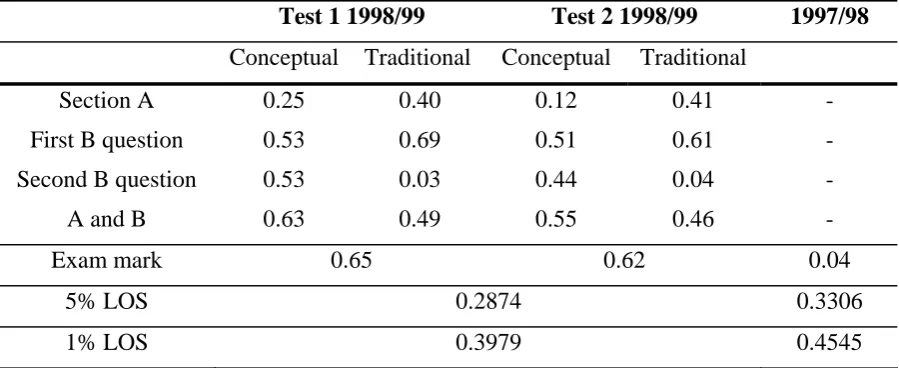
[image:7.595.87.537.337.521.2]Averages and standard deviations were calculated for the marks gained in different sections of the 1997/99 and 1998/99 Mechanics examination. For the 1998/99 students there was good overall correlation between the FCI score and the examination results. This was in strong contrast to the data for the 1997/98 students, which showed no correlation between the FCI score and examination results. These results are shown in Table 2.
Test 1 1998/99 Test 2 1998/99 1997/98
Conceptual Traditional Conceptual Traditional
Section A
First B question
Second B question
A and B
0.25
0.53
0.53
0.63
0.40
0.69
0.03
0.49
0.12
0.51
0.44
0.55
0.41
0.61
0.04
0.46
-
-
-
-
Exam mark 0.65 0.62 0.04
5% LOS 0.2874 0.3306
1% LOS 0.3979 0.4545
Conference Proceedings
Qualitative Results and Discussion
Module Evaluative Questionnaire
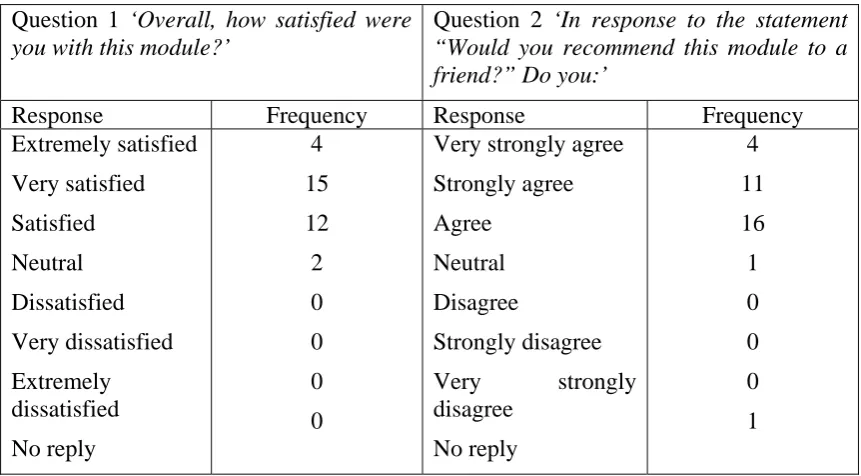
Tables 3 and 4 summarise the responses of 33 replies out of a group of 52 students.
Question 1 ‘Overall, how satisfied were you with this module?’
Question 2 ‘In response to the statement “Would you recommend this module to a friend?” Do you:’
Response Frequency Response Frequency Extremely satisfied Very satisfied Satisfied Neutral Dissatisfied Very dissatisfied Extremely dissatisfied No reply 4 15 12 2 0 0 0 0
Very strongly agree
[image:8.595.99.530.139.377.2]Strongly agree Agree Neutral Disagree Strongly disagree Very strongly disagree No reply 4 11 16 1 0 0 0 1
Table 3 Replies to Module Evaluative Questionnaire Questions 1 and 2.
Question 3 ‘Features liked.’ Question 4 ‘Features disliked.’
Class involvement (22)
Use of printed notes (18)
Demonstrations (11)
Quality of the lecturer (5)
Interesting lectures (4)
Teaching method (4)
Relaxed atmosphere (5)
Random selection method (7)
Missing parts of equations (6)
Class questions (4)
[image:8.595.100.529.139.394.2]Printed notes (3)
Table 4 Summary of Replies to Module Evaluative Questionnaire Questions 3 and 4. Numbers in brackets show the frequency of the comment.
The results indicated that the students felt positively towards the changes that were made. The dislike of some students for the process of random selection was anticipated, and we were pleased that only a few students commented negatively about this.
Module Lecturer
Conference Proceedings
on thinking about and discussing concepts, less time was spent on presenting worked numerical examples”.
Focus Group Enquiry
Ten students volunteered to attend the enquiry and were asked to consider three questions that we thought would provide useful information. The questions, and the consensus views to each, were as follows:
After considering the way in which the Mechanics module was taught what would you consider to be useful or less useful?
The students thought that it was good that the lecturer was enthusiastic and ‘taught’ rather than ‘lectured to’ the class. They liked the interaction between the lecturer and the class, and the demonstrations. They found the gaps in the notes useful in lectures, but felt that it made catching up missed lectures difficult. They felt that the concepts were covered well, but that some of the worked examples were covered rather too quickly.
How has the experience of learning in the Mechanics module affected or influenced learning styles used in other modules?
The students had not found it possible to transfer the learning style to other modules as these were taught differently. However, certain aspects of their behaviour were a consequence of the style of learning that they had experienced in Mechanics. For example, in discussions during break times the students identified different styles of lecture delivery. Some students had also experimented with an alternative technique to writing down the notes in the lecture by listening to the lecturer and obtaining a copy of the notes from another student afterwards. Some students expressed a desire for the teaching style of other modules to be changed.
What were the reasons behind your choice of questions answered in the examination?
The students selected questions that related to topics that they had studied prior to coming to University, and with which they felt more comfortable. A question involving integration was avoided because of its mathematics content, and the last question on the paper was avoided because it was new material and it was covered towards the end of the module.
Conclusions
Making the changes to the lecture module proved to be quite challenging. We felt that having more than one person reviewing the material, thinking of (and providing answers for) Class Questions, selecting tutorial and homework questions, and writing the examination paper was beneficial, although it significantly increased staff time. Changing to a co-operative learning approach was therefore initially costly although, once established, continuation with the teaching method requires relatively little extra effort. Since completing the project we have found a text that would have been very helpful in developing Class Questions to promote a conceptual approach to Mechanics (Mazur, 1997).
Conference Proceedings
all involved enjoyed the experience. This supports the view that attitude affects learning and the students enquired why other modules were not taught this way.
We were disappointed that we could not show an improvement in either deep learning index or the conceptual understanding of Mechanics. Since the changes only covered one module we did not expect a change in the deep learning index. However we had hoped for an improvement between the first and second FCI tests. It is possible that the students did not treat the second FCI test with the same seriousness as the first. It is also possible that, since over half the class have a preferred learning style that theoretically copes well with more formal lectures, the changes introduced were sufficiently challenging over such a short timescale that little discernable change could reasonably be expected.
One consequence of the change in teaching method was an accompanying change in the content of the examination paper. The much greater correlation between the FCI scores and examination results for the 1998/99 cohort might be interpreted as an indication that the 1998/99 paper was a better test of the students’ abilities in the conceptual aspects of Mechanics than the 1997/98 paper. However, some caution was exercised when making changes to the style of the paper, as it would be unfamiliar to the students. Also it had to be structured so that we could analyse how well the students performed in traditional versus conceptual parts. Ideally, there should be greater integration of these two parts and this did occur on the paper in the following session.
Although the changes introduced to the module could not be shown to be effective in the cognitive domain there was some success in the affective domain. We therefore believe that the changes did improve both the students’ and the lecturer’s experience of the module, justifying the time and effort involved. We also believe that an additional benefit was that the nature of the interaction between the students and the lecturer gave greater emphasis to the need to understand principles as well as to be able to put numbers into existing formulae. Pressure of time in lectures often means that we pick the solution to a problem that, ‘magically’, turns out to be correct. In reality, we are often required to solve new problems, in which case an understanding of the concepts is at least as important as knowledge of the relevant theory and underpins the ability to learn, and thereby understand and apply, new material.
Acknowledgements
We would like to thank Professor Steve Donnelly, Mechanics module lecturer, for his whole-hearted co-operation and involvement in the project, and Professor John Cowan† and Dr Philip James*, who willingly gave their time to help us with its evaluation. We have had useful discussions with Dr John Sharpe*, Professor Dick Culver‡ and Professor George Carter*, and would like to thank them for their advice and support. We also like to thank Dr Hilary Tait+ and Dr Philip James for permission to use a modified version of the ASSIST questionnaire. The work reported in this paper was supported by the University of Salford Teaching and Learning Quality Improvement Scheme (TLQIS).
† The Open University in Scotland
‡ Binghampton University, New York, US
* University of Salford, Salford, UK
Conference Proceedings
References
Black P,(1997) Aims, assessments and workplace needs, in Physics Education, 32, 351-360
Booth K M and James B W (2001) Interactive learning in a Level 1 Mechanics module, in International Journal of Science Education, 23(9), 955-967
Fishbane P M, Gasiorowicz S and Thornton S T, (1993) Physics for Scientists and Engineers (Extended Version) Englewood Cliffs, NJ: Prentice Hall, Inc.
Goleman D, (1996) Emotional Intelligence London: Bloomsbury
Hestenes D, Wells M and Swackmamer G, (1992) Force Concept Inventory, in Physics Teacher, 30(3), 141-151
Hewitt P,(1998) Conceptual Physics (Eighth Edition) Reading, MA: Addison Wesley Longman, Inc.
James P and Turner A, (1998) Measuring the development of deep learning, TLQIS Final Report University of Salford
Johnson D W, Johnson R T and Smith K A,(1991) Active Learning: Cooperation in the College Classroom Edina, MN: Interaction Book Company
Kolb D A, (1983) Experiential Learning: Experience as the Source of Learning and Development NY: Prentice-Hall, Inc.
Kolb D A, (1985) Learning-Style Inventory: Self-Scoring Inventory and Interpretation Booklet Boston, MA: Hay/McBer
Mazur E, (1997) Peer Instruction: A User’s Manual Upper Saddle River, NJ: Prentice Hall, Inc.